ON THIS PAGE
Progress0%






Our Global Presence :





The challenges in Enterprise AI Development continue to shape how organizations approach innovation, automation, and data-driven decision-making.
Businesses typically find that designing and deploying AI systems is much harder than they initially thought it would be, despite AI’s promise to make things more efficient, scalable, and give them a competitive edge.
These problems, which may range from broken data environments to resistance within the organisation, can slow down progress or even halt projects altogether if they aren’t addressed promptly.
As businesses transition from testing AI to implementing it on a large scale, the focus shifts from proving that it works to ensuring it remains effective.
This change raises more serious technological, operational, and governance issues. Organisations that want to reap real commercial benefits from their AI investments need to understand why AI initiatives fail and how to address these problems in a methodical way.
Enterprise AI development differs significantly from AI projects for small businesses or consumers. Businesses operate within complex ecosystems that encompass ancient systems, established rules, diverse stakeholders, and a significant amount of sensitive data. AI solutions must seamlessly integrate with existing processes and meet stringent criteria for security, reliability, and compliance.
Enterprises must adapt AI tools to integrate with their existing infrastructure, whereas startups can build AI-first solutions from the ground up. This is why the problems that arise when businesses attempt to utilize AI are often more about the business’s setup than about the technology itself. AI models must work across departments, support critical operations essential to the mission, and consistently produce the same results over time.
Data forms the foundation of every successful AI initiative, yet enterprise environments often struggle to provide the consistency and accessibility AI systems require. Data-related issues are among the most common challenges enterprises face in implementing AI, and they directly influence model accuracy, reliability, and scalability across the organization.
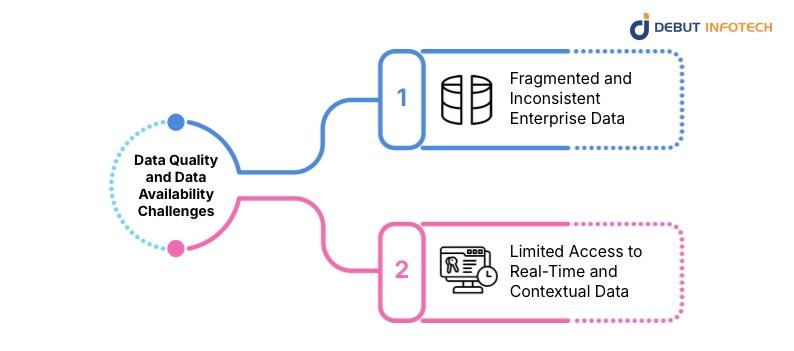
One of the most persistent challenges enterprises face in implementing AI is poor data quality. Enterprise data is often scattered across multiple systems, departments, and formats. Inconsistent labeling, missing values, and outdated records make it difficult to train reliable AI models.
AI algorithms depend on clean, well-structured data to perform accurately. When training data is flawed, even advanced AI tools produce unreliable results. Enterprises must invest heavily in data governance frameworks, standardization, and data pipelines before AI models can deliver value.
Another common issue is limited access to real-time data. Many enterprise systems were not designed for continuous data streaming. This restricts the ability of AI models to adapt quickly to changing conditions, especially in sectors such as finance, healthcare, and logistics.
Overcoming these challenges in enterprise AI adoption requires modernizing data infrastructure and enabling secure data-sharing across departments without compromising privacy or compliance.
Most enterprises operate within complex IT ecosystems built long before AI became a strategic priority. Integrating modern AI tools into these legacy environments introduces technical and operational challenges that can slow adoption and increase implementation risk if not carefully managed.
Legacy systems present a major barrier to enterprise AI development. Many enterprises rely on outdated software that lacks APIs or flexible integration options. Introducing AI into such environments often requires custom connectors, middleware, or system upgrades.
These integration challenges increase AI development cost and extend deployment timelines. Enterprises frequently underestimate the effort required to align AI models with existing enterprise resource planning (ERP), customer relationship management (CRM), and data warehouse systems.
Integrating AI into live enterprise systems also carries operational risks. Any system downtime or malfunction can affect critical business processes. As a result, enterprises adopt a cautious approach that can slow AI adoption.
Successful AI development services prioritize phased integration, sandbox testing, and rollback mechanisms to minimize disruptions while enabling a gradual, AI-driven transformation.
Enterprise AI development requires specialized skills that span data science, engineering, and domain expertise. Many organizations find that their internal teams lack the necessary experience to design, deploy, and maintain AI systems at scale, making talent gaps a persistent barrier to adoption.
A shortage of skilled professionals remains a key challenge to implementing AI in enterprises. Building, training, and maintaining AI models requires expertise in data science, machine learning engineering, domain knowledge, and system architecture.
Many enterprises struggle to hire AI Developers with experience in large-scale deployments. Competition for talent drives up costs and limits internal capability development. This talent gap often forces enterprises to rely on external AI Consultants and specialized AI development companies.
AI projects require close collaboration between technical teams and business stakeholders. Misalignment between these groups leads to unclear objectives, unrealistic expectations, and poorly scoped projects.
Enterprises that invest in cross-functional training and shared accountability are better positioned to overcome enterprise challenges in AI adoption.
Cost remains a major concern for enterprises investing in AI initiatives. Beyond initial development, enterprises must manage long-term expenses related to infrastructure, maintenance, monitoring, and scaling, all of which influence decision-making and project sustainability.
AI development cost extends beyond model training. Enterprises must account for infrastructure, data preparation, monitoring tools, security systems, and long-term maintenance. Cloud computing costs, in particular, can escalate rapidly as AI workloads scale.
These financial challenges of implementing AI in enterprises often cause leadership teams to delay or limit AI investments. Without clear cost controls and ROI metrics, AI initiatives struggle to gain sustained executive support.
Enterprises must balance innovation goals with fiscal responsibility. Pilot projects may succeed, but scaling them across the organization introduces new expenses. Cost-effective AI adoption requires careful planning, reuse of existing assets, and prioritization of high-impact use cases.
AI data security is one of the most critical enterprise challenges in AI adoption. Enterprises handle vast amounts of confidential data, including customer information, financial records, and intellectual property. AI systems increase the attack surface by introducing new data flows and access points.
Data breaches or misuse can result in regulatory penalties, reputational damage, and loss of customer trust. Enterprises must implement robust encryption, access controls, and monitoring mechanisms to secure AI-driven environments.
Regulatory requirements add another layer of complexity. Enterprises operating across regions must comply with data protection laws that govern the storage, processing, and use of data. AI models trained on sensitive data must adhere to strict compliance standards throughout their lifecycle.
Addressing these challenges in enterprise AI development requires embedding security and compliance into system design rather than treating them as afterthoughts.
Trust is crucial for enterprise AI adoption, particularly in environments where decisions have significant financial, legal, or ethical implications. Challenges related to transparency and bias can limit AI deployment if stakeholders cannot clearly understand or justify AI-driven outcomes.
Many advanced AI models operate as black boxes, making it difficult to explain how decisions are made. This lack of transparency poses significant risks in regulated industries, where accountability and auditability are crucial.
Enterprise stakeholders often hesitate to trust AI-driven recommendations without clear explanations. This challenge slows adoption and limits the scope of AI deployment in decision-critical processes.
Bias in training data can lead to unfair or discriminatory outcomes. Enterprises must actively identify and mitigate bias within AI algorithms to ensure the ethical and compliant use of these systems.
Developing explainable AI models and implementing governance frameworks helps enterprises overcome the challenges of ai implementation in enterprises while building trust across stakeholders.
Many enterprises achieve success with small AI pilots but struggle to scale them. Differences in data availability, infrastructure, and operational complexity across departments create bottlenecks.
Scaling AI models requires standardized processes, shared platforms, and enterprise-wide coordination. Without these foundations, AI initiatives remain isolated and underutilized. As AI systems scale, performance and reliability become critical. Models must handle increased data volumes, user demands, and operational complexity without degradation.
Addressing these challenges in enterprise AI adoption involves continuous monitoring, retraining strategies, and infrastructure optimization.
AI adoption is not only a technical shift but also an organizational one. Resistance from employees and stakeholders can slow progress if concerns about automation, job impact, or trust in AI systems are not addressed proactively.
Resistance to change is a common yet underestimated challenge enterprises face in implementing AI. Employees may fear job displacement or distrust automated systems. This resistance can limit user adoption and reduce the effectiveness of AI.
Clear communication, training programs, and stakeholder engagement are essential for successful AI integration. Enterprises that align their AI initiatives with workforce development goals tend to experience smoother transitions.
AI initiatives require strong leadership and a clear strategic vision. Without executive sponsorship, AI projects often lack direction and resources.
Aligning AI goals with business objectives ensures that AI development services deliver measurable value rather than isolated technical achievements.
AI models degrade over time as data patterns change. Enterprises must continuously monitor model performance and retrain systems to maintain accuracy. Lack of lifecycle management is a key challenge in enterprise AI development. Without structured governance, models become outdated, risky, or non-compliant.
Effective governance defines ownership, accountability, and standards across AI initiatives. It ensures consistent deployment, ethical use, and compliance across the organization. Governance frameworks play a crucial role in addressing enterprise challenges related to AI adoption at scale.
A critical yet often overlooked challenge in enterprise AI development is measuring performance beyond technical accuracy. While AI models may perform well in controlled environments, enterprises must evaluate whether these systems deliver measurable business outcomes. Without clear performance metrics tied to operational efficiency, cost reduction, or revenue growth, AI initiatives struggle to justify continued investment.
Enterprises need defined KPIs that connect AI outputs to business goals, such as process automation rates, decision-making speed, or error reduction. Regular performance reviews help identify underperforming models early and ensure AI systems remain aligned with evolving enterprise priorities. Clear ROI measurement strengthens executive confidence and supports sustainable AI adoption at scale.
AI gateways are increasingly used to address several challenges solved by AI gateways in enterprise environments, especially as enterprises deploy multiple AI tools, models, and platforms across different teams. They act as centralized control layers that simplify AI integration, improve governance, and support secure scaling across complex enterprise systems.
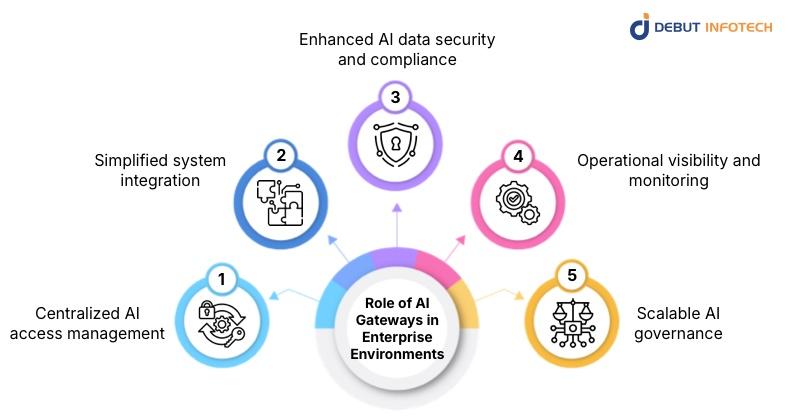
Key roles AI gateways play in enterprise environments include:
By clearly defining and centralizing these roles, AI gateways help enterprises reduce fragmentation, maintain control, and scale AI initiatives more effectively across complex organizational environments.
Given the complexity of enterprise AI development, many organizations collaborate with external experts to reduce risk and accelerate delivery. Choosing the right AI Consultants or Enterprise AI Development Company can significantly impact AI success at scale. Enterprises should assess partners based on industry experience, expertise in AI models and algorithms, strong AI data security practices, and the ability to provide long-term support beyond initial deployment.
Effective partnerships go beyond implementation to support strategy, change management, and ongoing optimization. Enterprises that work with experienced AI development companies gain access to proven frameworks that address recurring challenges of implementing AI in enterprises, including legacy integration and enterprise-wide scaling. Many organizations find value in partnering with experienced providers such as Debut Infotech when navigating complex integration, security, and scalability requirements.
The challenges in enterprise AI development are multifaceted, spanning technology, data, talent, security, and organizational culture. Enterprises that approach AI adoption with a narrow technical focus often encounter delays, cost overruns, and limited impact. A structured strategy that addresses data readiness, system integration, governance, and workforce alignment is essential for long-term success.
By combining internal capabilities with external expertise, enterprises can overcome these barriers and unlock sustainable value from AI initiatives. Organizations that work with experienced partners like Debut Infotech gain access to proven frameworks, scalable architectures, and practical insights that simplify the adoption of AI. As AI continues to evolve, enterprises that proactively address these challenges will be best positioned to turn innovation into measurable business outcomes, with Debut Infotech supporting that journey through tailored enterprise AI solutions.
A. The biggest challenges in Enterprise AI Development include poor data quality, difficulty in integrating AI with legacy systems, high AI development costs, a shortage of skilled talent, AI data security risks, a lack of model transparency, and challenges in scaling AI solutions across departments. These issues often surface when enterprises move from pilot projects to full-scale AI deployment.
A. Many enterprises struggle because enterprise challenges in AI adoption go beyond technology. Organizational resistance, unclear business alignment, regulatory constraints, and weak data governance often slow progress. Without proper change management and leadership support, even well-designed AI initiatives fail to gain traction.
A. Data-related problems are among the most common challenges of implementing AI in enterprises. Incomplete, inconsistent, or siloed data leads to inaccurate AI models and unreliable outputs. Enterprises must establish strong data governance, standardization, and integration strategies before AI tools can deliver meaningful results.
A. AI gateways help address several challenges solved by AI gateways in enterprise environments. They centralize access to AI models, improve system integration, enhance AI data security, and enforce governance policies. This makes it easier for enterprises to manage multiple AI tools and scale AI adoption securely.
A. The cost of AI development is higher in enterprises due to infrastructure upgrades, data preparation, security requirements, compliance obligations, and ongoing model monitoring. Unlike small projects, enterprise AI solutions must operate at scale, support mission-critical processes, and remain reliable over time.
A. To overcome talent gaps, enterprises often hire AI Developers externally or collaborate with AI Consultants and experienced AI development companies. This approach provides access to specialized skills, accelerates implementation, and reduces the risks associated with building internal AI capabilities from scratch.
A. Ensuring AI data security requires embedding security controls into every stage of AI development. Enterprises must use encryption, access management, continuous monitoring, and compliance-aware AI models. Clear governance frameworks and regular audits help mitigate risks and ensure the responsible use of AI across the organization.

Our Latest Insights
USA
2501 Chatham, Rd Suite R Springfield, IL 62704
+1-708-515-4004
info@debutinfotech.com
UK
7 Pound Close, Yarnton, Oxfordshire, OX51QG
+44-770-304-0079
info@debutinfotech.com
Canada
154 Eden Oak Trail, Kitchener, ON N2A 0H9
+1-708-515-4004
info@debutinfotech.com
INDIA
Sector 101-A, Plot No: I-42, IT City Rd, JLPL Industrial Area, Mohali, PB 140306
9888402396
info@debutinfotech.com