ON THIS PAGE
Progress0%






Our Global Presence :




Enterprise adoption of AI is moving from experimentation to structured implementation, making Enterprise AI agent architecture a critical foundation for scalable intelligence. Recent data from McKinsey & Company shows that 72% of organizations have adopted AI in at least one business function, highlighting how widely AI is now embedded in operations.
In addition, 65% of organizations are already using generative AI regularly, reflecting rapid growth in advanced AI capabilities.
This shift is driving the need for well-defined architectures that can manage data flows, decision-making, and system integration across enterprise environments.
Enterprise AI agent architecture addresses this by organizing intelligent agents into structured layers, enabling automation, consistency, and scalability. It also supports real-world applications, aligns with business objectives, and helps organizations overcome challenges related to integration, governance, and performance while preparing for future AI-driven transformation.
In this piece, we will explain what an enterprise AI agent architecture is, its layers, real-life use cases, benefits, a step-by-step implementation guide, the technologies and tools involved, challenges, and future trends.
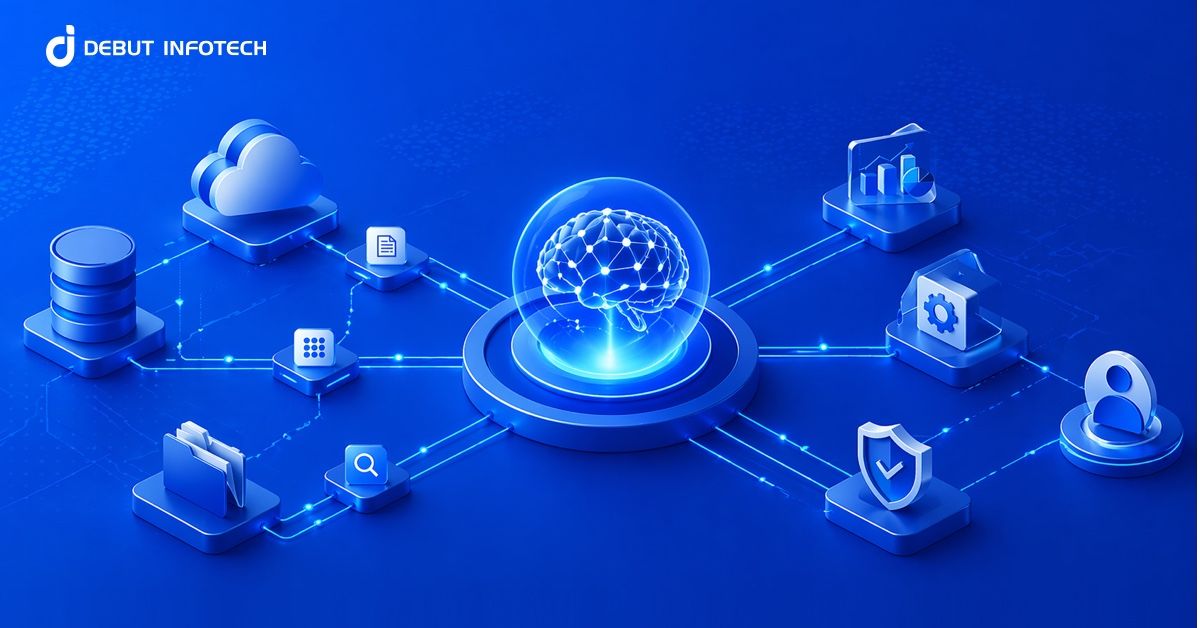
Enterprise AI agent architecture defines how intelligent agents are structured, deployed, and managed within large-scale business environments. It outlines how data flows through systems, how decisions are made, and how actions are executed across interconnected platforms.
This AI agent architecture for enterprise systems consulting integrates machine learning models, business rules, APIs, and automation tools into a unified system. It also establishes governance, monitoring, and feedback mechanisms, ensuring AI agents operate reliably, adapt over time, and align with enterprise objectives and compliance requirements.
Organizations adopt AI architectures to improve performance and efficiency across operations. Here are the key advantages that demonstrate how structured AI systems deliver measurable business value:
Enterprise AI agent architecture reduces operational bottlenecks by automating repetitive workflows and coordinating tasks across multiple systems. It allows processes to run continuously without manual intervention, improving turnaround times and consistency.
Teams spend less time on routine work and more on strategic initiatives. Over time, this structured automation leads to smoother operations, better resource utilization, and a more responsive organizational workflow that adapts to demand changes.
AI agents rely on data-driven models that process information with high precision. By minimizing manual input and standardizing decision-making processes, they reduce the likelihood of errors. This is particularly valuable in data-intensive operations such as analytics, reporting, and compliance.
Consistent accuracy improves trust in outputs, strengthens decision quality, and ensures that business actions are based on reliable and validated information across systems.
A well-designed AI agent architecture helps organizations control costs by reducing reliance on manual labor and minimizing workflow inefficiencies. It streamlines operations, lowers error-related expenses, and optimizes resource allocation.
Over time, businesses benefit from predictable operating costs and improved financial planning. This approach also allows companies to scale operations without proportionally increasing expenses, creating a more sustainable cost structure.
AI agents improve customer interactions by delivering faster, more consistent, and personalized responses across multiple channels. They can handle large volumes of inquiries simultaneously while maintaining service quality. This ensures customers receive timely support without delays.
Over time, consistent engagement and accurate responses build trust, strengthen relationships, and contribute to higher customer satisfaction and long-term retention across digital and human-assisted touchpoints.
Enterprise AI agents process real-time data and generate insights quickly, enabling faster decision-making across departments. Instead of waiting for manual analysis, organizations can act on immediate intelligence. This speed is especially valuable in dynamic environments such as finance, operations, and supply chain management.
Faster decisions improve responsiveness, reduce delays, and enable businesses to adapt quickly to market changes and operational challenges.
AI agents architecture incorporates feedback loops that allow systems to learn from outcomes and improve performance over time. As new data becomes available, models are updated to reflect changing conditions and behaviors. This continuous improvement ensures that AI systems remain effective and relevant.
Organizations benefit from solutions that evolve alongside their operations, supporting long-term efficiency, accuracy, and adaptability without requiring complete system redesigns.
Enterprise AI systems rely on layered designs to function effectively. Each layer plays a distinct role in processing data, making decisions, and executing actions within the overall architecture.
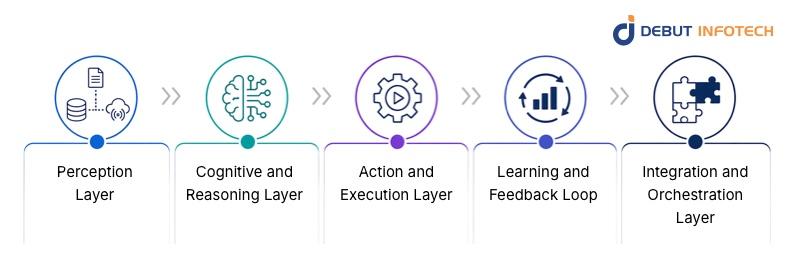
The perception layer is responsible for ingesting and interpreting data from diverse enterprise sources, including structured databases, APIs, documents, and real-time streams. It performs data preprocessing, normalization, and feature extraction to make inputs usable for downstream systems. This layer ensures data consistency, quality, and readiness, forming the foundation for accurate analysis and reliable decision-making across the AI agent architecture.
This layer serves as the system’s decision engine, where machine learning models, natural language processing, and rule-based logic work together to analyze inputs. It identifies patterns, predicts outcomes, and determines appropriate actions.
The layer also incorporates contextual understanding, enabling AI agents to make informed decisions aligned with business objectives while maintaining consistency across different operational scenarios.
The action and execution layer translates decisions into tangible outcomes by interacting with enterprise applications and workflows. It triggers automated processes, updates systems, sends notifications, or initiates transactions based on predefined rules or learned behaviors. This layer ensures that insights generated by AI are not just theoretical but actively drive business operations in a controlled and efficient manner.
This layer enables continuous system improvement by capturing feedback from executed actions and outcomes. It retrains models, adjusts parameters, and refines decision logic using new data. By incorporating performance metrics and user feedback, the system evolves over time. This adaptive capability ensures sustained accuracy, relevance, and efficiency, allowing AI agents to respond effectively to changing business conditions.
The integration and orchestration layer connects AI agents with enterprise systems such as CRM, ERP, and cloud platforms. It manages communication, data exchange, and workflow coordination across different services. This AI system integration layer ensures seamless interoperability, enabling multiple components to function as a unified system. It also supports scalability by allowing new AI tools and services to be integrated without disrupting existing operations.
A strong architectural foundation depends on well-defined principles. These guidelines ensure that AI systems remain flexible, secure, and able to support evolving enterprise requirements over time.
Modularity involves designing the architecture as a collection of independent yet connected components. Each module handles a specific function, such as data processing, model inference, or execution. This approach simplifies development, testing, and maintenance for AI development companies. It also allows organizations to update or replace individual components without affecting the entire system, improving flexibility and long-term sustainability.
Interoperability ensures that different systems, tools, and platforms can communicate effectively within the AI architecture. It relies on standardized protocols, APIs, and data formats to enable seamless integration. This principle is critical for enterprises with diverse technology stacks, as it allows AI agents to operate across multiple environments while maintaining consistency, reducing integration complexity, and supporting broader adoption.
Scalability ensures that the AI agent architecture can handle growing data volumes, user demands, and operational complexity without performance degradation. It often involves cloud-based infrastructure, distributed computing, and flexible resource allocation. A scalable design supports business growth by allowing systems to expand efficiently, ensuring consistent performance even as workloads increase or new use cases are introduced.
Security and compliance focus on protecting sensitive data and ensuring adherence to regulatory requirements. This includes implementing access controls, encryption, monitoring, and audit mechanisms throughout the architecture.
Enterprises must also align with industry standards and legal frameworks. A strong security foundation builds trust, reduces risk, and ensures that AI systems operate responsibly within defined governance structures.
Implementing an AI agent architecture requires a clear and structured approach. The following steps outline how organizations or AI implementation services can move from planning to deployment while maintaining control and alignment with business goals.
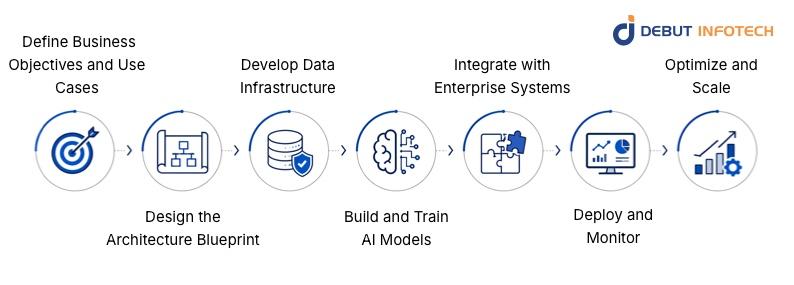
Start by identifying clear business goals and specific problems that AI agents can address. This includes mapping use cases to measurable outcomes such as cost reduction, efficiency gains, or improved customer experience. Stakeholder alignment is critical at this stage. A well-defined scope ensures that the implementation remains focused, practical, and aligned with overall enterprise strategy and operational priorities.
Develop a detailed architectural plan that outlines system components, data flow, integration points, and technology choices. This blueprint should define how each layer interacts and how scalability, security, and performance will be managed. Clear documentation at this stage reduces ambiguity during development and ensures all teams work toward a consistent and structured implementation approach.
Build a reliable data foundation by setting up pipelines, storage systems, and governance frameworks. This includes data collection, cleaning, transformation, and access controls. High-quality data is essential for effective AI performance. A strong infrastructure ensures that AI agents receive accurate, timely, and relevant data, supporting consistent outputs and enabling long-term system reliability.
Develop machine learning and AI models tailored to the defined use cases. This involves selecting appropriate algorithms, training them on relevant datasets, and validating performance through testing. Model accuracy, interpretability, and efficiency should be prioritized. Continuous iteration during this phase ensures that the models meet business requirements and perform effectively in real-world scenarios.
Connect AI agents with existing enterprise platforms such as CRM, ERP, and internal applications. This step ensures seamless data exchange and workflow automation across systems. Integration should be designed to minimize disruption while enabling interoperability. Proper API management and middleware solutions help maintain stability and ensure that AI-driven processes align with existing operational structures.
Deploy the AI system in a controlled production environment, ensuring all components function as expected. Continuous monitoring is essential for tracking performance, detecting anomalies, and maintaining system health. Metrics such as response time, accuracy, and system uptime should be evaluated regularly. This step ensures reliability and provides insights needed for ongoing improvements.
Refine the system based on performance data, user feedback, and evolving business needs. Optimization may involve improving models, enhancing workflows, or upgrading infrastructure. Once stable, the architecture can be scaled to support additional use cases or higher workloads. This step ensures the AI system continues to deliver value as it adapts to organizational growth and changing demands.
Machine learning frameworks such as TensorFlow and PyTorch provide the foundation for building, training, and deploying AI models within enterprise systems. They support tasks like data processing, model optimization, and inference. These frameworks enable developers to create scalable and high-performance models that integrate seamlessly into AI agent architectures, ensuring reliable and efficient decision-making across business operations.
Natural language processing tools like spaCy and Google Cloud Natural Language API allow AI agents to understand and process human language. These tools are essential for applications such as chatbots, sentiment analysis, and document processing. They help convert unstructured text into actionable insights, enabling AI systems to interact effectively with users and extract meaningful information from large volumes of textual data.
Enterprise AI systems depend on robust data infrastructure, powered by platforms such as Apache Kafka and Amazon S3. These tools handle data ingestion, streaming, storage, and retrieval at scale. They ensure that AI agents have access to high-quality, real-time, and historical data, supporting consistent performance and enabling advanced analytics across distributed enterprise environments.
Integration platforms such as MuleSoft and Postman enable seamless communication between AI agents and enterprise systems. They facilitate API creation, testing, and management, ensuring interoperability across applications. These tools simplify the process of connecting diverse systems, allowing AI agents to interact with existing infrastructure while maintaining stability, scalability, and efficient data exchange.
Cloud platforms like Microsoft Azure and Google Cloud Platform provide the infrastructure needed to deploy and scale AI agent systems. They offer services for computing, storage, and model deployment, supporting flexible and cost-effective operations. Cloud environments also enable continuous integration and delivery, ensuring that enterprise AI solutions can evolve quickly while maintaining performance and reliability.
Enterprise AI agent architecture delivers practical value across industries. These real-world applications highlight how organizations use AI agents to solve problems and improve operational performance.
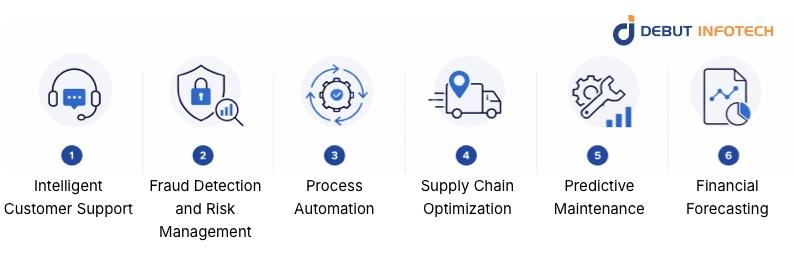
AI agents transform customer support by handling inquiries across chat, email, and voice channels with speed and consistency. They can resolve common issues, provide personalized responses, and escalate complex cases to human agents when needed. This reduces wait times and operational costs while maintaining service quality.
Over time, continuous learning improves response accuracy, enabling organizations to deliver reliable, scalable, and efficient customer engagement experiences.
AI agents analyze transaction data, user behavior, and historical patterns to detect anomalies that may indicate fraud or risk. They operate in real time, enabling immediate alerts and preventive actions. This proactive approach reduces financial losses and strengthens compliance efforts. By continuously learning from new threats, AI systems improve detection accuracy and help organizations maintain a secure and resilient operational environment.
Enterprise AI agents automate routine business processes such as data entry, approvals, and reporting, reducing manual workload and improving efficiency. They ensure tasks are executed consistently and in accordance with defined rules, minimizing delays and errors.
Automation also enhances visibility into workflows, enabling better tracking and optimization. This leads to faster operations, improved productivity, and more efficient use of organizational resources.
AI agents enhance supply chain operations by analyzing demand patterns, inventory levels, and logistics data to make informed decisions. They help forecast demand, optimize stock levels, and streamline distribution processes. This reduces waste, prevents stockouts, and improves delivery timelines.
By enabling real-time adjustments, AI-driven systems create a more agile and responsive supply chain that supports consistent operational performance.
AI agents monitor equipment performance using sensor data and historical records to predict potential failures before they occur. This allows organizations to schedule maintenance proactively, reducing downtime and avoiding costly disruptions.
Predictive maintenance improves asset lifespan and operational reliability. Over time, the system becomes more accurate, helping businesses maintain consistent performance and reduce unexpected maintenance expenses.
AI agents support financial planning by analyzing historical data, market trends, and real-time inputs to generate accurate forecasts. They assist in budgeting, revenue prediction, and risk assessment, enabling informed decision-making. This improves financial visibility and planning accuracy.
Organizations can respond quickly to changes, optimize resource allocation, and maintain stability through data-driven financial strategies supported by intelligent automation systems.
Also Read this: AI Agent Development Lifecycle
Despite its advantages, implementing AI architecture comes with challenges. Understanding these issues helps organizations prepare effectively and adopt strategies that reduce risks and improve outcomes.
Poor data quality remains one of the biggest barriers to the effective deployment of AI systems. Enterprises often deal with incomplete, inconsistent, or siloed data spread across departments. This limits model accuracy and leads to unreliable outputs. In many cases, legacy storage systems and manual data handling further complicate access, slowing down implementation and reducing the overall effectiveness of AI-driven decision-making.
To address this, organizations should invest in strong data governance frameworks, standardized data formats, and automated data pipelines. Data validation and cleansing processes need to be embedded early.
Establishing centralized data platforms, such as data lakes or warehouses, improves accessibility. Regular audits and monitoring ensure data integrity, helping AI agents operate on accurate, consistent, and timely information.
Many enterprises rely on legacy systems that were not designed to support modern AI capabilities. These systems often lack APIs or use outdated technologies, making integration complex and resource-intensive.
As a result, connecting AI agents to existing workflows can lead to delays, increased costs, and operational disruptions if not handled carefully.
A practical approach involves using middleware, APIs, and microservices to bridge the gap between old and new systems. Gradual modernization strategies, rather than full system replacement, reduce risk.
Organizations should also prioritize interoperability during AI architecture design. This ensures AI agents can interact smoothly with legacy infrastructure without compromising performance or stability.
AI models, especially complex ones, often function as black boxes, making it difficult to understand how decisions are made. This lack of transparency can erode trust among stakeholders and create challenges in regulated industries that require explainability. Without clarity, it becomes harder to validate decisions or address errors effectively.
To improve transparency, enterprises should adopt explainable AI techniques that provide insights into model behavior and decision logic.
Using interpretable models where possible, along with visualization tools and audit trails, enhances understanding. Clear documentation and governance policies also help stakeholders trust AI systems while ensuring compliance with regulatory standards.
AI systems handle large volumes of sensitive enterprise and customer data, making them attractive targets for cyber threats. Risks include data breaches, unauthorized access, and model manipulation. Inadequate security measures can lead to compliance violations, financial losses, and reputational damage, especially in industries with strict data protection requirements.
Organizations should implement robust security frameworks that include encryption, access controls, and continuous monitoring. Adopting zero-trust architectures and conducting regular security audits strengthens protection.
Data anonymization and privacy-preserving techniques also reduce risk. Ensuring compliance with regulations and maintaining clear data policies helps safeguard both enterprise assets and customer information.
Adopting AI agent systems often requires significant changes in workflows, roles, and decision-making processes. Employees may resist these changes due to uncertainty or lack of understanding.
Without proper alignment, organizations may struggle to realize the full value of AI, leading to underutilized systems and fragmented adoption across departments.
Successful adoption depends on structured change management strategies. Organizations should invest in training programs, clear communication, and stakeholder engagement. Demonstrating tangible benefits early helps build confidence.
Leadership support and cross-functional collaboration are also critical. This ensures teams adapt effectively, enabling AI systems to integrate smoothly into daily operations and deliver sustained value.
Enterprise AI continues to evolve as technologies advance. These emerging AI trends highlight how AI agent architecture is expected to develop, shaping the future of intelligent systems in business environments.
Enterprise AI systems are moving toward fully autonomous ecosystems where multiple agents operate independently while coordinating tasks across functions. These agents can make decisions, delegate responsibilities, and optimize workflows without constant human input. This shift improves efficiency and responsiveness, allowing organizations to manage complex operations at scale while maintaining consistency, control, and adaptability across interconnected business environments.
AI integration with edge computing enables data processing closer to the source, reducing latency and improving real-time responsiveness. This is particularly valuable in environments requiring immediate decision-making, such as manufacturing and logistics.
By minimizing reliance on centralized systems, enterprises can enhance performance, reduce bandwidth usage, and ensure faster insights, supporting more efficient and localized AI-driven operations.
Enterprises are placing greater emphasis on AI systems that provide clear, interpretable decision-making processes. Advancements in explainable AI help organizations understand how models arrive at conclusions, improving trust and accountability.
At the same time, ethical AI frameworks are being strengthened to address bias, fairness, and compliance. This ensures responsible AI adoption while meeting regulatory and stakeholder expectations.
AI agent architectures are evolving to deliver highly personalized experiences across customer and employee interactions. By analyzing behavioral data and contextual signals, AI systems can tailor recommendations, services, and communications in real time. This Agent architecture in AI capability enhances engagement and satisfaction while maintaining operational efficiency, enabling enterprises to deliver individualized experiences consistently across large and diverse user bases.
As AI adoption grows, organizations are prioritizing governance frameworks to ensure compliance with evolving regulations. This includes establishing policies for data usage, model validation, and accountability.
Strong governance structures help mitigate risks, maintain transparency, and ensure ethical practices. Enterprises that invest in governance are better positioned to scale AI responsibly while maintaining stakeholder trust and regulatory alignment.
Enterprise AI agent architecture provides a structured approach to building intelligent, scalable, and reliable systems across business operations. It connects data, decision-making, and execution into a unified framework that drives efficiency and accuracy.
With clear design principles, layered architecture, and a focused implementation strategy, organizations can unlock real value from AI while addressing challenges and preparing for continuous innovation and long-term growth.
If you’re looking to build a robust Enterprise AI agent architecture, Debut Infotech is a reliable AI agents development company offering tailored services designed for scalability, integration, and performance. Our team helps businesses design, deploy, and optimize intelligent systems that align with operational goals, ensuring reliable outcomes and long-term value across enterprise environments.
A. It’s built in layers, usually with microservices, so that each piece can scale independently. You add load balancing, retries, and fallback logic to keep things running under pressure. Caching helps with speed. Monitoring and logging catch issues early. Redundancy across systems keeps failures from taking everything down at once.
A. You’re looking at a solid stack: model layer, orchestration engine, memory store, tool connectors, APIs, and monitoring. Security and access control are baked in, not added later. There’s also versioning, testing pipelines, and observability so teams can track performance and fix issues without guesswork.
A. Orchestration acts like a conductor, deciding what runs and when. Memory stores past interactions, so the agent doesn’t have to start from scratch every time. Tool integration connects external systems through APIs. Together, they let the agent plan, recall context, and actually get things done, rather than just generate text.
A. It’s the structure behind how an AI agent works. Think of it as the blueprint. It defines how the model processes input, makes decisions, stores memory, and interacts with tools or systems. Without it, the agent is just a model. With it, the model becomes functional and useful.
A. Most agents include a core model, memory system, decision logic, and tool interface. There’s usually an input handler and output generator too. Some setups add a planning module. Each part plays a role, from understanding tasks to executing them, keeping the agent structured and consistent.
A. Agents combine model predictions with rules or workflows. The model suggests actions based on context, while the system may guide choices using prompts, constraints, or scoring methods. Some agents break tasks into steps, evaluate options, and pick the most suitable action instead of blindly guessing.
A. APIs are the main route. Agents connect to tools, databases, and services through them. Webhooks handle real-time updates. Some setups use SDKs or middleware to simplify connections. Message queues help manage tasks in larger systems. The goal is smooth communication between the agent and external systems.
A. They automate repetitive work, speed up decisions, and handle tasks around the clock. Teams get more donhttps://docs.google.com/document/d/1RpsH_yLg997gFzUhQMeqt50qL6ZBzFmoE5OMaBDHDaM/edit?tab=t.0e without scaling headcount. Agents also reduce human error in routine processes. Over time, they improve with data, making them more accurate and useful across customer support, operations, and internal workflows.

Our Latest Insights

USA

2501 Chatham, Rd Suite R Springfield, IL 62704
+1-708-515-4004
info@debutinfotech.com
UK

7 Pound Close, Yarnton, Oxfordshire, OX51QG
+44-770-304-0079
info@debutinfotech.com
Canada

154 Eden Oak Trail, Kitchener, ON N2A 0H9
+1-708-515-4004
info@debutinfotech.com
INDIA

Sector 101-A, Plot No: I-42, IT City Rd, JLPL Industrial Area, Mohali, PB 140306
9888402396
info@debutinfotech.com

9001:2015
Quality Certified

ISO 27001
Security Certified

A+ Rating
Accredited Business

Certik
Security & Audit


Copyright © 2026, Debut Infotech. All rights reserved. | Privacy Policy