ON THIS PAGE
Progress0%






Our Global Presence :


These days, when companies come to us at Debut Infotech Pvt Ltd to help them assemble software engineering teams, we have noticed they now prefer to hire full stack developers rather than hiring frontend or backend engineers separately.
That’s a bit different from what it used to be in the early days of software engineering, considering the fact that software teams used to be built around specialization. But all that is changing now.
After investigating some reasons for this new preference, we have realised that most companies believe that a full stack developer better understands how the entire system fits together
Modern full stack developers understand how the entire system, including frontend interfaces and backend logic. In fact, many believe that the end-to-end visibility a full stack developer provides is crucial to the smooth execution of a project. Furthermore, they are convinced that hiring full stack development services rather than hiring specialist engineers separately helps them release their products more quickly, reduce handoffs, and ensure projects are developed with cleaner architectures.
But how true is that?
Find out in this article as we explore the job description of full stack web developers, the tools they use, and how the teams built around them are shaping the future of software delivery.
In simple words, a full stack software developer is an engineer skilled at working on both the frontend and backend of an application.
But in actual practice, the job description of a full stack developer extends a little beyond that.
The modern full stack software developer is a technical expert who fully understands how technical decisions affect the final delivery of a software product and has the responsibility of structuring the product and making development tradeoffs for the sole purpose of ensuring the software is capable of delivering business results.
So, yes, people view them as technical developers who “know a little bit of everything,’ but their role has evolved past just being a “jack of all trades.”
Wondering what this means specifically in actual practice?
A full stack developer should be able to comfortably execute actions related to user interfaces, server-side logic, databases, and APIs. This means their typical job description might involve refining React interfaces, optimizing backend endpoints, and reviewing how decisions made in both the backend and frontend affect both performance and scalability. Furthermore, the modern full stack developer is expected to understand deployment environments, version-control workflows, and collaboration patterns.
When you think of it from a purely business perspective, it makes a lot of sense because that means that you get to hire one professional to do the job of two. However, it also makes sense from a purely technical standpoint because it means you have a single professional conceptualising the software product’s development journey, which is good for a coherent architecture. Therefore, familiarity with modern full stack development tools and how different layers interact is now table stakes for most professionals in software engineering, especially as systems grow more interconnected.
Related Read: What Is Full Stack Development: A Complete Overview
Specialization wasn’t just widespread in the early days of software engineering; it was required. Teams were organized into clearly defined roles:
The most practical way to produce dependable software was to divide responsibilities, since systems were complex and the tools available at the time were less developed than they are now.
But then something changed.
Software development as an industry started to become more product-driven. New ideas were being generated by the second, and that meant new products had to hit the market as quickly as possible. This product-driven shift shortened the release cycles and development times.
How did the professional software development community react to this change?
They started relying on cloud platforms to reduce infrastructure friction and used agile practices to iterate quickly and regularly, enabling faster shipping. The drawback of that adjustment was that progress slowed a bit due to multiple handoffs and dependencies across workflows and agile methodologies. Every feature had to be reviewed and approved by multiple specialists, each with their own priorities and timelines.
But the market doesn’t wait for anybody.
New products still had to reach the market quickly.
That’s when companies and software engineers started to rethink the existing model. If an engineer could work across layers, they could potentially reduce wait times between these operations. Effectively, a single full stack web developer could design a feature end‑to‑end, understand how frontend decisions affected backend performance, and deploy without waiting on another team. As a result, development speed increased, roles became more consolidated, and teams became leaner, leading to greater overall efficiency.
This adaptability is now actively rewarded by the industry. Once-rigid roles are becoming less clear: backend developers concentrate on user experience, frontend engineers interact with APIs, and DevOps techniques are integrated into development processes. Because modern software requires engineers who can link the connections, full stack development naturally fits into this reality—not because specialization is out of date.
So, it is safe to say that the evolution of software engineering has produced versatile engineers who can effectively operate across all aspects of software development.
Also Read: Top Benefits to Hire Remote Full Stack Developers: When and Why to Scale Your Dev Team
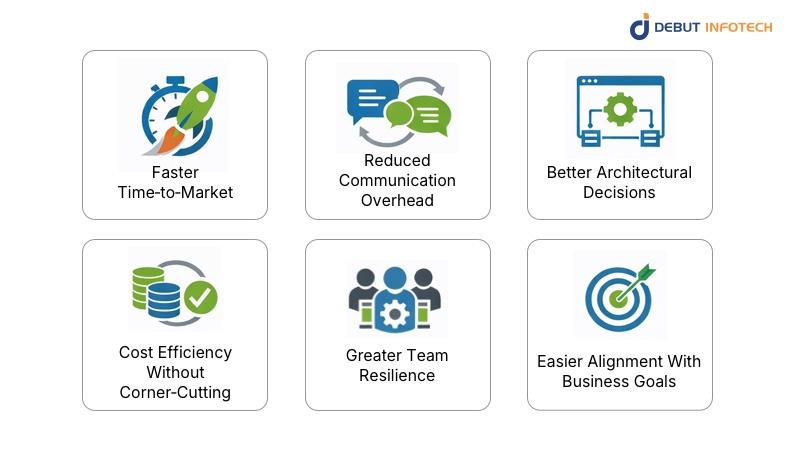
When companies come seeking our full stack development services at Debut Infotech Pvt Ltd, we have noticed some of the most vital things that seem to be their concerns. They’ll often use buzzwords like “flexibility,” “speed,” and “efficiency.” However, we’ve figured out the tangible benefits they actually want.
The following are some of the most important ones.
Remember, we said, the market doesn’t wait for anybody. Companies hiring full stack developers want professionals who can build high-quality software products in as little time as possible so that they can start servicing their target customers. And that’s one of the main values that a full stack developer offers. A full stack developer can take a feature from idea to production without waiting on multiple teams. When releasing MVPs or responding to market feedback, fewer handoffs lead to fewer delays.
Translating needs across roles takes time for traditional teams. Since full stack software developers are already familiar with the connections between various levels, they remove a lot of that friction. Meetings get smaller, decisions are made more quickly, and miscommunications decrease—often without anybody specifically attempting to “optimize” them.
Full Stack developers are more likely to make fair trade-offs since they have a comprehensive understanding of the system. No UI modification is made without taking the backend’s impact into account. The user experience is taken into consideration when making database decisions. This eventually results in less expensive rewrites and simpler architectures.
In early or mid-stage projects, hiring a single full stack web developer can frequently eliminate the requirement for several narrowly focused roles. That means doing the proper amount with fewer moving parts, not doing less. This is particularly important when planning a phased delivery or assessing the total cost of developing a web application.
When one specialist is unavailable, projects continue on. Redundancy is produced by full stack development since more individuals can intervene, evaluate code, or unblock progress. Under duress, teams become more resilient and less brittle.
Versatile engineers tend to think beyond tickets. A seasoned full stack software developer understands why a feature exists, not just how to build it. That context leads to smarter prioritization and fewer technically “correct” but commercially useless decisions.
Related Read: Front End vs Back End vs Full Stack Development: A Simple Guide for Beginners
While Full Stack Developers offer clear advantages, they’re not a silver bullet. Like any hiring model, there are trade‑offs—and being honest about them is the only way to use full‑stack talent effectively. Here are a few downsides that teams should account for upfront.
Not every full stack developer has the same level of depth across the stack. Some lean heavily frontend, others backend. When teams assume “full stack” automatically means expert everywhere, they risk shallow implementations or long‑term technical debt. This is why experience—and not just breadth—matters.
Frontend work demands a very different mindset from backend logic or infrastructure decisions. When full stack developers are constantly jumping between layers, productivity can dip. Over time, excessive context switching can lead to fatigue or slower execution if workloads aren’t well structured.
Because a full stack software developer can “do it all,” teams sometimes ask them to do exactly that. UI, APIs, deployments, bug fixes—simultaneously. Without clear boundaries, this turns versatility into overextension, which isn’t sustainable for either quality or morale.
Certain challenges—advanced security hardening, low‑latency systems, complex data pipelines—still require deep specialists. Full stack development works best for most product work, but forcing it into highly specialized domains can slow progress rather than speed it up.
Relying too heavily on Full Stack Developers can sometimes mask deeper problems: unclear requirements, poor tooling, or lack of process. Versatile engineers can “make things work,” but that doesn’t mean the system itself is healthy.
The takeaway isn’t to avoid Full Stack Developers, but to deploy them intentionally. When paired with clear scope, realistic expectations, and the occasional specialist support, full‑stack roles shine. When treated as a shortcut for deeper organizational issues, their impact quickly diminishes.
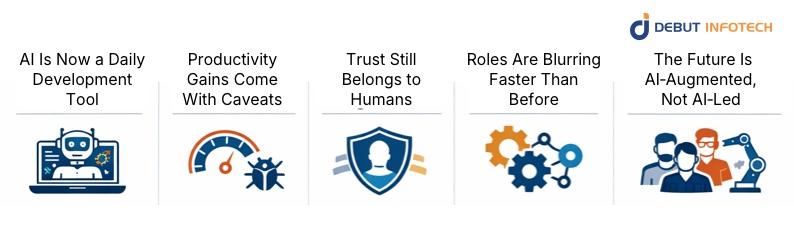
AI hasn’t quietly entered software engineering—it’s walked straight into the workflow. But its real impact isn’t about replacing engineers. It’s about reshaping how engineering work gets done, and in many cases, amplifying the value of Full Stack Developers.
AI coding assistants are no longer experimental. Most engineering teams now use them for scaffolding features, generating boilerplate, refactoring code, and writing documentation. The key shift is frequency: AI is embedded directly into IDEs and pull‑request workflows, not used as a side tool. This has shortened feedback loops, especially in full stack development, where context spans multiple layers.
Studies consistently show that AI can speed up common development tasks—but speed doesn’t equal correctness. Teams still report spending significant time validating outputs, fixing edge cases, and aligning generated code with existing systems. This is where Full Stack Developers stand out: they’re better positioned to evaluate AI‑generated code across frontend, backend, and infrastructure boundaries.
Despite high adoption, developers remain cautious. AI often produces code that is “almost right,” which can be more dangerous than being obviously wrong. Architectural decisions, security considerations, and performance trade‑offs still require human judgment—especially from a full stack software developer who understands system‑level consequences.
AI accelerates the ongoing blurring of roles. Frontend developers touch APIs. Backend engineers think about UX. Deployment concerns surface earlier in development. In this environment, full stack development isn’t a bonus skill—it’s a practical response to how modern systems are built.
The most effective teams aren’t “AI‑first.” They’re engineer‑first, AI‑assisted. Small, versatile teams using AI thoughtfully are outperforming larger, fragmented ones. And at the center of those teams, more often than not, are experienced Full Stack Developers who know how to connect everything without letting automation run the show.
Multiple indicators point to the fact that full stack developers are the future of software engineering. And that is because the industry needs cleaner code architecture more quickly. Therefore, there will be a high demand for engineers who think and implement end‑to‑end development, connect decisions across layers, and deliver working software without unnecessary friction.
We’ve seen how the industry changed from rigid specialization to adaptability, why full-stack jobs increase architectural clarity and reduce handoffs, where the drawbacks are (and how to deal with them), and how AI is speeding rather than replacing human-led development. Understanding the entire system has become a competitive advantage in a world where roles are becoming more ambiguous and tools are becoming more sophisticated.
For businesses, this means success depends less on assembling large, fragmented teams and more on empowering small, capable ones. Teams built around experienced Full Stack Developers move faster, adapt better, and make decisions that balance technical quality with real business outcomes.
This is exactly where Debut Infotech Pvt Ltd fits in. As a trusted custom software development company, we help organizations build and scale products by pairing senior full‑stack engineers with technical depth and practical delivery experience. Whether you’re launching something new or modernizing an existing platform, the future is clear—and it’s full stack
A. Indeed, full stack developers will play a significant role in the future. Companies value engineers who comprehend the complete system as software roles continue to merge between frontend, backend, and deployment. Full-stack expertise is becoming more, not less, relevant because to its versatility, system thinking, and ability to deliver end-to-end features.
A. Of course. In 2025, full stack development is still in high demand and is predicted to keep growing. Leaner teams that can work quickly without a lot of handoffs are what businesses seek. A competent full stack web developer is ideal for enterprise product teams, startups, and agile organizations.
A. No, rather than removing the need for developers, AI is changing the way they work. Although tools are capable of producing code, they still lack business context and system awareness. Because they can connect layers, examine outputs, and make well-informed design decisions, full stack developers are frequently in the best position to employ AI efficiently.
A. Yes, particularly for engineers and companies with long-term goals. Because they can adjust as technologies change, full stack software developers provide career resilience in 2026. With the advent of new frameworks and the development of AI capabilities, full-stack skills reduce reliance on specialized positions that could change or disappear.
A. When speed, clarity, and ownership are important—for example, in MVP builds, product iterations, or scaling small teams—hiring full stack developers makes sense. Deep technical issues still require specialists, but many businesses today begin with full-stack skills and add depth as needed.

Our Latest Insights
USA

2501 Chatham, Rd Suite R Springfield, IL 62704
+1-708-515-4004
info@debutinfotech.com
UK

7 Pound Close, Yarnton, Oxfordshire, OX51QG
+44-770-304-0079
info@debutinfotech.com
Canada

154 Eden Oak Trail, Kitchener, ON N2A 0H9
+1-708-515-4004
info@debutinfotech.com
INDIA

Sector 101-A, Plot No: I-42, IT City Rd, JLPL Industrial Area, Mohali, PB 140306
9888402396
info@debutinfotech.com

9001:2015
Quality Certified

ISO 27001
Security Certified

A+ Rating
Accredited Business

Certik
Security & Audit


Copyright © 2026, Debut Infotech. All rights reserved. | Privacy Policy