ON THIS PAGE
Progress0%






Our Global Presence :





Decentralized applications are moving from experimentation to real-world utility, shaping what many now describe as the Future of DApp Development.
Adoption is rising steadily, with the ecosystem averaging 18.7 million daily active wallets in Q3 2025, reflecting strong global user engagement. At the same time, financial activity is accelerating, as DApps generated $1.8 billion in fee revenue in Q1 2025, surpassing the underlying blockchain infrastructure.
DApp market growth is driven by advances in scalability, interoperability, and practical use cases across finance, gaming, and enterprise systems. As businesses seek secure, transparent, and cost-efficient solutions, DApps are becoming central to digital transformation strategies, positioning them as a long-term foundation for decentralized ecosystems.
In this guide, we’ll cover why DApp Development is becoming popular, key trends shaping the future of DApp development, and how businesses can leverage these trends.
Related Read: What Is a DApp? Discover Decentralized Apps Explained
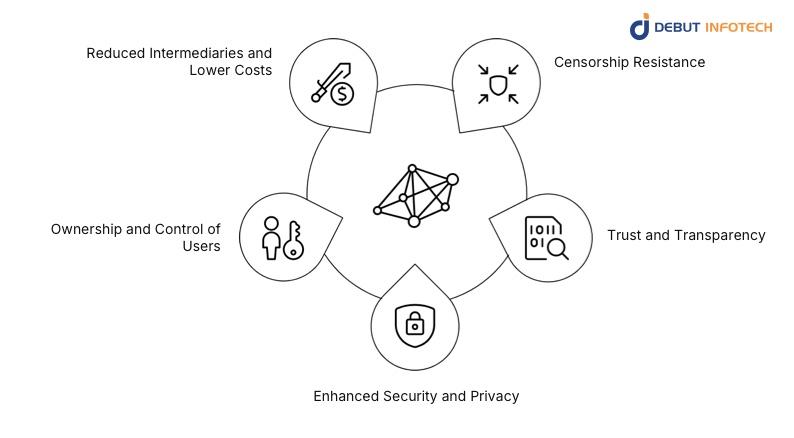
DApps operate on decentralized networks where control is distributed across nodes rather than concentrated in a single authority. This structure prevents unilateral interference, shutdowns, or data manipulation. Businesses benefit from consistent uptime and operational independence, especially in regions with strict controls. At the same time, users gain access to platforms that remain open, neutral, and resistant to external restrictions.
Blockchain-based systems record every transaction on an immutable ledger, making all activities traceable and verifiable in real time. This removes reliance on centralized validation and reduces disputes. For businesses, it improves auditability and accountability. For users, it builds confidence, as they can independently confirm transactions without depending on assurances from a third party.
DApps use distributed architectures combined with cryptographic encryption to secure data and transactions. This significantly reduces exposure to centralized breaches and common attack vectors. Privacy-enhancing technologies further allow selective data sharing, ensuring sensitive information remains protected. These capabilities make DApps suitable for industries that require robust data protection, including finance, healthcare, and identity management.
Users interact with DApps through private keys and decentralized wallets, giving them direct control over their assets and personal data. This removes dependency on centralized platforms that typically store and manage user information. Businesses can design services that respect user ownership while still delivering functionality, creating more balanced and transparent digital relationships between platforms and their users.
DApps rely on smart contracts to automate processes that traditionally require intermediaries such as banks, brokers, or verification services. This reduces administrative overhead and eliminates intermediary fees. Transactions are executed faster and with fewer points of friction. For businesses, this leads to cost efficiency and streamlined operations, while users benefit from faster, more direct interactions.
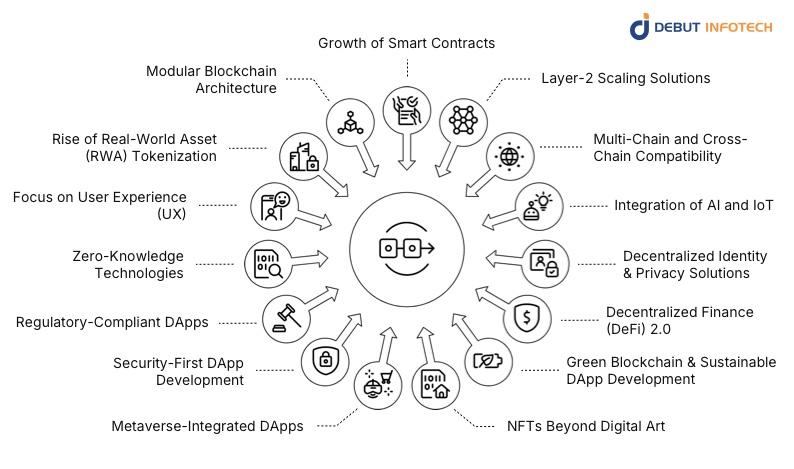
Here are trends shaping the future of dapps:
Smart contracts are evolving into highly reliable, programmable systems capable of handling complex business logic across industries. They now integrate external data through oracles and support multi-step automated workflows. This allows organizations to execute agreements without manual oversight, improving efficiency and reducing disputes.
The growing maturity of smart contract development is pushing DApp adoption rate in finance, supply chain, and enterprise automation, where accuracy and speed are critical for operational success.
Why It is crucial:
Layer-2 scaling solutions are improving the usability of blockchain networks by handling transactions off the main chain while maintaining security. These technologies reduce congestion and lower transaction costs, making DApps more accessible for everyday use.
As user demand increases, Layer-2 solutions are becoming essential for delivering fast and cost-effective decentralized applications across industries.
Why It Matters:
Multi-chain and cross-chain capabilities are allowing DApps to operate seamlessly across different blockchain ecosystems. This flexibility ensures that applications are not constrained by a single network. Businesses can optimize performance, reduce costs, and improve accessibility by leveraging multiple blockchains while maintaining a unified user experience.
a) Key Technologies:
b) Advantage:
The integration of AI, IoT, and blockchain is enabling DApps to process real-time data and automate decision-making. Connected devices generate continuous data streams, which AI analyzes and blockchain secures. This combination supports advanced use cases such as predictive maintenance and automated logistics, improving efficiency and reducing operational risks. This integration will play a role in the future of decentralized apps.
a) Real-World Applications:
b) Why it matters:
Decentralized identity solutions are giving users control over their personal data while enabling secure authentication. These systems rely on cryptographic proofs instead of centralized databases, reducing the risk of data breaches. Businesses benefit from streamlined verification processes and improved compliance, especially in sectors that handle sensitive information.
a) Key Innovations:
b) Why it is crucial:
DeFi 2.0 is focused on improving the sustainability and reliability of decentralized financial systems. It addresses earlier challenges such as unstable yields and liquidity inefficiencies. New protocols are introducing better risk management and capital efficiency, making DeFi application development more attractive to both retail and institutional users.
a) Breakthroughs in Privacy:
b) Advantages:
Sustainable blockchain practices are becoming a priority as concerns about energy consumption grow. When you hire Dapp developers, they will adopt energy-efficient consensus mechanisms and optimize infrastructure to reduce environmental impact. This trend aligns DApp development with global sustainability goals while maintaining performance and security standards.
a) New NFT Use Cases:
b) Why It’s Interesting:
NFTs are expanding far beyond collectibles and digital artwork into practical, utility-driven use cases. They now represent ownership of assets such as real estate, intellectual property, and event access rights. This shift is redefining how ownership and value are managed digitally. Businesses are leveraging NFTs to create new engagement models, unlock revenue streams, and provide verifiable proof of authenticity for both digital and physical assets.
a) Key Innovations:
b) Impact:
Metaverse-integrated DApps are becoming essential components of virtual ecosystems, enabling ownership, governance, and transactions within immersive environments. These applications allow users to interact economically and socially in decentralized virtual spaces. Businesses are exploring these blockchain platforms to build digital experiences, marketplaces, and branded environments that extend beyond traditional online interactions.
a) Features of Metaverse-Integrated:
b) Future Outlook:
Security-first development is becoming a core principle in DApp development as the value these applications handle continues to grow. Developers and top-tier dapp development services are embedding security practices from the design stage through deployment. This includes rigorous testing, audits, and continuous monitoring to prevent vulnerabilities and protect user assets.
a) Compliance Trends:
b) Future Potential:
Regulatory compliance is becoming a defining factor in DApp adoption, especially in industries such as finance and healthcare. Developers are building applications that incorporate compliance features without compromising decentralization. This includes identity verification, transaction monitoring, and reporting capabilities aligned with legal requirements.
a) Advantages:
b) Future Outlook:
Zero-knowledge technologies are transforming how privacy is handled in DApps by allowing data verification without revealing the underlying information. This approach enhances confidentiality while maintaining trust and transparency. It is particularly valuable for applications that require sensitive data handling, such as finance, identity verification, and healthcare systems.
a) Features:
b) Why it matters:
User experience is becoming a priority as DApps aim to attract non-technical users. Developers are simplifying interfaces, improving onboarding processes, and integrating seamless wallet solutions. This shift is reducing the complexity traditionally associated with blockchain applications, making them more accessible and practical for everyday use.
a) Key features:
b) Why it matters:
Real-world asset tokenization is enabling physical and financial assets to be represented on blockchain networks. This includes assets such as real estate, commodities, and financial instruments. By converting these into digital tokens, businesses can improve liquidity, enable fractional ownership, and streamline asset management processes.
Why It Matters:
Modular blockchain architecture is redefining how decentralized systems are built by separating core functions such as execution, consensus, and data availability. This approach allows developers to customize infrastructure based on specific application requirements. It improves scalability, flexibility, and performance, making it easier to build advanced DApps.
a) Key Technologies:
b) Why it is crucial?
Businesses should implement Layer-2 scaling technologies and modular blockchain architectures to support increasing transaction volumes without compromising performance.
Scalable solutions reduce latency and transaction costs while maintaining network security. This approach allows organizations to expand their user base and application capabilities without frequent infrastructure changes, ensuring long-term operational stability and consistent service delivery.
Security should be embedded across the entire development lifecycle, from architecture design to deployment and ongoing maintenance. Businesses need to conduct regular smart contract audits, implement secure coding standards, and monitor systems continuously.
Proactive security measures reduce vulnerabilities, protect digital assets, and strengthen user trust, which is critical for applications handling financial transactions or sensitive information.
Combining IoT devices with decentralized technologies enables businesses to securely capture, verify, and act on real-time data. This integration supports automated processes across supply chains, logistics, and smart infrastructure.
By connecting physical devices to blockchain networks, organizations can improve operational visibility, enhance efficiency, and ensure that data exchanged between devices remains accurate and tamper-resistant. This will transform the Web3 industry outlook.
Interoperability enables DApps to function across multiple blockchain networks, allowing seamless data and asset transfers. Businesses can avoid dependence on a single platform and select networks based on performance, dapp development cost, or use case requirements. This flexibility supports broader market reach, simplifies integrations, and ensures that applications remain adaptable as blockchain ecosystems continue to evolve.
The future of DApp development is shaped by scalability, interoperability, and real-world integration. As dapp trends like DeFi evolution, AI integration, and tokenization mature, businesses have clear opportunities to build secure, user-focused solutions. Success will depend on aligning technology choices with long-term goals while maintaining performance, compliance, and user trust.
Debut Infotech supports this shift by delivering tailored DApp solutions built for scalability, security, and real-world use. As a top-tier blockchain application development company, our expertise helps businesses turn emerging trends into practical applications, accelerating growth in the evolving decentralized ecosystem.
The future of dApps looks steady, not flashy hype like before. Expect tighter integration with AI, better user interfaces, and faster blockchains. Most growth will come from real use cases. Finance, gaming, identity, and social apps will quietly mature while users stop caring about the “blockchain” part altogether.
Costs vary a lot. A simple dApp can land between $20,000 and $50,000, while complex platforms easily cross $150,000. It depends on the features, the chosen blockchain, smart contract complexity, and security audits. Teams often underestimate audit and maintenance costs, which can add up after launch.
Yes, but not automatically. dApps make money through transaction fees, token models, subscriptions, or premium features. The catch is user adoption. Plenty of dApps exist with solid tech but no real users. Revenue usually follows strong utility, not just token hype or early buzz.
The market is growing, though not at the wild pace seen earlier. As of 2025, the global dApp market is valued at over $25 billion and projected to keep expanding steadily. Growth is being driven by DeFi, gaming, and NFTs, with user activity stabilizing across major blockchains.
The biggest headaches are scalability, security, and user experience. Gas fees still frustrate users, and smart contract bugs can be costly. Onboarding is another issue. Wallets and private keys confuse new users. Add regulatory uncertainty, and you’ve got a space that still needs polishing.

Our Latest Insights
USA
2501 Chatham, Rd Suite R Springfield, IL 62704
+1-708-515-4004
info@debutinfotech.com
UK
7 Pound Close, Yarnton, Oxfordshire, OX51QG
+44-770-304-0079
info@debutinfotech.com
Canada
154 Eden Oak Trail, Kitchener, ON N2A 0H9
+1-708-515-4004
info@debutinfotech.com
INDIA
Sector 101-A, Plot No: I-42, IT City Rd, JLPL Industrial Area, Mohali, PB 140306
9888402396
info@debutinfotech.com