ON THIS PAGE
Progress0%






Our Global Presence :


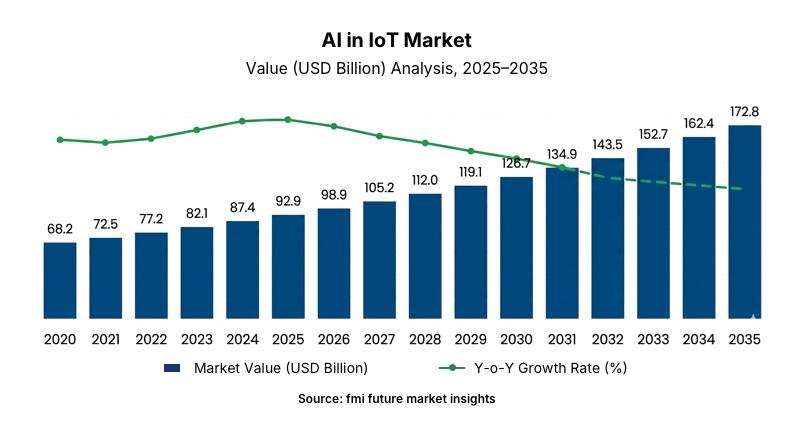
IoT Machine Learning represents the convergence of connected devices and advanced algorithms to turn sensor data into intelligent action. The global AI in IoT market is projected to grow from $92.9 billion in 2025 to approximately $172.8 billion by 2035 as organizations adopt analytics and automation at scale.
In addition, more than 68% of industrial companies now use AI-powered IoT to automate processes, analyze data in real time, and predict maintenance needs.
Predictive maintenance, one of the most impactful applications, is rapidly expanding, with its market poised to grow at a 35.1 % CAGR through 2029 as industry digitization accelerates. This combination reshapes operations in manufacturing, healthcare, agriculture, and logistics, enabling systems that learn, adapt, and make data-driven decisions.
Machine learning is a branch of artificial intelligence that enables systems to learn from data, identify patterns, and improve decisions over time without being explicitly programmed, relying instead on statistical models and adaptive algorithms in real environments.
The Internet of Things refers to a network of physical devices embedded with sensors, software, and connectivity that collect, transmit, and exchange data across systems, enabling remote monitoring, automation, and data-driven operations at scale across industries globally.
Machine Learning and the Internet of Things work together to turn raw device data into usable intelligence. IoT systems collect continuous data from sensors, devices, and machines.
On its own, this data has limited value. Machine learning adds the ability to analyze patterns, learn from behavior, and improve outcomes over time. When combined, organizations gain systems that do more than report status. They detect trends, anticipate issues, and support better decisions across operations.
Machine learning in IoT refers to the use of algorithms that analyze data generated by connected devices to identify patterns and make decisions with minimal human input. IoT devices stream high-volume, real-time data. Machine learning models process this data either at the edge, in the cloud, or across both layers. The result is intelligent behavior such as anomaly detection, prediction, classification, or automated control actions that improve with continued data exposure.
Integrating machine learning with IoT allows organizations to move beyond basic connectivity and monitoring.
IoT systems generate continuous streams of data, but machine learning provides the analytical layer needed to interpret that data, learn from patterns, and act on insights. This integration supports prediction, automation, and optimization across complex environments, enabling smarter operations, faster decisions, and systems that improve performance over time without constant manual tuning.
Machine learning helps reduce costs by identifying inefficiencies that are difficult to detect manually. Predictive maintenance models lower repair expenses by addressing issues before failures occur.
Energy usage, resource consumption, and asset utilization can be optimized continuously. This reduces downtime, limits waste, and extends equipment lifespan, leading to measurable savings across operations, infrastructure, and long-term maintenance planning without increasing operational complexity.
By analyzing real-time IoT data, IoT with machine learning optimizes workflows, equipment behavior, and system performance automatically. Processes adapt to changing conditions without human intervention.
Bottlenecks are identified early, throughput improves, and response times shorten. This level of efficiency is difficult to achieve with static rules, especially in environments where conditions change frequently, and systems operate at scale across multiple locations.
Machine learning enables organizations to extract new value from existing IoT data. Usage patterns, performance signals, and behavioral insights reveal opportunities for smarter features, new services, and improved product design. This supports data-driven innovation rather than guesswork.
Over time, connected products evolve based on real-world feedback, helping businesses stay competitive and introduce offerings aligned with actual customer and operational needs.
ML-powered IoT systems respond more accurately to user behavior and environmental conditions. Products become more reliable, personalized, and responsive.
Issues are detected earlier, reducing service disruptions. Insights from device data help organizations refine service delivery and anticipate customer needs, resulting in smoother interactions, higher satisfaction, and experiences that feel consistent and dependable across touchpoints and usage scenarios.
Machine learning allows IoT data to support new revenue models. Predictive insights enable performance-based services, subscription offerings, and smarter pricing strategies. Organizations can upsell maintenance, optimization, or analytics-driven services based on real usage data.
Better forecasting also improves demand planning and inventory control, helping businesses capture revenue opportunities while reducing missed sales and operational friction.
Unlike static systems, machine learning models improve as more IoT data becomes available. Feedback loops allow continuous refinement of predictions, decisions, and automated actions.
Performance gains accumulate over time without system redesign. This creates self-improving operations in which processes adapt to new conditions, scale efficiently, and maintain accuracy even as environments, workloads, and device behaviors evolve.
Descriptive intelligence uses machine learning to interpret historical and real-time IoT data to explain what is happening within a system. Models aggregate sensor readings, detect trends, and highlight deviations from normal behavior. This creates visibility across devices and processes, helping teams or machine learning development companies understand performance patterns, usage behavior, and system health without manual data analysis at an operational scale reliably.
Predictive intelligence uses machine learning models to forecast future events from IoT data patterns. By analyzing historical behavior and current signals, systems can estimate failures, demand changes, or performance issues before they occur. This capability supports better planning, reduces uncertainty, and enables organizations to take preventive action rather than respond after problems escalate across critical operational workflows.
Prescriptive intelligence builds on predictive insights by recommending or executing actions within IoT systems. Machine learning evaluates possible responses, constraints, and outcomes to determine the most effective action. In advanced setups, systems automatically adjust processes in real time, closing the loop between data, decision-making, and execution to optimize performance continuously across complex environments, devices, and operations.
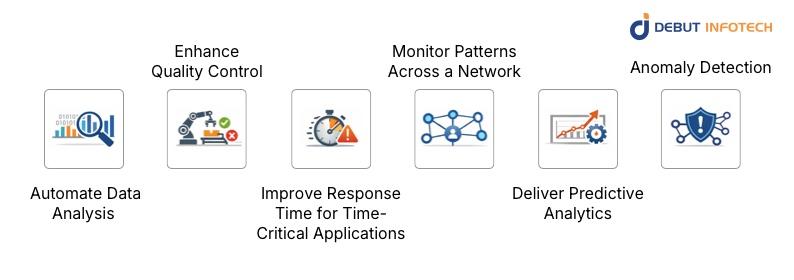
Machine learning automates the analysis of massive IoT data streams that would be impractical to review manually. Models classify, aggregate, and interpret sensor data continuously, reducing human effort and error. This allows organizations to detect trends, surface actionable insights faster, and maintain situational awareness across large device networks without relying on static dashboards or manual reporting workflows.
In IoT-enabled environments, machine learning improves quality control by identifying subtle deviations in sensor readings, images, or production metrics. These models learn what normal output looks like and flag defects early. This leads to consistent product quality, reduced rework, and fewer recalls, especially in high-volume operations where traditional inspection methods struggle to scale effectively.
Machine learning helps IoT systems respond faster in time-sensitive scenarios by detecting critical signals in real time. Models prioritize alerts, filter noise, and trigger automated actions when thresholds are crossed. This is particularly important in safety systems, healthcare monitoring, and industrial control environments where delayed responses can lead to equipment damage, service disruption, or serious operational risks.
ML models analyze behavior across thousands of connected devices to identify patterns that are not visible at the individual device level. This includes usage trends, performance degradation, or correlated failures. Network-wide pattern monitoring helps organizations optimize system performance, improve capacity planning, and detect systemic issues early before they escalate into widespread operational problems.
Machine learning enables predictive analytics by learning from historical and real-time IoT data. These models forecast equipment failures, demand changes, and system performance trends. Predictive insights support better planning, proactive maintenance, and more intelligent resource allocation.
Organizations benefit from reduced uncertainty and improved decision-making across operations that depend on connected devices and continuous data flows.
Anomaly detection uses machine learning to identify unusual behavior in IoT data that may indicate faults, security threats, or abnormal conditions.
Unlike rule-based alerts, ML adapts to changing patterns and reduces false positives. This makes it easier to detect issues early, protect systems, and maintain reliability in complex environments where normal behavior evolves over time.
Here are some examples of industrial applications of machine learning in IoT:
Machine learning improves transportation and logistics by analyzing IoT data from vehicles, routes, and infrastructure. Models optimize routing, predict delivery delays, monitor vehicle health, and reduce fuel consumption. This results in better fleet utilization, lower operating costs, and more reliable delivery schedules, especially in large-scale logistics networks operating under variable traffic and environmental conditions.
In agriculture, machine learning processes IoT data from soil sensors, weather stations, and crop monitoring systems. Models support precision farming by optimizing irrigation, fertilization, and pest control based on real conditions. This improves yields, reduces resource waste, and helps farmers make timely decisions, even across large and geographically distributed farming operations.
Manufacturing environments use machine learning and IoT to support predictive maintenance, process optimization, and quality assurance. Models analyze machine data to anticipate failures, optimize production parameters, and detect defects early. This reduces downtime, improves output consistency, and increases overall equipment effectiveness, making operations more resilient and cost-efficient in highly automated production settings.
In healthcare, industrial IoT machine learning enhances IoT-enabled monitoring systems by analyzing data from wearables and medical devices to improve patient care. Models detect early signs of deterioration, support remote monitoring, and reduce false alarms. This improves patient outcomes, enables timely interventions, and helps healthcare providers manage resources more effectively while maintaining continuous oversight outside traditional clinical settings.
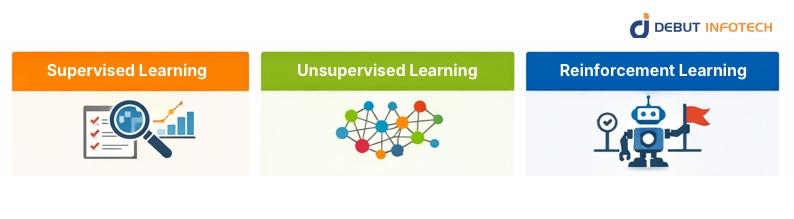
Supervised learning uses labeled datasets to train models that map inputs to known outputs. In IoT systems, it is commonly applied to classification, regression, and fault detection tasks. Sensors generate data that is matched with predefined outcomes, allowing models to learn accurate relationships. This approach is widely used when historical data and clear performance targets are available, such as in predictive maintenance, quality inspection, and demand forecasting.
Pros
Cons
Unsupervised learning analyzes unlabeled IoT data to uncover hidden patterns, structures, or relationships. Instead of predefined outcomes, models identify similarities, clusters, and anomalies based on data behavior. This approach is useful in IoT environments where data volume is high and labeling is impractical.
Common applications include anomaly detection, device behavior analysis, and network pattern monitoring across large, evolving systems.
Pros
Cons
Reinforcement learning enables IoT systems to learn optimal actions through interaction with their environment. Models receive feedback in the form of rewards or penalties and adjust behavior over time. This approach is suited for dynamic, decision-driven scenarios such as energy management, robotic control, and adaptive traffic systems. Reinforcement learning excels when predefined rules fail, and continuous optimization is required under changing conditions.
Pros
Cons
Here are some machine learning challenges with IoT:
Edge IoT devices have limited processing power, memory, and energy resources, making it challenging to run complex machine learning models locally. Real-time inference and data preprocessing strain constrained hardware. These limitations limit model size, accuracy, and responsiveness, particularly in scenarios that require low latency or large-scale deployment across resource-constrained devices.
Solution
Organizations address this challenge by using lightweight models, model compression, and edge-optimized frameworks. Techniques such as pruning, quantization, and knowledge distillation reduce resource demands. Hybrid architectures shift training and heavy analytics to the cloud while keeping inference at the edge, maintaining responsiveness while ensuring scalability and cost control.
IoT environments generate continuous, high-velocity data streams that must be processed with minimal delay. Managing real-time ingestion, filtering, and analysis is complex, especially when data arrives from distributed sources. Latency, synchronization issues, and inconsistent data quality make it difficult to maintain accurate, timely machine learning outputs across operational systems.
Solution
This challenge is addressed through stream-processing architectures and event-driven pipelines. Edge analytics reduces data volume before transmission, while scalable cloud machine learning platforms handle aggregation and model updates.
Using time-series databases, message brokers, and real-time inference engines helps maintain low latency, consistency, and reliability even as data volume and system complexity increase.
IoT systems often handle sensitive operational, personal, or medical data, increasing exposure to privacy and security risks. Machine learning requires large datasets, which expands the attack surface across devices, networks, and storage layers. Inadequate protection can lead to data breaches, regulatory violations, and loss of trust in connected systems.
Solution
Organizations mitigate these risks by applying strong encryption, access controls, and secure device authentication. Machine learning techniques such as federated learning and on-device inference reduce the need for raw data sharing.
Compliance-focused data governance, combined with continuous monitoring and security updates, helps protect sensitive information while still enabling effective machine learning across distributed IoT environments.
Machine learning models depend on large, accurate, and representative datasets, which are difficult to obtain in IoT environments. Sensor noise, missing values, inconsistent formats, and biased data reduce model reliability. Poor data quality leads to inaccurate predictions, weak generalization, and reduced confidence in automated decisions across connected systems.
Solution
This challenge is addressed through robust data engineering practices. Automated data validation, cleansing pipelines, and anomaly filtering improve input quality. Synthetic data generation and transfer learning reduce dependency on massive labeled IoT datasets for machine learning. Continuous feedback loops help refine datasets over time, ensuring models remain accurate, reliable, and aligned with real-world operating conditions.
Debut Infotech is a top machine learning development company that works with businesses to design, build, and deploy machine learning systems that integrate seamlessly with IoT environments. The focus stays on practical outcomes, not experimentation.
From edge-aware model design to scalable cloud architectures, we help organizations translate device data into reliable intelligence, automation, and long-term operational value across industries where performance, accuracy, and security matter.
IoT Machine Learning is a cornerstone of the future of smart technology. By integrating machine learning with connected devices, organizations unlock predictive insights, operational efficiency, and automated responses that redefine system performance. This combination supports real-world applications from predictive maintenance to intelligent automation across industries.
As adoption continues to expand, the ability to extract meaningful patterns from data will be essential for competitive advantage and resilient, adaptive digital infrastructure.
A. Businesses use IoT Machine Learning to reduce downtime, cut costs, and make faster decisions. ML turns raw IoT data into predictions and alerts, not dashboards nobody checks. This helps teams act early, optimize operations, and scale automation without constant manual oversight.
A. IoT Machine Learning relies on time-series sensor data, such as temperature, pressure, motion, location, and energy usage. Historical data improves accuracy, but models can also learn in near real time. Clean data pipelines matter more than the volume of data.
A. Yes, many IoT Machine Learning models run directly on edge devices. Edge ML reduces latency, lowers cloud costs, and keeps sensitive data local. Lightweight models handle tasks such as anomaly detection and image recognition without relying on continuous internet connectivity.
A. Machine learning improves IoT security by detecting unusual device behavior, traffic spikes, or access patterns. ML models flag anomalies that traditional rules miss, helping teams spot compromised devices early. This reduces response time and limits damage across large IoT networks.
A. Timelines vary by use case and data readiness. Simple pilots take eight to twelve weeks. Production-grade systems with edge deployment, integration, and testing often take three to six months. Existing data and clear goals significantly speed things up.
A. IoT Machine Learning appears in smart factories, predicting equipment failures; in agriculture, optimizing irrigation through sensor data; and in logistics, tracking shipments while forecasting delays. In smart homes, ML manages energy use and powers voice-controlled devices, turning raw IoT data into actionable insights that improve efficiency and decision-making.

Our Latest Insights

USA

2501 Chatham, Rd Suite R Springfield, IL 62704
+1-708-515-4004
info@debutinfotech.com
UK

7 Pound Close, Yarnton, Oxfordshire, OX51QG
+44-770-304-0079
info@debutinfotech.com
Canada

154 Eden Oak Trail, Kitchener, ON N2A 0H9
+1-708-515-4004
info@debutinfotech.com
INDIA

Sector 101-A, Plot No: I-42, IT City Rd, JLPL Industrial Area, Mohali, PB 140306
9888402396
info@debutinfotech.com

9001:2015
Quality Certified

ISO 27001
Security Certified

A+ Rating
Accredited Business

Certik
Security & Audit


Copyright © 2026, Debut Infotech. All rights reserved. | Privacy Policy