ON THIS PAGE
Progress0%





Our Global Presence :





The cat’s out of the bag! The potential of blockchain technology as a major driver for the future of the digital economy is no longer news. As such, investors and business leaders around the world are urgently trying to get in early to reap serious financial returns in the coming years.
Today, multinational corporations, sovereign wealth funds, institutional asset managers, and forward-thinking startups are actively building blockchain technology investment plans. Grand View Research reports that the global blockchain technology market, which was estimated at USD 31.28 billion in 2024, is projected to skyrocket to USD 1,431.54 billion by 2030, growing at a compound annual growth rate (CAGR) of 90.1% between 2025 and 2030.
But knowing that the market is growing is only part of the equation.
The more pressing questions are: How do you actually invest in blockchain technology? What are the best strategies? Which vehicles carry the least risk while maximizing your exposure to this transformative sector? And how do you align your blockchain technology investments with long-term value creation?
To help you answer these pressing questions, the blockchain experts at Debut Infotech Pvt Ltd have drawn on their decades of experience and broken it all down clearly and practically. Whether you are an entrepreneur exploring how to integrate blockchain into your business, an enterprise leader building a blockchain technology investment plan, or an investor seeking the best way to invest in blockchain technology, this article will equip you with the knowledge to invest wisely.
For starters, the blockchain is a distributed digital ledger that records transactions across a decentralized network of computers. Each transaction is grouped into a “block,” cryptographically secured and linked to the previous block, creating an immutable, tamper-resistant chain of records. This architecture is responsible for the three major properties that make the blockchain valuable to most industries today and, most importantly, make it a promising investment. These are:
These properties are driving adoption across financial services, supply chain, healthcare, real estate, legal documentation, and more.
When it comes to investing in blockchain technology, there is more than one way to skin a cat. From an investment lens, you’re gaining exposure to either of the following when you invest in blockchain technology:
You can choose to invest in any of these verticals. However, with all forms of investment, investors need to understand which layer aligns with their risk appetite, time horizon, and strategic objectives. That’s the first step towards building a dependable blockchain technology investment plan.
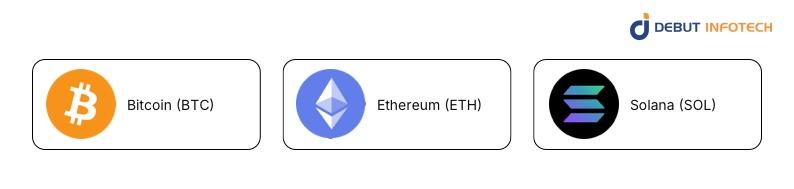
The most promising blockchains for investment are generally those that have been around for quite a while and have developed a reputation for ticking up in value over time.
While hundreds of networks do exist, not all of them can guarantee you this kind of return. Nonetheless, our years of experience with blockchain development services make it easy for us to spot the most promising ones. Some of them are listed below.
We’ll give you a heads-up. Most of them have real-world utility, developer activity, institutional backing, and long-term staying power.
Yes, you guessed it right! Bitcoin (BTC) remains the benchmark.
For example, reports by Yahoo Finance indicate that BlackRock’s Bitcoin Exchange-Traded Fund (ETF IBIT), which was launched in January 2024, has become the company’s top revenue source after becoming the fastest in history to reach USD 70 billion in assets. This is an excellent example of how Bitcoin has firmly transitioned from a speculative asset to an institutional-grade store of value. Therefore, investors seeking exposure to blockchain networks with lower volatility, Bitcoin can be a good starting point.
Being the programmable backbone of Web3, Ethereum is somewhat naturally the next most promising blockchain to invest in. One reason our blockchain experts believe this is that an overwhelming majority of DeFi protocols, NFT platforms, tokenized assets, and enterprise smart contract applications are built on Ethereum or its Layer 2 ecosystem. All these vital real-world use cases make ETH a productive asset in a way Bitcoin is not.
Many blockchain enthusiasts and investors often consider Solana as the performance-led alternative to Bitcoin and Ethereum. The network has been touted to offer high throughput, low transaction fees, and a growing ecosystem of consumer applications. Its traction in payments, retail DeFi, and tokenization makes it one of the more compelling high-growth options in a diversified blockchain technology investment plan, albeit with higher risk.
Beyond these three, Chainlink and Polygon are worth monitoring for investors building a broader portfolio. Just like the three we mentioned earlier, both Chainlink and Polygon also demonstrate real utility, active development, and institutional validation.
As we said earlier, there is more than one way to skin a cat. However, regardless of your preferred investment strategy, it is important to keep your portfolio diversified across investment vehicles, risk profiles, and time horizons.
Without further ado, the following are some of the best strategies available to investors today.
You can simply buy certain cryptocurrencies in anticipation that their value increases over time so that you can sell for a profit. Bitcoin (BTC) and Ethereum (ETH) remain the most established options, offering deep liquidity and a track record spanning over a decade. For investors seeking broader exposure, Solana, Chainlink, and XRP offer access to specialized blockchain ecosystems with distinct use cases.
The key consideration here is volatility. Bitcoin reached an all-time high of $126,198 in October 2025 before retracing significantly in early 2026 — a pattern consistent with prior market cycles. Dollar-cost averaging (DCA), which involves spreading purchases over time rather than investing a lump sum, remains one of the most widely recommended strategies for managing volatility in direct cryptocurrency investment.
If you don’t like the volatile nature of holding digital assets, then you can go the alternative route of investing in blockchain-focused Exchange-Traded Funds (ETFs).
Blockchain ETFs hold portfolios of publicly traded companies that derive significant revenue from blockchain-related activities. Most blockchain ETFs invest in companies such as Coinbase, NVIDIA, MicroStrategy, and IBM.
If that suits your investment preference, the following are some examples of blockchain ETFs to look out for in 2026:
ETFs are regulated, liquid, and accessible through standard brokerage accounts. As such, they are one of the most practical vehicles for mainstream investors building a blockchain technology investment plan.
If you would prefer to be more direct, you could also invest in individual companies that are investing in blockchain technology as a core part of their business. The key advantage of this direct approach is that, in addition to benefiting from the blockchain’s growth, you would also enjoy the broader business fundamentals of established firms.
For example, you could invest directly in NVIDIA, a GPU infrastructure company essential to blockchain and AI. In the same vein, you could invest in Coinbase, the world’s largest crypto exchange, or Block, a platform with deep Bitcoin integration via Cash App. Traditional enterprise technology firms such as IBM, Microsoft, and Amazon also maintain significant blockchain development practices through platforms like IBM Blockchain and Amazon Managed Blockchain on AWS. So, you can invest in those ventures directly as well.
While there are plenty of investment opportunities, it is important to watch for key criteria, such as revenue growth, profitability, and the degree of blockchain integration in the business and its core operations. Other relevant criteria to monitor include strategic partnerships, regulatory exposure, and the long-term scalability of the company’s blockchain initiatives.
Investors with a higher risk appetite and those seeking more active forms of blockchain investment might consider getting involved in decentralized finance (DeFi). DeFi protocols allow users to lend, borrow, trade, and earn yield on digital assets without centralized intermediaries. In 2026, DeFi and traditional finance (TradFi) are increasingly converging, with institutional capital rotating into DeFi protocols to generate yield.
Liquid staking and restaking have become particularly attractive, enabling investors to earn staking rewards on assets like ETH while retaining liquidity through derivative tokens. For more sophisticated investors, DeFi participation can complement a broader blockchain technology investment plan — though smart contract risk, liquidity volatility, and regulatory uncertainty remain important risk factors to assess.
NFTs have evolved well beyond digital art speculation. In 2026, their most impactful use cases involve representing ownership of real-world assets on-chain — real estate fractions, fine art, luxury goods, private equity interests, and carbon credits. For investors, this creates access to asset classes that were previously illiquid or restricted to high-net-worth individuals.
The RWA tokenization market has already reached tens of billions in value and is projected to grow rapidly through the decade, with tokenized treasuries, money markets, and structured products offering predictable, low-risk yields within compliant frameworks. This segment is particularly relevant for institutional blockchain technology investments, where risk management and regulatory compliance are non-negotiable.
For enterprises and business owners, one of the most strategic blockchain technology investments is not in financial markets at all — it is in building blockchain capability directly into your operations. Partnering with a specialized blockchain development firm to integrate smart contracts, build decentralized applications (dApps), tokenize assets, or deploy private blockchain networks can deliver compounding operational returns: reduced friction, improved transparency, automated compliance, and entirely new revenue models.
This is precisely where the value of experienced blockchain technology partners is most evident — from initial strategy and architecture through deployment, security audits, and ongoing support.
You’ve now seen some general investment strategies you should consider.
But how do you piece together an actual, actionable plan that is unique to you?
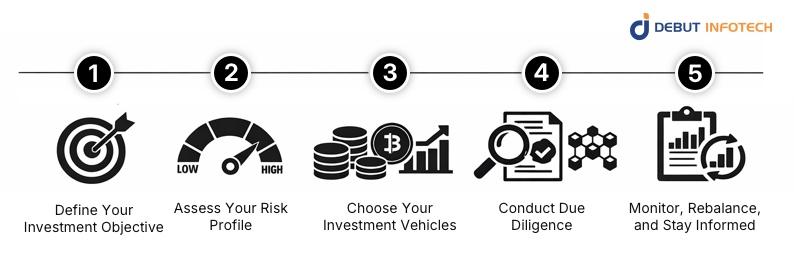
Our blockchain consultants at Debut Infotech have developed the following steps, drawing on their years of experience working with investors. Whether you are allocating capital as an investor or building blockchain into your enterprise roadmap, the following framework provides a practical starting point.
So, why are you investing in blockchain technology?
Are you seeking capital appreciation through crypto assets? Diversified exposure via ETFs? Operational ROI through enterprise blockchain integration? Or strategic positioning in an emerging sector?
Your answer to these questions will help you visualise your core objective, which in turn will help you choose the right investment vehicle, risk tolerance, and time horizon. Short-term traders and long-term strategic investors require very different blockchain technology investment plans.
Depending on your investment objective, you can start knowing where you stand on the risk spectrum, which is quite a stretch when it comes to blockchain technology investments. While regulated ETFs holding blue-chip technology stocks are generally considered lower-risk, direct cryptocurrency trading and participation in DeFi protocols are higher-risk.
So, where do you stand?
Once you can figure that out, you need to allocate your funds accordingly.
Many financial advisors recommend limiting exposure to speculative digital assets to 5–15% of a diversified portfolio, though institutional allocations are trending higher as the regulatory environment matures.
Based on your objectives and risk profile, select one of the vehicles outlined in this guide: direct crypto, blockchain ETFs, blockchain stocks, DeFi participation, RWA tokenization, or enterprise blockchain development. A diversified combination — for example, core ETF holdings supplemented by direct exposure to one or two high-conviction cryptocurrencies — is often the most resilient approach.
For each investment, evaluate the underlying fundamentals: for crypto assets, assess network activity, developer adoption, tokenomics, and regulatory status; for stocks and ETFs, analyze financial performance, blockchain integration depth, and competitive positioning; for enterprise blockchain projects, scrutinize the technology stack, security architecture, partner ecosystem, and measurable ROI potential.
The blockchain space moves at extraordinary speed. Regulatory changes, technological breakthroughs, and market cycles can all shift the risk/return profile of your investments. Building a regular review cadence into your blockchain technology investment plan — at least quarterly — ensures your allocations remain aligned with both market realities and your strategic objectives.
There’s no single “best way” to invest in blockchain technology. In fact, the closest thing to a “best way” is a multi-pronged approach that includes a diversified portfolio aligned with your objectives, risk tolerance, and time horizon. This portfolio could include blockchain ETFs, direct crypto holdings, shares in companies that are investing in blockchain technology, DeFi participation, or direct enterprise blockchain development.
However, as you navigate these options, it is important to focus on informed, strategic decision-making. Understanding the technology, the market, the regulatory environment, and the specific vehicles available to you is the foundation of any sound blockchain technology investment plan.
Debut Infotech, a blockchain development company has spent over a decade helping enterprises, startups, and blockchain 50 companies navigate exactly this landscape. Over the years, our blockchain development services have encompassed blockchain strategy and architecture, DeFi development, NFT marketplaces, tokenization platforms, and enterprise-grade private blockchain solutions. Therefore, if you need that technical depth and strategic clarity that blockchain technology investment demands, reach out to us today.
A. For beginners, blockchain ETFs such as the Amplify Transformational Data Sharing ETF (BLOK) or the Siren Nasdaq NexGen Economy ETF (BLCN) are widely regarded as the best starting point. They offer diversified exposure to blockchain-related companies without requiring direct custody of cryptocurrency or deep technical knowledge.
A. The most effective blockchain technology investment strategies include holding blockchain ETFs for broad, lower-volatility exposure; investing in stocks of companies that are investing in blockchain technology (e.g., NVIDIA, Coinbase, Block); direct cryptocurrency holdings using dollar-cost averaging to manage volatility; DeFi participation for yield generation; and RWA tokenization for access to previously illiquid asset classes.
A. Major companies that are investing in blockchain technology span multiple sectors. In technology and infrastructure: NVIDIA, IBM, and Amazon. In financial services: Coinbase, Block (formerly Square), MicroStrategy, and PayPal. In traditional finance: BlackRock, JPMorgan, and Visa.
A. Whether blockchain is a “good” investment depends entirely on your specific objectives, risk tolerance, and investment horizon. Consulting a qualified financial advisor before making significant allocations is strongly recommended. Nonetheless, the investment case for blockchain in 2026 is stronger than at any prior point, supported by improving regulatory clarity, accelerating institutional adoption, and the emergence of RWA tokenization as a mainstream financial instrument.
A. A sound blockchain technology investment plan begins with five key steps: (1) Define your investment objective (2) Assess your risk tolerance and determine what percentage of your portfolio to allocate to blockchain assets; (3) Select your investment vehicles (4) Conduct due diligence on each investment, examining fundamentals, regulatory exposure, and competitive positioning; (5) Build in regular review cycles to rebalance your portfolio and stay current with developments in the fast-moving blockchain sector.

Our Latest Insights
USA
2501 Chatham, Rd Suite R Springfield, IL 62704
+1-708-515-4004
info@debutinfotech.com
UK
7 Pound Close, Yarnton, Oxfordshire, OX51QG
+44-770-304-0079
info@debutinfotech.com
Canada
154 Eden Oak Trail, Kitchener, ON N2A 0H9
+1-708-515-4004
info@debutinfotech.com
INDIA
Sector 101-A, Plot No: I-42, IT City Rd, JLPL Industrial Area, Mohali, PB 140306
9888402396
info@debutinfotech.com