ON THIS PAGE
Progress0%






Our Global Presence :





When launching a new crypto exchange platform with a white-label solution, it is essential to ensure your platform is structured to allow traders to convert digital currencies to their preferred crypto assets without affecting price.
The rationale is quite simple: traders want a platform that is capable of executing their trades swiftly without any major price slippages.
Think about it this way: while the platform’s underlying technology may be prebuilt, the liquidity that keeps customers engaged must be carefully designed. It’s even trickier because platforms launched with white-label solutions are often already competing with established crypto exchange platforms.
So, how do you maximize liquidity for a white-label crypto exchange platform?
In this article, we’ll share some liquidity strategies that cover crypto exchange partnerships, liquidity providers, liquidation design, and system architecture.
But before we get into such intricate details, we’ll clarify what liquidity means in a crypto exchange environment, its major significance, and reasons why white label crypto exchanges sometimes struggle with it. Finally, we’ll then itemize 7 key strategies for maximizing liquidity.
Are you ready?
Liquidity in a crypto exchange is a measure of how easily market participants can buy or sell cryptocurrencies without significantly affecting the price. In other words, a highly liquid crypto exchange is one where crypto traders can execute trades quickly and at a predictable price without significant price slippage.
But if you would love to have a concrete answer to the fundamental question, ‘what is liquidity in crypto exchange,’ that most novice traders ask, you can describe liquidity as the combination of active buyers and sellers, sufficient order book depth, and efficient trade execution. These three major factors largely determine how liquid a crypto exchange is.
Let’s get a bit more granular; how would you assess liquidity as a white label crypto exchange platform operator?
The following are some metrics that can be used to judge a crypto exchange platform’s liquidity:
As a B2B SaaS crypto founder involved in white-label crypto exchange development, it is important to recognize that liquidity is a core business capability that shapes several high-level decisions in your platform’s day-to-day operations. Ranging from crypto exchange partnerships to microservices architecture, you need to understand how certain liquidity strategies work to understand how to retain your customers fully and compete with other crypto exchange platforms.
Let’s get something straight before we proceed: liquidity is a commercial survival factor for any white label crypto exchange.
Yes, opting for a white-label solution might have helped your business shorten its time-to-market, and blockchain technology might be giving you access to untapped markets. However, you must deliberately design, source, and maintain the platform’s liquidity strategies; otherwise, you may struggle to retain your customers over time.
Why is this so difficult to do?
To provide context, we’ll highlight key reasons liquidity is crucial and the factors that make it difficult for platforms to maintain.
You ready?
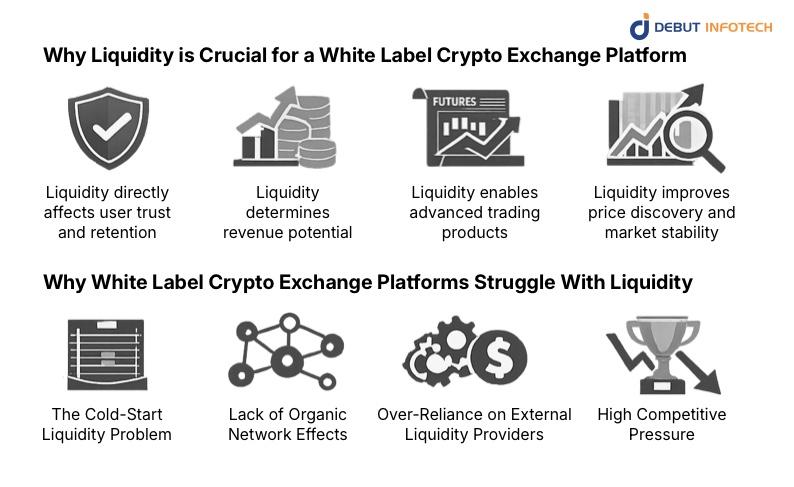
The following are some factors that underscore the significance of liquidity strategies in a white label crypto exchange:
Crypto traders really don’t care whether your trading platform was built using a white label solution or from scratch. They only care about fast trade executions, low spreads, and little or no slippage when they trade on the platform. These are all things that adequate liquidity can guarantee. However, when you can’t deliver on those promises, traders lose trust in the platform, ultimately leading to user churn.
Without sufficient liquidity, your crypto trading platform loses customers, which in turn reduces trading volume. As a result, the platform will see lower trading fees, which are typically the largest revenue driver for most crypto exchanges.
Another reason liquidity is crucial is that it provides a financial buffer for platforms to offer advanced trading products such as margin trading, futures, and options. As you might already imagine, these advanced trading products are usually the major attractive features for high-volume traders, who, in turn, boost the platform’s revenue. Therefore, an exchange with thin order books cannot support effective liquidation mechanisms, exposing itself to systemic risk. This is why liquidity risk and liquidation strategy planning must evolve together, especially when deciding which products to offer.
Finally, low-liquidity environments are more likely to experience sudden price swings and, as a result, are more susceptible to manipulation. For exchange operators, this creates reputational risk and regulatory exposure, especially when operating across multiple jurisdictions.
These four points effectively outline the key reasons liquidity is critical for crypto exchange platforms.
Now, let’s examine why white label crypto exchange platforms struggle with it
The reasons include the following:
Liquidity is inherently network-driven. Traders go where liquidity already exists, but liquidity only forms where traders are active. New white label platforms launch with empty order books, creating a self-reinforcing adoption barrier that cannot be solved by software alone.
Established exchanges benefit from years of accumulated traders, bots, and institutional participants. White label platforms, by contrast, must artificially stimulate activity through liquidity management strategy decisions such as market making or external aggregation.
Many platforms aim to improve liquidity by integrating third-party liquidity feeds through crypto exchange partnerships. While effective in the short term, this approach introduces dependency risk, cost escalation, and limited control over spreads—factors that directly affect long-term margins and crypto exchange cost planning.
White label exchanges are not just competing with other startups; they are competing with tier-1 centralized platforms and increasingly with decentralized crypto exchange alternatives that offer transparent, on-chain liquidity models.
Many founders treat liquidity strategies as a post-launch optimization problem rather than a launch prerequisite. By the time liquidity issues surface, user trust has already eroded—making recovery significantly harder.
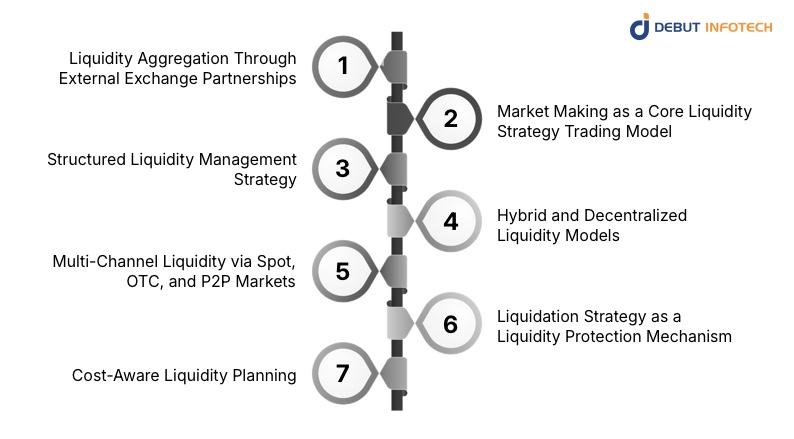
The best white-label crypto exchange platforms typically use proven, layered strategies to build the liquidity they need. In fact, our decentralized crypto exchange development services team at Debut Infotech Pvt Ltd regularly applies core liquidity strategies proven in real-world crypto exchanges to optimize liquidity.
Below, we will share these strategies with you. Some of them include:
Liquidity aggregation is the process of gathering buy and sell orders from different sources and connecting them to its order books via certain APIs. The point is that the white-label crypto exchange seeks to maintain deep liquidity by relying not only on active buy and sell orders on its platform but also on those from established exchanges via APIs.
This way, the platform mirrors and matches all trades placed on the platform against any external liquidity pools.
So, why does this strategy work?
Many regional exchanges and broker-style crypto trading platforms operate almost entirely on aggregated liquidity from tier-1 exchanges such as Binance or Kraken during their initial growth phase. Even Coinbase relied heavily on external liquidity sources in its early years, before its internal order books were deep enough.
Liquidity aggregation improves execution quality but reduces control. Pricing, spreads, and partners partially dictate availability. This is why aggregation is best viewed as a foundational liquidity strategy, not a permanent solution.
White-label crypto exchange platforms can also quote both buy (bid) and sell (ask) prices around the current market price for each crypto asset. They usually do this to ensure that traders always have a counterparty for every trade, ultimately improving order book depth and narrowing spreads.
While the rationale behind this approach is clearly to ensure that there are always counterparties, different white label crypto exchange platforms can do this in different ways, namely:
For example, major centralized exchange platforms such as Binance, OkX, and ByBit typically use professional market makers to provide liquidity by consistently quoting bid and ask prices. Additionally, smaller exchanges often subsidize market makers with reduced fees or incentives to bootstrap liquidity.
But this strategy isn’t just about faking volume. As a matter of fact, when it is implemented correctly, professional market makers:
However, market making must be aligned with a broader liquidity management strategy to avoid artificial or unstable liquidity.
Liquidity cannot be “set and forget.” Successful exchanges treat liquidity as a managed resource. With a structured liquidity management strategy, crypto exchanges implement short- and long-term plans to meet short-term financial obligations while ensuring they can support long-term growth and financial stability.
A well-defined liquidity management strategy involves:
The chase liquidity management strategy is demand-driven. Liquidity is aggressively sourced or increased in response to rising trading activity, rather than being statically allocated.
High-frequency exchanges and derivatives platforms dynamically scale liquidity during major market events (e.g., Bitcoin ETF announcements). Exchanges that fail to chase liquidity during surges experience massive slippage and forced liquidations.
For white label platforms, this strategy is especially important when operating with limited capital.
Relying solely on spot trading liquidity is a mistake many early exchanges make.
Let’s unpack that for a moment:
On the one hand, OTC crypto exchange development enables large traders to execute block trades without affecting the public order book. This:
Exchanges like Binance and Coinbase run OTC desks specifically to protect spot market liquidity during large trades.
On the other hand, P2P crypto exchange development supports fiat on- and off-ramps and regional liquidity where banking infrastructure is limited.
Wondering why this matters?
P2P markets reduce dependency on centralized liquidity while expanding user acquisition in emerging markets.
Together, OTC and P2P channels absorb pressure that would otherwise thin spot order books.
Some exchanges supplement centralized liquidity with decentralized mechanisms.
Hybrid platforms like Binance Smart Chain integrations and other CEX–DEX bridges allow exchanges to tap into on-chain liquidity during periods of centralized order book stress.
This strategy is particularly useful during:
It also aligns well with long-term roadmaps for decentralized crypto exchanges.
Liquidity strategy trading becomes meaningless if liquidation mechanics are poorly designed. A liquidation strategy ensures that leveraged positions can be closed without overwhelming the order book.
After the March 2020 market crash, several derivatives exchanges redesigned their liquidation strategy in strategic management to prevent cascading failures. Platforms with insufficient liquidity buffers suffered reputational damage and user losses.
For white label exchanges offering margin or futures, liquidation design is inseparable from liquidity risk strategy.
Every liquidity decision impacts crypto exchange cost.
Liquidity aggregation fees, market maker incentives, and infrastructure scaling all compound over time. Successful platforms:
This staged approach keeps costs predictable while improving execution quality.
Here’s one thing to remember when launching a white label crypto exchange: you need to expertly design the liquidity strategies from the outset to ensure that the platform can attract traders, retain activity, and scale sustainably.
So far in this article, we have outlined the effective strategies that successful exchanges rely on, including liquidity aggregation through crypto exchange partnerships, professional market making, structured liquidity management (including the chase liquidity management strategy), and diversification across spot, OTC, and P2P markets.
While these strategies have proven effective, many founders launching crypto exchange platforms still need guidance from a trusted trusted cryptocurrency exchange development company. That’s why a partner like Debut Infotech Pvt Ltd offers hands-on experience in white label exchange deployment, liquidity-ready architecture, and multi-market exchange models. Reach out to our experts today to get started.
A. A white-label cryptocurrency exchange is a prebuilt, customizable trading platform that enables companies to quickly launch a cryptocurrency exchange without starting from scratch. Although it reduces development time and costs, liquidity must be obtained and managed separately.
A. Liquidity aggregation through exchange partnerships, professional market making, diversified markets (spot, OTC, and P2P), and ongoing liquidity management are among the measures needed to increase liquidity. Layered tactics, not one-time fixes, are the key to achieving sustainable liquidity.
A. Accurate price discovery, minimal slippage, and quick transaction execution are all guaranteed by liquidity. A highly liquid cryptocurrency trading platform immediately affects revenue and long-term platform growth by enhancing user trust, boosting trading activity, and enabling sophisticated products like margin trading.
A. There isn’t just one ideal tactic. To adapt to changing market conditions and user growth while maintaining consistent execution quality, successful exchanges use a variety of liquidity solutions, including market making, liquidity aggregation, and demand-driven liquidity management.
A. Abrupt, massive order dumps that could deplete order books are avoided with a well-thought-out liquidation approach. Partial and gradual liquidations reduce cascading failures, preserve market stability, and ensure liquidity is available during periods of high trading volatility.

Our Latest Insights
USA
2501 Chatham, Rd Suite R Springfield, IL 62704
+1-708-515-4004
info@debutinfotech.com
UK
7 Pound Close, Yarnton, Oxfordshire, OX51QG
+44-770-304-0079
info@debutinfotech.com
Canada
154 Eden Oak Trail, Kitchener, ON N2A 0H9
+1-708-515-4004
info@debutinfotech.com
INDIA
Sector 101-A, Plot No: I-42, IT City Rd, JLPL Industrial Area, Mohali, PB 140306
9888402396
info@debutinfotech.com