ON THIS PAGE
Progress0%






Our Global Presence :





Organizations generate massive streams of time-dependent data from transactions, sensors, websites, and financial systems. Making sense of this information requires methods that can detect patterns and anticipate future outcomes. ML Time Series Forecasting combines traditional time-based analysis with machine learning models to identify trends, seasonality, and complex relationships across historical datasets. These forecasts guide operational planning in industries such as retail, finance, manufacturing, and digital platforms.
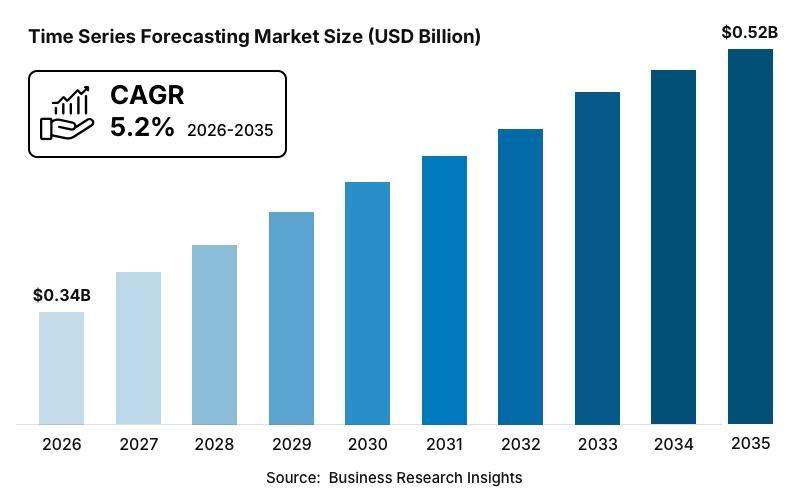
Adoption is accelerating as businesses move toward data-driven decision-making. Studies by Business Research Insights show that over 62% of enterprises now rely on predictive analytics to support real-time decisions across operations and strategy. Furthermore, about 72% of advanced analytics tools integrate AI-based algorithms for time series forecasting, highlighting the growing role of machine learning in predictive modeling.
This article explains the core concepts, models, tools, processes, and industry applications behind ML-driven forecasting systems.
Time series forecasting predicts future values using historical data arranged in chronological order. Each data point reflects observations recorded at specific time intervals such as hours, days, months, or years.
Analysts examine past behavior to identify patterns like trends, seasonal cycles, and recurring fluctuations. These patterns guide estimates of future outcomes.
Organizations rely on time series forecasting to support planning activities, including inventory management, sales projection, energy consumption planning, and operational capacity decisions.
Machine learning time series forecasting applies machine learning algorithms to analyze historical sequences and generate future predictions. These models examine patterns over time while incorporating additional variables, such as pricing changes, weather conditions, and economic signals.
Unlike traditional statistical approaches, machine learning models capture nonlinear relationships and complex dependencies within the data. This capability enables more adaptive forecasting systems that improve as new information becomes available, making them useful for large-scale business operations.
A trend represents the long-term direction of a dataset. Values may steadily rise, decline, or remain stable over extended periods. Population growth, product adoption, and revenue expansion often display clear trends. Detecting the trend helps analysts separate long-term movement from short-term fluctuations.
Seasonality refers to patterns that repeat at fixed intervals. These cycles occur daily, weekly, monthly, or yearly. Retail sales typically rise during holiday periods. Energy consumption increases during extreme weather seasons. Forecasting models must account for seasonal patterns to avoid misleading predictions.
Irregular components describe random fluctuations that trends or seasonal patterns cannot explain. These variations may occur due to unexpected events, measurement errors, or temporary disruptions. Forecasting models attempt to minimize the influence of noise while focusing on meaningful patterns.
Cyclic patterns resemble seasonal movements but occur over longer and less predictable periods. Economic expansion and contraction cycles provide a clear example. Cyclic behavior does not follow fixed intervals, which makes it harder to model. Analysts often examine broader economic indicators to understand these movements.
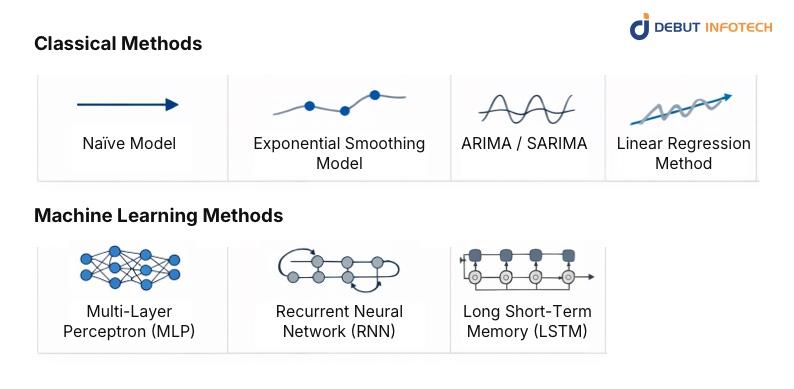
Classical time series models rely on statistical techniques that assume the data follow a structured pattern. These methods remain widely used because they are interpretable, efficient, and suitable for smaller datasets.
a) Naïve Model
The naïve model assumes the next value will be the same as the most recent observation. Despite its simplicity, this model often serves as a baseline for comparison. If advanced models cannot outperform a naïve forecast, the forecasting approach needs to be reconsidered.
b) Exponential Smoothing Model
Exponential smoothing assigns a higher weight to recent observations and gradually reduces the importance of older values. This method adapts quickly to changing patterns. Variants such as Holt’s method and Holt-Winters smoothing extend the model to account for trends and seasonal effects.
c) ARIMA / SARIMA
ARIMA stands for AutoRegressive Integrated Moving Average. It models relationships between current values and previous observations while addressing non-stationary data. SARIMA extends ARIMA by adding seasonal components, making it suitable for datasets that exhibit recurring seasonal behavior.
d) Linear Regression Method
Linear regression can also model time-based relationships by treating time as an independent variable. Additional variables such as marketing spend or weather conditions may also be included. While straightforward, regression works best when relationships between variables remain relatively stable.
Machine learning models analyze complex time-based patterns without strict statistical assumptions. These time series forecasting ML models often outperform traditional methods when dealing with large datasets, nonlinear patterns, and multiple influencing variables.
a) Multi-Layer Perceptron (MLP)
A Multi-Layer Perceptron is a type of neural network made up of several layers of interconnected neurons. The model learns patterns through repeated training iterations. In forecasting, past observations are used as input features to estimate future values.
Pros
Example
Retail sales forecasting where historical sales, marketing spend, and holiday indicators are used to predict next month’s product demand.
b) Recurrent Neural Network (RNN)
Recurrent Neural Networks process sequential data by retaining information from earlier time steps. This structure allows the network to capture temporal dependencies that traditional models may miss. RNNs are particularly useful for forecasting data where historical context matters.
Pros
Example
Electricity consumption forecasting where daily usage patterns depend heavily on previous hours or days.
c) Long Short-Term Memory (LSTM)
Long Short-Term Memory networks improve on standard RNNs by addressing the problem of long-term dependency loss. LSTM models use memory cells that retain important signals across longer time intervals. This design makes them suitable for forecasting problems involving extended time horizons.
Pros
Example
Financial market forecasting in which historical price movements over long time periods influence future trends.
Related Read: Top Foundations and Trends in Machine Learning
Forecasting models must be evaluated carefully before deployment. Accuracy determines whether predictions can support real operational decisions. Analysts commonly divide data into training and testing sets. The model learns patterns from historical data and then predicts values in the unseen test dataset.
Performance metrics help quantify forecast quality. Common measures include Mean Absolute Error (MAE), Root Mean Squared Error (RMSE), and Mean Absolute Percentage Error (MAPE). Lower error values indicate stronger predictive performance. Comparing metrics across models helps determine which method performs best.
Classical statistical models and machine learning forecasting methods each serve different forecasting needs. Classical approaches remain useful when datasets are smaller and interpretability matters. Machine learning approaches perform better when the data is large, complex, and influenced by multiple variables.
| Approach | Pros | Cons |
| Classical Time Series Methods | Easy to interpret and explain results; Require less computational power; Perform well with smaller datasets; Established statistical theory supports model design; Faster to train and deploy. | Limited ability to model nonlinear relationships; Struggle with large or complex datasets; Often rely on strict statistical assumptions. |
| Machine Learning Forecasting Methods | Capture nonlinear relationships effectively; Handle large datasets and multiple variables; Adapt to complex real-world patterns; Improve as more data becomes available; Often deliver higher predictive accuracy. | Require large datasets for training; Higher computational cost; Models can be harder to interpret; Model tuning and maintenance require specialized expertise. |
Classical models offer transparency and simplicity. Analysts can easily interpret parameters and understand how predictions are produced. These models also require less data and computational resources. Many organizations start with classical methods when building early forecasting pipelines.
Machine learning forecasting offers greater flexibility. These models handle nonlinear relationships, large datasets, and multiple external variables more effectively. For businesses that manage complex operational systems, ML-driven forecasting can reveal patterns that traditional statistical models may overlook.
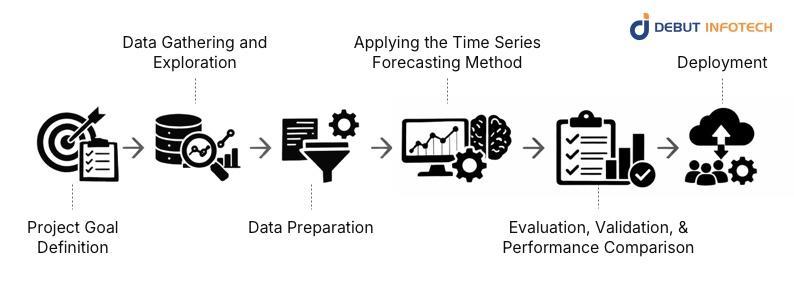
A forecasting project begins with a clearly defined objective. Teams identify the business problem the forecast should address, the time horizon of predictions, and the level of accuracy required. This stage also determines which variables may influence the outcome.
A clear goal guides data selection, modeling choices, and evaluation methods. It also ensures that the forecasting effort produces practical insights rather than isolated statistical outputs.
Once the objective is defined, analysts collect historical data relevant to the forecasting task. This may include internal operational records, external market indicators, or sensor data.
During exploration, analysts examine trends, seasonal behavior, missing values, and unusual spikes. Early exploration of the dataset reveals potential issues and helps determine whether classical statistical models or machine learning techniques are more suitable.
Raw time series data often requires careful preparation before modeling. Analysts clean the dataset by handling missing entries, correcting inconsistent timestamps, and removing duplicate observations.
Data transformation may also be necessary to stabilize variance or normalize values. Preparing the dataset properly improves model reliability and reduces the risk of inaccurate forecasts caused by poorly structured inputs.
The selected forecasting method is applied once the data is prepared. Analysts train statistical models or machine learning algorithms using historical observations.
Parameter tuning often occurs during this stage to improve predictive performance. Multiple models may be tested using the same dataset. This comparison allows analysts to determine which method captures the underlying time patterns most effectively.
After training, models are evaluated using validation datasets that were not part of the training process. This stage helps determine how well predictions perform in real-world scenarios. Accuracy metrics, such as Mean Absolute Error and Root Mean Squared Error, are examined.
Consistent performance across testing periods indicates the model can produce dependable forecasts for operational planning.
Deployment moves the forecasting model from experimentation into a live operational environment. The ML for time series forecasting model may be integrated into analytics dashboards, enterprise systems, or automated decision tools.
Predictions are generated at scheduled intervals using newly collected data. Continuous monitoring is required to detect performance changes, allowing teams to retrain or update the model when patterns shift over time.
Retail organizations rely heavily on forecasting systems to anticipate demand fluctuations. Machine learning models study historical sales, customer behavior, promotions, and seasonal patterns. These predictions guide pricing strategies, inventory levels, and logistics planning.
a) Demand Prediction
Retailers forecast product demand to maintain optimal inventory levels. Accurate predictions prevent stock shortages and reduce storage costs.
b) Dynamic Pricing
Time series forecasting ML models adjust prices based on demand signals, competitor pricing, and market behavior.
c) Improved Customer Experience
Better demand forecasting ensures products remain available when customers expect them.
Financial markets generate large volumes of time-dependent data. The best ML algorithm frameworks for time-series forecasting in financial services help analysts detect patterns in price movement, trading volumes, and market volatility.
a) Comprehensive Analysis
Financial institutions analyze historical market behavior to identify patterns that influence future price movement.
b) Portfolio Management
Forecasting tools help investors evaluate potential risk and adjust portfolio allocation strategies.
Manufacturing operations generate continuous operational data. Forecasting systems analyze machine performance, production cycles, and supply chain signals to improve planning and efficiency.
a) Predictive Maintenance
Sensor data helps identify early signs of equipment failure.
b) Raw Materials Demand Forecasting
Production forecasts guide procurement decisions for essential materials.
c) Operations Optimization
Forecasting insights support improved scheduling, resource allocation, and production efficiency.
Technology platforms also rely on time-based forecasting. Traffic levels, user behavior, and system activity often follow predictable patterns that can be modeled using machine learning.
a) Web Traffic Prediction
Forecasts help anticipate spikes in user activity.
b) Downtime Prevention
Monitoring trends in system performance helps identify early signs of system stress.
c) Hosting Cost Optimization
Forecasting traffic helps companies allocate cloud infrastructure more efficiently.
Energy providers rely on ML models for time series forecasting to anticipate electricity demand, manage grid stability, and plan generation capacity. Machine learning systems analyze historical consumption patterns, weather conditions, and seasonal usage changes to ensure a reliable power supply and efficient resource allocation.
a) Energy Demand Forecasting
Utilities use predictive analytics to forecast electricity consumption patterns to balance supply and demand across power grids.
b) Renewable Energy Output Prediction
Forecasting models estimate power generation from solar and wind sources based on weather patterns.
c) Grid Stability Management
Forecasting tools help operators maintain stable energy distribution during peak demand periods.
Successful forecasting begins with a deep understanding of how the data behaves over time. Analysts study trends, seasonal effects, sudden disruptions, and recurring cycles. This examination helps determine whether the dataset is stable or changing over time.
Understanding the nature of the data also guides the choice between classical statistical models and machine learning forecasting techniques.
Evaluation metrics must align with the forecasting objective. Some problems prioritize minimizing absolute prediction errors, while others focus on percentage-based accuracy. Metrics such as Mean Absolute Error, Root Mean Squared Error, and Mean Absolute Percentage Error help quantify prediction performance.
Selecting suitable metrics ensures that model comparisons reflect meaningful improvements rather than misleading numerical differences.
Many ML time series forecasting models assume that statistical properties of the dataset remain consistent over time. Stationarity means that the mean, variance, and correlation structure do not shift dramatically.
Analysts often apply Machine Learning techniques such as differencing or transformation to stabilize the series. Achieving stationarity helps models detect patterns more clearly and reduces the influence of unpredictable fluctuations.
Beginning with simple models provides an essential baseline for evaluating more complex techniques. Naïve forecasting, moving averages, or basic regression models can reveal whether the dataset contains predictable patterns.
If advanced machine learning models fail to outperform these basic approaches, the forecasting strategy may require reconsideration, improved data preparation, or additional explanatory variables.
Autocorrelation analysis examines how past observations influence future values. Statistical tools such as autocorrelation and partial autocorrelation plots reveal whether time-lag relationships exist within the dataset.
Identifying these relationships helps analysts select appropriate model structures, particularly when working with autoregressive methods or neural networks designed for sequential data.
Effective forecasting requires constant evaluation of assumptions and results. Analysts should question whether the data reflects real operational behavior, whether external factors influence predictions, and whether model outputs align with domain knowledge.
Asking critical questions throughout the ML net time series forecasting modeling process strengthens forecast reliability. It ensures the predictions support practical decision-making rather than purely technical analysis.
Large organizations depend on machine learning forecasting to manage complex operations, anticipate demand shifts, and support strategic planning. These systems analyze large volumes of historical and real-time data to improve operational decisions.

Amazon applies machine learning forecasting across its global logistics and retail systems. Algorithms analyze purchase history, browsing behavior, seasonal patterns, and regional demand signals. These forecasts help position inventory closer to customers, optimize delivery routes, and manage warehouse operations while reducing delays and improving supply chain responsiveness.
Walmart relies on the best ML models for time series forecasting to manage inventory across thousands of stores. Models evaluate historical sales, local shopping trends, holidays, and weather patterns. These insights guide replenishment decisions, reduce stock shortages, and improve store-level planning, ensuring products remain available during peak customer demand.
Netflix uses forecasting models to analyze viewing patterns across regions, devices, and time periods. Machine learning systems predict which content categories will attract viewers in different markets. These forecasts support content acquisition strategies, recommendation systems, and infrastructure planning to ensure stable streaming performance during peak usage periods.
Uber uses time-series forecasting to estimate rider demand and driver availability across cities. Machine learning models analyze historical trip data, traffic conditions, local events, and time-of-day patterns. These predictions help balance supply and demand, guide surge pricing strategies, and reduce waiting times for riders.
Google uses forecasting models to monitor system performance, estimate search traffic, and manage advertising demand. Time series analysis helps predict infrastructure load across data centers. These insights enable Google to allocate computing resources efficiently while maintaining the reliability of services used by millions of users worldwide.
Forecasting models depend on historical observations to detect patterns across time. When datasets are limited or incomplete, algorithms struggle to identify reliable trends or seasonal behavior. This situation is common in new businesses, emerging products, or recently deployed systems where sufficient historical records have not yet accumulated.
Solution
Teams or machine learning development companies can address limited data by combining multiple related datasets or using external sources that provide similar signals. Transfer learning and data augmentation techniques also help expand training data. Another practical step is to start with simpler statistical models that require fewer observations before transitioning to more complex machine learning approaches.
Technical models alone cannot fully explain fluctuations in time series data. Business events, regulatory changes, weather conditions, and operational decisions often influence the data. Without domain knowledge, analysts may misinterpret patterns, select inappropriate features, or overlook external variables that strongly affect forecasting accuracy.
Solution
Collaboration between data scientists and domain experts improves forecasting outcomes. Industry specialists help interpret unusual data patterns, identify relevant external variables, and validate model predictions against operational realities. Incorporating expert feedback during model development helps align forecasts with real-world conditions and improves the reliability of decision-making.
ML net time series forecast datasets often contain missing timestamps, duplicate records, inconsistent measurement intervals, or inaccurate values. These issues disrupt pattern detection and can significantly reduce forecasting accuracy. Poor data quality may result from manual data entry, sensor malfunctions, or fragmented data-collection systems across departments.
Solution
Improving data quality begins with structured data validation and preprocessing pipelines. Analysts implement methods for missing value imputation, outlier detection, and timestamp alignment. Automated monitoring systems can flag anomalies in incoming data streams, allowing teams to correct errors before they affect model training and forecasting reliability.
Concept drift occurs when the statistical properties of time series data change over time. Market behavior, consumer preferences, or operational conditions may shift unexpectedly. When this happens, models trained on historical patterns begin producing inaccurate forecasts because the relationships learned during training no longer reflect current conditions.
Solution
Continuous monitoring and model retraining help address concept drift. Forecasting systems should regularly evaluate prediction errors and detect performance degradation. Updating models with recent data ensures that new patterns are incorporated. Adaptive machine learning pipelines that retrain automatically can maintain forecasting accuracy as conditions evolve.
Modern forecasting workflows rely on scalable machine learning platforms that support data processing, model training, evaluation, and deployment. Cloud-based machine learning environments simplify experimentation and allow organizations to build forecasting pipelines that operate reliably at production scale.
Google Cloud offers forecasting capabilities through services such as Vertex AI and BigQuery ML. These tools allow teams to train models on large datasets, automate feature engineering, and deploy predictions through scalable infrastructure. Integration with data warehouses and analytics services simplifies the development of enterprise forecasting pipelines.
Azure Machine Learning provides tools for building, training, and deploying forecasting models within a unified environment. The platform supports automated machine learning workflows, experiment tracking, and scalable model deployment. Integration with other Azure services allows organizations to combine forecasting models with data engineering and business analytics systems.
Amazon Web Services offers forecasting tools, including Amazon Forecast and SageMaker. These services allow organizations to train machine learning models using historical data and generate predictions through managed infrastructure. The platform supports large-scale forecasting tasks and integrates with storage, analytics, and data processing services.
ML Time Series Forecasting provides organizations with a structured approach to anticipate future outcomes using historical data and machine learning models. From retail demand planning to financial analysis and infrastructure monitoring, these forecasting systems support better operational decisions. With the right data preparation, model selection, and evaluation practices, businesses can build forecasting pipelines that remain reliable even as data patterns evolve.
Partnering with an experienced machine learning development company strengthens this process. Debut Infotech helps organizations design and deploy ML Time Series Forecasting solutions tailored to business goals. Their team builds scalable models, integrates forecasting tools, and delivers reliable predictive systems that support smarter, data-driven decision-making across industries.
A. There’s no single best ML algorithm for time series forecasting. It depends on your data and goal. LSTM and GRU work well for sequential patterns. XGBoost and Random Forest handle structured data nicely. ARIMA still holds up for simpler cases. Many teams test a few options, then stick with the one that performs consistently.
A. Traditional methods like ARIMA rely on fixed assumptions and simpler patterns. ML Time Series Forecasting handles messy, nonlinear data better. It learns from large datasets, adapts over time, and picks up hidden relationships. That flexibility makes it more useful when patterns shift or when data isn’t clean.
A. Most people rely on error metrics like MAE, RMSE, or MAPE. These show how far predictions are from actual values. Backtesting is also key. You train on past data, predict into the future, and compare the results. If it performs well across different time windows, you’re on solid ground.
A. Costs vary a lot. A simple setup with open-source tools might stay under a few thousand dollars. More complex projects with large datasets, cloud infrastructure, and custom models can run into tens of thousands. Ongoing costs like maintenance, retraining, and storage also add up over time.
A. A basic model can be up and running in a few weeks if the data is clean and ready. Real-world projects take longer. Data prep, testing different models, and fine-tuning can stretch timelines to a few months. Deployment and monitoring add extra time as well.

Our Latest Insights


USA
2501 Chatham, Rd Suite R Springfield, IL 62704
+1-708-515-4004
info@debutinfotech.com
UK
7 Pound Close, Yarnton, Oxfordshire, OX51QG
+44-770-304-0079
info@debutinfotech.com
Canada
154 Eden Oak Trail, Kitchener, ON N2A 0H9
+1-708-515-4004
info@debutinfotech.com
INDIA
Sector 101-A, Plot No: I-42, IT City Rd, JLPL Industrial Area, Mohali, PB 140306
9888402396
info@debutinfotech.com