ON THIS PAGE
Progress0%






Our Global Presence :





Proof of Authority (PoA) is a consensus mechanism that allows participants to verify transactions on the blockchain. It uses trusted validators to check transactions and keep the network running. Proof of Authority in blockchain relies on the identities and reputations of approved participants to confirm transactions. This is different from traditional consensus models, which rely on computational power or token ownership. This method allows for faster processing, lower energy use, and more predictable governance. This makes it a good choice for permissioned and enterprise blockchain systems.
PoA doesn’t require much computational power or large token stakes. Instead, it uses trusted validators whose identities have been checked to approve transactions and make new blocks. This method makes PoA especially appealing for enterprise blockchain development services, consortium blockchains, and permissioned networks where members already trust each other.
Several blockchain platforms, including Ethereum test networks and enterprise solutions like VeChain, have successfully implemented this strategy. Their use of Proof of Authority demonstrates that identity-based validation can be both secure and efficient.
In this guide, we will look at:
Proof of Authority (PoA) is a way for people to agree on things. In this system, approved validators confirm transactions and make new blocks based on their confirmed identities, not their computational power or token holdings. In a PoA blockchain network, validators are chosen following a strict process and are in charge of keeping the network safe.
Anyone can help check transactions on a public blockchain. In a PoA network, only trusted entities can do this work. Because validators can be easily identified, their professional reputation is crucial to ensuring that everyone is honest.
Some important features of Proof of Authority include
Because validators use their own names, their reputations are at stake. If a validator does anything bad, their name and reputation are at risk, which deters them from doing so.
This architecture makes PoA highly desirable for business blockchain applications that require both transparency and accountability.
To understand why PoA is useful, it helps to examine the problems with older methods of reaching consensus.
Proof of Work is used by Bitcoin and other networks. This implies that miners must solve complex mathematical problems to verify transactions and create new blocks.
This method is quite safe; however, it has a lot of problems:
Because of these concerns, PoW is not the best choice for commercial blockchain platforms that prioritize speed and scalability.
Proof of Stake makes energy use more efficient by letting validators stake cryptocurrency tokens instead of solving math problems. But this model can still have problems, such as:
Enterprises exploring blockchain integration often prefer a mechanism that identifies and holds validators accountable. Because of this need, Proof of Authority was made.
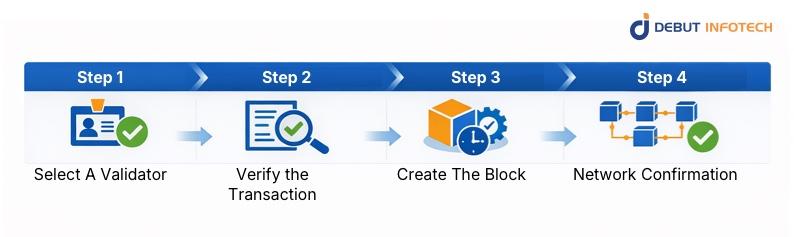
To understand what is Proof of Authority in blockchain, it helps to break down the validation process.
A PoA blockchain only lets a small number of validators do the following:
Before they can join the network, these validators must go through a thorough verification process.
Before they can join a PoA blockchain, validators must undergo an approval process. These validators are usually well-known people or groups whose identities have been verified.
Validator criteria could include:
Validators are well-known; therefore, they have a strong reason to act ethically within the network.
When a user sends a transaction to the network, validator nodes verify that it follows the rules of the blockchain.
The validation process usually includes:
This process goes significantly faster because there are fewer validators than on public networks.
A validator is responsible for making a new block after transactions have been checked. Validators take turns making blocks according to a set rotation schedule or network algorithm.
The validator pool is limited, and blocks are created quickly. This process leads to:
Other validators verify the block’s accuracy after it is created, then add it to the blockchain ledger for good.
Once it has been checked:
This streamlined method helps PoA networks keep their high throughput and good performance, which is especially helpful for enterprise blockchain applications.
Proof of Authority differs from many classic consensus models in that it focuses on trust and identity.
The main principle behind PoA is that validators are known people or entities. Their real-world identities serve as collateral to prevent inappropriate conduct.
This method provides:
This paradigm makes PoA especially effective for industries like banking, healthcare, and supply chain management that need to follow the rules and be accountable.
There are fewer validators on PoA blockchain networks than on public blockchains. This feature enables faster block creation and faster transaction processing.
Faster transaction speeds are important for firms that work with blockchain to be able to run their operations more efficiently.
Proof of Authority (PoA) networks don’t need as much computational capacity to stay safe as Proof of Work (PoW) networks do. Validators check transactions using rules that everyone agrees on.
PoA networks use a lot less energy because of this, which is healthier for the environment.
PoA networks can have explicit rules and decision-making processes because validators are pre-approved. This framework enables businesses to stay in control while also leveraging the openness of blockchain.
Proof of Authority has several characteristics that make it a good choice for commercial blockchain deployments.
Companies that provide technology, such as Debut Infotech, often help businesses develop PoA-based networks tailored to their specific needs.
Despite its advantages, PoA also has certain limitations.
But in commercial blockchain systems where members already trust each other, this trade-off is generally acceptable
When it comes to establishing robust validator governance structures, organizations often turn to blockchain consultants.
PoA is better for businesses where controlled participation and accountability are more important than anonymity.
To better understand what is Proof of Authority in blockchain, it helps to compare it with other widely used consensus models.
| Feature | Proof of Authority | Proof of Work | Proof of Stake |
| Validation basis | Identity and reputation | Computational power | Token ownership |
| Energy consumption | Very low | Extremely high | Low |
| Transaction speed | Fast | Slow | Moderate |
| Decentralization | Moderate | High | Moderate |
| Best use case | Enterprise blockchains | Public cryptocurrencies | DeFi networks |
Proof of Work focuses on security and decentralization through computation, while Proof of Authority focuses on trust and efficiency.
When a firm wants to adopt blockchain, the best consensus method depends on the use case, how the company is run, and how well it needs to work.
Proof of Authority is used by a number of blockchain platforms to provide effective, scalable solutions.
VeChain is a well-known blockchain network that uses a Proof of Authority consensus process.
The platform is all about making supply chains more open and getting enterprises to use it. It lets firms track commodities, verify their authenticity, and manage logistics data on a secure blockchain network.
VeChain’s PoA methodology keeps the network running smoothly and processes transactions quickly, making it a good choice for business use.
Some Ethereum test networks also use Proof of Authority consensus mechanisms to provide developers with quick testing environments.
PoA lets developers try out smart contracts and decentralized apps without the expenses or delays that come with Proof of Work or Proof of Stake networks.
The Energy Web Foundation runs a blockchain network that helps with things like keeping track of renewable energy and regulating the grid.
The platform uses a PoA-based consensus process to ensure that transactions are safe and fast while maintaining trust among all parties involved in the business.

PoA blockchain networks are extensively employed in enterprise settings that involve the collaboration of trusted participants.
In the realm of enterprise and consortium blockchain networks, Proof of Authority has become increasingly prevalent. It is great for many corporate uses because it is efficient and has controlled governance.
Many people are involved in supply chains, including manufacturers, distributors, and retailers.
PoA blockchain networks enable:
PoA ensures that everyone trusts each other and keeps things running smoothly by allowing only known participants.
PoA networks can help governments and businesses run digital identity systems.
Organizations can safely store and validate credentials without relying on centralized databases if trusted validators verify identity records.
Banks and other financial institutions can use PoA blockchains to handle:
PoA is well-suited to regulated financial environments, as it offers faster transaction speeds and predictable governance.
Companies can also use PoA blockchains to keep private records secure while still being open to everyone.
Businesses that want to utilize these technologies will typically partner with a blockchain development company to develop a secure blockchain system and ensure it works well with their current systems of operation.
For you to develop a PoA blockchain network, you will need to plan well and have some technical knowledge.
Enterprises adopting blockchain solutions require more than just decentralization. They need:
Proof of Authority addresses these needs by offering a consensus mechanism tailored to enterprise-grade blockchain ecosystems.
It allows companies to create secure and scalable networks without the inefficiencies of traditional mining-based systems.
For organizations exploring blockchain ecosystem protocols, PoA provides a strong foundation for building consortium-based blockchain solutions.
As blockchain technology continues to mature, Proof of Authority is likely to play a growing role in enterprise blockchain adoption.
Industries such as:
are increasingly exploring PoA networks to manage complex digital infrastructures.
With advancements in governance models and validator frameworks, PoA could become a standard consensus mechanism for permissioned blockchain networks.
As businesses continue to invest in blockchain business development, the demand for scalable and efficient consensus mechanisms like Proof of Authority will continue to grow.
Proof of Authority has emerged as an efficient consensus mechanism designed for enterprise blockchain networks that require speed, trust, and predictable governance. By relying on verified validators rather than computational power or token ownership, PoA enables faster transactions, reduced energy consumption, and improved operational efficiency.
As organizations continue exploring blockchain adoption, PoA offers a practical framework for building scalable and secure networks. With guidance from experienced technology providers like Debut Infotech, businesses can successfully implement Proof of Authority solutions that support innovation, transparency, and long-term digital transformation.
A. Proof of Authority (PoA) is a blockchain consensus mechanism where transactions are validated by approved and trusted validators whose identities are verified. Instead of relying on computational power like mining or cryptocurrency staking, PoA depends on the credibility and reputation of validators to maintain network integrity.
A. In a POA blockchain network, selected validators verify transactions and create new blocks. These validators are pre-approved and take turns producing blocks according to a predefined schedule. Because the number of validators is limited, transactions can be processed quickly and efficiently.
A. Proof of Authority offers several benefits, including:
Faster transaction processing
Lower energy consumption compared to mining-based networks
Reduced operational costs
Strong accountability through validator identity verification
These advantages make PoA particularly suitable for enterprise blockchain applications.
A. Proof of Authority is less decentralized than public blockchain networks because only a limited number of approved validators participate in the consensus process. However, this structure improves efficiency and governance, which is why PoA is widely used in private and consortium blockchain environments.
A. Some well-known platforms using PoA include VeChain and certain development environments associated with Ethereum. These networks use PoA to achieve faster transactions and maintain trusted validator participation.
A. PoA is commonly used in industries where participants are known and trusted, such as:
Supply chain management
Financial services
Healthcare data management
Government identity systems
Energy sector infrastructure
These sectors benefit from PoA’s efficiency and structured governance.
A. Businesses can implement PoA networks by defining validator governance, selecting suitable blockchain platforms, developing smart contracts, and integrating the blockchain with existing systems. Many organizations partner with experienced providers like Debut Infotech to design and deploy scalable Proof of Authority blockchain solutions.

Our Latest Insights
USA
2501 Chatham, Rd Suite R Springfield, IL 62704
+1-708-515-4004
info@debutinfotech.com
UK
7 Pound Close, Yarnton, Oxfordshire, OX51QG
+44-770-304-0079
info@debutinfotech.com
Canada
154 Eden Oak Trail, Kitchener, ON N2A 0H9
+1-708-515-4004
info@debutinfotech.com
INDIA
Sector 101-A, Plot No: I-42, IT City Rd, JLPL Industrial Area, Mohali, PB 140306
9888402396
info@debutinfotech.com