ON THIS PAGE
Progress0%






Our Global Presence :





Smart Contract audit cost has become a major consideration for businesses building on blockchain technology in 2026. As smart contracts continue to power decentralized finance platforms, tokenized assets, and enterprise blockchain solutions, security has moved from a technical concern to a core business requirement. A single vulnerability can lead to financial loss, reputational damage, and legal exposure. That reality has made smart contract audits an unavoidable line item in project budgets.
As blockchain adoption matures, businesses are no longer satisfied with vague pricing ranges or generic security assurances. Decision-makers want to understand how much a smart contract audit costs, what drives those costs, and how to budget accurately without overspending. This guide breaks down audit pricing in practical terms, explaining cost ranges, influencing factors, and what businesses should realistically expect when planning smart contract audit services in 2026.
Smart contracts have evolved far beyond simple token transfers. In 2026, they now handle staking logic, liquidity pools, governance rules, cross-chain interactions, and even the tokenization of real-world assets. As this complexity increases, so does the potential attack surface. Each added function introduces new edge cases and exploit paths, making professional audits a foundational requirement rather than an optional safeguard.
At the same time, regulatory bodies and institutional investors have raised their expectations. Formal security audits are now a prerequisite for exchange listings, strategic partnerships, and enterprise adoption. Projects without verified audit reports often struggle to gain traction, regardless of how innovative their use case may be.
The financial risks of skipping an audit are equally significant. Unverified smart contracts can be exploited within minutes, resulting in irreversible financial losses and long-term reputational damage. In most scenarios, the smart contract security audit cost is negligible when compared to the financial and operational fallout caused by a single vulnerability.
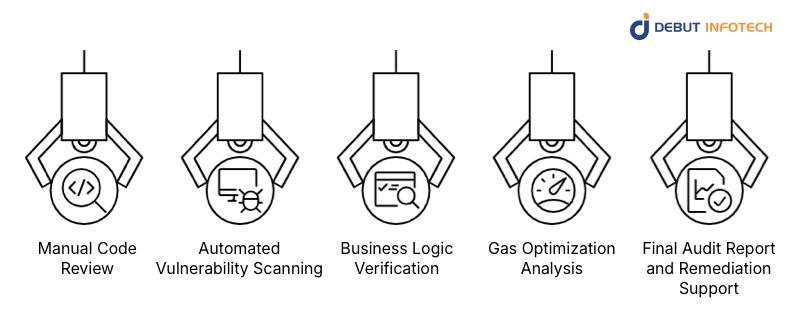
Understanding smart contract audit cost in 2026 requires stepping back from individual quotes and looking at the broader pricing landscape. Audit costs are not standardized because no two projects carry the same level of complexity or risk. However, businesses can still plan effectively by understanding common pricing patterns.
The smart contract audit cost average in 2026 typically falls between $10,000 and $50,000. This range reflects the growing sophistication of smart contracts and the increased expectations placed on auditors. Smaller, single-purpose contracts sit at the lower end, while large protocols with multiple interconnected components fall toward the upper end.
The smart contract audit cost range is wide because audits scale with the level of responsibility. A contract that controls millions of dollars in user funds or automates financial decisions requires deeper scrutiny than one that performs a limited utility function. In practice, the more damage a vulnerability could cause, the more intensive—and expensive—the audit becomes.
For businesses evaluating how much does a smart contract audit cost, the key is understanding that pricing is driven by effort, not branding. The cost reflects the number of audit hours, the seniority of auditors involved, and the level of assurance required.
| Audit Scope | Typical Cost Range | Best Suited For |
| Simple contracts | $5,000 – $12,000 | Basic tokens, limited permissions |
| Mid-complexity contracts | $15,000 – $40,000 | NFT platforms, marketplaces |
| High-risk protocols | $25,000 – $80,000+ | DeFi, staking, liquidity systems |
Several core factors influence the final cost of a smart contract audit. Understanding these variables helps businesses avoid surprises and allocate their budgets more accurately.
Larger codebases naturally require more time for review. However, complexity matters more than raw size. Contracts with intricate logic, multiple dependencies, or upgradeable components demand deeper analysis. Interactions between contracts increase the risk of hidden vulnerabilities, which extends audit timelines.
Ethereum remains the baseline for pricing. However, Avalanche smart contract audit cost can be slightly higher due to subnet behavior and performance-specific assumptions that require additional verification.
| Network | Relative Cost | Reason |
| Ethereum | Baseline | Mature tooling and standards |
| Avalanche | Slightly higher | Subnets and performance tuning |
| Other EVM chains | Comparable | Depends on ecosystem maturity |
Contracts that manage user funds are treated differently from informational or utility contracts. DeFi platforms, staking systems, and liquidity protocols require extensive scenario testing because exploits can be automated and scaled rapidly.
This is why defi smart contract audit cost is generally higher than audits for non-financial applications. Auditors must simulate attack vectors, stress-test logic, and evaluate both technical security and economic incentives.
A single-pass audit costs less than a multi-round review with fix verification. Projects that require post-remediation reviews or expanded testing naturally incur higher costs but also achieve higher confidence levels.
Audit pricing becomes clearer when viewed through specific use cases rather than abstract ranges.
| Project Type | Typical Audit Cost | Why Costs Differ |
| Basic Token Contract | $5,000 – $12,000 | Simple logic, limited permissions |
| NFT / Marketplace | $15,000 – $40,000 | Multiple transaction paths and access rules |
| DeFi Protocol | $25,000 – $80,000+ | Financial exposure, exploit simulations |
| Real-World Asset Tokenization | $30,000+ | Ownership, revenue, and compliance logic |
Higher prices reflect greater potential damage if something fails, not inefficiency.
Not all audit firms operate at the same pricing level, and a higher cost does not always mean a better fit.
Trail of Bits smart contract audit cost sits firmly at the premium end of the market, often exceeding $80,000. Their audits are typically chosen by projects seeking institutional-grade assurance or operating at very high risk levels.
Mid-tier audit providers offer a more balanced option for many businesses. These firms offer solid security coverage at more affordable prices, typically ranging from $15,000 to $40,000. For many funded startups and scaling platforms, this tier provides the best balance between cost and confidence.
Choosing the right provider is less about reputation and more about alignment. Businesses should match audit depth to actual exposure, rather than defaulting to the most expensive option.
The cost of a smart contract audit is often misunderstood as a compliance expense. In reality, it is a strategic investment in long-term platform stability.
A thorough audit reduces the likelihood of emergency patches, rushed fixes, and crisis-driven development. It also strengthens credibility with investors, partners, and users, many of whom now view audit reports as a minimum requirement for trust.
From a financial perspective, the smart contract security audit cost is small compared to the losses caused by exploits, stalled launches, or damaged reputation. Businesses that treat audits as part of core infrastructure—not an afterthought—tend to scale more smoothly.
Effective audit budgeting starts long before deployment. Security costs should be planned during the early development phase, not introduced as a last-minute requirement. When audits are integrated into the core build process, businesses can avoid rushed reviews, delayed launches, and inflated remediation costs.
Working with experienced blockchain consultants helps teams define the right audit scope from the outset. Clear scoping prevents unnecessary reviews while still maintaining appropriate security standards. Consultants also help align audit depth with actual business risk, ensuring funds are spent where they matter most.
Partnering with a blockchain development firm that understands audit requirements further streamlines budgeting. Teams that build with security expectations in mind produce cleaner, more review-ready code, reducing both audit time and overall cost.
Audit readiness is rarely accidental—it is the result of disciplined development practices. Collaborating with an experienced smart contract development company ensures that contracts are designed with security validation in mind from the outset.
Teams that hire smart contract developers with security experience tend to complete audits more quickly and with fewer revisions. This is especially important for projects involving DeFi smart contract development, where financial exposure necessitates security-first design decisions from the outset.
When development and security planning move together, audits become smoother, faster, and more cost-effective.
A common misunderstanding is that audits guarantee zero risk. In reality, audits significantly reduce risk but cannot eliminate it entirely, especially as contracts become increasingly integrated with external systems over time.
Another misconception is that a single audit is sufficient for all time. Any contract upgrade, feature addition, or integration introduces new risk and requires re-evaluation to maintain security standards.
Ultimately, selecting the most cost-effective audit option is often a false economy. Cost-cutting at the expense of depth and expertise frequently leads to higher losses later, either through missed vulnerabilities or repeated audits.
Selecting the right audit partner has a direct impact on both security outcomes and business value. Auditors should demonstrate experience across multiple blockchain ecosystems and use cases, especially when working with complex DeFi protocols or platform-specific deployments. Broad exposure enables auditors to identify context-specific risks that less experienced teams may miss.
Transparency in pricing and scope is equally important. Clear deliverables help businesses understand what they are paying for and avoid misalignment during the audit process. Strong communication and remediation support also matter, as audit findings only create value when teams clearly understand the issues and can effectively validate fixes.
Audit depth should align with business goals and risk exposure. High-value or financially sensitive contracts require deeper reviews, while lower-risk applications can operate with narrower scopes. Combining audits with ongoing monitoring and periodic reviews further strengthens security as contracts evolve.
When treated as strategic investments rather than one-time expenses, smart contract audits protect assets, reinforce trust, and support long-term platform growth.
Audit processes are becoming more structured, which may lead to improved pricing transparency over time. However, increasing contract complexity and enterprise adoption will continue to drive demand.
Automation will assist auditors more effectively, but human expertise will remain essential for interpreting intent, economic behavior, and edge cases. As blockchain technology becomes more embedded in mainstream business operations, audits will remain a permanent and growing requirement.
Smart contract audit cost in 2026 reflects the growing importance of security in blockchain ecosystems. From basic token audits to complex DeFi protocols and real-world asset platforms, pricing varies widely based on complexity, risk, and scope. Understanding the smart contract audit cost range, average pricing, and influencing factors enables businesses to plan realistically and avoid unexpected expenses. Rather than viewing audits as a burden, forward-thinking companies treat them as essential safeguards for long-term success.
At Debut Infotech, we help businesses navigate audit readiness by aligning secure development practices with realistic budgeting. Whether you are working with blockchain consultants, building DeFi platforms, or launching smart contracts in real estate tokenization, security planning should start early and remain a continuous priority. By investing wisely in smart contract audit services and partnering with experienced development teams, businesses can protect their assets, build trust, and scale confidently in 2026 and beyond.
A. The cost of a smart contract audit in 2026 typically ranges from $5,000 to $80,000, depending on the contract’s size, complexity, and risk profile. Simple token contracts sit at the lower end, while complex DeFi protocols and asset tokenization platforms require deeper audits and higher budgets.
A. Pricing is mainly influenced by code complexity, the number of contracts, financial exposure, blockchain network, and audit depth. DeFi platforms, cross-chain logic, and contracts handling user funds significantly increase review effort and cost.
A. DeFi smart contract audit cost is higher because these protocols manage real-time financial transactions and liquidity. Auditors must simulate attack scenarios, test edge cases, and analyze economic incentives, which requires more time and specialized expertise.
A. Yes. Even simple contracts can contain critical vulnerabilities. Many exploits have occurred in small, seemingly straightforward contracts. An audit ensures logic accuracy, access control safety, and protection against known attack vectors.
A. Most audits take between one and four weeks, depending on theirscope and complexity. Larger protocols or multi-round audits that include fix verification may take longer.
A. Yes. Any code modification introduces new risk. Even minor changes can create vulnerabilities, which is why re-audits or partial reviews are strongly recommended after updates or feature additions.
A. Yes. Writing clean, modular code, conducting internal testing, and working with experienced developers all help reduce audit time. Early collaboration with blockchain consultants also prevents unnecessary revisions and cost overruns.

Our Latest Insights
USA
2501 Chatham, Rd Suite R Springfield, IL 62704
+1-708-515-4004
info@debutinfotech.com
UK
7 Pound Close, Yarnton, Oxfordshire, OX51QG
+44-770-304-0079
info@debutinfotech.com
Canada
154 Eden Oak Trail, Kitchener, ON N2A 0H9
+1-708-515-4004
info@debutinfotech.com
INDIA
Sector 101-A, Plot No: I-42, IT City Rd, JLPL Industrial Area, Mohali, PB 140306
9888402396
info@debutinfotech.com