ON THIS PAGE
Progress0%






Our Global Presence :





Stablecoin development costs vary by project complexity: A basic proof of concept may cost $15,000–$40,000, while production-grade stablecoin platforms can require $250,000–$1 million or more.
Stablecoin architecture determines the development budget: Fiat-backed, crypto-collateralized, commodity-backed, algorithmic, and hybrid stablecoins require different smart contract functionality, reserve mechanisms, integrations, and security controls.
Development expenses are separate from issuer funding requirements: Reserve backing, regulatory capital, licensing, and operational liquidity can significantly increase the total investment beyond the software development budget.
Blockchain selection affects both implementation and operating costs: Ethereum, Polygon, Solana, Stellar, Hedera, TRON, and other networks differ in transaction fees, token standards, development requirements, and infrastructure compatibility.
Regulatory compliance directly influences stablecoin architecture: Frameworks such as the US GENIUS Act, EU MiCA, and Hong Kong Stablecoins Ordinance introduce jurisdiction-specific requirements for capital, reserves, redemption, reporting, and issuer operations.
Production-ready stablecoin development requires careful timeline planning: A technology MVP may take approximately 3–6 months, while complex production platforms can require 6–12 months or longer, excluding additional regulatory approval time.
Long-term operating costs must be included in the business case: Security monitoring, smart contract maintenance, reserve reconciliation, custody, compliance, infrastructure, and redemption support create recurring expenses after launch.
Stablecoins have come a long way from being primarily associated with cryptocurrency trading. Today, financial institutions, payment providers, fintech companies, and enterprises are exploring stablecoin-based systems for cross-border settlements, digital payments, and treasury operations.
And the numbers indicate that stablecoin activity has grown well beyond its earlier use cases.
According to Visa’s stablecoin research, adjusted global stablecoin transaction volume reached approximately $10.2 trillion over the preceding 12 months, based on its published measurement. Unlike raw on-chain transaction volume, this figure attempts to filter out activity such as automated trading and internal transfers that may distort payment-related comparisons.
Meanwhile, the regulatory environment is undergoing significant changes.
The United States enacted the GENIUS Act in July 2025, establishing a federal framework for payment stablecoin issuance. More recently, on October 21, 2026, the Office of the Comptroller of the Currency (OCC) issued its final implementing rule, scheduled to take effect on January 18, 2027.
These developments are giving businesses a clearer picture of the technical, financial, and regulatory responsibilities involved in launching stablecoins.
But here’s the question many organizations are asking.
How much does it actually cost to create a stablecoin?
Well, there’s no single figure that applies to every project.
Developing a basic token with minting and burning functionality is considerably different from launching a fiat-backed stablecoin supported by regulated reserves, redemption systems, security controls, and operational reporting.
A company might spend a relatively modest amount developing a proof of concept. However, establishing an independently regulated stablecoin issuer can require millions of dollars in capital and operational resources, in addition to software development expenses.
To help businesses understand these differences, this guide examines stablecoin development costs, including technical development, smart contract audits, reserve management, blockchain deployment, compliance, and ongoing maintenance.
We’ll also discuss how stablecoin architecture and regulatory requirements influence the final budget.
Let’s begin with the numbers.
The technology development cost for a stablecoin can range from approximately $15,000 for a limited proof of concept to $1 million or more for a sophisticated production platform.
However, these amounts represent different levels of technical scope, not the total capital required to operate a regulated stablecoin issuer.
Here’s how businesses can approach early budgeting.
| Project Type | Illustrative Technology Budget | Scope |
| Stablecoin proof of concept | 15,000–40,000 | Demonstration token, basic controls, testnet deployment |
| Custom stablecoin MVP | 100,000–250,000 | Token contracts, issuance workflows, integrations, testing |
| Production fiat-backed platform | 250,000–1 million+ | Reserve integration, redemption, custody, security, reporting |
| Crypto-collateralized protocol | 250,000–750,000+ | Collateral vaults, oracles, liquidation logic, governance |
The distinction between development expenditure and launch funding is especially important.
For instance, a fiat-backed stablecoin with $10 million in circulating tokens may require $10 million in eligible reserve assets to support its outstanding obligations, subject to the applicable regulatory framework.
That backing is not a software development fee. It is a separate financial obligation associated with issuing and redeeming the stablecoin.
Similarly, some issuers must maintain additional regulatory capital and operational resources.
In other words, a development quote alone cannot tell you whether you have enough money to launch the business.
Before evaluating different stablecoin models, it helps to understand where the technology budget goes.
A stablecoin platform typically involves several connected systems. Smart contracts manage token behavior, backend services coordinate issuance and redemption, and external integrations connect the platform with financial and operational infrastructure.
The following figures provide indicative budgeting allowances for individual workstreams.
| Development Component | Illustrative Cost Range |
| Discovery and technical architecture | 10,000–30,000 |
| Stablecoin smart contract development | 20,000–80,000 |
| Minting, burning, and redemption systems | 25,000–100,000 |
| Reserve ledger and reporting integration | 20,000–80,000 |
| Wallet, banking, and custody integration | 20,000–75,000 |
| Administration and monitoring interfaces | 15,000–60,000 |
| QA, integration testing, and deployment | 15,000–60,000 |
| External smart contract security audit | 5,000–50,000+ |
| Initial infrastructure and security setup | 10,000–40,000 |
Now, let’s examine what businesses are actually paying for.
Every stablecoin project begins with decisions that influence its cost throughout development.
Will the stablecoin be backed by fiat currency, cryptocurrency, commodities, or another asset? Which blockchain will support issuance? Who will control minting? How will holders redeem tokens?
These aren’t questions that should be answered after development begins.
During the discovery stage, engineering teams define the stablecoin’s lifecycle, map operational requirements, evaluate blockchain options, and document potential technical risks.
For regulated projects, this work must also align with the proposed issuer structure and guidance from qualified legal advisers.
Typical deliverables include:
Investing in the correct architecture early can prevent expensive changes to token controls, reserve accounting, or administrative permissions later.
Smart contracts form an important part of the stablecoin’s technical foundation.
Depending on the design, they govern token issuance, transfers, burning, authorization, and certain administrative controls.
A basic token contract may require relatively little custom logic. However, a production stablecoin may need additional functionality for minting permissions, emergency controls, role management, and integration with off-chain systems.
For example, a fiat-backed issuer generally needs a controlled mechanism for increasing token supply only after its prescribed issuance conditions have been satisfied.
The contract should not allow arbitrary minting merely because an administrator possesses a privileged key.
More complex projects may also require upgrade controls, transaction restrictions, or multi-signature authorization.
The cost of building a stablecoin smart contract therefore depends on the required functionality, security model, and selected blockchain.
Businesses should also budget for independent review rather than considering successful deployment proof that the code is secure.
Creating a token contract is only one part of issuing a stablecoin.
A production platform needs a reliable way to connect changes in token supply with financial records and customer requests.
Consider a fiat-backed stablecoin.
When an eligible customer deposits funds, the issuer must verify the transaction and complete the applicable compliance checks before authorizing token issuance.
Likewise, when a holder requests redemption, the platform needs to coordinate token cancellation, payment processing, and accounting records.
These operations require backend logic, APIs, databases, transaction monitoring, and reconciliation procedures.
The more complicated the settlement environment, the greater the integration and testing effort.
For example, supporting several banking partners or currencies introduces additional requirements compared with a single-currency issuance model.
For a fiat-backed stablecoin, reserve management is central to the operating model.
The issuer must be able to account for outstanding token supply and the corresponding reserve assets under its applicable legal obligations.
That means the development scope may include:
Some projects may also use proof-of-reserve infrastructure to communicate verified information on-chain.
For instance, Chainlink Proof of Reserve supports reserve-data integration and can be used to connect reserve verification with certain smart contract safeguards.
However, an on-chain proof-of-reserve feed does not automatically replace independent financial assurance, legally required reserve disclosures, or an issuer’s responsibility for maintaining sufficient assets.
The important consideration is how the complete system establishes, verifies, and reports backing.
A stablecoin needs secure mechanisms for interacting with wallets and financial infrastructure.
At a basic level, token holders need compatible wallets to receive and transfer assets.
However, regulated business applications may require much more.
An enterprise issuance platform might integrate with banking partners, institutional custody systems, identity verification providers, and payment services.
Custody design is particularly important because privileged wallets and signing keys may control large quantities of assets or sensitive issuer functions.
Businesses may need to implement multi-signature approvals, hardware security modules, multi-party computation, or other key-management arrangements.
Integration costs depend on provider capabilities, API complexity, commercial agreements, and security requirements.
A project using an established custody provider can have a very different engineering scope from one developing a substantial portion of its custody infrastructure internally.
Before launch, teams must confirm that token supply, redemption procedures, access permissions, and transaction records behave as expected.
Testing should cover more than successful transactions.
What happens if a banking integration fails after a minting request is submitted? What if a transaction fails?
Can the system prevent duplicate issuance?
How does it respond when a privileged key is compromised or an administrative service becomes unavailable?
These scenarios require structured integration testing and security validation.
Production systems also need monitoring interfaces, incident procedures, and sufficient operational visibility to investigate exceptions.
The effort required depends on transaction volumes, availability requirements, and the number of external services connected to the platform.
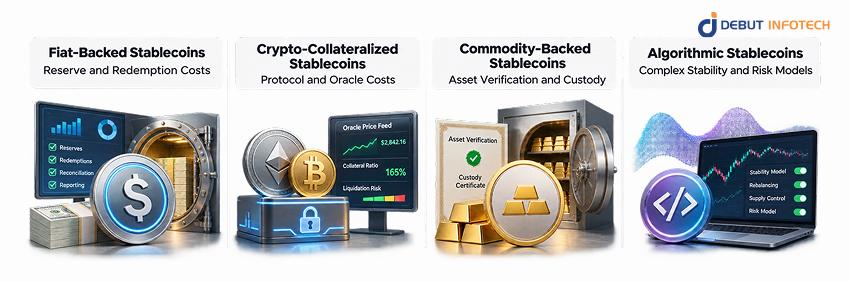
The cost of developing a stablecoin depends significantly on its backing mechanism and how it maintains its intended value.
Fiat-backed stablecoins require reserve management and banking integrations, while crypto-collateralized models depend on collateral vaults, price oracles, and liquidation mechanisms.
Commodity-backed tokens introduce physical asset custody requirements, whereas algorithmic and synthetic designs involve more complicated economic and risk-management systems.
And these differences can have a considerable impact on development pricing.
| Stablecoin Type | Indicative Development Cost (USD) | Primary Cost Drivers |
| Fiat-Backed | 80,000–250,000 | Banking integration, reserves, issuance and redemption |
| Crypto-Collateralized | 150,000–400,000 | Collateral vaults, price oracles, liquidations |
| Commodity-Backed | 120,000–300,000 | Asset custody, verification, physical redemption |
| Algorithmic | 250,000–600,000+ | Stability mechanisms, simulations, economic security |
| Hybrid | 300,000–700,000 | Multiple backing systems, governance, reconciliation |
| Synthetic / Delta-Hedged | Project-specific quotation | Derivatives, hedging, exchange and counterparty risk |
| Yield-Bearing | 200,000–500,000 | Yield accounting, asset integration, compliance |
Fiat-backed stablecoins aim to maintain a value relative to a specified currency, such as the US dollar or euro.
Their operating model generally depends on eligible reserve assets, redemption arrangements, and controls connecting token issuance with the issuer’s financial obligations.
For example, when an eligible customer deposits funds, the platform must verify the transaction before authorizing the corresponding token issuance.
Likewise, a redemption request requires coordination between token cancellation, financial accounting, and the relevant payment systems.
These operations involve considerably more than deploying a token contract.
Estimated development cost: 80,000–250,000.
For enterprise applications, the technical scope may include banking integrations, reserve reconciliation, issuance and redemption services, transaction monitoring, and reporting infrastructure.
However, the most significant financial requirements may arise outside software development.
Depending on the jurisdiction, issuers can face licensing expenses, minimum capital requirements, reserve funding obligations, and recurring independent assurance costs.
For instance, a fiat-backed stablecoin with $10 million in outstanding tokens may require $10 million in eligible backing assets under a full one-to-one reserve arrangement.
That funding is separate from the engineering budget.
Therefore, the cost of developing a fiat-backed stablecoin must be evaluated alongside the financial resources required to establish and operate the issuer.
Crypto-collateralized stablecoins use digital assets to support token issuance.
Unlike a conventional fiat-backed structure, these systems may rely on collateral vaults, price feeds, collateralization ratios, automated liquidations, and governance mechanisms.
That introduces additional smart contract logic and security responsibilities.
Estimated development cost: 150,000–400,000.
Consider a protocol requiring users to deposit cryptocurrency worth 150% of the stablecoins they intend to mint.
Under that assumption, issuing $1 million in tokens would require $1.5 million in collateral at the time of issuance.
However, collateral values fluctuate.
If the market value declines below the required threshold, the protocol must respond according to its liquidation or collateral-management rules.
Developing these mechanisms requires more than basic token functionality.
The engineering team may need to implement oracle integrations, liquidation auctions, keeper services, interest calculations, governance controls, and emergency procedures.
Economic simulations and security assessments become particularly important because failures can affect collateral positions and the stability of the protocol.
The final budget also depends on whether the business adapts established mechanisms or develops custom collateralization logic.
Commodity-backed stablecoins reference physical assets such as gold or silver.
Unlike currency-pegged stablecoins, their value generally follows the market price of the underlying commodity.
For example, Pax Gold (PAXG) represents ownership rights associated with physical gold held in professional vault facilities. Its value changes with the price of gold rather than remaining fixed at one US dollar.
This distinction matters when businesses evaluate the commercial purpose of the token.
Estimated development cost: 120,000–300,000.
A commodity-backed platform may need to integrate token issuance with custody records, asset verification, redemption procedures, and reporting systems.
Consider a company planning a gold-backed token.
The system needs to establish how much gold supports each token, where the underlying assets are stored, how their existence is verified, and what happens when holders request redemption.
Physical redemption can also introduce logistics and processing expenses.
These costs aren’t necessarily reflected in the software development quotation.
For example, Paxos publishes separate charges for certain PAXG creation, redemption, and conversion activities. Those issuer-specific fees demonstrate why physical asset operations must be assessed independently.
Businesses should therefore account for custody arrangements, asset verification, insurance where applicable, independent assurance, and redemption processes alongside the technology budget.
Algorithmic stablecoins attempt to maintain a target value through mechanisms such as supply adjustments, market incentives, or other programmatic controls.
Unlike fully reserve-backed structures, some algorithmic models rely heavily on market behavior and confidence in the stabilization mechanism.
And that’s where the technical and financial risks become more complicated.
Estimated development cost: 250,000–600,000+.
A project may require specialized smart contracts, supply-management algorithms, liquidity mechanisms, governance controls, and extensive economic testing.
For example, a protocol might increase or decrease token supply in response to changes in market price.
But a supply adjustment doesn’t automatically restore demand.
If market participants lose confidence in the mechanism, the token may trade significantly below its intended value.
The collapse of TerraUSD in 2022 demonstrated the risks of relying on a fragile relationship between a stablecoin and its supporting token.
Consequently, algorithmic development requires careful evaluation of potential failure scenarios, market liquidity, and economic incentives.
Businesses may need to invest in simulations, stress testing, formal modeling, and multiple independent security assessments.
Even then, successful testing cannot guarantee that the stablecoin will maintain its peg under every market condition.
Algorithmic stablecoins should therefore not be treated as a low-cost substitute for regulated fiat-backed issuance.
Hybrid stablecoins combine elements of different collateral or stabilization mechanisms.
For example, a project may use both fiat-backed assets and crypto collateral, or combine collateral reserves with algorithmic controls.
The objective may be to balance liquidity, capital efficiency, or operational flexibility.
However, combining these mechanisms also creates additional dependencies.
Estimated development cost: 300,000–700,000.
A hybrid platform may require more than one reserve or collateral-management system, along with controls that coordinate their operation.
Consider a stablecoin supported by both traditional financial assets and crypto collateral.
The issuer or protocol must establish how each asset contributes to backing, how its value is measured, and which procedures apply when market conditions change.
Engineering requirements may include reserve reconciliation, price oracles, collateral monitoring, governance policies, and risk-management automation.
The business must also evaluate what happens when one component of the backing structure becomes unavailable or loses value.
These requirements increase architecture, development, integration, and testing effort.
The final budget depends on the number of collateral types, the operational responsibilities of each participant, and the complexity of the stabilization mechanism.
Synthetic stablecoins, sometimes described as synthetic dollars, attempt to maintain a reference value through financial positions rather than relying exclusively on conventional fiat reserves.
Some models use crypto collateral combined with offsetting derivatives positions to reduce exposure to movements in the underlying asset’s price.
For example, Ethena’s USDe uses backing assets and hedging strategies designed to support a dollar-denominated token.
Such systems introduce a different set of operational requirements from straightforward fiat-backed issuance.
Development cost: Project-specific; no reliable standalone market range established.
The technical platform may require derivatives exchange integrations, automated hedging, position monitoring, collateral management, and counterparty risk controls.
Consider a synthetic dollar supported by cryptocurrency and an offsetting short futures position.
As the value of the underlying asset changes, the protocol must monitor whether the hedging position continues to provide the intended exposure.
Funding rates, trading costs, exchange availability, and collateral requirements can all influence the operating model.
If a derivatives venue becomes unavailable or a hedge cannot be maintained, the protocol needs appropriate risk-management procedures.
These requirements can make synthetic stablecoin development technically demanding.
Businesses should obtain a project-specific quotation covering the hedging architecture, custody model, venue integrations, and financial risk controls rather than relying on a generic token development estimate.
Yield-bearing stablecoin arrangements introduce another set of technical and regulatory considerations.
Unlike the previous categories, yield-bearing is not necessarily a distinct collateral model. A yield-related product may be built around fiat-backed assets, crypto collateral, tokenized financial instruments, or a synthetic structure.
The defining consideration is how returns are generated, accounted for, and potentially distributed.
Indicative development cost: 200,000–500,000.
Such projects may require integrations with yield-generating assets, accounting systems, reward calculation logic, reporting infrastructure, and additional risk-management controls.
For example, a product connected to tokenized government debt may need systems to track changes in asset value, manage accruals, and calculate entitlements.
Other structures may derive returns from lending or derivatives strategies, introducing additional counterparty and market risks.
However, businesses need to consider the legal classification before developing these features.
Under the US GENIUS Act, permitted payment stablecoin issuers are restricted from paying interest or yield solely in connection with holding, using, or retaining a payment stablecoin.
The European Union’s MiCA framework also restricts interest associated with relevant e-money and asset-referenced tokens.
As a result, a yield-bearing product may require a different legal and technical structure from a conventional regulated payment stablecoin.
Businesses should establish the proposed return mechanism, legal classification, and permitted distribution arrangements before allocating development resources.
The right stablecoin model depends on the intended business application, financial obligations, technical requirements, and acceptable level of risk.
A payment company seeking a redeemable digital representation of a fiat currency may prioritize a fiat-backed structure.
A DeFi protocol may evaluate crypto-collateralized mechanisms, while a business tokenizing precious metals may need commodity custody and verification infrastructure.
Hybrid, synthetic, and yield-related models introduce additional financial engineering and operational considerations.
However, the lowest quoted development budget should not determine the final choice.
Businesses must also evaluate the cost of backing assets, regulatory requirements, security testing, liquidity management, and ongoing operations.
The important consideration is not simply how much a stablecoin costs to develop, but whether its backing mechanism and operating model are financially sustainable for the intended business.
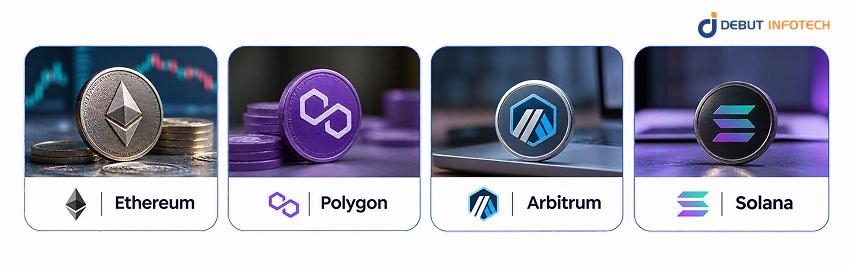
Choosing the blockchain is another important architectural and financial decision that can influence both the initial development budget and the cost of operating a stablecoin.
Ethereum, Polygon, Arbitrum, Solana, BNB Smart Chain, TRON, Stellar, Hedera, Base, Avalanche, and XRP Ledger provide different approaches to token issuance, transaction processing, and infrastructure integration.
But here’s where businesses need to look beyond network fees.
A blockchain may offer inexpensive transactions, yet require additional engineering resources because of its development environment, custody integrations, or account structure. Likewise, networks with native token issuance can eliminate some custom smart contract work without removing the need for secure backend infrastructure.
Therefore, stablecoin development cost by blockchain network should be evaluated across three areas: initial implementation, on-chain transaction fees, and ongoing operational requirements.
Let’s examine how the major networks compare.
The table below summarizes the primary cost structures across all eleven networks.
| Blockchain | Network Fee or Cost Example | Additional Cost Considerations |
| Ethereum | 0.001 ETH for 1M gas at 1 gwei | Variable gas, ERC-20 engineering, integrations |
| Polygon PoS | 0.1 POL for 1M gas at 100 gwei | Gas variability, custody, monitoring |
| Arbitrum One | L2 execution gas plus Ethereum data-posting costs | Settlement and bridging requirements |
| Solana | 5,000 lamports per signature; token-account deposits | Specialized development and account setup |
| BNB Smart Chain | 0.00005 BNB for 1M gas at 0.05 gwei | BEP-20 contracts, security, integrations |
| TRON | 0.0001 TRX per uncovered Energy unit | Bandwidth, Energy, resource allocation |
| Stellar | Base fee of 0.00001 XLM per operation | Account reserves, trustlines, integrations |
| Hedera | Standard native token creation starts around $1 | Token configuration, custody, backend systems |
| Base | L2 execution starts at 0.005 gwei, plus other fees | L1 security costs and integrations |
| Avalanche C-Chain | 0.005 AVAX for 1M gas at 5 nAVAX | Dynamic gas, custody, contract engineering |
| XRP Ledger | 0.00001 XRP minimum standard transaction fee | Account and ledger-object reserves |
Ethereum supports the ERC-20 token standard and provides an established ecosystem of smart contract tools, wallet providers, and blockchain infrastructure.
Its broad compatibility can make it a practical choice for businesses developing stablecoins intended to interact with Ethereum-based applications and financial services.
However, Ethereum uses a dynamic gas-fee model.
According to Ethereum’s official documentation, network fees depend on gas consumption, the base fee, and any priority fee included in the transaction.
What does it cost?
For illustration, deploying a contract that consumes 1 million gas at a gas price of 1 gwei would cost 0.001 ETH.
An ERC-20 transfer consuming 65,000 gas under the same conditions would cost 0.000065 ETH.
These examples show how gas consumption affects network expenses. Actual costs depend on the contract and prevailing network fees.
For enterprises expecting substantial transaction volumes, recurring token transfers, minting, and redemption operations should be included in the cost model.
Cost consideration: Ethereum offers extensive compatibility and development tooling, but gas fees and production integrations must be evaluated against the project’s expected activity.
Polygon PoS provides an EVM-compatible environment that supports Solidity-based token development.
Businesses already using Ethereum development tools may be able to reuse parts of their contract architecture and engineering expertise.
The network also supports comparatively inexpensive execution, although transaction fees vary with gas demand.
What does it cost?
Polygon PoS charges gas fees in POL.
For example, a contract consuming 1 million gas at 100 gwei would incur a network fee of 0.1 POL.
A token transfer consuming 65,000 gas at the same rate would cost 0.0065 POL.
These are illustrative calculations, not fixed network charges. Actual gas usage and gas prices must be checked before deployment.
For businesses processing frequent transfers, the network may reduce recurring execution expenses compared with more expensive fee environments.
However, smart contract development, custody integrations, monitoring, and compliance infrastructure remain separate expenses.
Cost consideration: Polygon PoS is worth evaluating when EVM compatibility and lower recurring execution costs are important requirements.
Arbitrum offers Ethereum-compatible smart contract execution through layer-2 infrastructure.
It can support stablecoin applications that require access to the broader Ethereum ecosystem while seeking lower transaction costs.
However, its network fees include more than execution alone.
According to Arbitrum’s official documentation, transaction costs account for layer-2 computation and the expense of posting transaction data to Ethereum.
What does it cost?
Arbitrum’s total transaction fee is calculated using the effective layer-2 gas price and an estimated gas amount that includes the data-posting component.
For instance, 1 million units of layer-2 execution gas at 0.02 gwei would represent 0.00002 ETH in execution costs.
However, that calculation excludes the additional amount associated with posting data to Ethereum.
The complete cost must therefore be estimated for the actual transaction.
Businesses should also consider the engineering effort associated with withdrawals, bridging arrangements, and settlement operations.
Cost consideration: Arbitrum can be suitable for EVM-based stablecoin applications where transaction efficiency matters, but the total budget should include layer-1 dependencies and integration requirements.
Solana uses a different development environment and account model from Ethereum-compatible blockchains.
It supports token issuance through the SPL Token Program and Token-2022, which provides additional token functionality.
This can make Solana relevant for payment-oriented applications expecting frequent transfers.
What does it cost?
According to Solana’s official payment documentation, the base transaction fee is 5,000 lamports per signature, with optional prioritization fees.
The documentation illustrates a base transaction cost of approximately $0.0007, depending on the SOL price.
Creating a new token account can also require a refundable storage deposit. Solana’s payment documentation illustrates an amount of approximately 0.0029 SOL for a token account, although the exact requirement depends on the account configuration.
For a business onboarding thousands of users, these account-creation requirements should be included in the operating model.
Additionally, Solana development may require different engineering resources from Solidity-based implementations.
Cost consideration: Solana may be appropriate for high-frequency stablecoin applications, provided the required wallets, custody services, and engineering capabilities support the selected token architecture.
BNB Smart Chain supports EVM-compatible development and the BEP-20 token standard.
Businesses familiar with Ethereum smart contracts can use similar development tools to create and manage stablecoins on BNB Smart Chain.
Its fee structure follows a gas-based model, with transaction costs paid in BNB.
What does it cost?
BNB Chain’s published network configuration lists a standard minimum priority gas price of 0.05 gwei for BSC mainnet.
At that illustrative rate, a transaction consuming 65,000 gas would cost 0.00000325 BNB.
A contract deployment consuming 1 million gas would cost 0.00005 BNB under the same assumption.
These calculations demonstrate the relationship between gas usage and cost, rather than guaranteeing the actual fee charged for every transaction.
Businesses should also distinguish BNB Smart Chain from opBNB, a separate layer-2 network with its own fee structure.
The total development budget depends on custom contract functionality, integrations, audits, and the intended operating model.
Cost consideration: BNB Smart Chain can be relevant for businesses looking for EVM-compatible stablecoin development with comparatively low network fees.
TRON supports TRC-20 tokens and is another network businesses may evaluate for stablecoin transfers and payment applications.
Unlike Ethereum’s conventional gas model, TRON uses two network resources: Bandwidth and Energy.
Bandwidth covers transaction data, while Energy measures smart contract execution.
Both resources can be obtained through staking or delegated arrangements.
What does it cost?
According to TRON’s official documentation, the documented mainnet resource rates are:
For illustration, a contract operation requiring 65,000 Energy would incur 6.5 TRX in Energy charges if the payer had no available Energy.
Bandwidth consumption would be calculated separately.
However, TRC-20 transfer costs depend on the actual contract execution path, available resources, and current chain parameters.
Businesses expecting large transaction volumes should also evaluate resource delegation or staking arrangements and the financial implications of maintaining them.
Cost consideration: TRON can support high-volume token transfers, but cost modeling should account for Energy consumption and resource-management strategies rather than relying on a fixed transfer fee.
Stellar takes a different approach to stablecoin issuance.
Businesses can issue assets natively on the network without necessarily deploying a custom smart contract for basic token functionality.
This can simplify certain issuance architectures, particularly for payment and settlement applications.
However, issuers still need off-chain infrastructure for reserve management, redemption, compliance, and operational controls.
What does it cost?
According to Stellar’s official documentation, the base transaction fee is 0.00001 XLM per operation.
For example, a transaction containing two standard operations would have a minimum base fee of 0.00002 XLM under normal fee conditions.
Stellar also maintains minimum account balances and reserves associated with certain ledger entries, including trustlines.
These requirements become relevant when supporting many customer accounts or asset relationships.
Businesses using additional smart contracts through Soroban must also account for resource-based execution fees.
Cost consideration: Stellar is worth evaluating for payment-focused stablecoin issuance where native assets can satisfy the intended requirements without extensive custom token contracts.
Hedera supports stablecoin issuance through the Hedera Token Service (HTS).
Unlike networks that rely primarily on custom token contracts, HTS provides native token creation and management capabilities.
Businesses can use the service for functions such as issuance, transfers, minting, burning, and token administration.
Additional smart contracts can be introduced when the application needs custom behavior.
What does it cost?
Hedera uses a fee model denominated in USD and paid in HBAR.
According to Hedera’s 2026 Simple Fees documentation, the base fee for creating a standard token starts at approximately $1, while creating a token with custom fees starts at approximately $2, before additional charges for transaction-specific characteristics.
Token operations such as transfers and administrative changes have separate network fees.
The final amount depends on factors including signatures, account state, and token configuration.
Hedera also provides a fee calculator for estimating specific transactions.
For businesses developing asset-backed tokens, native token functionality may reduce the need for certain custom contracts.
However, connecting token operations with reserve management, institutional custody, and financial reporting still requires engineering.
Cost consideration: Hedera can be a useful option for enterprises prioritizing native token controls and more predictable network-fee budgeting.
Base is an Ethereum layer-2 network supporting EVM-compatible smart contracts.
Businesses can deploy ERC-20 token implementations using familiar Ethereum development tools while benefiting from layer-2 execution.
However, Base transaction fees have multiple components.
What does it cost?
According to Base’s official network-fee documentation, transactions include layer-2 execution fees and layer-1 security fees.
Base documents a minimum layer-2 base fee of 0.005 gwei.
At that rate, a transaction consuming 200,000 gas would incur an execution fee of 0.000001 ETH.
At an illustrative ETH price of $2,000, that equals approximately $0.002 in layer-2 execution costs.
However, this amount excludes the layer-1 security fee, applicable priority fees, and any operator fee.
Actual transaction expenses depend on the complete fee calculation.
Cost consideration: Base is relevant for businesses seeking Ethereum-compatible stablecoin infrastructure, but layer-1 data costs and integration requirements must be included in the budget.
Avalanche’s C-Chain supports EVM-compatible smart contracts, making it another option for businesses developing ERC-20-style stablecoins.
Its network fees are paid in AVAX and vary according to gas usage and prevailing fee conditions.
The network also provides development infrastructure that supports custom financial applications.
What does it cost?
Avalanche C-Chain uses a dynamic gas-fee model.
According to the Avalanche C-Chain fee explorer, transaction charges depend on the base fee, priority fee, and gas requirements.
For illustration, a token transfer consuming 55,000 gas at an effective rate of 5 nAVAX per gas would cost approximately 0.000275 AVAX.
A deployment consuming 1 million gas at the same rate would cost 0.005 AVAX.
These amounts are hypothetical calculations; actual charges depend on current parameters and transaction configuration.
Businesses should also consider that custom blockchain environments or additional infrastructure can introduce costs beyond standard C-Chain deployment.
Cost consideration: Avalanche C-Chain can suit EVM-based stablecoin projects requiring custom integrations, with network charges modeled according to expected usage.
XRP Ledger (XRPL) supports native issued assets and tokenization capabilities without requiring an ERC-20-style smart contract for basic stablecoin issuance.
It can therefore be relevant for applications involving digital payments, cross-border transfers, and asset-backed token issuance.
The network provides issuer-level controls and account settings for certain token types.
What does it cost?
According to XRPL’s official transaction documentation, the standard minimum transaction fee is 10 drops, equivalent to 0.00001 XRP.
However, XRPL also has account and ledger reserve requirements.
Its published mainnet configuration specifies:
For stablecoins using trustline-based assets, onboarding users and managing trustlines can therefore introduce additional reserve requirements.
These reserved XRP balances are different from transaction fees and may become available again when the relevant account or ledger objects are removed appropriately.
Businesses should also evaluate whether trustline tokens or Multi-Purpose Tokens better suit their intended architecture.
Cost consideration: XRP Ledger can support native stablecoin issuance with low standard transaction fees, but account reserves, issuer controls, and redemption infrastructure must be included in the complete project assessment.
There isn’t a universal answer because blockchain transaction fees and software development costs are not the same.
From a network-fee perspective, Stellar, XRP Ledger, Solana, Hedera, and several EVM-compatible alternatives can support relatively inexpensive token transfers.
However, the network offering the lowest transaction fee may not deliver the lowest overall project cost.
For example, a company with an existing Solidity engineering team may find Ethereum-compatible networks easier to integrate into its current systems.
A business developing an institutional payment solution may instead evaluate Stellar, Hedera, or XRPL because their native token capabilities could reduce the need for certain custom contract functions.
The important consideration is how the selected network fits the complete stablecoin architecture.
Before making a decision, businesses should estimate contract or token implementation costs, expected transaction volumes, account setup requirements, wallet and custody compatibility, security assessments, and ongoing infrastructure expenses.
For organizations evaluating different blockchain architectures, our Blockchain Development Services cover feasibility assessment, smart contract engineering, infrastructure integration, and deployment planning.
Stablecoin compliance and regulatory costs vary significantly across jurisdictions. While some markets establish minimum issuer capital requirements of several million dollars, others calculate financial obligations based on reserve assets, outstanding token supply, or annual operating expenses.
And here’s where stablecoin budgeting becomes more complicated.
The amount required to establish a regulated issuer is not necessarily the amount a business spends on licensing and compliance. Regulatory capital, reserve backing, application fees, and ongoing compliance expenditure are separate financial considerations.
For instance, a company planning to launch a fiat-backed stablecoin in the United States may face a different capital requirement from an issuer operating under the European Union’s MiCA framework.
Therefore, businesses should determine their proposed jurisdiction and issuer classification before finalizing their development and launch budgets.
| Jurisdiction | Regulatory Framework | Capital Requirement or Regulatory Cost | Additional Cost Considerations |
| United States | GENIUS Act / OCC | $5 million minimum capital for applicable issuers | 12-month operating-expense backstop, reserve backing, legal and compliance expenses |
| European Union (ART) | MiCA | Highest of €350,000, 2% of average reserves, or 25% of previous annual fixed overheads | Authorization, reserve management, financial reporting |
| European Union (EMT) | MiCA / E-Money Framework | Generally €350,000 initial capital for a newly authorized electronic money institution | Ongoing own funds, safeguarding, issuer compliance |
| Hong Kong | Stablecoins Ordinance | HK$25 million minimum paid-up capital or approved equivalent resources | Licensing, reserve custody, redemption and reporting |
| UAE | CBUAE Payment Token Services Regulation | AED 15 million + 0.5% of outstanding payment token value, or 2% under the alternative reserve arrangement | Licensing, reserve management, custody and compliance |
| Singapore | MAS Stablecoin Framework | Higher of S$1 million or 50% of annual operating expenses under the announced framework | Liquid assets, reserve custody, independent assurance |
| Canada | Proposed Stablecoin Regulations | Proposed annual base assessments of C25,000–C750,000, based on outstanding token value | Variable assessments for higher tiers, reporting and compliance |
| United Kingdom | FCA Cryptoasset Framework | £350,000 permanent minimum capital for qualifying stablecoin issuers under rules effective October 2027 | Additional prudential requirements, backing assets, compliance |
The GENIUS Act established a federal regulatory framework for payment stablecoin issuance in the United States.
On October 21, 2026, the Office of the Comptroller of the Currency (OCC) issued its final implementing rule, scheduled to take effect on January 18, 2027.
Under the OCC’s final rule, permitted payment stablecoin issuers subject to its capital framework must maintain at least $5 million in regulatory capital, with the possibility of higher requirements depending on their business model and risk profile.
The rule also establishes an operational backstop based on 12 months of operating expenses.
For instance, an issuer with $1.2 million in qualifying annual operating expenses would need to account for an operational backstop of approximately $1.2 million under the relevant calculation.
This backstop is distinct from the minimum capital requirement, and both are separate from reserve assets backing outstanding stablecoins.
Consequently, a business planning a U.S. stablecoin project cannot consider a $200,000 software development estimate sufficient funding for establishing an OCC-supervised issuer.
The European Union’s Markets in Crypto-Assets Regulation (MiCA) establishes different financial requirements for asset-referenced tokens (ARTs) and e-money tokens (EMTs).
The distinction matters because stablecoin classification determines the applicable authorization and capital framework.
Under MiCA Article 35, ART issuers must maintain own funds equal to at least the highest of:
For example, an issuer maintaining €20 million in average reserve assets would face a reserve-based own-funds calculation of €400,000.
However, the actual requirement could be higher if the overhead-based calculation or additional regulatory requirements exceeded that figure.
Significant ARTs are subject to a higher reserve-based percentage of 3%, alongside other applicable requirements.
Issuers of e-money tokens generally need to operate as authorized credit institutions or electronic money institutions, subject to the applicable legal provisions.
A newly authorized electronic money institution generally needs at least €350,000 in initial capital under the EU electronic money framework.
Ongoing own-funds calculations can include 2% of average outstanding electronic money, with additional requirements depending on the issuer’s circumstances.
Hong Kong introduced its dedicated stablecoin issuer regime under the Stablecoins Ordinance, which became effective on August 1, 2025.
Under the Stablecoins Ordinance, licensed stablecoin issuers generally need at least HK$25 million in paid-up capital, an approved equivalent in another currency, or other financial resources accepted by the Hong Kong Monetary Authority (HKMA).
Issuers must also maintain adequate financial resources and liquid assets to meet their obligations.
Beyond the capital requirement, the framework includes reserve management, redemption, governance, and regulatory reporting obligations.
For a business planning to issue a fiat-referenced stablecoin in Hong Kong, these requirements create a financial commitment separate from the cost of developing token contracts and supporting infrastructure.
The United Arab Emirates has established requirements for payment token issuers through the Central Bank of the UAE’s Payment Token Services Regulation.
According to Article 13 of the regulation, licensed payment token issuers must maintain:
For issuers using the alternative reserve arrangement specified in the regulation, the additional capital requirement increases to 2%.
Consider a payment token issuer with AED 100 million in outstanding tokens.
Under the standard capital calculation, it would need at least AED 15.5 million in regulatory capital.
Under the alternative reserve arrangement, the calculation would increase to AED 17 million.
These amounts do not include the reserve assets supporting the tokens or the expenses associated with regulatory compliance and operations.
Singapore’s Monetary Authority (MAS) announced a regulatory framework for single-currency stablecoins, with legislative implementation undergoing further consultation during 2026.
Under the announced framework, issuers would need minimum base capital equal to the higher of:
For example, if an issuer has S$3 million annual operating expenses, the capital calculation would amount to S$1.5 million.
The framework also includes separate liquid-asset requirements intended to support operating expenses and orderly wind-down.
Reserve assets must be maintained at a value of at least 100% of the single-currency stablecoins in circulation, subject to the framework’s requirements.
However, businesses should distinguish the announced framework from provisions that have already been brought into force.
In September 2026, MAS issued a consultation on proposed legislative amendments to implement its stablecoin regime.
Canada’s proposed Stablecoin Regulations, published in October 2026, include a tiered approach to annual supervisory assessments.
Unlike minimum capital requirements, these assessments represent proposed recurring regulatory charges.
Under the Canada Gazette proposal, the base assessment would depend on the average value of outstanding stablecoins.
Issuers in the two higher tiers would also face variable assessments based on the remaining recoverable supervisory costs.
The proposal provides for inflation adjustments as well.
For example:
The proposed framework also includes requirements relating to registration, reserve backing, redemption, governance, and risk management.
The United Kingdom’s Financial Conduct Authority published its final cryptoasset regulatory rules in June 2026, with the new framework applying to relevant firms authorized under the regime from October 25, 2027.
Under the FCA’s CRYPTOPRU 4 capital requirements, a firm authorized to issue qualifying stablecoins has a permanent minimum capital requirement of £350,000.
However, this is a minimum rather than a complete capital calculation.
The FCA’s broader prudential framework also considers activity-related and risk-based financial requirements. The applicable amount may therefore exceed £350,000.
Businesses should also distinguish between ordinary qualifying stablecoin issuers and issuers whose stablecoins are recognized as systemic.
The Bank of England’s systemic stablecoin framework provides a separate capital approach based on the higher of six months of relevant operating expenses or specified recovery and wind-down costs, alongside other financial safeguards.
The cost of launching a stablecoin is only the beginning.
Once the platform becomes operational, businesses must maintain its technical infrastructure, security controls, reporting systems, and financial integrations.
The exact recurring budget depends on transaction activity, regulation, third-party services, and operational scale.
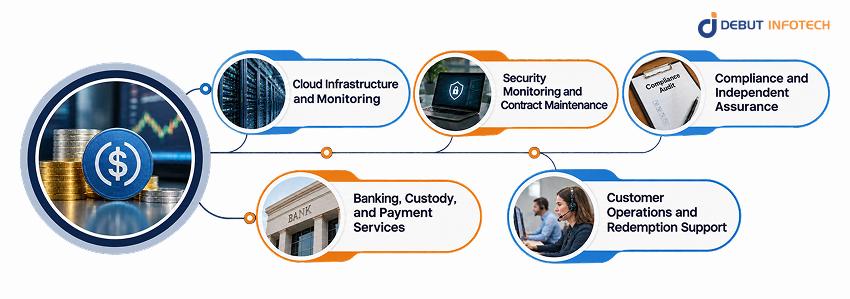
Production systems require dependable API services, databases, blockchain connectivity, monitoring, and backups.
Businesses may use managed infrastructure providers or operate some components internally.
Monthly expenditure depends on transaction volume, availability requirements, data retention, and the architecture selected.
Stablecoin systems require ongoing monitoring for suspicious activity, unexpected contract behavior, privileged access, and integration failures.
Software dependencies may also need updating as blockchain networks, interfaces, and operational requirements change.
When upgrades are permitted, the issuer should maintain appropriate authorization and testing procedures.
Regulated issuers may face recurring costs for reporting, audits, financial assurance, legal advice, transaction monitoring, and compliance personnel.
These expenses depend on the jurisdiction and scope of operations.
They should be estimated separately from general hosting and software maintenance.
External financial infrastructure can create recurring charges for custody, payment processing, settlements, account maintenance, or other contractual services.
The issuer should obtain commercial terms directly from prospective providers rather than relying on generic assumptions.
A stablecoin business may also require support teams to manage redemptions, customer onboarding, transaction enquiries, and operational exceptions.
For regulated operations, these processes form part of the business’s continuing responsibilities.
How should businesses estimate annual maintenance?
A practical approach is to develop a 12-month operating model that identifies fixed expenses, usage-dependent charges, regulatory obligations, and contingency funding.
Applying a generic percentage of development cost can be useful as a preliminary software-maintenance assumption, but it is not a dependable estimate of the full cost of operating a regulated stablecoin issuer.
Stablecoin development timelines depend on both technology and external dependencies.
A proof of concept can often be completed much faster than a platform designed for production issuance.
The following periods are illustrative engineering planning ranges, assuming requirements are defined and necessary specialists are available.
| Project Stage | Indicative Duration |
| Feasibility and architecture | 2–5 weeks |
| Core contract development | 4–10 weeks |
| Backend and integration engineering | 8–20 weeks |
| Testing and security assessments | 4–10 weeks |
| Production preparation | 2–6 weeks |
Several stages can run in parallel. For a controlled technology MVP, businesses may plan approximately three to six months, depending on complexity.
A more extensive production platform may require six to twelve months or longer.
But here’s an important distinction.
Finishing the software does not mean the stablecoin is authorized to launch.
Banking arrangements, issuer licensing, regulatory applications, reserve-provider agreements, and other external approvals can extend the overall timeline significantly.
For some regulated issuance models, authorization and launch preparation may take a year or more.
Businesses should therefore maintain separate engineering and regulatory milestones rather than treating them as one fixed delivery schedule.
Reducing stablecoin development costs doesn’t mean eliminating necessary security or compliance work.
The better approach is to reduce unnecessary complexity, avoid duplicated engineering, and make important architectural decisions before expensive implementation begins.
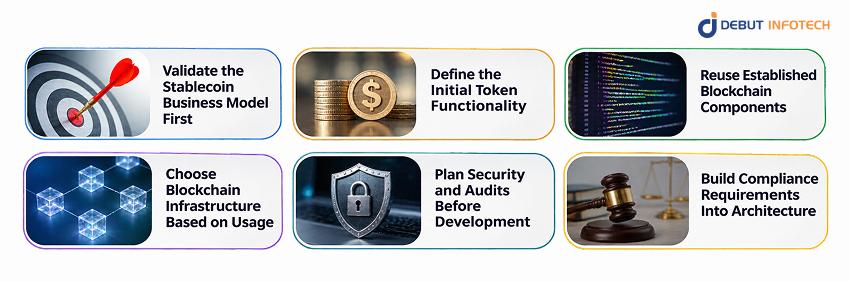
Here are six practical considerations.
Before commissioning custom contracts, establish why the business needs to issue a stablecoin.
Could the intended payment or settlement use case be supported by integrating an existing regulated stablecoin instead?
If new issuance isn’t essential, integration may substantially reduce technology and operational requirements.
However, distribution and payment activities may still carry legal obligations.
Launching with every possible feature increases development and testing requirements.
Businesses should identify essential functions such as issuance, redemption, permissions, custody integration, and monitoring.
Additional capabilities can be evaluated once the foundation is properly defined.
Security-critical functions should not be deferred merely to meet an arbitrary budget.
Well-maintained smart contract libraries and established token standards can reduce the need to develop common functionality from scratch.
However, reused components still require integration testing and security review.
Custom behavior should be introduced only where it serves a clear business or operational requirement.
Network selection should reflect expected transaction volume, wallet compatibility, institutional support, and operational requirements.
A less expensive deployment fee is not necessarily the cheapest long-term option.
Model transaction and infrastructure costs under realistic usage scenarios before making the decision.
Independent audits become more difficult to schedule when teams leave them until immediately before launch.
Define the audit scope early, establish the expected review process, and reserve time for remediation.
This helps reduce delays caused by late security findings.
Regulatory obligations may affect reserve records, redemption procedures, customer onboarding, transaction restrictions, and reporting.
These requirements should inform technical specifications from the beginning.
Retrofitting them after development is complete can involve substantial additional engineering.
As we’ve discussed, stablecoin development costs depend on more than token creation. Blockchain selection, reserve management, security, regulatory obligations, and integrations all influence the final investment. Getting these requirements right from the beginning helps businesses avoid unnecessary development expenses and costly architectural changes.
At Debut Infotech, our Stablecoin Development Services draw on experience in tokenization, digital wallets, cryptocurrency exchanges, and blockchain infrastructure.
Our work includes PRC Coin, a BNB Chain utility token integrated with an ICO platform and digital asset exchange. For XSGD, a Singapore Dollar-pegged stablecoin, we optimized blockchain infrastructure, with company-reported results including $10 million+ in cross-border transactions and 35% improved processing efficiency.
We also engineer smart contracts with independent audit readiness in mind, incorporating secure coding practices, access controls, code reviews, and vulnerability testing to support rigorous third-party assessments, including those conducted by firms such as CertiK.
Stablecoin development starts at approximately 15,000–40,000 for a proof of concept, while an integrated MVP may cost 100,000–250,000. Production platforms typically require 250,000–500,000 or more, with complex enterprise systems exceeding $1 million. The final price depends on architecture, functionality, integrations, and security requirements. These estimates exclude regulatory capital, reserve backing, and certain external expenses.
Developing a fiat-backed stablecoin may cost 80,000–250,000, based on published vendor estimates. More extensive production infrastructure can exceed $500,000. Businesses must also account for banking integrations, reserve management, security audits, and regulatory authorization. Under a full 1:1 reserve requirement, issuing $5 million in outstanding stablecoins requires at least $5 million in eligible backing assets, separate from development expenditure.
Stablecoin development costs depend on the backing model, blockchain network, smart contract complexity, and financial integrations. Illustrative component budgets include 20,000–80,000 for smart contract engineering, 20,000–75,000 for wallet, banking, and custody integrations, and 5,000–50,000 or more for security audits. These workstream estimates may overlap. Custom collateral mechanisms, multiple networks, and extensive regulatory requirements can increase the overall investment.
Blockchain deployment fees vary by network, contract complexity, and transaction demand. On Ethereum, deploying a contract consuming one million gas at 1 gwei would cost 0.001 ETH, excluding engineering expenses. Solana charges a base fee of 5,000 lamports per signature, with additional costs possible. Actual development, security auditing, and integration expenses generally exceed the blockchain deployment fee.
A focused stablecoin security audit may cost approximately 5,000–50,000, depending on contract complexity and assessment scope. More extensive systems involving multiple smart contracts, collateral vaults, governance, or cross-chain functionality may require higher budgets. Independent audits can include manual code reviews, vulnerability testing, and remediation verification. Additional reviews may be necessary when developers introduce significant changes after the original assessment.
Reserve funding depends on the stablecoin’s backing model and applicable regulations. Under a full 1:1 fiat-backed arrangement, $10 million in outstanding stablecoins requires at least $10 million in eligible reserve assets. These assets support redemption obligations and are not software development expenses. Issuers may also need separate regulatory capital, operational liquidity, and funding for licensing, security, financial assurance, and ongoing operations.
Multi-chain stablecoin development can increase expenses because each supported network introduces additional integration, testing, and monitoring requirements. According to published vendor estimates, cross-chain bridge integration may add 40,000–100,000 to a project’s scope, depending on architecture and security requirements. The total also depends on token supply coordination, wallet compatibility, custody support, and whether the project uses established infrastructure or custom bridging mechanisms.
Exchange listing expenses are generally separate from stablecoin development costs. However, not every exchange charges a listing fee. Coinbase and Kraken state that they do not charge token listing fees. Businesses may still need to budget for technical integration, liquidity provision, market-making services, and ongoing exchange-related operations. Listing approval also depends on the exchange’s eligibility and review requirements.
Yes, businesses may be able to launch branded stablecoins through an authorized issuance provider rather than establishing their own regulated issuing entity. Providers such as Paxos and Bridge offer issuance infrastructure under specific commercial arrangements. This can change the capital, compliance, and development responsibilities involved. However, provider fees, technical integrations, contractual obligations, and any applicable regulatory requirements still need separate evaluation.

Our Latest Insights
USA
2501 Chatham, Rd Suite R Springfield, IL 62704
+1-708-515-4004
info@debutinfotech.com
UK
7 Pound Close, Yarnton, Oxfordshire, OX51QG
+44-770-304-0079
info@debutinfotech.com
Canada
154 Eden Oak Trail, Kitchener, ON N2A 0H9
+1-708-515-4004
info@debutinfotech.com
INDIA
Sector 101-A, Plot No: I-42, IT City Rd, JLPL Industrial Area, Mohali, PB 140306
9888402396
info@debutinfotech.com