ON THIS PAGE
Progress0%






Our Global Presence :





For years, crypto has been framed as a choice between two extremes.
At one end is CeFi, which is established upon well-known financial systems, regulations, and custodian security. DeFi, on the other hand, is more focused on openness, transparency, and permissionless innovation, but with higher responsibility and risk on the side of the user.
CeDeFi is coming up as a solution to that gap.
Instead of making a choice between the two models, CeDeFi integrates the positive sides of both models. It adds the protections and regulations individuals desire of centralized finance without compromising the on-chain visibility and flexibility that attracts individuals to decentralized finance.
In this guide, we will find out what CeDeFi is, why it is gaining traction, the pros and cons of this new approach, and how this hybrid solution is leading to a more sustainable course of crypto adoption in the global arena.
CeDeFi was created in response to a more pragmatic question, posed by the crypto world, which is “How can we maintain a level of innovation without putting users in unnecessary danger?”
CeDeFi integrates both aspects of full centralization and pure DeFi protocols, as opposed to enforcing a decision between the two. It leverages blockchain technology to ensure transparency, speed, and efficiency, and has centralized safeguards that ensure compliance, oversight, and risk management. It is not aimed at watering down decentralization, but to scale it.
This concept gained momentum when the ecosystem, such as the Binance Smart Chain launched CeDeFi as a solution to actual issues in DeFi. The existence of high fees, weak liquidity profile, constant escapades, and regulatory risk makes DeFi potent yet unstable, particularly to average users.
CeDeFi offers a more approachable path, as on-chain opportunities like staking, yield programmes and token launches remain available to users in a more organized environment. Projects are generally screened, contracts are kept track of and identity verification helps curb scams and fraud. To a great number of users, that added level of security makes participation less daunting.
CeDeFi also assists in establishing more resilient crypto tokens on a token basis. When markets become volatile, liquidity is managed better, governance is more transparent and safety mechanisms can be implemented. The transactions are quick and economical, and do not put all the risk on the user.
With the current development in the crypto regulation sphere, CeDeFi is increasingly accepted by institutions and long-term investors. It facilitates the compliant use cases such as regulated token transactions and stablecoin transactions yet remains flexible as blockchain finance ought to be.
In short, CeDeFi doesn’t take sides. It is about establishing a middle ground that will assist crypto in going beyond the experimentation phase to daily use.
CeDeFi is becoming popular due to its ability to address certain issues that concern the crypto world today. Here’s why:
Decentralized platforms have suffered billions of dollars in hacks and smart contract vulnerabilities of more than $3B since 2021. Although DeFi provides freedom, it does not necessarily secure the funds of users. CeDeFi solves this problem by implementing safety without losing transparency.
Big financial institutions are willing to join crypto but require some definite compliance and risk management. CeDeFi fills this need by integrating the form of centralized finance and the novelty of decentralized mechanisms, which is appealing to institutional investors and conservative retail users.
The crypto environment is being actively developed by regulators worldwide. Policies such as MiCA in the EU, SEC regulation in the US, and FATF policies are driving towards safer and more responsible platforms. CeDeFi enables projects to be compliant yet decentralized in nature to mitigate legal and operational risks.
Most users are bombarded with handling of their private keys, self-selected wallets, and browsing decentralized exchanges. CeDeFi makes it easy to participate through the protection and the simplification of the user experience without totally controlling it.
Permissionless systems may not perform well during times of market volatility which causes liquidity shortages and instability. CeDeFi has regulated liquidity and governance solutions, which will allow tokens to be stable even in unstable markets.
Decentralization in its purest form is great at establishing innovation and experimentation, yet resilient crypto tokens demand a moderate approach. CeDeFi does this by combining flexibility, transparency with governance, oversight and risk management.
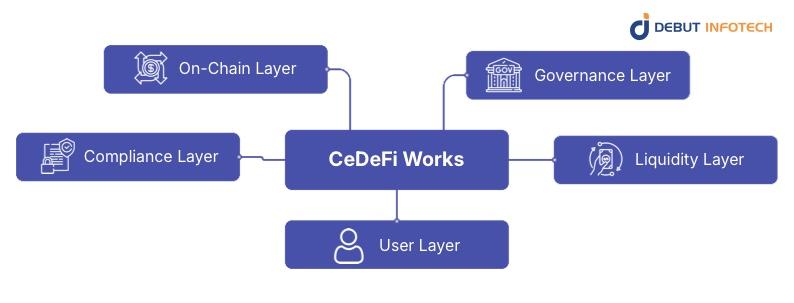
CeDeFi tokens are designed to integrate the most effective aspects of centralized and decentralized finance. In order to understand their functionality, it is useful to divide the system into five important layers:
CeDeFi tokens, in other words, are a comprehensive strategy between transparency, flexibility, and safety, which would make crypto simpler and safer not just to everyday users but also to institutions.
When it comes to navigating the crypto world, you’ve probably heard a lot about DeFi protocols and centralized finance systems. But where does CeDeFi fit in? Think of it as the middle ground, taking the best of both worlds while reducing the downsides.
Here’s a simple breakdown:
| Feature | DeFi Protocols | CeFi | CeDeFi |
| Custody | You hold your own funds | Centralized control | A hybrid approach—part self-custody, part managed |
| Compliance | Minimal or none | Fully regulated | Selective, balancing freedom and rules |
| Transparency | High, everything on-chain | Low, centralized ledgers | High, with some controls |
| User Experience | Can be tricky for newcomers | Simple and guided | Simplified, aiming for the best of both |
| Institutional Use | Limited | Widely used | Growing rapidly among institutions |
| Risk Exposure | High, vulnerable to hacks or mismanagement | Medium, some protection | Lower, thanks to built-in safeguards |
In a nutshell, CeDeFi will provide you with the flexibility and transparency of DeFi protocols and at the same time provide the security and risk management that is offered by traditional finance. It is about ensuring that crypto usage is safer, easier, and more convenient to all users, both retailers and institutions.
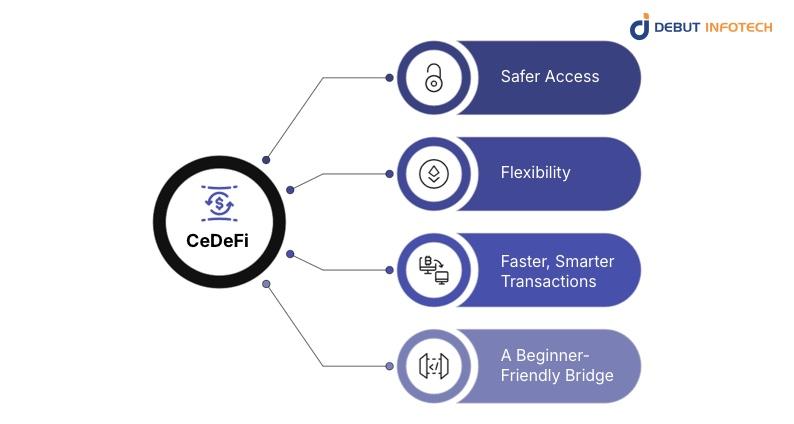
CeDeFi is fast becoming the intelligent platform that offers the best of the two worlds to anyone who desires the security of centralised finance systems and the freedom found in decentralized finance. Let’s break down why it’s winning over both beginners and seasoned crypto users:
1. Safer Access
Security is one of the most significant issues of crypto, and CeDeFi deals with it directly. Platforms usually have KYC checks, transaction monitoring and governance checks to ensure funds are not compromised. As opposed to full-scale systems of decentralization where anyone can freely interoperate and remain anonymous, CeDeFi establishes a sense of trust and responsibility, minimizing the risks of a hack or scam. Users have the opportunity to navigate the crypto world without the fear of losing their assets.
2. Flexibility
CeDeFi does not compromise on the freedom and functionality of DeFi despite centralized safeguards. The opportunities of smart contracts, lending, or yield farming are still available. The distinction is that these interactions have other safety nets, such as whitelisted contracts and risk controls, allowing one to experiment with crypto and take risks.
3. Faster, Smarter Transactions
CeDeFi uses blockchain technology to make transactions more efficient and reliable by mixing a centralized infrastructure with it. The processing of orders, liquidity, and compliance checks can be done by centralized elements within a short amount of time, and the blockchain guarantees transparency. This hybrid approach is also attractive to institutions, which do not have to overcome regulatory mandates, and further accelerate the mainstream adoption of crypto.
4. A Beginner-Friendly Bridge
CeDeFi can serve as a friendly introduction of new participants into the crypto world. It has a well-organized structure and a common interface that makes the process less intimidating and assists users with the idea on how to stake, lend, or liquidate pools without having to plunge into a high-risk environment. Basically, CeDeFi educates the users about DeFi but in a more secure, step-by-step manner.
In order to know whether CeDeFi really assists in creating more resilient crypto tokens, it is important to discuss these problems in simple terms:
1. Centralization Concerns
Compared to a complete permissionless DeFi environment, CeDeFi is a controlled setting. Some of these decisions are made by certain teams or authorized bodies, e.g. protocol upgrades, validator selection or liquidity management. This minimizes lawlessness and abuse of risk, but it also implies that the user needs to believe in human control in addition to code. To users who appreciate total freedom, it may seem like a move in the wrong direction of the original DeFi promise.
2. Reduced Privacy
The majority of CeDeFi platforms implement KYC and compliance checks to comply with the regulatory standards and appeal to institutional investors. Although this prevents market manipulation and fraud, it lowers anonymity. Traditional DeFi allows users to communicate with protocols without giving any personal data. CeDeFi transforms that, and it can be a deal breaker when a user is more concerned with privacy rather than convenience or security.
3. Central Point of Failure
Since CeDeFi remains based on centralised management, it is inherently exposed to elements of risk as experienced in traditional CeFi platforms. Users can be impacted if the managing entity decides badly, experiences internal malfunctions, or undergoes legal proceedings. Although funds can be on-chain, it is not always fully decentralized, and governance and control can form an easy single point of failure.
4. Potential Conflict of Values
Part of the crypto community perceives CeDeFi as a tradeoff and not a development. In this light, introducing regulation and centralized controls is counterproductive to the objective of developing financial systems that do not involve intermediaries.
In the larger sense, such difficulties underscore what CeDeFi actually is, not a replacement of decentralization, but a form of structured development of it. CeDeFi intends to make some trade-offs to mitigate risk, make the product more user-friendly, and facilitate broader adoption, even at the cost of redefining what decentralization should look like in the upcoming crypto finance.
CeDeFi is quickly shaping up to be more than just another crypto buzzword. Having reached the stage of maturity, the industry is turning into a viable interface between the rapid pace of blockchain innovation and the actual regulations that financial systems need to address.
To most businesses and first time users, it can be daunting to dive into decentralised finance. Having a wallet, swapping through smart contracts and interacting with security threats isn’t necessarily intuitive. CeDeFi removes that obstacle by providing more comfortable security measures such as structured governance and compliance without sacrificing transparency and efficiency, which makes crypto so appealing. Such a balance makes it an easy point of entry among both businesses and everyday users who need to get exposure to crypto without being overly complex.
CeDeFi also gives Web3 developers the space to develop in a responsible manner. Projects can be kept on track with the regulatory expectation, as well as be compatible with the DeFi protocols, which will build an ecosystem that, in addition to being innovative, will be more stable and reliable in the long term.
This model is particularly interesting because it is flexible. CeDeFi can be scaled to the needs of an enormous variety of real-life applications to institutional-grade DeFi platforms, cross-border payments, and even new digital currency projects. It’s not about replacing decentralization, it’s about refining how decentralised finance functions in environments where resilience and compliance matter.
CeDeFi is a rising trend that is offering a viable alternative to traditional finance, being innovative and reliable at the same time. Although the problem of governance and compliance is still present, it has the potential to transform financial systems to be more effective and accessible.
In the case of businesses interested in developing in this space, it is important to hire Defi developers that are competent. Debut Infotech provides the experience of designing CeDeFi solutions based on the principles of decentralization, security, and compliance, which transforms complex concepts into trustworthy and convenient platforms.
With the right team, CeDeFi can move from concept to a trusted, widely adopted financial model.
A. CeDeFi (Centralized Decentralized Finance) is a mixed model of finance. It involves a blend of the safety, control and convenience of centralized finance (CeFi) and the creativity, openness and profit potential of decentralized finance (DeFi). In simple terms, CeDeFi offers a middle ground. Through familiar platforms, which are regulated, users can access DeFi products, such as yield farming and decentralised exchanges (DEXs). This will both reduce complexity, risk, and enhance compliance and user support.
A. CeFi is an acronym of Centralized Finance. It is a financial framework that involves the management of transactions and user assets by a central authority or intermediary. This is similar to the practice in conventional finance, such as banks and brokerage firms. CeFi has been implemented by Coinbase and Binance in the crypto world, which provide users with a familiar and controlled platform to trade and store digital assets.
A. Of course, DeFi lending is highly risky. It is characterized by a high level of volatility and the presence of smart contract bugs or hacks. Compared to conventional finance, there is minimal to no regulation and no consumer protections. Other risks include liquidation events and impermanent loss. The risk lies in three primary areas, namely the technology itself, the unstable crypto assets it uses as collateral, and the unregulated anonymity of the ecosystem. Investors should treat DeFi lending with caution and realize that it is far more complicated than other financial products.

Our Latest Insights
USA
2501 Chatham, Rd Suite R Springfield, IL 62704
+1-708-515-4004
info@debutinfotech.com
UK
7 Pound Close, Yarnton, Oxfordshire, OX51QG
+44-770-304-0079
info@debutinfotech.com
Canada
154 Eden Oak Trail, Kitchener, ON N2A 0H9
+1-708-515-4004
info@debutinfotech.com
INDIA
Sector 101-A, Plot No: I-42, IT City Rd, JLPL Industrial Area, Mohali, PB 140306
9888402396
info@debutinfotech.com