ON THIS PAGE
Progress0%



Our Global Presence :


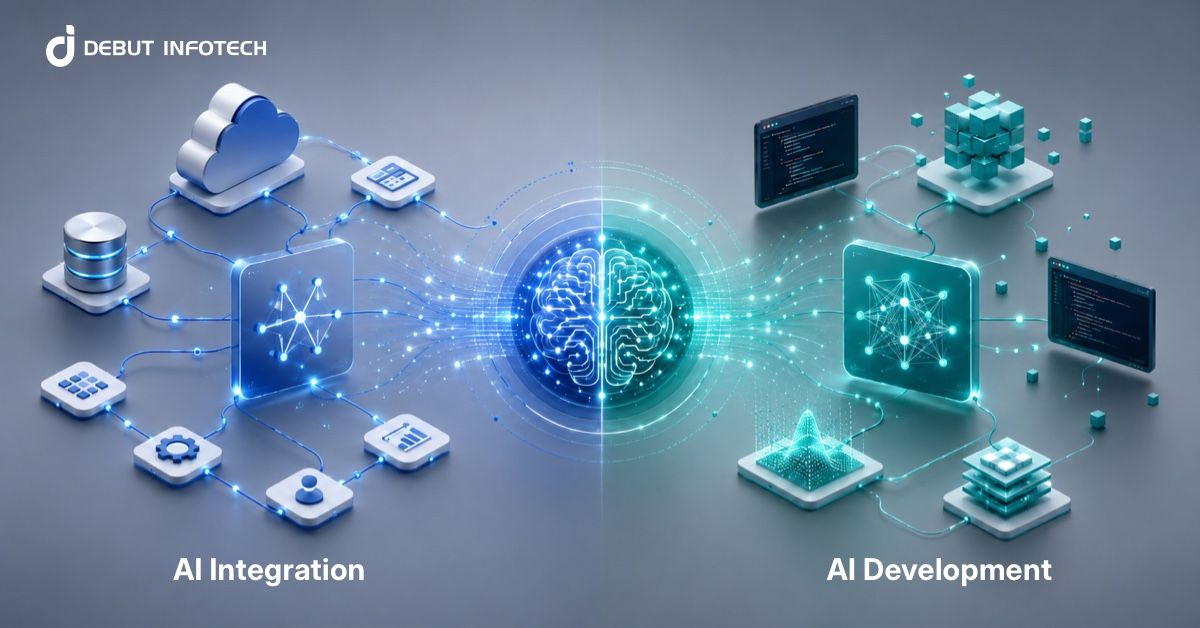


AI integration vs AI development is a business decision, not just a technical one. The right approach depends on objectives, data ownership, compliance, implementation timelines, and long term competitive goals.
AI integration delivers faster time to value by connecting pre trained models, APIs, and platforms to existing workflows, making it ideal for common enterprise use cases.
Custom AI development provides greater control and differentiation through proprietary models, domain specific intelligence, and governance for regulated or data sensitive industries.
Hybrid AI architectures often offer the best balance by combining foundation models with technologies like RAG, vector databases, and enterprise data to improve flexibility and security.
Total cost of ownership should guide investment decisions. Integration typically lowers upfront costs, while custom development may offer better long term economics for high volume AI workloads.
A phased implementation framework reduces deployment risk. Moving from readiness assessment to pilot and production enables organizations to validate ROI before scaling AI initiatives.
For most enterprises, the question is not whether to adopt artificial intelligence, but how. The real challenge is deciding how to implement it. Many organizations frame the discussion as AI integration vs AI development, treating them as competing options.
In practice, the decision is far more nuanced. The right approach depends on business objectives, data sensitivity, regulatory obligations, performance requirements, implementation timelines, available expertise, and long-term ownership goals.
The rapid adoption of AI has made this decision increasingly important. According to McKinsey’s State of AI research, 78% of organizations reported using AI in at least one business function in 2024, highlighting how quickly AI has become part of enterprise operations. In addition, Gartner predicts that more than 80% of enterprises will have used generative AI APIs or models, or deployed generative AI-enabled applications by 2026, up from less than 5% in 2023. These figures show that AI implementation is no longer an experimental initiative for most organizations. It is becoming a core technology strategy.
The decision framework extends beyond choosing between buying and building. Enterprise leaders must evaluate how much control they need over data, how accurate outputs must be, what compliance standards apply, how quickly value must be delivered, and whether long-term competitive advantage requires proprietary AI capabilities.
In many cases, the optimal answer is a hybrid model that combines existing AI services with custom-built components.
This article examines the practical differences between Enterprise AI integration and AI development, outlines the key variables that influence enterprise decisions, compares architecture models, provides a technology stack comparison, explains implementation considerations, and answers common questions organizations face when planning AI initiatives.
AI integration focuses on incorporating existing artificial intelligence capabilities into business processes. Rather than building models from scratch, organizations connect pre-trained foundation models, AI APIs, SaaS platforms, copilots, automation tools, and machine learning services into existing workflows. The primary goal for companies offering AI integration services is to accelerate deployment while minimizing development complexity.
Examples include connecting GPT-powered assistants to customer support platforms, integrating AI document processing into enterprise resource planning systems, deploying Microsoft Copilot across productivity environments, or embedding AI search capabilities within internal knowledge bases. The organization consumes AI as a service while focusing on business process improvements rather than model creation.
Custom AI development takes a different approach. Instead of relying primarily on externally managed models and infrastructure, organizations design, train, fine-tune, and govern AI systems tailored to specific business requirements. These systems often leverage proprietary datasets, custom pipelines, specialized workflows, and internal governance controls.
A healthcare provider developing a diagnostic support model trained on institution-specific clinical data, or a financial institution building fraud-detection models using proprietary transaction patterns, would typically fall into this category. The objective is not simply AI adoption but the creation of differentiated capabilities that competitors cannot easily replicate.
The distinction becomes clearer when viewed through the lens of ownership. AI integration patterns prioritizes speed, convenience, and lower initial investment. Development prioritizes control, customization, intellectual property, and long-term strategic value. Neither approach is inherently superior. Their effectiveness depends entirely on the business problem being solved.
Many organizations mistakenly assume the decision exists at two extremes. Enterprise AI implementations typically exist on a spectrum.
| Approach | Description | Typical Use Case |
| Pure Integration | Uses third-party AI services with minimal customization | Chatbots, copilots, document summarization |
| Fine-Tuned Integration | Uses external foundation models with custom prompts, retrieval systems, or fine-tuning | Internal knowledge assistants, customer support automation |
| Hybrid Build | Combines proprietary data layers, orchestration, and workflows with external models | Enterprise search, decision-support systems, AI agents |
| Full Custom Development | Builds or extensively trains proprietary models and infrastructure | Specialized prediction systems, regulated environments, proprietary AI products |
The majority of successful enterprise implementations now sit within the fine-tuned integration or hybrid categories. Organizations can achieve faster deployment than with fully custom development while maintaining greater control than with simple API consumption. This middle ground often delivers the best balance between business value, technical flexibility, and operational governance.
Selecting between AI integration, custom AI development, and a hybrid approach requires a structured evaluation process. Organizations often focus on technology choices too early, when the more important question is whether the business problem requires existing AI capabilities or a purpose-built solution. Six variables typically determine the most suitable implementation path.
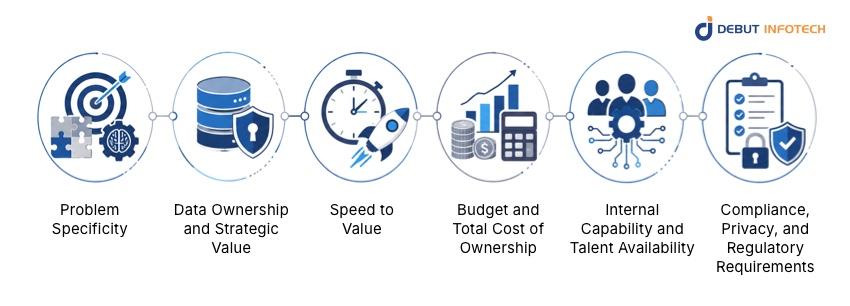
The first consideration is how specialized the problem is. Generic use cases such as content generation, document summarization, meeting transcription, customer support assistance, and enterprise search can often be addressed through integrated foundation models and AI platforms.
Highly specialized use cases are different. If the organization needs industry-specific reasoning, proprietary workflows, unique prediction models, or domain expertise unavailable in public models, custom development becomes more attractive. The more unique the problem, the greater the value of tailored AI systems.
Data often determines the long-term direction of an AI initiative. Organizations possessing large volumes of proprietary, high-quality data may benefit from developing custom models or hybrid architectures that transform those assets into competitive advantages.
If the required intelligence can be generated using publicly available knowledge and standard business information, integration may be sufficient. When institutional knowledge, historical operational data, customer interactions, or proprietary research drive business outcomes, development investments become easier to justify.
Implementation timelines can significantly influence the decision. Integration projects frequently move from proof of concept to production within weeks or months because foundational capabilities already exist.
Custom development projects typically require additional time for data preparation, model evaluation, architecture design, testing, governance implementation, deployment, and ongoing optimization. Organizations pursuing immediate productivity gains usually favor integration-first strategies before expanding into custom development.
Initial project cost and long-term ownership costs should be evaluated together. Integration generally reduces upfront spending because external providers manage infrastructure, model training, and platform maintenance.
Custom development requires larger investments in engineering resources, infrastructure, model lifecycle management, security controls, and monitoring systems. However, organizations with large-scale AI workloads may eventually reduce recurring platform costs through proprietary solutions. The most cost-effective option depends on expected usage volume and strategic objectives.
Successful AI development depends on access to specialized expertise. Data scientists, machine learning engineers, MLOps professionals, security teams, architects, and governance specialists all contribute to enterprise-grade deployments.
Organizations with limited AI resources often achieve stronger outcomes through integration platforms supported by experienced implementation partners. Enterprises with mature data and engineering teams may be better positioned to build and manage custom systems internally.
Regulatory obligations frequently become the deciding factor. Industries such as healthcare, banking, insurance, government, defense, and pharmaceuticals often require strict controls over data residency, explainability, auditability, and model governance.
When regulations limit external data exposure or require extensive oversight, custom development or hybrid architectures provide greater control. Less regulated environments may benefit from the efficiency and flexibility of integration-first approaches.
Enterprise Decision Matrix
| Decision Factor | Choose AI Integration When | Choose Custom AI Development When | Choose Hybrid When |
| Speed to value | You need a usable workflow in weeks. | You can invest months for proprietary capability. | You need quick proof before a deeper build. |
| Data ownership | Data sensitivity is manageable with vendor controls | Data must stay fully governed or proprietary. | Some workflows can use APIs while sensitive parts stay custom. |
| Accuracy requirement | Existing models are good enough. | Domain-specific accuracy is critical. | Base model works but needs RAG or fine-tuning. |
| Budget profile | Lower upfront cost is important | Long-term ownership justifies upfront cost. | Budget needs staged validation. |
| Strategic value | AI supports operations but is not the product core | AI is central to product differentiation | AI starts as support and may become core. |
Organizations that score consistently in one column usually have a clear implementation direction. When requirements span multiple columns, a hybrid architecture often offers the best balance between speed, flexibility, cost control, and long-term strategic ownership.
Architecture decisions determine how AI systems scale, how securely they operate, and how effectively they support enterprise objectives. While implementation details vary across industries, most enterprise AI solutions can be grouped into three architectural patterns: integration-first, custom development, and hybrid AI.
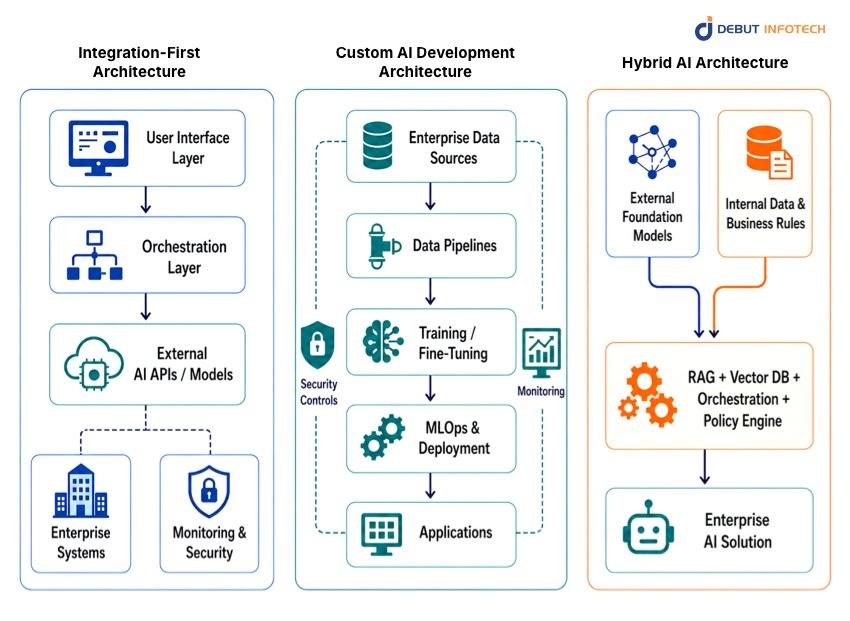
An integration-first architecture focuses on connecting enterprise applications to existing AI services. Organizations consume external models through APIs while maintaining business logic and workflow orchestration internally.
The user interface layer may include web applications, customer portals, productivity tools, internal dashboards, or chat-based assistants. Requests are routed through orchestration layers that manage prompts, workflows, authentication, and business rules before interacting with external AI providers.
Enterprise systems such as CRM platforms, ERP systems, ticketing tools, document repositories, and communication platforms provide the operational data used by the AI service. Monitoring and security controls oversee usage, access management, and performance.
This architecture delivers rapid deployment and lower complexity but offers less control over model behavior and infrastructure.
A custom AI architecture places greater ownership within the organization. Instead of relying primarily on external providers, enterprises build, train, fine-tune, deploy, and manage AI models within controlled environments.
Data pipelines collect, transform, validate, and prepare information from enterprise sources. Training environments create or adapt models using proprietary datasets. MLOps systems manage experimentation, deployment, versioning, evaluation, and lifecycle governance.
Security controls are deeply integrated into every layer, including data governance, encryption, identity management, audit logging, and compliance monitoring. Monitoring systems track model accuracy, drift, reliability, and operational performance.
This architecture requires greater investment but delivers maximum control, customization, and intellectual property ownership.
Hybrid architecture combines the speed of integration with the flexibility of custom development. This approach has become increasingly popular because it allows organizations to leverage advanced foundation models while retaining control over critical business knowledge and workflows.
External models provide reasoning, language understanding, and content generation capabilities. Internal systems contribute proprietary data, business rules, domain knowledge, and governance controls. Retrieval-augmented generation (RAG), vector databases, orchestration layers, and policy engines connect the components.
The result is a solution that delivers enterprise-grade performance without requiring organizations to build every AI capability from the ground up.
Side-by-Side Enterprise AI Architecture Diagram
Across all three models, monitoring, governance, security, identity management, observability, and compliance controls should be treated as foundational architectural layers rather than optional additions. Enterprises that incorporate these controls early typically experience fewer operational and regulatory challenges as AI adoption expands.
The technology stack behind an enterprise AI solution varies significantly depending on whether the organization chooses integration-first deployment, custom AI development, or a hybrid implementation. While the business objective may remain the same, the underlying infrastructure, governance requirements, operational responsibilities, and ownership model differ considerably.
Integration-first environments prioritize speed and simplicity. Organizations consume managed AI services and focus on workflow enablement rather than model management.
Custom AI development environments prioritize ownership, flexibility, and deep customization, requiring dedicated infrastructure and operational processes.
Hybrid architectures combine both approaches, allowing enterprises to leverage foundation models while maintaining control over proprietary data, workflows, and governance mechanisms.
The following comparison highlights how technology choices evolve across each implementation path.
| Layer | Integration-First | Custom Development | Hybrid |
| Model layer | GPT-4o, Claude, Gemini, SaaS AI APIs | Custom ML models, fine-tuned Llama/Mistral, domain models | Foundation model + fine-tuned or RAG layer |
| Orchestration | API wrapper, light workflow logic | LangChain, LlamaIndex, Semantic Kernel, custom services | Orchestration layer routes between APIs and custom components |
| Data layer | Limited context injection, connector-based access | Owned feature store, data lake, training datasets | Enterprise data through RAG or controlled feature pipelines |
| Deployment | Vendor API + app integration | Cloud, private cloud, or on-prem inference | API-based for general tasks, self-hosted for sensitive tasks |
| Monitoring | API usage, latency, cost, output quality | Model drift, training lineage, MLOps metrics | Combined LLMOps + MLOps monitoring |
| Governance | Vendor DPA, usage policy, RBAC | Full audit trail, model cards, retraining policy | Policy split by use case sensitivity |
As organizations move from integration toward development, operational responsibility increases substantially. Teams become accountable for model quality, deployment reliability, lifecycle management, observability, security controls, and compliance reporting. The trade-off is greater control over performance, intellectual property, and long-term platform strategy.
Many enterprises ultimately adopt hybrid architectures because they provide a practical balance between innovation speed and operational control. This approach enables organizations to benefit from rapidly evolving foundation models while retaining ownership of the business logic, data assets, and governance processes that differentiate their operations.
Once an organization has selected an implementation path, execution becomes the next challenge. Successful AI adoption rarely happens through a single deployment effort. Mature enterprises typically follow a phased AI Implementation framework that reduces risk, validates business value, and creates clear decision points before scaling investments.
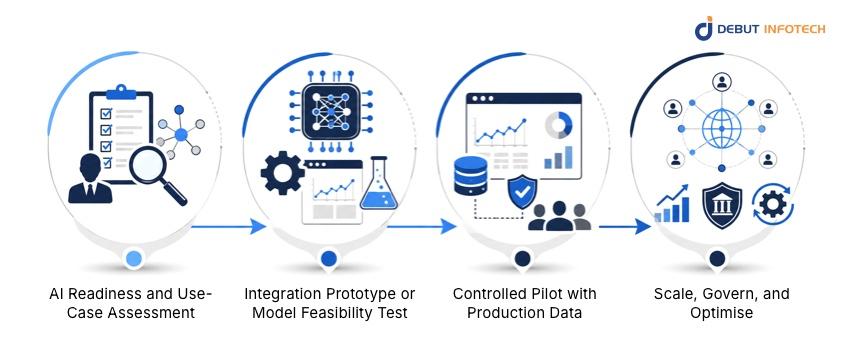
This phase focuses on understanding business objectives, data quality, technical readiness, compliance obligations, and expected outcomes. Stakeholders identify high-value use cases and assess whether integration, development, or hybrid deployment aligns with organizational goals.
Timeline: 2–4 weeks
Primary Output: AI strategy, use-case prioritization, data readiness assessment, implementation recommendation
Go/No-Go Decision: Is there sufficient business value and organizational readiness to proceed?
Common Failure Mode: Pursuing AI without a clearly defined business problem or measurable success criteria.
The second phase validates technical feasibility. Integration projects often involve rapid API-based prototypes, while development projects may focus on model training experiments, retrieval testing, or proof-of-concept environments.
The objective is to determine whether the proposed solution can achieve required levels of accuracy, usability, security, and operational performance.
Timeline: 4–8 weeks
Working prototype, benchmark results, feasibility report
Go/No-Go Decision: Does the solution meet minimum technical and business performance thresholds?
Common Failure Mode: Evaluating AI solely on technical performance while ignoring workflow adoption and user experience.
During the pilot phase, the solution operates with real business data and a limited group of users. Governance controls, monitoring tools, security mechanisms, and operational AI production workflows are tested under realistic conditions.
Pilot programs provide critical insights into model reliability, latency, integration complexity, and organizational adoption before enterprise-wide deployment.
Timeline: 6–12 weeks
Primary Output: Pilot performance metrics, compliance validation, operational readiness assessment
Go/No-Go Decision: Can the solution deliver measurable value while meeting operational and compliance requirements?
Common Failure Mode: Expanding too quickly before establishing monitoring, governance, and support processes.
Once the pilot demonstrates success, organizations expand deployment across departments, business units, and workflows. Attention shifts toward governance, model lifecycle management, observability, cost optimization, security oversight, and continuous improvement.
This phase transforms AI from an isolated project into a managed enterprise capability.
Timeline: Ongoing
Primary Output: Enterprise-scale deployment, governance framework, optimization roadmap
Go/No-Go Decision: Is the solution consistently delivering business outcomes at scale?
Common Failure Mode: Treating deployment as the finish line and neglecting ongoing optimization and governance activities.
Organizations that follow a phased implementation model generally achieve stronger adoption rates and lower operational risk because decisions are validated incrementally rather than through large-scale, high-risk deployments.
Deploying AI into production introduces operational, security, compliance, and reliability risks that extend beyond model accuracy. Whether an organization chooses AI build vs integrate, or hybrid deployment, robust risk controls are necessary to maintain trust, regulatory compliance, and business continuity.
The most effective governance programs treat risk management as a continuous process rather than a one-time implementation task.
| Risk | Potential Impact | Recommended Mitigation |
| Vendor Lock-In | Reduced flexibility and rising costs | Multi-model architecture, abstraction layers, portability planning |
| Data Leakage | Exposure of sensitive information | PII redaction, encryption, RBAC, data classification policies |
| Model Drift | Declining performance over time | Continuous monitoring, retraining schedules, performance benchmarks |
| Poor Integration Testing | Workflow failures and user disruption | End-to-end testing, staging environments, automated validation |
| Latency Spikes | Reduced user experience and productivity | Caching, load balancing, performance monitoring, fallback routing |
| Hallucination | Incorrect outputs and business risk | RAG, validation layers, confidence scoring, human review |
| Prompt Injection | Security breaches and manipulated outputs | Input filtering, policy enforcement, prompt isolation controls |
| API Failure | Service disruption | Fallback workflows, secondary providers, redundancy planning |
| Retraining Gaps | Outdated model behavior | Model lifecycle management and scheduled evaluations |
| Weak Observability | Delayed incident detection | Audit logs, dashboards, tracing, real-time monitoring |
Identity and access management controls play a central role in enterprise AI security. Role-Based Access Control (RBAC), least-privilege policies, and audit logging help ensure that users access only the information and capabilities required for their responsibilities. These controls become increasingly important when AI systems interact with sensitive customer, financial, healthcare, or operational data.
Organizations should also establish human-in-the-loop escalation paths for high-risk decisions. AI systems can automate recommendations, summarize information, and accelerate workflows, but critical business actions often require human validation. This safeguard is particularly valuable when outputs influence compliance decisions, financial transactions, customer communications, or regulated processes.
Operational visibility is equally important. Model monitoring, SLA tracking, cost alerts, response-quality evaluations, and observability platforms such as MLflow, Langfuse, and Datadog help teams detect issues before they affect business operations. Combined with retraining policies and governance reviews, these controls create a sustainable foundation for enterprise AI adoption.
The organizations achieving the strongest production outcomes are rarely those with the most advanced models. They are the ones that invest in governance, monitoring, security, and operational discipline from the beginning. AI capabilities may create value, but risk controls ensure that value remains reliable, scalable, and sustainable over time.
Cost discussions around AI often focus on initial implementation expenses, but enterprise decision-makers should evaluate total cost of ownership (TCO) over multiple years. The most affordable option during the first few months is not always the most economical choice over the life of the solution.
AI integration typically has lower upfront costs because organizations leverage existing models, APIs, infrastructure, and vendor-managed services. Teams offering enterprise AI development services spend less time building foundational capabilities, allowing projects to move from planning to deployment relatively quickly. This makes integration attractive for organizations seeking immediate productivity improvements or rapid proof-of-value initiatives.
Custom AI development follows a different AI development cost structure. Initial investments are usually higher because organizations must establish data pipelines, model infrastructure, governance controls, testing environments, deployment processes, monitoring systems, and operational support capabilities. The organization assumes responsibility for a larger portion of the technology stack.
However, long-term economics can shift as AI usage grows. High-volume workloads may generate substantial recurring API and licensing costs in integration-first environments. Over time, enterprises with large-scale usage patterns may find that custom models or hybrid architectures provide better cost predictability and greater operational control.
AI Cost Comparison
| Cost Factor | Integration-First | Custom Development | Hybrid |
| Initial Setup | Low | High | Medium |
| Annual Licensing | High dependency on vendor pricing | Lower vendor dependency | Moderate |
| Customization Cost | Limited to moderate | Extensive | Moderate to High |
| Infrastructure Cost | Mostly vendor-managed | Enterprise-managed | Shared responsibility |
| Maintenance Effort | Lower | Higher | Moderate |
| Switching Cost | Potentially high due to vendor dependence | Lower vendor dependency | Moderate |
| 3-Year TCO Trend | Lower initially, may increase with scale | Higher initially, may stabilize over time | Balanced |
| Intellectual Property Ownership | Limited | High | Shared ownership model |
Intellectual property is often overlooked during cost analysis. Organizations building proprietary AI capabilities create assets that may generate value beyond operational efficiency. Custom models, domain-specific workflows, training datasets, and governance frameworks can become long-term strategic assets rather than recurring operational expenses.
For many enterprises, the most practical evaluation method is not asking which option is cheapest today. The better question is which approach delivers the best balance of business value, operational flexibility, and total ownership cost over a 3- to 5-year horizon.
The right AI implementation strategy depends on business priorities rather than technology preferences. Organizations should align their approach with their objectives, constraints, regulatory obligations, and long-term plans.
AI integration strategy is often the best option when organizations need results quickly, and the required capabilities already exist within commercial AI platforms. Customer support assistants, knowledge management systems, document processing, productivity automation, content generation, and workflow enhancement projects frequently fall into this category.
Integration is particularly effective when:
Organizations can typically validate value faster while minimizing implementation complexity.
Custom AI development becomes more attractive when competitive advantage depends on proprietary knowledge, specialized workflows, or strict governance requirements. Industries subject to significant regulatory oversight often benefit from greater control over model behaviour, data handling, deployment environments, and auditing processes.
Development is often the stronger choice when:
In these situations, higher upfront investment can support stronger long-term value creation.
Hybrid AI provides a practical middle ground. Organizations can leverage proven foundation models while gradually building proprietary capabilities around business-specific data, workflows, governance controls, and operational processes.
A hybrid approach is often suitable when:
Many enterprises begin with integration and gradually evolve toward hybrid architectures as usage expands and business requirements become clearer.
Choose Integration If:
Choose Development If:
Choose Hybrid If:
For most enterprises, the decision is not permanent. AI adoption often progresses through stages. Organizations frequently start with integration, expand into hybrid architectures as usage matures, and selectively develop proprietary capabilities where ownership, control, or competitive differentiation create measurable business value.
The AI integration vs AI development decision is not about choosing a universally better approach. It is about selecting the implementation model that aligns with your business objectives, data strategy, compliance requirements, budget, and long-term ownership goals.
Integration delivers faster deployment and lower initial complexity, while custom development provides greater control, customization, and intellectual property ownership. Hybrid architectures often offer the best balance between speed and strategic flexibility.
By evaluating technical, operational, and financial factors together, enterprises can build AI solutions that create measurable value today while supporting future growth and innovation.
AI integration connects existing AI tools, models, or platforms to your current systems and workflows. In contrast, custom AI development involves building AI solutions tailored to specific business requirements, often using proprietary data. Integration is usually faster and cheaper, while development offers greater control, customization, and long-term differentiation.
An enterprise should choose AI integration when it needs quick deployment, lower upfront costs, and proven AI capabilities. It works well for common use cases such as chatbots, document, customer support, content generation, and workflow automation where existing AI platforms already meet most business requirements.
Custom AI development is the better choice when an organization has unique processes, specialized data, strict compliance requirements, or needs features unavailable in off-the-shelf solutions. It is also suitable when AI capabilities are expected to become a core competitive advantage rather than just a supporting business tool.
Since there is no single best approach for every enterprise, the right choice depends on business goals, timelines, budget, data availability, and technical requirements. Many organizations start with AI integration to gain quick results and later invest in custom AI development as their needs become more specialized and strategic.
AI integration projects can often be completed within a few weeks to a few months, depending on system complexity. Custom AI development usually takes several months and may extend beyond a year for advanced solutions. Development requires additional time for data preparation, model training, testing, deployment, and optimization.

Our Latest Insights

USA

2501 Chatham, Rd Suite R Springfield, IL 62704
+1-708-515-4004
info@debutinfotech.com
UK

7 Pound Close, Yarnton, Oxfordshire, OX51QG
+44-770-304-0079
info@debutinfotech.com
Canada

154 Eden Oak Trail, Kitchener, ON N2A 0H9
+1-708-515-4004
info@debutinfotech.com
INDIA

Sector 101-A, Plot No: I-42, IT City Rd, JLPL Industrial Area, Mohali, PB 140306
9888402396
info@debutinfotech.com

9001:2015
Quality Certified

ISO 27001
Security Certified

A+ Rating
Accredited Business

Certik
Security & Audit


Copyright © 2026, Debut Infotech. All rights reserved. | Privacy Policy