ON THIS PAGE
Progress0%






Our Global Presence :


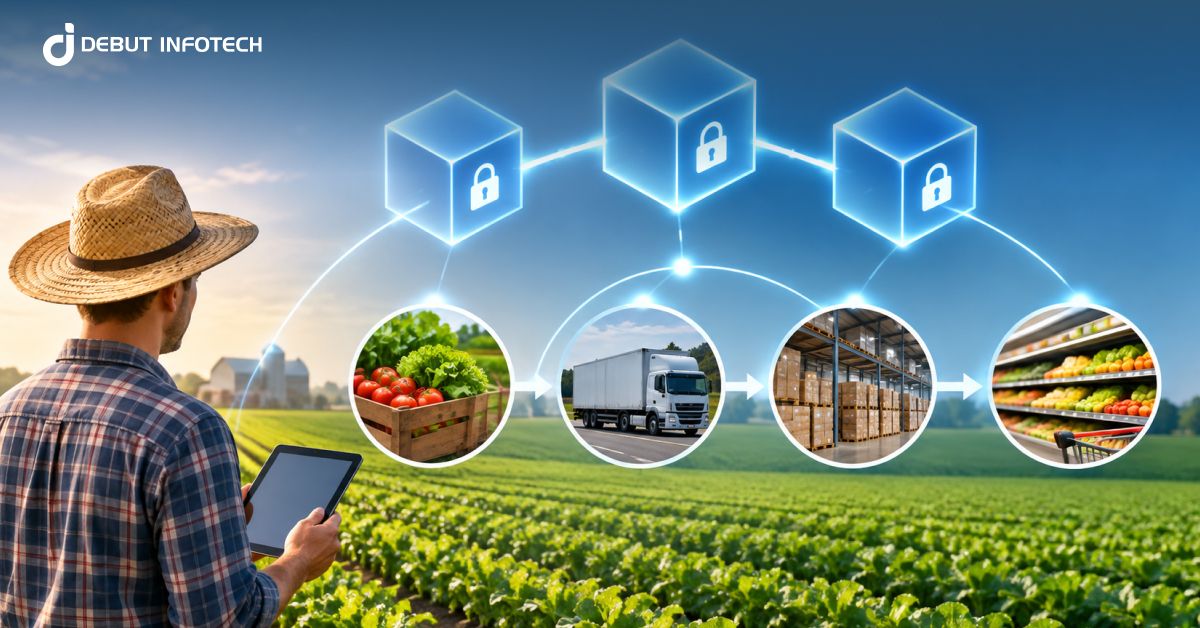


Blockchain merits evaluation when independent supply chain partners need shared, verifiable records and recurring disputes create measurable costs.
Traceability, certification checks, delivery acceptance, and cold chain monitoring are practical applications.
Reliable results depend on accurate source data, supplier participation, enterprise integrations, and agreed governance.
Implementation budgets must cover applications, integrations, supplier onboarding, and ongoing operations.
Start with one costly workflow, establish baseline metrics, and expand only when pilot results justify investment.
A conventional database may offer better value when participants accept one trusted operator.
Agricultural supply chains depend on accurate information about where products come from, how they move, and what buyers receive. A grower records the harvested quantity, a processor documents quality checks, and a carrier records delivery. When these records do not match, businesses spend time checking shipment details, resolving payment disputes, and verifying product claims.
Blockchain in agricultural supply chains gives growers, processors, logistics providers, and buyers a shared record of agreed transactions. For example, a shipment record can show who supplied the goods, the quantity dispatched, and what the buyer accepted. This can help businesses verify handovers and resolve discrepancies without repeatedly requesting documents from one another. The investment becomes worth considering when these problems cause recurring costs or delays.
This guide explains how blockchain works across agricultural supply chains and where it can support traceability, certification checks, delivery acceptance, and payments. It also examines implementation costs, ROI, and the steps required to connect business systems and onboard suppliers.
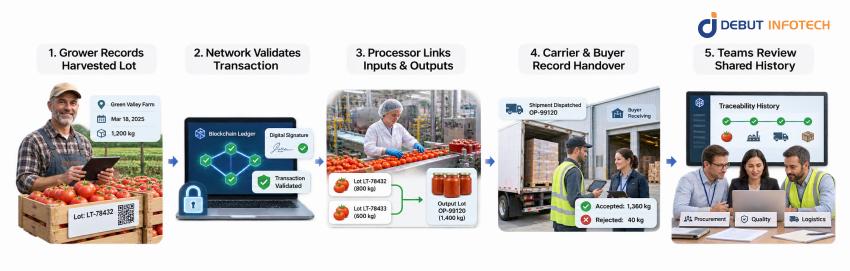
Blockchain technology in agriculture records agreed business events across a network of authorized organizations. For a produce shipment:
1. The grower records the harvested lot. The grower assigns a lot identifier and enters the farm location, harvest date, and quantity. This gives buyers an origin reference for checking sourcing claims and requesting evidence of agricultural product provenance.
2. The network validates the submitted transaction. The submitting organization signs the transaction using its digital identity. The network checks it against configured endorsement and validation rules before committing it to the ledger. These checks establish whether the submission meets network requirements; they do not verify the physical shipment.
3. The processor links incoming and outgoing goods. The processor records received quantities, quality checks, and packing details. When lots are combined, it links the inputs to the output. This supports agricultural supply chain traceability, helping teams identify affected products without searching unrelated shipments.
4. The carrier and buyer record the handover. The carrier logs dispatch details, and the buyer confirms received quantities and rejected goods. Finance teams can compare these records when resolving shortages or deciding whether an invoice qualifies for payment.
5. Authorized teams review the shared history. Procurement, logistics, and quality teams view permitted events through their applications. They can follow a lot through processing and delivery, inspect supporting documents, and identify subsequent corrections without losing the original transaction history.
A conventional database usually works when growers, processors, and buyers accept one organization as the operator of their shared records. Consider blockchain for agricultural supply chain management when participants need independently verifiable transaction history and shared rules for accepting changes. Its value depends on how the network distributes validation and administrative control, and whether those arrangements address a measurable business problem.
| Decision Factor | Conventional Database Usually Fits | Blockchain Merits Evaluation |
| Record Ownership | One organization controls the workflow | Independent organizations share responsibility |
| Trust Arrangement | Participants accept a central operator | Participants require independently verifiable history |
| Main Problem | Internal reporting or fragmented applications | Repeated disputes across company boundaries |
| Change Control | An administrator can manage corrections | Participants require agreed validation and correction rules |
| Participation | External parties mainly consume information | External parties contribute and verify events |
A shared database with signed records, access controls, and audit logs may satisfy the requirement at lower cost. Blockchain becomes more defensible when the business needs distributed verification and governance.
Before selecting technology, compare both approaches against the same workflow and operating assumptions. Debut Infotech’s blockchain consulting services can support that assessment through process mapping, participant analysis, and architecture evaluation.
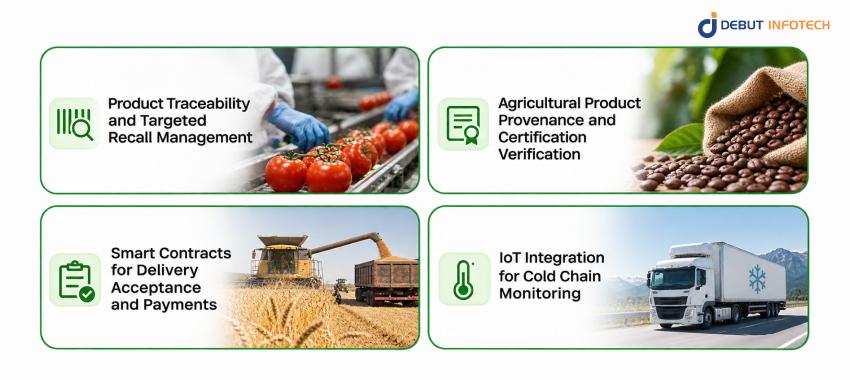
The strongest blockchain applications in agriculture involve records that several businesses must contribute, verify, and use to make decisions. The following examples show where shared transaction history can support a specific operational workflow.
If a processor discovers contamination in a batch of tomatoes, it needs to know which farms supplied that batch and which customers received it. Blockchain food traceability links the farm’s lot record to the processor’s batch and the distributor’s shipments.
The quality team can use those connections to identify potentially affected goods and notify the relevant customers. This can reduce time spent collecting records from suppliers. Missing batch links can still force a wider recall; blockchain cannot fill those gaps automatically.
For a US processor or distributor sourcing from domestic growers and overseas suppliers, test a lot that has been split, repacked, or combined during processing. Can the team connect each input to the affected outputs and identify every receiving customer? Define the record package needed for food safety and traceability, including lot identifiers, trading parties, dates, quantities, and transformation links. The system should export that evidence for review without requiring access to the blockchain itself.
A coffee importer paying a premium for certified beans needs evidence that the delivered lot matches the supplier’s claim. The platform links the lot to its farm of origin, trading history, and certificate details. Approved buyers can check who issued the certificate and whether it remains valid.
The blockchain contribution is a shared history of certificate references, lot transfers, and subsequent corrections that trading partners can verify. This supports food fraud prevention by making inconsistencies easier to investigate. Certificate issuers remain responsible for validating certification claims.
A grain buyer may require delivery confirmation and a passed quality inspection before approving payment. Smart contracts in agriculture check whether both approvals have been recorded, then mark the invoice ready for the finance system to process.
Effective smart contracts for agricultural supply chain management also account for exceptions. If only part of a delivery is accepted, the system can flag the disputed quantity for review. Smart contract development translates these agreed terms into tested rules; banks or payment providers execute the transfer.
For refrigerated produce, sensors measure temperature while goods move between storage facilities and carriers. Combining IoT and blockchain in agriculture links temperature alerts to the shipment’s recorded handovers, giving the grower, carrier, and buyer evidence of when a breach occurred.
The quality team can inspect the shipment and compare the alert with custody records. Sensors provide the measurements; blockchain preserves the submitted event history. Inspection results and contractual handling requirements determine the response.
Applications, integrations, and standardized records create much of a traceability platform’s operational improvement. The additional benefits of blockchain in agricultural supply chains come from allowing independent organizations to verify transaction history under shared validation and governance rules.
Evaluate the benefits of blockchain in agricultural supply chains against costs that operations and finance can substantiate:
Debut Infotech delivered the iFinca coffee supply chain platform in 2019, connecting farmers with exporters, importers, roasters, and cafes. The platform uses Hyperledger Fabric to record transactions, with mobile access, offline synchronization, and sensor-based weighing for coffee sacks.
Buyers could trace coffee to its source and farmgate price, while farmers contributed records through mobile tools.
In early 2017, Walmart conducted blockchain pilots with IBM to trace mangoes in the United States and pork in China. Walmart’s 2018 Global Responsibility Report Summary reports that the mango pilot reduced traceback time from nearly seven days to 2.2 seconds.
This use of blockchain in agriculture illustrates the value of connecting supplier records before an investigation begins. The historical result depended on captured product information, consistent identifiers, and supplier participation alongside the ledger.
Connecting existing systems and onboarding suppliers often requires more work than building the ledger. Agricultural blockchain implementation cost depends on the workflow, integrations, and number of businesses involved.
| Project Scope | Estimated Cost |
| Discovery and solution design | $10,000 to $25,000 |
| Focused pilot with limited integrations | $40,000 to $100,000 |
| Production platform with enterprise integrations | $150,000 to $400,000+ |
| Hosting, maintenance, and agreed support | $3,000 to $15,000+ monthly |
Ask for an estimate that separates three cost areas:
Calculate annual benefits from workflows with a measurable baseline. Reconciliation savings, for example, depend on annual exception volume, hours saved per exception, and loaded labor cost. Count staff capacity as a cash saving only when the business can actually reduce expenditure.
Net annual benefit = Annual measurable benefits − Annual operating costs
Simple payback period = Upfront implementation investment ÷ Net annual benefit
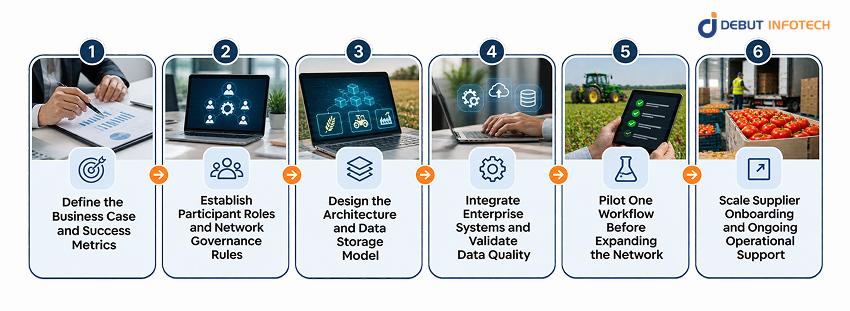
Choose one expensive workflow, such as delivery disputes or lot traceback. Establish the baseline before development:
Operations and finance should agree what would justify expansion: the required share of complete lot histories, an acceptable reduction in reconciliation time, sustained supplier participation, and an operating cost supported by measurable benefits. Set these thresholds before the pilot begins so the funding decision follows recorded results.
Agree who can join, submit records, validate transactions, and approve software changes. Assign responsibility for inaccurate submissions, disputes, operating costs, and participant exit. Secure anchor participants’ commitment to provide usable data before funding development.
Select a permissioned architecture when known organizations require controlled membership and commercial privacy. Separate shared events from confidential prices, personal information, and bulky evidence files.
Hyperledger Fabric’s documentation describes private data collections that restrict underlying data to authorized organizations while recording hashes on the channel ledger. Debut Infotech’s Hyperledger development services can help evaluate these controls against participant requirements.
Use existing systems as event sources where possible. Establish consistent lot identifiers, units, timestamps, and location references. API development services can connect those systems while supporting validation, retries, and duplicate detection.
Where trading partners use GS1 standards, evaluate EPCIS for exchanging traceability events. Agree the event structure and identifiers before integrating each supplier. A common exchange format can reduce custom mappings and make records easier to reuse across the network.
| Architecture Layer | Responsibility | Required Control |
| ERP, WMS, apps, sensors | Capture operational events | Authorized source and consistent identifiers |
| Integration Layer | Validate and submit transactions | Schema checks, retries, duplicate prevention |
| Permissioned ledger | Record agreed history | Membership and endorsement policies |
| Evidence storage | Retain documents and telemetry | Access, retention, backup, hash verification |
| Workflow applications | Support investigation and action | Role permissions and exception routing |
Reject incomplete events or route them for correction. Preserve correction history rather than silently overwriting disputed evidence.
Run the pilot alongside current operations and test realistic exceptions:
Compare pilot results with the baseline and an equivalent centralized solution. Review complete lot-history coverage, exception handling time, active supplier participation, and cost per transaction or shipment. Fund expansion only when the pilot meets the thresholds agreed by operations and finance.
Expand in waves based on supplier readiness and transaction importance. Provide mobile or portal access when direct integration is impractical, and test data capture under actual field conditions.
For each onboarding wave, assign responsibility for supplier training, failed submissions, missing events, and support costs. Across an agri-food supply chain, an operations owner should monitor participation and record completeness, while the technical team maintains integrations, access controls, and recovery procedures. Confirm these responsibilities before adding more suppliers.
A network may work technically while suppliers struggle to use it or refuse to share commercially sensitive records. The challenges of blockchain adoption in agricultural supply chains need attention before development budgets are committed.
US agribusiness teams should also confirm which customer, certification, and regulatory recordkeeping obligations apply to their products and activities. Build the required fields, retention rules, and export capabilities into the scope. Blockchain should support those obligations through accessible evidence and reliable reporting.
Debut Infotech addressed offline mobile access, sensor-based weighing, and transactions across independent coffee businesses through its work on iFinca. That experience informs the questions we help clients resolve before committing to development.
As a blockchain development company, we help assess where shared verification addresses a business problem and define the applications, integrations, and operating responsibilities needed to support it.
Our assessment turns the proposed workflow into a delivery scope your operations, finance, and technology teams can review:
These outputs help your team evaluate the proposed investment against a defined scope and determine what evidence the pilot must produce.
Participants submit identified business events, such as lot creation or delivery acceptance, to a shared ledger. Network rules determine which transactions can be committed. Applications connect the history to documents and operational systems. Its reliability depends on consistent identifiers, credible source evidence, and complete participation across the workflow being traced.
Applications include lot traceability, certification verification, delivery acceptance, and shared cold chain evidence. Potential benefits include less reconciliation work, faster dispute resolution, and more precise inventory investigations. These gains depend on data quality and adoption. Measure them against current operations and compare them with what a centralized platform could deliver.
iFinca illustrates a coffee platform combining a permissioned ledger with mobile tools and field data capture. Walmart’s historical mango traceback project with IBM demonstrated much faster retrieval of connected provenance records. Both examples show that applications, integrations, and participant processes contribute to results alongside the underlying blockchain.
A focused custom pilot might be budgeted at $40,000–$100,000. A production deployment could require $150,000–$400,000 or more. These figures are planning scenarios rather than quotations. Obtain a scoped estimate that identifies integration work, onboarding, infrastructure, support, exclusions, and ongoing responsibilities.
Common barriers include inaccurate source records, weak supplier incentives, fragmented identifiers, limited connectivity, and disagreement over governance. Commercial confidentiality can also restrict participation. Address these issues through field-ready capture tools, selective data access, shared operating rules, and funded onboarding. A technically successful ledger cannot compensate for missing or unreliable business events.
Blockchain merits evaluation when independent organizations must contribute and verify a shared transaction history, and unilateral control would create unacceptable trust or reconciliation problems. A conventional database usually fits when participants accept one operator and standard access controls and audit logs meet their needs. Compare total cost and governance requirements before committing.

Our Latest Insights
USA
2501 Chatham, Rd Suite R Springfield, IL 62704
+1-708-515-4004
info@debutinfotech.com
UK
7 Pound Close, Yarnton, Oxfordshire, OX51QG
+44-770-304-0079
info@debutinfotech.com
Canada
154 Eden Oak Trail, Kitchener, ON N2A 0H9
+1-708-515-4004
info@debutinfotech.com
INDIA
Sector 101-A, Plot No: I-42, IT City Rd, JLPL Industrial Area, Mohali, PB 140306
9888402396
info@debutinfotech.com