ON THIS PAGE
Progress0%






Our Global Presence :




Custom debt collection software helps businesses centralize overdue accounts, automate permitted communications, manage payment plans, and maintain consistent collection workflows.
Core features include case management, debtor payment portals, integrated SMS and email communication, recovery analytics, and role-based access controls.
Custom software versus SaaS depends on business needs: SaaS generally offers faster deployment and lower upfront costs, while custom development provides greater control over workflows and integrations.
Regulatory compliance requires workflows that account for applicable FDCPA, Regulation F, TCPA, and FCRA obligations, supported by audit logs, consent records, security controls, and legal review.
Development costs and timelines vary by complexity: an MVP may cost $30,000–$60,000 and take 3–5 months, while enterprise platforms may cost $150,000–$350,000 or more.
Successful implementation starts with defined requirements, a suitable technology stack, essential MVP modules, tested integrations, secure data migration, and staff training.
Choosing a development partner requires evaluating fintech experience, compliance expertise, security practices, transparent pricing, ongoing support, and contractual ownership of code and data.
Debt collection can become difficult to manage when account volumes grow, payment plans multiply, and teams rely on manual follow-ups.
Custom debt collection software helps businesses centralize account records, automate permitted communications, track repayments, and manage compliance on a single platform. It also lets companies build workflows around their collection policies instead of forcing teams to work around a generic tool.
The need for effective collection processes is clear. The Consumer Financial Protection Bureau (CFPB) reported that the US third-party debt collection market was valued at $20.2 billion, with around 140,000 employees across more than 6,400 agencies. In addition, the Federal Reserve Bank of New York reported that US household debt reached $18.04 trillion in the fourth quarter of 2024.
This guide explains how custom debt collection software works, which features businesses should prioritize, and how to build a reliable platform. It also examines development costs, compliance requirements, common challenges, and the criteria for choosing a development company.
Custom debt collection software is an application designed around an organization’s specific processes for managing overdue accounts, contacting debtors, collecting payments, and maintaining records. Unlike ready-made products, it can reflect the business’s collection rules, reporting requirements, user roles, and integration needs.
Banks, fintech lenders, credit unions, collection agencies, healthcare providers, utility companies, and businesses with large accounts receivable portfolios can use these systems. Agencies may need multi-client account management, while lenders may prioritize repayment schedules and payment tracking. Healthcare providers may require billing integrations and flexible payment arrangements.
Consider custom debt collection software when standard platforms cannot support essential workflows, security policies, or integrations. Businesses with straightforward requirements may find subscriptions more economical. Organizations managing large portfolios, several departments, or complex collection processes may benefit more from a platform designed around their operations.
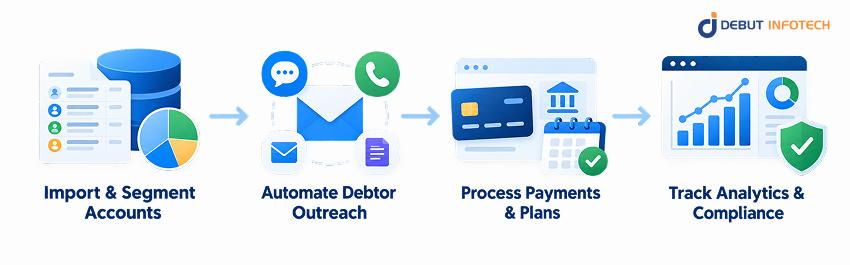
Debt collection software works by importing delinquent accounts, segmenting them by priority, automating permitted debtor communications, processing payments, and tracking recovery performance. It centralizes account information, schedules follow-ups, manages payment plans, and maintains compliance records.
These four processes help collection teams manage overdue accounts more consistently.
The system imports account records from accounting platforms, loan management applications, CRMs, or spreadsheets. It organizes accounts by overdue period, outstanding balance, payment history, and status.
Accurate segmentation helps collectors prioritize cases, assign workloads, and identify accounts requiring attention. Data validation reduces duplicate records and errors in data collection.
The platform schedules approved communications through email, SMS, letters, and telephone calls. Templates maintain consistent messaging, while workflow rules determine when follow-ups should occur.
Consent checks, contact restrictions, and communication logs help prevent prohibited outreach. Automation reduces the need for manual reminders and allows collectors to focus on cases requiring personal attention.
Payment integrations allow debtors to pay via supported methods, including cards and bank transfers. The system records transactions, updates balances, and generates receipts. Payment-plan tools track installments, send permitted reminders, and flag missed payments. Reconciliation features help finance teams compare collection records with payment processor and accounting data.
Reporting dashboards measure recovery rates, overdue balances, collector workloads, and payment-plan performance. Managers can compare results across teams and account categories.
Timestamped records of communications, payments, disputes, and account changes support audits and complaint investigations. Access controls help ensure employees see only the information required for their responsibilities.
Custom debt collection software offers tailored workflows, built-in compliance controls, direct system integrations, automated follow-ups, and greater control over data security. It can also reduce dependence on per-user licensing and improve operational efficiency.
The following benefits depend on the quality of implementation, accurate data, and effective staff procedures.
Every organization follows different procedures for prioritizing accounts, assigning collectors, arranging repayments, and escalating unresolved cases.
Custom software can encode these rules into configurable workflows. For example, an account may move to supervisor review after a defined period, provided the next action complies with applicable restrictions and internal policies.
This flexibility helps managers maintain consistent procedures without forcing staff to work around generic software. Teams can revise priorities as portfolio needs change, reduce repetitive administration, and give collectors clearer instructions. Workflow changes should be tested before deployment to prevent errors across active accounts.
Collection activities may be subject to rules governing communication, disclosures, disputes, and consumer reporting. Custom software can incorporate relevant controls into scheduling, message templates, consent checks, and approval processes. This makes compliance part of daily operations instead of leaving every decision to manual review.
Configurable rules allow authorized staff to update controls when requirements change. Automated safeguards can block restricted contact attempts and flag cases needing review. Software cannot guarantee compliance on its own. Organizations still need legal guidance, staff training, documented policies, and regular testing to ensure that system behavior matches applicable obligations.
Custom platforms can connect with accounting applications, enterprise resource planning systems, customer relationship management software, and loan servicing tools. These integrations reduce duplicate data entry and help synchronize account balances, customer records, invoices, and payment activity.
Collectors gain a more complete account history without switching between disconnected applications. Finance and customer service teams can also work from more consistent information. Clear data ownership rules and error handling remain important because conflicting updates can create inaccurate balances or missed payments.
Automated reminders, payment links, account prioritization, and scheduled follow-ups help teams consistently contact eligible debtors. Analytics can identify accounts that may need earlier attention, while payment-plan tools simplify repayment. These functions reduce missed tasks and improve visibility across collection activities.
Recovery results still depend on debt characteristics, data quality, communication practices, and the effectiveness of the collection strategy. Automation does not guarantee higher recovery rates. Businesses should measure outcomes before and after implementation and adjust workflows based on reliable performance data.
A custom platform may give the business ownership of its source code and control over its data, depending on the development contract. Agreements should define intellectual property rights, third-party components, repository access, and documentation ownership before work begins.
Avoiding per-seat subscriptions may improve long-term cost control as teams grow. However, hosting, maintenance, security updates, support, and enhancements still require funding. The financial advantage depends on user volume, contract terms, ongoing operating costs, and the length of time the organization plans to use the platform.
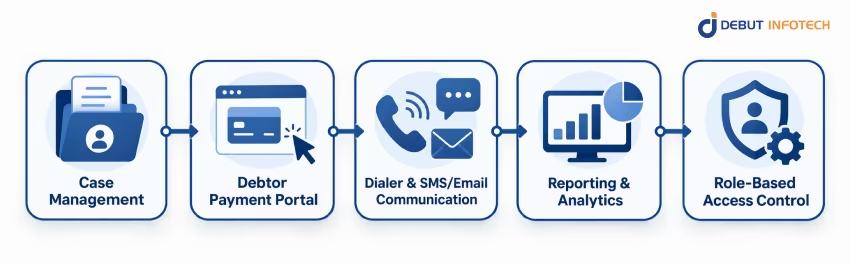
Effective debt collection software should include case management, a secure debtor payment portal, integrated communication tools, reporting dashboards, and role-based access controls. These features help collectors manage accounts, accept repayments, track communication, measure recovery performance, and protect sensitive financial information while maintaining clear records of collection activities.
Case management organizes debtor profiles, outstanding balances, payment history, disputes, contact records, and assigned tasks.
Collectors can review account activity, record notes, and track next actions. Prioritization rules help teams manage large portfolios consistently and identify cases requiring review.
A self-service portal lets debtors review eligible balances, make payments, request arrangements, and download receipts. Clear payment options reduce routine enquiries. Secure authentication and accurate account information help protect sensitive data and prevent confusion during repayment.
Integrated communication tools manage calls, emails, and text messages through one interface. Templates, delivery records, consent checks, and suppression controls reduce repetitive work. Automated dialing and messaging must follow applicable communication laws and restrictions.
Dashboards track recovery rates, overdue balances, payment-plan performance, contact outcomes, and collector workloads. Filters help managers compare results across teams and periods. Accurate reporting depends on consistent definitions and reliable synchronization with payment and accounting systems.
Role-based access controls information and actions based on employee responsibilities. Collectors, supervisors, finance teams, and administrators receive appropriate permissions. Sensitive activities, including account changes and data exports, should be logged and may require additional approval.
Custom debt collection software is built around a business’s specific requirements, while software-as-a-service (SaaS) provides predefined features on a subscription basis.
SaaS usually offers faster deployment and lower initial costs. Custom development provides more control over workflows, integrations, and architecture, but requires greater upfront investment and ongoing technical management.
| Factor | Custom software | Off-the-shelf SaaS |
| Upfront cost | High | Low |
| Recurring cost | Hosting, maintenance, support | Subscription and usage fees |
| Timeline | Several months or longer | Days to weeks |
| Customization | Extensive | Vendor-defined options |
| Compliance ownership | Business and development partners | Business and vendor, according to responsibilities |
| Scalability | Designed around requirements | Depends on vendor plans |
| Data portability | Defined by architecture and contract | Depends on export options and contract |
SaaS suits businesses that need standard features quickly and can adapt to existing workflows. Custom development is better suited to organizations with complex integrations, specialized collection strategies, or strict internal security requirements.
Compare total costs over several years, including upgrades, support, migration, and third-party services. Review service availability, data export rights, and termination terms before deciding. Choose the option that meets current needs without creating unnecessary operational or financial burdens.
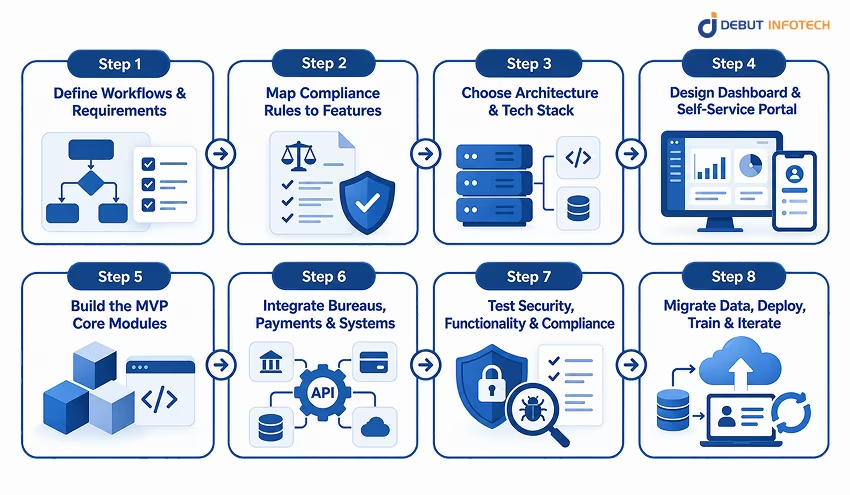
To build custom debt collection software, define requirements, map applicable regulations, select the technology stack, design interfaces, develop core modules, integrate external systems, test for security and compliance, and deploy the platform. Following these steps helps control project risks, protect debtor information, and ensure the system supports actual collection workflows.
Document the process from account assignment to settlement. Identify user roles, account categories, communication channels, escalation rules, reporting needs, and integrations.
Interview collectors, supervisors, finance staff, and compliance teams. Convert findings into prioritized requirements and measurable goals, such as fewer manual tasks or more accurate payment reconciliation.
Identify applicable laws based on debt type, business role, communication method, and jurisdiction. Map requirements to contact restrictions, consent records, validation notices, dispute handling, and communication logs.
Have qualified legal and compliance professionals review the mapping before development so controls reflect actual obligations.
Select an architecture that supports expected account volumes, integrations, security requirements, and future growth. A modular application may suit an MVP better than complex microservices. Choose technologies based on team expertise, maintainability, hosting needs, and integration support rather than popularity alone.
Create separate interfaces for collectors and debtors. The dashboard should display account status, history, pending tasks, and permitted actions. The portal should clearly explain balances, payment options, and arrangement terms.
Test prototypes with users to identify navigation problems, accessibility issues, and unnecessary steps before implementation.
Start with account management, segmentation, case tracking, approved communications, payment recording, and basic reporting. Include role-based permissions and audit logs from the beginning.
Validate an end-to-end collection process before adding predictive analytics or advanced automation. A focused MVP helps test assumptions without immediately funding every planned feature.
Connect required credit reporting services, payment processors, CRMs, ERPs, and accounting tools. Define data ownership, authentication, synchronization, and error handling.
Test integrations in sandbox environments, including failed payments and duplicate notifications. Validate reporting permissions and transaction accuracy before connecting live accounts.
Test account calculations, payment flows, permission boundaries, contact restrictions, dispute handling, and audit records. Conduct performance testing, vulnerability assessments, and appropriate penetration testing.
Ask compliance specialists to review realistic scenarios. Resolve critical defects before launch, document the results, and establish a process to monitor remaining risks.
Clean and validate account records before migration. Remove duplicates, map fields, verify balances, and reconcile samples against source systems.
Deploy through a controlled pilot, train staff by role, and monitor errors and user feedback. Use post-launch results to refine workflows and prioritize improvements without disrupting collection operations.
Compliance requirements for debt recovery software development depend on the debt, the business role, the communication method, and the jurisdiction. US collection platforms may need to support several federal laws. Legal advisers should confirm which provisions apply to each workflow.
The Fair Debt Collection Practices Act (FDCPA) restricts certain practices by covered debt collectors, including harassment, false representations, and prohibited collection conduct. Software should support accurate account records, required disclosures, dispute handling, and communication histories. Applicability varies by business and activity, so organizations should obtain legal guidance before configuring controls.
Regulation F implements the FDCPA and addresses debt collection communications and validation information. Controls may include contact counters, notice templates, date tracking, and dispute flags.
Generally, placing more than seven telephone calls within seven consecutive days about a particular debt, or calling within seven days after a telephone conversation about that debt, creates a rebuttable presumption of violation, subject to exceptions.
The Telephone Consumer Protection Act (TCPA) regulates certain calls and text messages, with requirements that vary by technology, purpose, and consent.
Software should maintain consent records, process opt-outs, support applicable do-not-call screening, and suppress restricted communications. Legal review should address automated dialing, artificial or prerecorded voices, and messaging practices relevant to the organization’s outreach.
The Fair Credit Reporting Act (FCRA) governs consumer reporting and the use of consumer report information in covered circumstances. Platforms should support accurate reporting, permissible access, dispute investigations, and corrections.
Restrict submission permissions and maintain records of reporting changes. Confirm the responsibilities of furnishers and users of consumer reports with qualified advisers before implementing related workflows.
Development costs depend on feature complexity, integrations, security controls, team rates, and deployment needs. Debt collection software development typically costs between $30,000 and $60,000 for an MVP, $60,000 and $150,000 for a mid-level platform, and $150,000 or more for an enterprise solution.
An MVP with account management, basic workflows, payment recording, and reporting may cost 30,000–60,000 and take three to five months. A mid-level platform with automated outreach, a debtor portal, integrations, and stronger analytics may cost 60,000–150,000 over five to nine months. An enterprise system with complex integrations, multi-client support, and advanced controls may cost 150,000–350,000 or more and take nine to fifteen months or longer.
| Build level | Estimated cost | Timeline |
| MVP | 30,000–60,000 | 3–5 months |
| Mid-level | 60,000–150,000 | 5–9 months |
| Enterprise | 150,000–350,000+ | 9–15+ months |
A focused first release can help businesses validate requirements before funding advanced features. Ask developers or debt collection software customization services to itemize deliverables, assumptions, integrations, and testing. Actual costs vary with team location, technical complexity, third-party fees, and the quality of existing systems and data.
Key debt collection software development cost drivers include:
Request an itemized estimate covering design, development, testing, migration, and deployment. Confirm whether hosting, external API fees, legal review, and future changes are included. Clear assumptions make proposals easier to compare and reduce budget surprises.
Budget for hosting, monitoring, backups, bug fixes, security patches, and technical support after launch. A common planning allowance is 15–25% of initial development costs annually for maintenance, although actual spending varies. Cloud usage and third-party services may be charged separately.
Regulatory changes in debt collection software development solutions may require updated workflows, templates, contact controls, and regression testing. Reserve funds for significant enhancements and compliance reviews. Support agreements should define response times, security responsibilities, release schedules, and fees for work outside the agreed scope.
Hard-coded legal rules make updates expensive in debt collection software development for enterprises.
With the help of reputable fintech software development service providers, build configurable settings for contact limits, notices, consent restrictions, and escalation criteria. Record rule changes and require authorized approval. Compliance specialists should review updates and test affected workflows before deployment to reduce the risk of prohibited collection actions.
Older accounting and loan servicing systems may have limited APIs or inconsistent data formats. Use API-first design for new modules and introduce integrations in phases. Document data ownership, retry logic, and error handling. Pilot critical connections before extending them across the collection operation.
Weak access controls can expose personal and financial information in custom debt collection software. Encrypt sensitive data, enforce least-privilege access, require multifactor authentication, and log important actions. Test backups and debt recovery procedures regularly. Establish incident response plans and conduct security assessments before launch and throughout the platform’s lifecycle.
Staff may resist custom debt collection software that disrupts familiar routines. Involve collectors during requirements gathering, test prototypes with them, and address feedback early.
Provide role-specific training and accessible support. A phased rollout allows teams to identify usability problems and build confidence without interrupting the entire collection operation.
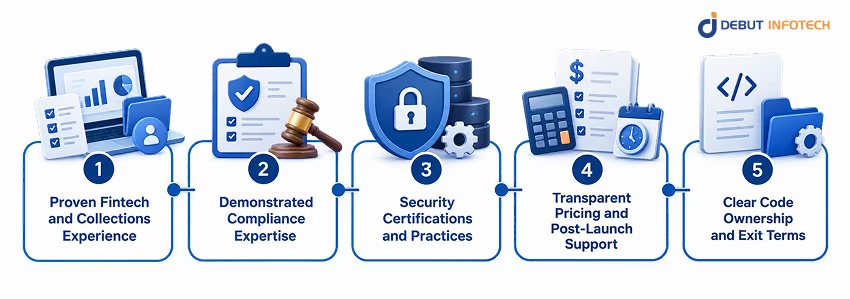
Choose a custom debt collection software development company with proven fintech experience, practical knowledge of applicable collection regulations, strong security practices, transparent pricing, and reliable post-launch support. Confirm source code ownership, data rights, and exit terms before signing. These checks help you select a custom debt collection software development partner capable of delivering and maintaining a suitable platform.
Review relevant fintech projects, collection platforms, payment integrations, and case studies. Ask for references and examples of comparable implementations. Experience with similar workflows helps developers identify requirements and reduce avoidable technical risks.
Confirm experience translating applicable collection regulations into testable software controls. When you hire debt collection software developers, they ought to collaborate with legal and compliance advisers to validate workflows, consent checks, and communication restrictions. Technical expertise alone cannot replace qualified legal guidance.
Examine secure development procedures, encryption, access controls, vulnerability testing, and incident response. Request relevant independent assessments where available. Verify how the team protects production data during development, testing, migration, and ongoing support.
Request itemized pricing for enterprise debt collection software development, integrations, testing, deployment, and maintenance. Confirm support hours, response times, warranty terms, and change-request fees. Clear agreements help control spending and establish responsibility after launch.
Define ownership of source code, documentation, custom components, and project data. Confirm repository access, third-party licensing, export formats, and transition support. Clear exit terms protect your ability to maintain or transfer the platform.
Debt collection software development helps businesses manage overdue accounts, automate permitted communications, and improve reporting.
Custom platforms suit organizations whose workflows exceed standard software capabilities.
Debut Infotech helps businesses build custom software around their operational needs. Our development team can help you create debt collection platforms with automated workflows, payment integrations, reporting dashboards, and security controls.
Whether you’re modernizing an existing system or building a solution from scratch, our custom software development company prioritizes practical functionality, scalability, and long-term support.
1. How Long Does It Take to Develop Debt Collection Software?
Developing debt collection software typically takes 3 to 9 months, depending on its features and complexity. A basic system with payment tracking and automated reminders may take 3 to 4 months to build. More advanced platforms with AI, multiple integrations, analytics, and compliance tools can take 6 to 9 months or longer to implement.
2. How Does AI Improve Debt Collection Software?
AI improves debt collection software by helping teams predict payment behavior, prioritize overdue accounts, and personalize collection messages. It can also automate routine tasks, recommend suitable repayment plans, and analyze customer responses. This helps collection teams save time, reduce manual work, and focus on accounts that need closer attention.
3. Is Custom Debt Collection Software Better Than Off-the-Shelf Debt Collection SaaS?
Custom debt collection software is often better for businesses with specific workflows, complex integrations, or strict compliance needs. Off-the-shelf SaaS is usually faster to deploy and costs less upfront. The right choice depends on your budget, operational needs, scalability plans, and the level of control you want over features and data.
4. Which Technology Stack and System Integration Are Required for Debt Collection Software?
A typical debt collection software stack includes React or Angular for the frontend, Node.js, Python, or Java for the backend, and PostgreSQL or MySQL for data storage. Integrations may include CRM systems, accounting software, payment gateways, banking APIs, email and SMS services, and identity verification tools, depending on business requirements.

Our Latest Insights
USA
2501 Chatham, Rd Suite R Springfield, IL 62704
+1-708-515-4004
info@debutinfotech.com
UK
7 Pound Close, Yarnton, Oxfordshire, OX51QG
+44-770-304-0079
info@debutinfotech.com
Canada
154 Eden Oak Trail, Kitchener, ON N2A 0H9
+1-708-515-4004
info@debutinfotech.com
INDIA
Sector 101-A, Plot No: I-42, IT City Rd, JLPL Industrial Area, Mohali, PB 140306
9888402396
info@debutinfotech.com