ON THIS PAGE
Progress0%






Our Global Presence :






There are more large organizations today looking to build decentralized exchanges than there were a couple of years ago. And the reason for that isn’t far-fetched. It is because there are more customers looking for decentralized trading solutions a couple of years ago.
The intents for decentralized exchanges revolve around providing a medium for users around the world to trade directly from their wallets with whomever they please, wherever they are, and more importantly, on their own terms with little or no single points of failure. The immense value they offer makes them a no-brainer for any corporate organization that wants user-owned custody for its customers, swift and transparent trade execution, and resilient market access without centralized controls.
There’s clearly an immense amount of business opportunity for any organization brave and competent enough to tap in.
But it’s not just all upside. There are trade-offs in terms of cost and execution requirements that these corporate organizations must meet before they advance.
And that’s where you start to wonder if it is truly worth it.
If you have similar doubts as a startup founder, business owner, or C-suite executive looking to get into decentralized exchange development, this article is your comparative analysis crash course. It discusses what a decentralized exchange is, how it actually works, which DEX features matter, what a realistic DEX development cost looks like, and where the real enterprise ROI lives.
Let’s take a deep dive.
A decentralized exchange (DEX) is a blockchain-based trading platform that facilitates direct, peer-to-peer trading between trading partners worldwide without a centralized authority. In the absence of a centralized authority, smart contracts enable this transfer of control to multiple control points. They define rules that ensure users trade directly from their wallets, rather than handing assets to a central custodian.
Therefore, with decentralized exchanges, organizations don’t assume any account-custodial risks; likewise, users don’t have to deal with withdrawal queues because everything is direct. All they need to do is connect a wallet, approve a transaction, and they can start trading peer‑to‑pool or peer‑to‑peer in a few minutes.
But how is that even possible?
Instead of a centralized matching engine and omnibus custody, a DEX features on‑chain logic to handle quotes, pricing, swaps, and settlement. Therefore, depending on the model, liquidity may come from automated market maker (AMM) pools, an on‑chain order book, or a hybrid that blends both.
As a result, peer-to-peer trades are settled on the chain, thereby making the state transparent, as the “rules” of every transaction are enforced by code. That’s the key defining factor about most decentralized exchange benefits: users have full custody, the entire system can be audited transparently, and there are little or no opaque intermediaries.
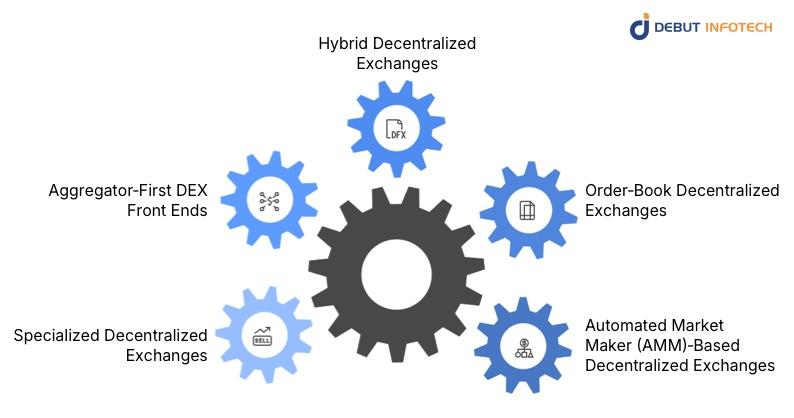
Although all decentralized exchanges aim to eliminate intermediaries and provide users with quicker access to trading solutions, they differ significantly in their operating models and technical architectures.
Below, we have highlighted some key types of decentralized exchanges:
AMM‑based decentralized exchanges rely on liquidity pools instead of traditional buyers and sellers.
This means that when individual users try to initiate trades on these types of decentralized exchanges, the system doesn’t execute them using matching orders. Instead, AMM-based DEXs rely on pooled assets from multiple sources and set pricing formulas using smart contracts.
As a result, swaps become instant and predictable, thus making them ideal for trading long-tail tokens and exploring new markets. In addition, trading becomes simple, composable, and quick.
Order‑book DEXs recreate the familiar trading experience of centralized platforms, but without custodial risk.
Here’s how it works:
Buyers and sellers place limit or market orders, which are matched either fully on‑chain or through hybrid designs with on‑chain settlement. This model appeals to professional traders and institutions that require price precision, depth visibility, and advanced order types. As a result, order‑book DEX development favors high‑volume and enterprise‑grade trading environments.
Hybrid decentralized exchanges tend to have features of both centralized and decentralized exchanges. This boils down to the fact that they execute trades by combining AMM liquidity pools, order books, and Request for Quote (RFQ) mechanisms into a single system.
And that’s why both retail and institutional traders usually opt for this type of decentralized exchange, as it improves capital efficiency and trade execution. On the one hand, AMMs handle long‑tail liquidity; on the other, order books or RFQs handle large or sensitive trades.
This multi-pronged approach makes them ideal for enterprises aiming to build decentralized exchange platforms that can serve different user segments.
DEX aggregators execute crypto trades by scanning multiple decentralized exchanges, identifying the optimal trading path for a token swap, and then routing trades to the best available prices in real time. The aggregator-first DEX front ends merely provide a single trading interface to the customers to find these ‘optimal’ trading paths. They do not host their own pools, and that is a good thing in a way because execution quality improves, and the slippage on the end-user side is more or less eliminated.
Therefore, companies pursuing decentralized crypto exchange development and aggregator‑driven designs should focus more on UX, analytics, and routing intelligence than on protocol‑level liquidity.
Specialized DEXs are built around specific asset classes or trading products rather than general swaps. So, an organization could build a DEX that specializes in facilitating the trading of futures, perpetuals, options, or even a slight combination of a few of them for either NFTs, carbon credits, or real-world assets, but not offering all services.
The asset classes we have listed have varying requirements. Therefore, specialized decentralized exchanges offer only custom services for these asset classes. The major advantage of this service offering is the precision enabled by its features, risk control system, and incentive model. The users in that market segment feel well catered to.
So, when we say that enterprises are looking to invest more in building centralized exchange platforms, what are the key features influencing this shift?
Below, we have highlighted key technical features that any high-quality modern decentralized exchange should possess.
Every decentralized exchange needs a trading engine. For example, AMMs use liquidity pools and formulas (e.g., the constant product formula) to price trades. This eliminates the need to go through traditional market makers.
On the other hand, hybrid DEX models use either on‑chain or off‑chain order books (with on‑chain settlement) to serve the same functionality, including the semblance of limit orders and depth visibility. Finally, Request‑for‑Quote modules and permissioned pools allow negotiated pricing, reduced information leakage, and compliance‑aware access.
Liquidity is the backbone of any decentralized exchange, and for enterprises, flexibility is the real differentiator. A well‑designed liquidity layer allows for both single‑sided and bi‑sided pools, configurable fee tiers, and automated rebalancing mechanisms.
In practice, this means product teams can adapt liquidity strategies to market conditions, while liquidity providers (LPs) receive intuitive, rewarding tools. High‑quality DEX development services focus on building liquidity systems that support growth without adding unnecessary complexity.
Security is not optional in decentralized exchange development—it’s foundational. Every decentralized exchange script begins and ends with its smart contracts, which is why audits are a non‑negotiable launch requirement. A Security‑First DEX typically undergoes multiple independent audits and, where appropriate, formal verification to validate critical logic. Just as important is having a clear upgrade and patching process, so fixes don’t introduce new risks post‑deployment.
Pricing integrity is equally critical. Robust oracle design, medianized price feeds, and manipulation‑resistant mechanisms ensure the exchange’s “price of record” remains reliable. Without this, even well‑audited DEXs become vulnerable to sandwich attacks and short‑term volatility exploitation.
For enterprises, a decentralized exchange is also a data engine. Executives and product teams need clear visibility into daily, weekly, and monthly performance, covering volume, fees, liquidity depth, and user behavior. Strong analytics infrastructure transforms raw on‑chain data into actionable insights that guide decision‑making.
Even the most sophisticated decentralized exchange fails if users struggle to interact with it. Seamless wallet integrations are a baseline requirement—supporting major wallets and hardware devices ensures users can trade securely with minimal friction. Ideally, most interactions require only a wallet connection and a single transaction approval.
Lastly, modern decentralized crypto exchange development must be multi‑chain by default. Whether through native deployments or cross‑chain messaging layers, serious DEX platforms meet users where liquidity already exists. Cross‑chain support isn’t just a feature anymore—it’s an expectation.
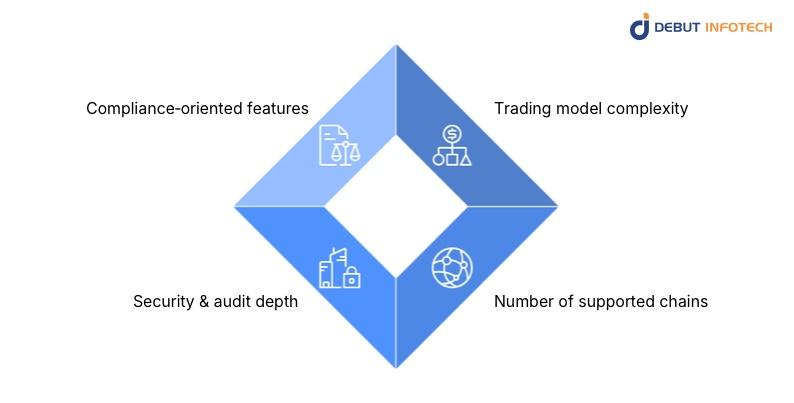
So, what should you budget for when developing a decentralized exchange?
The honest answer to this is that what you have to budget for depends on the platform’s trading model, security posture, and multichain ambitions.
Let’s break this down below:
The complexity of your platform’s trading model determines the type of trading engine you should go with, which directly affects development costs.
This logic means that an AMM-only DEX platform would be more affordable than a hybrid model that combines an AMM with order-book logic and RFQ mechanisms. The latter needs a more complex engineering and security review than the former.
As you might have imagined, multi-chain DEX platforms tend to cost slightly more than single-chain DEX platforms. This is because adding a new network to the decentralized exchange script requires additional infrastructure, indexers, QZ cycles, and monitoring overhead.
All these things cost more to implement effectively. In fact, multichain DEX development is typically 2 to 3 times more expensive due to expanded testing and compatibility work.
Budgets change most when it comes to security. Smart contract audits can account for 15–35% of the overall build cost, according to industry data, particularly when formal verification or ongoing monitoring is needed.
Compliance-oriented features are key functionalities that ensure the DEX platform remains compliant with prevailing regulatory standards. While these should not be treated as extras, you should expect a larger engineering footprint if your DEX calls for reporting layers, regional limits, permissioned pools, or KYB flows for institutional users. These controls increase testing, add more smart contract gates, and incorporate bespoke business logic. And that’s why they significantly impact your development costs.
We’ve provided a rough cost estimate for different types of decentralized exchanges to give you an idea of what to expect.
| S/N | DEX Type | Estimated cost range (USD) |
| 1 | White label decentralized exchange platform. | 10,000 – 20,000 |
| 2 | Entry-level custom | 30,000 – 80,000 |
| 3 | Mid-scale multi-chain DEX | 80,000 – 150,000 |
| 4 | Fully custom security-first DEX | 50,000 – 350,000 |
| 5 | Enterprise DEX | 250,000 – 500,000 |
We now have a rough idea of the cost to implement DEX development. But what are the potential returns on investment?
What are the decentralized exchange benefits enterprises stand to gain in terms of revenue, ecosystem control, and long‑term operational resilience?
Below, we have framed these potential returns across two major verticals. Let’s have a look
Enterprises can enjoy better revenues and a more profitable business model in terms of the following tangible benefits:
Enterprises can enjoy more revenue by charging trading fees when users interact directly with the protocol. Furthermore, these fees can be varied depending on the asset class, market segment, and liquidity requirements of each investor. This revenue source has been a major draw for investors contemplating implementing a decentralized exchange.
For partners who want deeper market access for their tokens, businesses can offer liquidity packages. By providing incentives, tailored LP programs, and priority listing algorithms, this “liquidity-as-a-service” model enables you to monetize your exchange infrastructure. Because liquidity is always needed, particularly for developing ecosystems, this business model is scalable.
But revenue isn’t the only upside for engaging in this. There are other strategic benefits for investing in decentralized exchange development, and many executives tend to underestimate these intangibles. Some of them include:
By owning a DEX, you effectively own the rails of your digital economy. You’re not relying on a third‑party platform to list assets, manage liquidity, or gate your innovation. You control the roadmap, listing rules, incentives, and infrastructure — reducing friction for every future product you launch.
A DEX gives you first‑party data that centralized exchanges do not share: volume trends, liquidity behavior, retention signals, pool performance, and user‑level interactions (aggregated and privacy‑preserving). This is the kind of intelligence that helps ecosystems optimize incentives, improve product decisions, and forecast growth.
For years, decentralized exchanges were seen as clever—but limited. Today, decentralized exchange development is practical, scalable, and aligned with where digital markets are headed: user custody, programmable liquidity, and transparent execution that teams can actually ship on. The winners won’t just launch a DEX; they’ll design the right engine, implement Security‑First DEX principles, build sustainable liquidity, and measure ROI like a real business. And in turn, they’ll reap the decentralized exchange benefits like increased revenue and ecosystem control.
If that’s your direction, our DEX development services here at Debut Infotech have been crafted specifically for you. From discovery and protocol selection to a security-first, audit-ready approach, our customers have reaped the benefits of our years of industry experience.
Reach out today for a consultation.
This is the process of creating a cryptocurrency trading platform that allows consumers to trade directly from their wallets using smart contracts. In contrast to centralized exchanges, DEXs give customers greater control and transparency by eliminating custodial risk and relying on on-chain logic for pricing, settlement, and execution.
User-owned custody, transparent execution, lower counterparty risk, and programmable trading logic are the main advantages of decentralized exchanges. Additionally, DEXs offer firms resilience against centralized exchange outages or regulatory disruptions, first-party market data, and ecosystem control.
The complexity of the trading model, the number of supported blockchains, the security requirements, and the depth of the analytics all affect the cost of developing a DEX. A fully customized, security-first decentralized exchange with hybrid liquidity, audits, and multi-chain support is significantly more expensive than an MVP AMM-based DEX.
For businesses looking for a quicker time-to-market without starting from scratch, a white-label decentralized exchange is frequently the best option. While branding, liquidity strategy, and compliance-oriented controls can be customized, it offers pre-built trading logic, essential DEX capabilities, and security components.
The development of decentralized exchanges generates enterprise ROI through trading fees, liquidity services, and ecosystem expansion. DEXs are beneficial beyond short-term profit calculations because they deliver strategic ROI through data ownership, reduced reliance on third-party platforms, and long-term control of infrastructure.

Our Latest Insights
USA
2501 Chatham, Rd Suite R Springfield, IL 62704
+1-708-515-4004
info@debutinfotech.com
UK
7 Pound Close, Yarnton, Oxfordshire, OX51QG
+44-770-304-0079
info@debutinfotech.com
Canada
154 Eden Oak Trail, Kitchener, ON N2A 0H9
+1-708-515-4004
info@debutinfotech.com
INDIA
Sector 101-A, Plot No: I-42, IT City Rd, JLPL Industrial Area, Mohali, PB 140306
9888402396
info@debutinfotech.com