ON THIS PAGE
Progress0%






Our Global Presence :





The rise of decentralized finance hinges on infrastructure that delivers security, transparency, and efficient trading — and that’s where a Decentralized Exchange Script plays a central role.
In 2025, weekly decentralized exchange trading volume averaged $18.6 billion, up about 33 % year-on-year, while unique wallets interacting with DEXs surged from 6.8 million to over 9.7 million, reflecting broad adoption of on-chain markets. These platforms now handle spot and derivatives activity that rivals legacy systems, driven by demand for non-custodial asset control and programmable liquidity.
A robust DEX script provides a ready foundation for deploying secure smart contracts, integrating with multi-chain liquidity, integrating with popular wallets, and customizing utility tokens. Across core features like atomic swaps, liquidity pools, and advanced order books, such scripts accelerate deployment while preserving trustless execution in evolving crypto ecosystems.
In this article, we will explain the meaning of DEX scripts, its core features, why businesses use them, their advantages, the top leading scripts in the market, development timelines, and costs.
A decentralized exchange script is a pre-built, customizable software solution used to create a blockchain-based trading platform where users exchange assets directly from their wallets. It includes smart contracts, liquidity mechanisms, trading logic, and wallet integrations. The script eliminates the need for custodial control, automates on-chain trade execution, and shortens development time while maintaining transparency, security, and full user ownership of funds.
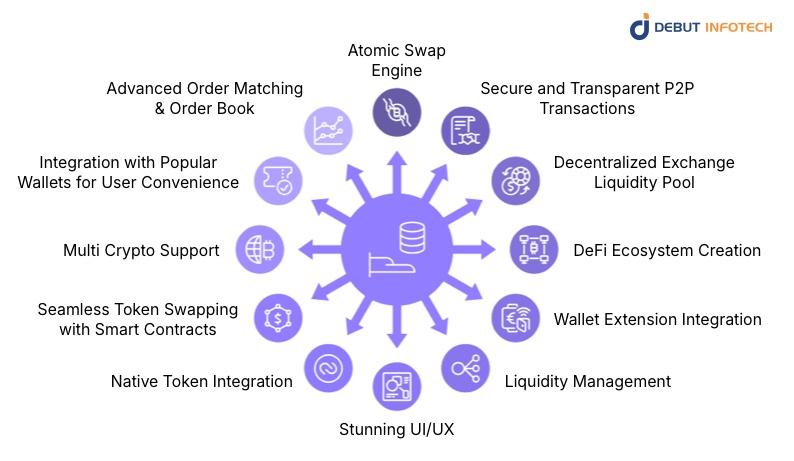
Building a functional decentralized exchange requires more than basic swap logic. Infrastructure decisions, liquidity design, wallet connectivity, and execution reliability all influence how traders experience performance, trust, and long-term usability on the platform.
The atomic swap engine enables trustless, cross-asset trading without intermediaries. Transactions execute only when both parties meet predefined conditions, preventing partial settlements. This mechanism reduces counterparty risk and allows secure asset exchange across compatible blockchains while keeping funds under user control throughout the process.
Peer-to-peer transactions run entirely through smart contracts, ensuring transparency and auditability. Every trade is recorded on-chain, reducing the risk of manipulation. Users interact directly without centralized custody, improving trust, minimizing operational risk, and ensuring that funds remain protected until transaction conditions are met.
Liquidity pools allow users to deposit assets and facilitate automated trading through algorithmic pricing models. These pools replace traditional order matching with continuous liquidity, enabling instant swaps. Liquidity providers earn fees proportional to their contribution, creating a sustainable incentive structure for long-term participation.
The script supports building a broader DeFi ecosystem by integrating staking, yield farming, governance, lands, and lending modules. This transforms the exchange into a multifunctional financial platform, increasing user engagement, transaction volume, and ecosystem value beyond simple token swapping functionality.
Wallet extension integration enables users to connect directly through browser-based wallets. This removes account registration requirements and simplifies authentication. Trades are approved directly from the wallet interface, improving usability while ensuring private keys remain with users at all times.
Advanced liquidity management tools help control slippage, balance pools, and maintain stable trading conditions. Administrators can configure fee models, incentives, and pool parameters. These controls ensure efficient capital utilization and consistent pricing across different trading pairs, even during periods of high volatility.
The interface is designed for usability and clarity, focusing on intuitive trade flows and real-time data visibility. Clean layouts, responsive design, and simplified navigation reduce friction for users, helping both beginners and experienced traders execute transactions confidently and efficiently.
Native token integration allows platforms to introduce governance rights, staking rewards, and fee discounts. The token becomes central to platform operations, encouraging long-term participation while supporting ecosystem growth through controlled token economics and aligned user incentives.
Smart contracts automate token swaps by handling price calculation, execution, and settlement. This removes manual intervention and reduces errors. Once confirmed on-chain, swaps complete efficiently, ensuring predictable execution while maintaining transparency and consistency across all supported trading pairs.
Multi-crypto support allows the exchange to list multiple tokens and standards across different networks. This flexibility helps platforms expand asset offerings quickly, respond to market demand, and onboard new projects without modifying the underlying exchange architecture.
The script supports integration with widely used wallets, improving accessibility and trust. Users trade within familiar wallet environments, reducing learning curves and friction. This compatibility increases adoption rates and ensures smoother onboarding for both retail and experienced crypto users.
Advanced order-matching and order-book functionality support limit and market orders for professional traders. This feature enables precise price control, more efficient liquidity distribution, and better trade execution, making the platform suitable for users who prefer traditional trading mechanics alongside decentralized settlement.
Launching a decentralized exchange involves balancing speed, security, cost control, and future flexibility. Many teams choose structured foundations that reduce risk while allowing room to adapt as market conditions and technical requirements change.
Using a decentralized exchange script significantly shortens p2p crypto exchange developmenttimelines by providing pre-built smart contracts, trading logic, and core infrastructure. Teams avoid months of foundational engineering work and instead focus on customization. This speed matters in fast-moving crypto markets, where launching early often determines liquidity growth, user adoption, and competitive positioning.
Building a DEX from scratch requires extensive engineering, testing, and auditing, which increases cost and risk. A ready-made script reduces these expenses by relying on tested architecture and reusable components. Businesses save on development hours and auditing cycles while still deploying a secure, production-ready exchange with predictable budget requirements.
Decentralized exchange scripts are built on smart contracts that have already been tested across multiple deployments. This reduces the likelihood of critical vulnerabilities and logic errors. Using a proven architecture strengthens platform credibility, reassures users, and lowers the risk of exploits that could damage trust or cause irreversible financial losses.
A decentralized cryptocurrency exchange script allows deep customization of UI, token models, liquidity rules, and supported blockchains without altering the underlying trading engine. This flexibility lets businesses tailor the white label crypto exchange to specific markets or user groups while preserving system stability. Custom features can be added without disrupting core exchange functionality.
Top decentralized exchange scripts are designed with modular architecture, making it easier to scale across multiple blockchains and asset types. As trading volume grows or new networks gain traction, platforms can expand without rewriting core components. This adaptability supports long-term growth while keeping operational complexity under control as the exchange evolves.
Using a decentralized exchange script helps platforms adapt quickly to regulatory changes or market shifts. Features such as KYC layers, geo-restrictions, or governance controls can be added when needed. This flexibility allows businesses to respond to external pressures without halting operations or rebuilding the exchange from the ground up.
DEX platforms allow users to trade directly from their wallets without having to transfer funds to a centralized entity. This reduces custodial risk and eliminates reliance on third-party asset management. Users maintain control of their private keys throughout the trading process, which strengthens trust and aligns with the principles of decentralized finance.
All transactions on Security-First DEX are recorded on the blockchain and can be publicly verified. This transparency reduces concerns around hidden fees, trade manipulation, or fund misuse. Clear on-chain records help build confidence among users, auditors, and partners by making platform operations openly observable.
Decentralized exchanges operate without centralized servers controlling funds or trades. This structure reduces the risk of outages, hacks, or operational shutdowns caused by a single failure point. Even if parts of the system experience issues, core trading functionality remains accessible on-chain.
DEX development servicesprovide a way for platforms to serve users globally without traditional onboarding barriers. Anyone with a compatible wallet can participate without account approvals or centralized restrictions. This open access increases market reach, liquidity potential, and inclusivity, making decentralized exchanges attractive to users across different regions.
Decentralized exchanges integrate naturally with broader DeFi protocols such as lending, staking, and yield strategies. This interoperability allows platforms to expand functionality over time. As DeFi adoption grows, DEX platforms benefit from increased transaction activity and deeper ecosystem participation without restructuring their core systems.
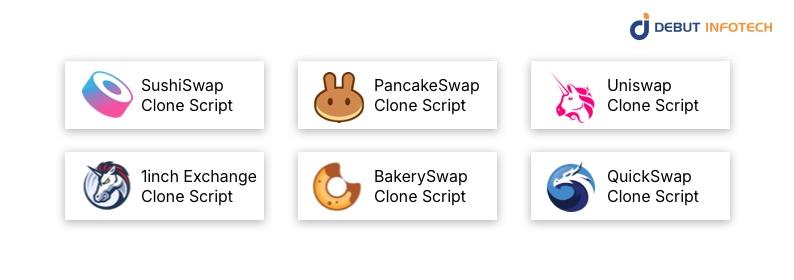
Different decentralized exchanges are built to serve different priorities. Some focus on speed and low fees, others on liquidity depth, aggregation, or ecosystem expansion. Script selection often reflects the market segment a platform intends to serve. Here is a list of top dex scripts for decentralized exchange development:
SushiSwap clone scripts replicate a community-driven automated market maker with governance features. They support liquidity pools, yield farming, staking, and token-based voting. This decentralized crypto exchange script suits platforms aiming to build strong user participation and decentralized decision-making. Businesses benefit from flexible fee structures, incentive mechanisms, and rapid deployment while retaining control over branding, supported networks, long-term protocol upgrades across multiple DeFi use cases, and liquidity strategies.
PancakeSwap clone scripts are optimized for low transaction fees and high-speed trading environments. Built for scalable networks, they support automated market making, farming, lotteries, and staking features. This script is ideal for platforms targeting retail users who value fast execution and low costs.
It allows businesses to launch feature-rich exchanges with simplified operations and strong liquidity incentives across multiple blockchain ecosystems and regions globally today.
Uniswap clone scripts are based on a proven automated market maker model widely adopted across DeFi. They enable permissionless token listing, efficient liquidity pooling, and predictable pricing through smart contracts. This script suits platforms prioritizing simplicity, reliability, and deep liquidity.
Businesses gain access to an architecture trusted by traders while customizing interfaces, supported chains, and fee parameters for scalable decentralized trading platforms worldwide and long-term growth.
1inch exchange clone scripts focus on liquidity aggregation and optimal trade routing. They source prices from multiple liquidity pools to reduce slippage and improve execution rates. This best decentralized crypto exchange script suits platforms targeting advanced traders and institutional users.
Businesses benefit from smart routing logic, improved pricing efficiency, and a competitive trading experience without building complex aggregation systems from scratch across decentralized and multi-chain environments securely at scale.
BakerySwap clone scripts combine decentralized trading with NFT marketplace capabilities. They support automated market-making, staking, and NFT minting on a single platform. This script is suitable for projects exploring hybrid DeFi and NFT models. Businesses can attract diverse user segments while creating multiple revenue streams through trading fees, NFT sales, and ecosystem incentives across growing Web3 communities and digital markets worldwide, at scale.
QuickSwap clone scripts are designed for high-speed, low-cost trading on scalable networks. They support automated liquidity pools, fast settlement, and efficient swaps, making them suited for active traders. This script works well for platforms prioritizing performance and user experience. Businesses gain a ready foundation for launching top decentralized exchanges that handle high volumes without excessive fees or congestion across decentralized ecosystems and growing user bases globally today at scale.
Developing a decentralized exchange using a ready-made script typically takes between four and eight weeks. The timeline depends on the level of customization, supported blockchains, liquidity features, and security requirements.
Basic deployments with standard AMM functionality and wallet integration move faster. More advanced builds that include cross-chain swaps, governance modules, custom token economics, or enhanced order books require additional testing and smart contract validation before launch.
The cost of developing a decentralized exchange using a script generally falls between the mid-five-figure and low-six-figure range. DEX development cost depends on factors such as blockchain support, smart contract customization, liquidity mechanisms, security audits, and UI complexity. Script-based development reduces engineering and testing costs compared to building from scratch. Businesses gain predictable budgeting, faster deployment, and production-ready infrastructure without sacrificing performance, scalability, or security standards.
Debut Infotech approaches decentralized crypto exchange development with a focus on stability, security, and long-term usability. By using decentralized exchange scripts as a foundation, our team delivers production-ready platforms without cutting corners on customization or performance. This approach allows faster deployment while maintaining audited smart contracts, scalable architecture, and clean user interfaces. The result is a decentralized exchange built to operate reliably in real market conditions, not just as a proof-of-concept.
A Decentralized Exchange Script is more than boilerplate code: it’s the backbone of secure, efficient on-chain trading. By combining trusted smart contracts, liquidity mechanisms, multi-wallet integration, and customizable features, these scripts empower platforms to launch competitive DEXs quickly. As decentralized trading continues to grow in volume and users, script-based development offers a practical path to resilience and innovation, helping teams meet user expectations without rebuilding foundational systems from scratch.
A. Absolutely. Most Decentralized Exchange Scripts let you tweak things like trading pairs, fees, user interface, and security protocols. You can adjust the platform to fit specific markets, add unique features, or even integrate smart contracts, making it flexible enough for almost any trading setup.
A. It runs on blockchain technology, allowing users to trade crypto directly without an intermediary. Orders are matched automatically via smart contracts, and all transactions are recorded on-chain. This setup gives users full control over their funds while keeping trades transparent and tamper-proof.
A. There are a few bumps to watch for. Security is a big one—any vulnerability can be costly. Liquidity can be tricky if there aren’t enough users. Integration with different tokens or blockchains can get complex, and maintaining smooth performance under heavy trading loads is another challenge.
A. Most scripts come pre-built with essential features like wallets, order books, and smart contract integration. Developers can skip building everything from scratch, tweak the modules they need, and launch quickly. Pre-configured templates and tested code reduce errors and speed up deployment.
A. Yes, that’s one of its main strengths. You can trade a wide range of tokens and coins, even across different blockchains if the script supports it. Multi-asset support makes the platform attractive for traders looking to diversify without hopping between exchanges.

Our Latest Insights
USA
2501 Chatham, Rd Suite R Springfield, IL 62704
+1-708-515-4004
info@debutinfotech.com
UK
7 Pound Close, Yarnton, Oxfordshire, OX51QG
+44-770-304-0079
info@debutinfotech.com
Canada
154 Eden Oak Trail, Kitchener, ON N2A 0H9
+1-708-515-4004
info@debutinfotech.com
INDIA
Sector 101-A, Plot No: I-42, IT City Rd, JLPL Industrial Area, Mohali, PB 140306
9888402396
info@debutinfotech.com