ON THIS PAGE
Progress0%






Our Global Presence :




Exchange architecture depends on the operating model: Centralized, decentralized, P2P, and hybrid exchanges require different approaches to custody, settlement, liquidity, and compliance.
Custom and white-label development involve different trade-offs: Custom solutions offer greater control and differentiation, while white-label platforms can accelerate launch when their integrations and security controls meet business requirements.
A viable MVP must support complete trading workflows: Account verification, deposits, order execution, ledger updates, withdrawals, liquidity integration, reconciliation, and administrative controls should work together before launch.
Cryptocurrency exchange architecture must prioritize financial accuracy and resilience: An authoritative internal ledger, idempotent transactions, secure APIs, failure isolation, and automated reconciliation help prevent duplicate postings and unexplained balance discrepancies.
Security and compliance must be embedded in daily operations: Identity verification, AML/CFT controls, access restrictions, wallet security, transaction monitoring, audit trails, and incident-response procedures should reflect the exchange's operating jurisdictions and custody model.
Liquidity, wallets, and blockchain integrations require coordinated planning: Provider failover, wallet-funding thresholds, network-specific confirmation rules, transaction tracking, and reconciliation help maintain reliable execution and asset transfers.
Crypto exchange development cost and timeline depend on scope and readiness: Budget for engineering, third-party services, security testing, launch preparation, ongoing maintenance, and operating capital separately; use stage gates and low, expected, and high estimates to manage uncertainty.
An exchange project can go off course before development begins when the team focuses on the trading interface but overlooks the systems behind it. Jurisdiction, business model, custody, liquidity, settlement, and compliance decisions shape everything from wallet infrastructure and transaction controls to project cost and delivery time.
This crypto exchange platform development guide follows the decisions required to move from concept to production. Using a custodial spot exchange as the primary reference, it explains how to choose between custom and white-label development, define an achievable MVP, design the system architecture, secure asset movements, connect liquidity and blockchain networks, and prepare for ongoing operations. It also provides practical criteria for estimating the investment, setting realistic delivery stages, and selecting a development partner capable of supporting a production-ready platform.
An exchange model is more than a commercial label. It establishes who holds customer assets, how orders become trades, where settlement occurs, and which organization manages exceptions. These decisions define the cryptocurrency exchange architecture, risk controls, staffing requirements, and third-party integrations needed to operate the product.
| Model | How it operates | Main planning implications | Suitable when |
| Centralized exchange | The operator manages user accounts, internal balances, order matching, and asset movements | Requires a matching engine, double-entry ledger, wallet controls, reconciliation, and administrative oversight | The business wants managed trading, customer support, and control over the user experience |
| Decentralized exchange | Users connect their wallets and trade through smart contracts | Requires contract security, on-chain settlement, fee management, wallet connectivity, and reliable Blockchain network integration | Self-custody and transparent on-chain execution are central to the product |
| Peer-to-peer marketplace | The platform connects buyers and sellers and may coordinate escrow or asset release | Requires identity controls, offer management, payment verification, fraud monitoring, and dispute resolution | Users need flexible payment methods and direct negotiation |
| Hybrid exchange | Centralized services are combined with selected decentralized components | Requires clearly defined custody boundaries, coordinated settlement, and multiple control frameworks | The product needs managed performance alongside selected self-custody capabilities |
The model also determines which crypto exchange platform features belong in the first release. A centralized platform may prioritize order management, matching, ledgering, deposits, withdrawals, and back-office controls. A decentralized product may require audited smart contracts, wallet support, transaction simulation, and on-chain pricing. A P2P marketplace depends more heavily on escrow rules, counterparty screening, messaging, and dispute workflows.
Before development begins, document the custody model, price-discovery method, settlement path, liquidity management approach, compliance responsibilities, and failure-handling procedures. White-label software should not be treated as another exchange model. It is a delivery option that should be assessed only after the operating model and jurisdiction-specific requirements have been defined and reviewed.
Once the operating model is clear, the next decision is how much of the platform to build and own. Custom development places more product and engineering responsibility on the business and its development partner. A white-label solution reduces some initial development work but introduces dependencies on the vendor’s architecture, roadmap, security practices, and commercial terms.
| Decision area | Custom development | White-label solution |
| Launch schedule | Requires more time for design, engineering, integration, and testing | Can shorten the crypto exchange development timeline when the existing product fits the required model |
| Product control | Supports differentiated workflows, interfaces, fees, markets, and operational rules | Customization is limited by the vendor’s available modules and configuration options |
| Technology ownership | Provides greater control over the source code, infrastructure, data model, and crypto exchange technology stack | Ownership and access depend on the license, hosting arrangement, and vendor contract |
| Integrations | Can be designed around selected liquidity, custody, payment, compliance, and blockchain providers | May restrict providers or require additional fees for unsupported integrations |
| Security assurance | Allows the team to define controls and commission testing for the complete system | Requires evidence of secure development, tenant isolation, testing, vulnerability handling, and incident response |
| Maintenance | Gives the operator control over upgrades and technical priorities while creating direct exchange platform maintenance responsibilities | The vendor manages core updates, but release schedules and product changes may remain outside the operator’s control |
| Commercial impact | Usually carries a higher initial crypto exchange platform development cost | May lower initial spending but introduce licensing, transaction, customization, hosting, and support charges |
Custom development is generally more suitable when the exchange depends on proprietary trading workflows, unusual integrations, regional payment methods, or long-term product differentiation. White-label software may fit a faster market-entry plan when its architecture, controls, and integrations already satisfy the project’s requirements.
However, licensing an existing platform does not transfer every business risk to the vendor. Depending on the operating model and jurisdiction, the exchange operator may still be responsible for licensing, compliance, custody oversight, liquidity, treasury, customer support, and incident management. Before selecting either approach, compare total ownership costs, source-code rights, data portability, service levels, security evidence, upgrade policies, and the practical exit path if the vendor relationship ends.
An exchange MVP is not simply the version with the fewest screens. It is the smallest release that can complete a trade, explain every balance movement, control asset transfers, and give operators the tools to resolve problems. For a custodial spot platform, the essential journey runs from registration and deposit through order execution, settlement, and withdrawal.
Prioritize crypto exchange platform features according to the workflows they must complete and the risks they must contain.
| Workflow | MVP capabilities | Evidence required before launch |
| Register and recover an account | Authentication, KYC or KYB, permissions, account status, and secure recovery | Identity decisions and sensitive account actions are traceable |
| Deposit assets | Address assignment, network detection, confirmation rules, crediting, and duplicate protection | On-chain deposits reconcile with internal customer balances |
| Place and manage an order | Balance validation, order entry, cancellation, matching, fees, order status, and market data | Each order follows defined rules and has a complete event history |
| Settle the trade | Balance holds, double-entry postings, fee allocation, adjustments, and reconciliation | Every balance change can be traced to an authorized transaction |
| Withdraw assets | Address checks, risk screening, approvals, signing, broadcasting, and status updates | Repeated requests cannot create duplicate withdrawals |
| Access liquidity | Provider balances, market mapping, prices, routing rules, monitoring, and crypto exchange liquidity integration | The platform responds predictably when pricing or a provider becomes unavailable |
| Manage operations | Administrative controls, compliance cases, audit records, alerts, customer support, and incident workflows | Each exception has an owner, evidence trail, and response procedure |
The same principle applies to cryptocurrency wallet infrastructure. Adding a withdrawal button is not enough. The supporting workflow must verify available balances, evaluate the destination, apply approval policies, authorize signing, broadcast the transaction, monitor its status, and reconcile the completed transfer.
Features such as copy trading, staking, margin, lending, derivatives, and complex rewards can be deferred unless they define the product’s central value. Early testing should instead measure order completion, ledger discrepancies, deposit-credit exceptions, withdrawal failures, reconciliation breaks, and liquidity-provider failover.
A focused MVP with complete controls provides better evidence than a broad demonstration that depends on manual database corrections or undocumented workarounds.
The cryptocurrency exchange architecture should be defined before the team commits to programming languages, databases, cloud services, or blockchain providers. Architecture establishes how orders, balances, assets, identity decisions, and operational events move through the platform. The crypto exchange technology stack can then be selected according to the performance, consistency, security, integration, and recovery requirements of each workload.
Not every part of the platform has the same performance requirement. Order entry, matching, and market-data distribution require low latency and predictable throughput. WebSocket connections can deliver live updates to customer interfaces, while FIX connectivity may support institutional participants where appropriate.
Balances and settlements require a different priority which is correctness. The ledger must prevent double spending, duplicate postings, and untraceable adjustments even when requests are repeated or services fail. A faster database is not useful if the platform cannot explain why a customer’s balance changed.
Event streaming can separate trading, settlement, compliance, notification, and reporting workloads, but messaging alone does not guarantee financial integrity. Commands and provider callbacks should be idempotent, events should carry sequence or correlation identifiers, and retries should not create duplicate orders, credits, or withdrawals.
The internal ledger should remain the authoritative record of customer balances. Cryptocurrency wallet infrastructure records assets held or moved on supported networks, but it should reconcile with the ledger rather than replace it. Similarly, blockchain network integration must account for confirmations, fee changes, delayed transactions, chain reorganizations, and provider outages.
Trading platform scalability depends on identifying which services need independent scaling. Market-data distribution may support many concurrent connections, while matching requires controlled sequencing and ledgering requires strong consistency. Queues, caching, replicas, and horizontal scaling should be introduced only where they preserve the rules of the underlying workflow.
The architecture should also define failure isolation, recovery objectives, provider fallbacks, backup restoration, and reconciliation after an outage. Once these boundaries and measurable requirements are documented, the team can evaluate technologies through benchmarks and failure testing instead of choosing tools based on familiarity or popularity.
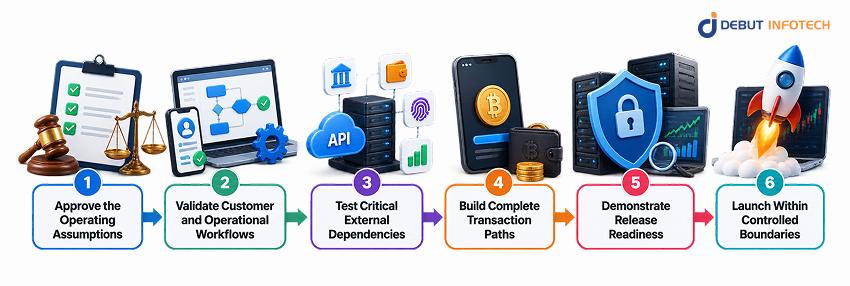
Once the exchange model, MVP scope, and architecture are approved, development should not become an uninterrupted race toward release. A stage-gated crypto exchange platform development process divides the project into reviewable phases. Each phase ends with a clear decision, proceed, revise the work, reduce the scope, or stop before further investment.
The first stage establishes where the exchange will operate, whom it will serve, which assets and trading pairs it will support, and how it will generate revenue. The team should also define custody responsibilities, banking dependencies, identity requirements, compliance workflows, and prohibited activities.
The gate is passed when business leaders, legal counsel, compliance specialists, and product owners agree on the operating assumptions. Any unresolved licensing, custody, or banking issue should remain visible rather than being treated as a future implementation detail.
Next, the team maps customer and administrative journeys, including registration, verification, deposits, trading, withdrawals, account recovery, dispute handling, and transaction reviews. Exceptional situations deserve the same attention as normal activity. These may include rejected verification, incomplete deposits, unavailable markets, delayed withdrawals, and incorrect provider callbacks.
Development should proceed only when each workflow has acceptance criteria, an accountable owner, and a defined system response. Balance changes, approval steps, audit records, and customer notifications must be specified before engineers implement them.
External dependencies can undermine a well-designed platform. The team should therefore test wallet providers, banking connections, identity services, market-data feeds, and crypto exchange liquidity integration before completing the broader product.
Small technical proofs can confirm API behavior, transaction limits, response times, sandbox reliability, reconciliation data, and fallback options. The gate is passed when the project has evidence that critical providers can support the intended workflow. If a dependency fails, the team can replace it or adjust the scope without rebuilding the entire platform.
Rather than building every interface first and connecting backend systems later, engineers should deliver complete slices of functionality. A deposit slice, for example, would include the customer interface, address generation, confirmation monitoring, ledger posting, compliance checks, notifications, and administrative visibility.
Each increment should undergo code review, automated testing, access-control checks, and product validation. The stage is complete when the agreed functionality works across its full path and repeated requests, interrupted sessions, or delayed responses do not produce duplicate orders or balance changes.
Functional testing alone cannot establish launch readiness. The platform must be evaluated under heavy traffic, provider failure, delayed blockchain confirmations, abnormal trading activity, unsuccessful settlements, and attempted unauthorized access.
The approved crypto exchange security requirements should guide penetration testing, privilege reviews, wallet-control verification, incident-response exercises, and backup restoration. Reconciliation testing should also confirm that the internal ledger agrees with custodial, banking, liquidity, and blockchain records. Release approval should be withheld until critical findings are resolved and recovery procedures have been demonstrated.
The initial release can restrict supported assets, markets, transaction values, withdrawal limits, or customer groups. These boundaries reduce exposure while the team observes real trading behavior, support demand, liquidity conditions, settlement accuracy, and provider performance.
Expansion should depend on predefined evidence rather than early user growth alone. Reliable reconciliation, acceptable execution quality, manageable exception volumes, and stable operational response provide stronger signals that the platform is ready for additional markets or higher limits.
A stage gate is not simply a project-status meeting. Every decision should record the evidence reviewed, unresolved risks, approval owners, and conditions for the next phase. This approach makes the crypto exchange development process easier to govern while preventing schedule pressure from overriding financial accuracy or launch safety.
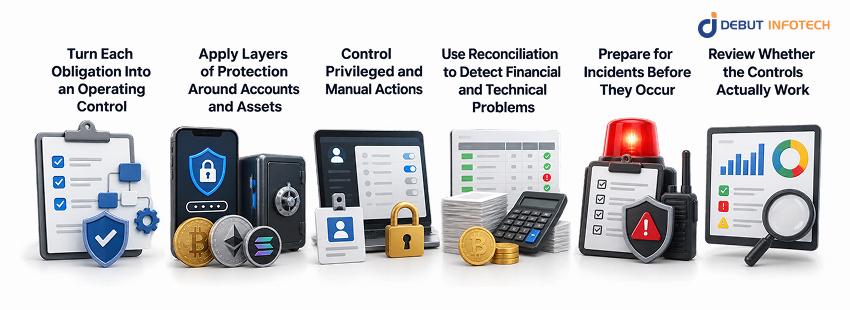
The most important exchange controls are not always visible to customers. They determine what happens when a user changes a withdrawal address, an employee adjusts a balance, a transaction triggers an alert, or a wallet begins behaving unexpectedly. Security and compliance must therefore be built into routine workflows, approval rules, monitoring systems, and incident procedures.
The exact crypto exchange security requirements depend on the services offered, assets supported, custody arrangement, customer types, and operating jurisdictions. FATF applies a risk-based AML/CFT approach to virtual asset service providers. In the United States, some exchange activities may be classified as money transmission under FinCEN rules, while OFAC sanctions requirements apply to virtual-currency transactions. These obligations should be confirmed by qualified legal and compliance professionals.
A regulatory requirement only becomes useful when the exchange can apply it consistently. Each obligation should be translated into a trigger, required data, responsible employee, permitted action, escalation route, and retained record.
Customer verification, for example, involves more than connecting an identity provider. The operating process must explain what happens when documents cannot be verified, ownership information is incomplete, or screening produces a possible match. It should also record who reviewed the case, which evidence informed the decision, and whether additional monitoring is required.
The same approach applies to sanctions screening, transaction monitoring, record retention, regulatory reporting, and Travel Rule processes where applicable. Software can identify events and enforce rules, but authorized employees must remain responsible for sensitive or ambiguous decisions.
No single control can protect an exchange against account takeover, insider misuse, compromised credentials, or fraudulent withdrawals. Customer accounts may require multifactor authentication, device and session monitoring, login alerts, withdrawal limits, and additional verification after high-risk account changes.
Cryptocurrency wallet infrastructure requires its own protection model. The exchange should determine which assets remain available for routine withdrawals, which require more restricted storage, and what approvals are needed to move funds. Key isolation, role separation, transaction limits, address screening, and multi-party approval can reduce the impact of a compromised account or employee credential.
Blockchain transactions may be difficult or impossible to reverse after confirmation. For that reason, withdrawal controls must evaluate risk before signing and broadcasting the transaction, not after funds have left the wallet.
Administrative tools can create as much risk as customer-facing features. Employees may need to restrict accounts, approve withdrawals, update transaction limits, create support credits, or correct ledger entries. These capabilities should be granted according to job responsibilities rather than general administrative access.
Sensitive actions should require a reason, an approval path, and a permanent audit record. The employee initiating a material balance adjustment should not be the only person authorizing it. Emergency access may occasionally be necessary, but its use should generate an immediate alert and mandatory review.
Access should also change when employees move between roles or leave the organization. Regular permission reviews help prevent old accounts and excessive privileges from becoming unnoticed security weaknesses.
Security monitoring should extend beyond login attempts and infrastructure alerts. Reconciliation can reveal duplicate credits, incomplete settlements, unauthorized transfers, provider errors, and discrepancies between customer balances and externally held assets.
The internal ledger should be compared with blockchain wallets, custodial accounts, bank records, and liquidity-provider statements. Differences should enter a controlled exception process rather than being corrected through undocumented manual entries. Each exception needs an owner, supporting evidence, resolution status, and approval history.
This connection between financial records and technical monitoring helps the team distinguish a processing delay from a genuine loss or control failure.
An exchange should have documented procedures for unauthorized withdrawals, compromised keys, data breaches, sanctions matches, blockchain disruptions, liquidity-provider outages, and prolonged reconciliation failures. These procedures should establish who can suspend a market, freeze an account, stop withdrawals, contact customers, preserve evidence, and coordinate any required regulatory notification.
NIST’s Cybersecurity Framework 2.0 organizes cybersecurity risk management around six functions which include govern, identify, protect, detect, respond, and recover. This structure can help exchange operators confirm that preventive controls are supported by monitoring, accountable decision-making, incident response, and tested recovery procedures.
Tabletop exercises and recovery tests should include business, engineering, security, compliance, treasury, and customer-support teams. An incident plan that only the security department understands may fail when several departments must act quickly.
Compliance cannot be judged by the number of tools installed. Management should review unresolved alerts, investigation time, reconciliation exceptions, privileged-access findings, recovery-test results, recurring incidents, and overdue corrective actions.
These measures show whether the operating model is controlling real risks or merely producing more alerts and documentation. When the exchange adds a jurisdiction, asset, payment method, or provider, the team should reassess the affected controls before expanding the service.
Liquidity determines whether customers can execute trades at reasonable prices. Wallets control where assets are held and how deposits or withdrawals are authorized. Blockchain connections determine when an external asset movement can be treated as valid. Although these functions serve different purposes, they must share consistent asset definitions, balance states, transaction identifiers, and reconciliation rules.
Planning them separately can create serious operational gaps. A trade may execute with an external provider while settlement remains incomplete. A customer may have sufficient account balance but encounter a delayed withdrawal because the hot wallet lacks funds. A deposit may also appear on-chain without meeting the exchange’s confirmation or screening policy.
The platform needs a central asset registry containing each asset’s internal identifier, supported network, token contract, decimal precision, deposit requirements, withdrawal limits, fee rules, and operating status. Ticker symbols alone are insufficient because similarly named assets may exist on multiple networks or use different contract addresses.
Balance states should also be explicit. The ledger may distinguish between available, reserved, pending-deposit, pending-withdrawal, settled, and restricted funds. The internal ledger remains the record of customer entitlements, while wallet balances show assets controlled through a blockchain network. The two records must reconcile, but they do not represent the same information.
| Event | Liquidity responsibility | Ledger responsibility | Wallet and network responsibility |
| Deposit | No immediate trading action unless inventory must be adjusted | Records the deposit as pending and releases it after required checks | Detects the transaction, validates the asset and address, and monitors confirmations |
| Trade | Matches internally or routes eligible orders to an external provider | Reserves funds and records executions, fees, and updated balances | Usually requires no immediate on-chain movement for trades completed within a centralized exchange |
| Withdrawal | May trigger inventory conversion or provider rebalancing | Reserves or debits the customer’s balance and records withdrawal status | Selects funds, applies signing rules, broadcasts the transaction, and tracks confirmation |
| Treasury rebalance | Moves inventory between markets or liquidity sources | Records internal treasury movements and provider exposure | Transfers assets between hot, restricted, custodial, or provider-controlled wallets |
This mapping gives each status a specific meaning. A “completed” trade, deposit, or withdrawal should not describe several different technical states depending on which service produced the message.
An exchange can source liquidity from its internal order book, contracted market makers, external trading venues, or a combination of these options. The right model depends on expected volume, supported trading pairs, capital availability, regional access, and acceptable counterparty exposure.
A crypto exchange liquidity integration must normalize provider-specific market symbols, quantity rules, price precision, order types, fees, execution reports, cancellations, and partial fills. The platform should also define what happens when a provider rejects an order, returns an incomplete status, disconnects during execution, or reports a fill after the exchange has timed out.
Effective Liquidity management also requires policies for prefunded provider accounts, maximum exposure, routing priorities, price tolerances, and rebalancing. Teams should monitor spread, order-book depth, slippage, fill rate, rejected orders, and the amount of capital held with each provider. Displayed prices are not enough if customers cannot execute meaningful order sizes near those prices.
Cryptocurrency wallet infrastructure should balance customer access with asset protection. A hot wallet can support routine withdrawals quickly, but keeping excessive funds online increases exposure. More restricted storage may reduce that risk while introducing additional approval and transfer time.
The team should estimate normal and peak withdrawal demand for each asset, establish wallet-funding thresholds, and define who can authorize replenishment. Key-management methods, approval requirements, signing policies, and custody arrangements should reflect the exchange’s operating model rather than being chosen only because a particular technology is popular.
Wallet planning must also cover unsupported deposits, incorrect networks, tokens sent without required memos, fee shortages, stuck transactions, and recovery requests. Some mistakes may be recoverable, while others may be technically impossible or too risky to resolve. Customer-facing policies should explain these limitations before a transfer is initiated.
Blockchain network integration should account for the operating behavior of every supported network. Address formats, token contracts, decimal rules, fee assets, transaction models, confirmation policies, and finality conditions can differ significantly.
The network service must also handle delayed transactions, replacement transactions, reorganizations, node disagreement, provider outages, and sudden fee increases. A blockchain API provider can simplify connectivity, but it does not remove the exchange’s responsibility for validating events or maintaining fallback procedures.
Network adapters can isolate these differences from the rest of the platform. This allows the ledger and customer interface to use consistent internal states while each adapter manages chain-specific transaction rules.
The highest operational risk often appears between systems. An external provider may execute an order before its confirmation message arrives. A deposit may be detected and later affected by a network reorganization. A withdrawal may pass customer checks but remain queued because the designated wallet has insufficient funds.
Every handoff should therefore use unique transaction references, idempotent commands, explicit state transitions, retry limits, and exception queues. Automated reconciliation should compare ledger entries with wallet activity, liquidity-provider records, and blockchain transactions.
When these components are planned together, customers receive more accurate balances, clearer transaction statuses, and more dependable execution. Operations teams also gain the information needed to distinguish a normal delay from a financial discrepancy or security incident.
A useful budget should show what the team is building, what external services are required, and which expenses continue after launch. A single project total makes comparison difficult because one proposal may include security testing, provider integrations, and deployment support while another covers only application development.
A transparent crypto exchange platform development cost breakdown should separate product engineering, third-party services, launch preparation, ongoing operations, and business capital. This prevents essential requirements from appearing later as unexpected change requests.
Each work package should identify its deliverables, assumptions, dependencies, responsible roles, estimated effort, and acceptance criteria. This makes it easier to understand why two apparently similar proposals produce different totals.
The crypto exchange platform development cost does not include every expense needed to operate the business. Identity verification, sanctions screening, blockchain analytics, custody, node access, cloud infrastructure, market data, banking connections, monitoring, and customer-support tools may each use different pricing models.
A provider may charge an implementation fee, monthly minimum, per-verification cost, transaction fee, asset fee, or volume-based rate. These charges should appear separately from development labor so the business can see which expenses are controlled by the engineering scope and which depend on customer activity.
Vendor replacements should also be considered. A low-cost service may become unsuitable when transaction volume, geographic coverage, or compliance requirements increase. Using provider adapters and retaining access to operational data can reduce the cost of changing vendors later.
Some of the largest financial commitments are not software expenses. Liquidity-provider deposits, market-making inventory, customer withdrawal reserves, custodial balances, insurance, licensing fees, and any applicable regulatory capital belong in the wider launch budget.
Combining these items with development costs creates a misleading estimate. The business should maintain separate figures for:
This distinction helps founders understand how much capital is needed to build the platform and how much is required to operate it responsibly.
Security should not appear as an unspecified percentage added at the end of the estimate. The budget should identify threat modeling, secure code review, penetration testing, access-control validation, wallet testing, recovery exercises, and remediation as distinct activities.
A smart-contract audit should only be included when the platform actually uses custom smart contracts. Similarly, mobile application testing, institutional FIX connectivity, advanced surveillance, or multi-region recovery should be priced only when they belong to the approved scope.
Launch preparation may also require data migration, operational training, customer-support procedures, provider certification, production rehearsals, and incident-response exercises. These tasks consume time even though they do not create visible customer features.
Early estimates contain uncertainty, particularly when provider documentation, licensing assumptions, transaction volumes, or legacy-system requirements remain unresolved. Instead of presenting one precise figure, the team can produce low, expected, and high scenarios tied to documented assumptions.
Contingency should be assigned to specific uncertainties rather than added as unexplained padding. For example, an unfamiliar banking integration may receive a larger reserve than a standard interface already tested by the team. As technical proofs and provider agreements remove uncertainty, the relevant reserve can be reduced at each project gate.
Vendor proposals should be normalized against the same scope, acceptance criteria, external fees, and post-launch responsibilities. One estimate may appear lower because it excludes production infrastructure, security remediation, provider setup, or the crypto exchange platform maintenance requirements that begin after release.
The final budget should therefore show the initial build cost, launch-readiness expenses, expected monthly run rate, and first-year ownership cost. This component-level view gives decision-makers a more reliable basis for approving scope, comparing vendors, and deciding which capabilities belong in the first release.
Building a cryptocurrency exchange involves more than connecting an order book to digital wallets. The platform must coordinate trading, custody, liquidity, compliance, reconciliation, and security without compromising performance. Debut Infotech helps startups and enterprises turn these requirements into production-ready exchange ecosystems.
Our work with NDAX reflects this capability. We contributed to its wallet and exchange ecosystem, supporting multi-chain transactions, trading automation, and portfolio management. According to our published case study, the infrastructure has facilitated more than $12 billion in cumulative trading volume.
Through our cryptocurrency exchange development services, we help businesses choose the right exchange model, define essential features, and plan secure wallet, liquidity, blockchain, and compliance integrations.
Whether you are validating an MVP, launching a custom exchange, or upgrading an existing platform, our team can map technical dependencies, establish realistic milestones, and prepare a tailored development estimate.
Licensing depends on the exchange’s activities, assets, custody model, and operating locations. FinCEN requirements may apply to businesses exchanging or transmitting convertible virtual currency, while many states regulate virtual-currency transmission separately. Securities or derivatives services can introduce additional federal requirements. Obtain jurisdiction-specific legal guidance before defining the platform because software development alone does not establish regulatory compliance.
Common revenue streams include trading fees, spreads, subscriptions, custody services, conversion charges, and infrastructure services. Some business models also generate revenue through stablecoin arrangements or blockchain rewards. Coinbase’s 2025 filing illustrates how a major exchange can combine transaction revenue with subscription and service income, including stablecoin, custody, and developer-service revenue.
Essential crypto exchange platform features include account onboarding, identity verification, authentication, deposits, withdrawals, wallet management, order entry, execution, liquidity access, an internal ledger, reconciliation, administrative controls, and audit records. Advanced products such as margin trading, derivatives, staking, and copy trading should only enter the MVP when they are fundamental to its business model.
The answer depends on the intended customer experience and risk model. Custodial Cryptocurrency wallet infrastructure gives the operator greater control over deposits, withdrawals, and recovery, but also introduces key-management, safeguarding, and reconciliation responsibilities. Noncustodial models give users more control but may complicate execution and support. NIST recognizes self-hosted, externally hosted, and hybrid custody structures.
A blockchain records confirmed asset transfers, while the exchange ledger records customer balances, trading holds, executed orders, fees, and internal adjustments. Effective Cryptocurrency exchange architecture therefore separates trading records from Blockchain network integration. NIST notes that scaling approaches can process activity off-chain before deferred on-chain settlement. Both records must still be reconciled to identify missing, duplicated, or delayed movements.

Our Latest Insights
USA
2501 Chatham, Rd Suite R Springfield, IL 62704
+1-708-515-4004
info@debutinfotech.com
UK
7 Pound Close, Yarnton, Oxfordshire, OX51QG
+44-770-304-0079
info@debutinfotech.com
Canada
154 Eden Oak Trail, Kitchener, ON N2A 0H9
+1-708-515-4004
info@debutinfotech.com
INDIA
Sector 101-A, Plot No: I-42, IT City Rd, JLPL Industrial Area, Mohali, PB 140306
9888402396
info@debutinfotech.com