ON THIS PAGE
Progress0%






Our Global Presence :



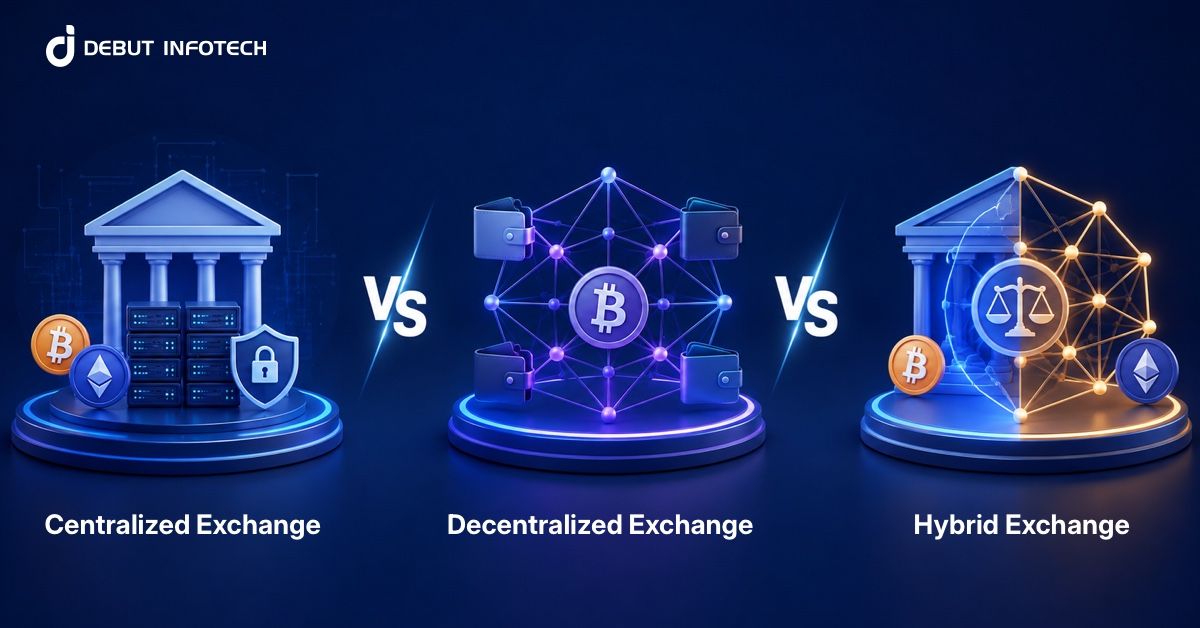


Exchange architecture directly impacts business outcomes by influencing user experience, regulatory obligations, liquidity management, and long-term profitability.
Centralized exchanges (CEXs) offer the strongest monetization potential through trading fees, listings, staking, and institutional services, making them attractive for rapid market entry.
Decentralized exchanges (DEXs) prioritize self-custody and transparency but require robust smart contract security and often face liquidity and usability challenges.
Hybrid exchanges combine centralized performance with decentralized asset control, creating a flexible model for businesses seeking both compliance readiness and innovation.
Development costs vary significantly by architecture, with hybrid exchanges typically requiring the highest investment due to their complex infrastructure and security requirements.
Security is determined more by implementation quality than by exchange type, making audits, monitoring, wallet protection, and compliance controls essential across all models.
Selecting the right exchange model depends on business goals, target users, budget, and expansion plans, as no single approach is universally best for every cryptocurrency platform.
The debate around centralized vs decentralized vs hybrid exchange models has become increasingly important as businesses enter the cryptocurrency market and seek sustainable ways to serve a growing global user base. Each model offers distinct advantages in areas such as security, liquidity, compliance, user control, scalability, and revenue generation. Choosing the right approach can influence everything from development costs and regulatory readiness to long-term profitability.
The opportunity is significant. According to Triple-A’s 2024 cryptocurrency ownership report, global crypto ownership reached 562 million people, representing 6.8% of the world’s population, highlighting the expanding demand for digital asset trading platforms.
At the same time, decentralized finance continues to attract substantial capital. Research examining the DeFi ecosystem notes that decentralized financial protocols collectively account for over 90% of total value locked (TVL) within major DeFi categories, demonstrating the growing influence of blockchain-based financial infrastructure.
Understanding the differences between centralized, decentralized, and hybrid exchanges is essential for businesses looking to launch a competitive platform, manage risk effectively, and position themselves for future growth in an increasingly sophisticated crypto ecosystem.
This guide explores the differences between centralized, decentralized, and hybrid exchanges, why choosing the right model matters, how they compare across key areas, their development costs, revenue potential, common challenges, essential features, and emerging industry trends.
Selecting the best cryptocurrency exchange business model affects far more than platform functionality. It influences security architecture, user acquisition, regulatory obligations, operational costs, liquidity management, and long-term profitability. Businesses that align their exchange model with their goals are better positioned to scale efficiently and meet market demands.
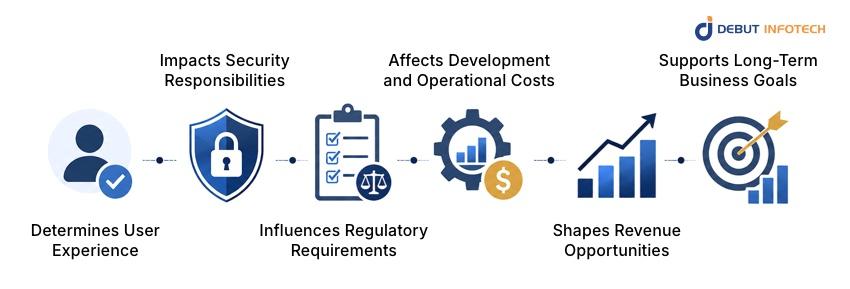
The exchange model directly affects how users interact with the platform, from registration and onboarding to trade execution and asset management. Centralized exchanges typically offer smoother experiences for beginners, while decentralized platforms appeal to users seeking greater control. Choosing the right model helps businesses deliver an experience that matches user expectations and encourages long-term engagement and retention.
Each exchange model comes with different security obligations and risk management requirements. Centralized exchanges must secure user funds through custodial infrastructure, while decentralized platforms rely heavily on smart contract security and user-controlled wallets. Understanding these responsibilities from the start helps businesses implement suitable protection measures and reduce exposure to financial and reputational risks.
Regulatory compliance can significantly affect how an exchange operates and expands into new markets. Centralized exchanges often require extensive KYC, AML, and reporting processes, while decentralized platforms may face evolving legal interpretations. Selecting an exchange model that aligns with regulatory expectations helps businesses avoid compliance challenges and build a more sustainable operation.
The chosen exchange model has a major impact on development budgets, infrastructure requirements, staffing needs, and ongoing maintenance expenses. Businesses must account for factors such as liquidity management, security systems, customer support, compliance tools, and blockchain integrations. Evaluating the crypto exchange development cost early helps ensure resources are allocated efficiently and long-term profitability remains achievable.
Different crypto exchange models support different monetization strategies. Centralized exchanges can generate income through trading fees, listing fees, staking services, and premium offerings, while decentralized platforms may rely on protocol fees and liquidity mechanisms. Selecting the right model enables businesses to maximize revenue opportunities aligned with their target audience and growth objectives.
An exchange model should support both immediate operational needs and future business ambitions. A crypto exchange platform for businesses designed for institutional trading may require features that differ significantly from a DeFi-focused marketplace. Choosing the appropriate structure from the outset helps businesses scale more effectively, introduce new services, and adapt to changing market conditions.
Centralized Exchange (CEX)
A centralized exchange is a crypto trading platform operated and managed by a central organization that controls transactions, user accounts, order matching, asset custody, and platform operations. Users deposit funds into the exchange’s wallets and rely on the cryptocurrency exchange platform to facilitate trades. Centralized exchanges are known for high liquidity, fast execution speeds, and user-friendly interfaces.
Decentralized Exchange (DEX)
A decentralized exchange enables peer-to-peer cryptocurrency trading through smart contracts without relying on a central authority to hold user funds. Traders maintain control of their assets throughout the trading process. DEX platforms prioritize transparency, privacy, and self-custody while reducing reliance on intermediaries.
Hybrid Exchange (HEX)
A hybrid exchange combines elements of centralized and decentralized systems. It aims to deliver the speed, liquidity, and usability of centralized exchanges while preserving some of the security, transparency, and asset control advantages associated with decentralized platforms. Hybrid models seek to balance convenience and decentralization.
Each crypto exchange business model offers distinct advantages and trade-offs. Comparing centralized vs decentralized exchange vs hybrid across key operational areas helps businesses identify the option that best aligns with their objectives, budget, user expectations, and growth strategy.
| Comparison Factor | Centralized Exchange (CEX) | Decentralized Exchange (DEX) | Hybrid Exchange (HEX) |
| Asset Custody | Exchange controls and stores user assets | Users retain full control of their funds and private keys | Combines self-custody benefits with streamlined trading experiences |
| Trading Speed | Very fast execution through centralized matching engines | Dependent on blockchain speed and network conditions | Faster than most DEXs while retaining some decentralized elements |
| Liquidity Availability | Generally offers the highest liquidity and market depth | Relies on liquidity pools and community participation | Aggregates liquidity from multiple sources |
| User Accessibility | Beginner-friendly with customer support and account recovery | Requires wallet knowledge and blockchain familiarity | Balances ease of use with greater user control |
| Regulatory Compliance | Typically supports full KYC and AML compliance | Regulatory frameworks remain less defined in many regions | Can integrate compliance features while maintaining decentralization benefits |
| Security Structure | Strong institutional security but higher custodial risk | Reduced custodial risk but dependent on smart contract security | Combines centralized protections with decentralized security advantages |
Centralized Exchange
Centralized exchanges act as custodians of user assets, storing funds in platform-controlled wallets and managing private keys on behalf of traders. This approach simplifies account management and recovery processes for users. However, it also places greater responsibility on the exchange to secure funds against breaches, insider threats, and operational failures.
Decentralized Exchange
Decentralized exchanges allow users to maintain full ownership of their assets by keeping funds in personal wallets throughout the trading process. Private keys never leave the user’s control, reducing custodial risks. This model strengthens user autonomy but requires traders to take responsibility for wallet security and key management.
Hybrid Exchange
Hybrid exchanges seek to combine the convenience of centralized custody with the security benefits of self-custody. Depending on the platform design, users may retain greater control over their assets while still accessing streamlined trading experiences. This balanced approach appeals to businesses seeking stronger security without sacrificing usability.
Centralized Exchange
Centralized exchanges typically deliver the fastest trading experience because transactions are processed through centralized matching engines rather than directly on a blockchain. Orders can be executed almost instantly, making these platforms attractive to high-frequency traders, institutions, and users who prioritize speed, responsiveness, and real-time market participation.
Decentralized Exchange
Trading speed on decentralized exchanges often depends on the underlying blockchain network. Congestion, transaction confirmation times, and gas fee fluctuations can impact execution speed. While blockchain technology continues to improve, some users may experience slower transactions compared to centralized alternatives during periods of high network activity.
Hybrid Exchange
Hybrid exchanges attempt to improve execution speed by combining centralized order matching with decentralized settlement mechanisms. This structure can reduce delays commonly associated with blockchain transactions while maintaining certain decentralized characteristics. As a result, users often benefit from faster trading without completely sacrificing transparency or asset control.
Centralized Exchange
Centralized exchanges generally provide deeper liquidity because they attract large user bases, institutional participants, and professional market makers. High liquidity allows traders to execute large orders with minimal price impact. Strong liquidity also contributes to tighter spreads, improved market efficiency, and a more stable trading environment.
Decentralized Exchange
Liquidity on decentralized exchanges is usually supplied through liquidity pools funded by users rather than centralized market makers. While this approach supports decentralization, liquidity levels across trading pairs may vary. Lower liquidity can sometimes result in higher slippage, particularly for large transactions or less popular digital assets.
Hybrid Exchange
Hybrid exchanges are designed to improve liquidity by combining multiple liquidity sources, including centralized order books, liquidity pools, and external providers. This approach can create a more efficient trading environment and help reduce the liquidity limitations that some decentralized platforms face while preserving selected decentralized benefits.
Centralized Exchange
Centralized exchanges are generally easier for newcomers to use because they offer familiar interfaces, guided onboarding, customer support, and account recovery options. These features lower the barrier to entry for users with limited blockchain experience and accelerate adoption among mainstream audiences.
Decentralized Exchange
Decentralized exchanges require users to interact with crypto wallets, manage private keys, and understand blockchain transactions. While experienced crypto users often appreciate this level of control, newcomers may find the process more complex. User education and simplified interfaces remain important considerations for broader adoption.
Hybrid Exchange
Hybrid exchanges aim to bridge the usability gap between centralized and decentralized platforms. By simplifying onboarding and trading processes while retaining certain decentralized features, they can appeal to both experienced traders and newer users. This balance helps businesses attract a broader and more diverse customer base.
Centralized Exchange
Centralized exchanges are typically subject to extensive regulatory oversight. They often implement KYC verification, AML monitoring, transaction reporting, and identity checks to comply with legal requirements. While these measures increase operational responsibilities, they can also strengthen trust among regulators, institutional investors, and mainstream users.
Decentralized Exchange
Regulatory compliance presents unique challenges for decentralized exchanges because there is often no single entity controlling platform operations. As governments continue developing digital asset regulations, businesses operating DEX platforms must closely monitor evolving requirements and assess how future compliance expectations may affect platform functionality.
Hybrid Exchange
Hybrid exchanges offer greater flexibility when addressing compliance requirements. Businesses can integrate identity verification, monitoring systems, and reporting tools where necessary while maintaining selected decentralized features. This adaptability can make hybrid platforms appealing for organizations seeking a balance between innovation and regulatory readiness.
Centralized Exchange
Centralized exchanges invest heavily in cybersecurity infrastructure, including cold storage solutions, encryption protocols, fraud detection systems, and security monitoring tools. While these protections can be highly effective, centralized platforms remain attractive targets for attackers because significant volumes of assets are stored within a single ecosystem.
Decentralized Exchange
Decentralized exchanges reduce custodial risks because users retain ownership of their funds. However, centralized exchange vs decentralized exchange security depends heavily on smart contract integrity and code quality. Vulnerabilities in contracts, inadequate audits, or user errors can pose risks, making rigorous testing and security reviews critical for successful DEX operations.
Hybrid Exchange
Hybrid exchanges distribute security responsibilities across both centralized and decentralized components. This structure can reduce single points of failure while maintaining institutional-grade protections. However, the added architectural complexity requires careful planning, extensive testing, and ongoing monitoring to ensure security remains effective across all systems.
Security remains one of the most important considerations when choosing an exchange model. Each approach offers distinct advantages and vulnerabilities when performing an exchange platform comparison.
Centralized exchanges benefit from dedicated security teams, advanced monitoring systems, insurance programs, and fraud detection mechanisms. However, they represent attractive targets for hackers because large amounts of user assets are stored in centralized wallets.
Decentralized exchanges eliminate many custodial risks because users maintain control of their private keys. This reduces the likelihood of large-scale exchange breaches. However, vulnerabilities in smart contracts, protocol exploits, and user errors can still result in losses.
Hybrid exchanges attempt to reduce risks by combining institutional-grade security controls with decentralized asset management principles. While this approach can strengthen overall security, the architecture is often more complex and requires careful implementation.
No model is universally safer than the others. Security ultimately depends on platform design, code quality, infrastructure protection, compliance practices, and ongoing maintenance.
Regulatory expectations continue to evolve across global crypto markets. Businesses must evaluate how each exchange model aligns with applicable legal requirements before crypto exchange platform development begins.
Centralized exchanges typically face the most extensive compliance obligations. These often include KYC verification, AML monitoring, transaction reporting, sanctions screening, and licensing requirements.
Decentralized exchanges present unique compliance challenges because they operate without traditional intermediaries. Regulators in many jurisdictions are actively assessing how existing laws should apply to decentralized protocols.
Hybrid exchanges often provide greater flexibility. Businesses can implement compliance controls where required while preserving selected decentralized features that appeal to crypto-native users.
A proactive compliance strategy helps reduce legal risks, improve investor confidence, and support long-term sustainability.
Development costs vary significantly depending on the exchange architecture, security requirements, integrations, and feature complexity.
| Factor | Centralized Exchange (CEX) | Decentralized Exchange (DEX) | Hybrid Exchange (HEX) |
| Estimated Development Cost | $40,000 – $250,000+ | $50,000 – $300,000+ | $80,000 – $500,000+ |
| Infrastructure Requirements | High-performance centralized servers | Blockchain-based infrastructure and smart contracts | Combination of centralized and decentralized infrastructure |
| Compliance Costs | Typically highest due to KYC and AML requirements | Lower in some jurisdictions but evolving regulations apply | Moderate to high depending on compliance implementation |
| Security Investment | Custodial wallet protection and monitoring systems | Smart contract audits and blockchain security reviews | Requires both custodial and decentralized security mechanisms |
| Maintenance Complexity | Moderate to high | High due to protocol updates and audits | Highest due to mixed architecture |
Centralized exchanges generally require investment in trading engines, liquidity management systems, user management modules, compliance infrastructure, wallet integration, and administrative dashboards. Development costs are often moderate to high.
DEX development focuses heavily on smart contracts, liquidity pool mechanisms, blockchain integrations, token support, and security auditing. Costs can increase substantially when multiple blockchain networks are supported.
Hybrid exchanges are usually the most expensive to build because they combine centralized trading infrastructure with decentralized components. Businesses must manage additional complexity, security requirements, and integration efforts.
Estimated Cost Range
Centralized Exchange: $40,000 – $250,000+
Decentralized Exchange: $50,000 – $300,000+
Hybrid Exchange: $80,000 – $500,000+
Profitability depends on user adoption, liquidity, transaction volume, and service offerings, rather than solely on the exchange model.
| Revenue Factor | Centralized Exchange (CEX) | Decentralized Exchange (DEX) | Hybrid Exchange (HEX) |
| Trading Fees | Strong revenue source due to high trading volumes | Earned through protocol and swap fees | Supports both traditional and decentralized fee models |
| Listing Fees | Common revenue stream for new token listings | Less common | Available depending on platform structure |
| Staking Services | Frequently offered to users | Limited depending on protocol design | Can support staking and DeFi services |
| Liquidity Incentives | Usually managed internally or through partners | Driven by liquidity providers and token incentives | Combines multiple liquidity monetization opportunities |
| Institutional Services | Strong potential for premium offerings | Limited institutional adoption | Growing opportunity for institutional-grade services |
| Overall Revenue Potential | Currently highest in most markets | Moderate but growing | High long-term potential due to diversified revenue streams |
Centralized exchanges often generate revenue through:
Decentralized exchanges commonly earn revenue through protocol fees, liquidity pool fees, governance token mechanisms, and ecosystem participation incentives.
Hybrid exchanges can combine multiple revenue streams from both centralized and decentralized environments. This flexibility creates opportunities to diversify earnings and serve broader user segments.
For most businesses, centralized exchanges currently offer the greatest revenue potential due to higher trading volumes and more mature monetization models. Hybrid exchanges, however, are increasingly viewed as strong long-term contenders.
The best crypto exchange model depends on business objectives, target audience, budget, and regulatory strategy.
| Business Goal | Recommended Model |
| Fast market entry | Centralized Exchange |
| Institutional trading services | Centralized Exchange |
| DeFi-focused ecosystem | Decentralized Exchange |
| Maximum user asset control | Decentralized Exchange |
| Balance between compliance and decentralization | Hybrid Exchange |
| Long-term innovation strategy | Hybrid Exchange |
Businesses should evaluate both current requirements and future expansion plans before making a final decision.
Building a crypto exchange involves more than development. Businesses must address technical, operational, regulatory, and market-related challenges to create a secure, scalable, and competitive platform.
Security is one of the biggest concerns for any crypto exchange. Businesses must protect user funds, sensitive data, wallets, APIs, and trading systems from cyberattacks. Additional challenges include managing private keys, preventing unauthorized access, securing smart contracts, and maintaining compliance with industry security standards while supporting platform scalability.
Solutions and Recommendations
Businesses should adopt a security-first development approach that includes multi-signature wallets, encryption, cold storage, two-factor authentication, regular penetration testing, and continuous monitoring. Conducting independent security audits and implementing strict access controls can significantly reduce risks while strengthening user confidence and long-term platform credibility.
New exchanges often struggle to attract enough trading volume during the early stages of operation. Low liquidity can lead to wider spreads, increased slippage, and reduced trading activity. Without sufficient market depth, users may experience poor trade execution, making it difficult for the platform to compete effectively.
Solutions and Recommendations
Businesses can improve liquidity by partnering with professional market makers, integrating liquidity aggregation services, and supporting popular trading pairs. Offering incentives for liquidity providers and developing strategic partnerships with established exchanges can also help create a more active and attractive trading environment.
Regulatory frameworks differ significantly across countries and continue to evolve rapidly. Businesses must address licensing requirements, KYC obligations, AML procedures, data protection rules, and reporting standards. Failing to understand these requirements early can lead to legal complications, financial penalties, and restrictions on market expansion.
Solutions and Recommendations
Working with experienced legal and compliance professionals from the beginning helps businesses build regulatory readiness into their exchange architecture. Implementing automated compliance tools, maintaining clear documentation, and regularly reviewing regulatory updates can reduce risks and support sustainable long-term operations across multiple jurisdictions.
As user numbers and trading volumes increase, exchanges may face performance bottlenecks, slower transaction processing, and infrastructure limitations. Systems that perform well during launch may struggle under higher demand. Scalability planning is critical to maintaining platform stability, reliability, and user satisfaction during periods of growth.
Solutions and Recommendations
Businesses should build scalable architectures using cloud infrastructure, modular development frameworks, load-balancing mechanisms, and optimized databases. Regular performance testing and infrastructure monitoring help identify potential weaknesses before they affect users. Investing in scalability early often reduces the need for costly upgrades later.
Trust remains a major factor influencing user adoption and retention. Security incidents, poor customer support, lack of transparency, delayed withdrawals, or platform outages can quickly damage a company’s reputation. Building trust requires consistent performance and a clear commitment to protecting user interests.
Solutions and Recommendations
Businesses should prioritize transparency, communicate clearly with users, publish security practices, provide responsive customer support, and maintain reliable platform performance. Regular updates, transparent fee structures, and visible compliance efforts help strengthen credibility and encourage long-term user engagement.
Launching an exchange is only the beginning. Businesses must continuously update software, address security vulnerabilities, improve performance, support new assets, and adapt to changing regulations. Ongoing maintenance requires dedicated technical resources and can become increasingly complex as the platform grows.
Solutions and Recommendations
Establishing a dedicated maintenance and support strategy helps ensure long-term platform stability. Regular software updates, scheduled security audits, proactive monitoring, and continuous feature improvements enable businesses to respond quickly to emerging challenges while maintaining a competitive and reliable exchange ecosystem.
Selecting an exchange model requires careful evaluation of business goals, target users, budget, compliance requirements, and future expansion plans. A structured approach helps reduce risk and supports long-term success.
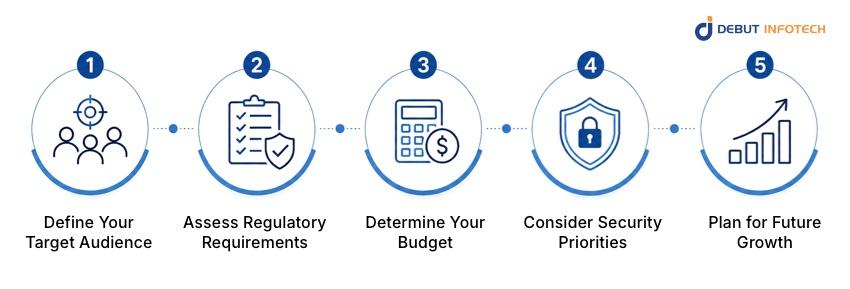
Understanding your intended users is one of the most important steps when selecting an exchange model. Retail traders, institutional investors, professional traders, and DeFi participants all have different expectations regarding security, usability, and asset control. Identifying your audience early helps ensure the platform delivers the features and experience they are most likely to value.
Regulatory obligations vary by jurisdiction and can influence everything from platform architecture to daily operations. Businesses should evaluate licensing requirements, KYC obligations, AML procedures, and reporting standards before choosing an exchange model. Aligning the platform with applicable regulations reduces legal uncertainty and strengthens the foundation for long-term growth.
Development costs can differ substantially depending on whether the exchange is centralized, decentralized, or hybrid. Beyond initial development, businesses should also consider security audits, compliance implementation, infrastructure management, liquidity solutions, and ongoing maintenance. Establishing a realistic budget helps identify the most practical model without compromising critical functionality or performance.
Security expectations should influence every stage of exchange planning. Businesses need to determine whether they prefer custodial asset management, self-custody solutions, or a combination of both. Evaluating security priorities helps guide decisions around wallet architecture, access controls, smart contract development, monitoring systems, and overall risk management strategies.
The ideal exchange model should accommodate future expansion rather than simply addressing current requirements. Businesses should consider whether they plan to introduce additional trading pairs, support multiple blockchains, expand internationally, or launch new financial services. A scalable exchange architecture reduces redevelopment costs and supports sustainable growth over time.
Modern crypto exchanges must deliver security, performance, compliance, and flexibility. These core features help platforms meet user expectations while supporting growth in an increasingly competitive market.
A modern crypto exchange depends on a high-performance trading engine capable of processing large volumes of transactions quickly and accurately. Fast order matching, low latency, and stable performance are critical for maintaining user confidence and supporting active trading environments. An efficient trading engine also contributes to better liquidity and overall platform reliability.
Security remains a core requirement for any successful exchange platform. A comprehensive security framework should include encryption protocols, multi-signature wallets, two-factor authentication, intrusion detection systems, and continuous monitoring tools. These protections help safeguard user assets, prevent unauthorized access, and strengthen trust among traders and institutional participants.
Liquidity is essential for ensuring users can execute trades efficiently without significant price fluctuations. A robust liquidity management system may include market-making mechanisms, liquidity aggregation tools, and integrations with external providers. Strong exchange liquidity improves market depth, enhances trading experiences, and makes the platform more attractive to active traders.
Compliance functionality is increasingly important as regulators continue to strengthen oversight of digital asset markets. Modern exchanges should include integrated KYC verification, AML monitoring, transaction screening, risk assessment tools, and reporting capabilities. These features help businesses meet legal obligations while maintaining operational efficiency and reducing compliance-related risks.
Traders increasingly expect access to a wide range of cryptocurrencies, tokens, and blockchain networks from a single platform. Supporting multiple assets and chains enhances flexibility, attracts broader user groups, and creates more trading opportunities. Multi-chain functionality also positions exchanges to adapt as new blockchain ecosystems gain adoption and market relevance.
Choosing the right crypto exchange development partner can significantly impact project success. Businesses often seek experienced providers capable of delivering secure, scalable, and future-ready crypto exchange solutions tailored to their specific requirements.
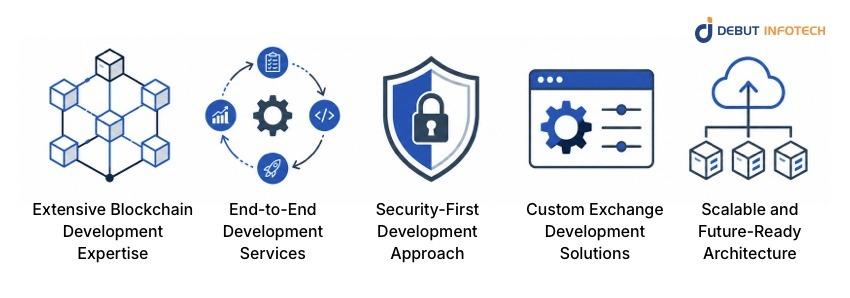
Debut Infotech has extensive experience delivering blockchain and cryptocurrency exchange solutions across diverse industries and business models. Its development teams understand the technical, operational, and regulatory aspects of exchange development, enabling businesses to build secure, scalable, and feature-rich platforms that align with current market expectations and future growth objectives.
Businesses benefit from comprehensive support throughout the entire development lifecycle. From initial consulting and market analysis to UI/UX design, development, testing, deployment, and post-launch support, Debut Infotech provides a structured approach that helps reduce development complexity and ensures smoother project execution from start to finish.
Security is integrated into every stage of the development process. Debut Infotech implements industry-standard security practices, secure wallet architectures, encryption mechanisms, authentication systems, and rigorous testing procedures. This proactive approach helps businesses minimize vulnerabilities, protect user assets, and build greater trust among platform users.
Every crypto exchange has unique business goals, target audiences, and operational requirements. Debut Infotech develops customized centralized, decentralized, and hybrid exchange solutions tailored to specific needs. This flexibility allows businesses to launch platforms with features, workflows, and capabilities that support their long-term strategy.
Debut Infotech designs exchange platforms with future growth in mind. Scalable architectures, modular development practices, and support for emerging blockchain technologies help businesses adapt to changing market conditions. This approach enables exchanges to accommodate increasing user demand and expand services without major infrastructure limitations.
Hybrid exchanges are attracting growing interest as businesses and traders look for solutions that combine security, compliance, user control, and performance without the limitations often associated with purely centralized or decentralized models.
Crypto users are becoming more conscious of asset ownership and security following several high-profile exchange failures. Many traders want the convenience of centralized trading without completely surrendering control of their funds. Hybrid exchanges address this demand by incorporating self-custody features while maintaining a user-friendly trading experience that appeals to both retail and professional participants.
As governments introduce stricter regulations for digital asset businesses, exchange operators are seeking models that can support compliance requirements without abandoning innovation. Hybrid exchanges offer greater flexibility by enabling businesses to integrate KYC, AML, and monitoring systems while preserving selected decentralized features that continue to attract blockchain-focused users and investors.
Security expectations continue to rise as traders become more aware of custodial risks and smart contract vulnerabilities. Hybrid exchanges are gaining attention because they distribute security responsibilities across multiple layers rather than relying entirely on a centralized or decentralized framework. This approach can help reduce certain risks while maintaining strong protection mechanisms and operational efficiency.
Users increasingly expect crypto platforms to offer fast onboarding, efficient trading, intuitive interfaces, and simplified asset management. Traditional decentralized exchanges often present usability challenges for less experienced traders. Hybrid exchanges aim to eliminate many of these barriers by combining accessibility and convenience with the transparency and control associated with decentralized ecosystems.
The growing adoption of multiple blockchain networks is increasing demand for seamless cross-chain trading capabilities. Hybrid exchanges are well-positioned to support blockchain interoperability by connecting liquidity sources, assets, and services across different ecosystems. This capability can improve trading flexibility, expand market access, and create more opportunities for both users and exchange operators.
Choosing between a centralized vs decentralized vs hybrid exchange ultimately depends on your business objectives, target audience, regulatory requirements, security priorities, and available budget.
Centralized exchanges offer strong liquidity and user-friendly experiences; decentralized exchanges provide greater asset control and transparency; and hybrid exchanges aim to combine the strengths of both models.
By carefully evaluating development costs, revenue opportunities, compliance obligations, and long-term scalability, businesses can select an exchange architecture that supports sustainable growth and delivers lasting value in the evolving cryptocurrency market.
Centralized exchanges (CEX) are run by a company that holds user funds and manages trades through an internal system. Decentralized exchanges (DEX) let users trade directly from their wallets using smart contracts, so no intermediary holds assets. CEX is faster, while DEX gives users more control over their funds.
Centralized exchanges rely on a single authority managing custody and order matching. Hybrid exchanges combine centralized speed with decentralized crypto custody, letting users trade quickly while still keeping some control of assets. Hybrid setups aim to balance security and performance, reducing the risks associated with either full central control or full decentralization.
Security depends on the threat model. DEX platforms usually offer stronger asset security because users retain control of their private keys, and funds remain in wallets. CEX platforms can be safer against user mistakes but are more vulnerable to hacks because they store large amounts of assets in centralized wallets.
Most businesses prefer centralized exchanges because they’re easier to scale, faster for high-volume trading, and generate consistent fee revenue. Liquidity is also easier to manage. Hybrid models are gaining attention, but CEX platforms still dominate in attracting users and building profitable exchange operations quickly.
Enterprises usually choose hybrid or centralized exchanges depending on compliance needs. Centralized platforms work well in regulated environments with strict reporting requirements. Hybrid models suit enterprises wanting control over assets while maintaining performance. Pure DEX setups are less common for large organizations due to governance and integration limitations.
CEX platforms generate more revenue overall because they charge trading fees, listing fees, and often earn from margin trading and staking services. DEXs rely mainly on swap fees and smaller-scale liquidity pools. High trading volume on CEXs makes revenue streams more stable and predictable.
CEX platforms attract more traders mainly because they’re easy to use, offer higher liquidity, and support fiat deposits. Beginners prefer them since onboarding is simple. DEXs attract a more technical audience focused on privacy and control. Overall, CEXs still dominate in daily active users and trading activity.
Building a crypto exchange can range widely based on features. A basic platform may cost around $50,000 to $150,000. Mid-level exchanges go from $150,000 to $500,000. Advanced platforms with high security, liquidity tools, and compliance systems can cost more than $1 million, depending on complexity and infrastructure requirements.
Developing a centralized exchange usually costs more due to infrastructure, security, and compliance requirements. Entry-level builds start around $100,000 to $250,000. Mid-range platforms sit between $250,000 and $700,000. Large-scale exchanges with deep liquidity, advanced matching engines, and regulatory compliance can exceed $2 million depending on scope and region.
Decentralized exchange development is generally cheaper than centralized systems, but it still depends on the level of complexity. Basic DEX platforms may cost $40,000 to $120,000. More advanced versions with cross-chain support, liquidity protocols, and auditing requirements can range from $150,000 to $500,000, depending on features and smart contract complexity.
Hybrid exchange development sits between centralized and decentralized builds because it combines both architectures. Costs usually range from $80,000 to $300,000 for basic versions. Advanced hybrid systems with custody layers, trading engines, and blockchain integration can range from $300,000 to $900,000, depending on the scope requirements.
Compliance requirements for crypto exchanges include KYC verification, AML monitoring, data protection policies, jurisdiction-dependent licensing, and regular audits. Exchanges must also implement transaction tracking, reporting systems, and cybersecurity standards. Regulations vary by country, so legal alignment is necessary before launch or operation begins.

Our Latest Insights
USA
2501 Chatham, Rd Suite R Springfield, IL 62704
+1-708-515-4004
info@debutinfotech.com
UK
7 Pound Close, Yarnton, Oxfordshire, OX51QG
+44-770-304-0079
info@debutinfotech.com
Canada
154 Eden Oak Trail, Kitchener, ON N2A 0H9
+1-708-515-4004
info@debutinfotech.com
INDIA
Sector 101-A, Plot No: I-42, IT City Rd, JLPL Industrial Area, Mohali, PB 140306
9888402396
info@debutinfotech.com