ON THIS PAGE
Progress0%






Our Global Presence :






Many trading possibilities in the fast-paced space of decentralized finance (DeFi) might appear and vanish in the blink of an eye. One such chance presents itself with the release of fresh tokens on PancakeSwap and Uniswap, two leading decentralized exchanges (DEXs). Often causing price swings, these events are a treasure for smart traders. Traders have turned to DeFi sniper bots—automated systems meant to quickly spot and seize these volatile opportunities—to maximize possible earnings.
DeFi sniper bots offer a strategic advantage in a very competitive market regardless of whether your targets are freshly minted tokens or use of price differences.
As decentralized finance grows, automated trading has become the primary driver of market liquidity. In 2026, the “speed advantage” has become a fundamental requirement for anyone looking to capitalize on DEX volatility. The market has seen a massive influx of retail-friendly “Telegram Bots” alongside institutional-grade MEV (Maximal Extractable Value) infrastructure, creating a highly competitive but deeply liquid environment.
Key Market Statistics (2026)
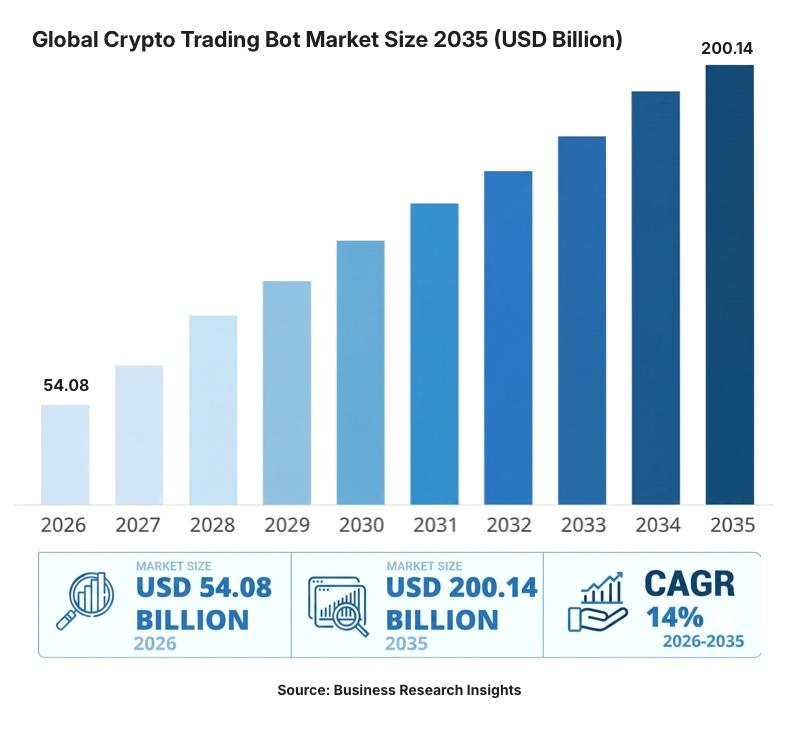
$54 Billion Market Size: The global crypto trading bot market is valued at approximately $54 billion in 2026 and is projected to reach $200 billion in 2035, with a 14% CAGR as AI integration becomes more prevalent.
Using direct blockchain protocol interaction, a DeFi sniper trading bot is a specialized program used to execute trades on decentralized exchanges (DEXs) quickly. The bot’s capacity to “snipe” a trading opportunity in seconds—taking advantage of temporary events like newly issued token listings or liquidity occurrences—helps to define the word “sniper.”
Trading possibilities on DEXs, including Uniswap, PancakeSwap, or SushiSwap, can be somewhat time-sensitive. Token values often change drastically in a few seconds; by the time a human trader responds, the greatest chances could have passed. DeFi snipers instantly execute transactions according to predefined criteria like price thresholds or liquidity levels, therefore removing this wait.
The bots can target particular coins, track liquidity pools, and even automatically sell tokens once a preset profit margin is attained. Given the increasing number of DeFi systems and protocols, having a dependable bot can make all the difference between missing out completely and making significant gains.
A DeFi sniper bot’s primary purpose is to track the blockchain for particular trading signals and carry them out faster than human traders could. These bots are seen in great detail here:
Traders have an advantage since this automation dramatically lowers the time between spotting an opportunity and making a deal. Crypto trading bot development can optimize these bots to suit particular trading approaches and tastes.
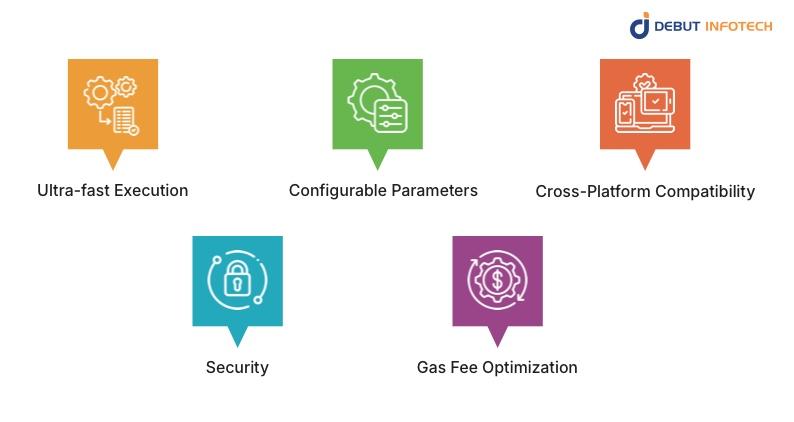
Not all trading bots are made equal, and some characteristics of DeFi sniper trading bots seem necessary for success. The following distinguishes the best DeFi trading bots:
By creating a DeFi sniper bot with all these capabilities, the right DeFi development services can guarantee that traders have a tool fit for the best performance and safety by using the correct DeFi protocols.
DeFi sniper trading bot development depends much on smart contract integration. Smart contracts are self-executing agreements directly written in code terms of the agreement. They let DeFi snipers do independent transactions and engage with decentralized exchanges (DEXs).
When it makes a trade, a bot engages the smart contracts controlling the decentralized exchange. These agreements define the token swaps, the liquidity source, and the computation of fees. Operating straight on the blockchain, the bot may avoid the typical delays connected with user interfaces and centralized systems.
For instance, when a token is issued, the smart contract in charge of trading will manage the matching of buyers and sellers. A DeFi sniper bot monitoring the smart contract and acting with a buy order as soon as the token becomes available has a major advantage over human traders.
Developing a sniper bot that interacts well with these smart contracts requires a thorough understanding of smart contract development. To guarantee flawless execution, developers must grasp the inner workings of DeFi systems and how to maximize bot interactions with them.
Among the most crucial considerations for DeFi sniper bots is speed. Bot users have a significant edge over human traders because they can conduct trades within milliseconds. Timing is essential in a fiercely competitive environment where token values could change in seconds.
DeFi sniper bots provide multiple speed benefits:
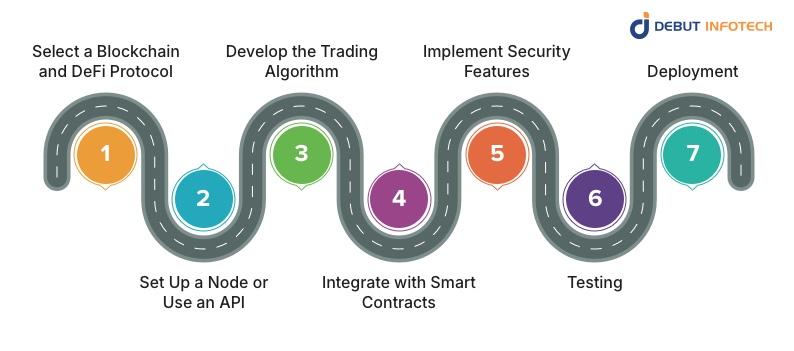
Creating a decent DeFi sniper bot is not easy. It requires knowledge of smart contracts, blockchain technology, trading strategies, and decentralized exchanges. This is a detailed walk-through guide for creating a sniper bot.
A well-structured tech stack determines how quickly and reliably a sniping bot reacts to market events. Each layer contributes to execution speed, data handling, and transaction security.
Most sniping bots are built with JavaScript (Node.js) or Python, as both handle blockchain interactions efficiently. JavaScript pairs seamlessly with libraries like Web3.js for real-time execution, while Python supports flexible scripting and testing. For ultra-low latency and concurrency, some developers or blockchain application development companies integrate Go or Rust to handle high-frequency transaction processing and parallel operations effectively.
Development frameworks streamline contract interaction, deployment, and testing workflows. Tools like Hardhat and Truffle simplify debugging and scripting for Ethereum-based bots. On the backend, lightweight frameworks such as Express.js help structure APIs for managing bot triggers, transaction queues, and logging systems without introducing unnecessary processing delays.
Efficient data storage ensures bots can track transactions, token metrics, and execution history without delays. Defi companies often use MongoDB for flexible, unstructured data such as logs and token metadata, while Redis provides high-speed caching for real-time reads. For structured datasets like trade performance and wallet tracking, PostgreSQL provides reliability, consistency, and strong query performance under load.
Infrastructure plays a direct role in execution speed and uptime. Cloud platforms such as Amazon Web Services and Google Cloud Platform offer scalable environments with global server distribution. Many advanced setups prioritize low-latency regions or dedicated servers, ensuring bots can respond instantly to mempool activity without delays caused by shared or congested environments. If you need help with choosing the right infrastructure, you can seek support from reliable blockchain consultants.
Reliable blockchain access is critical for monitoring and executing trades. Services like Infura and Alchemy provide quick integration, but private RPC nodes deliver faster response times and better reliability. WebSocket connections enable real-time mempool tracking, allowing bots to detect pending transactions and react before they are confirmed on-chain.
Security tools protect both funds and execution integrity. Libraries such as OpenZeppelin help enforce safe smart contract standards, while solutions like HashiCorp Vault securely manage private keys and credentials. Defi token development companies utilize additional encryption layers and access controls to reduce exposure to breaches, especially in automated environments that handle continuous blockchain transactions and sensitive wallet data.
DeFi sniper bots have several risks and obstacles despite their benefits:
Legal and ethical issues still hold relevance even if DeFi is meant to be a decentralized, permissionless technology. Regarding legality, DeFi sniper bots fall in a hazy area, particularly given that DeFi itself is still developing in terms of control. Often viewed as immoral, front-running—using bots to preload trades based on unverified blockchain events—may be prohibited in some places.
Apart from any legal issues, traders and developers should also pay close attention to ethical issues. Sometimes, the employment of bots to exploit market inefficiencies results in an unfair marketplace whereby human traders—especially beginners—are greatly disadvantageous. Although most governments do not forbid DeFi sniper bots, their use raises ethical questions, especially in competitive token launches.
Moreover, traders should keep updated about the most recent legal needs as the environment of regulations for DeFi platforms and crypto trading bot development changes. Working with a crypto trading bot development company that follows the rules helps lower bot use risks.
The benefits of using DeFi sniper bots are clear, and many experienced traders have adopted them as part of their trading strategy. Some key advantages include:
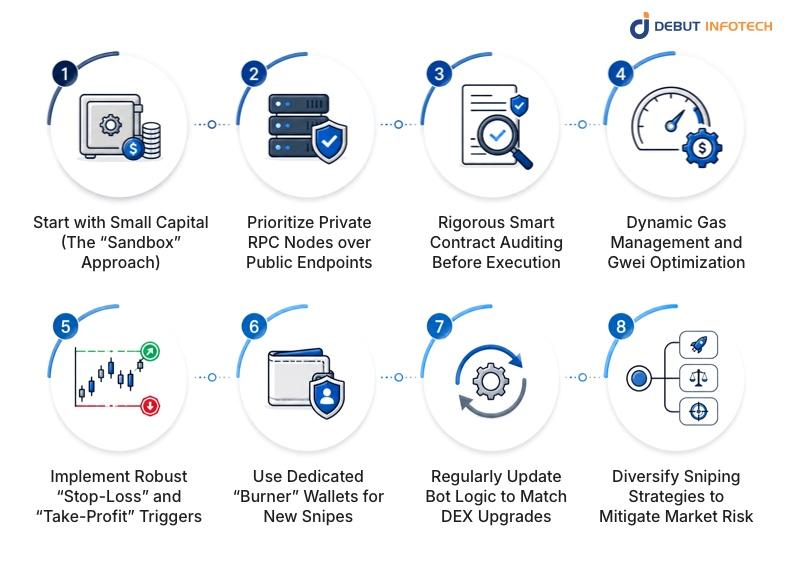
In sniper bot trading, strong execution comes down to discipline, not just speed. These practices help reduce avoidable losses while maintaining consistent performance across different market conditions.
Running a crypto sniper bot with limited capital allows you to observe real execution behavior without exposing large funds. It helps identify issues such as failed transactions, miscalculated slippage, or incorrect triggers. Gradually increasing capital after consistent performance ensures your strategy is stable and reduces the impact of early-stage mistakes or unexpected contract behaviors.
Public RPC endpoints often suffer from congestion, rate limits, and delayed responses, which can affect execution timing. Private nodes provide faster and more reliable access to blockchain data, especially during high-demand periods. This improved speed allows bots to detect mempool activity earlier and submit transactions with better positioning against competing traders.
Entering trades without reviewing contract logic exposes bots to risks like hidden taxes or restricted selling. Careful inspection of smart contracts helps detect potential traps before execution. Using automated scanners alongside manual checks improves accuracy, ensuring the bot interacts only with contracts that meet expected safety and functionality standards.
Gas fees determine how quickly transactions are processed. Static gas settings often fail in competitive environments where network demand fluctuates rapidly. Bots need dynamic adjustment mechanisms that respond to real-time conditions, balancing speed and cost. Proper optimization ensures transactions are neither delayed nor unnecessarily expensive during high-competition scenarios.
Automated exit conditions protect against sudden market reversals and lock in gains without manual intervention. Clearly defined stop-loss levels prevent excessive losses, while take-profit triggers secure earnings at predefined targets. Integrating these rules into bot logic ensures disciplined trading, reduces emotional decision-making, and maintains consistency across multiple trades.
Separating wallets for different trades limits exposure if a contract turns malicious. Burner wallets isolate risk, ensuring that only allocated funds are affected by potential exploits or restrictions. This setup also helps manage multiple strategies simultaneously while protecting primary holdings from direct interaction with unverified or newly launched tokens.
Decentralized exchanges frequently update their contracts, fee structures, and routing logic. Sniping bots with outdated configurations may fail or run inefficiently. Regular updates ensure compatibility with new protocols, maintain execution accuracy, and prevent missed opportunities caused by changes in how transactions are processed or validated on the network.
Relying on a single strategy increases vulnerability to market shifts or contract-specific restrictions. Combining approaches such as launch sniping, arbitrage, and event-based execution spreads risk across different scenarios. This diversification improves long-term performance by reducing dependence on a single method and enabling the bot to adapt to changing market conditions.
DeFi sniper trading bots are developing along with DeFi’s expansion and inventiveness. Advances in artificial intelligence (AI), blockchain interoperability, and growing attention to user security will probably define future trends in bot development.
The development of DeFi sniper bots will rely heavily on artificial intelligence (AI). AI will enable bots to learn from prior market data, instantly modify their trading plans, and even project market moves depending on trends. By lowering the risk of mistakes, enhancing decision-making, and foreseeing market shifts, AI-enhanced bots can maximize trading performance.
The demand for bots that can run across several chains is growing as new blockchains create DeFi ecosystems outside Ethereum. Bots that can snipe deals on platforms beyond Ethereum, such as Binance Smart Chain, Solana, or Avalanche, will appeal to traders.
For speed and efficiency, many sniper bots now depend on centralized infrastructure. Still, fully decentralized bots running on decentralized nodes will probably surface and provide even more security and transparency.
As AI-powered bots keep becoming smarter, they will offer real-time decision-making powers and superior predictive analytics. This will enable bots to spot possibilities more precisely and quickly, hence improving their efficacy.
Bots specifically designed for DeFi: More bots catering to particular DeFi use cases—such as yield farming, Defi staking, or liquidity provision—will probably come. On DeFi systems, these bots will automate a greater spectrum of financial tasks than only token trading.
Bots that can guarantee adherence to different legal criteria will be needed when governments start closely controlling DeFi. This can entail including compliance audits into the bot’s decision-making process.
DeFi projects actively deploy mechanisms to detect, restrict, or trap automated trading bots. Understanding both the restriction and the workaround helps reduce failed transactions and unexpected losses.
Projects often enforce “dead blocks” that prevent trading during the first few blocks after launch. Some contracts also blocklist early buyers detected as bots. This blocks selling or transfers, trapping funds, and discouraging automated sniping during the most volatile launch window.
Countermeasure:
Defi trading bots can delay entry by monitoring block numbers and waiting until restrictions lift. Advanced setups simulate transactions or analyze contract conditions before execution. Using multiple wallets with staggered entries also reduces the chance of triggering blocklist logic tied to early participation patterns.
Smart contracts may impose strict caps on transaction sizes, limiting how much can be bought or sold in a single trade. These limits aim to prevent bots from acquiring large token shares instantly, reducing the risk of price manipulation or rapid liquidity draining.
Countermeasure:
Bots adapt by splitting trades into smaller chunks that comply with contract limits. They execute sequential or parallel transactions across multiple wallets, maintaining overall position size while avoiding rejections. Proper sizing logic ensures trades remain efficient without exceeding allowed thresholds or causing failed swaps.
Some projects create fake or misleading liquidity events to lure bots into premature trades. These bait setups simulate legitimate liquidity additions, triggering bot entries before real trading conditions stabilize, often resulting in immediate losses once actual liquidity dynamics shift.
Countermeasure:
Bots counter this by verifying liquidity locks and analyzing pool depth before execution. Monitoring contract ownership, lock duration, and transaction patterns helps filter out fake signals. Delayed confirmation strategies reduce the risk of reacting to manipulated liquidity events designed to trap automated traders.
Honey pot contracts allow users to buy tokens but restrict or completely block selling. This traps bots that fail to detect the restriction, permanently locking funds. The logic is often hidden within contract functions, making it difficult to identify without deeper inspection.
Countermeasure:
Bots mitigate this risk by simulating both buy and sell transactions before committing funds. Contract analysis tools and pre-trade testing help detect hidden restrictions. Integrating automated checks into the execution logic ensures that trades proceed only when both entry and exit conditions are verified.
Some tokens apply extremely high taxes on buying or selling, reducing profitability or making trades unviable. These taxes can change dynamically, catching bots that rely solely on price signals and fail to account for the transaction costs embedded in the contract.
Countermeasure:
Bots calculate effective costs by factoring in tax percentages before executing trades. Real-time contract reading and simulation allow accurate profit estimation. By filtering out tokens with unfavorable tax structures, bots avoid trades where hidden costs outweigh potential gains.
Certain contracts reject transactions with gas prices above a defined limit. This prevents bots from using aggressive gas bidding to gain priority in execution. Transactions exceeding the cap fail, leaving bots unable to compete using traditional speed-based strategies.
Countermeasure:
Bots dynamically adjust gas strategies, staying within acceptable limits while remaining competitive. Instead of overbidding, they optimize timing and use private nodes for faster propagation. Fine-tuned gas algorithms help maintain execution priority without triggering rejection conditions tied to excessive fees.
Dynamic gas fee rules change acceptable transaction parameters in real time. These anti-GWEI mechanisms prevent bots from relying on fixed gas strategies, forcing them into unpredictable execution environments where incorrect fee settings can result in failed or delayed transactions.
Countermeasure:
Bots respond by implementing adaptive gas models that adjust based on network conditions and contract requirements. Continuous monitoring of fee patterns allows real-time updates to transaction parameters. This flexibility ensures transactions remain valid and competitive despite fluctuating gas acceptance rules.
Some projects restrict trading to wallets that meet specific age or balance thresholds. Newly created wallets or those with insufficient balances are blocked, preventing bots from rapidly deploying fresh addresses to bypass other anti-bot restrictions.
Countermeasure:
Bots prepare by maintaining pre-funded, aged wallets that meet contract requirements. Wallet rotation strategies ensure compliance while reducing detection risk. Managing wallet histories and balances in advance allows bots to operate within constraints without sacrificing execution flexibility or access.
Token launches are just the entry point. More advanced strategies push bots into deeper, more competitive territory.
This strategy tracks specific smart contract function calls using their method IDs. Instead of reacting to general events, the bot watches for exact transaction signatures. That precision allows earlier entry into trades, especially during liquidity additions or contract interactions that signal upcoming price movement.
Bots scan multiple decentralized exchanges simultaneously. When a price difference appears between platforms like Uniswap and PancakeSwap, they execute trades instantly to capture profit. Timing matters here. Even slight delays can wipe out margins due to competition and slippage.
Projects often move liquidity between pools or platforms. Bots monitor these shifts and position early before price adjustments stabilize. Catching liquidity migration early can open short-lived opportunities where tokens are temporarily undervalued or mispriced.
Bots respond to predefined triggers such as contract deployments, liquidity locks, or ownership renouncements. These events often signal reduced risk or increased trust, which can drive buying pressure. Automated detection ensures the defi bot reacts faster than manual traders.
Using multiple wallets spreads transactions across addresses for DeFi protocols. This reduces detection risk and bypasses certain anti-bot measures. It also allows parallel execution, increasing the chance of successful entries during highly competitive launches.
This approach places transactions before and after a target trade. The bot profits from the price movement caused by that transaction. It’s highly competitive and often requires mempool monitoring and precise control of gas fees to succeed.
Instead of withdrawing profits, bots reinvest gains automatically into new opportunities. Over time, these compounds return. The logic must balance risk and exposure to avoid overcommitting capital in volatile conditions.
For traders trying to have an advantage in the cutthroat and fast-paced realm of decentralized finance, DeFi sniper trading bots have grown to be a necessary tool. Leveraging new token launches, liquidity events, and other transient possibilities, these bots let users virtually immediately make trades. But, building and deploying a successful sniper bot requires a thorough knowledge of blockchain, smart contracts, and DeFi systems.
Working with a seasoned crypto trading bot development company guarantees your bot is reliable, safe, and built to stay. Features like cross-platform compatibility, gas optimization, and artificial intelligence-powered decision-making help today’s sniper bots to be stronger than ever.
The technology underlying these bots will also change as DeFi develops, providing ever more advanced capabilities for developers and traders. DeFi sniper bots give you a chance to remain competitive and profit in the dynamic world of distributed finance regardless of your level of trading experience.
A. Crypto sniping is an automated trading approach where bots execute buy or sell orders instantly when predefined blockchain conditions are met. It focuses on speed, targeting early entry into new token launches, liquidity events, or price inefficiencies before manual traders can react or compete effectively.
A. Snipers in crypto are traders or automated bots that enter trades at precise moments, typically during token launches or liquidity additions. They monitor blockchain activity in real time and execute transactions faster than humans, aiming to secure favorable prices before the broader market responds.
A. A DeFi sniper bot targets specific events, such as token launches or liquidity additions, for quick entry. A MEV bot focuses on extracting value from transaction ordering, including arbitrage or sandwiching. MEV bots operate broadly across opportunities, while sniper bots concentrate on precise, event-driven trades.
A. There’s no fixed amount, but starting with a small, controlled budget is common during testing. Effective sniping depends more on execution speed, gas optimization, and strategy than capital size. Gradual scaling after consistent results helps manage risk and prevent large losses during early experimentation.
A. A sniper bot cannot fully protect against rug pulls or honeypots, but it can reduce risk through smart contract checks and transaction simulations. Bots with built-in validation can detect suspicious logic before execution, though manual verification and cautious trading remain necessary to avoid costly mistakes.
A. A private RPC node provides faster and more reliable access to blockchain data compared to public endpoints. It reduces latency, avoids rate limits, and improves transaction propagation speed. This advantage helps your bot detect opportunities earlier and submit transactions with better positioning in competitive trading environments.

Our Latest Insights
USA
2501 Chatham, Rd Suite R Springfield, IL 62704
+1-708-515-4004
info@debutinfotech.com
UK
7 Pound Close, Yarnton, Oxfordshire, OX51QG
+44-770-304-0079
info@debutinfotech.com
Canada
154 Eden Oak Trail, Kitchener, ON N2A 0H9
+1-708-515-4004
info@debutinfotech.com
INDIA
Sector 101-A, Plot No: I-42, IT City Rd, JLPL Industrial Area, Mohali, PB 140306
9888402396
info@debutinfotech.com