ON THIS PAGE
Progress0%




Our Global Presence :


As enterprises grow in size, operations across multiple industries like finance, human resources, supply chain, inventory, and customer management become more complex to manage, particularly when systems lack connections. Enterprise resource planning (ERP) systems address this issue by streamlining business core processes into a unified platform that enhances efficiency, visibility and decision-making.
Nevertheless, the success of an ERP project usually lies in the selection of the appropriate partner among the numerous existing ERP software companies. Skilled ERP developers assist companies in creating future-proof systems, integrating legacy tools, safeguarding confidential data, and supporting future digital transformation.
This guide showcases 10 of the most successful ERP software companies in 2026, which was narrowed down to some of the most important industry factors, such as:
This list helps business leaders and IT decision-makers identify reliable ERP partners for building efficient, future-ready enterprise systems.
With hundreds of vendors offering enterprise solutions today, identifying reliable ERP partners requires more than reviewing marketing claims. Today hundreds of vendors provide enterprise solutions, and to find reliable ERP partners, more than marketing claims should be reviewed. To develop this guide, we assessed companies based on criteria that are generally used by enterprise technology consultants, CIOs, and digital transformation teams when they are sourcing vendors to develop or implement modern ERP systems.
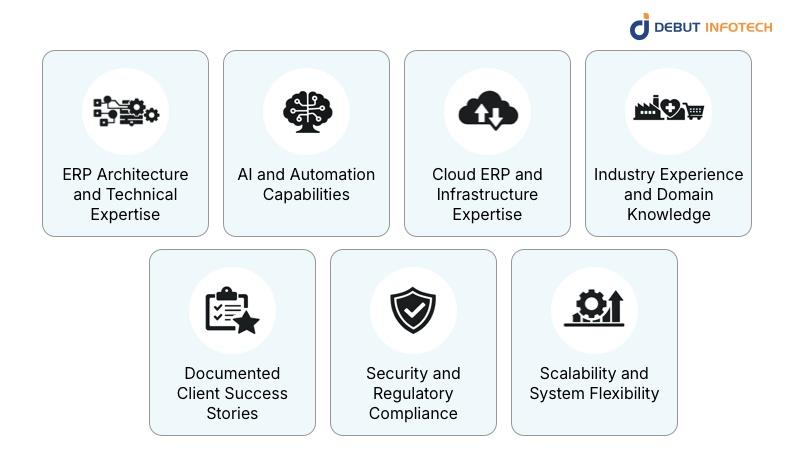
The selection criteria we used were based on vendors that have a proven history of providing scalable enterprise solutions, good security practices, and quantifiable business results. Here are the key criteria we considered:
ERP Architecture and Technical Expertise
A properly designed architecture is the cornerstone of any successful ERP project. Leading vendors develop ERP systems that bridge the core business processes such as finance, supply chain, HR, and inventory without compromising performance and reliability. To illustrate this, manufacturing firms tend to rely on ERP to coordinate procurement, production planning and logistics in real time.
AI and Automation Capabilities
Current ERP systems are becoming more automated and predictive analytics. Businesses that incorporate AI-enhanced capabilities, including automated reporting, automated demand forecasting, and automated workflow automation, assist organizations in minimizing manual operations and quickening their operational choices.
Cloud ERP and Infrastructure Expertise
A large number of organizations are moving off old on-premise systems and moving to cloud-based ERP systems to gain flexibility and save money. Trusted vendors of cloud migration have the potential to guarantee secure data transfer, system uptime, and smooth integration with current business applications.
Industry Experience and Domain Knowledge
ERP requirements vary significantly by industry. Vendors who have a profound understanding of their sector are often able to provide better solutions. For instance:
Companies with specialized industry knowledge can tailor ERP functionality to meet these operational needs.
Documented Client Success Stories
Evidence of effective ERP implementations is a good sign of reliability. We considered vendors that have shown quantifiable results like increased operational efficiency, faster financial reporting or lower maintenance costs of the system.
Security and Regulatory Compliance
Due to the sensitive nature of financial and operational information in ERP platforms, there should be well-developed cybersecurity standards. Leading providers usually operate under the recognized standards like the ISO 27001, SOC 2, and GDPR compliance, which make sure that the enterprise data is safely maintained.
Scalability and System Flexibility
Business changes with time and therefore ERP systems need to accommodate future expansions. Major vendors develop modular architectures that enable organizations to add new functionality, bring in third-party tools, and increase user capacity without having to rebuild the system. The most appropriate vendors offer continuous technical support, personnel training, monitoring of performance, and constant updates so businesses remain stable in operations and achieve maximum ROI.
Finding the right ERP partner can make a huge difference in how smoothly your business runs. The most appropriate providers do not merely offer software but will lead businesses through the overall process of enterprise software development, including planning and customization, integration, and long-term maintenance. Below are some of the most trusted ERP software companies and platforms in 2026, known for helping organizations modernize operations and scale efficiently.

One of the more flexible companies that businesses should consider when looking to have a more custom ERP is Debut Infotech. On its official site, the company positions itself around blockchain, AI, and software development, and its enterprise services page particularly singles out custom ERP and CRM systems, process automation, and business intelligence platforms. That makes it well suited to organizations which desire more custom workflows, more integrations, or a more flexible enterprise software development process than standard ERP rollouts usually offer.
The company also focuses on secure, high performance enterprise applications and agile delivery, which is particularly applicable in companies that require a dedicated software development team to develop or extend internal systems over time. Debut Infotech can also be an option when considering ERP software for small businesses that require customization over a strict prebuilt package, though growing businesses that have already outgrown basic tools may also be considered.
Key Services
| Pros | Cons |
| Custom ERP development tailored to specific business workflows | Implementation timelines depend on project complexity |
| Strong expertise in AI, blockchain, and emerging technologies | Not an out-of-the-box ERP platform (requires development) |

Oracle NetSuite is one of the most established cloud ERP platforms for businesses that want a single suite for accounting, ERP, CRM, and ecommerce. Oracle’s official ERP page describes it as an integrated cloud business software suite, and its ERP page highlights automation of core processes plus real-time visibility into operational and financial performance.
NetSuite is also notable for scale. Oracle states that NetSuite has 43,000+ customers in 200+ countries and dependent territories, which is a strong trust signal for buyers comparing mature ERP ecosystems. For smaller and mid-sized organizations, it is also one of the better-known options in the conversation around ERP software for small companies, particularly those that need finance, inventory, and order management in one cloud system.
Key Services / Capabilities
| Pros | Cons |
| Fully cloud-based ERP with integrated CRM and finance modules | Licensing costs can increase as companies scale |
| Ideal for mid-market companies and fast-growing businesses | Customization may require specialized NetSuite developers |

SAP S/4HANA is designed to support organizations that require enterprise-level process depth in finance, procurement and the supply chain. The official product page of SAP emphasizes the use of AI to transform finance, modernize procurement, and support end-to-end business operations. In practice, that makes SAP S/4HANA a strong option for large enterprises with complex global operations and demanding compliance needs.
Its official materials point users to technical documentation, help resources, onboarding content, and data security guidance. That gives SAP credibility not just as software, but as a long-term ERP operating environment for businesses with high governance requirements.
Key Services / Capabilities
| Pros | Cons |
| Enterprise-grade ERP with real-time data processing | Expensive implementation and licensing |
| Advanced analytics and supply chain management | Complex deployment requiring specialized consultants |

One of the most accessible ERP ecosystems to organizations that already use Microsoft tools is Microsoft Dynamics 365. According to Microsoft, Dynamics 365 is described as an AI-powered CRM and ERP software that unites teams, processes, and data. Its ERP solution pages focus on cloud-based ERP, AI productivity, and measurable business outcomes.
Microsoft also supports the product with factual customer and ROI messages on its official site, such as a commissioned Forrester Total Economic Impact study with 106% ROI over three years, saving $3.9M legacy costs and $8.9M productivity gains for the modeled company. Such official benchmark content will help build trust among buyers who compare operational value, particularly when firms consider a wider enterprise software development process which encompasses ERP, analytics, and workflow automation.
Key Services / Capabilities
| Pros | Cons |
| Seamless integration with Microsoft ecosystem (Azure, Power BI, Office) | Customization may require Microsoft-certified developers |
| Flexible modular ERP + CRM platform | Licensing tiers can be confusing |

Saritasa is a US-based technology firm that provides custom enterprise applications and ERP solutions that fit business processes. By integrating ERP systems with modern web and mobile technology, the company assists organizations in streamlining operations.
Saritasa frequently offers a team of software developers who engage in close collaboration with clients during planning to deployment. Businesses also work with Saritasa when they need to hire web developers to build custom ERP dashboards, portals, and integrations.
Key Services / Capabilities
| Pros | Cons |
| Strong experience in web, mobile, and enterprise application development | May require additional integrations for complex enterprise environments |
| Flexible development approach tailored to business workflows | Limited focus on large enterprise ERP platforms compared to global consulting firms |

Acumatica brands itself as a modern cloud ERP system that aims to enhance efficiency and enable businesses to grow confidently. Its official site focuses on usability, security, reliability, AI-driven automation, and genuine cloud architecture. That combination makes it a strong contender for mid-market firms that want enterprise features without the heaviness often associated with legacy ERP systems.
Its product pages also show a clear focus on industries such as manufacturing, construction, distribution, professional services, and retail. That industry alignment is useful for buyers looking beyond generic software claims and toward fit-for-purpose ERP. Acumatica’s messaging around easy navigation and minimal training also suggests a people-first usability advantage, which many vendor comparison pages overlook.
Key Services / Capabilities
| Pros | Cons |
| Cloud-native ERP built for scalability | Smaller partner ecosystem compared to SAP or Oracle |
| Flexible pricing model based on resources instead of users | Limited brand recognition in some regions |

ScienceSoft is an IT consultancy and software development firm based in the US with more than 30 years of experience in providing trusted enterprise software development services. The company assists organizations in designing and deploying secure and scalable ERP systems to centralize business processes and enhance the visibility of data.
ScienceSoft has a systematic enterprise software development process, including business analysis, ERP customization, system integration, testing, and long-term support. Its proficiency in cloud migration and modernization of legacy systems makes it a reliable partner to businesses that are looking at efficient and future-ready ERP solutions.
Key Services / Capabilities
| Pros | Cons |
| Strong expertise in enterprise software development services and ERP integration | Pricing can be higher compared to smaller ERP vendors |
| Proven experience across industries such as healthcare, retail, and manufacturing | Projects may require longer planning phases due to structured processes |

Infor CloudSuite is best understood as an industry-first ERP approach rather than a one-size-fits-all suite. Infor’s official site describes the company as a global leader in cloud-based, industry-specific enterprise software, while its CloudSuite resources highlight an intelligent cloud platform built on industry best practices. That framing is important because many ERP buyers today are not just comparing features, they are comparing how well a system maps to sector-specific operations.
Infor’s official materials also show depth in areas like high tech and electronics, healthcare, equipment, and the public sector. Notably, Infor reports that its CloudSuite Public Sector solution is FedRAMP-qualified, a significant indicator of trust and compliance to buyers in government situations. This level of industry depth specifically makes Infor particularly responsive to organizations in regulated or operationally specific settings.
Key Services / Capabilities
| Pros | Cons |
| Industry-specific ERP solutions (manufacturing, healthcare, logistics) | Limited adoption compared to SAP or Microsoft |
| Advanced supply chain capabilities | Customizations may require partner support |

Sage Intacct is especially strong for finance-led ERP and accounting modernization. Sage’s official pages describe it as AI-powered cloud accounting and financial management software trusted by 30,000+ finance teams, with real-time visibility and a strong focus on automation, integrations, and ROI. That makes it particularly useful for service-based organizations and growing companies where finance operations are the first priority.
Concrete outcome claims are also featured on the official regional pages of Sage, such as cutting close time by up to 79%, month-end close savings, and benefits of automation in finance. Another practical trust signal is its implementation model: Sage explicitly states that customers should work with a certified implementation partner for setup, migration, configuration, reporting, and post-go-live support. Such openness gives buyers credibility on their part as they seek actual deployment requirements, as opposed to the ambiguous marketing claims.
Key Services / Capabilities
| Pros | Cons |
| Strong integration ecosystem | Primarily focused on finance (less comprehensive ERP) |
| Excellent reporting and accounting automation | May require third-party apps for full ERP functionality |

IFS Cloud is a strong choice for asset-intensive and mission-critical industries where ERP needs to support more than back-office processes. According to its official site, IFS claims that its ERP provides industry-specific functionality across various industries with embedded best practices and regulatory support. The larger IFS Cloud messaging focuses on composable enterprise applications and Industrial AI as well.
Such positioning makes IFS particularly attractive to the manufacturing, energy, construction, aerospace, engineering and service operations segments. IFS also publishes security and governance messaging around role-based permissions, segregation of duties, audit logs, and support for requirements such as SOX. For buyers in operationally complex industries, those controls are often as important as the feature list itself
Key Services / Capabilities
| Pros | Cons |
| Strong asset and service management capabilities | Smaller ecosystem compared to SAP or Oracle |
| Modern cloud ERP architecture | Limited adoption among smaller companies |
The right choice of an ERP partner is critical to companies that want to make operations efficient, enhance data visibility, and sustain long-term development. Each of the above-mentioned ERP platforms and providers has its own strengths, be it industry expertise, cloud services, or sophisticated analytics. The final decision will always be based on the size of your organization, objectives, and the extent of customization you need.
Debut Infotech is a reputable provider of enterprise software development services when it comes to businesses that require customized solutions. Being well-experienced in the field of AI-based systems, cloud technologies, and custom ERP development, the company assists organizations in creating scalable solutions that may suit their operations.
If you are planning to upgrade or implement an ERP system, you should consider collaborating with Debut Infotech to create a secure and flexible ERP system that will support your business growth.
A. ERP software development refers to the development and customization of software that integrates the core business functions of a company into a single system.
Rather than having to operate with different tools, ERP combines functions like finance and accounting, human resources (HR), manufacturing, and supply chain management.
ERP systems enable businesses to enhance efficiency and data sharing and to make improved decisions by centralizing these processes under one platform.
A. Businesses with unique or complicated processes may want to use custom ERP. It is created to be compatible with particular workflows rather than making companies conform to an existing standardized system.
It also provides a higher level of scalability and security controls. In many cases, it can reduce long-term licensing costs as well.
However, the best option depends on your company’s size, budget, and how quickly you need the system implemented.

Our Latest Insights
USA

2501 Chatham, Rd Suite R Springfield, IL 62704
+1-708-515-4004
info@debutinfotech.com
UK

7 Pound Close, Yarnton, Oxfordshire, OX51QG
+44-770-304-0079
info@debutinfotech.com
Canada

154 Eden Oak Trail, Kitchener, ON N2A 0H9
+1-708-515-4004
info@debutinfotech.com
INDIA

Sector 101-A, Plot No: I-42, IT City Rd, JLPL Industrial Area, Mohali, PB 140306
9888402396
info@debutinfotech.com

9001:2015
Quality Certified

ISO 27001
Security Certified

A+ Rating
Accredited Business

Certik
Security & Audit


Copyright © 2026, Debut Infotech. All rights reserved. | Privacy Policy