ON THIS PAGE
Progress0%






Our Global Presence :





As blockchain technology transitions to the Web3 sphere more than ever before, the argument between Ethereum vs Polkadot has gained increased significance. Both networks are key players that determine the future of decentralized applications, finance, and digital infrastructure.
Ethereum established the infrastructure of smart contracts and is today the base of the largest ecosystem of DeFi platforms, NFTs, and decentralized apps. Polkadot is another platform that was developed by Ethereum co-founder Gavin Wood, but it aims at interoperability and multi-chain connectivity to enable other blockchains to interact.
As multi-chain ecosystems and cross-chain applications grow at a rapid pace, the most important question among developers, businesses, and investors is obvious: which blockchain network has more potential in 2026?
In this guide, we will discuss how both Ethereum and Polkadot compare to each other. This will give you an idea of the current positioning of each network in the ever-changing blockchain landscape.
Ethereum is among the most powerful platforms within the modern blockchain ecosystem. Launched by Vitalik Buterin in 2015, it spawned a compelling concept that has changed the industry: blockchains could do much more than accept payment; they could also execute programmable applications using smart contracts.
Ethereum is fundamentally a decentralized network, which can enable the developers to create and deploy decentralized applications (dApps) without using centralized servers or intermediaries. These applications operate on the Ethereum Virtual Machine (EVM), a universal computing platform that provides the replication of smart contracts in their original form.
Over the years, Ethereum has supported several thousands of Web3 projects. It drives some of the largest industries of the crypto economy such as decentralized finance (DeFi), NFTs, games, and digital identity.
Some well-known examples include:
The other reason Ethereum remains the leader in the space is its developer community. It has the largest blockchain developer pool in the world with a wide range of documentation, open-source blockchain infrastructure and a vibrant global ecosystem, continually innovating and expanding the Web3 ecosystem.
Polkadot is a next-generation blockchain platform that was developed by Dr. Gavin Wood, a co-founder of Ethereum. It was created to overcome certain most significant shortcomings of the initial blockchain networks, particularly scalability and interoperability. Polkadot is not a single blockchain, but rather links a number of specialized blockchains together into a single blockchain ecosystem.
From the very beginning, Polkadot has been based on the Relay Chain that is the core network providing security and consensus. Associated with this are independent blockchains referred to as parachains. Each parachain is free to execute its own applications, transact with others, and still have the same security as the primary network.
Polkadot also has cross-chain communication in the form of XCMP (Cross-Chain Message Passing). The technology enables various parachains to share data and assets without involving external bridges- this is why blockchains are likely to collaborate smoothly.
A number of real world projects are already being developed on Polkadot. For example:
The interesting feature of Polkadot is that it enables various blockchains to run at the same time and share the same security system. By doing so, this enables developers to create specialized networks, without compromising on the interoperability, which is gaining even greater prominence in the future of the blockchain industry as multi-chain networks become a reality.
In order to fully see the difference between Ethereum and Polkadot, it can be useful to consider the manner in which each network is built. Although both platforms are major blockchain systems, their designs have completely different philosophies.
Ethereum has a single-chain structure, in which the primary blockchain takes care of smart contracts, transactions, and security.
Ethereum is overly dependent on Layer-2 scaling solutions to enhance scaling. These networks are the ones that handle transactions that are not part of the main chain then settle them back on Ethereum.
Common examples include:
This measure minimizes congestion on the primary network as well as preserving the robust security model of Ethereum.
Polkadot was created to have multi-chain interoperability.
Instead of relying on one main chain, Polkadot operates through:
The parachains can be customized to a particular use case like DeFi, identity systems, or gaming and at the same time be linked to the broader Polkadot ecosystem.
| Feature | Ethereum | Polkadot |
| Core Design | Single blockchain with Layer-2 scaling | Multi-chain architecture |
| Smart Contracts | Built directly on Ethereum | Implemented through parachains |
| Scalability | Layer-2 rollups | Parallel parachains |
| Interoperability | Achieved via bridges | Built-in cross-chain communication |
| Security | Secured by Ethereum base chain | Shared security through Relay Chain |
In simple terms:
Both solutions attempt to address blockchain scalability, yet they convey two distinct visions of the future of modern blockchain platforms.
Ecosystem growth and developer adoption is one of the most obvious signs of long-term potential when analyzing the difference between Ethereum and Polkadot.
Within the blockchain sector, networks with the greatest number of developers, applications, and infrastructure are more likely to develop rapidly and have a more dominant network effect.
Ethereum is the most developed ecosystem in Web3. Since the introduction of smart contracts, it has gone on to form the backbone of thousands of decentralized applications in finance, games, NFTs and DAOs.
Ethereum has the following strengths:
Due to this solid foundation, Ethereum now runs more than 4,000 live decentralized applications (dApps), which is amongst the most used blockchain platforms in Web3 innovation.
Polkadot’s ecosystem is younger but growing fast, especially in the number of the projects that specialize in multi-chain applications and interoperability.
The network was also created, such that different blockchains could be connected and communicate with each other to create a more flexible Web3 infrastructure.
Polkadot’s main ecosystem strengths include:
Moonbeam is one of the prominent projects of the Polkadot ecosystem.
It is an Ethereum-compatible parachain, which will enable developers to run applications based on the EVM on Polkadot.
This implies that projects that were initially developed with Ethereum can reuse the functionality in the multi-chain nature of Polkadot without having to restructure their infrastructure.
One of the biggest problems of blockchain networks nowadays is scalability. With the continued rise of DeFi platforms, Web3 applications and on-chain services, both Ethereum and Polkadot have come up with various measures to enable more transactions without compromising on security.
Although the two networks strive to enhance performance, the scaling methods of both networks are fundamentally different.
Ethereum increases scalability by using Layer-2 networks that process the transactions not on the primary Ethereum chain and subsequently settle them there.
This solution can minimize congestion, lower fees, and enables the network to accommodate much more activity.
Key Ethereum scaling technologies include:
Examples of Ethereum Layer-2 networks:
These networks already serve several decentralized applications and thus teams that are looking towards blockchain integration can develop scalable products and still enjoy the security of Ethereum and its vast ecosystem.
Polkadot uses an entirely separate scaling model that consists of parachains.
Rather than using additional layers, Polkadot enables the use of many independent blockchains that are linked to a central Relay Chain.
Each parachain processes its own transactions while sharing security with the main network.
The main features of the Polkadot scaling model include:
Using this architecture enables Polkadot to be scaled horizontally through the addition of more parachains.
Security is a major consideration when contrasting blockchain networks, particularly to developers, businesses and users who rely on decentralized systems. Ethereum and Polkadot are both based on advanced Proof-of-Stake mechanisms which are, yet they differ in significant aspects.
Ethereum has a Proof-of-Stake (PoS) consensus framework and validators are required to deposit ETH to confirm a transaction and keep the system running.
Key security characteristics include:
Due to Ethereum supporting numerous top blockchain ecosystem protocols, it has been heavily audited and continually enhanced by one of the most extensive communities of developers in Web3.
Polkadot operates under Nominated Proof-of-Stake (NPoS), in which the holders of the tokens nominate validators who are being tasked with securing the network.
What makes Polkadot different is its shared security model.
Core components include:
This architecture enables the integration of multiple blockchains that get the advantage of a single security structure.
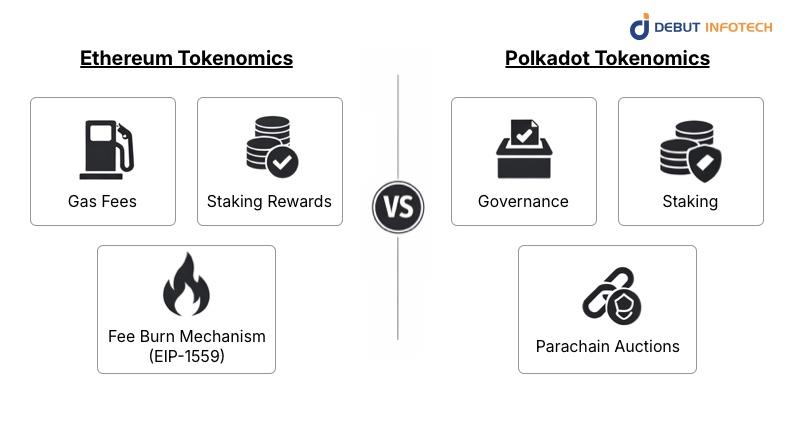
When determining the long-term potential of Ethereum vs Polkadot, one should consider how their native tokens drive each of the ecosystems. The concept of tokenomics affects network security, incentives, governance, and even the blockchain development cost building on these platforms.
The native token of Ethereum, ETH, is needed in the network in a number of crucial ways.
1. Gas Fees
ETH is utilized to complete transaction fees and smart contract execution over the Ethereum network. All decentralized applications, whether it be a DeFi platform, a marketplace of NFTs, etc. all need ETH to execute a transaction.
2. Staking Rewards
Using the Proof-of-Stake model of Ethereum, users will be able to stake ETH to assist in making transactions and securing the network. In return, staking rewards are given to validators.
3. Fee Burn Mechanism (EIP-1559)
A part of Ethereum transaction charges is burnt forever, that is, it is pulled out of the market. This system is used to decrease the supply of ETH overtime, and it can affect the economic value in the long run.
In the case of startups and businesses developing decentralized apps, the cost of developing the blockchain to work on the Ethereum network can be directly influenced by the fee structure and network demand.
The native token of Polkadot, DOT, aids the network in a variety of ways.
1. Governance
DOT holders have a chance to engage in on-chain governance and participate in voting on the network upgrades and protocol changes.
2. Staking
Similar to Ethereum, Polkadot secures its network with the help of staking. Validators and nominators use DOT to engage in transaction validation.
3. Parachain Auctions
The most unique characteristic of Polkadot is its parachain auction system. To have a slot on the Polkadot network, projects have to place DOT tokens in a locked state and attach their blockchain to the network.
The parachain auctions at Polkadot make economic incentives unique.
Polkadot actually encourages long-term commitment among developers by implementing a mechanism that binds DOT to access the network and ensure the demand of the scarce parachain slots is regulated.
In the comparison of the future ability of Ethereum and Polkadot, the most important question is not which network is more advantageous. Rather, it is the question of which ecosystem will be in a better position for the next stage of Web3 development.
The two platforms have good merits, however, they solve different issues in the blockchain ecosystem.
Ethereum is still the leader in decentralized applications and digital finance. There are several reasons behind its sustained leadership:
The majority of DeFi is still operated on Ethereum. It has a liquidity flow worth billions of dollars in its ecosystem, which sustains lending protocols, decentralized exchanges and a stablecoin.
Ethereum has the most significant community of blockchain developers having thousands of open-source tools, frameworks, and learning materials.
Ethereum is home to some of the most established projects in Web3, both in the form of DeFi platforms and NFT marketplaces and DAOs.
Due to this good infrastructure and network effect, a lot of startups and businesses continue to hire skilled blockchain developers in developing decentralized apps.
Polkadot follows another direction and concentrates on interoperability and multi-chain architecture that is scalable.
Its key advantages include:
Polkadot allows other blockchains to interact and exchange information using its relay chain.
Polkadot uses a variety of parachains that operate simultaneously instead of using only one chain.
Polkadot’s on-chain governance model allows protocol upgrades and changes without disruptive hard forks.
The debate between Ethereum and Polkadot may not come down to one clear winner. Rather than competing, the two networks are moving toward complementary roles in the Web3 ecosystem, and that actually makes the business decision harder, not easier.
Ethereum continues to dominate in decentralised applications, DeFi liquidity, and developer activity. Polkadot brings distinct strengths in cross-chain interoperability and scalable multi-chain infrastructure. For businesses, this means the choice is less about which network is better and more about which one fits what you are building — your transaction volume, your user base, your compliance requirements, and your long-term roadmap.
That is where a specialist blockchain app development company makes the difference, and that is precisely what Debut Infotech is built to do.
Blockchain-native since 2015, we have worked with businesses across supply chain, financial services, healthcare, and real estate — each with a different answer to the Ethereum vs. Polkadot question, and each requiring that answer to be grounded in business requirements rather than developer preference. A supply chain traceability platform has different finality requirements than a DeFi liquidity protocol. A tokenised asset marketplace has different interoperability demands than an enterprise permissioned system. The network choice follows from those specifics, not the other way around.
We map your transaction volume, regulatory exposure, user scale, and integration requirements against the real-world capabilities of each network, and deliver a documented architecture recommendation you can build on and defend. From there, our Ethereum development services cover the full build lifecycle across smart contracts, DeFi protocols, and decentralised applications, while our Polkadot development services span parachain architecture, cross-chain bridge implementation, and multi-network coordination.
Whether the right answer is Ethereum or Polkadot, Debut Infotech helps you choose with clarity and build with precision — across smart contracts, DeFi platforms, tokenization, and cross-chain applications.
The right blockchain for your business exists. Debut Infotech helps you find it.
A. Whether Polkadot is better than Ethereum depends on your goals. The two networks have different points of strength.
Polkadot is built for interoperability and scalability. It features parachain architecture that enables it to conduct transactions quicker and tends to be cheaper.
Ethereum, on the other hand, is most adopted, secure and has a mature ecosystem. It still powers the largest number of decentralized applications (dApps) in Web3.
To simplify it so that it can be easily understood, Polkadot is good at interlinking blockchains, whereas Ethereum continues to be the biggest platform used by decentralized applications.
A. Polkadot is regarded as a competitor to Ethereum due to its ability to focus on interoperability and scalability. It has parachain structure which enables many blockchains to be active simultaneously and interact with each other.
Nevertheless, Polkadot continues to lag in terms of adoption and ecosystem size than Ethereum, which continues to be the most popular place to create and develop decentralized applications.

Our Latest Insights
USA
2501 Chatham, Rd Suite R Springfield, IL 62704
+1-708-515-4004
info@debutinfotech.com
UK
7 Pound Close, Yarnton, Oxfordshire, OX51QG
+44-770-304-0079
info@debutinfotech.com
Canada
154 Eden Oak Trail, Kitchener, ON N2A 0H9
+1-708-515-4004
info@debutinfotech.com
INDIA
Sector 101-A, Plot No: I-42, IT City Rd, JLPL Industrial Area, Mohali, PB 140306
9888402396
info@debutinfotech.com