ON THIS PAGE
Progress0%





Our Global Presence :





In 2026, speed is no longer a competitive advantage for startups—it’s a requirement. Markets move faster, customer expectations are higher, and small teams are expected to deliver what once took entire departments. This is where Generative AI tools have started to matter, not as experiments, but as everyday business infrastructure.
From writing code and creating content to analysing data, designing products, and supporting customers, startups are increasingly using AI tools to do more with fewer people. The appeal is simple: faster execution, lower operating costs, and the ability to test ideas without heavy upfront investment.
But with the rapid rise of AI programs and platforms, choosing the right tools has become a challenge in itself. Not every generative AI tool fits every startup stage or use case. That’s why this guide breaks down the top generative AI tools for startups in 2026, starting with a quick comparison before diving deeper into how—and when—each tool makes sense.
Before we dive into how each tool works in practice, it helps to see them side by side. The table below provides a quick overview of each generative AI tool’s best use cases, where it excels, and the typical pricing startupsencounter. Think of this as orientation, not a verdict.
| Tool | What it’s Best For | Typical Startup Use Case | Pricing (Indicative) |
| ChatGPT | General-purpose reasoning & content | Research, drafting, internal tools | Free / $20–$30 per user |
| Claude | Long-form reasoning & analysis | Policy docs, specs, deep reviews | Free / Paid plans |
| GitHub Copilot | Code generation & refactoring | Faster software development | ~$10–$19 per user |
| Midjourney | Image generation | Branding, marketing visuals | ~$10–$60 per month |
| Notion AI | Knowledge & documentation | Internal docs, planning | Add-on pricing |
| Hugging Face | Open-source models & datasets | Model experimentation | Free / Usage-based |
| LangChain | Building AI workflows | Custom AI features | Mostly open-source |
| Runway | Video & media generation | Marketing, demos | Free / Paid tiers |
| Jasper | Marketing copy & campaigns | Content scaling | ~$40+ per month |
| Stable Diffusion | Custom image generation | Product & design assets | Open-source / Hosted |
This snapshot should make one thing clear: startups aren’t using a single AI program to do everything. Most teams combine two or three tools, depending on whether their priority is speed, cost control, or building differentiated products.
Generative AI tools are software systems designed to create new outputs rather than simply analyse existing data. Instead of just classifying information or spotting patterns, these tools generate text, images, code, audio, video, and even structured decisions based on prompts and context. That’s the key difference—and the reason they’ve become so useful to startups.
Under the hood, most generative AI tools are powered by large generative AI models, including transformer-based language models and, in some cases, generative adversarial networks. But for startups, the technical mechanics matter far less than the outcome: faster execution with fewer people.
In 2026, startups are under pressure to move quickly without burning capital. Hiring large teams early is risky, and outsourcing everything slows feedback loops. Generative AI tools sit neatly in between. They help founders write code without expanding engineering teams, produce marketing assets without agencies, and test ideas before committing serious resources.
Used responsibly, these tools don’t replace people—they remove bottlenecks. That’s why many startups now treat generative AI less as a novelty and more as core infrastructure, alongside cloud hosting, analytics, and payments.
Next, let’s look at the tools themselves—and where each one actually fits.
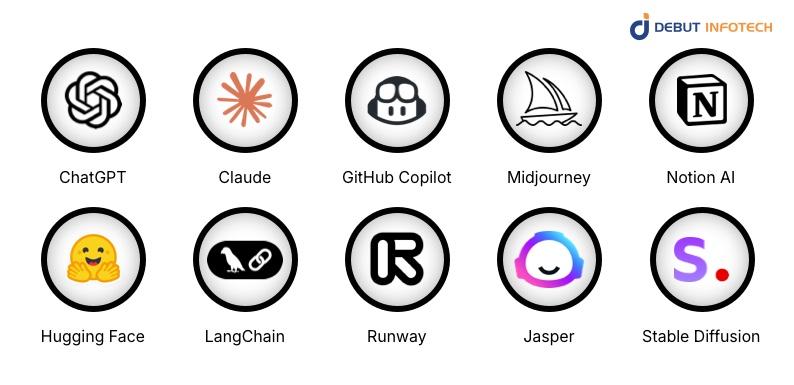
Rather than treating these tools as interchangeable, it’s more useful to look at what kind of work they actually remove from a startup’s plate. Some help you think. Others help you ship. A few do both—imperfectly, but fast enough to matter.
Let’s start with two tools most startups encounter early.
If generative AI tools had an entry point, this would probably be it. ChatGPT has become the default AI tool many startups turn to when they need help quickly thinking through problems—whether that’s drafting copy, debugging code, summarising research, or exploring early product ideas.
What makes it valuable in 2026 isn’t novelty, but versatility. Small teams use it as a second brain: for internal documentation, customer support drafts, quick market research, and even lightweight automation when connected to other Generative AI platforms. It’s often the first step before teams decide whether they need deeper Generative AI Integration Services or a custom build.
That said, ChatGPT is most effective as a generalist. Startups relying on it for domain-critical decisions usually outgrow it—or supplement it—fairly quickly.
Claude tends to appeal to startups that prioritize complex reasoning over speed alone. Where ChatGPT feels conversational and broad, Claude is often used for longer documents, careful analysis, and work that requires staying within constraints—policy drafts, internal specs, or sensitive reviews.
In practice, startups use Claude when accuracy and coherence matter more than flair. It’s particularly useful for teams building regulated products or documenting AI use cases where clarity and responsibility matter. That’s also where conversations about how generative AI can be used responsibly as a tool tend to surface more naturally.
Claude isn’t always the fastest option, and it’s not designed for heavy automation. But for founders and teams who want fewer surprises in their outputs, it has carved out a clear role in the generative AI toolkit.
For engineering-led startups, GitHub Copilot feels less like a tool and more like an extra pair of hands. It lives inside the code editor and quietly handles the repetitive parts of development—boilerplate functions, tests, refactors, even unfamiliar syntax.
In 2026, many startups use Copilot not to replace engineers, but to extend the reach of small teams. It shortens feedback loops and helps junior developers move faster without constant oversight. That efficiency is why Copilot often shows up early, long before a startup considers hiring external generative AI consultants or investing in custom AI development.
It’s not a silver bullet. Copilot still needs strong human review, especially in security-sensitive code. But as far as practical Generative AI for Business goes, this is one of the clearest wins.
Midjourney is usually the moment startups realise how far generative AI tools have come. What once required designers, briefs, and turnaround time can now begin with a prompt and a few iterations.
Startups use Midjourney for early branding, landing page visuals, pitch decks, and campaign concepts—often before a design team even exists. It’s fast, visually striking, and good enough to test ideas without committing budget upfront. For non-designers, that alone removes a major bottleneck.
That said, Midjourney works best as a creative accelerator, not a final production pipeline. Teams building strong brands still refine outputs manually or pair it with professional design workflows. Used this way, it fits neatly into broader AI use cases without overreaching.
Notion AI doesn’t try to feel revolutionary—and that’s precisely why startups keep it around. It sits inside a tool many teams already use and quietly accelerates work: meeting notes, internal docs, roadmaps, and half-formed ideas that need structure.
In 2026, startups rely on Notion AI less for creativity and more for continuity. It helps teams document decisions, summarise discussions, and keep knowledge from getting lost as they scale. For founders juggling multiple priorities, that alone makes it useful.
It’s not the tool you use to build products or train models. Instead, it supports the work around them. For early teams, that’s often enough before investing in heavier Generative AI frameworks or custom integrations.
Hugging Face is where generative AI stops being abstract and starts becoming something you can shape. Startups turn to it when they want access to real generative AI models, datasets, and experimentation tools—without locking themselves into a single vendor.
Engineering teams use Hugging Face to prototype AI features, test open-source models, and explore alternatives to closed platforms. It’s especially popular with startups planning to build differentiated products rather than just consume APIs. This is often the stage where teams begin thinking about gen AI development services or whether to hire generative AI developers in-house.
Hugging Face isn’t plug-and-play. It rewards technical curiosity. But for startups serious about owning their AI stack, it’s hard to ignore.
LangChain usually enters the picture when a startup realizes that a single prompt isn’t enough anymore. Once teams start chaining steps—retrieving data, calling tools, applying logic, then generating outputs—this framework becomes hard to avoid.
In practical terms, LangChain helps startups turn raw generative AI models into usable workflows. Think internal assistants, customer-facing chatbots, or AI features that actually interact with databases and APIs. It’s less about novelty and more about control.
This is often the point at which founders move beyond off-the-shelf tools and consider Generative AI Integration Services or work with generative AI development companies to productionise ideas. LangChain doesn’t do the thinking for you—but it gives structure to teams that already know what they want to build.
Runway is where generative AI starts saving startups real time in creative production. Video, once expensive and slow, is now something teams can prototype in hours rather than weeks.
Startups use Runway to create product demos, social media clips, and marketing experiments without hiring video teams upfront. For early-stage growth, that speed matters. You test messaging, visuals, and formats before doubling down.
Runway isn’t perfect, and it doesn’t replace professional production when quality is critical. But as part of modern AI use cases, it gives startups a way to explore video content without committing heavy resources—something that was far less accessible just a few years ago.
Jasper is often where startups land when content stops being occasional and starts becoming operational. Instead of treating copywriting as a one-off task, Jasper helps teams systemise it—blog drafts, product messaging, email campaigns, and ad variations.
In 2026, many startups use Jasper to maintain consistency rather than creativity. It’s useful when tone, speed, and volume matter more than originality. For non-marketing founders, it reduces reliance on external agencies early on and keeps execution in-house.
That said, Jasper works best with clear direction. Teams that treat it as a replacement for strategy usually hit limits fast. Used properly, it fits neatly into Generative AI for Business workflows.
Stable Diffusion appeals to a different mindset. Where Midjourney is about speed, Stable Diffusion is about control. Startups choose it when they want to own their image generation pipeline—custom styles, private deployments, or tighter brand alignment.
Because it’s open-source, Stable Diffusion often appears alongside broader generative AI frameworks and internal tooling. Teams experimenting here are usually further along, thinking about infrastructure, not just outputs.
It’s not the easiest tool to start with. But for startups building proprietary creative systems or handling sensitive data, Stable Diffusion offers the flexibility that closed platforms lack.
By 2026, generative AI tools will be less about experimentation and more about execution. Startups aren’t adopting these tools because they’re trendy—they’re using them to move faster, reduce costs, and compete with teams far larger than their own. From general-purpose AI programs to specialised creative and development tools, the real value lies in knowing where each tool fits.
For early-stage teams, off-the-shelf generative AI tools are often enough to validate ideas and streamline operations. As products mature, many startups begin combining multiple tools or exploring custom workflows built on Generative AI platforms. This is usually the point at which conversations shift toward Generative AI Integration Services, working with generative AI development companies, or hiring generative AI engineers internally.
The takeaway is simple: generative AI works best when treated as infrastructure, not magic. Used thoughtfully, these tools don’t replace teams—they give startups the breathing room to build better products, faster, and more responsibly.
A. Software programs known as “generative AI tools” use context and instructions to produce new content, including text, graphics, code, audio, and video. Instead of analyzing only existing data, they use trained generative AI models to generate outputs.
A. Keeping people informed, verifying results, safeguarding private information, and being open about AI-generated content are all examples of responsible use. Additionally, startups should document AI use cases and avoid using AI in high-risk decisions without safeguards.
A. Indeed. Many generative AI programs can assist with writing, design, research, and customer service, and are built for non-technical users. Only when startups want greater automation or customization do more sophisticated tools and frameworks become pertinent.
A. The top AI marketing solutions provide audience targeting, analytics, ad optimization, and content production. Copywriting, picture creation, email personalization, and campaign automation technologies are popular choices. Your objectives—speed, scale, or deeper customer insights—will determine which option is best for you.
A. Code generation, debugging, refactoring, and documentation are all aided by AI coding tools. They are frequently used to reduce repetitive tasks and accelerate development. The majority function best when coupled with seasoned engineers who can maintain code quality and review outputs.

Our Latest Insights
USA
2501 Chatham, Rd Suite R Springfield, IL 62704
+1-708-515-4004
info@debutinfotech.com
UK
7 Pound Close, Yarnton, Oxfordshire, OX51QG
+44-770-304-0079
info@debutinfotech.com
Canada
154 Eden Oak Trail, Kitchener, ON N2A 0H9
+1-708-515-4004
info@debutinfotech.com
INDIA
Sector 101-A, Plot No: I-42, IT City Rd, JLPL Industrial Area, Mohali, PB 140306
9888402396
info@debutinfotech.com