ON THIS PAGE
Progress0%






Our Global Presence :


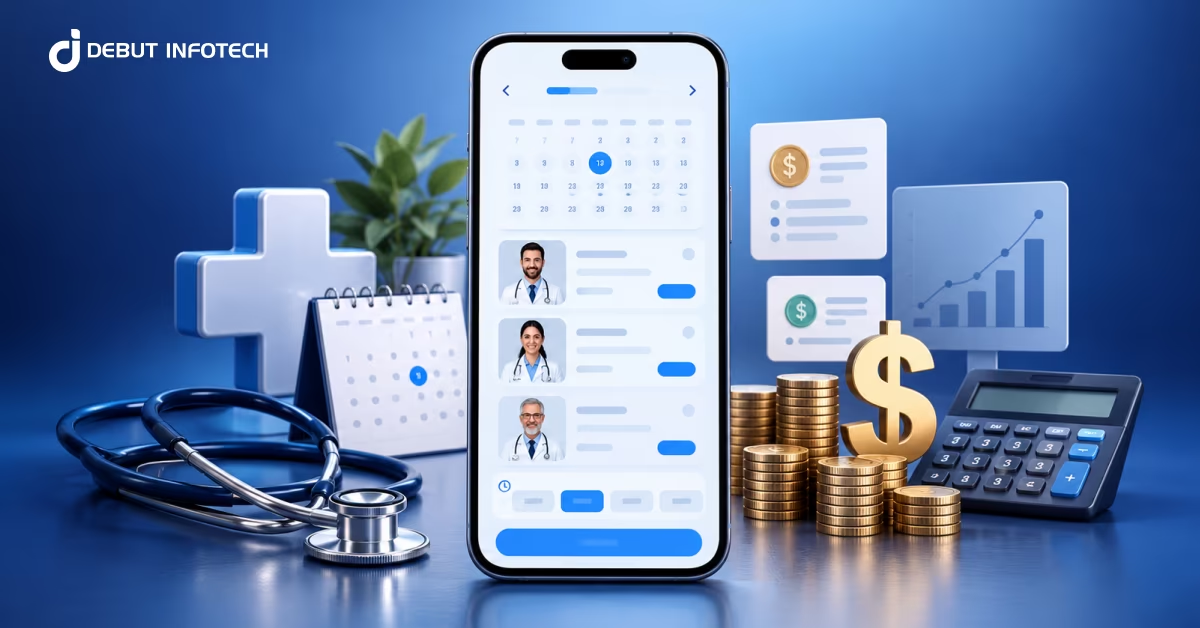


Healthcare scheduling app development costs range from $50K–$200K for a focused clinic scheduler, depending on scope and features.
Define booking workflows, provider availability, and rescheduling rules to control healthcare scheduling app development costs.
EHR integrations increase development costs through FHIR mapping, booking validation, synchronization, and error recovery.
Budget for security controls, HIPAA reviews, encryption, and testing to reduce healthcare data protection risks.
First-year costs include development, hosting, messaging, maintenance, training, and contingency expenses.
AI scheduling adds integration, testing, privacy, and usage costs; validate measurable benefits before investing.
The estimated cost for developing a focused clinic scheduling app can range from $50,000 to $200,000, depending on the number of hours it takes to deliver, which is typically between 1,000 and 2,000 hours, with an average rate of $50–$100 per hour. This planning model includes patient facing web app, scheduling and rescheduling, scheduling administration, reminders, testing, and security foundations. Not including EHR integration, native mobile apps, marketplace features and running costs. It is not a market average or a Debut Infotech quote.
To help keep your healthcare appointment scheduling app development costs manageable, you should consider setting three priorities: what should the app be capable of doing when it is initially launched, what systems does it need to interface with, and what platforms does it need to operate? This guide outlines comparisons of those scope decisions, discusses how things add to development effort, and distinguishes between build costs and first-year operating costs. You’ll also learn when existing scheduling software may better fit your requirements and budget.
A focused clinic scheduler has a modeled build budget of $50,000 – $200,000 for planning purposes. A multi-location system or provider marketplace that is connected will have a wider estimate due to the added workflows, integrations, and testing. The table below uses illustrative labor assumptions to compare these scopes. These figures are neither verified market averages nor Debut Infotech quotes.
| Product scope | Assumed delivery effort | Modeled development budget | Included scope | Main exclusions |
| Focused clinic scheduler | 1,000–2,000 hours | $50,000–$200,000 | Patient-facing web app, provider availability, booking and rescheduling, scheduling administration, reminders, testing, and security foundations | EHR integration, native mobile apps, payments, and AI |
| Connected multi-location system | 2,000–4,000 hours | $100,000–$400,000 | Clinic-scheduler capabilities, location and resource rules, expanded permissions, reporting, and one defined EHR or practice-management integration | Additional integrations, extensive legacy-data migration, and separate native apps |
| Multi-provider marketplace | 4,000–7,000 hours | $200,000–$700,000 | Provider onboarding, search and discovery, booking workflows, marketplace administration, and defined payment workflows | Telehealth, insurance eligibility, multiple EHR connections, and AI |
Calculated at an assumed blended delivery rate of $50–$100 per hour. Each lower bound is the minimum hours and rate, and each upper bound is the maximum. Hours indicate the total team effort, not elapsed development time.
The following ranges offer a general guideline for healthcare app scheduling development cost. They don’t set the budget for your project. Each estimate needs to include the numbers of providers and locations, rules for appointments, data flows, user roles, and acceptance criteria. The blended rate should also specify if it covers product planning, design, engineering, product QA, security, deployment, project management.
Integration scope deserves particular attention. The connected-system model assumes one documented integration with suitable access and a test environment. If availability must be reconciled across several systems, or scheduling write access is unavailable, that assumption changes. Vendors should price the additional work explicitly rather than bury it inside a general “integration included” statement.
Development expenditure is also different from the budget required to bring it to market and run it. Unless specified, third party setup fees, staff training, hosting, messaging, monitoring, support and contingencies must be entered as separate line items. Start with the scope tier to get a base line measurement, adjust the estimate to your actual needs before funding is made.
To better understand the features you need to include in your healthcare appointment scheduling app, you should note how an appointment progresses from being requested to being booked. Are patients able to book directly or do some appointments require staff permission? What determines the appointment length? Who handles changes when a provider becomes unavailable? These answers will form the basis of the product’s support at launch.
Suppose that the visits to a clinic last 40 minutes for new patients and 20 minutes for follow-ups. Displaying all of the open positions to all of the patients would overlook that difference. The booking workflow must match the requested visit to suitable availability. This is a hypothetical example that illustrates why a feature with the name “calendar” requires definite scheduling rules behind it.
Develop the scope by focusing on patients, providers, scheduling staff:
| Workflow | Launch requirement | Add when the operation requires it |
| Patient selects a visit | Clear appointment types, eligibility rules, and suitable slots | Referrals or staff approval for restricted appointments |
| Patient books or changes a visit | Confirmation status, cancellation rules, and appointment rescheduling | Deposits, cancellation charges, or waitlist offers |
| Provider manages availability | Working hours, visit durations, buffers, and closures | Shared rooms, equipment, or rotating locations |
| Staff resolves exceptions | Authorized booking changes and a clear record of actions | Approval queues or escalation workflows |
| Patient receives updates | Confirmations and reminders with appropriate preferences | Additional communication channels |
| Administrator manages access | Permissions matched to each role’s responsibilities | More complex location or organizational controls |
A conditional capability becomes essential when the appointment cannot proceed without it. For instance, if a visit needs access to certain equipment, it should be included in the launch scope. An advanced provider discovery may be valuable for a marketplace, but may not be necessary for a clinic that has a steady stream of patients.
Convert these decisions into acceptance criteria before you start your appointment booking app development. For each workflow, describe the trigger, the role to take responsibility, the action to take, and the expected outcome. Include exceptions such as provider absence or requests requiring review. Developers can then estimate defined behavior, and your team can assess new feature requests against an agreed operational need.
After the launch workflows are configured, the amount of work that the team needs to estimate is based on platform coverage, scheduling complexity, and scale of operation. The decisions impact design, back-end development, and testing. For a fair comparison of appointment scheduling app development cost, request both vendors to quote the same set of requirements, and determine which factors would alter their estimates.
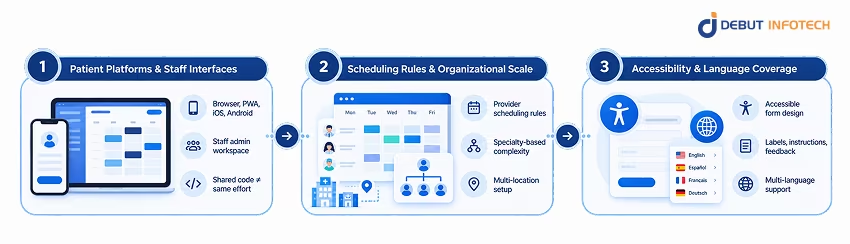
Define options for booking via browser, a progressive web app (PWA) that can be downloaded, or iOS or Android apps. Also identify the interface staff will use to manage schedules. A patient mobile app does not replace the administrative workspace.
Cross-platform frameworks such as Flutter support multiple platforms from one codebase, although additional platform setup may still be required. Shared code should not be treated as a guarantee of identical effort across devices. When considering mobile app development services, ask for individual estimates for shared development and platform-specific implementation, testing, and release tasks.
Provider count alone is an incomplete measure of complexity. A larger clinic that has a single set of appointment rules can be set up with fewer configurations than a smaller clinic that has various rules for each specialty.
| Decision | What the estimate should account for |
| Providers and locations | Shared versus location-specific settings, administration, and reporting |
| Appointment rules | Duration variations, buffers, approval conditions, and exceptions |
| Rooms and equipment | Availability dependencies between providers and required resources |
| Usage and reliability | Expected booking volumes, peak demand, and performance targets |
| Organizational structure | One clinic versus separate organizations needing distinct configurations |
The requirements affect not only the interface, but also the backend. Establish expectations of usage and growth to support the architecture and testing effort.
Include accessibility in design acceptance criteria and QA planning. W3C guidance states that labels, instructions and feedback are key aspects of accessible forms directly relevant to patients filling out a booking.
For multilingual delivery, scope more than translated screens. In addition, the descriptions and reminders for appointments, the date format, and error messages must also be reviewed. Determine languages and regional formats needed prior to estimating. This gives each quote a clearer boundary and helps prevent essential patient-facing work from appearing later as an unexpected addition.
When you’re considering an “EHR integration included” quote, you should ask yourself what it will connect to. Is it able to fetch availability, make appointments and update cancellations? Which system has the authoritative schedule? Don’t assume that integration will be a fixed price deliverable until you’ve confirmed one or more of the following: supported operations, vendor approvals, testing access, and commercial fees.
FHIR introduces three concepts of scheduling: Schedule for organizing the availability, Slot for representing a time interval, and Appointment for a planned healthcare event. These definitions provide a framework for exchanging information; the selected EHR’s documentation must establish which resources, versions, and operations it supports.
Reliable real-time appointment booking needs more than just fetching a free slot. The availability of a slot does not mean it will be accepted and may have other booking requirements. Plan for validation, confirmation and recovery, not just the preliminary connection.
| Budget item | Required outcome |
| Data mapping | Patient, provider, location, and appointment records match across systems |
| Booking confirmation | Competing requests cannot produce conflicting confirmed appointments |
| Safe retries | Repeated submissions do not create duplicate bookings |
| Change synchronization | Staff edits, cancellations, and rescheduling reach the relevant systems |
| Recovery and reconciliation | Uncertain outcomes are checked and unresolved cases reach staff |
| Integration testing | Timeouts, stale availability, rejected requests, and interrupted updates are covered |
Let’s say the EHR schedules an appointment, but the response is not delivered to the app. If the operation is retried immediately, the booking might be duplicated. The scope should define how the app checks whether the first request succeeded and what the patient sees while that outcome remains uncertain.
Request a short discovery phase where access or API behavior is unverified. The outputs from it should include identified workflows supported, unmet dependencies and updated implementation effort. That provides you with a stronger foundation to build a budget than a promise of integration with undefined boundaries.
Plan for security and privacy assessment prior to implementation, and testing and operational responsibility defined before launch. For a US medical appointment booking app, a qualified reviewer should determine HIPAA applicability from the parties involved and the information handled. HHS defines covered entities and business associates as covered by the Security Rule, and it is not possible to determine by name alone if an app is covered.
Begin by creating a cross-referenced map of data on booking forms, databases, notifications, logs, analytics and support tools. Determine what each service receives and if that information is needed. This provides the team with a point of reference for estimating healthcare data security work and auditing vendor agreements.
| Budget item | Deliverable to request |
| Risk analysis and privacy review | Documented data flows, risks, applicable obligations, and mitigation priorities |
| Access and authentication | Role permissions, account lifecycle controls, and authentication measures matched to assessed risks |
| Data protection | Encryption and key-management design, secure configuration, and controls for logs and notifications |
| Testing and remediation | Security testing, prioritized findings, fixes, and verification |
| Operational readiness | Audit logging, incident procedures, backup restoration testing, and staff training |
HHS needs risk analysis and administrative, physical and technical safeguards for regulated entities. It also covers access management, incident response, contingency planning and continuous evaluation. These responsibilities are not limited to coding and require named owners.
Add vendor review and contractual work for the handling of ePHI by third parties. HHS cloud guidance involves proper business associate agreements and adhering to relevant HIPAA requirements, which cannot be satisfied with a signature
Clearly differentiate launch implementation from routine monitoring and reassessment and remediation. Discuss with vendors what they are responsible for and what is still your organization’s responsibility.
When there’s a measurable booking challenge, like users leaving long forms unfinished or employees having to re-explain their appointment preferences, think about implementing AI healthcare appointment scheduling via conversational interface. Before considering more complicated automation or navigation, review if simpler navigation or rule-based automation can resolve the issue. Reminders and cancellation triggers are not sufficient to convince people to invest in AI.
Assign clear responsibility to the assistant: clarify a patient’s request and assist in determining the booking options. The scheduling system continues to be responsible for eligibility and validation of availability as well as confirming appointments. Unclear requests should reach staff. Do not include diagnostics, urgency and treatment recommendations in the scheduling scope.
The estimate should not only include model usage fees, but should also include the integration, privacy review, testing on a representative set of requests, staff handoffs, and monitoring. Specify the information that the assistant requires and inspect the terms of data handling of the AI provider before use.
Test a small-scale trial of the existing process. Track booking completions, wrong selections, staff intervention and booking costs. When using AI, use it broadly when those results are there to back the investment. If it adds more correction work that it takes away, it’s best to improve the process first.
Define “first year” before calculating the total. Here, it means the one-time delivery costs plus 12 months of operation after launch. Then budget product enhancements separately so your cost to build a healthcare appointment booking app remains distinguishable from the cost of operating and expanding it. This distinction will make it easier to avoid overstating or omitting operating expenses.
Use this budget formula:
First-year funding requirement = build + excluded setup and launch costs + contingency + 12-month operating budget.
In the following hypothetical example, it is assumed that there is a single web scheduler for a clinic which has ten providers, 2000 bookings per month and two messages per booking. It doesn’t cover EHR integration, native apps, payments or AI. All amounts are planning allowances, not supplier prices or Debut Infotech quotes.
| Budget item | Illustrative calculation | Amount |
| Development | 1,500 delivery hours × $75/hour | $112,500 |
| Launch and staff training, excluded from build | 40 hours × $75/hour | $3,000 |
| Delivery contingency | 15% × $115,500 | $17,325 |
| Hosting, backups, and monitoring | $500/month × 12 | $6,000 |
| Messaging | 4,000 messages/month × assumed $0.05 × 12 | $2,400 |
| Corrective maintenance and support | 20 hours/month × $75 × 12 | $18,000 |
| Security reassessment allowance | 40 hours × $100/hour | $4,000 |
| Total funding requirement | Including uncommitted contingency | $163,225 |
The build allowance assumes launch security implementation and testing are included. The separate security line covers post-launch reassessment; support covers routine fixes and upkeep, while hosting covers infrastructure charges. Ensure that these limits are also confirmed in the proposal to prevent double payments.
Test the model against changing usage. Under these assumptions, doubling the volume of books would double the costs of messaging but the cost of infrastructure would require separate evaluation. Replace each allowance with reviewed quotes and actual service requirements. Then, allocate extra funds for product enhancements separately so that your cost of building a healthcare appointment booking app is clearly distinguishable from the cost of operating and expanding the product.
Choose the delivery approach after checking which requirements existing software can meet. Your launch requirements could be met by an EHR module or a subscription to a scheduling solution, or it could be warranted by vital workflow gaps. Make sure to evaluate every choice for the same timeframe, such as implementation, subscriptions, integrations, support, and data migration at exit.
| Approach | Suitable starting point | Cost question to resolve |
| Existing EHR module | Booking fits the system already used by staff | What do activation, configuration, licensing, and training cost? |
| Scheduling SaaS | Available features support your workflows | How do usage, locations, integrations, and support affect subscription spending? |
| Hybrid solution | Existing scheduling software needs a tailored patient interface | What will connecting and maintaining the two systems require? |
| Custom development | Necessary workflows exceed available product capabilities | Can you fund delivery and ongoing product ownership? |
When you have an operational requirement that can be satisfied by the use of standard software and the organisation is unable to keep up the maintenance of a custom medical appointment booking app, it’s not always easy to justify its implementation. The same scrutiny should be given to a hybrid approach: who is responsible for which component, who is responsible for solving problems between the components?
For a custom build that is justified, distribute the investment over functional work flows. Provide deferred abilities, but maintain essential security, access and booking controls. Ask developers to price later phases separately and identify dependencies that could make postponement expensive. This helps you reduce launch spending without creating avoidable rebuilding costs.

Structure appointment booking app development around milestones with clear acceptance criteria. At each stage there should be a tangible outcome for your team to review before making an approval to spend.
| Stage | Evidence required to proceed |
| Discovery | Agreed requirements, confirmed dependencies, and an estimate tied to scope |
| Design | Booking and staff workflows validated through prototype testing |
| Development | Demonstrated functionality that meets agreed acceptance criteria |
| Testing | Documented results, resolved critical defects, and remaining risks |
| Pilot | Feedback from a limited rollout and an agreed correction plan |
| Launch | Deployment approval, training, operational handover, and recovery procedures |
To hire healthcare app developers, seek out all the teams that have been shortlisted and get each team to quote for the same scope and define their assumptions. Make comparisons based on labor, third-party fees, exclusions, payment milestones and terms on change requests. Ensure integration access is validated or is to be taken as provisional.
Ownership and access to source code, designs, documentation, infrastructure accounts and deployment credentials should also be outlined in the contract. Explain what the defect correction, warranty and continuous support involves, what to expect from the response and what costs are involved.
Compare the estimate with the delivery proof that the vendor will share. Address ambiguous roles in advance of signing, and have a limited discovery period for uncertain issues. This allows you to more easily evaluate the initial quote and future scope changes.
Turn your budget assumptions into a scope your team can evaluate. Through our healthcare application development services, we can discuss how your scheduling product should fit existing systems and day-to-day operations. Share your launch priorities, integration requirements, and patient and staff needs so we can identify what the estimate must cover.
The illustrative clinic-scheduler model in this guide ranges from $50,000–$200,000, assuming 1,000–2,000 delivery hours at $50–$100 per hour. This is a planning calculation, not a verified market average or company quote. Your medical appointment app development cost requires a defined scope, with integrations, launch expenses, and recurring charges explicitly included or excluded.
A reliable timeline requires agreed requirements, team capacity, and confirmed external dependencies. Total delivery hours alone cannot establish a launch date because design, implementation, testing, and approvals may overlap or depend on one another. Ask for a milestone schedule that identifies integration access, review deadlines, pilot duration, and the conditions required for launch approval.
Start by checking whether your EHR’s scheduling module supports the patient access and staff workflows you need. Request a demonstration using your appointment rules, then confirm configuration limits, licensing, and implementation requirements. If it meets those needs, extending the existing system may be appropriate. Price any custom interface separately where the built-in experience leaves essential gaps.
Scheduling estimates do not establish budgets for other healthcare products. Telehealth, remote monitoring, clinical documentation, and diagnostic functionality introduce different workflows, data requirements, and review needs. Define the product category and intended use before comparing prices. If additional capabilities share your scheduling app, ask vendors to estimate their incremental implementation and operating costs separately.

Our Latest Insights
USA
2501 Chatham, Rd Suite R Springfield, IL 62704
+1-708-515-4004
info@debutinfotech.com
UK
7 Pound Close, Yarnton, Oxfordshire, OX51QG
+44-770-304-0079
info@debutinfotech.com
Canada
154 Eden Oak Trail, Kitchener, ON N2A 0H9
+1-708-515-4004
info@debutinfotech.com
INDIA
Sector 101-A, Plot No: I-42, IT City Rd, JLPL Industrial Area, Mohali, PB 140306
9888402396
info@debutinfotech.com