ON THIS PAGE
Progress0%





Our Global Presence :


Building sustainable blockchain games in 2026 means learning from early missteps and designing experiences players want to stay in for years, not weeks. The global blockchain gaming market was valued at about $24.4 billion in 2025, with daily active wallets averaging around 4.66 million despite market headwinds, showing strong ongoing engagement.
Blockchain gamers reached roughly 102 million globally, a 72 % year-over-year increase, indicating broad interest in games that blend entertainment with ownership.
Yet retention remains a challenge: about 52 % of players remain active after 90 days, highlighting the need for sustainable design over hype.
This guide breaks down the practical steps and priorities you need to build blockchain games that can thrive through market shifts and attract both players and investors.
A blockchain game is a digital game that integrates blockchain technology to manage ownership, progression, and value exchange within the game. Players can own in-game assets as tokens or NFTs, trade them freely, and carry value outside the game’s closed ecosystem. Unlike traditional games, blockchain games introduce transparency and player-controlled assets. The goal is not financial extraction but building persistent, player-owned environments that can survive beyond a single publisher or platform.
Early blockchain games focused heavily on financial incentives while neglecting fundamental game design. This imbalance created systems that worked only during bullish market conditions. Once external demand dropped, the cracks became obvious. These issues shaped how modern Web3 game development services now approach sustainability.
Early blockchain games rewarded players aggressively without matching sinks or demand. Token supply expanded faster than player growth or spending needs. Once new users slowed, prices collapsed. This eroded trust, discouraged long-term participation, and turned game economies into short-lived extraction loops rather than stable entertainment systems.
Most early players joined blockchain games to maximize short-term earnings, not to enjoy gameplay. This behavior distorted design priorities and community culture. When rewards dropped or token prices fell, engagement disappeared quickly, leaving empty servers and no organic player base to support ongoing development efforts.
Gameplay depth was often sacrificed for launch speed. Many titles relied on repetitive actions with minimal skill, strategy, or progression systems. Without meaningful challenge or variety, players lost interest fast, exposing that financial incentives alone cannot sustain a game over time beyond initial curiosity.
NFTs were marketed primarily as investment vehicles rather than gameplay tools. Value depended on hype cycles instead of in-game usefulness. This encouraged flipping over playing, attracted speculators rather than gamers, and tied player satisfaction to volatile markets that blockchain game developers could neither control nor meaningfully influence.
Early blockchain game economies lacked stress testing and contingency planning. When broader crypto markets declined, player exits accelerated and liquidity dried up. With no buffers or alternative revenue models, entire ecosystems collapsed, forcing blockchain development services to abandon projects and damaging confidence across the sector for years afterward.
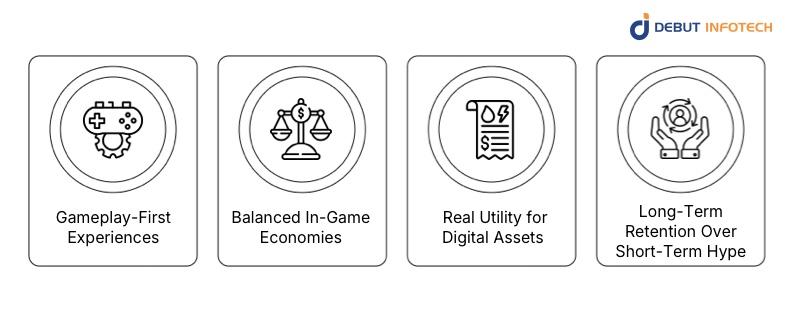
Web3 game development has matured significantly. Here are the practical priorities guiding modern studios as they build games meant to survive market volatility and retain players long term:
Modern Web3 game development services treat gameplay as the primary product, not a wrapper for tokens. Core mechanics are designed, tested, and refined before blockchain features are added. This approach ensures games remain engaging even without financial incentives, attracting traditional players and supporting healthier economies over longer life cycles that can grow steadily over time.
Economic design in 2026 focuses on stability, pacing, and predictability. Token issuance, sinks, and rewards are modeled around realistic player behavior rather than aggressive growth assumptions. Blockchain app development companies plan for slow periods, returning users, and content gaps, ensuring economies remain functional and fair even as market conditions fluctuate over extended live operations across multiple release cycles.
Digital assets are designed to serve clear gameplay purposes rather than speculative appeal. Items unlock abilities, customization, access, or progression options that matter during play. This utility-driven approach ties value to usage, encourages active participation, and reduces dependence on secondary markets to justify ownership for both players and long-term developers operating sustainable game ecosystems globally.
Success metrics have shifted from launch excitement to sustained engagement. Teams track retention, session depth, and progression velocity instead of token price movements. Content roadmaps, live operations, and community feedback loops are built to keep players invested for months or years, regardless of external market cycles that have historically disrupted blockchain-based products and undermined user trust.
Sustainability determines whether a blockchain game grows or collapses. Here is why long-term thinking is essential for player trust, economic stability, regulatory safety, and enterprise confidence.
Sustainable blockchain games protect players from sudden economic shocks that wipe out progress or asset value. When systems are predictable and balanced, players feel safe investing time and money. This trust directly affects retention, community health, and word-of-mouth growth, which are far more valuable than short-lived user spikes driven by speculation.
Retention depends on consistent progression, fair rewards, and systems that respect player effort. Sustainable design ensures that rewards do not degrade rapidly over time. Players stay engaged because the game continues to feel worthwhile months after launch, not because they are rushing to extract value before an inevitable collapse.
A sustainable economy absorbs fluctuations in player activity and market conditions without breaking. The token supply, sinks, and rewards are carefully managed to avoid runaway inflation or deflation. This resilience allows developers to operate games through both growth and downturn cycles without resorting to drastic changes that damage player confidence.
Stable economic systems give development teams the freedom to plan long-term updates. When revenue and player engagement are predictable, studios can invest in seasonal content, balance updates, and new features. This steady operation model mirrors traditional live-service games rather than experimental products dependent on market timing.
Sustainable games are easier to align with evolving regulatory expectations. Clear separation between gameplay and financial speculation lowers legal exposure and platform restrictions. This reduces the risk of sudden delistings, payment disruptions, or compliance issues that can abruptly shut down access for players and partners.
Investors and enterprise partners avoid fragile ecosystems. Sustainable blockchain games demonstrate predictable performance, responsible economic design, and long-term viability. This credibility opens doors to licensing deals, infrastructure partnerships, and strategic funding that speculative projects rarely secure, supporting growth without compromising the player experience.
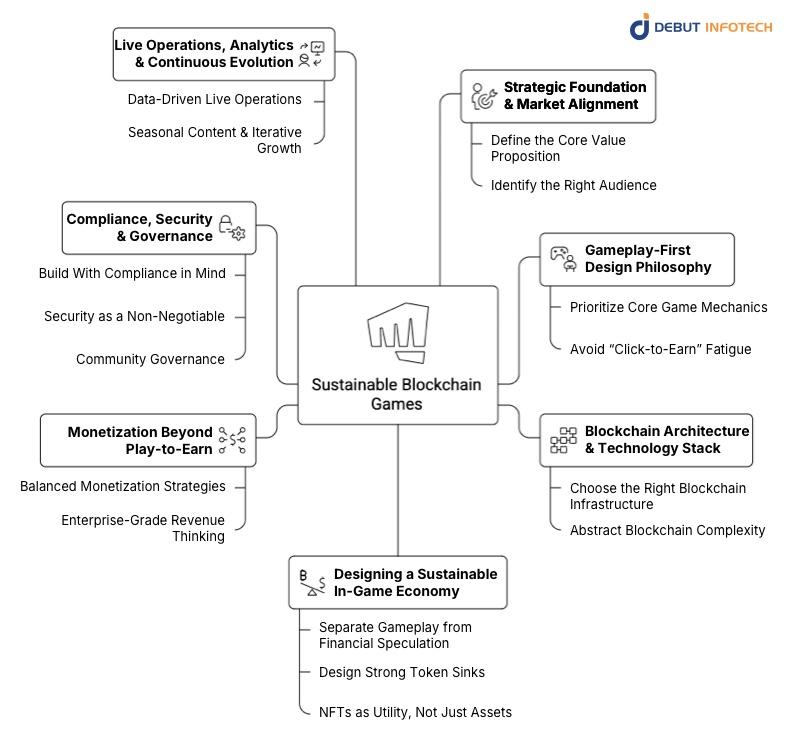
Building sustainable blockchain games requires structured planning across design, technology, and operations. Here are the steps involved in creating games that remain viable well after launch:
Every sustainable blockchain game starts with a clear strategic intent. This phase aligns product vision, market demand, and blockchain relevance before any technical or creative decisions are locked in.
1. Define the Core Value Proposition
The game must clearly justify why blockchain improves the experience. Ownership, persistence, or interoperability should solve a real design or player problem, not exist as a marketing hook detached from actual gameplay value.
2. Identify the Right Audience
Developers must decide whether to target traditional gamers, crypto-native users, or a hybrid audience. Each group has different tolerance levels for complexity, wallets, and risk, which directly affects onboarding, retention, and feature prioritization decisions.
Strong gameplay is the foundation of sustainability. This step ensures the game remains engaging even if tokens, markets, or enterprise blockchain elements are temporarily removed or de-emphasized.
1. Prioritize Core Game Mechanics
Combat systems, progression loops, strategy depth, or creative freedom must carry the experience. Blockchain features should enhance these mechanics, not compensate for weak design or repetitive interactions that fail to hold attention over time.
2. Avoid “Click-to-Earn” Fatigue
Games built around repetitive earning actions burn players quickly. Sustainable design favors meaningful decisions, skill expression, and variety, ensuring progression feels earned through play rather than mechanical task repetition tied only to rewards.
Technical choices determine scalability, blockchain development cost, and player friction. This phase focuses on selecting infrastructure that supports long-term operations without exposing players to unnecessary complexity or instability.
1. Choose the Right Blockchain Infrastructure
Factors like transaction speed, fees, tooling maturity, and support for blockchain ecosystem protocols matter more than popularity. The wrong infrastructure introduces latency, high costs, and maintenance challenges that negatively affect player experience and operational sustainability.
2. Abstract Blockchain Complexity
Wallet management, signing transactions, and gas mechanics should remain invisible to most players. Abstraction layers improve onboarding, reduce confusion, and allow users to focus on gameplay rather than technical processes they may not fully understand.
Economic design determines whether a game grows steadily or collapses under pressure. This step establishes systems that reward engagement while resisting inflation, speculation, and exploitative behavior.
1. Separate Gameplay from Financial Speculation
Player progression should not depend on token price movements. Skills, time investment, and in-game achievements must remain the primary drivers of advancement, protecting the experience from external market volatility.
2. Design Strong Token Sinks
Effective sinks remove tokens through upgrades, crafting, repairs, or customization. These systems stabilize supply, balance reward loops, and give players meaningful spending options tied directly to gameplay rather than forced consumption.
3. NFTs as Utility, Not Just Assets
NFTs should unlock gameplay options, customization, or access rather than exist purely for resale. Utility-based design ensures assets remain valuable over time, encouraging long-term engagement rather than speculative flipping.
Relying solely on play-to-earn rewards creates fragile economies. Sustainable games diversify revenue to support development, live operations, and content without inflating token supply.
1. Balanced Monetization Strategies
Cosmetics, battle passes, expansions, and optional convenience features provide revenue without disrupting balance. These methods mirror proven models from traditional games while remaining compatible with blockchain-based ownership systems.
2. Enterprise-Grade Revenue Thinking
The best blockchain games are treated as long-term products with predictable cash flow. Revenue planning accounts for maintenance, updates, compliance, and support, reducing dependence on speculative asset sales or short-term hype cycles.
Operational integrity protects both players and developers. This step ensures the game can operate legally, securely, and transparently across regions and market conditions.
1. Build With Compliance in Mind
Legal considerations influence token design, asset trading, and monetization models. Early compliance planning reduces the risk of future restrictions, platform bans, or forced redesigns that can disrupt live operations and player access.
2. Security as a Non-Negotiable
Smart contract audits, secure key management, and continuous monitoring protect assets and reputation. A single exploit can permanently damage trust, making security investment essential rather than optional.
3. Community Governance
Well-defined governance structures allow player participation without destabilizing development. Voting systems, feedback channels, and transparent decision-making strengthen community trust while preserving clear authority over core game direction.
Sustainable blockchain games are never static. Ongoing analysis and iteration allow systems to adapt as player behavior, content needs, and market conditions evolve.
1. Data-Driven Live Operations
Player behavior data guides balance changes, economy tuning, and feature updates. Decisions based on real usage patterns reduce guesswork and help maintain fairness, engagement, and long-term stability.
2. Seasonal Content & Iterative Growth
Regular content drops, events, and seasonal updates keep players engaged while allowing controlled experimentation. Iterative growth reduces risk by improving systems gradually rather than introducing disruptive changes that destabilize existing economies.
Enterprises view blockchain games as more than entertainment products. Here is why companies invest in them as revenue platforms, community hubs, and long-term digital ecosystems:
1. Revenue-Generating Digital Products
Enterprises see blockchain game development as a scalable approach to creating digital products with diversified revenue streams. Beyond asset sales, games support subscriptions, cosmetics, expansions, and branded experiences. This model generates recurring income while reducing dependence on advertising or one-time purchases, making games attractive as long-term commercial assets rather than experimental marketing tools.
2. Long-Term Digital Ecosystems
Blockchain in games allows enterprises to build persistent digital ecosystems where users maintain identity, ownership, and progression across experiences. These ecosystems extend beyond a single game session, supporting future content, blockchain integration, and partnerships. Ownership mechanics strengthen user attachment, increasing lifetime value and reducing churn across product lines.
3. Community Engagement Platforms
Games provide enterprises with direct, ongoing engagement channels rather than passive audiences. Players participate, contribute, and form communities around shared experiences. Blockchain infrastructure supports loyalty systems, governance participation, and reward programs, giving enterprises structured ways to maintain relationships without relying solely on external social platforms.
4. IP Expansion Channels
Established brands use blockchain games to expand intellectual property into interactive formats. Game worlds allow users to explore, customize, and engage with IP actively rather than consuming it passively. This deepens brand loyalty, opens merchandising opportunities, and creates new narratives that extend beyond traditional media or licensing models.
At Debut Infotech, we help studios and enterprises build blockchain games designed to last, not just launch. As a blockchain game development company, we focus on creating gameplay-first experiences supported by secure blockchain architecture, balanced in-game economies, and infrastructure built for long-term operations.
Our approach combines deep game design expertise with practical blockchain engineering, ensuring that tokenized assets, NFTs, and on-chain mechanics enhance gameplay rather than distract from it. From early concept validation to live operations, we design systems that prioritize player retention, scalability, security, and compliance across evolving market conditions.
We support end-to-end blockchain game development, helping teams move from experimentation to production-ready ecosystems. Our services extend beyond game builds to include strategic guidance and technical execution, enabling you to work with a blockchain development team and blockchain consultants that understand both game mechanics and decentralized systems.
A. Blockchain games generate revenue through a mix of in-game purchases, marketplace fees, token utility, and optional NFT sales. The strongest models focus on cosmetics, expansions, and player-driven economies, rather than constant token sales. Sustainable revenue comes from players choosing to spend, not feeling forced over long-term game lifecycles.
A. Games use blockchain to give players real ownership of items, progress, and currencies. It removes reliance on closed servers and fragile databases. For multiplayer worlds, blockchain games allow assets to move across blockchain platforms, support open marketplaces, and build trust without players relying on a single publisher.
A. Scalable multiplayer blockchain games rely on off-chain gameplay with on-chain settlement. Studios use Layer 2 networks, sidechains, and rollups to keep fees low. State channels, server authority, and periodic blockchain checkpoints help games stay fast while maintaining ownership and fairness at a global scale.
A. Building blockchain games in 2026 can cost anywhere from $50,000 for simple prototypes to over $500,000 for full-scale multiplayer titles. Costs depend on game complexity, the chosen blockchain, security audits, live operations, and long-term content updates that keep players engaged. Marketing and community management also add up.
A. Choosing a blockchain game developer comes down to shipped games, not promises. Look for teams that understand game design first, blockchain second. Ask about token economics, security practices, live support, and how they handle scaling once real players show up. Experience saves money later fast.

Our Latest Insights
USA

2501 Chatham, Rd Suite R Springfield, IL 62704
+1-708-515-4004
info@debutinfotech.com
UK

7 Pound Close, Yarnton, Oxfordshire, OX51QG
+44-770-304-0079
info@debutinfotech.com
Canada

154 Eden Oak Trail, Kitchener, ON N2A 0H9
+1-708-515-4004
info@debutinfotech.com
INDIA

Sector 101-A, Plot No: I-42, IT City Rd, JLPL Industrial Area, Mohali, PB 140306
9888402396
info@debutinfotech.com

9001:2015
Quality Certified

ISO 27001
Security Certified

A+ Rating
Accredited Business

Certik
Security & Audit


Copyright © 2026, Debut Infotech. All rights reserved. | Privacy Policy