ON THIS PAGE
Progress0%






Our Global Presence :






On May 7, 2021, Colonial Pipeline, one of the largest pipelines for refined oil products in the US, got hit by a serious ransomware attack. It was serious: they lost 100 gigabytes of data, resulting in the encryption of critical systems, and ultimately, the pipeline had to shut down.
In order to retake control of their systems, Colonial Pipeline had to pay the attackers, a group of hackers called Darkside, a whopping sum of 75 Bitcoin ($4.4 Million) in ransom in exchange for the decryption key. However, that wasn’t to be the end, as the Department of Justice later announced the seizure of 63.7 Bitcoins (USD 2.4 Million), which allegedly represented the proceeds of the attack, a month later, on June 7, 2021.
This event underscores the importance of blockchain analytics in cybersecurity, as it helped trace ransom payments and identify the attackers. Consequently, many private and public institutions are currently exploring the possibilities of analyzing openly accessible blockchain data to enhance the security of cryptocurrency markets. Following this widespread adoption, the field of blockchain analytics has been experiencing constant development since then, resulting in some prevailing trends and patterns.
In this article, we explore the ongoing blockchain analytics trends shaping the blockchain technology industry as a whole. Furthermore, we explore the role it plays in other fields like crime detection, healthcare, and supply chain management.
But first:
Blockchain analytics is the application of numerous analytical techniques and approaches to identify trends, patterns, and correlations in blockchain data. It’s like employing data analytics to gain important insights, specifically from blockchain data.
Transparency is one of the benefits of blockchain technology. This is because transactions, which are at the heart of blockchain technology, are openly recorded and visible to anybody on the public ledger. Furthermore, it cannot be tampered with. This means that anyone interested will always find a huge amount of data on the blockchain free to explore and study.
From transaction data and user addresses to smart contract activities, every aspect of the blockchain network is open to scrutiny. Here’s how it works:
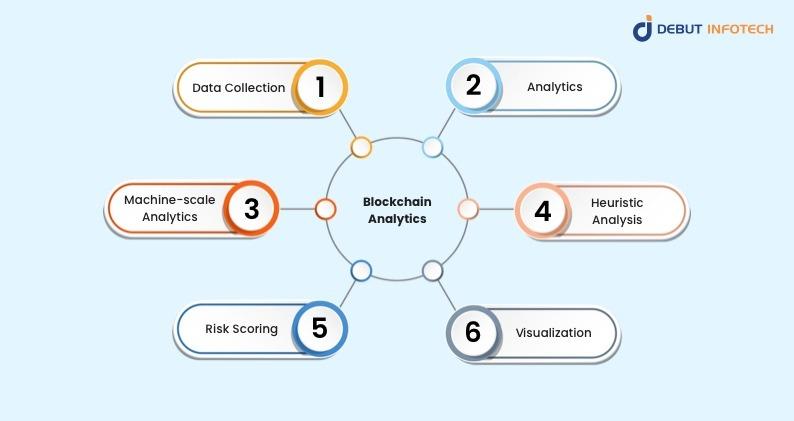
Through all these steps, your business or organization can get more value from the publicly available blockchain transaction data, especially with the help of a blockchain development company. You can think of fraud detection, business optimization, compliance – you name it! Blockchain analytics can help you understand blockchain environments to a very large extent.
In 2026, the regulatory environment of decentralized finance (DeFi) has become more stable and enforcement-focused. After significant policy changes in 2025, governments no longer see DeFi as a peripheral innovation but an important part of the global financial system that needs regulation.
Among the most important changes, there is the shift of fragmented regulation to more coordinated global standards. This alignment is being further advanced by the Financial Action Task Force (FATF), and most jurisdictions are now adopting or planning to adopt the “Travel Rule”, requiring the information about senders and receivers to be shared when digital assets are exchanged. More than 85 jurisdictions have already implemented or are in progress of implementing such structures as an international trend toward transparency and anti-money laundering (AML) compliance.
In the United States, regulation policy has been more established in the form of the legislation, including the GENIUS Act, which subjected stablecoins to formal financial regulation and imposed AML, sanctions screening and customer due diligence standards. More recent policy changes have however reduced previously planned changes in regulation against DeFi brokers, with the tax reporting requirements now constrained to custodial intermediaries and not extended to fully decentralized platforms.
Meanwhile, the expectations of enforcement and compliance have become stricter all over the world. Regulators are targeting risks connected to stablecoins, cross-chain transactions, and technologies that promote anonymity, and are also increasing their regulation of other aspects like traditional banks to crypto-native platforms. The emergence of new institutions like the Anti-Money Laundering Authority (AMLA) of the EU are enhancing coordination of supervision across borders. Companies that operate under blockchain ecosystem protocols now have to focus on solid governance, AML, and regulatory alignment to be competitive and operate within the legal framework.
In 2026, RWA tokenization has become a regulated branch of the financial system and not an experimental innovation. As platforms like the MiCA framework by the EU have started to integrate tokenized assets, such as bonds, funds, and real estate, into their frameworks, such assets are now subject to high compliance requirements, such as AML checks, investor reporting requirements, and records of verifiable ownership. This has enhanced institutional confidence and the standard of transparency and auditability.
With its increased adoption, blockchain analytics tools are being exploited to trace the provenance of assets, verify collateral off-chain and aid regulatory reporting. It is not only the issuance of tokens that is being focused on but rather lifecycle monitoring and compliance assurance. This development presents the rising prominence of enterprise blockchain, in which controlled financial agencies require safe, auditable, and compliant infrastructures on tokenized assets.
Decentralized Physical Infrastructure Networks (DePIN) are on the rise in the fields of energy, telecommunications, and smart mobility in 2026. Nevertheless, data integrity, cybersecurity threats, and adherence to privacy models such as GDPR are becoming a matter of growing concern by regulators. Consequently, analytics solutions are currently developed to test device-generated data and verify that the networks of infrastructure facilities are in compliance with regulatory standards.
This trend is indicative of a larger change of speculative blockchain applications to actual use. Blockchain analytics is a vital aspect in the verification of operational information, identification of inconsistencies as well as accountability in the systems that are decentralized. As a result, DePIN is becoming one of the most feasible blockchain use cases, albeit it does so with an increased range of governance and compliance requirements.
The swift increase of multi-chain ecosystems has placed cross-chain transaction visibility as one of the regulatory priorities in the year 2026. The regulators around the world led by the FATF guidelines are imposing more stringent conditions on the monitoring of fund transfers within blockchain networks. Cross-chain bridges that have been previously used in massive attacks and illegal transfers are now under more scrutiny.
Blockchain analytics systems are emerging to offer end-to-end visibility in multiple chains, allowing regulators and firms to follow complicated transaction roots as well as detect suspicious activity. This is necessary in relation to AML compliance, implementation of sanctions, and prevention of financial crimes. Consequently, interoperability analysis has turned into an important element of secure blockchain integration and regulatory reporting frameworks.
In 2026, blockchain analytics is now based on artificial intelligence especially in forensic investigations and compliance. Regulators are increasingly asking companies to implement AI-based monitoring systems that can detect fraud in real time, rate transactions risks and report automatically. This is the beginning of proactive surveillance as opposed to reactive investigation.
The new generation of forensic tools is based on machine learning to discover concealed transaction patterns, link wallets with criminal elements, and enhance the quality of investigations. This combination of AI and blockchain analytics is transforming compliance strategies in the world. As a way to address these needs, numerous organizations are currently hiring blockchain engineers who have experience in AI to create intelligent systems that comply with regulations and can adjust to emerging standards on a global level.
Interesting times lie ahead for blockchain analytics. Yet, the goal remains the same: creating systems and tools that help us glean impactful insights from the publicly available blockchain data. Just like blockchain analytics proved vital in the Colonial Pipeline event, several advances in this field are still gearing it for more success.
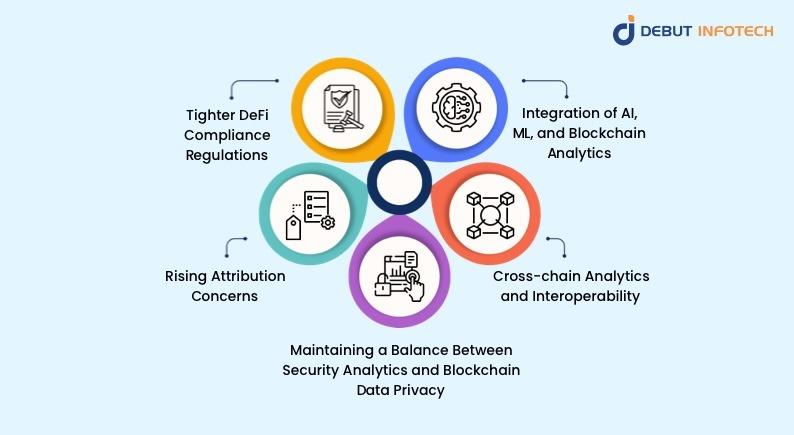
From the tighter compliance regulations to the rising attribution concerns, many regulatory bodies are now fully tuned into the idea of using blockchain analytics to prevent fraud and safeguard the finances of the public. And in that quest, they’re employing emerging technologies like AI and machine learning.
That’s not all; they’re also maintaining a balance between security and privacy to ensure compliance with global regulations and the successful catch of any fraudulent user.
And while all these sound very interesting, the blockchain analytics trends can be difficult to keep up with for most organizations. That’s why partnering with a blockchain development company like Debut Infotech is important for keeping up with the trends. Working with skilled developers may help businesses stay ahead of the curve and fully benefit from blockchain technology.
A. Blockchain analytics assists in the interpretation of blockchain activity. It tracks and analyzes transaction data to figure out what is going on within digital networks.
It has extensive applications in measuring risk and enabling compliance with regulations. Companies use it to make sure that transactions are done according to legal and financial principles.
Blockchain analytics is also instrumental in the detection and investigation of financial crimes. It assists in monitoring stolen money, determining money laundering schemes, and detecting suspicious transactions.
In addition, it converts complicated transaction information into insights. This enables businesses and analysts to know the trends in the market and make informed decisions regarding digital assets.
A. Blockchain analytics is an approach that assists organizations to fulfill Anti-Money Laundering (AML) requirements in a more effective way.
It also offers the capability to monitor crypto transactions in real-time, which enables firms to find suspicious transactions quickly. It also allows tracing of transactions, thus companies can trace the flow of funds within wallets and networks.
Besides that, analytics tools put a risk score on wallets and cross them with sanctions and high-risk lists, particularly when crypto engages with conventional financial systems. Altogether, blockchain analytics enhances transparency, identifies financial crime, and promotes compliance with regulators.
A. Yes- blockchain analytics have the potential to reveal the identity of the individuals operating under the anonymity of wallets. Most wallets are in fact pseudonymous, that is, they can be tracked with the proper tools.
Analytics services inspect the blockchain fund flows, wallets, and transaction trends in order to identify relationships. Such insights may be used together with off-chain information, like identity verification (KYC) data at centralized exchanges.
Even when privacy tools like mixers are used, advanced analytics can still follow transaction trails across multiple wallets.
In summary, blockchain operations can be tracked, and anonymity is becoming more problematic to handle.
A. On-chain analytics takes data from the blockchain, including the transactions and the wallet activity. It is open and safe but slower.
Off-chain analytics makes use of data not stored on the blockchain, such as social media or exchange data. It is quicker but less transparent and more centralized.
In simple terms:
On-chain analytics is more confidential and clear but slow. Off-chain analytics is faster and broader but less decentralized.

Our Latest Insights
USA
2501 Chatham, Rd Suite R Springfield, IL 62704
+1-708-515-4004
info@debutinfotech.com
UK
7 Pound Close, Yarnton, Oxfordshire, OX51QG
+44-770-304-0079
info@debutinfotech.com
Canada
154 Eden Oak Trail, Kitchener, ON N2A 0H9
+1-708-515-4004
info@debutinfotech.com
INDIA
Sector 101-A, Plot No: I-42, IT City Rd, JLPL Industrial Area, Mohali, PB 140306
9888402396
info@debutinfotech.com