



Uber Business Model: How Uber Works, Makes Money & Scales

Uber is no longer simply a ride-hailing company. It has evolved into a global technology-enabled, multi-sided marketplace that connects consumers with drivers, couriers, merchants, shippers and carriers through a single digital ecosystem.
At the center of the Uber business model is a relatively simple idea: use technology to connect demand with available supply. A customer looking for a ride can be matched with a driver; someone ordering food can be connected with a restaurant and courier; and a shipper can be connected with a carrier through Uber Freight. Uber provides the digital infrastructure that supports these interactions, including marketplace matching, payments, pricing, routing, tracking and other operational tools.
In other words, Uber does not operate like a traditional transportation company that primarily owns and operates a fleet of vehicles. Instead, its business model is built around managing a marketplace and using technology to make transactions between different participants more efficient.
How Does Uber Work?
Uber works as a technology-driven marketplace that connects people who need a service with providers who can fulfill that demand. While the basic concept is simple, the platform uses matching, pricing, routing, payments and real-time data to coordinate the entire transaction.
The same basic model works across Uber’s major businesses, although the participants and process vary between rides, delivery and freight.
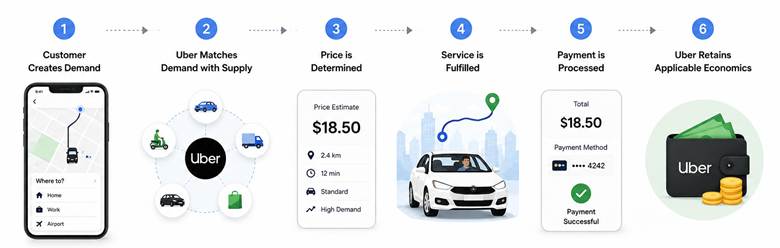
1. A Customer Creates Demand
The process starts when a customer requests a service through the Uber platform.
For example, a customer may:
- Request a ride by entering a pickup and destination
- Place a food or grocery order
- Request a delivery service
In Uber Freight, the process begins differently: a shipper creates a transportation requirement that needs to be fulfilled by a carrier.
This creates the demand that Uber’s marketplace needs to match with available supply.
2. Uber Matches Demand With Supply
Once a request is created, Uber’s marketplace technology works to identify suitable available providers.
For a ride, this means finding an appropriate driver. For a delivery, it can involve coordinating the merchant, courier and customer. For freight, the platform connects shipping requirements with available carrier capacity.
Uber uses technology for matching, dispatching, routing and marketplace management to help coordinate these interactions.
The objective is straightforward: connect the right request with the right available provider as efficiently as possible.
3. The Price Is Determined
Pricing is another important part of Uber’s marketplace.
The amount a customer pays can vary depending on factors such as:
- Distance
- Location
- Time
- Demand
- Available supply
- Type of service
- Local market conditions
When demand increases relative to available supply, prices can change accordingly. This allows Uber’s marketplace to respond to changing conditions rather than relying on one fixed price for every transaction.
For businesses building an on-demand marketplace, this pricing layer is particularly important because pricing has to work for both customers and service providers.
4. The Service is Fulfilled
After the request is accepted, the provider completes the service.
- For a ride, the driver picks up the passenger and takes them to the requested destination.
- For Delivery, the merchant prepares the order and a courier helps deliver it to the customer.
- For Freight, the carrier transports the shipment according to the agreed requirements.
Throughout the process, Uber’s technology can support features such as navigation, real-time tracking, status updates, communication and trip or order information.
5. Payment is Processed
Once the service is completed, the transaction is settled through the platform.
For customers, this can provide a convenient way to pay without having to arrange the entire transaction separately with the driver, courier, merchant or carrier.
However, Uber’s revenue recognition is more nuanced than simply keeping a fixed percentage of every transaction. Depending on the market and contractual arrangement, Uber may act as an agent and recognize revenue net of amounts paid to drivers or merchants, while in some arrangements it records revenue on a gross basis.
This distinction is important when analyzing the Uber revenue model.
6. Uber Monetizes the Marketplace
After facilitating the transaction, Uber generates revenue through the applicable economics of each business.
Its revenue can come from activities associated with Mobility, Delivery and Freight, as well as additional services such as advertising and memberships.
The exact revenue mechanism differs by business and market, which is why it is more accurate to describe Uber as a platform and marketplace business rather than simply saying that Uber “takes a commission from every ride.”
How Does Uber Make Money?
Uber makes money by monetizing the transactions and services that happen across its marketplace. The company operates three main business segments Mobility, Delivery and Freight and also generates additional revenue through areas such as advertising and memberships. In 2025, Uber reported $52.02 billion in total revenue, compared with $43.98 billion in 2024.
| Revenue stream | How Uber makes money |
|---|---|
| Mobility | Uber earns revenue from fees paid by drivers for using its platform and related services and, in certain markets, fees paid by end users. Mobility also includes advertising and certain financial partnership products. |
| Delivery | Uber earns revenue from merchants and couriers using its Delivery platform and in certain markets, fees paid by end users. Delivery also generates advertising revenue from merchants and brands. |
| Freight | Uber generates revenue from freight transportation services and transportation management, connecting shippers with carriers through its digital freight marketplace. |
| Advertising | Merchants and brands pay to promote products and services to Uber’s large consumer network through formats such as sponsored listings and other advertising placements. |
| Memberships | Uber One is a paid membership program offering benefits such as discounts, special pricing, cash back and other perks across eligible Uber services. |
| Other platform services | Uber also generates revenue from certain financial partnership products and other services connected to its platform ecosystem. |
1. Mobility
Mobility is Uber’s largest revenue-generating segment.
It includes ridesharing and other transportation options such as taxis, rentals, carsharing, micromobility and public transit-related offerings. Uber generates revenue through fees associated with drivers’ use of its platform and in certain markets, fees charged to end users.
2. Delivery
Uber’s Delivery business has expanded well beyond restaurant food delivery. It includes restaurants as well as grocery, convenience and other retail deliveries in certain markets.
Uber earns revenue from merchants and couriers using its platform, applicable end-user fees, and advertising.
3. Freight
Uber Freight applies Uber’s marketplace approach to logistics.
The platform connects shippers that need goods transported with carriers that have transportation capacity. Uber generates revenue through freight transportation services and transportation management and logistics services
4. Advertising
Advertising has become an increasingly important part of Uber’s monetization strategy.
Uber uses its large consumer and merchant network to offer advertising opportunities to brands and businesses. These can include sponsored listings and other advertising formats across Uber and Uber Eats.
5. Uber One Membership
Uber also monetizes its customer base through Uber One, its cross-platform membership program.
Uber Revenue Model: The Bigger Picture
The important takeaway is that Uber does not depend on a single revenue stream.
Its model combines:
Mobility + Delivery + Freight + Advertising + Memberships + Other platform services
This diversification allows Uber to monetize different parts of the ecosystem while using many of the same underlying assets: its technology, customer base, marketplace, payments infrastructure, data and brand.
It also explains why looking only at the fare paid for an Uber ride does not give you a complete picture of how Uber makes money.
Uber’s revenue model is best understood as monetizing a large, multi-sided marketplace, rather than as a simple fixed commission model. The company earns from different participants and services depending on the business, market and contractual arrangement.
Uber Business Model Canvas
The Uber Business Model Canvas helps explain how the company creates value, delivers its services and generates revenue. Instead of looking at Uber only as a ride-hailing app, the canvas shows how its customers, service providers, technology, marketplace and revenue streams work together. Uber’s own description of its platform emphasizes four foundations: a large network, technology, operational capabilities and product expertise.
1. Customer Segments
Uber serves several groups rather than one type of customer.
- Riders who need transportation
- Delivery customers ordering food, groceries, or other products
- Restaurants, grocery stores and retailers looking for customers and delivery capabilities
- Drivers and couriers looking for earning opportunities
- Shippers that need transportation and logistics services
- Carriers that provide freight capacity
- Brands and advertisers that want to reach Uber’s consumer network
This multi-sided structure is important because Uber creates value by connecting these groups through the same platform.
2. Value Proposition
Uber’s value proposition is based on making services easier to discover, request, fulfill and pay for.
For consumers, this can mean convenient access to rides, deliveries, tracking, digital payments and estimated pricing. For drivers and couriers, Uber provides access to customer demand and technology for managing trips and deliveries. Merchants gain access to customers and delivery infrastructure, while shippers and carriers can use Uber Freight to manage transportation more efficiently.
The main value propositions include:
- Convenience and accessibility
- Real-time matching between demand and supply
- Pricing and availability information
- Real-time tracking
- Digital payments
- Access to a large customer or provider network
- Delivery and logistics infrastructure
- Better utilization of available transportation capacity
3. Channels
Uber primarily reaches its users through its digital platforms and applications.
Its channels include:
- Uber app
- Uber Eats
- Uber Freight
- Web-based platforms
- Merchant interfaces and tools
- Partner integrations and other digital channels
These channels allow Uber to manage interactions between consumers, providers, merchants and logistics participants without requiring a traditional physical network of stores or booking offices.
4. Revenue Streams
Uber monetizes the activity taking place across its marketplace.
Its major revenue sources include:
- Mobility
- Delivery
- Freight
- Advertising
- Memberships such as Uber One
- Other platform-related services
The exact way Uber recognizes revenue can vary depending on the service, market and contractual arrangement. This is why describing Uber’s model as simply a “fixed commission business” would be misleading.
5. Key Resources
Uber’s most important resources are not just its apps. Its competitive foundation includes:
- Proprietary technology
- Marketplace data
- Large global network
- Brand recognition
- Drivers and couriers
- Merchant relationships
- Shipper and carrier relationships
- Payment and mapping infrastructure
- Marketplace liquidity
- Operational expertise
Uber describes its network as including consumers, Drivers, Merchants, Shippers, and Carriers, supported by shared data, technology and infrastructure.
6. Key Activities
To keep the marketplace working, Uber needs to continuously manage several activities:
- Matching demand with available supply
- Dispatching and routing
- Pricing
- Payment processing
- Marketplace management
- Platform development
- Safety and fraud prevention
- Customer and provider support
- Merchant and partner management
- Data and analytics
- Regulatory and operational management
These activities are what turn Uber’s technology into a functioning on-demand marketplace.
Uber Business Model Canvas at a Glance
| Business Model Element | Uber |
|---|---|
| Customer Segments | Riders, delivery customers, drivers, couriers, merchants, shippers, carriers, advertisers |
| Value Proposition | Convenience, matching, availability, tracking, payments, customer reach, logistics efficiency |
| Channels | Uber app, Uber Eats, Uber Freight, web and partner platforms |
| Revenue Streams | Mobility, Delivery, Freight, advertising, memberships, other platform services |
| Key Resources | Technology, data, brand, network, marketplace participants, infrastructure |
| Key Activities | Matching, pricing, routing, payments, marketplace operations, safety, support |
What the Business Model Canvas Tells Us
The most important insight is that Uber’s business model is built around the marketplace, not a single product.
The same underlying technology and network can support different services. For example, Uber can connect a rider with a driver through Mobility, a customer with a merchant and courier through Delivery, or a shipper with a carrier through Freight. This creates opportunities for cross-platform usage and network effects. In simple terms, Uber’s business model works because it brings different sides of a fragmented market together and provides the technology needed to make those interactions happen at scale.
Uber’s business model works because it creates value for multiple sides of its marketplace at the same time. More customers create more demand, while more drivers, couriers, and merchants improve availability and choice.
This creates a network effect that can strengthen the platform as it grows:
More Customers → More Demand → More Drivers & Merchants → Better Availability → Better Experience → More Transactions → More Data → Better Matching & Pricing → Stronger Marketplace
Uber can also increase engagement by offering multiple services, such as Mobility and Delivery. As customers use more services, the platform gets more opportunities to generate transactions and strengthen its relationship with those customers.
Lessons From Uber’s Business Model
Uber’s growth offers lessons that go beyond ride-hailing. The company’s experience shows how a business can combine marketplace economics, technology, operational execution and multiple services to build a scalable platform.
Here are some of the most useful lessons for businesses planning to build a similar model.
1. Solve a Problem People Face Regularly
A strong business often starts with a problem that customers encounter repeatedly.
Uber built its initial model around everyday transportation needs and then expanded into other frequent-use categories such as food, grocery and logistics.
Lesson: Look for problems that customers need to solve repeatedly, not just occasionally. Frequent use can create stronger opportunities for engagement and retention.
2. Build Both Sides of the Marketplace
A marketplace cannot succeed with customers alone. Uber needs both demand and supply customers looking for services and drivers, couriers, merchants or carriers capable of fulfilling them.
Lesson: When building a marketplace, invest in both sides. Getting customers without enough supply creates a poor experience; getting supply without enough demand creates poor utilization.
3. Technology Needs Strong Operations Behind It
An attractive app is only one part of an on-demand business.
Uber combines its technology with local operations teams that understand individual markets, support platform participants and work with cities and regulators.
Lesson: Technology can coordinate a marketplace, but people and processes are still essential for making it work in the real world.
4. Expand Into Adjacent Markets
Uber has used its existing technology, network and expertise across Mobility, Delivery and Freight rather than building every new business completely from scratch. This creates opportunities to reuse capabilities such as payments, marketplace technology, routing, data and customer relationships.
Lesson: Once you have a strong core platform, look for adjacent problems where the same infrastructure can create additional value.
5. Monetize More Than the Core Transaction
A marketplace can create value beyond its primary transaction. Uber has added advertising and Uber One membership alongside its core Mobility, Delivery and Freight businesses. Uber reported 46 million Uber One members at the end of 2025 and more than $2 billion in annualized advertising revenue.
Lesson: Once an ecosystem has meaningful engagement, explore additional revenue streams that improve the economics without weakening the core customer experience.
6. Focus on Marketplace Density, Not Just User Numbers
Having millions of users does not automatically make a marketplace successful. What matters is whether there is enough demand and supply in the same place at the right time.
Higher marketplace liquidity can improve availability, reduce friction and make the platform more useful.
Lesson: For an on-demand marketplace, density and liquidity can matter more than raw user count.
The Bigger Lesson
The most important takeaway from Uber is that building the app is only the beginning.
A successful Uber-like business requires a combination of: Technology + Supply + Demand + Operations + Network Effects + Monetization
That is what turns an app into a scalable marketplace business model.
Want to Build an Uber-Like Platform?
Understanding the Uber business model is useful, but building an Uber-like platform requires much more than developing a customer-facing app. A successful on-demand marketplace needs multiple applications and backend systems that can connect customers with drivers, couriers, merchants or other service providers while managing pricing, payments, real-time tracking, communication and marketplace operations. Businesses planning to launch this type of platform can work with an experienced mobile app development company to design and develop the technology around their specific business model. An Uber-like solution may include multiple applications and systems working together. The exact requirements depend on whether the platform is designed for ride-hailing, food delivery, logistics, home services or another on-demand business.
Core Components of an Uber-Like Platform
Customer App:
Allows users to create requests, view pricing, track services, make payments and manage bookings or orders.
Driver or Service Provider App:
Enables drivers, couriers or service providers to receive requests, accept jobs, navigate to destinations, update service status, and manage earnings.
Admin Dashboard:
Gives the business centralized control over users, providers, bookings, transactions, payments, locations, reports and platform activity.
Matching & Dispatch System:
Connects customer requests with suitable available providers based on location, availability, service type and business rules.
Real-Time Tracking:
Allows customers and administrators to track rides, deliveries or service requests as they progress.
Pricing Engine:
Supports pricing based on factors such as distance, time, demand, location, service type or other business rules.
Payment Integration:
Handles digital payments, transaction records, refunds and applicable payouts or settlements.
Ratings & Reviews:
Helps customers and service providers share feedback and maintain trust across the marketplace.
Notifications & Communication:
Keeps users informed about bookings, provider assignments, status updates, payments and other important events.
Analytics & Reporting:
Helps businesses monitor bookings, revenue, customer behavior, provider performance, cancellations and other marketplace metrics.
Security & Fraud Protection:
Protects user accounts, transactions, personal information and the platform from unauthorized or suspicious activity.
Building the Platform Around Your Business
The technology requirements should start with the business model, not simply a list of features.
For example, a ride-hailing platform may require advanced dispatch and location tracking, while a logistics marketplace may need shipment management, carrier onboarding, route optimization and freight documentation.
Debut Infotech can help businesses plan and develop custom mobile applications and supporting technology for different on-demand business models. The development approach can be tailored around the platform’s users, service workflow, target market, operational requirements and long-term growth plans.
Planning to Build an On-Demand Marketplace?
Whether you want to build a ride-hailing app, delivery platform, logistics marketplace, or another Uber-like solution, the focus should be on building the complete ecosystem, not just the app.
Looking for mobile app development or custom on-demand platform development? Talk to Debut Infotech’s development team.
Share:


