ON THIS PAGE
Progress0%






Our Global Presence :





AI development costs range from $5,000 to $800,000+ in 2026, depending on whether you're building an LLM integration, RAG system, AI copilot, custom ML model, AI agent, or enterprise AI platform.
Project complexity, data quality, integrations, compliance requirements, and deployment model are the biggest pricing drivers, with regulated industries often increasing development costs by 20–40%.
Generative AI solutions follow different pricing models, from $5,000–$60,000 for LLM API integrations to $50,000–$350,000+ for multi agent AI systems requiring advanced orchestration and governance.
Implementation timelines typically range from 2 to 52 weeks, with MVPs launching in weeks while enterprise AI platforms require phased delivery, testing, security validation, and production deployment.
Starting with a proof of concept, using RAG before fine-tuning, and investing in clean training data helps reduce AI development costs while improving implementation speed, scalability, and long-term ROI.
AI development cost ranges from around $5,000 for a simple LLM API integration to over $500,000 for a full enterprise AI platform with custom machine learning models, LLM fine-tuning, and production data infrastructure. That range is wide for one reason: “AI development” is not a single product. An API integration that connects your app to an existing model and a fine-tuned model trained on your proprietary data are fundamentally different engineering efforts, and most cost guides treat them as the same thing.
This guide fixes that. It is organized by AI project type, so you can find the range that matches what you are actually building, understand what drives that range up or down, and use it to build an internal budget. The numbers reflect 2026 AI development pricing, including current LLM API costs and GPU compute rates. If you want to map a specific project to a service and team, start with our AI Development & Integration Services page.
This table is the fastest way to find your number. Each row represents a distinct type of AI project, including a starter/MVP range, a full-production build range, a realistic timeline, and the single variable that most affects the cost. Read it as a starting point for budgeting, then read the section that matches your project for the details behind the range. Treat these as reference ranges for AI development pricing — your actual figure depends on scope, data readiness, and integration surface.
| AI Project Type | MVP / Starter Cost | Full Build Cost | Timeline | Key Cost Driver |
| LLM API Integration (GPT‑4o, Claude, Gemini) | $5,000–$20,000 | $20,000–$60,000 | 2–8 weeks | Integration complexity, prompt engineering, guardrails |
| RAG System (enterprise knowledge base) | $20,000–$50,000 | $50,000–$120,000 | 6–16 weeks | Document volume, retrieval quality, vector DB, enterprise integration |
| AI Chatbot / Conversational AI | $15,000–$40,000 | $40,000–$200,000 | 6–28 weeks | Chatbot type (rule‑based vs LLM), integrations, channels |
| AI Copilot (enterprise workflow) | $40,000–$90,000 | $90,000–$250,000 | 12–32 weeks | Orchestration complexity, tool‑calling, security controls |
| Custom ML Model (classification/regression) | $15,000–$40,000 | $40,000–$120,000 | 8–20 weeks | Training data quality, model complexity, and retraining pipeline |
| NLP / Text Analytics System | $20,000–$60,000 | $60,000–$180,000 | 10–24 weeks | Entity types, language count, training‑data annotation |
| Computer Vision System | $30,000–$80,000 | $80,000–$250,000 | 12–32 weeks | Image volume, accuracy requirements, edge vs cloud deployment |
| LLM Fine‑Tuning (custom model) | $20,000–$60,000 | $60,000–$200,000 | 8–24 weeks | Training data size, base model, compute cost, evaluation cycles |
| AI Agent / Multi‑Agent System | $50,000–$120,000 | $120,000–$350,000+ | 16–48 weeks | Agent count, tool orchestration, planning complexity, safety review |
| Forecasting / Predictive Analytics | $15,000–$50,000 | $50,000–$150,000 | 8–24 weeks | Data availability, feature engineering, and retraining frequency |
| AI‑Powered Automation (RPA + AI) | $20,000–$60,000 | $60,000–$200,000 | 10–28 weeks | Process complexity, exception handling, and integration count |
| Enterprise AI Platform (multi‑use‑case) | $100,000–$250,000 | $250,000–$800,000+ | 24–52 weeks | Use‑case count, data infrastructure, governance, change management |
All ranges shown are for reference. The actual project cost depends on the scope, complexity, and selected features.
The one thing to be aware of before digging deeper is that for nearly every row, the same few factors come into play: data quality, integration count, compliance load and the amount of custom work, versus assembled work. The next section, then, fills in that mental model, so that the remainder of this guide is not 12 price lists at random.
Before the project-type sections, here is the set of variables that determine where in a range your project lands. Understanding these AI development cost factors is what lets you scope and negotiate intelligently — and it explains why two vendors can quote very different numbers for what sounds like the same project.
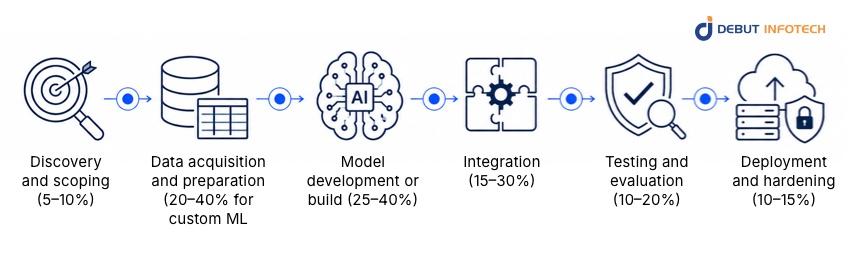
It helps to see how an enterprise AI development cost breaks down over the life of a project, because the distribution is rarely what buyers expect, and it’s where the “why” behind a quote becomes visible. The percentages listed below are representative of a medium- to larger-sized frame and will vary by project type, but remain similar in shape.
Generative AI and LLM projects are the primary AI investment for most enterprises in 2026, so this is the section to read closely. Generative AI development costs span a wide range, from a thin API wrapper to an autonomous multi-agent system. Here is what each tier actually involves, and what current LLM pricing means for it.
This connects an existing product or workflow to a hosted model, such as GPT-4o, Claude, or Gemini, via an API. The work is prompt engineering, context management, guardrails, an API wrapper, error handling, and cost monitoring — not model training. The starter end is a single integration point with straightforward prompt logic; the upper end is multiple integration points, complex prompt chains, and production-grade guardrails. The build is inexpensive because the intelligence already exists; the ongoing token cost is the real budget line (covered in the ongoing costs section). Current list pricing illustrates why model choice matters here: GPT-4o runs about $2.50 input / $10 output per million tokens, and Claude Sonnet 4.6 about $3 / $15, while smaller models cost a fraction of that.
Retrieval-augmented generation lets a model draw on your enterprise knowledge, not just its training data. A production RAG build includes a document-ingestion pipeline, chunking and embedding, a vector store, retrieval and reranking, context injection, and — critically — an evaluation framework. Retrieval-quality evaluation is the most consistently underscoped piece of an RAG project and the most common cause of RAG failure: a system that retrieves the wrong context confidently is worse than no system at all. Document volume, retrieval quality targets, and the number of enterprise sources you integrate drive the range.
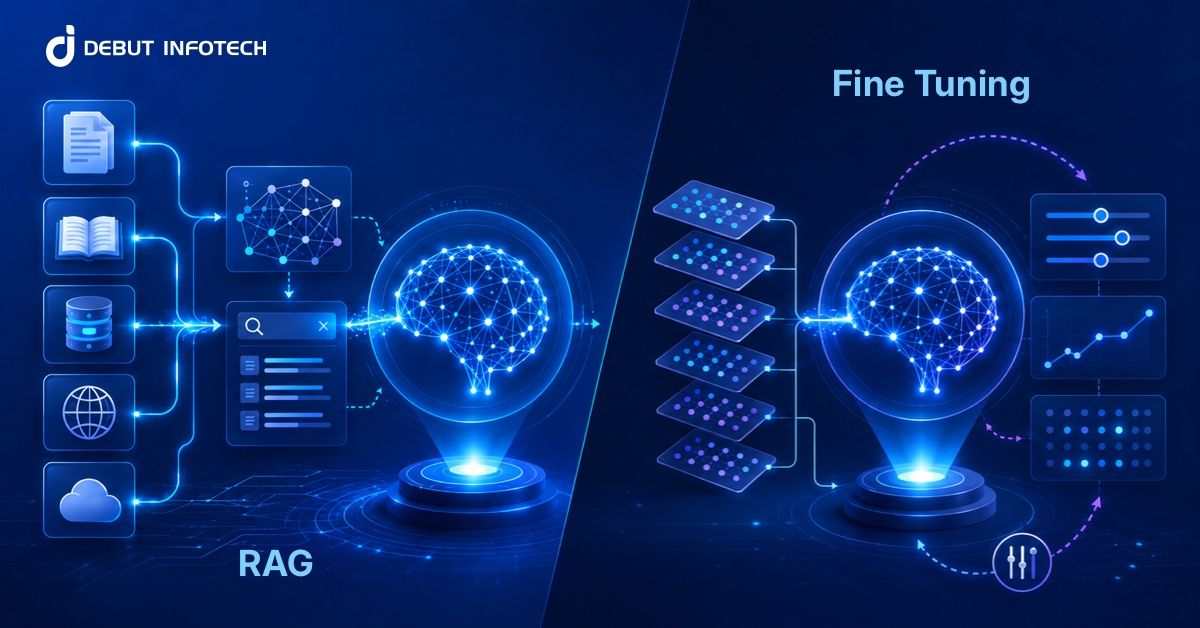
Fine-tuning trains a custom model on your proprietary data. Cost is driven by base-model selection, the size and curation cost of your training data, compute (GPU hours, with A100-class hardware running roughly $1.50–$3.50/GPU-hour on specialized clouds and more on the hyperscalers), the number of evaluation cycles, and deployment infrastructure. A common mistake is reaching for fine-tuning before confirming that prompt engineering or RAG can’t solve the problem at a fraction of the cost. When it is the right call, see our LLM fine-tuning services for scope and approach.
A copilot embeds AI assistance directly into an enterprise workflow, with a tool-calling layer that lets the model take actions in your systems. These are the most complex GenAI projects because of that tool-calling layer, the security requirements around letting a model act, and the enterprise integrations involved. The full architecture and cost breakdown are covered in our dedicated AI copilot development page.
The emerging highest-complexity tier, where multiple AI agents plan, coordinate, and use tools to complete multi-step work. Cost drivers are agent count, the number of tools each agent can call, planning-loop design, the human-in-the-loop review architecture, and safety testing, which is non-optional when agents take autonomous action. For projects in this tier, our AI agent development work goes deeper into architecture and guardrails.
Not every enterprise AI project is generative. Traditional machine learning and deep learning remain distinct cost categories, and many enterprises are building both predictive models and LLM applications. Machine learning development cost is driven first and foremost by data: how much you have, how clean it is, and whether it’s labeled. Here are the four most common model types and what each costs.
The same project type can carry very different quotes depending on how the work is structured commercially. This is the variable most buyers don’t think about until contracting — and it’s the question Operations and Procurement always raise. Here are the four engagement models and their cost implications.
Almost every enterprise discovers these costs after signing, which is exactly why they belong in a budget before you sign. The build cost is only the largest line for the first year, not the only one. Here is the full picture of the total cost of ownership for a production AI system.
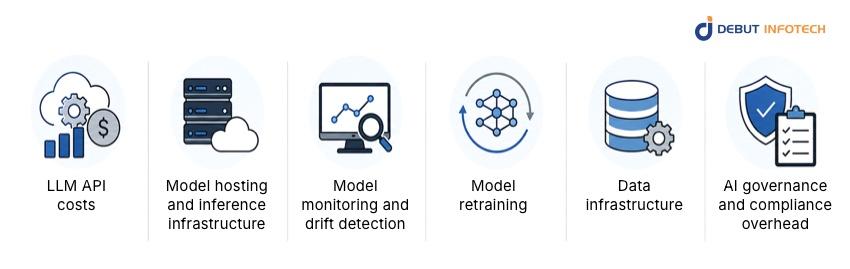
Total cost of ownership, summarized: budget 30–50% on top of the build cost in the first year (LLM API, hosting, monitoring, retraining, governance), and 20–30% of build cost per year thereafter. A $200,000 build is realistically a $260,000–$300,000 first year and a $40,000–$60,000/year run-rate after that.
To make the numbers concrete, here is how a realistic first-year budget comes together for a common scenario — an enterprise standing up two AI capabilities at once: a RAG system over internal documentation, plus a customer-facing copilot.
A production RAG system over a few hundred thousand documents, integrated with two internal systems, costs around $70,000–$100,000 to build. A workflow copilot with tool-calling into the CRM and a couple of security-reviewed actions lands around $110,000–$160,000. That’s a build cost of roughly $180,000–$260,000.
Layer in first-year ongoing costs at the 30–50% guidance above: LLM API usage for both systems at moderate volume (say $4,000–$9,000/month combined), monitoring and data infrastructure ($1,500–$6,000/month combined), and one retraining/evaluation cycle. That adds roughly $70,000–$120,000 in the first year. The all-in first-year number is therefore in the range of $250,000–$380,000, settling at a $50,000–$90,000/year run rate.
The point of the exercise isn’t the exact figure — it’s that a credible AI budget is built cost plus a clearly-scoped operating line, and that the engagement model (here, hybrid: fixed-price discovery, then T&M build) is what keeps the build half of that from drifting.
Where your team is based is one of the largest cost levers, which is why buyers evaluating offshore, nearshore, and onshore options ask about it directly. The table below shows market hourly-rate benchmarks by role and region — useful for understanding the spread when comparing AI development costs in India, the UK, and the US. Senior AI talent commands a premium everywhere; the regional gap is real, but it is narrower at the senior architecture level than at the execution level.
| Role | India ($/hr) | Eastern Europe ($/hr) | UK ($/hr) | US ($/hr) |
| AI/ML Engineer – Senior | $55–$110 | $85–$160 | $150–$270 | $180–$340 |
| LLM / GenAI Engineer – Senior | $60–$115 | $90–$165 | $160–$290 | $190–$360 |
| Data Engineer – Mid | $30–$65 | $55–$105 | $95–$170 | $115–$210 |
| MLOps Engineer | $40–$80 | $70–$130 | $130–$230 | $160–$290 |
| AI Solutions Architect | $65–$120 | $95–$175 | $170–$300 | $200–$370 |
The regional decision usually frames itself as offshore, nearshore, or onshore, and each trades cost against something else. Offshore (for example, India) offers the lowest rates and a deep senior AI talent pool at that price point, with a wider time-zone gap to manage. Nearshore (for example, Eastern Europe relative to Western Europe) narrows the time-zone gap at a moderate premium. Onshore (UK or US) maximizes proximity and time-zone alignment at the highest rate and is sometimes required for data residency or contractual reasons. For most enterprise AI projects, the cost-effective answer is a blended model: senior architecture wherever the best people sit, execution weighted toward lower-cost regions, and onshore presence only where compliance or stakeholder proximity genuinely demands it.
The practical takeaway for an enterprise buyer is that the lowest hourly rate rarely produces the lowest project cost. What protects your budget is the seniority of the architecture and oversight, paired with execution scaled appropriately to the task. Debut operates on exactly that hybrid model: senior architecture and oversight directing the work, with execution resourced to fit the project rather than the rate card.
A budget holder’s job isn’t to spend the least — it’s to spend deliberately. These are the levers that lower AI development costs without quietly lowering quality.
AI development cost in 2026 cannot be reduced to a single model, hourly rate, or feature list. The final investment depends on the business problem, data readiness, model strategy, integration complexity, security requirements, expected usage, and the environment in which the solution must operate.
The most cost-effective AI projects usually begin with a clearly defined business outcome and the smallest viable solution needed to validate it. Once the initial release demonstrates value, the architecture can expand based on real performance, user feedback, and operational requirements rather than assumptions.
As an experienced enterprise AI development company, Debut Infotech helps organizations plan, build, deploy, and optimize AI-powered solutions across a broad range of use cases. Our capabilities include generative AI, machine learning, natural language processing, conversational and voice AI, computer vision, predictive analytics, data engineering, AI agents, intelligent automation, model integration, and MLOps.
Our AI engineering team includes solution architects, machine learning engineers, data engineers, NLP specialists, cloud professionals, and experienced AI developers. With more than a decade of technology delivery experience, the team supports projects from feasibility assessment and proof of concept through production deployment, monitoring, and continuous improvement.
This experience spans focused workflow automations, enterprise integrations, conversational AI platforms, predictive systems, and multi-model AI products.
AI development cost in 2026 is not set by a single model, hourly rate, or feature list. It’s driven by the business problem, available data, implementation approach, integration depth, security requirements, expected usage, and the environment the system runs in.
A well-planned AI project starts with the smallest solution that can prove business value. From there, the architecture expands based on real performance and measurable outcomes, not assumptions.
Debut Infotech is an AI development company supporting organizations across the major branches of artificial intelligence: generative AI, machine learning, natural language processing, conversational and voice AI, computer vision, predictive analytics, data engineering, AI agents, intelligent automation, model integration, and MLOps.
Our team includes AI architects, data engineers, machine learning specialists, NLP engineers, cloud professionals, and AI developers with more than a decade of technology delivery experience. They take businesses from feasibility assessment and proof of concept through deployment, monitoring, and continuous optimization.
That experience shows up across projects with different scopes, industries, and cost structures.
Lummid Containers — inventory automation and intelligent filtering across fragmented supplier platforms.
Telehealth Pharmacy Provider — AI clinical documentation integrated into an existing EHR.
Veterinary Telehealth Platform — AI-assisted call management for high call volumes.
Immigration Legal Services Organization — enterprise AI chatbot and legal automation platform.
Drawpost — a Debut Infotech original AI SaaS product for social media automation.
These projects demonstrate why AI development costs vary widely. An EHR documentation pipeline, a voice-based intake system, an inventory intelligence platform, a legal automation system, and a multi-model AI SaaS product may all use artificial intelligence, but they require different architectures, skills, integrations, security controls, timelines, and operational budgets.
Organizations looking to hire AI developers should therefore evaluate more than hourly rates. The right development team should be able to:
Debut Infotech helps businesses define these requirements before the full development budget is committed. Whether your project requires an AI proof of concept, generative AI application, machine learning model, AI agent, conversational platform, predictive system, or enterprise automation solution, our team can translate the idea into a practical implementation plan.
AI development costs range from $5,000 for a simple LLM API integration to over $500,000 for an enterprise AI platform with custom ML models, LLM fine-tuning, and production data infrastructure. The range reflects fundamentally different project types; an API integration is not the same product as a fine-tuned model on proprietary enterprise data. Scope your project type first, then work from the ranges in this guide to build an initial budget.
Generative AI project costs vary by type: LLM API integration ($5,000–$60,000), a RAG system for enterprise knowledge retrieval ($20,000–$120,000), LLM fine-tuning on proprietary data ($20,000–$200,000), an AI copilot with tool-calling and enterprise integrations ($40,000–$250,000), and multi-agent agentic systems ($50,000–$350,000+). Ongoing LLM API costs scale with usage and are a separate budget line from the build cost.
Custom ML model development costs $15,000–$250,000, depending on model type and data readiness. Classification and regression models cost $15,000–$120,000; NLP systems cost $20,000–$180,000; computer vision systems cost $30,000–$250,000. Training data quality is the single largest cost variable — clean, labeled data at scale significantly reduces build time, while annotation costs for unlabelled data can account for 40–60% of total project cost.
Ongoing costs for a production AI system include LLM API usage ($2,500–$12,000+/month for high-volume enterprise applications, depending on model and token split), model hosting ($1,100–$2,500/month for a single self-hosted GPU, more for multi-GPU nodes), model monitoring ($500–$5,000/month), and annual retraining (20–40% of build cost per year). Total first-year cost of ownership is typically 130–150% of the initial build cost.
The lowest-risk, lowest-cost entry point is a fixed-scope LLM API integration using a hosted model like GPT-4o or Claude, which can deliver a working prototype in 2–4 weeks for $5,000–$20,000. For teams with a specific ML use case, a time-boxed proof-of-concept — 4–6 weeks at a fixed $15,000–$30,000 — validates feasibility before committing to a full build. Avoid starting with fine-tuning or custom model development before confirming that an RAG or prompt engineering services approach can’t solve the problem at a lower cost.

Our Latest Insights
USA

2501 Chatham, Rd Suite R Springfield, IL 62704
+1-708-515-4004
info@debutinfotech.com
UK

7 Pound Close, Yarnton, Oxfordshire, OX51QG
+44-770-304-0079
info@debutinfotech.com
Canada

326 Parkvale Drive, Kitchener, ON N2R1Y7
+1-708-515-4004
info@debutinfotech.com
INDIA

Sector 101-A, Plot No: I-42, IT City Rd, JLPL Industrial Area, Mohali, PB 140306
9888402396
info@debutinfotech.com
Copyright © 2026, Debut Infotech. All rights reserved. | Privacy Policy