ON THIS PAGE
Progress0%






Our Global Presence :





The Cardano Blockchain is now one of the most academically sound and forward-looking systems in the world of decentralized tech. Cardano is different from many other blockchain networks in that it puts more emphasis on research, peer review, and long-term sustainability than on quick change.
As more businesses look into enterprise blockchain, scalable blockchain infrastructure, and advanced blockchain integration techniques, Cardano gives them a solid base to build apps that are safe and ready for the future. Its stringent development cycle and stratified structure make it highly attractive to companies that require stability and large scale performance.
The Cardano Blockchain is the third-generation blockchain network that will help in solving the issues on the previous networks, such as Bitcoin and Ethereum. The first-generation blockchains provided decentralized ledgers, and the second-generation platforms enabled the implementation of smart contracts. Cardano’s goal is to make both of these better and better.
Cardano is based on three main ideas:
Charles Hoskin developed Cardano to develop a blockchain that both incorporates new concepts and adheres to the highest standards of science. He wanted to develop a system that could sustain the world’s financial infrastructure while still being safe and flexible.
Cardano is based on the ideas of accuracy and proof, which are different from the way many other blockchain projects slowly change over time. Every new feature goes through a lot of research and testing before it is added to the network.
The Cardano Foundation and other groups support this strategy. The foundation is very important for promoting, governing, and developing the ecosystem.
The development of Cardano is based on academic research. Protocols are based on peer-reviewed papers, which means that every part of them is sound in theory before they are put into practice. This reduces the likelihood of security holes and makes the network more stable overall.
This level of thoroughness gives firms that are paying for enterprise blockchain development services. peace of mind that their solutions are built on a solid basis.
There are five major phases of Cardano’s development, each of which focuses on a different part of the ecosystem:
This step-by-step plan ensures changes are made slowly, keeping the network running smoothly and safely.
The two-layer architecture of Cardano is one of its most unique design choices. It separates transaction processing from smart contract execution.
The settlement layer processes transactions that use ADA, Cardano’s native coin. It ensures that value is transferred across the network in a fast, secure and efficient manner.
This layer is configured under performance and hence is suitable with applications that require a high number of transactions within a short period of time such as payment services and money transfer sites.
Smart contracts and decentralized apps run on the compute layer. Cardano lets developers use complicated logic without slowing down transactions by separating this layer from the settlement layer.
This modular design makes Cardano very flexible for enterprises that want to use complex blockchain integration solutions without slowing down their operations.
Ouroboros is a proof-of-stake (PoS) consensus algorithm that forms the core of the Cardano Blockchain. It also ensures that the network is secure and functional.
Ouroboros does not generate validators through mining that consumes much energy. Rather, it selects them based on the amount of ADA they hold and their vested interest in the network.
It implies that Cardano can be used as an alternative to businesses considering developing large-scale applications because it is eco-friendly and inexpensive.
Smart contracts were included during the Goguen phase, which greatly increased Cardano’s capabilities and enabled developers to build decentralized apps across many fields.
Plutus is Cardano’s main smart contract platform, built in Haskell. It is for developers who need a lot of control and accuracy.
Developers can create the following with Plutus:
Its powerful type system reduces errors and ensures contracts work exactly as they should.
Marlowe is a programming language made just for financial apps. It differs from Plutus because it is meant to be easy for those who don’t know how to code to use. This means financial experts can create smart contracts without needing to know much about coding.
Some such uses are:
Plutus and Marlowe work together to create Cardano a flexible platform for developers and enterprises that want to try out different blockchain use cases.
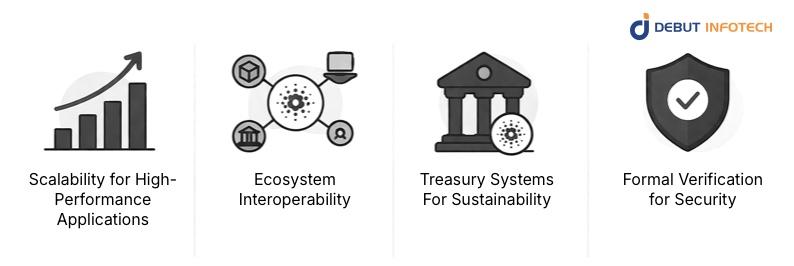
Several key characteristics that meet the needs of businesses and developers are making Cardano more popular.
Cardano is built to handle more transactions as more people use it. Innovations like Hydra aim to greatly increase throughput, making the platform useful for large-scale applications.
Businesses that hire top blockchain app development companies to make systems that work well will find this ability to grow very useful.
Cardano makes it easy to link up with other blockchain networks and regular systems. Companies can easily add blockchain to their current workflows because it is able to operate with other systems.
It also lets people work together on different blockchain ecosystem protocols, which makes solutions more flexible and connected.
Cardano’s treasury structure ensures that network development receives funding consistently. The treasury receives a portion of the transaction fees, which it then uses to fund future enhancements and new ideas.
This self-sustaining plan makes the business less reliant on outside funding and guarantees its long-term success.
Cardano places great emphasis on security. The platform ensures its code works as intended by employing formal verification methods to prove it.
This is very significant for fields like banking and healthcare, where data accuracy and reliability are critical.
Because of its design and features, Cardano can be used in many real-world situations.
Cardano supports decentralized finance (DeFi) solutions, which enables:
These apps make it less necessary to use traditional financial middlemen and minimize the price of transactions.
Cardano’s transparent and unchangeable ledger lets businesses follow things from their source to their delivery. This makes people more responsible and lowers the chance of fraud.
Cardano can safely store and exchange private information, including medical records, so that only the right people may see it.
Educational institutions can offer digital certificates that can’t be tampered with, which makes credential verification more trustworthy and less likely to be fraud.
As more and more businesses start using blockchain technology, Cardano has become a popular choice for corporate solutions.
Businesses often collaborate with a Cardano blockchain development company to build:
Companies can improve their operations without having to replace their current infrastructure by effectively integrating blockchain.
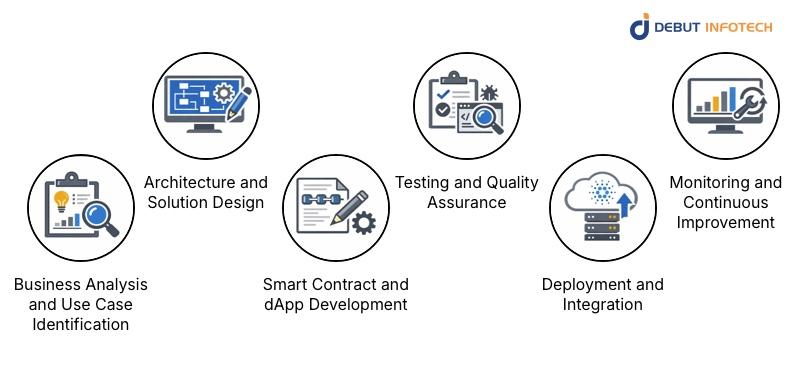
In order to develop on the Cardano Blockchain, you must have a clear strategy that will bridge the technical capability and commercial ambitions. Cardano focuses on precision, testing, and scalability, while other ecosystems prioritize rapid, experimental growth.
The initial step of any successful blockchain project is to clearly understand the purpose of the project. At this point, companies determine:
With experienced blockchain consultants, however, you will be able to translate such ideas into practical solutions that support practical needs rather than theoretical ones.
After the use case is clear, developers plan how the system will work. This includes:
This step is very important for making sure that everything works with current blockchain infrastructure and business tools.
Using Plutus or Marlowe, developers build the application’s core logic.
This stage involves:
Because Cardano values correctness so much, developers must follow tight coding standards to make sure the code is reliable.
Testing on Cardano goes beyond standard practices. It often includes:
This ensures that applications are strong enough to be used in businesses.
The application is put on the Cardano network when it has been tested. Then, it is added to current systems using effective blockchain integration strategies.
This enables firms improve their operations without having to stop the current workflow.
After deployment, apps need to be observed all the time to make sure they work well. As the ecosystem changes, updates and improvements are made.
Companies that engage blockchain engineers who know how to work with Cardano are better able to keep their solutions running and grow them.
Cardano is mostly a public blockchain, but businesses often need specialized environments that fit their specific demands.
A cardano private blockchain development company can help businesses make solutions that offer the best of both worlds: decentralization and regulated access.
These solutions are especially useful in fields like finance, healthcare, and transportation, where keeping track of data and following the rules is very important.
Cardano is more than simply a technological platform; it is also a catalyst for innovation in blockchain business development.
Organizations can leverage Cardano to:
Its secure and scalable architecture makes it easier for companies to try out new models without putting their operations at risk.
The topic of a Cardano NASA blockchain partnership is increasingly gaining traction, and individuals are discussing it heavily across the internet communities and in the industry fora.
No official check-in with a massive relationship with NASA is present in the present. Although this is merely an educated guess, it points to one important fact: the technology that Cardano has created is ideal in situations where a lot of trust is required.
These features make Cardano a good choice for fields like aerospace, research, and advanced engineering, where accuracy and security are very important.
Cardano has a lot of good features, but businesses should think about the problems associated with it before adoption.
1. Learning Curve Is Steeper
You need to know a lot about Haskell-based tools like Plutus to use Cardano. This can make it harder to get new developers up to speed than in programming environments that are more commonly used.
2. Slower Development Cycle
Because the platform is based on research, it takes longer for features to be released. This makes things more reliable, but it could also slow down the time it takes to get some projects to market.
3. Ecosystem Maturity
Cardano’s ecosystem is still expanding, even if it is growing quickly. It is still not as advanced as earlier blockchain networks. In some sectors, this means there are fewer tools and integrations.
For a lot of companies, these problems are worth it for the benefits of security, scalability, and long-term sustainability, especially when they engage with competent blockchain app development companies.
Innovation and scalability remain key to Cardano’s continual growth. Its roadmap puts it in a strong position to be a prominent player in the next generation of blockchain platforms.
Here are some important things to keep an eye on:
These improvements should lead to more widespread use in all kinds of sectors and areas.
More and more businesses in all kinds of fields are using Cardano for their blockchain projects.
Some of the main reasons are:
These benefits make Cardano an attractive choice for companies seeking robust enterprise blockchain development services.
To successfully use Cardano solutions, you need more than just technical skills; you also need to be able to think strategically. This is where Debut Infotech shines out as a reliable business that builds Cardano blockchains.
Debut Infotech offers full blockchain development services, from the first meeting to the last, including deployment and maintenance.
Businesses can hire blockchain developers with deep expertise in:
The company focuses on creating scalable, secure solutions that are customized for businesses and work well with their current systems.
Debut Infotech helps organizations keep the quality of their blockchain development high while keeping blockchain development costs low by streamlining workflows and using teams with a lot of experience.
Their team of skilled blockchain consultants helps businesses at every step by giving them advice on how to:
The Cardano Blockchain is a big step forward for decentralized technology. It is different from other platforms in the space since it is based on research, has a layered architecture, and focuses on sustainability.
Cardano is a solid and future-proof platform for building safe, scalable, and cutting-edge applications as the use of blockchain grows. Its potential is growing, from decentralized finance and smart contracts to business apps and tokenized ecosystems.
Businesses that want to stay competitive in a world that is becoming more and more digital can use Cardano with the help of an expert Cardano blockchain development company like Debut Infotech to open up new prospects and ensure long-term success.
A. The Cardano blockchain is used to build decentralized applications (dApps), execute smart contracts, and enable secure digital transactions. It is widely used across industries such as finance, supply chain, healthcare, and identity management due to its scalability and robust security framework.
A. Cardano stands out because of its research-driven approach and peer-reviewed development process. Unlike many other blockchain platforms, it uses formal verification methods and a layered architecture to ensure higher security, scalability, and long-term sustainability.
A. Cardano primarily uses Haskell-based tools for development. Smart contracts are written in Plutus, while financial contracts are written in Marlowe. These languages provide strong security and reliability, making them suitable for enterprise-grade blockchain development services.
A. Yes, Cardano is highly suitable for enterprise blockchain applications. Its scalable architecture, energy-efficient consensus mechanism, and strong security model make it ideal for businesses looking to implement blockchain in real-world operations.
A. There is currently no officially confirmed partnership between Cardano and NASA. However, Cardano’s technology is well-suited for high-security and data-intensive environments, which is why such discussions often arise.
A. The blockchain development cost for Cardano-based solutions varies depending on factors such as project complexity, features, integrations, and development timeline. Working with experienced blockchain app development companies can help optimize costs while ensuring high-quality delivery.
A. To get started, businesses should define their use case, choose the right development approach, and partner with a trusted company for Cardano blockchain development blockchain developers or consult with experts to guide the process from planning to deployment.

Our Latest Insights
USA
2501 Chatham, Rd Suite R Springfield, IL 62704
+1-708-515-4004
info@debutinfotech.com
UK
7 Pound Close, Yarnton, Oxfordshire, OX51QG
+44-770-304-0079
info@debutinfotech.com
Canada
154 Eden Oak Trail, Kitchener, ON N2A 0H9
+1-708-515-4004
info@debutinfotech.com
INDIA
Sector 101-A, Plot No: I-42, IT City Rd, JLPL Industrial Area, Mohali, PB 140306
9888402396
info@debutinfotech.com