ON THIS PAGE
Progress0%






Our Global Presence :





Unprecedented expansion in decentralized finance (DeFi) has recently changed the way people and companies interact with financial systems. DeFi use cases now surpass their early promises and provide practical solutions beyond traditional financial services. From loan and borrowing to yield farming and decentralized insurance, the possibilities DeFi offers excite both creators and investors equally. As a reputable Defi development company, Debut Infotech has closely watched and added to this ecosystem’s growth.
DeFi is a movement that questions accepted centralized finance (CeFi) models. Although DeFi and CeFi want to facilitate financial transactions, DeFi uses decentralized technologies like blockchain to bring transparency, inclusion, and autonomy. The chances for both people and businesses are significant, given the fast development of blockchain systems and the growing need for customized DeFi development tools. This blog analyzes the most interesting defi use cases, thus illuminating how they are changing sectors and lives.
Decentralized finance involves financial applications developed on blockchain systems free of middlemen. DeFi uses smart contracts to automatically enforce agreements rather than depending on banks or other centralized organizations. This fundamental change has democratized financial services so that customers worldwide may engage in lending, borrowing, trading, and other activities DeFi offers.
DeFi systems use decentralized networks’ ability to provide transparency and lower single point of failure risk. A network of DeFi platforms built on top of these protocols allows for the decentralization of trust away from traditional institutions and toward code and consensus. As a prominent provider of blockchain development services, Debut Infotech has assisted many companies in investigating the potentially revolutionary effects of decentralized financial systems.
DeFi has moved past the “experimental” phase. It now sits as a serious financial layer built on blockchain infrastructure, with capital, users, and institutions all flowing in. The easiest way to track its growth is through Total Value Locked (TVL), user activity, and stablecoin liquidity.
Taken together, these numbers show a shift. DeFi is no longer driven purely by speculation. Capital is moving toward structured products such as lending, staking, and real-world asset tokenization, signaling a more mature and stable market direction.
Before DeFi, smart contracts were only available on Ethereum, one of the most famous blockchain platforms. To fix the problems with current financial systems, creative developers and DeFi development companies have added more cases of decentralized finance over time. From complex derivatives markets to decentralized exchanges (DEXs), DeFi now covers a wide range of uses.
Thanks to technological improvements and simplified development procedures, the cost of blockchain development connected with DeFi projects has been more under control. Because of this, businesses can use blockchain’s benefits without having to pay huge amounts of money upfront. Our specialty at Debut Infotech is providing scalable and reasonably priced DeFi solutions adapted to our customer requirements.
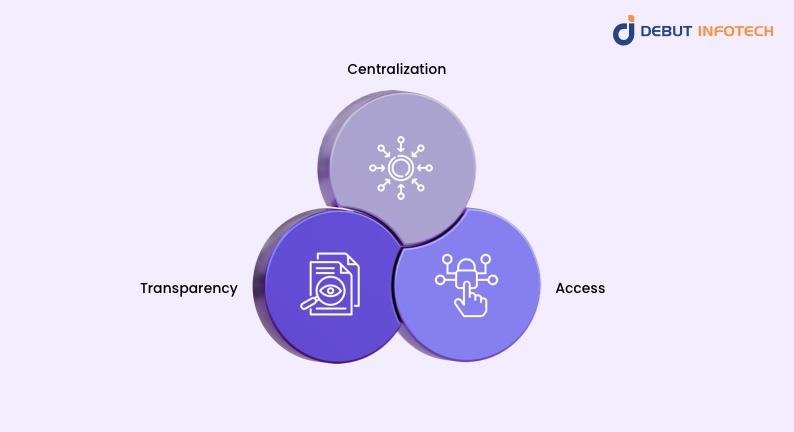
Comparing DeFi vs CeFi emphasizes the basic change in the way financial systems run:
Another important issue in the DeFi vs. CeFi debate is who controls the funds. CeFi users entrust their assets to centralized systems, thus running the risk of mismanagement or loss from insolvency or hackers. DeFi guarantees customers have complete control over their assets thanks to private keys, preserving their full custody.
Because of these differences, DeFi is becoming a more appealing option, especially for people in underdeveloped areas or who want more control over their finances. However, the decision between DeFi and CeFi usually comes down to personal preferences like regulatory compliance, simplicity of usage, or degree of financial system trust.
Understanding how DeFi differs from traditional finance helps clarify its value. The comparison below highlights practical differences across control, transparency, access, speed, cost, and system availability.
| Factor | DeFi | Traditional Finance (TradFi) |
| Control / Custody | Users hold assets directly through wallets. No intermediaries involved. | Banks and custodians control user funds and access to them. |
| Auditability | Fully transparent. Transactions are recorded on public blockchains. | Limited transparency. Internal systems are not publicly verifiable. |
| Entry Barrier | Open to anyone with internet access and a wallet. | Requires identity checks, credit history, and documentation. |
| Settlement | Near-instant or within minutes, depending on the chain. | Takes hours to days due to clearing systems and intermediaries. |
| Costs | Lower fees due to automation and the absence of intermediaries (though gas fees can vary). | Higher fees due to operational overhead and intermediaries. |
| Availability | Operates 24/7 with no downtime. | Limited to business hours and regional banking systems. |
In DeFi, users retain full control over their assets through non-custodial wallets. Private keys serve as the only access point, meaning no third party can freeze, restrict, or manage funds. Transactions are executed directly via smart contracts, removing intermediaries entirely. This model gives users financial sovereignty but also places responsibility on them to secure their keys and manage risks without relying on institutional safeguards.
In contrast, Traditional finance operates on custodial systems in which banks, brokers, or financial institutions hold and manage users’ funds. Access is tied to accounts controlled by these entities, which can impose restrictions, delays, or compliance checks. While this setup reduces user responsibility and offers recovery options, it limits direct ownership. Customers rely heavily on institutional trust, and in some cases, access to funds can be temporarily restricted due to policies or regulations.
DeFi systems are built on public blockchains, where every transaction is recorded and verifiable. Anyone can audit fund movements, smart contract activity, and protocol reserves in real time. This transparency reduces the chances of hidden liabilities or misreporting. It creates a trustless environment in which users rely on code and data rather than institutional claims, though understanding the data may require some technical familiarity.
In traditional finance, auditability is limited to internal systems and periodic disclosures. Financial institutions publish reports, but users cannot independently verify transactions or reserves in real time. Audits are conducted by third parties, which introduces a layer of trust rather than direct verification. While regulatory oversight exists, the lack of transparency can obscure operational risks and delay customers’ access to critical financial information.
DeFi platforms are open to anyone with an internet connection and a compatible wallet. There are no mandatory identity checks for most protocols, which lowers barriers for users globally. This inclusivity supports financial access in underserved regions. However, the absence of onboarding guidance and regulatory protection can make entry challenging for beginners, especially those unfamiliar with wallets, private keys, or blockchain transaction processes.
Traditional finance requires formal onboarding processes, including identity verification, credit checks, and compliance documentation. These requirements can exclude individuals without proper identification or financial history. While this system ensures regulatory compliance and reduces fraud, it also raises barriers to entry. Access to financial services often depends on geography, income level, and institutional approval, limiting participation for many potential users worldwide.
Settlement in DeFi occurs directly on-chain, often within seconds or minutes, depending on the blockchain used. Once a transaction is confirmed, it is final and cannot be reversed. This eliminates the need for clearinghouses and intermediaries, reducing delays and counterparty risk. Real-time settlement improves capital efficiency, especially for trading and lending, where immediate access to funds can significantly impact financial strategies and opportunities.
Traditional finance relies on multi-step settlement processes involving clearinghouses, banks, and intermediaries. Transactions can take hours or several days to finalize, particularly for cross-border payments. This delay introduces counterparty risk and ties up capital during the settlement period. While these systems are designed for stability and regulatory compliance, they lack the speed and efficiency seen in blockchain-based financial networks.
DeFi reduces operational costs by automating processes through smart contracts and removing intermediaries. Users typically pay network fees, known as gas fees, which vary based on blockchain congestion. In many cases, these costs are lower than traditional service fees, especially for large transactions. However, during peak network usage, fees can rise significantly, which may impact smaller users or frequent transactions.
Traditional finance involves multiple cost layers, including transaction fees, service charges, brokerage fees, and administrative expenses. These costs stem from maintaining infrastructure, staffing, and regulatory compliance. While fees are often predictable, they can accumulate quickly, especially for international transfers or investment services. Users pay for the convenience, security, and support provided by centralized institutions, even if it increases the overall cost of financial activities.
DeFi platforms operate continuously without downtime, allowing users to access financial services 24/7. There are no business hours, holidays, or geographic restrictions. This constant availability supports global participation and real-time financial activity. Whether trading, lending, or staking, users can interact with protocols at any time. This always-on nature is particularly valuable for markets that require quick responses to price movements or liquidity changes.
Traditional financial systems are bound by operating hours, regional regulations, and institutional schedules. Banking services, stock markets, and payment systems often close during weekends and holidays. This limits when users can execute transactions or access services. While digital banking has improved accessibility, core financial operations still depend on centralized systems that follow fixed timelines, which can delay urgent transactions or financial decisions.
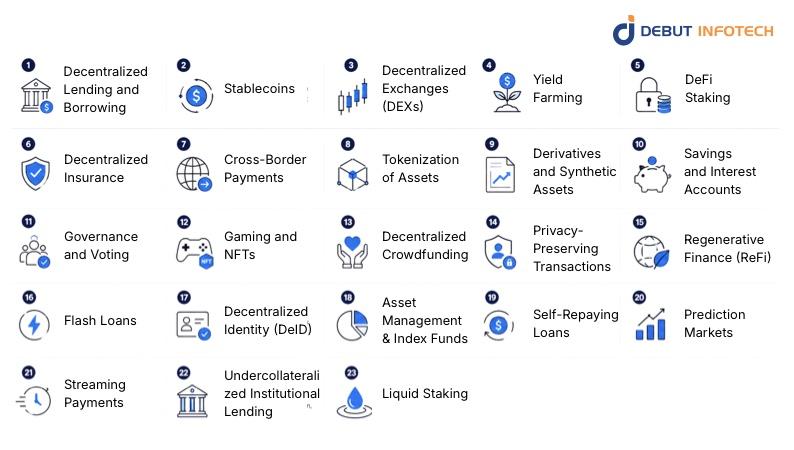
By removing traditional constraints, DeFi lending platforms such as Aave, Compound, and MakerDAO have transformed loan accessibility. By offering collateral—usually in the form of cryptocurrencies—borrowers may access money almost immediately. DeFi loans are open to anyone with collateral, therefore democratizing financial access, unlike traditional loans, which demand a good credit score or thorough documentation. In turn, lenders can make money by earning interest on the assets they don’t use. With blockchain technology’s enhanced transparency guaranteeing fairness and security, this invention offers a win-win situation for lenders and borrowers.
Stablecoins are essential for close bridging of the volatility of cryptocurrencies with stable fiat currencies. These cryptocurrencies promise the advantages of blockchain technology without price volatility by being pegged to assets like the US dollar or gold. DeFi platforms produce and manage decentralized stablecoins like DAI, guaranteeing total transparency and decentralization. They can be used for foreign money transfers, savings, and to pay for things online, making them an essential part of the DeFi ecosystem.
With top decentralized exchanges like Uniswap, SushiSwap, and PancakeSwap, users may trade cryptocurrencies straight from their wallets, which has completely changed traditional trading. DEXs work differently than centralized exchanges because they use automatic smart contracts to make sure users always have control of their funds. These systems also leverage liquidity pools, so users may donate money or receive fees or rewards in exchange. DEXs are a necessary part of DeFi since they lower transaction costs and provide security by removing middlemen.
Users of yield farming—also known as liquidity mining—lock their money into DeFi systems to get rewards. For example, providing liquidity to Yearn or Curve Finance lets people create returns—sometimes as governance tokens. Because of its possible large profits, yield farming has drawn a lot of attention, but it also carries risks like market swings and smart contract deficiencies.
By “staking,” you agree to support the processes of a blockchain network in exchange for rewards. By extending this idea to DeFi platforms, users can bet their tokens and earn interest or more tokens. For Ethereum 2.0, platforms like Lido Finance and Rocket Pool provide staking services wherein users may engage without requiring technical knowledge or minimal staking criteria. Users looking for long-term development and passive revenue will especially find DeFi staking to be appealing.
Risk management primarily relies on insurance; hence, DeFi has advanced this area with tools like Nexus Mutual and Etherisc. These decentralized insurance systems cover several risks, including smart contract failures, trade secrets, and travel delays. DeFi insurance systems guarantee faster, more transparent reimbursements by pooling user funds, removing conventional insurers’ needs. This invention has great power in solving the flaws in existing insurance models.
Cross-border payments are among the most logical decentralized finance examples available. High fees, lengthy settlement periods, and restricted access define traditional remittance systems. Using blockchain technology, DeFi apps like Stellar and Celo allow flawless worldwide transactions, substantially lowering processing times and costs. For companies handling foreign clients or migrant workers returning money home, this is especially relevant.
Tokenizing turns tangible objects—such as real estate, artwork, or commodities—into digital tokens on a blockchain. Since these tokens represent fractional ownership, people may invest more easily in high-value assets. This innovation is spearheaded by platforms like RealT and Securitize, making more liquidity and accessibility possible. DeFi democratizes ownership in once-exclusive markets and creates new investment opportunities by tokenization.
Derivatives are financial tools derived from an underlying asset, say commodities, stocks, or currencies. Synthetic assets created using DeFi tools such as Synthetix and UMA let users expose themselves to traditional financial markets without owning the real assets. A synthetic stock token, for instance, can replicate the price of a company’s shares, enabling traders to hedge risks. This use case closes the distance separating traditional investment markets from decentralized finance.
Anchor Protocol and Yearn Finance are DeFi platforms that provide savings accounts with interest rates much higher than regular banks. These protocols accept user deposits and distribute that money to various strategies that generate yield, including lending or liquidity provision. These accounts are a good choice for optimizing idle money since the interest acquired returns to the customers. Smart contract automation and openness guarantee a safe and quick procedure.
In traditional finance, governance is usually centralized, and only a small number of people influence decision-making. DeFi uses platforms like MakerDAO and Curve to set up decentralized governance. Token holders can vote on important ideas. This covers adjustments to fund payments, protocol parameters, or fresh feature implementations. Mechanisms of governance guarantee that DeFi systems stay community-driven and in line with the needs of their users.
Gaming companies have jumped on the DeFi bandwagon to boost user engagement and provide new revenue models. DeFi ideas include play-to-earn (P2E) models—where players may earn tokens or NFTs with actual worth—and are included in blockchain games, including Axie Infinity and Decentraland. NFT staking also lets players lock their digital treasures in exchange for rewards, fusing, and decentralized finance.
DeFi has changed crowdfunding by eliminating middlemen like banks and venture investors. Tools like Gitcoin and Juicebox let companies, developers, and artists fund themselves straight from fans. The blockchain records these donations, guaranteeing transparency and trust. Decentralized crowdfunding lowers financing constraints and helps artists to keep control over their creations.
Although blockchain technology is mostly transparent, privacy still worries many consumers. Tornado Cash and Aztec are two privacy-focused protocols developed by DeFi that solve this problem by facilitating anonymous transactions. These platforms guarantee that user identities and transaction data stay private while following the blockchain’s decentralized ideas. Companies and people looking for financial privacy without depending on opaque systems significantly benefit from this.
ReFi, or regenerative finance, is a developing DeFi application with an eye toward environmental effect and sustainability. Using DeFi, platforms such as KlimaDAO fund other environmentally friendly enterprises, carbon offset schemes, and renewable energy projects. ReFi generates a win-back for the earth and investors by matching financial incentives with environmental objectives. This creative application shows how DeFi might support worldwide issues outside of finance.
Flash loans let users borrow large amounts of crypto without collateral, as long as the funds are repaid within the same blockchain transaction. This “all-or-nothing” mechanism removes lender risk entirely. They’re commonly used for arbitrage opportunities, collateral swaps, and liquidations across multiple protocols.
If the strategy fails or repayment conditions aren’t met, the transaction automatically reverses. This makes flash loans a powerful tool for advanced traders and developers looking to execute complex financial strategies instantly, without upfront capital or credit checks.
Decentralized identity shifts control of personal data from centralized authorities to individuals. Users store identity credentials on blockchain-based systems and share only the required information when interacting with platforms. This reduces reliance on repeated KYC processes and minimizes data exposure.
In DeFi, DeID can enable permissioned access to services like undercollateralized lending while preserving privacy. It also helps reduce fraud and identity theft, as users retain ownership of their credentials rather than relying on centralized databases that are prone to breaches.
DeFi asset management platforms offer automated investment strategies through smart contracts. Users can deposit funds into curated portfolios or index-style products that track sectors like DeFi tokens, stable assets, or NFTs. These portfolios rebalance automatically according to predefined rules, eliminating the need for manual intervention.
Compared to traditional funds, this reduces management fees and increases transparency, since all transactions are visible on-chain. It opens up structured investment opportunities to a wider audience without requiring access to traditional financial advisors or institutions.
Self-repaying loans introduce a model where deposited collateral generates a yield that gradually pays off the borrowed amount. Instead of making regular repayments, users rely on interest earned from DeFi protocols to reduce their debt over time. This creates a passive repayment structure that can be appealing to long-term borrowers.
While the speed of repayment depends on yield performance, the model reduces financial pressure on users. It blends lending with yield farming, offering a more flexible and automated borrowing experience within decentralized ecosystems.
Prediction markets allow users to speculate on the outcome of real-world events, including elections, sports results, and economic indicators. Participants buy and sell shares tied to specific outcomes, and prices adjust based on collective sentiment. These markets often produce accurate forecasts because they aggregate diverse opinions and financial incentives.
Built on blockchain, they operate transparently and without centralized control. This reduces the risk of manipulation and censorship, making them useful for data-driven decision-making as well as financial speculation.
Streaming payments provide a continuous flow of funds rather than fixed, periodic transfers. Payments can be made per second, minute, or hour, giving both senders and recipients greater flexibility. This model is ideal for salaries, subscriptions, and freelance work, where value is delivered over time.
If a service stops, payments can halt instantly without waiting for billing cycles. Built on smart contracts, streaming payments improve cash flow management and reduce disputes, as transactions are transparent and tied directly to time-based delivery.
Undercollateralized lending in DeFi is designed for institutions rather than retail users. Instead of relying purely on collateral, these systems incorporate creditworthiness, reputation, and off-chain agreements. This allows borrowers to access capital more efficiently while still operating within a decentralized framework.
Smart contracts handle execution, while risk is managed through governance and legal structures. It brings DeFi closer to traditional credit markets, enabling larger-scale financing opportunities and attracting institutional participation without fully abandoning decentralization principles.
Liquid staking is among the popular DeFi examples. It allows users to stake their crypto assets while still retaining liquidity through derivative tokens. When assets are staked, users receive a tokenized version representing their position, which can be used across other DeFi protocols. This increases capital efficiency, as users can earn staking rewards while participating in lending, trading, or liquidity provision. It removes the traditional lock-up limitation associated with staking. As a result, users no longer have to choose between earning yield and maintaining access to their funds.
DeFi innovation relies on a set of core technologies that power its functionality. These building blocks enable automation, real-world integration, and continuous liquidity across decentralized financial systems.
Smart contracts are self-executing programs deployed on blockchain networks that enforce predefined rules without intermediaries. They replace traditional legal and operational processes by embedding logic directly into code, ensuring transactions occur only when specific conditions are met.
How it works:
Once deployed, the contract monitors inputs and automatically executes actions when conditions are satisfied. It cannot be altered mid-execution, ensuring consistency.
Benefits:
They reduce costs, eliminate manual errors, and enable trustless transactions with predictable, transparent outcomes.
Oracles act as data providers that connect blockchain systems with real-world information. Since blockchains cannot access external data directly, oracles provide inputs such as asset prices, weather data, and event outcomes needed for DeFi operations.
How it works:
Oracles collect data from multiple external sources, verify its accuracy, and feed it into smart contracts. These inputs trigger contract execution based on real-world conditions.
Benefits:
They expand the use cases of Defi, enable accurate pricing, and ensure protocols respond reliably to external events.
Liquidity pools are collections of user-deposited funds locked in smart contracts, while Automated Market Makers (AMMs) use algorithms to price assets and facilitate trades without traditional order books.
How it works:
Users deposit token pairs into pools, and AMMs apply mathematical formulas to determine pricing and execute trades instantly against the pool.
Benefits:
They provide continuous liquidity, remove reliance on centralized exchanges, and allow users to earn passive income through fees and incentives.
DeFi is still evolving, with new trends shaping its direction. These developments point toward greater scalability, usability, regulatory alignment, and deeper integration with both digital and real-world financial systems.
Mass adoption will depend on simplifying the user experience and improving trust. Wallet interfaces are becoming more intuitive, reducing the technical barrier for new users.
As more businesses integrate DeFi services into existing platforms, users may interact with decentralized systems without even realizing it. This shift will move DeFi from niche crypto communities into everyday financial activities.
Layer-2 solutions are addressing the cost and speed limitations of base-layer blockchains. By processing transactions off-chain and settling them on-chain later, they significantly reduce fees and congestion. This makes microtransactions, gaming, and high-frequency trading more viable.
As adoption grows, Layer-2 networks will play a central role in scaling DeFi for global use.
Cross-chain interoperability is solving fragmentation across blockchain ecosystems. Instead of being confined to a single network, users can move assets and data seamlessly across chains. This improves liquidity distribution and expands access to different protocols.
As interoperability standards mature, DeFi applications will function more like a unified financial system rather than isolated platforms.
Real-world asset tokenization is bringing tangible assets, such as real estate, bonds, and commodities, into DeFi. This creates new investment opportunities backed by physical value rather than just digital tokens. It also improves liquidity for traditionally illiquid assets.
As legal frameworks develop, RWA integration is expected to attract institutional capital into decentralized ecosystems.
RegFi introduces compliance mechanisms into DeFi without removing its core advantages. Protocols are beginning to integrate identity verification, transaction monitoring, and reporting features. This helps align with global regulations while maintaining transparency. As governments clarify policies, compliant DeFi platforms will be better positioned to attract institutional users and operate at scale.
AI is starting to enhance DeFi by optimizing decision-making processes. It can analyze market data, manage risk, and adjust lending or trading strategies in real time. This reduces reliance on manual intervention and improves efficiency. As AI models become more advanced, DeFi protocols will evolve into more adaptive and responsive financial systems.
Account abstraction simplifies how users interact with blockchain wallets. It removes the complexity of managing private keys, gas fees, and transaction approvals.
Users can interact with DeFi applications through more familiar interfaces, similar to traditional apps. This improvement in usability is key to onboarding non-technical users and driving broader adoption.
When it comes to creativity and inclusion, DeFi is changing the financial world in unprecedented ways. From lending and staking to decentralized exchanges and synthetic assets, the DeFi application cases underlined in this blog show the transforming power of decentralized finance.
At Debut Infotech, we are glad to use our extensive DeFi development tools to help bring about this change. Contact us if you are ready to discover how DeFi systems and blockchain platforms might help your company. Let’s help define financial futures together.
A. Decentralized exchanges and lending still lead the pack. Platforms let users swap tokens directly or earn interest by lending assets without banks in the middle. Liquidity pools power most of this activity, and they’ve stayed popular because they’re simple to access and often offer attractive yields.
A. It depends on what you value. DeFi is transparent since transactions and smart contracts are visible on-chain, which builds trust. But that same code can have bugs or vulnerabilities. Banks rely on regulation and insurance, while DeFi puts responsibility on users to manage risks carefully.
A. Start by setting up a crypto wallet, such as MetaMask or Trust Wallet. Fund it with crypto from an exchange, then connect to a DeFi platform. If needed, use a bridge to move assets across chains. From there, you can trade, lend, or stake tokens directly.
A. Not fully. DeFi has grown fast and handles lending, trading, and payments without banks, but it still lacks widespread regulation, user protection, and mainstream adoption. Traditional banks offer stability and trust that many people still rely on, so both systems will likely coexist for now.
A. Most serious protocols use audited smart contracts, bug bounty programs, and multi-signature wallets to reduce risk. Some also add insurance funds or real-time monitoring tools. Still, no system is perfect. Security often depends on code quality, regular updates, and the speed at which teams respond to threats.
A. Impermanent loss occurs when you provide liquidity and token prices shift, reducing your potential gains relative to holding. It mainly affects liquidity pools, not all DeFi activities. Lending or staking usually avoids it, but anything tied to price ratios can expose you to it.
A. DeFi use cases revolve around replacing traditional financial services with blockchain-based alternatives. You can lend and borrow crypto, trade tokens on decentralized exchanges, earn interest through staking or yield farming, and send payments without banks. It also covers asset tokenization and derivatives trading, both handled by smart contracts rather than intermediaries.

Our Latest Insights
USA
2501 Chatham, Rd Suite R Springfield, IL 62704
+1-708-515-4004
info@debutinfotech.com
UK
7 Pound Close, Yarnton, Oxfordshire, OX51QG
+44-770-304-0079
info@debutinfotech.com
Canada
154 Eden Oak Trail, Kitchener, ON N2A 0H9
+1-708-515-4004
info@debutinfotech.com
INDIA
Sector 101-A, Plot No: I-42, IT City Rd, JLPL Industrial Area, Mohali, PB 140306
9888402396
info@debutinfotech.com