ON THIS PAGE
Progress0%






Our Global Presence :





What if you could create a full video script… in less time than it takes to finish your coffee?
That is precisely what AI script writing promises to do and it is already transforming how people, marketers and businesses are able to create content on a large scale. Whether it is YouTube videos or ad campaigns and podcasts, AI tools can provide ideas, organize your thoughts, and even write complete scripts in a few minutes.
But here’s where it gets interesting.
Not all AI-generated scripts are created equal. Some feel powerful, engaging, and ready to publish. Others? Robotic, generic, and easy to ignore. It is not only the difference in the tool but in the use.
So, is AI script writing the ultimate shortcut to better content… or just another overhyped trend?
The answer might surprise you and if you’re creating content in 2026, it’s something you can’t afford to ignore.
Fundamentally, AI script writing is the process of creating scripts with the assistance of intelligent technology, without having to start writing every time. Rather than sitting at the computer screen and staring at a blank page, you can just set a prompt by stating your topic, tone, or even your target audience, and the AI makes the idea into a detailed script.
In the background, these tools are based on NLP techniques(Natural Language Processing) and machine learning.
Simply put, the AI was trained with huge amounts of written material. This enables it to learn the way people speak, organize ideas and narrate stories.
On typing a prompt the AI will guess what to reveal next- creating work that feels and sounds natural, relevant and consistent.
Think about it as a writing assistant that is always-available and will have you go through ideas to script in minutes.
The flexibility of AI script writing is one of the largest strengths. It has the ability to support a broad variety of content formats, such as:
The heavy lifting, ideas, structure, and first drafts, can be dealt with by AI.
However, the actual quality lies in the manner in which you steer it and the production is polished. It is your experience, tone and creativity that make a simple script an interesting and reliable one.
That is why the best solution is not AI vs human, it is AI and human input.
Ever wondered why certain AI generated scripts sound more polished and engaging and others are generic, it all boils down to the way the process is managed. Based on actual applications to content teams and creators, one thing can be certain: AI script writing is not merely about writing text but about making sure the system is oriented properly and human knowledge is used at the appropriate level.
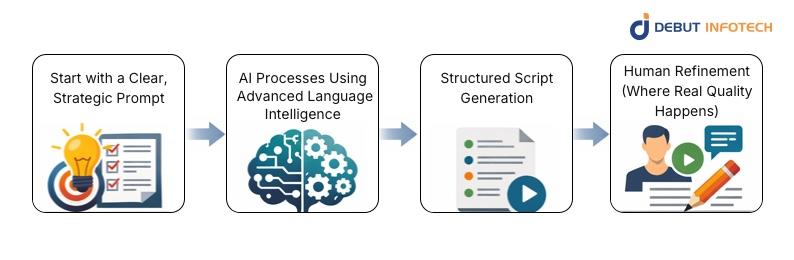
Here’s how it actually works in practice.
Step 1: Start with a Clear, Strategic Prompt
Each good script is initiated with an articulated prompt.
You’re not just telling the AI what to write, you’re setting direction, context, and expectations. This comprises your subject matter, intended audience, tone, format and even intended outcome.
As an illustration, professional creators do not write:
“Write a script about business.”
They say:
“Write a 90-second YouTube script about how startup founders can go about validating a business idea, presenting it in a conversational and slightly persuasive tone.”
It is this clarity that distinguishes mediocre outputs and high performance scripts.
Step 2: AI Processes Using Advanced Language Intelligence
Once your prompt is submitted, the system uses advanced AI algorithms trained on large-scale language data.
These models don’t “think” like humans but they are highly effective at:
That is why AI can generate scripts that seem to be structured and coherent in a matter of seconds. Nevertheless, one should realize that the output is informed by learned patterns, not actual judgment or lived experience
Step 3: Structured Script Generation
At this point, the AI creates a complete draft.
In most cases, this includes:
Professionally, the draft must be regarded as a rough version, rather than a final one. It is speedy and orderly, but not profound, or original in itself.
Step 4: Human Refinement (Where Real Quality Happens)
This is the place where most of the beginners fall short and where actual skill lies.
In order to achieve quality standards (particularly SEO, brand voice, and engagement) you must:
It is this human layer that makes the script not only readable, but also reliable, helpful and enjoyable in the professional content workflow.
If you have spent any actual time producing content, be it on YouTube, marketing campaigns, or even client work, you are already aware that it is not just writing that is the most massive challenge. It’s consistency, speed, and maintaining quality at scale.
This is where AI script writing tools are transforming a difference that can be measured not in terms of replacing expertise but in terms of having a strong support mechanism when utilized properly.
Faster Content Creation (Without Sacrificing Structure)
In traditional workflows, a single script can take hours, from research to outlining and then final drafts.
Using AI, it is possible to create a structured preliminary draft within minutes. More to the point, advanced creators make use of this draft as a stepping stone, rather than an endpoint, which enables them to put their efforts into the perfecting of storytelling, tone, and audience interaction.
Cost Efficiency That Actually Scales
Operationally, content production is among the most resource consuming aspects of businesses.
The initial drafting costs less with AI as teams are able to spend budgets on strategy, editing, and distribution, which have a direct effect on performance and ROI.
Smarter Idea Generation (Backed by Data Patterns)
Writer’s block is not only a matter of creativity, but it is also a productivity bottleneck.
AI uses extensive language patterns to propose angles, hooks, and formats that resonate with what is already being consumed by the audiences. This is more of a strategic advantage rather than a convenience to experienced users.
Real Scalability for Agencies and Content Teams
Scaling content does not mean creating more content, it means being consistent between outputs.
AI allows different teams to produce numerous scripts across platforms without losing format and message. This, together with human control, forms a repeatable and stable content system.
Multilingual Reach Without Rebuilding From Scratch
Creation of new markets traditionally needs distinct content workflows.
This is made easier by AI which can translate scripts into several languages rapidly but still, allows specialists to localize tonality and culture. This makes global content strategies more feasible and less expensive.
AI script writing can be much faster and more efficient but based on practical experience with content groups, marketing campaigns and creator workflows, it remains evident that it has critical drawbacks.
It is not optional to understand them. It is what makes the difference between good, reliable content, and content that is robotic and unmemorable.
Emotional Depth Still Needs Human Input
Practically, even the most developed AI script generators fail to deliver emotional sensitivity.
They are able to create a good script, but still they tend to overlook the small human touches, tone changes, cultural background and the real storytelling that keeps the audience glued to the story.
rewriting key sections
That is why even experienced creators seldom release AI-generated scripts in their original form. They polish them, bring in personal expertise, and tune them to actual viewer expectations.
Originality Requires Oversight
AI models are trained with vast quantities of data, thus, they produce patterns naturally.
In editorial terms this poses an actual danger: technically accurate but not with a certain voice, with no fresh point of view.
Professionals mitigate this by:
Without this layer, the output often feels generic.
Bias and Accuracy Must Be Checked
The quality of AI outputs depends on the quality of the data that it is trained on.
In real-world applications, this means bias, outdated information, or incomplete context can appear in scripts, sometimes subtly.
For anyone publishing content at scale, this creates a credibility risk.
Best practice is clear:
After creating scripts by AI, fact-checking, and contextual review should always be conducted, and sensitivity checks.
Over-Reliance Can Weaken Creative Authority
In a long-term content strategy point of view, being over-reliant on AI may silence your voice.
Brands and creators that shine through are those that are articulate, tell a great story, and maintain a steady voice.
When AI forms the core of the content, this distinction can be erased.
Experienced teams use AI as a starting point, not the final output.
Ethical and Legal Considerations Matter
There are also growing concerns around:
AI can generate confident-sounding content that isn’t always accurate.
In industries where trust is important, such as marketing, education, media, this is a grave danger.
Being transparent, verifying and ascertaining originality have become significant components of responsible content creation.
AI script writing is not a hypothetical concept anymore, creators, production teams, and marketing departments are already using AI scripts to enhance output, decrease turnaround time, and test ideas at scale. As an expert, one may argue that the most important aspect is not where it is applied but the effectiveness of its application with human judgment.
Here’s what that looks like in practice:
Film & Entertainment
In professional and independent film sets, AI is becoming more utilized at the initial stage of brainstorming and writing a draft, not to substitute the screenwriter, but to act as an assistant.
Filmmakers experiment with AI to:
Real-world adoption has already been seen through a number of AI-assisted short films that have already been presented at film festivals across the world. Nonetheless, industry professionals continuously improve these outputs in order to achieve emotional focus, narrative integrity and originality-where human experience is of significant importance.
Insight: In filmmaking, AI accelerates creative exploration, but human storytelling defines final quality.
Marketing & Advertising
In terms of performance marketing, AI script writing has been turned into a high-impact efficiency tool.
Marketing teams use it to:
This is especially useful in A/B testing, in which speed plays a direct role in the outcomes. Rather than sticking to one creative line, brands can simultaneously test as many as possible angles and make more rapid data-driven choices.
Insight: AI doesn’t just save time, it improves decision-making accuracy when used in structured testing environments.
YouTube Automation Channels
High-volume YouTube creators are among the most practical users of AI script writing.
In real-world workflows, creators use AI to:
Channels in niches such as tech, finance, and storytelling are built on this method of content production. Nevertheless, even skilled creators work extensively on editing, fact-checking, tone, and matching scripts to the expectations of the audience.
Insight: Sustainable growth on YouTube comes from combining AI efficiency with human content strategy.
Podcast Production
AI is helping creators of podcasts automate what is typically a time-consuming task.
AI supports:
In the case of weekly or daily podcasts, this greatly lowers the pressure of production and quality is not compromised. Nonetheless, more experienced hosts customize scripts in order to maintain authenticity and trust among the audience.
Insight: In podcasting, AI improves workflow consistency, but human voice builds audience connection.
When you are exploring AI script writing, the type of tool you use can mean the difference between high quality output and how much time you actually save.
Here’s a closer look at some of the most popular options and where they really shine.
| Tool | Best Use Case | Pricing | Key Strength | Limitation |
| ChatGPT | Versatile scripts (YouTube, ads, podcasts) | Free + Paid plans | Flexible, conversational output | Needs good prompts |
| Jasper AI | Marketing & ad scripts | Paid only | Conversion-focused templates | Expensive, less creative |
| Sudowrite | Creative storytelling | Paid | Strong narrative and emotion | Not ideal for ads |
| Squibler | Long-form scripts/projects | Free + Paid | Structured writing support | Requires editing |
ChatGPT
Best for: Versatile script creation (YouTube, ads, podcasts, storytelling)
Pricing: Free plan is available, the paid plans have advanced features.
Why people use it:
ChatGPT can be considered one of the most versatile AI script writing tools. You are able to write complete scripts, polish the tone as well as even rewrite passages until they sound natural. It becomes more powerful especially when you give it good directions.
Pros:
Cons:
Jasper AI
Best for: Marketing and ad scripts
Pricing: Paid plans only (premium-focused tool)
Why people use it:
Jasper is constructed with marketers in mind. It provides ready-made templates that assist in the creation of high converting scripts in advertisements, sales videos, and brand messaging.
Pros:
Cons:
Sudowrite
Best for: Storytelling and creative scripts
Pricing: Paid subscription
Why people use it:
Sudowrite is a writing tool that is oriented to the flow of the narrative, emotion and creativity. It assists in the enlargement of scenes, the enhancement of descriptions and creation of more interesting scripts.
Pros:
Cons:
To achieve great results with an AI script, it is not about clicking on the create button and hoping for magic. It is all about how to steer the process in the right direction and with purpose, as you would with a professional writer.

1. Start with a Clear Audience and Goal
Before you write anything, ask yourself: Who is this for, and what should they do after watching or reading?
Are you teaching beginners, entertaining an audience, or convincing target consumers?
As soon as your purpose and target audience is specified, the AI generates information that does not feel generic.
2. Write Prompts That Actually Guide the AI
This is where the majority of people achieve average results.
Instead of vague instructions, be specific:
Think of your prompt as a brief. The clearer it is, the better the output.
3. Generate More Than One Draft
The result you get on your first attempt is seldom a good one.
Create multiple versions and compare them. You’ll start to notice:
The finest scripts are usually the ones produced by incorporating the better sections of the various outputs.
4. Edit for Clarity, Flow, and Accuracy
This is where real quality is introduced.
Read through the script and refine:
AI provides you with a good base-point, but it is editing that gets it to work in practice.
5. Add Your Human Creativity
This is the step that separates average content from memorable content.
Bring in:
AI can structure ideas, but it can’t replace your unique voice or experience.
At its core, AI script writing is changing how content gets created but not in the way many people assume. It’s not about replacing writers. It’s about removing friction.
No longer does one have to grapple with blank pages or a lack of ideas; now you can brainstorm, organize your scripts and go through concepts to draft in much less time. This translates to more time to concentrate on what really matters when it comes to content, your voice, your point of view and your story.
Based on practical application, speed is not the only benefit, but it also includes consistency and scalability. Still, the real quality is in the process of refining, shaping and humanizing what AI provides.
Thus, AI script writing is an influential creative companion. It can make you get going quicker, get smarter, and be more productive but the bottom line remains in your hands.
And that’s exactly where great content is made.
A. An AI script writer is a software program that generates written scripts through the use of artificial intelligence.
It is based on some technologies such as machine learning and natural language processing (NLP) to comprehend language and produce content automatically.
Using it, you can write scripts to videos, films, advertisements, podcasts, and other types of content, sometimes within only a few minutes.
A. The most suitable tool will be based on what you are making.
Squibler and Sudowrite are good at story-telling.
Creatify AI is best suited to content marketing.
All these tools assist you to organize scripts, create dialogue, and create interesting material in a shorter time, all that you have to do is to select them according to your aim.

Our Latest Insights
USA
2501 Chatham, Rd Suite R Springfield, IL 62704
+1-708-515-4004
info@debutinfotech.com
UK
7 Pound Close, Yarnton, Oxfordshire, OX51QG
+44-770-304-0079
info@debutinfotech.com
Canada
154 Eden Oak Trail, Kitchener, ON N2A 0H9
+1-708-515-4004
info@debutinfotech.com
INDIA
Sector 101-A, Plot No: I-42, IT City Rd, JLPL Industrial Area, Mohali, PB 140306
9888402396
info@debutinfotech.com