ON THIS PAGE
Progress0%





Our Global Presence :





A custom corporate wellness app can typically cost $20,000 to $300,000+, depending on scope, integrations, security, and enterprise complexity.
MVPs generally fall between $15,000 and $35,000, while enterprise platforms with AI, multi-tenancy, and deeper integrations require a higher investment.
HRIS, HCM, SSO, wearable, and health API integrations are among the biggest factors that can increase the overall budget.
Enterprises should also account for maintenance, third-party software, security reviews, data migration, and post-launch enhancements.
Starting with a focused MVP and planning integrations early can help reduce unnecessary development spend.
ROI should be measured through adoption, repeat participation, program utilization, administrative efficiency, and cost per engaged employee.
Employee well-being has moved from an HR initiative to a broader business concern as burnout, stress, and mental health challenges continue to shape the workplace. Wellness programs can become fragmented across providers, while HR teams may spend more time consolidating data and managing participation. At the same time, leadership can lose visibility into which programs employees actually use and whether those initiatives are delivering measurable value.
That challenge carries a real business impact. According to WHO’s September 2026 mental-health-at-work update, depression and anxiety are associated with an estimated 12 billion lost working days annually and about $1 trillion in lost productivity globally. Gallup’s 2026 workplace data also shows that only 20% of employees worldwide were engaged at work in 2025.
For enterprises looking to build a corporate wellness app, several factors can shape the overall investment, including feature scope, integrations, security requirements, scalability, compliance needs, and development complexity. Among these, cost is often one of the key considerations when defining the initial scope and budget. For planning purposes, custom corporate wellness app development can range from around $20,000 to $300,000+ based on the scope assumptions used in this guide.
This guide breaks down the major cost drivers, feature and integration costs, development timelines, maintenance, hidden expenses, and build-versus-buy considerations enterprises should evaluate before investing.
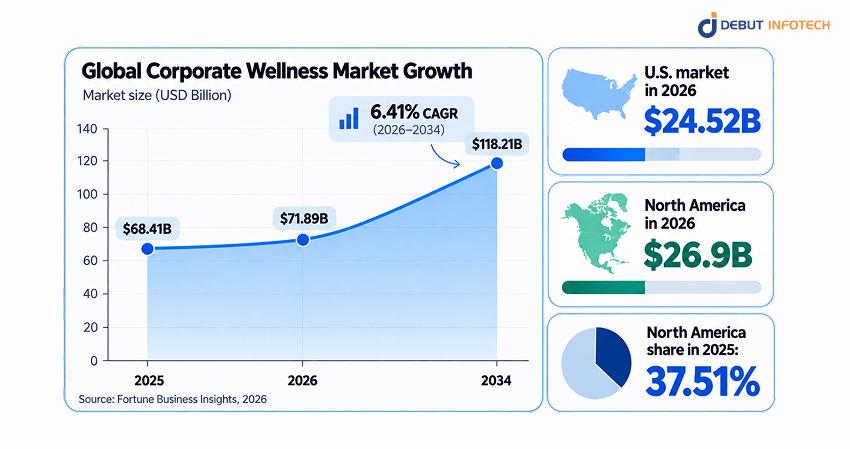
Corporate wellness apps are becoming a more important part of how employers deliver, manage, and measure workforce well-being programs. The U.S. corporate wellness market is projected to reach about $24.52 billion in 2026, reflecting continued employer investment in workplace wellness, employee engagement, and digital health programs.
These platforms help organizations bring fragmented wellness initiatives into one environment while making programs easier for employees to access and HR teams to manage. They can support:
The broader market is also expanding. The global corporate wellness market is estimated at $71.89 billion in 2026 and is projected to reach $118.21 billion by 2034, while North America is expected to represent about $26.9 billion in 2026.
Corporate wellness apps can support different employee needs, from fitness and mental well-being to preventive care and workplace engagement. The type of app also affects development scope, integrations, and overall cost.
Fitness and Activity Tracking Apps
These apps help employees track steps, workouts, activity goals, and progress. They may also connect with wearables and health APIs.
Mental Health and Mindfulness Apps
These platforms support stress management, meditation, emotional wellness, and access to structured mental health resources. Advanced versions may include AI-based recommendations or digital assistants.
Wellness Gamification Apps
Gamification apps use points, badges, leaderboards, challenges, and rewards to increase participation and encourage healthy habits.
Nutrition and Lifestyle Apps
These apps support meal planning, nutrition tracking, healthy habits, and personalized recommendations. They may also connect with broader wellness programs.
Health Assessment and Screening Apps
These platforms support wellness assessments, questionnaires, screenings, and risk evaluations. They can also provide aggregated insights for HR teams.
Telehealth and Virtual Care Apps
Telehealth wellness apps connect employees with healthcare professionals through virtual consultations, messaging, scheduling, and remote care services.
Community and Social Wellness Apps
These apps encourage participation through group challenges, shared goals, peer communities, and team-based wellness activities.
Sleep and Recovery Apps
Sleep-focused apps help employees monitor sleep patterns, recovery, and habits through tracking, educational content, and wearable integrations.
Work-Life Balance Apps
These platforms support stress management, burnout prevention, wellness check-ins, break reminders, and healthier work-life habits.
Integrated Corporate Wellness Platforms
Larger organizations may combine several of these capabilities into one platform, including fitness, mental wellness, challenges, assessments, rewards, analytics, and enterprise integrations. These solutions typically require more development effort than single-purpose wellness apps.
The cost to develop an employee wellness app varies considerably based on platform complexity, integrations, security requirements, automation, and enterprise deployment needs.
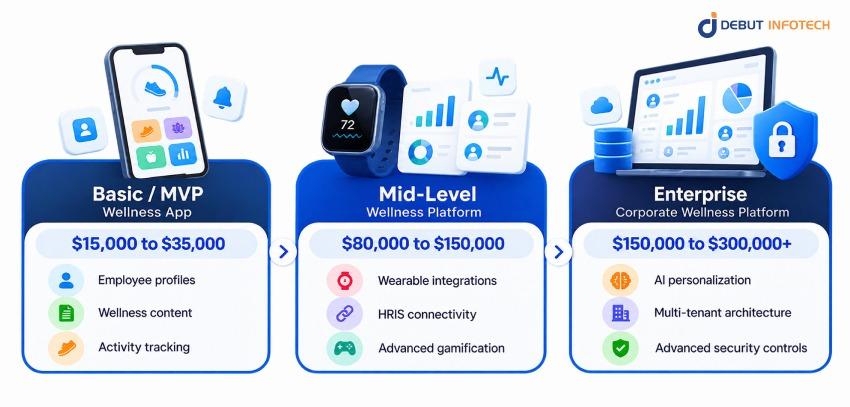
It is best suited for pilot programs or organizations starting with a focused wellness initiative.
It is suitable for organizations that need broader functionality and stronger connectivity with existing systems.
It is built for large or distributed workforces that require greater scalability, control, and customization.
Two corporate wellness platforms can serve the same number of employees and still have very different budgets. The corporate wellness app development cost rises when the platform has to support more user roles, connected systems, data sources, compliance controls, and operational complexity.
A basic platform with profiles, wellness content, activity tracking, and challenges requires less engineering than one with AI personalization, advanced analytics, rewards, multi-role workflows, and multi-tenant architecture. Each additional layer adds development, testing, and ongoing maintenance effort.
Supporting iOS, Android, web, tablets, and multiple device types increases development and testing effort. Cross-platform app development can reduce some duplication, but complex device-specific functionality may still require additional work.
Custom user journeys, multiple employee roles, branded experiences, and accessibility requirements increase design and validation effort, particularly for large or diverse workforces.
CDC reported in 2026 that more than 1 in 4 U.S. adults have some type of disability, reinforcing the need to account for accessibility early rather than retrofit it later.
Higher user volumes, analytics, notifications, integrations, and AI workloads increase cloud and backend requirements. Flexera’s 2026 State of the Cloud findings show that organizations estimate 29% of cloud spend is wasted, while 85% identify managing cloud costs as a top challenge.
Connecting with HRIS, HCM, SSO, wearables, health APIs, rewards systems, or analytics tools can significantly affect the employee wellness platform development cost because each integration requires mapping, testing, and ongoing maintenance.
Encryption, consent management, access controls, audit logs, and privacy requirements can add to the cost. Platforms handling regulated data may also need to meet HIPAA, GDPR, or enterprise security standards.
The final cost also depends on team structure, experience, and geographic location.
| Region | Typical 2026 Hourly Rate |
| United States | $60 to $95 per hour |
| Western Europe | $50 to $80 per hour |
| Australia | $55 to $90 per hour |
| Canada | $50 to $85 per hour |
| UAE | $40 to $70 per hour |
| Eastern Europe | $35 to $60 per hour |
| Asia | $22 to $40 per hour |
These ranges are indicative and can vary based on seniority, engagement model, and specialization. AI, cloud, cybersecurity, and healthcare expertise may push rates above the typical band.
The most useful corporate wellness app features should make participation simple for employees while giving HR and program teams enough control to manage wellness initiatives across the workforce.
Employees need features that help them access programs and stay engaged without adding complexity.
✔ Wellness assessments and goal setting
✔ Fitness and activity tracking
✔ Mental wellness resources
✔ Nutrition and sleep support
✔ Individual and team wellness challenges
✔ Rewards and incentive tracking
✔ Personal progress dashboards
✔ Wearable and health API connectivity
✔ Personalized wellness recommendations
Administrators need tools that help them run the employee wellness platform at scale and understand how programs are performing.
✔ Employee and access management
✔ Program and challenge configuration
✔ Wellness content management
✔ Rewards and incentive administration
✔ Aggregated engagement analytics
✔ Workforce-level reporting
✔ Role-based access controls
✔ Integration management
✔ Privacy and consent settings
Some advanced features can push the corporate wellness app cost higher because they add more configuration, data handling, and enterprise controls.
Points, badges, leaderboards, team challenges, and incentive rules add custom engagement logic.
Custom dashboards, workforce segmentation, and participation trends require more data processing and reporting work.
Enterprise SSO introduces identity-provider configuration, federation protocols, user provisioning, role mapping, and enterprise access testing.
Multi-tenant platforms must keep each client’s users, data, settings, and programs separated within one system.
White-label functionality adds support for client-specific branding, content, domains, and configurations.
The cost to develop an AI-powered employee wellness app depends on how deeply AI is embedded into the platform and the amount of data, model usage, and infrastructure required.
| AI Capability | How It Affects Cost |
| Personalized Wellness Recommendations | It adds recommendation logic, user-data processing, and ongoing tuning requirements. |
| AI Wellness Assistants | It increases costs through conversational AI integration, response controls, testing, and model usage. |
| Predictive and Population-Level Analytics | It requires stronger data pipelines, analytics infrastructure, larger datasets, and model validation. |
| AI Infrastructure and Model Costs | It adds recurring expenses for APIs, cloud processing, storage, monitoring, and evaluation. |
A platform using AI only for basic personalization will cost less than one combining assistants, predictive analytics, and large-scale workforce data processing.
Integrations can add roughly $15,000 to $150,000+ to the corporate wellness platform development cost, depending on the number of systems involved, API availability, data complexity, and customization required.
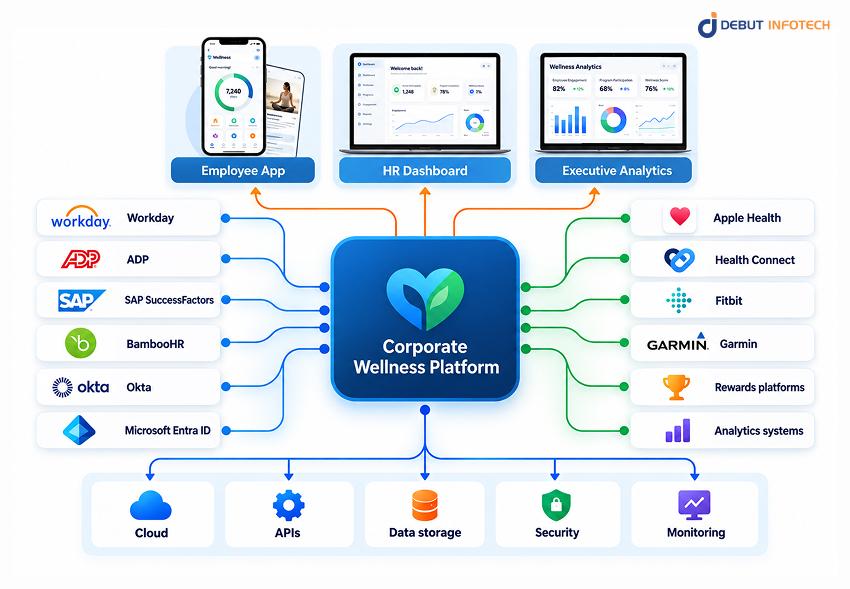
Typical planning range: $5,000 to $30,000+ per platform
Connecting Apple Health/HealthKit, Health Connect, Fitbit, Garmin, or similar ecosystems requires permission handling, data synchronization, normalization, and device testing. Multi-device environments can push the cost considerably higher.
Typical planning range: $10,000 to $30,000+
Workday, ADP, SAP SuccessFactors, BambooHR, and similar systems may require employee provisioning, eligibility mapping, workflow configuration, and custom data synchronization.
Typical planning range: $5,000 to $15,000+
Integrations with Okta, Microsoft Entra ID, or other identity providers can include SAML/OIDC configuration, role mapping, automated provisioning, and access-control testing.
For enterprises combining HRIS, SSO, multiple wearables, benefits systems, and proprietary platforms, overall integration costs can move into the $60,000 to $150,000+ range.
The corporate wellness app development cost is built up across planning, design, engineering, integrations, testing, and deployment. In enterprise projects, the largest share usually goes toward backend development, system integrations, and quality assurance because these areas handle data, connectivity, and platform reliability.
| Development Component | Typical Cost Share | What It Covers |
| Discovery and Planning | 5% to 10% | Requirements, user flows, feature prioritization, architecture planning, and project scope |
| UI/UX Design | 10% to 15% | Employee and admin journeys, wireframes, visual design, accessibility, and prototypes |
| Frontend Development | 20% to 25% | Mobile and web interfaces, dashboards, workflows, and user interactions |
| Backend Development | 25% to 30% | Business logic, databases, authentication, analytics, notifications, and core platform services |
| API and System Integrations | 10% to 20% | HRIS, HCM, SSO, wearables, health APIs, rewards systems, and third-party services |
| Testing and Quality Assurance | 10% to 15% | Functional testing, security checks, compatibility testing, and performance validation |
| Deployment and DevOps | 5% to 10% | Cloud setup, CI/CD, monitoring, release management, and production deployment |
These percentage ranges indicate how individual components may contribute to different project budgets and should not be added together as a fixed 100% allocation.
For an employee wellness app development project, backend engineering and integrations usually account for a larger share when the platform must connect with multiple enterprise systems or process data from several sources.
Choosing the right mobile architecture is an important part of employee wellness app development, particularly when the platform must support both iOS and Android users. Working with an experienced Mobile App Development Company can help enterprises evaluate native and cross-platform options based on performance, integration requirements, scalability, and long-term maintenance.
The technology stack should also support secure data handling, reliable enterprise integrations, and consistent performance across employee and admin experiences.
Building a corporate wellness app requires aligning employee wellness programs, enterprise systems, privacy requirements, and administrative workflows from the beginning. A structured approach helps reduce rework while keeping the platform ready for broader workforce wellbeing needs.
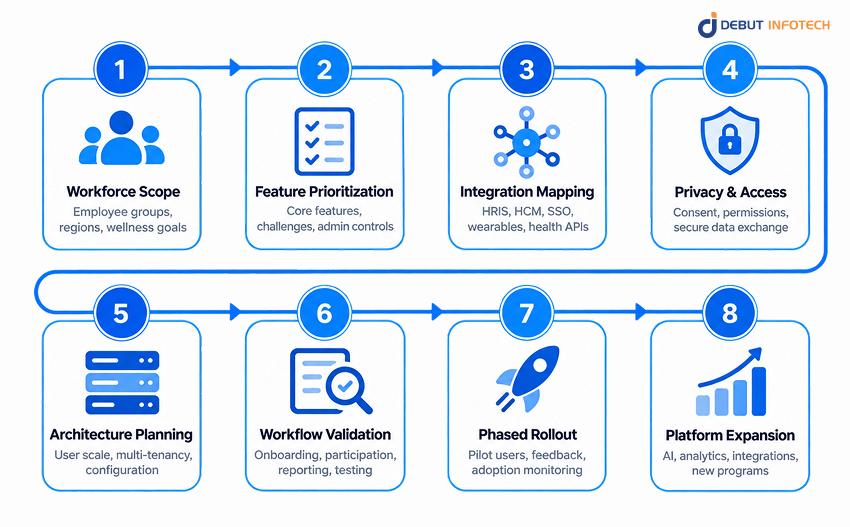
Start by identifying who will use the platform, which wellness initiatives it will support, and how HR teams will manage them.
✔ Employee groups and regions
✔ Wellness program categories
✔ Administrative roles
✔ Participation and reporting goals
Focus the initial release on the capabilities employees and administrators need most. More complex features can be introduced as usage and program requirements grow.
✔ Wellness assessments
✔ Activity tracking
✔ Wellness challenges
✔ Rewards and notifications
✔ Basic admin controls
Identify connected systems before development begins. Integration complexity can directly affect architecture, timelines, and the cost to develop an employee wellness app.
✔ HRIS and HCM systems
✔ SSO and identity providers
✔ Wearables and health APIs
✔ Rewards and analytics tools
Establish how wellness data will be collected, stored, accessed, and reported. Employee-level information and workforce-level reporting should have clearly defined access boundaries.
✔ Role-based permissions
✔ Consent management
✔ Secure data exchange
✔ Audit and monitoring controls
✔ Applicable privacy requirements
The architecture should reflect how the platform will operate in practice. A single-enterprise application will have different requirements from a white-label or multi-tenant platform.
✔ User and data separation
✔ Configuration requirements
✔ Expected user volumes
✔ Regional deployment needs
✔ Future integration capacity
Develop employee-facing experiences alongside the administrative tools needed to operate the platform. Validate the workflows that depend on connected systems and employee data before wider deployment.
✔ Employee onboarding
✔ Program participation
✔ Data synchronization
✔ Admin reporting
✔ Security and performance testing
A phased rollout gives the organization an opportunity to identify usability, integration, and adoption issues before expanding the platform across the workforce.
✔ Pilot user group
✔ Activation monitoring
✔ Employee feedback
✔ Integration validation
✔ Administrative review
Use actual engagement and operational data to determine what should be added next. As employee wellness programs mature, the platform can support broader functionality without overloading the first release.
✔ Advanced analytics
✔ AI personalization
✔ Additional integrations
✔ New wellness categories
✔ Multi-tenant or white-label capabilities
The timeline for employee wellness app development depends on product complexity, integrations, compliance requirements, and enterprise deployment scope.
| Development Level | Typical Timeline | What Does It Include? |
| MVP | 10 to 12 weeks | Core wellness features, basic admin controls, limited integrations |
| Mid-Level App | 4 to 6 months | Wearables, HRIS connectivity, SSO, analytics, broader functionality |
| Enterprise Platform | 6 to 12 months | Multi-tenant architecture, AI capabilities, advanced security, complex integrations |
Projects involving legacy systems, multiple regions, or extensive compliance reviews may require additional time.
An employee wellness app development team usually brings together product, design, engineering, QA, cloud, and security specialists. The exact mix depends on whether the project is an MVP, a mid-level platform, or a large enterprise system.
Core Product Team
Engineering Team
Specialist Roles
For enterprise corporate wellness app development, specialist involvement usually increases as integrations, security requirements, and platform complexity grow.
Security and compliance can directly affect the corporate wellness app development cost, especially when the platform handles sensitive employee wellness data.
These controls support secure employee-data handling and can help organizations build a HIPAA- or GDPR-compliant wellness app where those regulations apply.
The typical annual planning range for maintaining a corporate wellness app is approximately $10,000 to $75,000+, depending on which operating-cost categories apply, user volume, infrastructure usage, integrations, and support requirements.
Typical range: $3,000 to $20,000+ per year
Covers hosting, databases, storage, backups, monitoring, and scaling as employee usage grows.
Typical range: $2,000 to $15,000+ per year
Includes wearable APIs, HRIS connections, identity providers, analytics tools, and other third-party services that may charge recurring fees.
Typical range: $8,000 to $40,000+ per year
Covers bug fixes, OS updates, security patches, performance monitoring, compliance updates, and ongoing technical support.
Enterprise platforms with AI features, multiple integrations, or large employee populations may require a higher annual maintenance budget.
Beyond the initial corporate wellness app development cost, enterprises should account for expenses that may appear during implementation, compliance reviews, and post-launch expansion.
Wearable APIs, analytics tools, AI services, messaging platforms, and other software can introduce recurring licensing or usage fees.
Moving historical employee data or connecting older HR systems may require additional mapping, cleanup, testing, and custom integration work.
Privacy assessments, penetration testing, legal reviews, and periodic security audits can add costs beyond the core development budget.
New integrations, reporting features, AI capabilities, and workflow changes can increase the long-term corporate wellness platform cost as the product evolves.
As a practical planning measure, enterprises should reserve an additional 10% to 20% of the initial budget for unforeseen implementation needs, integration changes, and post-launch enhancements.
The choice between buying an existing platform and investing in employee wellness app development depends on how much customization, integration depth, and long-term control the organization needs.
A ready-made platform is a practical option when the organization needs:
Custom development is better suited when the organization requires:
| Consideration | Off-the-Shelf Platform | Custom Corporate Wellness App |
| Initial Investment | Lower | Higher |
| Launch Speed | Faster | Longer |
| Customization | Limited | Extensive |
| Integrations | Predefined | Built around enterprise systems |
| Data Control | Vendor-dependent | Greater control |
| Best Fit | Standard wellness programs | Complex enterprise requirements |
For enterprises with specialized workflows, multiple connected systems, or plans to build a differentiated platform, custom development may justify the higher corporate wellness platform development cost through greater flexibility and ownership.
To control the corporate wellness app development cost, enterprises should focus on reducing avoidable complexity early while keeping the platform flexible enough to grow.
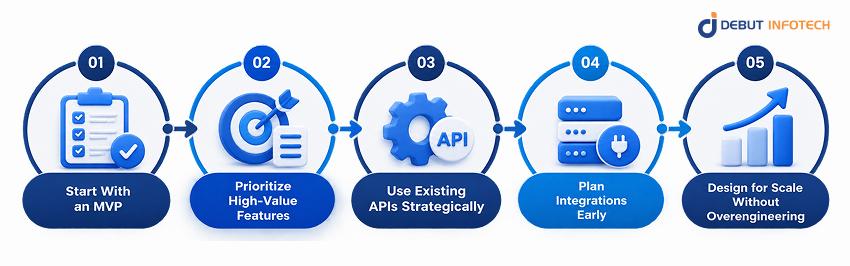
Begin with the workflows that solve the most immediate employee and HR needs. Validate adoption and usage before investing in a broader feature set.
The right starting point depends on how much functionality, integration depth, and scalability the organization needs at launch.
Fund the features that directly support engagement, program delivery, reporting, and administration first. Lower-value additions can be moved to later releases.
Avoid rebuilding functions that reliable APIs already handle well. Wearables, identity, messaging, and similar services can often be integrated faster and more cost-effectively.
Map HRIS, HCM, SSO, wearable, and other system dependencies before development begins. Early planning reduces rework and unexpected integration costs later.
Build for expected growth, but do not introduce enterprise-level complexity before it is required. A phased architecture can support expansion without inflating the initial cost of developing a corporate wellness app.
The ROI of an employee wellness platform should be measured through a mix of participation, usage, operational efficiency, and business outcomes rather than a single metric.
Enterprises should monitor:
To assess whether the platform is delivering value, compare these metrics against the original program goals. Higher participation, stronger repeat usage, better program visibility, and lower administrative effort can indicate that the corporate wellness app is improving both employee engagement and program management.
For larger enterprises, ROI should be reviewed over time so leadership can identify which programs justify further investment and which areas need adjustment.
Debut Infotech brings together mobile engineering, AI, healthcare software, cloud infrastructure, data engineering, and enterprise integrations within one delivery team. This combination is particularly relevant for corporate wellness platforms that must connect employee experiences with health data, HR systems, analytics, identity management, and long-term product operations.
From product discovery and UX design to mobile and web development, backend engineering, integrations, QA, and cloud deployment, our teams can manage the complete product lifecycle.
For enterprises, this helps keep employee applications, admin workflows, APIs, analytics, and connected systems aligned under one delivery model.
Our work on WellPoP involved connected health devices, remote monitoring, analytics, secure data exchange, and FHIR and non-FHIR integrations. This experience also reflects the capabilities behind our Healthcare App Development Services, particularly for platforms that need to handle sensitive health data, connected devices, interoperability, and regulated workflows.
The same engineering capabilities can support corporate wellness platforms that need to combine wearable data, employee wellness information, secure access, and administrative reporting within one environment.
Debut Infotech also builds AI-enabled and data-intensive SaaS products. Our work on TalentQuest involved intelligent matching and large-scale data processing within an enterprise platform.
For an employee wellness platform, similar capabilities can support personalized wellness recommendations, AI assistants, engagement analysis, and workforce-level insights without treating AI as an isolated add-on.
Enterprise wellness products often expand from a focused initial release into a broader platform with more users, integrations, business units, and workflows. Our experience across cloud engineering, enterprise integrations, multi-user applications, and scalable product development helps organizations plan for that growth without overengineering the first version.
With 500+ digital solutions delivered and 150+ engineers and specialists, Debut Infotech can support the product as it moves from initial scope to a larger enterprise deployment.
The cost to build a corporate wellness app can range from a focused MVP investment to a substantial enterprise platform budget. The deciding factor is not simply how many wellness features the product includes, but how those features connect with employee workflows, enterprise systems, data sources, security requirements, and long-term operating needs.
For enterprises, the strongest approach is to define the business use case first, identify the integrations and compliance requirements early, and separate must-have capabilities from features that can be introduced in later releases. This makes the corporate wellness app development cost easier to control while keeping the platform ready for future growth.
A well-planned employee wellness platform should ultimately balance employee adoption with administrative control, measurable program performance, secure data handling, and the flexibility to evolve as workforce requirements change.
There is no fixed per-employee corporate wellness app cost because development is driven more by platform scope, integrations, architecture, and security than headcount alone. Enterprises should evaluate the total platform investment against expected active users, adoption levels, and long-term usage.
A ready-made platform usually has a lower upfront cost and faster deployment. Custom employee wellness app development requires a larger initial investment but provides more control over workflows, integrations, data, branding, and long-term product ownership.
Beyond the initial cost of developing a corporate wellness app, enterprises should budget for third-party APIs, software licenses, data migration, legacy integrations, security reviews, compliance assessments, and post-launch enhancements. A 10% to 20% contingency can help cover unforeseen implementation needs.
Ongoing corporate wellness platform cost can typically range from $10,000 to $75,000+ annually, depending on cloud usage, APIs, integrations, user volume, security updates, and support requirements.
Yes. An employee wellness platform can connect with HRIS, HCM, insurance systems, identity providers, wearables, and other enterprise tools through APIs and supported integration protocols. The complexity depends on data mapping, authentication, API availability, and workflow requirements.
No. A HIPAA compliant wellness app may be required when the platform handles protected health information (PHI) in a context where HIPAA applies. However, HIPAA does not automatically apply to every corporate wellness app. Applicability depends on how the wellness program is structured, the entities involved, and whether the platform creates, receives, maintains, or transmits PHI on behalf of a covered entity or business associate.
Corporate wellness apps can protect employee data through encryption, role-based access controls, SSO, secure APIs, audit logs, consent management, and regular security testing. Platforms handling sensitive health or wellness data may also need additional privacy and compliance controls based on applicable regulations and enterprise requirements.
Yes. A custom corporate wellness platform can support white-label branding, separate user groups, configurable programs, tenant-level reporting, and different administrative controls. Multi-tenant architecture and greater configurability can increase the overall corporate wellness platform development cost.

Our Latest Insights
USA
2501 Chatham, Rd Suite R Springfield, IL 62704
+1-708-515-4004
info@debutinfotech.com
UK
7 Pound Close, Yarnton, Oxfordshire, OX51QG
+44-770-304-0079
info@debutinfotech.com
Canada
154 Eden Oak Trail, Kitchener, ON N2A 0H9
+1-708-515-4004
info@debutinfotech.com
INDIA
Sector 101-A, Plot No: I-42, IT City Rd, JLPL Industrial Area, Mohali, PB 140306
9888402396
info@debutinfotech.com