ON THIS PAGE
Progress0%






Our Global Presence :




Budget USD $40,000–$300,000 or more for white-label software and setup, depending on your trading features, custody integrations, and infrastructure requirements.
Compare fixed licensing and revenue share at your expected trading volumes, and budget for hosting, custody, identity verification, and support.
Basic configuration and testing can take 7–14 days, while extensive customization can take eight weeks or more. Your public launch date also depends on provider onboarding, launch testing, and any required approvals.
Before signing, confirm who manages security updates, who responds to incidents, and how your team can export trade and ledger data.
You’ve decided what kind of crypto exchange to launch. Now you need to know how much it will cost. A white-label crypto exchange comes with core features already built, including the system that matches buy and sell orders.
For upfront software and setup, plan for $40,000 to $300,000 USD or more, depending on the scope of your exchange. The cost to launch a white-label crypto exchange also depends on how the vendor bills you. Two quotes can look similar upfront and lead to different first-year costs if one vendor charges a flat monthly fee and the other takes a share of trading revenue.
This guide breaks down what you’ll pay before launch, which expenses recur each month, and how to turn those figures into a first-year budget for finance.
When comparing crypto exchange software pricing, check which features and integrations each quote covers. The ranges below are upfront planning estimates for software and setup.
| Launch Scope | Estimated Upfront Cost (USD) | What’s Included |
| Spot Trading MVP | $40,000 to $80,000 | Web trading interface, order matching, a limited set of trading pairs, basic KYC/AML integration, and an admin dashboard |
| Expanded exchange launch | $80,000 to $150,000 | Web and mobile trading, connections to multiple liquidity sources, and advanced risk controls |
| Enterprise exchange | $200,000 to $300,000 or more | Dedicated infrastructure, institutional API access, an OTC desk, and custom integrations |
Building a crypto exchange in-house can take 12 to 18 months. An open-source implementation can take 6 to 12 months. Both require an engineering team to assemble, integrate, and test the platform. You also need to budget for custody infrastructure, any software licenses, and regulatory work. With white-label crypto exchange software, you license a prebuilt platform under your own brand, and the software can be ready in weeks.
Your white-label crypto exchange setup cost depends on how users trade, who holds customer assets, and where trade settles. A spot exchange can start with a standard order book and a limited set of trading pairs. A hybrid or derivatives exchange adds more work around settlement or risk controls.
| White-Label Crypto Exchange Type | Estimated Upfront Cost (USD) | What Drives the Cost |
| Centralized exchange (CEX) | $40,000 to $100,000+ | A web-based spot exchange with limited trading pairs sits near the low end. Custom custody, fiat deposits and withdrawals, and connections to multiple liquidity providers raise the setup cost. |
| Decentralized exchange (DEX) | $40,000 to $120,000+ | A single-chain launch using existing smart contracts requires less setup. Custom contracts, support for additional networks, and smart contract audits push the quote higher. |
| Peer-to-peer exchange (P2P) | $40,000 to $80,000+ | A limited launch can cover trade listings, escrow, and basic dispute handling. Each additional payment method or custom dispute workflow adds integration and testing work. |
| Hybrid exchange | $50,000 to $150,000+ | Off-chain order matching and on-chain settlement add work around failed transactions and reconciliation. Supporting multiple chains or custom settlement rules can increase the quote further. |
| Derivatives exchange | $80,000 to $200,000+ | A prebuilt futures or perpetuals module puts the project near the low end. Custom margin rules, multiple collateral types, and more complex liquidation logic raise the cost. |
If your DEX needs proprietary settlement rules or support for additional chains, budget separately for custom blockchain development and smart contract audits.
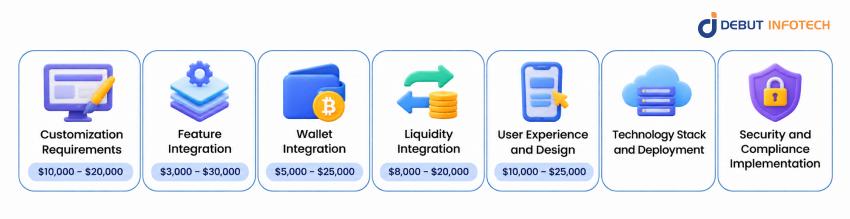
A quote may cover branded web trading and one liquidity connection. If your launch also requires native apps, routing across multiple liquidity providers, or custom withdrawal approvals, ask the vendor to price each requirement. Those decisions can change your white-label crypto exchange setup cost even when the exchange type stays the same.
Estimated Cost: $10,000 to $20,000
White-label crypto exchange customization costs rise when you rebuild onboarding or commission new screens. Confirm whether the base package covers your logo, colors, and domain before requesting a custom design.
Estimated Cost: $3,000 to $30,000
Staking can add $3,000 to $8,000 and derivatives $15,000 to $30,000. For AI-powered fraud alerts or customer support, ask vendors to itemize setup costs for data integration and testing, plus recurring charges for model usage and monitoring.
Estimated Cost: $5,000 to $25,000
A multisignature hot and cold wallet setup can add $5,000 to $12,000. Institutional key management using hardware security modules can add $10,000 to $25,000. Ask for a quote based on how you plan to hold customer assets.
Estimated Cost: $8,000 to $20,000
Use this range if you need to connect multiple providers and route orders between them in real time. Ask which connections and routing rules the setup fee covers.
Estimated Cost: $10,000 to $25,000
A substantial interface redesign or native iOS and Android apps can add to the upfront quote. If the customization estimate already covers redesigned screens or user flows, count that work once.
Your cryptocurrency exchange infrastructure costs can rise if the vendor needs to deploy into your cloud account, meet your database standards, or configure and test a separate disaster recovery environment.
Ask the vendor to scope the controls your team requires, such as dual approval for withdrawals, audit logs for admin actions, and transaction monitoring integration. Have the vendor itemize implementation and prelaunch testing.
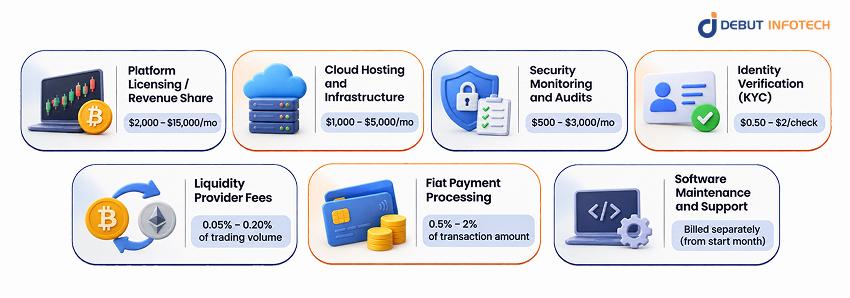
A platform subscription can start before your first trade. Identity verification and payment fees grow as customers sign up and fund their accounts. Build your monthly forecast around two inputs for each expense: when billing starts and how the charge is calculated. Use the following USD ranges for initial budgeting.
1. Platform Licensing or Revenue Share: Allow $2,000 to $15,000 per month for the recurring platform charge. If your contract uses revenue share, calculate the white-label crypto exchange licensing cost using the agreed percentage, the revenue it applies to, and any monthly minimum.
2. Cloud Hosting and Infrastructure: If your platform fee excludes hosting, budget $1,000 to $5,000 per month. Include production, staging, backups, and any disaster recovery capacity in your cryptocurrency exchange infrastructure costs.
3. Security Monitoring and Audits: Allow $500 to $3,000 per month for monitoring and audits combined. In your cash forecast, put periodic audit payments in the months they fall due.
4. Identity Verification (KYC): Budget $0.50 to $2 per check or $1 to $3 per verified user, depending on the billing model. Account for retries and manual reviews if your contract charges for them.
5. Liquidity Provider Fees: For volume-based pricing, allow 0.05% to 0.20% of the trading volume covered by the agreement. If your agreement uses a spread markup or monthly minimum, model the bill using those terms.
6. Fiat Payment Processing: Allow 0.5% to 2% of the transaction amount. Forecast deposits and withdrawals using the rate and projected volume for each payment method.
7. Software Maintenance and Support: Check whether the platform fee covers patches, upgrades, and incident response. Add separately billed crypto exchange software maintenance costs from the month those charges begin.
An exchange can be ready to deploy while finance still needs to fund an independent audit, a second payment gateway, or a market-making program. Add these crypto exchange setup expenses to your budget where they fall outside the signed software quote.
| Hidden Cost | Budget Allowance (USD) | What to Verify |
| Regulatory licensing and legal work | $5,000 to $50,000 as an initial allowance | Have counsel scope the products and states you plan to serve. The full licensing budget can exceed this allowance. |
| Independent security audits | $10,000 to $40,000 per audit cycle | Confirm which systems the auditor will review, whether the fee covers retesting, and who pays to fix findings. |
| Liquidity bootstrapping | $50,000 to $500,000 for a launch program | Price market-maker incentives and trading fee subsidies. Show any required prefunding as a separate cash commitment. |
| Payment gateway integration | $2,000 to $10,000 per provider | Check which connections the setup quote covers and whether each integration includes testing and settlement reporting. |
| Additional infrastructure protection | $500 to $3,000 per month | Check whether your hosting and monitoring plans already cover DDoS protection, content delivery, and cloud security. |
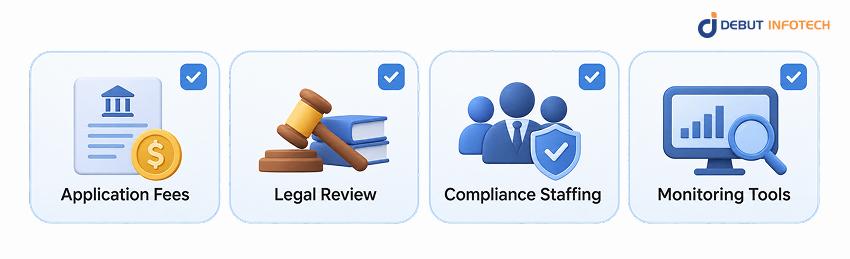
In the United States, the states you serve and the products you offer shape your white-label crypto exchange setup cost. New York charges a $5,000 USD BitLicense application fee, and California’s digital asset licensing requirements took effect on July 1, 2026 for covered businesses. If your exchange qualifies as a money transmitter under FinCEN rules, budget for registration and the staff and systems needed to run an anti-money-laundering program. If you plan to offer retail futures, confirm the applicable CFTC requirements before pricing the integration.
In the United Kingdom, cryptoasset businesses covered by the money laundering regulations must register with the Financial Conduct Authority before operating. If your launch plan extends into 2027, budget for any authorization work under the new regime, which starts on October 25, 2027. In Dubai, United Arab Emirates, VARA fee schedule lists an AED 100,000 application fee and an AED 200,000 annual supervision fee for exchange services under its remit. Record application fees in your launch budget, annual fees in your operating forecast, and any required capital in your cash plan.
An illustrative first-year expense range is $498,000 to $990,000 USD for a web-based spot exchange with third-party custody and a lean operating team. This covers setup and 12 months of operations.
To estimate your total investment, add fiat processing and customer acquisition costs where applicable. Show any required liquidity prefunding and regulatory capital separately in your cash forecast.
A standard spot exchange can be ready to deploy in 7 to 14 days if you use the platform’s existing features and integrations. Allow 8 weeks or more for extensive customization. Set your public trading date around provider onboarding, launch testing, and any required approvals.
When estimating the cost to launch a white-label crypto exchange, confirm when your platform fees begin. If billing starts before public trading, include those charges in your prelaunch cash forecast.
For an enterprise launch, the decision comes down to how much of the trading platform your team can reuse. If a prebuilt platform meets your requirements for execution, custody, and reporting, white label can reduce upfront engineering costs. If proprietary order types, custom settlement rules, or dedicated infrastructure are central to your operating model, our cryptocurrency exchange development services can help you scope a custom build.
| Decision Factor | White-Label Crypto Exchange Development | Custom Crypto Exchange Development |
| Upfront Budget (USD) | $40,000 to $300,000+ | $500,000+ |
| Delivery Timeline | Technical deployment can take weeks, depending on scope | A full in-house build can take 12 to 18 months |
| Trading and settlement | Configure existing workflows and scope any changes with the provider | Design the trading rules and settlement workflows around your operating model |
| Code and data rights | Confirm source code access, data export rights, and migration terms | Define ownership of custom code and check third-party component licenses |
| Post-launch ownership | Confirm who handles upgrades and incidents, and what the platform fee covers | Assign a team to maintain the platform, manage releases, and respond to incidents |
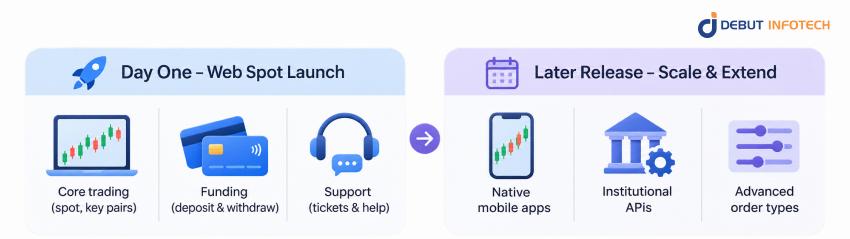
Start with the trading experience your first customers need. For a web-based spot launch, price the initial trading pairs, funding methods, and support workflows first. Then decide which additions justify a higher white-label crypto exchange development cost.
✓ Set a clear launch scope. Give each day-one feature a business reason. If native apps or advanced order types serve a later customer segment, price them as a separate release.
✓ Reuse integrations your partners already support. Verify that the platform supports the specific custody, KYC, and liquidity services you plan to use. Ask the provider to demonstrate a complete workflow, including how it handles failed transactions, before budgeting for a new connector.
✓ Customize where it matters. Start with standard branding and reserve your white-label crypto exchange customization budget for workflows that affect how you operate, such as withdrawal approvals or reconciliation exports.
✓ Price the next stage of growth. Ask what it costs to add trading pairs, increase order throughput, or move to dedicated infrastructure. Check whether those changes require a plan upgrade or additional engineering.
✓ Compare fees at two trading volumes. Model a slower launch and a higher-volume month using the same assumptions for each quote. Include any subscription, revenue share, minimum fees, and separately billed support.
✓ Verify what the delivery team will support. Ask for a comparable exchange deployment and a demonstration of the features you’re buying. Put acceptance criteria, defect fixes, and post-launch support terms in the agreement before approving the white-label crypto exchange setup cost.
Debut Infotech helps brokerages, fintech companies, and financial institutions launch an exchange under their own brand. With our white-label crypto exchange software, you can go live in as little as six weeks, depending on your customization needs, provider onboarding, and any required approvals.
It depends on the package. The setup fee may cover a connection to a liquidity provider or access to a shared pool. Ask whether the agreement also covers market-making services, trading fees, monthly minimums, or any prefunding you need at launch.
For a redesigned onboarding flow or custom screens, budget $10,000 to $20,000 USD. Your white-label crypto exchange customization costs depend on what the base package covers and how much design, development, and testing your changes require.
Maintenance can cover security patches, bug fixes, software updates, and incident response. To forecast crypto exchange software maintenance costs, check the support hours, response times, and whether the agreement covers fixes to custom modules.
A fixed monthly fee gives finance a predictable platform charge. Revenue share rises or falls with the revenue defined in your contract. Compare both models at low and high trading volumes, factoring in any monthly minimums and separately billed support.
That depends on your contract. Confirm which customer, trade, and ledger records you can export, in what format, and by when. For custom modules, check whether you can take the source code and run it on another platform after the agreement ends.

Our Latest Insights
USA
2501 Chatham, Rd Suite R Springfield, IL 62704
+1-708-515-4004
info@debutinfotech.com
UK
7 Pound Close, Yarnton, Oxfordshire, OX51QG
+44-770-304-0079
info@debutinfotech.com
Canada
154 Eden Oak Trail, Kitchener, ON N2A 0H9
+1-708-515-4004
info@debutinfotech.com
INDIA
Sector 101-A, Plot No: I-42, IT City Rd, JLPL Industrial Area, Mohali, PB 140306
9888402396
info@debutinfotech.com