ON THIS PAGE
Progress0%






Our Global Presence :






Doctor on-demand app development costs range from $40,000 to $250,000+. The final budget depends on feature complexity, platform selection, healthcare integrations, security requirements, and development team rates.
Development timelines depend on the platform’s scope. A basic MVP may take 3–5 months, a mid-level platform 5–8 months, and an advanced telemedicine solution 8–14+ months.
MVP development helps control initial investment. Prioritizing doctor profiles, appointment booking, payments, notifications, and essential consultation workflows allows businesses to validate their service before adding advanced features.
Healthcare compliance and data security must be planned early. HIPAA-related obligations, GDPR requirements, encryption, role-based access control, audit logging, and security testing can affect architecture, development costs, and ongoing maintenance.
Technology choices influence scalability and development costs. Swift, Kotlin, Flutter, and React Native support mobile development, while WebRTC, Twilio, Agora, and healthcare APIs can enable real-time consultations and system integrations.
Custom, white-label, and no-code solutions involve different trade-offs. Custom development offers greater control and flexibility, white-label platforms can accelerate launch, and no-code tools may suit prototypes or simpler MVPs.
Ongoing operating expenses extend beyond initial development. Video API usage, cloud hosting, security audits, provider licensing, third-party integrations, and software maintenance should be included in the long-term budget.
Building a doctor on-demand app involves more than creating a platform where patients can connect with healthcare professionals. Businesses need to plan for consultation workflows, appointment management, secure patient data handling, payment processing and the integrations required to deliver a reliable digital healthcare experience.
The development budget depends on the type of healthcare platform you want to launch. A focused MVP may require a different level of investment than a feature-rich solution with real-time consultations, electronic health records, insurance workflows and advanced clinical integrations. Defining these requirements early can help businesses prioritize essential features and plan for future expansion.
So, what does it take to build a doctor on-demand app in 2027? This guide explores the key cost factors, development estimates, feature requirements, technology choices, timelines and ongoing expenses to help you plan your investment and make informed development decisions.
The development budget depends on how much functionality your healthcare business needs at launch. The following estimates provide an initial comparison of project scope and delivery timelines.
| Development Scope | Estimated Cost | Estimated Timeline |
| Basic MVP | $40,000–$70,000 | 3–5 months |
| Mid-Level Platform | $70,000–$140,000 | 5–8 months |
| Advanced Platform | $140,000–$250,000+ | 8–14+ months |
A basic MVP can validate the core patient and doctor journey. A mid-level platform can introduce video consultations and more advanced healthcare workflows. An advanced solution may require multiple applications and complex integrations.
These are preliminary planning estimates rather than fixed quotations. Your actual budget will depend on the agreed feature list, technology choices, integrations, and compliance requirements.
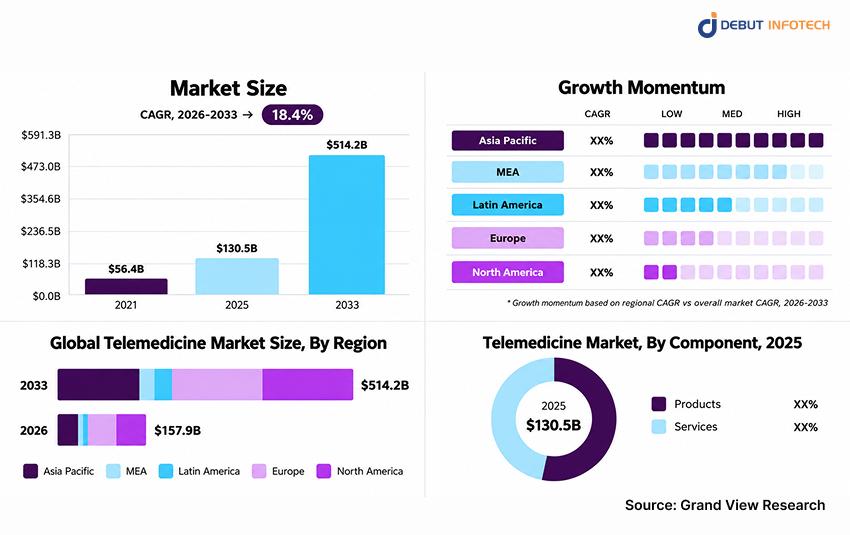
The telemedicine market provides a useful indication of the opportunity for doctor on-demand platforms. Grand View Research estimates that the global telemedicine market was worth $130.5 billion in 2025 and projects it to reach $514.2 billion by 2033, representing an 18.4% CAGR from 2026 to 2033. The report also places web and mobile delivery at 79% of the market in 2025, showing the importance of digital access channels.
Consumer adoption is also substantial. Rock Health’s 2023 Consumer Adoption Survey found that 76% of U.S. respondents had used virtual care, and 83% of those users had done so within the previous 12 months. Convenience was the leading reason for choosing virtual care over in-person care, cited by 39% of recent users, followed by shorter wait times at 30%.
Provider adoption supports the business case from the clinical side. The American Medical Association reported that 71.4% of physicians said their practices used telehealth in 2024. The same research found that 52.5% of physicians were in practices that used telehealth to manage chronic disease, and 48.5% were in practices that used it to diagnose or treat patients.
Public healthcare data shows that telehealth is also embedded in established healthcare systems. HHS reports that 25% of Medicare fee-for-service users received a telehealth service in 2024, unchanged from 2023. It also reports that 95% of HRSA-funded health centers used telehealth to provide primary care in 2024.
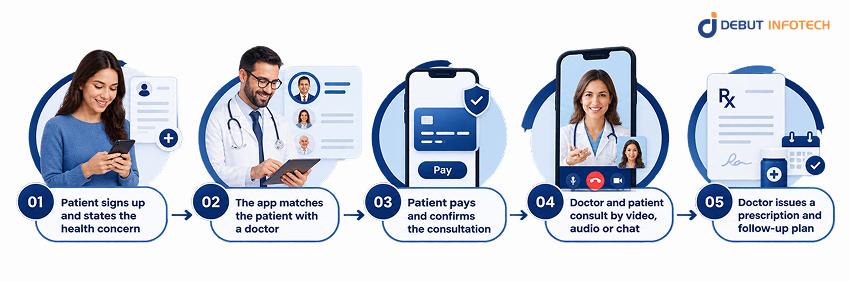
A doctor on-demand app takes a patient from registration to consultation and follow-up within one digital workflow. The platform collects the patient’s concerns, matches them with a suitable doctor, processes payments, enables consultations, and supports prescriptions and follow-up care.
Each stage depends on secure backend services and healthcare integrations.
The patient downloads the app, creates an account, enters basic personal information, and describes why they need medical attention. The app may ask about symptoms, age, location, preferred language, medical history, or the type of doctor required.
After the patient explains the problem, the app shows suitable doctors. In an instant-care model, the platform can automatically connect the patient with an available professional. For scheduled care, the patient selects a doctor, specialty, language, time slot, or other preference.
The patient reviews the consultation price, applies insurance or an eligible payment method, and confirms the appointment. The app then displays the appointment details and gives the patient instructions for joining the consultation.
At the scheduled time, the patient enters the consultation room. Depending on the service, the conversation happens through HD video, audio, or secure messaging. The doctor reviews the patient’s information, asks questions, provides clinical advice, and decides whether further care is needed.
After the consultation, the doctor can provide a prescription where legally allowed, explain how the patient should use the medication, and recommend follow-up care. The patient can view the instructions in the app and receive reminders for the next appointment.
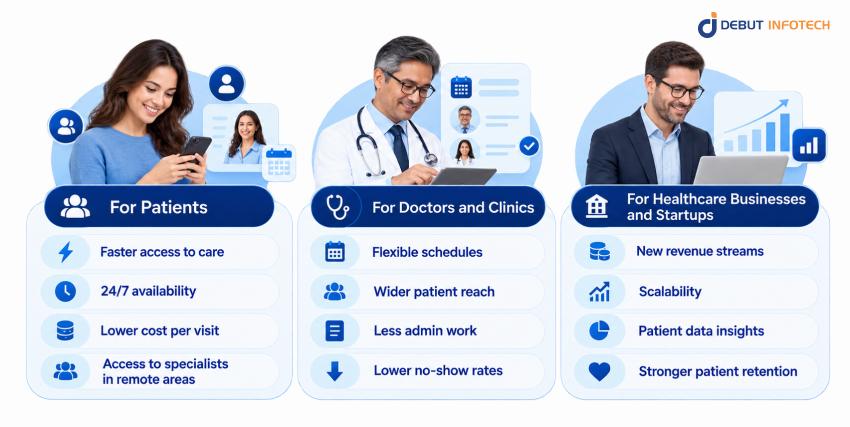
A doctor on-demand app can create business opportunities by making healthcare services accessible through a digital platform. Its value depends on how effectively it connects patients with qualified providers and supports the complete consultation journey.
For healthcare businesses, the main advantages include new revenue opportunities, more efficient appointment management, and the ability to expand services without relying entirely on physical facilities. A well-designed platform can also support patient retention through convenient booking and follow-up care.
Doctor on-demand app development can cost roughly $40,000 to $250,000+, depending on the product’s complexity, platforms, features, integrations, development region, and compliance requirements. A basic MVP costs less, while an advanced healthcare platform with video, EHR integration, AI, insurance, and security controls requires a substantially larger investment.
Development tiers help businesses estimate how much functionality they can include at different budget levels. A basic MVP focuses on the core patient and doctor journey, while mid-level products add stronger communication, payments, and healthcare workflows. Advanced platforms require more engineering, integrations, security controls, and testing.
The table below provides a practical starting point for comparing scope, timelines, and team requirements.
| Development tier | Estimated cost | Timeline | Typical team |
| Basic MVP | $40,000–$70,000 | 3–5 months | 3–5 specialists |
| Mid-level platform | $70,000–$140,000 | 5–8 months | 5–8 specialists |
| Advanced platform | $140,000–$250,000+ | 8–14+ months | 8–12+ specialists |
A basic MVP generally includes patient and doctor profiles, appointment booking, search, payments, notifications, chat, and basic administration. It is suitable for validating a focused healthcare service before adding complex integrations.
A mid-level platform can add video consultations, doctor matching, e-prescriptions, health record access, insurance workflows, advanced dashboards, stronger analytics, and more extensive third-party integrations. This tier usually represents a practical starting point for a growing healthcare business.
An advanced platform is designed for larger healthcare networks or businesses with broader requirements. It may include multiple applications, enterprise integrations, AI-assisted workflows, remote monitoring, multilingual support, complex billing, advanced security controls, and detailed clinical data management.
Location can have a substantial effect on doctor appointment app development cost because software teams charge different hourly rates across regions. However, the lowest hourly rate is not automatically the lowest project cost. Experience with healthcare applications, security, integrations, testing, and project management can reduce rework and delays.
The following ranges provide a broad comparison of how regional rates can affect the overall budget.
| Development region | Typical hourly rate | Approx. cost for similar scope |
| North America | $100–$180+ | $100,000–$300,000+ |
| Western Europe | $70–$140 | $70,000–$230,000+ |
| Eastern Europe | $40–$90 | $40,000–$150,000 |
| Latin America | $35–$80 | $35,000–$130,000 |
| South Asia | $25–$60 | $25,000–$100,000 |
| Africa | $25–$60 | $25,000–$100,000 |
These are planning estimates rather than fixed market prices. Two teams in the same region can quote different amounts because their experience, process, technology choices, security practices, and healthcare expertise differ.
A doctor on-demand platform normally includes several connected products rather than one application. The patient app handles discovery, booking, payments, and consultations. The doctor app manages availability, appointments, and clinical workflows. The admin panel controls users, doctors, payments, reports, and platform operations. Backend services connect these modules and can account for a substantial share of the total development budget.
| Module | Estimated cost | Main components |
| Patient app | $15,000–$50,000 | Registration, search, booking, payments, consultation, records |
| Doctor app | $15,000–$50,000 | Profile, availability, appointments, consultation, prescriptions |
| Admin panel | $10,000–$35,000 | User management, doctor verification, payments, analytics |
| Backend and APIs | $15,000–$60,000 | Authentication, business logic, database, integrations |
| Video/chat infrastructure | $5,000–$25,000+ | Real-time communication, session management, notifications |
The module estimates overlap in some projects because backend services support several applications. The final quote should therefore be based on the complete architecture rather than simply adding every line as an independent project.
Feature complexity, platform choice, design depth, team rates, development model, communication infrastructure, integrations, compliance, AI, and ongoing hosting all affect doctor appointment app development cost. These factors can increase the budget at different stages, so understanding their individual impact helps businesses prioritize features and make better decisions before development begins.
The number and complexity of features directly affect development effort.
A simple appointment calendar requires less work than instant doctor matching, e-prescriptions, health records, insurance processing, and real-time consultations.
Complex workflows also require more testing and error handling. Carefully defining the MVP can prevent unnecessary development costs while leaving room to add advanced capabilities after the core service has been validated.
| Cost element | Impact | Why it affects cost |
| Basic booking | Low | Simple scheduling logic |
| Doctor matching | Medium | Requires availability and matching rules |
| E-prescriptions | Medium–High | Adds clinical and compliance workflows |
| Insurance workflows | High | Requires payer and billing logic |
| Complex clinical features | Very High | More development, testing, and compliance work |
Supporting iOS, Android, web, or all three increases the amount of development and testing required. Native apps provide greater platform-specific control but require separate codebases.
Flutter and React Native can reduce duplicated work through cross-platform development. A responsive web application may also be needed for doctors or administrators. The final platform strategy should reflect the target audience, device usage, budget, and product roadmap.
| Platform strategy | Cost impact | Main reason |
| iOS only | Low–Medium | One mobile ecosystem |
| Android only | Low–Medium | One mobile ecosystem |
| iOS + Android native | High | Separate development paths |
| Flutter/React Native | Medium | Shared codebase |
| Mobile + web | High | Additional interface and testing |
| Mobile + web + native apps | Very High | Multiple platforms and environments |
UI/UX costs increase as the number of screens, user roles, workflows, and interaction states grows.
A basic doctor on demand appointment app requires fewer interfaces than a platform that includes patient dashboards, doctor workspaces, clinical records, consultation rooms, payment flows, and administrative tools.
Healthcare products also require careful information hierarchy because users must understand medical and appointment information without unnecessary confusion.
| Design scope | Cost impact | Typical requirement |
| Basic layouts | Low | Standard forms and booking screens |
| Custom UI | Medium | Branded interfaces and custom components |
| Advanced dashboards | Medium–High | Data-heavy patient and doctor views |
| Complex interaction design | High | Multiple workflows and user roles |
| Extensive usability testing | High | More testing rounds and user research |
Developer rates vary significantly by region. A North American team may charge substantially more per hour than a team in South Asia, Latin America, Eastern Europe, or Africa.
However, the hourly rate does not tell the whole story. A less experienced team may require more supervision or rework, while an experienced healthcare team may complete complex requirements more quickly and reduce costly implementation errors.
| Team location | Typical rate | Cost impact |
| North America | $100–$180+ | Very High |
| Western Europe | $70–$140 | High |
| Eastern Europe | $40–$90 | Medium |
| Latin America | $35–$80 | Medium |
| South Asia | $25–$60 | Low–Medium |
| Africa | $25–$60 | Low–Medium |
The choice between an in-house team, freelancers, and an agency affects both direct and indirect costs.
In-house development requires salaries, recruitment, equipment, benefits, management, and infrastructure.
Freelancers can reduce initial spending but may require more coordination. Agencies generally provide multiple specialists within a single delivery structure.
For healthcare products, the team’s experience with security, compliance, and integrations should also influence the decision.
| Team model | Initial cost | Cost impact | Best suited for |
| In-house | High | High | Long-term internal product teams |
| Freelancers | Low–Medium | Low–Medium | Small or defined projects |
| Specialized agency | Medium–High | Medium–High | Complex healthcare products |
| Hybrid team | Medium–High | Medium–High | Businesses with internal technical staff |
Video consultations add both development and recurring infrastructure expenses. The platform needs secure session creation, authentication, call controls, connection recovery, messaging, notifications, and monitoring.
Third-party providers can reduce engineering time but charge based on usage. Building more infrastructure internally can increase the initial development budget.
Expected consultation volume should therefore be estimated before selecting the communication architecture.
| Video/chat requirement | Cost impact | Main cost driver |
| Basic secure chat | Low–Medium | Messaging infrastructure |
| Audio calls | Medium | Real-time communication |
| HD video | Medium–High | Video minutes and bandwidth |
| Group consultations | High | Multiple participants |
| Recording and storage | High | Storage and processing |
| Custom video infrastructure | Very High | Engineering and maintenance |
Integrations can add considerable development effort because each external service has its own API, authentication system, documentation, testing environment, and data structure.
Healthcare platforms may connect with EHR systems, pharmacies, laboratories, insurance providers, payment gateways, and identity services.
More integrations mean more development and testing. They also create ongoing maintenance work when external providers change their APIs or technical requirements.
| Integration | Cost impact | Why |
| Payment gateway | Low–Medium | API and transaction handling |
| Push notifications | Low | Standard service integration |
| EHR/FHIR | High | Healthcare data mapping |
| Pharmacy | High | Prescription and fulfillment workflows |
| Insurance | High–Very High | Eligibility, claims, and payer logic |
| Multiple healthcare systems | Very High | Several interfaces and testing environments |
Compliance requirements can significantly increase the cost of a healthcare application because they influence architecture, data storage, access control, logging, consent, testing, and vendor selection. Requirements vary by market and service.
A platform serving U.S. patients may need HIPAA-related controls, while applications handling European users may have GDPR obligations. Enterprise healthcare clients can also request additional security assessments and documentation.
| Requirement | Cost impact | Cost driver |
| Encryption | Medium | Implementation and key management |
| MFA | Low–Medium | Authentication infrastructure |
| Role-based access | Medium | User and permission structure |
| Audit logging | Medium | Storage and monitoring |
| Penetration testing | Medium–High | External security testing |
| Extensive compliance program | High–Very High | Audits, policies, remediation, documentation |
AI can increase development costs because healthcare AI doctor on demand app features require more than connecting an API.
Symptom triage, clinical documentation, transcription, patient routing, and health recommendations require testing, monitoring, safeguards, and appropriate human oversight.
Costs can also come from model usage, data processing, prompt management, evaluation, and infrastructure. The more sensitive the AI workflow, the greater the validation and governance requirements.
| AI feature | Cost impact | Main cost driver |
| AI chatbot | Medium | Model/API integration |
| Speech transcription | Medium | Usage and processing |
| Appointment routing | Medium | Rules and AI logic |
| AI triage | High | Validation and safety controls |
| Clinical summarization | High | Data handling and accuracy testing |
| Custom AI model | Very High | Data, training, infrastructure, monitoring |
Hosting and maintenance become ongoing expenses once the application goes live.
Cloud infrastructure, databases, storage, monitoring, backups, security tools, notifications, and third-party services can all generate recurring charges.
Development teams also need to maintain compatibility with new operating-system versions, fix bugs, patch vulnerabilities, and update integrations. Higher user and consultation volumes generally increase infrastructure and support requirements.
| Ongoing cost | Cost impact | What drives the expense? |
| Cloud hosting | Medium | Users and system workload |
| Database | Medium | Data volume and queries |
| Storage | Medium | Records and media |
| Monitoring | Low–Medium | Number of services |
| Security maintenance | Medium–High | Threat level and compliance |
| Feature updates | Medium–High | Product roadmap |
| Technical support | Medium–High | User and provider volume |
Doctor on demand platform development is only part of the financial commitment. Video usage, security audits, licensing, legal work, cloud infrastructure, software updates, and technical maintenance can create recurring expenses after launch. Planning for these costs early gives the business a more realistic view of the platform’s long-term operating budget.
Video consultation costs persist after launch because providers generally charge based on usage. Expenses can depend on consultation minutes, participants, recording, bandwidth, and regional traffic.
A platform with thousands of monthly consultations can therefore spend far more than an MVP with limited usage. Businesses should also budget for fallback mechanisms, session monitoring, SDK updates, and technical support when estimating the long-term cost of video infrastructure.
| Cost item | Cost impact | What increases the cost? |
| Video minutes | High | More consultations and longer calls |
| Recording | Medium–High | Storage, processing, and retention |
| Bandwidth | Medium | Higher call volume and video quality |
| SDK maintenance | | Low–Medium | Provider updates and compatibility work |
| Technical support | Medium | Larger user and provider base |
Security and compliance audits are recurring expenses for healthcare platforms. Depending on the target market, the business may need penetration testing, vulnerability assessments, compliance reviews, risk assessments, and external audits. Costs can increase when enterprise customers request additional security evidence or certifications.
Regular assessments also uncover remediation work, which may require engineering time. These expenses should be included in the operating budget rather than treated as one-time launch costs.
| Cost item | Cost impact | What increases the cost? |
| Penetration testing | Medium | Application size and testing scope |
| Compliance audit | High | Regulatory and enterprise requirements |
| Vulnerability assessment | Medium | Number of systems and integrations |
| Security remediation | Medium–High | Severity and number of findings |
| Recertification | Medium | Required audit frequency |
Healthcare licensing and legal expenses vary by location and service model. Costs may include provider credential verification, professional licensing checks, business registrations, medical liability coverage, legal reviews, privacy agreements, and prescribing requirements.
Expanding into another state or country can introduce additional obligations. Pharmacy and insurance partnerships may also require contracts and technical compliance work. These expenses can increase as the platform adds specialties, providers, and geographic markets.
| Cost item | Cost impact | What increases the cost? |
| Provider verification | Medium | Number of doctors onboarded |
| Medical licensing checks | Medium–High | Number of jurisdictions |
| Legal review | Medium | Complexity of business and data agreements |
| Liability insurance | Medium–High | Service type and coverage |
| Prescribing compliance | | High | Medication and market requirements |
Post-launch updates are necessary because mobile operating systems, browsers, cloud services, security standards, and third-party APIs change over time.
Developers or doctor on demand app development company for healthcare businesses may need to update SDKs, fix compatibility issues, patch vulnerabilities, improve performance, and adapt integrations.
Healthcare workflows can also change as regulations or interoperability standards develop.
A maintenance budget should cover routine improvements and unexpected fixes, rather than assuming the original development team can leave the application unchanged after launch.
| Cost item | Cost impact | What increases the cost? |
| Bug fixes | Low–Medium | Number and severity of issues |
| OS compatibility | Medium | Frequency of platform updates |
| API updates | Medium | Number of third-party services |
| Security patches | Medium–High | Vulnerability severity |
| Feature maintenance | Medium–High | Size and complexity of the product |
A strong doctor on-demand app should cover the complete patient and provider journey, from registration and doctor matching to consultation, payment, prescriptions, and follow-up.
Core features should support secure communication and healthcare workflows, while advanced options such as AI triage, wearable integration, and multilingual support can extend the platform’s capabilities.
Patients should be able to create secure accounts, manage personal information, enter relevant medical details, upload documents where appropriate, manage consent, and view their consultation history. Profile design should avoid collecting unnecessary information because each additional health data field increases privacy and security responsibilities.
Patients should be able to search by specialty, availability, language, consultation type, or other relevant criteria. Instant matching can connect patients with available doctors, while scheduled bookings support planned consultations. Doctors should have control over availability, appointment duration, breaks, cancellations, and the types of consultations accepted.
Real-time communication is central to many doctor on-demand services. The platform should support reliable video, audio fallback, secure messaging, call status indicators, and appropriate controls for ending or reconnecting a session. The design should also account for patients with weaker connections.
Doctors should be able to create prescriptions and care instructions where permitted by local rules. Patients can then access relevant records and recommendations through the application. Integration with existing health records can reduce duplicate data entry and provide clinicians with more useful information.
Payment functionality should support consultation charges, receipts, refunds, invoices, promotional codes, and relevant payment methods. Insurance workflows can be more complex because eligibility checks, claims, copayments, coverage rules, and payer integrations may differ between markets.
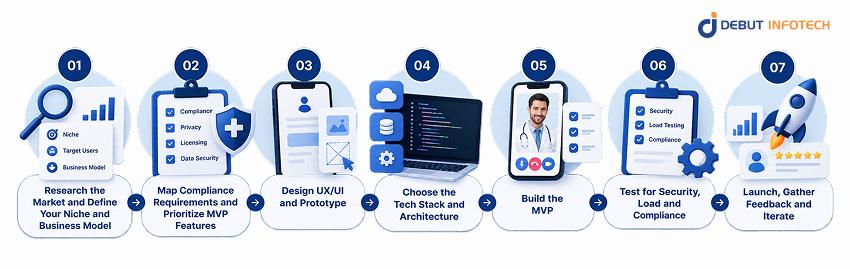
Developing a doctor on-demand app starts with defining the healthcare niche and business model, then moves through compliance planning, UX design, technology selection, MVP development, testing, and launch.
Following these steps helps control scope, address security requirements early, and create a foundation that supports future features and users in doctor appointment app development.
Begin by identifying the healthcare problem the application will solve.
Decide whether the platform will focus on general consultations, mental health, dermatology, chronic disease management, specialist access, employer healthcare, or another niche.
Define the target users, provider network, pricing model, geographic market, and revenue source before writing detailed requirements.
Compliance requirements depend on where the service operates and what information it processes.
Map privacy, healthcare, licensing, prescribing, payment, and data-storage requirements before development begins. Then separate must-have MVP features from later additions.
A smaller, more compliant product is easier to test and validate than a large platform with unnecessary features.
Create user flows for patients, doctors, and administrators. Map registration, matching, booking, payment, consultation, prescription, and follow-up journeys. Build clickable prototypes before development so stakeholders can identify confusing screens early.
The design should also consider accessibility, error handling, consent, and situations where patients lose connectivity during a consultation.
Select technologies based on product requirements rather than popularity. Decide whether mobile development will be native or cross-platform.
Define the backend architecture, database, authentication system, cloud environment, real-time communication provider, payment gateway integration, notification service, and integration strategy. Healthcare data should be separated and protected in accordance with the applicable security model.
Development should follow the approved user flows and technical architecture.
Start with doctor registration, doctor profiles, search or matching, appointment management, consultation, payments, notifications, and essential administration. Build APIs and backend services alongside the client applications.
Use version control, code reviews, automated testing, and controlled environments throughout the process.
Healthcare applications require more extensive testing than ordinary booking apps. Test authentication, authorization, data access, encryption, payments, video sessions, notifications, APIs, and failure conditions.
Load testing should confirm that the platform can handle expected consultation demand. Security testing should identify vulnerabilities before production. Compliance reviews should verify that required controls are working.
Launch with a controlled user group when possible. Monitor crashes, consultation completion, appointment cancellations, provider response times, payment failures, and support requests.
Collect feedback from patients and doctors, then prioritize improvements based on business and clinical impact. New features should be added only when they support a validated need or measurable product goal.
Each development approach can reduce a different part of the initial investment.
No-code tools generally have the lowest entry cost, white-label platforms can shorten development time, and custom doctor on demand apps provide greater control.
The cheapest option at launch may not remain the cheapest as user numbers, integrations, compliance requirements, and customization needs increase.
| Factor | Custom development | White-label | No-code |
| Initial cost | $40,000–$250,000+ | $10,000–$80,000+ | $2,000–$30,000+ |
| Development speed | Medium–Slow | Fast | Very fast |
| Customization | Very high | Medium | Low–Medium |
| Healthcare integrations | High flexibility | Depends on vendor | Often limited |
| Scalability | High | Medium–High | Low–Medium |
| Compliance control | High | Depends on provider | Limited |
| Ownership | Full product ownership | Vendor dependent | Platform dependent |
| Long-term flexibility | High | Medium | | Low–Medium |
| Best suited for | Scalable healthcare platforms | Faster market entry | Prototypes and simple MVPs |
White-label software can make sense when speed matters more than complete product control. However, recurring licensing fees, customization charges, vendor restrictions, and migration risks should be included in the calculation. A low upfront virtual doctor app development cost does not necessarily mean a lower total cost over several years.
Custom healthcare app development usually requires the largest initial budget, but it allows the business to control the architecture, user experience, integrations, security model, and product roadmap. For a regulated healthcare platform that expects significant growth, the additional upfront investment can reduce dependence on a third-party platform.
A doctor appointment app is mainly designed around scheduling. Patients can search for doctors, check availability, book appointments, receive reminders, and manage cancellations.
On the other hand, a doctor-on-demand app extends this workflow to virtual care. It adds real-time matching, consultations, secure communication, payments, prescriptions, records, and potentially insurance and pharmacy integrations.
| Factor | Doctor appointment app | Doctor on-demand app |
| Core purpose | Schedule appointments | Deliver virtual consultations |
| Patient registration | ✓ | ✓ |
| Doctor search | ✓ | ✓ |
| Appointment booking | ✓ | ✓ |
| Instant doctor matching | Optional | Common |
| Video consultation | Optional | Core feature |
| Audio consultation | Optional | Common |
| Secure chat | Basic/optional | Core feature |
| E-prescriptions | Optional | Common |
| Health records | Basic | More advanced |
| Online payments | Common | Core feature |
| Insurance integration | Optional | Often required |
| Pharmacy integration | Rare | Possible |
| Real-time availability | Limited | Important |
| Estimated development cost | 25,000–90,000+ | 70,000–250,000+ |
| Typical complexity | Low–Medium | Medium–High |
| Main infrastructure | Booking, notifications, payments | Booking, video, chat, records, payments, integrations |
The difference in cost comes mainly from the additional infrastructure and clinical workflows. A medical appointment scheduling application does not necessarily require real-time video, clinical records, e-prescribing, or complex healthcare integrations. Each of these additions introduces development, testing, security, infrastructure, and maintenance requirements.
Businesses should choose based on the service they intend to deliver. If the goal is to help patients schedule physical visits, an appointment app may be enough. If the platform will provide remote consultations from doctor discovery through follow-up care, then a doctor-on-demand architecture is more appropriate.
A telemedicine app typically requires mobile or web technologies, a secure backend, real-time doctor-patient communication infrastructure, a suitable database and cloud environment, strong security controls, and healthcare integrations.
The technology stack should support reliable consultations, the protection of health information, interoperability, payments, notifications, and future expansion without introducing unnecessary technical complexity.
iOS applications can be developed with Swift, while Android applications commonly use Kotlin.
React Native and Flutter can support cross-platform development from a shared codebase. The best choice depends on performance needs, available engineering skills, device requirements, existing systems, and the planned product roadmap.
Node.js, Python, and Java can all support telemedicine backends. The backend manages authentication, doctor availability, appointments, payments, patient records, notifications, business rules, and integrations. Architecture may use REST APIs, GraphQL, microservices, or a modular monolith depending on the project’s scale and operational requirements.
Real-time consultations can use WebRTC directly or services such as Twilio, Agora, or Vonage. A managed provider can reduce the engineering burden of building real-time infrastructure. The application still needs proper authentication, session controls, error handling, privacy protections, and monitoring around the video service.
PostgreSQL is a common relational database option for structured application data. Cloud environments such as AWS and Google Cloud can provide services suitable for healthcare workloads when configured and contracted appropriately. The specific compliance status of a cloud service depends on the service, configuration, contractual arrangements, and applicable regulations.
Security architecture should include encryption in transit and at rest, MFA, role-based access control, secure authentication, audit logs, secrets management, backups, monitoring, and vulnerability management. Sensitive clinical data should only be accessible to authorized users for legitimate purposes.
Healthcare applications may need FHIR and HL7 interfaces for interoperability. Payment gateways process consultation charges. Push notification services support reminders and appointment alerts. AI/ML APIs can provide features such as transcription, summarization, or patient routing. Each integration adds testing, security, monitoring, and maintenance requirements.
Build a Doctor On-Demand App With Debut Infotech
Building a doctor on-demand app requires a development strategy that aligns with your business model, healthcare workflows, and budget. As a mobile app development company, Debut Infotech can help businesses plan and develop healthcare applications around their functional requirements, security needs, and long-term growth objectives.
From patient and doctor applications to appointment management, virtual consultations, and healthcare integrations, the development process focuses on creating a platform that supports your intended care delivery model. The right scope also helps prioritize essential features while planning for future expansion.
Whether you are launching an MVP or building a more advanced telemedicine platform, defining your requirements early can help establish a practical development roadmap and budget.
Ready to discuss your doctor on-demand app idea? Contact Debut Infotech to explore your project requirements and plan your next steps.
The cost to build a doctor on-demand app typically ranges from $40,000 to $250,000+, depending on the features, platforms, integrations, and compliance requirements. A basic app with appointment booking costs less, while video consultations, e-prescriptions, payments, AI features, and advanced admin tools can push development costs much higher.
A doctor appointment app can cost around $25,000 to $100,000+ to develop. The final price depends on whether you need iOS, Android, or both, as well as features such as doctor profiles, search, scheduling, payments, reminders, reviews, and admin management. Third-party healthcare integrations and security requirements can also increase the overall cost.
Developing a doctor on-demand app usually takes 4 to 9 months, depending on the app’s complexity. A basic version with profiles, search, booking, payments, and notifications may take around four months. Adding video consultations, electronic health records, prescriptions, insurance integrations, and advanced security can significantly extend the timeline.
A doctor on-demand app may need to comply with HIPAA when it is operated by a covered entity or a business associate subject to the regulation and handles protected health information. Applicable obligations depend on the business model and the parties involved. Before development begins, businesses should assess their regulatory responsibilities and establish the necessary privacy, security, access-control, and data-handling requirements.
A doctor appointment app mainly helps patients find doctors and schedule appointments for a specific date and time. A doctor on-demand app goes further by connecting patients with available doctors for immediate or near-immediate consultations. On-demand platforms often include video calls, urgent care options, online payments, prescriptions, and real-time availability.
The cost to develop a healthcare consultation app typically ranges from $30,000 to $120,000+, depending on its features and complexity. Basic apps with booking and messaging cost less, while video consultations, electronic prescriptions, payments, health records, third-party integrations, and compliance requirements can increase the development budget.
The cost to build a doctor-booking platform usually ranges from $25,000 to $100,000+. A basic platform with doctor profiles, search, availability, appointment scheduling, and notifications sits toward the lower end. Adding payments, video consultations, insurance integrations, reviews, analytics, and advanced admin features can significantly increase the final cost.

Our Latest Insights

USA
2501 Chatham, Rd Suite R Springfield, IL 62704
+1-708-515-4004
info@debutinfotech.com
UK
7 Pound Close, Yarnton, Oxfordshire, OX51QG
+44-770-304-0079
info@debutinfotech.com
Canada
154 Eden Oak Trail, Kitchener, ON N2A 0H9
+1-708-515-4004
info@debutinfotech.com
INDIA
Sector 101-A, Plot No: I-42, IT City Rd, JLPL Industrial Area, Mohali, PB 140306
9888402396
info@debutinfotech.com