ON THIS PAGE
Progress0%





Our Global Presence :



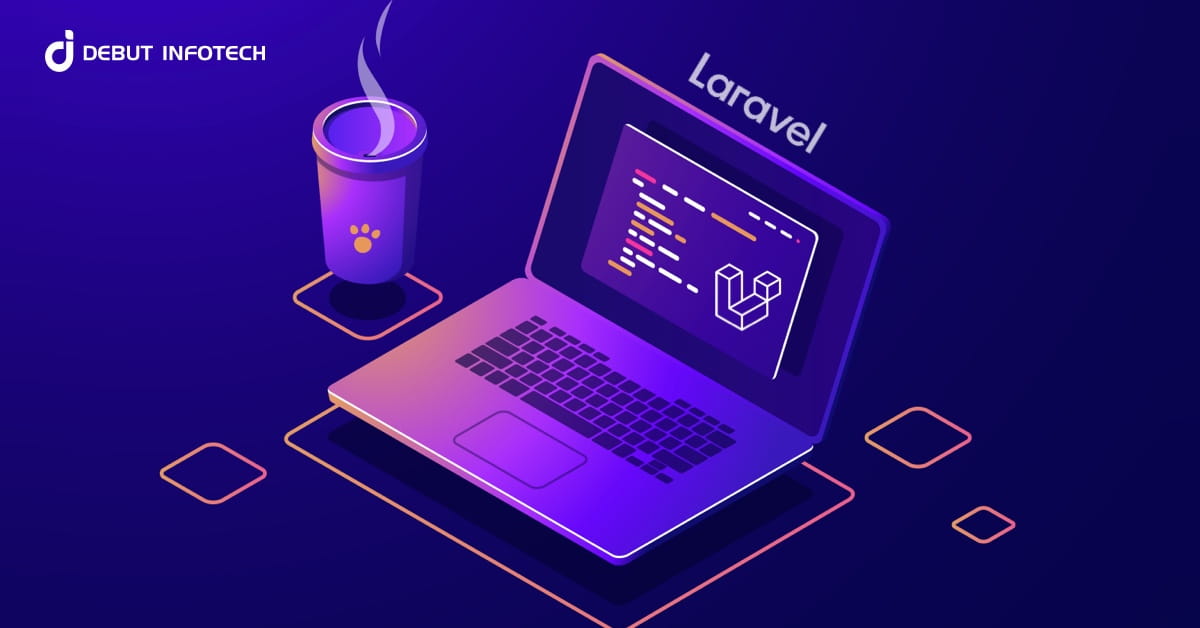


Laravel has emerged as a leading choice for PHP web development, offering developers a blend of structure, scalability, and expressive syntax.
As of recent industry analysis, Laravel remains the most widely adopted PHP framework, with 44% of developers reporting regular use, making it the top framework in its category. This widespread use reflects strong Laravel framework benefits, including clean architecture, built-in security, and efficient database management.
PHP itself continues to power a large share of the web, running 74.5% of sites with known server-side languages, which underscores the ongoing relevance of PHP ecosystems like Laravel.
For businesses seeking rapid development and maintainable codebases, Laravel’s combination of tools and community support positions it as a compelling solution for modern web applications.
Laravel is an open-source PHP framework built to support structured, secure, and maintainable web application development. It follows modern development practices, including MVC architecture, dependency injection, and modular design.
Laravel reduces repetitive coding by offering built-in tools for routing, authentication, database management, and security, allowing developers to focus on business logic and long-term application stability.
Also Read: How to Choose the Right Tech Stack for Web Development
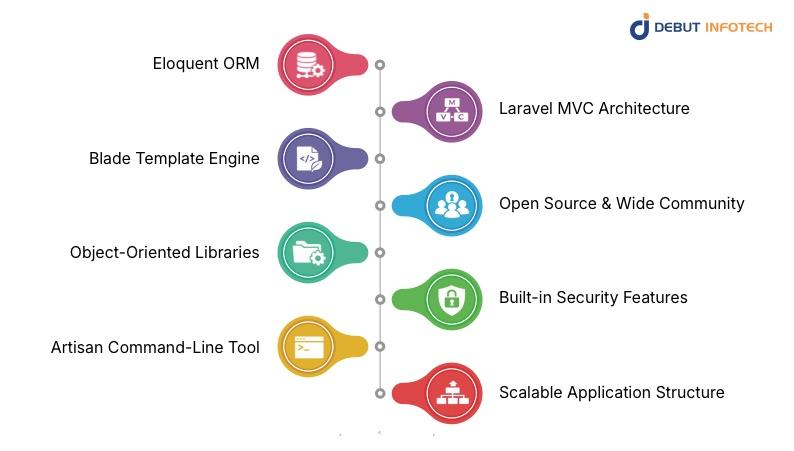
Laravel’s popularity is driven by practical features that reduce development effort, improve code organization, and support scalability, making it suitable for both small projects and large enterprise-grade web applications.
Eloquent ORM provides an intuitive, object-oriented approach to database interaction. It allows developers to define relationships between database tables using clear model structures rather than complex SQL queries. This simplifies data handling, improves readability, and supports efficient query execution, making database operations faster to implement and easier to maintain as applications grow.
Laravel’s MVC architecture separates application logic, data handling, and presentation into distinct layers. This separation improves code organization, simplifies debugging, and supports collaborative development. Each layer can evolve independently, helping development teams scale applications efficiently while maintaining a consistent structure and long-term code quality.
Blade is Laravel’s native templating engine designed for building dynamic user interfaces with clean syntax. It supports template inheritance, reusable components, and conditional rendering without adding performance overhead. Developers can create consistent layouts efficiently while keeping presentation logic separate from backend code, supporting faster UI development and easier updates.
Laravel is open source and supported by a large, active developer community worldwide. Regular updates, extensive documentation, and community-driven packages ensure long-term reliability. Developers benefit from shared solutions, tutorials, and forums that simplify problem-solving and keep the framework aligned with modern development standards.
Laravel includes object-oriented libraries that handle common application tasks such as authentication, session management, file storage, and caching. These libraries follow consistent design principles, encourage reusable code, and reduce development effort. Developers can implement advanced functionality without having to build core features from scratch.
Laravel offers built-in protection against common security risks, including SQL injection, cross-site scripting, and cross-site request forgery. It also supports encrypted data storage and secure password hashing by default. These features provide a strong security foundation and reduce the risk of vulnerabilities in production environments.
Artisan is Laravel’s command-line interface that automates repetitive development tasks. It helps developers generate boilerplate code, manage database migrations, run scheduled jobs, and perform maintenance tasks efficiently. This improves development speed, reduces manual errors, and keeps project workflows organized and consistent.
Laravel supports scalable application development through modular architecture, service containers, and clear dependency management. Applications can grow in complexity without disrupting existing functionality. This structure allows teams to add new features, integrate services, and manage large codebases while maintaining performance and maintainability.
Laravel offers clear advantages for web development by combining speed, security, and scalability, allowing businesses to launch reliable applications faster while maintaining control over performance, structure, and long-term maintenance. Here are some benefits of using laravel framework:
Laravel provides built-in authentication and authorization systems that simplify user access control. Developers can manage logins, registrations, password resets, and role-based permissions without extensive custom coding. This structured approach improves security consistency, reduces development time, and ensures access rules remain easy to maintain as applications grow.
Laravel accelerates development through reusable components, preconfigured tools, and clear coding conventions. Features like routing, database migrations, and package management reduce setup time. Development teams can move from planning to deployment faster while maintaining clean code, predictable workflows, and reliable application performance across projects of varying sizes.
Laravel includes built-in support for automated and unit testing, allowing developers to validate application behavior early. Testing tools help detect bugs before deployment, improve code reliability, and support safer updates. This structured testing environment strengthens long-term application stability and reduces unexpected issues during scaling or feature expansion.
Laravel’s MVC architecture enforces a clear separation between data handling, business logic, and presentation layers. This structure improves maintainability, simplifies debugging, and supports parallel development. Teams can update features or interfaces without affecting core logic, making long-term application management more predictable and controlled.
Laravel includes a built-in task scheduler that simplifies automated background operations. Laravel development companies can manage recurring jobs like email notifications, database cleanups, and report generation within the application itself. This reduces reliance on external cron setups and ensures consistent execution of time-based tasks across environments.
Laravel handles high traffic efficiently through caching mechanisms, queue management, and optimized request handling. Features like Redis integration and job queues help maintain responsiveness during peak usage. These capabilities allow applications to scale smoothly while maintaining stable performance and a consistent user experience under increasing demand.
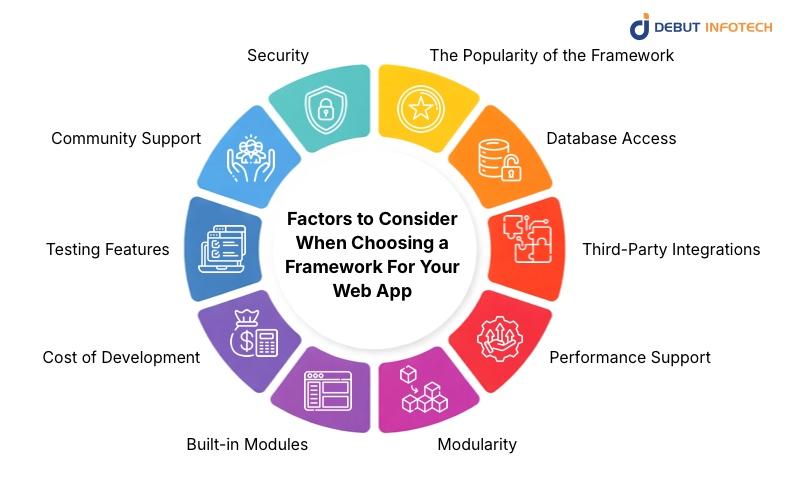
Choosing web development frameworks requires evaluating technical flexibility, long-term support, performance capabilities, and security readiness to ensure the platform aligns with both current requirements and future application growth.
A popular framework usually reflects stability, active development, and proven real-world use. Widespread adoption means better documentation, frequent updates, and access to shared solutions. This reduces long-term risk and makes it easier to hire developers already familiar with the framework’s structure and best practices.
A framework should support flexible and efficient database access. Built-in ORM tools, migration systems, and compatibility with multiple databases improve data handling. This flexibility ensures applications can evolve without major database rewrites while maintaining performance, consistency, and structured data management across environments.
Modern web applications rely on external services like payment gateways, APIs, and analytics tools. A strong framework should support seamless third-party integrations. This simplifies feature expansion, reduces custom development effort, and allows applications to connect reliably with external platforms as business needs change.
Performance support is critical for responsive web applications. The framework should include caching, optimization tools, and efficient request handling. These features help applications manage growing traffic without degradation, ensuring consistent speed, reduced server load, and stable performance under varying usage conditions.
Modularity allows applications to grow without becoming difficult to manage. A framework should support modular code organization, enabling developers to add or update features independently. This approach improves maintainability, simplifies scaling, and reduces the risk of breaking existing functionality during updates.
Built-in modules reduce development time by handling common tasks like authentication, validation, and file management. A framework with reliable native modules allows developers to focus on application-specific logic while maintaining consistency, security, and predictable behavior across different parts of the application.
Web app development cost depends on the learning curve, tooling, and available resources. A framework with strong documentation, reusable components, and community support lowers onboarding time and maintenance expenses. This helps teams deliver quality applications without unnecessary overhead or extended development cycles.
Testing features help ensure application reliability. A framework should support automated and unit testing with minimal setup. This allows developers to identify issues early, validate updates confidently, and maintain consistent application behavior as new features or changes are introduced.
Strong community support provides access to shared knowledge, updates, and third-party tools. Active communities help resolve issues faster and keep frameworks aligned with modern development standards. This support structure reduces dependency risks and strengthens the long-term sustainability of the project.
Security should be built into the framework rather than added later. Protection against common vulnerabilities, secure authentication methods, and regular updates help safeguard applications. A secure framework reduces exposure to threats and supports compliance with data protection and user privacy requirements.
Laravel is often regarded as one of the strongest PHP frameworks due to its balance of structure, flexibility, and developer efficiency. When you list out some benefits of Laravel over other php frameworks, you’d realise why it’s a better option.
It offers built-in rapid web application development tools, clear conventions, and long-term support, making it suitable for a wide range of projects. While other frameworks serve niche needs, Laravel’s ecosystem, scalability, and community backing make it a reliable choice for modern web development.
St. Jude Children’s Research Hospital uses Laravel to support secure, reliable digital platforms that manage sensitive medical and donation-related data. Laravel’s built-in security features and structured architecture help maintain compliance, performance stability, and consistent user experience across high-traffic, mission-critical healthcare web applications.
The New York Times relies on Laravel for parts of its digital infrastructure that require scalability and content flexibility. Laravel’s modular structure supports rapid content updates, backend stability, and seamless integration with other systems, helping the platform handle large volumes of readers and continuously changing editorial demands.
Disney uses Laravel to power select digital experiences that demand performance, scalability, and clean backend architecture. Laravel’s structured development approach supports content-heavy platforms, smooth integrations, and secure data handling, enabling Disney to maintain consistent brand experiences across diverse digital properties.
Warner Bros leverages Laravel to manage web platforms that support media content, promotional campaigns, and user engagement. Laravel’s flexibility allows rapid feature updates, while its MVC structure ensures clean separation of logic and presentation, helping maintain stable performance during high-traffic release periods.
Invoice Ninja is built on Laravel to deliver a feature-rich invoicing and billing platform. Laravel supports complex business logic, secure payment processing, and scalable account management. Its extensible architecture allows the platform to add features while maintaining reliability for global users continuously.
Alison, an online learning platform, uses Laravel to support scalable course delivery and user management. Laravel’s performance optimization tools and database handling capabilities help manage large user bases, dynamic content, and continuous platform updates while maintaining a consistent learning experience.
MyRank uses Laravel to power its performance-focused digital services. Laravel’s modular structure supports data processing, analytics integration, and feature expansion. The framework’s maintainability allows MyRank to scale functionality efficiently while keeping backend operations structured and easy to manage.
Related Read: Breaking Down the Cost to Hire Laravel Developers
While the benefits of laravel framework are numerous, its structured nature, performance considerations, and dependency management requirements introduce challenges that teams must address through proper configuration, optimization, and ongoing maintenance practices.
Laravel includes many built-in features that can introduce performance overhead for lightweight or high-speed applications. Without proper caching, query optimization, and configuration tuning, applications may consume more server resources than simpler PHP solutions, especially under heavy traffic or real-time processing demands.
Laravel follows structured conventions and modern PHP practices, and it sits within a broad ecosystem of tools that may feel overwhelming to new developers. Understanding MVC patterns, Composer, Artisan commands, and Laravel-specific workflows requires time, which can slow initial onboarding for teams unfamiliar with framework-driven development.
Laravel applications often require advanced server configurations, including specific PHP versions, extensions, and permission settings. Shared hosting environments may not fully support these requirements, increasing deployment complexity and sometimes leading to additional hosting costs or reliance on managed server solutions.
Laravel relies heavily on third-party packages to extend functionality. While this accelerates development, managing dependencies and framework updates requires careful version control.
Incompatible package updates can introduce breaking changes, requiring ongoing maintenance and regular testing to preserve application stability.
Laravel continues to stand out as a reliable and future-ready framework for PHP web development, especially when applied with architectural discipline and real-world delivery experience. At Debut Infotech, we apply Laravel with a strong emphasis on structure, security, and long-term maintainability, ensuring every solution aligns with both technical best practices and evolving business objectives.
As a custom software development company with deep Laravel expertise, we deliver Laravel development services that go beyond framework implementation. Our teams build scalable platforms, performance-driven systems, and business-critical applications that maintain clarity in code, consistency in performance, and operational reliability across environments. Built-in security, MVC architecture, and testing support are leveraged strategically to support growth, compliance, and long-term stability.
Our Laravel portfolio reflects this execution-first approach. Platforms such as Cimet, P2B, and Aithentic demonstrate our ability to deliver production-grade Laravel solutions across different business models, data complexities, and scale requirements. These projects highlight how Laravel framework benefits translate into real outcomes when paired with experienced engineers and disciplined delivery.
Companies looking to hire Laravel developers work with senior teams who understand not just the framework, but also system design, performance optimization, and enterprise-grade delivery expectations. This enables faster development cycles without compromising maintainability, security, or future extensibility.
For businesses seeking stable, scalable, and efficient PHP solutions, Laravel remains a practical framework choice. When backed by proven Laravel development services and top-tier developers, it becomes a strong foundation for building software that performs reliably today and adapts confidently tomorrow.
A. Laravel is used to build web applications faster and more cleanly. It handles routing, authentication, database work, APIs, and background tasks out of the box. Developers use it to avoid repetitive PHP code and focus on logic, structure, and features users actually care about in production projects.
A. Laravel sits on top of PHP and removes the rough edges. It gives you structure, security tools, and built-in features that PHP alone does not offer. You write less boilerplate, make fewer mistakes, and ship stable applications without reinventing the basics every time during real projects at scale.
A. Yes, Laravel is considered a full stack framework. It covers backend logic, databases, authentication, APIs, and server-side rendering. When paired with tools like Blade, Livewire, or JavaScript frameworks, it also supports building complete user-facing interfaces without friction for modern web applications and scalable product teams maintain.
A. Laravel works best for content platforms, SaaS products, APIs, dashboards, and custom business tools. It handles small builds well and scales into complex systems. Projects that need clean architecture, frequent updates, and long-term maintenance benefit the most from Laravel in professional development environments and teams today.
A. Laravel is mainly a backend framework. It manages server-side logic, databases, authentication, and APIs. That being said, it includes Blade for templating. It works smoothly with frontend tools, so developers can handle both sides of a web app when needed without constantly switching stacks or workflows.

Our Latest Insights
USA
2501 Chatham, Rd Suite R Springfield, IL 62704
+1-708-515-4004
info@debutinfotech.com
UK
7 Pound Close, Yarnton, Oxfordshire, OX51QG
+44-770-304-0079
info@debutinfotech.com
Canada
154 Eden Oak Trail, Kitchener, ON N2A 0H9
+1-708-515-4004
info@debutinfotech.com
INDIA
Sector 101-A, Plot No: I-42, IT City Rd, JLPL Industrial Area, Mohali, PB 140306
9888402396
info@debutinfotech.com