ON THIS PAGE
Progress0%






Our Global Presence :


Discover how Layer 2 blockchain development enables custom networks with better transaction control and lower costs. Explore frameworks and development costs.
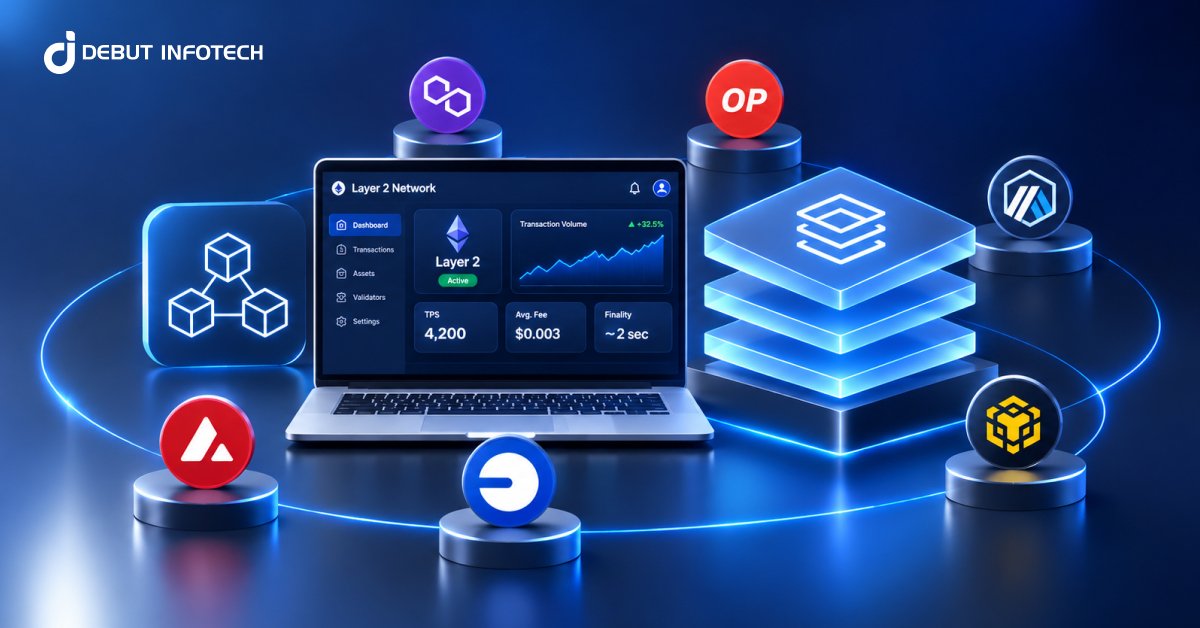


Custom Layer 2 blockchain development gives businesses greater flexibility over transaction processing, fee structures, network governance, and execution environments.
Existing Layer 2 networks remain practical for startups and applications with standard requirements, while custom L2 networks suit enterprises needing specialized infrastructure and operational control.
Optimistic rollups, ZK rollups, and Validiums offer different approaches to transaction verification, settlement, and data availability, making architecture selection critical for security and cost management.
OP Stack, Arbitrum Nitro, and ZK Stack provide established frameworks for developing custom blockchain networks without building every infrastructure component from scratch.
Financial services, stablecoin payments, RWA tokenization, blockchain gaming, and supply chain platforms can benefit from dedicated L2 infrastructure when their transaction and operational requirements justify it.
Custom Layer 2 development can cost $80,000–$200,000 for framework-based rollups and $200,000–$500,000+ for advanced implementations, excluding ongoing infrastructure and maintenance expenses.
Successful L2 implementation requires business feasibility assessment, rollup architecture selection, framework configuration, smart contract integration, security testing, production deployment, and continuous network maintenance.
Blockchain scaling has come a long way. What was once a major roadblock for enterprise adoption is now opening the door to an entirely different conversation: how much control should businesses have over the networks running their digital assets and transactions?
The numbers tell an interesting story. According to growthepie, Ethereum Layer 2 networks processed approximately 25.96 million transactions on November 20, 2026, representing nearly 93% of daily transactions across its tracked Ethereum ecosystem.
That’s a remarkable shift in where blockchain activity takes place. But there’s more to the story than faster transactions and lower fees.
As companies move from experimental blockchain projects to revenue-generating products, their infrastructure requirements are becoming harder to accommodate through a one-size-fits-all approach. Payment providers want predictable settlement costs. Financial institutions need tighter operational oversight. Businesses managing tokenized assets may require greater control over transaction rules.
And while existing Layer 2 networks can meet many of these needs, they aren’t necessarily the right fit for every business.
This is why Layer 2 blockchain development is entering a new phase as organizations plan for 2027. Custom L2 networks offer the possibility of dedicated execution environments built around specific commercial requirements.
But is launching your own network worth the investment?
Let’s examine what’s driving this shift and when custom Layer 2 infrastructure makes business sense.
For years, one of blockchain’s biggest challenges has been processing more transactions without sacrificing security or pushing fees beyond what users are willing to pay.
Layer 2 technology helps address that problem by moving transaction execution away from the underlying blockchain while retaining defined connections to its settlement and security mechanisms.
Take Ethereum, for example. Instead of processing every transaction directly on the mainnet, rollups execute transactions separately and submit the necessary data or cryptographic commitments to Ethereum.
This allows applications to handle considerably more activity without placing the entire execution burden on Layer 1.
However, businesses considering Layer 2 blockchain solutions need to understand an important distinction.
Using an existing Layer 2 network and developing a custom Layer 2 network are two different investments.
With an existing network, your development team can focus on building applications and integrating blockchain functionality. Much of the infrastructure is already available.
Custom Layer 2 development takes things further. Your organization can configure its own network using established rollup frameworks and make more decisions about transaction processing or fee structures. Depending on the architecture, it may also control governance and network access.
That flexibility comes at a price. The business becomes responsible for more of the infrastructure supporting its product.
And that’s where the discussion moves beyond technology into long-term business strategy.
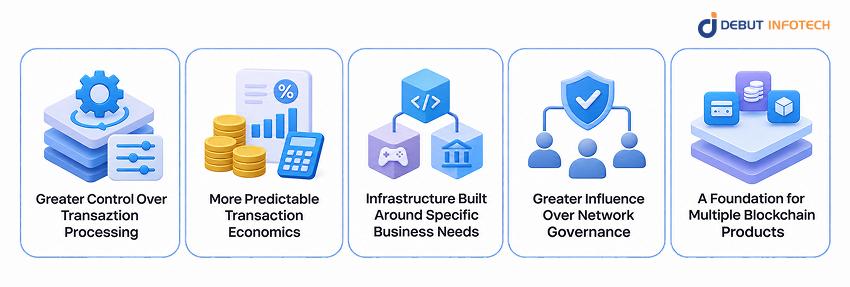
A few years ago, the conversation around blockchain scaling was relatively straightforward. Developers wanted faster transactions and lower gas fees. Businesses wanted applications that customers could use without paying excessive network charges.
Layer 2 networks helped make that possible.
But as blockchain adoption moves into more demanding commercial environments, businesses are starting to ask tougher questions.
Can the infrastructure support our expected transaction volumes? What happens when network conditions change? How much control do we have over operating costs? And can the network accommodate the requirements of several products under the same business?
These questions explain why custom Layer 2 networks are becoming an option worth evaluating.
In fact, the Ethereum Foundation’s March 2026 discussion of Ethereum’s L1 and L2 relationship explicitly recognized specialization and customization as reasons for different blockchain networks to exist.
Here’s what that means for businesses preparing their next infrastructure investment.
Shared blockchain networks operate according to established execution rules. While that arrangement works well for many applications, businesses with specialized workloads may want greater control over how transactions are processed.
Consider a payment provider handling frequent transfers between customers and merchants.
A dedicated network could allow the company to configure processing policies around its payment workflows and transaction priorities.
The advantage is not simply higher transaction capacity. It is the opportunity to make network-level decisions based on how the business actually operates.
Of course, dedicated infrastructure doesn’t automatically guarantee faster processing. Actual performance still depends on the network architecture and available resources.
Low fees are attractive. Predictable costs are what make financial planning easier.
For a business processing substantial transaction volume, unexpected changes in network expenses can complicate pricing decisions and reduce operating margins.
Custom Layer 2 solutions may support configurable fee mechanisms that give operators greater flexibility over how transaction charges are calculated.
This can be useful for companies developing payment products or digital asset services that depend on consistent pricing.
However, there’s a catch.
Operating your own network introduces expenses for sequencing and infrastructure maintenance. Settlement and data availability costs also remain relevant.
The financial case therefore depends on whether dedicated infrastructure produces better economics across the entire operating model.
A blockchain gaming platform and an institutional settlement system may both require affordable transactions. Beyond that, their requirements can be very different.
Gaming applications may prioritize frequent transfers of digital assets. Financial institutions may place greater emphasis on controlled execution and operational oversight.
A custom network allows businesses to configure supported infrastructure components around these differences.
For example, a company may introduce transaction permissions or specialized execution functionality rather than rely entirely on the rules of a general-purpose network.
The opportunity lies in choosing an architecture that supports the product instead of repeatedly adapting the product to the infrastructure.
Businesses building on public networks must operate within the governance and upgrade decisions of those networks.
For many companies, this is an acceptable tradeoff. It reduces the responsibility involved in maintaining blockchain infrastructure.
Others may need more influence over when upgrades occur and how operational changes are approved.
A custom L2 can support dedicated governance arrangements and more direct control over selected network components.
This becomes relevant when applications support business-critical processes.
Still, greater control also introduces greater accountability. Poorly managed upgrade permissions can expose the network to serious security risks.
Some businesses begin with one blockchain application and gradually introduce additional services.
A digital asset platform might expand into payments or tokenized asset management. Over time, operating these products through a dedicated execution environment could become commercially attractive.
Custom Layer 2 infrastructure can support this approach when the applications share meaningful technical requirements.
The important point is that businesses should not build a separate chain merely because they expect to grow.
They should establish whether that growth genuinely requires infrastructure ownership.
The real opportunity is to gain control where it creates business value without taking on complexity that serves no clear purpose.
Now comes the decision that deserves serious attention from business leaders.
Should your organization launch a dedicated Layer 2 network or continue building on an established one?
At first glance, owning the infrastructure may appear more attractive. You can configure supported network components and establish operating procedures that fit your requirements.
But owning more of the technology also means maintaining more of it.
For businesses evaluating enterprise Layer 2 blockchain solutions, the following comparison provides a useful starting point.
| Business consideration | Existing Layer 2 | Custom Layer 2 |
| Initial investment | Generally lower network-level costs | Additional infrastructure investment |
| Network control | Depends on the existing network | Greater configuration flexibility |
| Transaction fees | Established network fee structure | Configurable fee policies |
| Liquidity | Access to existing ecosystem services | May require new liquidity integrations |
| Security | Depends partly on host-network safeguards | Additional operational responsibilities |
| Governance | Subject to network policies | More control over upgrade decisions |
| Maintenance | Shared infrastructure responsibilities | Dedicated maintenance requirements |
| Best fit | Applications with standard network needs | Products requiring specialized execution |
Imagine a fintech startup introducing cryptocurrency payments to its customers.
Its immediate priorities are straightforward. The company wants reliable transactions and wallet connectivity. It also needs manageable processing fees without taking on unnecessary infrastructure expenses.
An established Ethereum Layer 2 could satisfy these requirements.
Building a dedicated network at this stage may divert resources from product development and customer acquisition.
The business would be paying to operate infrastructure before establishing whether it needs that level of control.
For early-stage products and applications with conventional requirements, using an existing Layer 2 often makes more commercial sense.
Now consider an established digital asset business operating multiple transaction-intensive applications.
It may need specialized execution rules and coordinated network governance. The organization might also have enough transaction activity to justify a dedicated operating environment.
Under these circumstances, custom Layer 2 blockchain development becomes a more serious investment option.
The business case should answer three questions:
If the answers are convincing, a custom L2 may be worth pursuing.
Otherwise, the additional engineering investment could be better spent on the application itself.
Choosing to build a dedicated network is only half the battle. The next challenge is deciding how that network should work.
Different scaling architectures handle transaction verification and settlement in different ways.
These choices affect performance and withdrawal behavior. They also determine which security assumptions the business must accept.
Three approaches are particularly relevant during the evaluation process.
Optimistic rollups process transactions outside the main blockchain and submit transaction data along with state commitments to Ethereum.
Instead of proving every state transition immediately, the system generally assumes submitted transitions are valid unless challenged through a dispute mechanism.
This design can support Ethereum-compatible applications while reducing direct execution requirements on the mainnet.
For businesses, the main considerations include challenge periods and withdrawal settlement.
Canonical withdrawals may involve waiting for the relevant dispute period to pass.
The organization must also verify that the network’s fraud-proof system is properly implemented and available to the parties expected to use it.
Zero-knowledge rollups take a different approach.
They use cryptographic validity proofs to demonstrate that transaction state transitions follow the protocol rules.
Ethereum can verify these proofs without having to execute every transaction directly.
This creates a different verification model from optimistic rollups.
However, the system requires proving infrastructure. Depending on the implementation, proof generation can introduce additional engineering and operating costs.
For enterprise buyers, the decision should consider application compatibility and security requirements alongside the economics of proof generation.
Validiums also use validity proofs. The major difference is where transaction data is stored.
Instead of publishing the data required for state reconstruction to Ethereum, validiums rely on external data availability arrangements.
This can reduce data publication costs.
But it also introduces additional trust and recovery considerations.
If the required data becomes unavailable, users may face difficulties reconstructing the network’s state or accessing their assets.
Businesses should therefore avoid treating a validium as equivalent to an Ethereum rollup with on-chain data availability.
| Architecture | Verification mechanism | Key business consideration |
| Optimistic Rollup | Dispute or fraud proofs | Challenge periods and exit mechanisms |
| ZK Rollup | Cryptographic validity proofs | Proving costs and implementation complexity |
| Validium | Validity proofs with external data availability | Data recovery and availability risks |
There is no universally superior approach.
The choice comes down to which combination of cost and security guarantees fits the business’s risk tolerance.
Building a blockchain network used to involve developing extensive infrastructure from the ground up.
Today, established rollup frameworks provide reusable components that can significantly reduce the amount of custom engineering required.
That doesn’t eliminate technical complexity. It does give businesses more practical ways to develop dedicated blockchain networks.
Three frameworks stand out for enterprise evaluation.
OP Stack provides open-source infrastructure for developing Ethereum-compatible rollup chains.
The framework allows developers to configure supported network components instead of creating an entire execution system from scratch.
Its architecture is relevant to businesses seeking dedicated execution while retaining compatibility with established Ethereum development tools.
Companies evaluating OP Stack should consider data availability choices and fee configuration. Upgrade management and interoperability also deserve attention.
Arbitrum Chains provide technology for creating customizable blockchain networks using Arbitrum infrastructure.
Businesses can configure several elements of the operating environment. These include supported data availability arrangements and transaction fee options.
One important distinction deserves attention: Arbitrum technology supports both chains settling directly to Ethereum and L3 arrangements settling through another blockchain.
These configurations do not carry identical settlement dependencies.
For organizations considering Arbitrum-based infrastructure, the evaluation should begin with the intended parent chain and security model.
ZK Stack provides infrastructure for developing configurable ZKsync chains.
The technology supports validity-proof-based networks and different data availability arrangements.
This gives developers options for building dedicated execution environments around application requirements.
Businesses evaluating ZK Stack should examine proof-generation costs and deployment complexity. Compatibility with existing applications should also be considered.
| Framework | Core approach | What businesses should evaluate |
| OP Stack | Ethereum-compatible rollup infrastructure | Execution compatibility and interoperability |
| Arbitrum Chains | Configurable chain infrastructure | Settlement arrangements and operational flexibility |
| ZK Stack | Validity-proof-based networks | Proving infrastructure and data availability |
Framework selection should not become a popularity contest.
A company with an extensive EVM application portfolio may prioritize compatibility. Another business may place greater weight on its preferred verification mechanism.
The right framework is the one that satisfies the technical requirements without creating unnecessary operating dependencies.
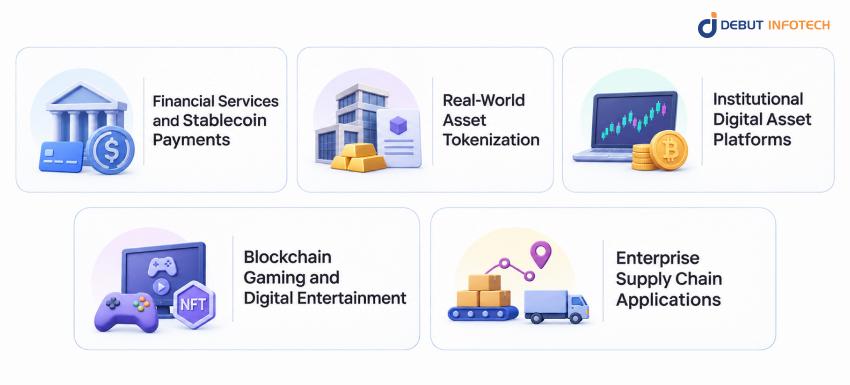
The case for dedicated blockchain infrastructure becomes clearer when we move away from technical specifications and look at how businesses operate.
A company handling occasional digital asset transfers doesn’t have the same requirements as a payment processor or an institutional settlement platform.
For certain industries, that difference can make custom infrastructure worth considering.
Payment businesses need more than fast transactions. They need dependable processing and predictable settlement arrangements that fit their existing financial operations.
A custom Layer 2 can support payment-specific execution rules and configurable transaction fees.
Consider a payment provider handling a large number of low-value transfers. The organization may want more control over transaction pricing so it can build a consistent fee structure for customers.
Dedicated infrastructure could support that objective.
However, stablecoin payment operations still depend on banking arrangements and liquidity access. Blockchain customization cannot replace those requirements.
Tokenization is bringing a wider range of assets into blockchain-based systems.
But managing tokenized assets involves more than transferring tokens between wallets.
Some products require investor eligibility checks and restrictions on transfers. Others involve ongoing asset servicing or settlement processes.
A custom network may be appropriate when several tokenized asset applications need to operate under consistent execution and governance rules.
The investment becomes harder to justify if the business only needs to issue a limited number of tokens.
Institutional financial operations demand clear accountability.
Technology teams need to understand how transactions are processed and which parties control critical infrastructure. They must also establish procedures for system upgrades and incident response.
Custom Layer 2 networks can help organizations configure selected network operations around these requirements.
For financial institutions exploring the broader opportunity, our guide to Layer 2 blockchain solutions for banks and fintech examines relevant infrastructure considerations.
The important distinction is that a custom network provides architectural flexibility. Regulatory compliance and secure custody still require separate controls.
Blockchain games can generate substantial transaction activity through asset transfers and other player interactions.
A dedicated execution environment may help developers manage these workloads more directly.
For example, a gaming company could configure transaction fees around frequent low-value interactions rather than depend entirely on a shared network’s fee policies.
That flexibility may become valuable for established products with significant on-chain activity.
Smaller games may find that an existing Layer 2 offers everything they need at a lower operating cost.
Supply chain operations often involve several businesses coordinating information across different systems.
Blockchain can provide a shared transaction record where participants need verifiable updates and consistent execution rules.
A custom Layer 2 may be considered when an enterprise requires dedicated infrastructure for interconnected supply chain applications.
However, companies should first establish whether a blockchain is necessary.
If conventional databases and integration services can meet the same requirements more efficiently, introducing dedicated blockchain infrastructure may create unnecessary complexity.
Across these industries, the underlying lesson is the same.
The value of a custom L2 comes from solving a specific operational challenge rather than simply introducing another blockchain network.
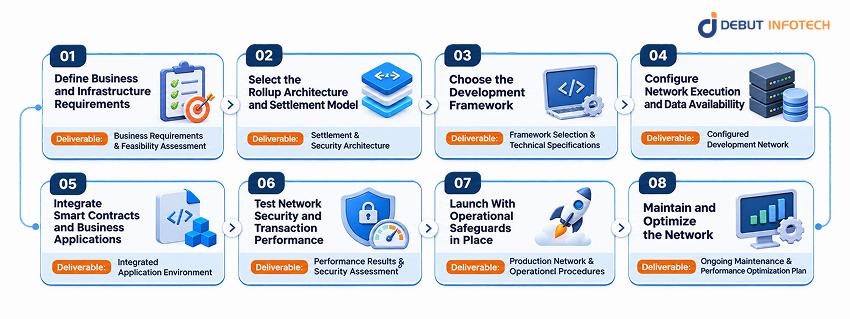
Once the business case is established, attention turns to implementation.
And this is where careful planning can save organizations from expensive mistakes.
A custom network may appear straightforward when built using an established framework. However, getting the chain running is only one part of the process.
The real challenge is making sure the network can support production workloads and remain secure over time.
Here’s how businesses can approach development.
Before selecting a blockchain framework, establish what the network needs to accomplish.
Start with transaction volume projections and performance requirements. Identify which applications will operate on the network and why existing Layer 2 solutions are insufficient.
The development team should also document integration requirements and any special transaction rules.
This discovery process creates the foundation for the architecture.
Key deliverable: Business requirements and feasibility assessment.
Next comes the decision about how transactions will be verified and settled.
Will the network use an optimistic or ZK rollup architecture? Where will it settle its state commitments? What security guarantees must users be able to rely on?
These decisions influence withdrawal behavior and recovery mechanisms.
They also determine which infrastructure components the business will need to maintain.
Key deliverable: Settlement and security architecture.
With the architecture defined, evaluate frameworks such as OP Stack or ZK Stack.
Compare supported features against your application’s requirements.
The team should consider execution compatibility and the effort required for future upgrades.
Choosing a framework early without understanding these requirements can create limitations that become expensive to address later.
Key deliverable: Framework selection and technical specifications.
Now the development work begins.
Engineers configure the sequencer and supporting blockchain nodes. They also establish transaction processing rules and connect the chosen data availability infrastructure.
The network must be able to publish the information required by its security model.
These components should be tested together before additional application functionality is introduced.
Key deliverable: Configured development network.
Once the underlying infrastructure is operational, the team can connect the applications that will use it.
This may involve deploying smart contracts, smart contract audits, and integrating wallets or existing enterprise systems.
Businesses requiring cross-chain asset transfers must also evaluate bridge architecture.
These integrations should be designed around real customer workflows rather than isolated transactions.
Key deliverable: Integrated application environment.
A blockchain can process transactions successfully during development and still fail to meet production requirements.
That is why testing must go beyond ordinary functionality.
The development team should evaluate performance under realistic workloads and verify how the system behaves when network components become unavailable.
Critical smart contracts and privileged access mechanisms require security review.
Independent assessments are particularly important when the network will hold or transfer valuable assets.
Key deliverable: Performance results and security assessment.
Production deployment requires more than moving the code to a live environment.
Monitoring systems must be configured and recovery procedures documented.
The business should establish who is responsible for network upgrades and critical operating decisions.
A controlled launch can help identify unexpected behavior before transaction volumes increase.
Key deliverable: Production network and operational procedures.
Blockchain development doesn’t end when the network goes live.
Infrastructure components require monitoring and updates. The team must also track settlement expenses and respond to security issues.
As the business expands, operating data can help determine whether additional infrastructure changes are necessary.
Key deliverable: Ongoing maintenance and performance optimization plan.
Custom Layer 2 blockchain development typically requires an indicative budget of $80,000 to $200,000 for a framework-based rollup. More advanced implementations can start at $200,000 and exceed $500,000 when businesses require extensive protocol customization or complex cross-chain infrastructure. These are published development-provider estimates rather than standardized industry averages.
Merehead+2
And that’s only the upfront investment.
A business deploying smart contracts on an established network can avoid many of the expenses involved in running its own blockchain. Launching a dedicated rollup brings additional engineering work and ongoing infrastructure costs.
For enterprises planning their 2027 blockchain investments, the real question is how much network ownership their business needs and whether that control will pay off over time.
Not every business needs the same level of customization. Some can use existing rollup frameworks with relatively few changes. Others require dedicated execution environments and more complicated settlement arrangements.
Here’s how the development budgets compare.
| Development approach | Estimated cost (USD) | Suitable for |
| Framework-Based Custom L2 | 80,000–200,000 | Standard rollup deployment using established frameworks |
| Advanced Custom L2 | 200,000–500,000+ | Complex execution requirements and specialized integrations |
| Managed Rollup-as-a-Service | Custom quote + recurring fees | Businesses seeking reduced infrastructure management responsibilities |
Managed solutions offer a different cost structure. For instance, a company like Conduit currently lists custom subscription pricing plus 5% of sequencer profit for its managed-chain plans.
The right investment depends on the network architecture and how much engineering responsibility your organization wants to retain.
Two businesses can choose the same rollup framework and still receive very different development quotes.
A standardized deployment might need limited configuration. An enterprise developing specialized transaction processing or cross-chain functionality will require more engineering.
The following table outlines the major cost components.
| Cost factor | What it involves | Estimated cost (USD) |
| Network Architecture | Settlement model and technical planning | 5,000–15,000 |
| Rollup Framework | OP Stack, Arbitrum, or ZK Stack configuration | 15,000–40,000 |
| Execution Infrastructure | Sequencer setup and blockchain nodes | 10,000–30,000 |
| Data Availability | Data publication and storage integration | 5,000–15,000 |
| Smart Contract Development | Application logic and protocol integration | 10,000–30,000 |
| Cross-Chain Integration | Bridge configuration and asset transfers | 10,000–35,000 |
| Security Testing | External audits and infrastructure assessments | 15,000–100,000+ |
| Operational Infrastructure | Hosting, RPC services, and monitoring | 3,000–15,000/month |
| Maintenance | Network upgrades and technical support | 5,000–20,000/month |
The largest budget differences usually come from custom engineering and security requirements.
For example, using an established bridge can reduce implementation work. Building a new cross-chain protocol introduces substantially more testing and security exposure.
Security spending deserves particular attention. Pharos Production’s 2026 research reports audit pricing from approximately $25,000 to $80,000 for mid-tier engagements and $80,000 to $350,000 for top-tier reviews. A complex rollup or bridge may require a broader audit scope.
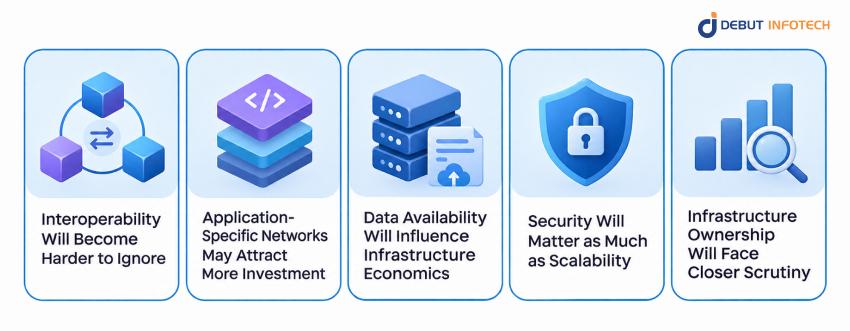
The next chapter of blockchain scaling is unlikely to be defined by transaction speed alone.
That problem hasn’t disappeared. But the rapid growth of L2 infrastructure has brought other priorities into sharper focus.
Businesses now have more choices about where their applications run and how much of the underlying infrastructure they want to control.
The Ethereum Foundation’s 2026 protocol priorities point toward continued scaling and improved interoperability. Meanwhile, rollup frameworks are making customizable networks more accessible.
These developments suggest several areas worth watching as businesses prepare their 2027 technology plans.
Launching a dedicated blockchain is one thing. Connecting it to the wider ecosystem is another.
As more applications operate across different networks, businesses need reliable ways to move assets and exchange information between them.
A custom L2 that offers strong performance but limited connectivity may struggle to attract users.
This places greater importance on cross-chain messaging and infrastructure compatibility.
For enterprise buyers, interoperability deserves a place alongside transaction performance during network evaluation.
Not every business needs its own blockchain.
However, organizations with specialized transaction requirements may increasingly evaluate dedicated execution environments.
Financial settlement and digital asset infrastructure are among the areas where customization could offer commercial value.
The key is whether the business can demonstrate sufficient demand and a sustainable operating model.
Data availability remains an important part of Layer 2 operating costs.
Ethereum’s continued work on blob capacity is intended to support the scaling needs of rollup networks.
These changes could improve the economics of transaction data publication over time.
Yet businesses should avoid building investment models around unverified future savings.
Actual expenses will depend on network usage and the chosen data availability arrangement.
Deploying a rollup is becoming more accessible.
Operating one with dependable security guarantees remains a demanding responsibility.
Businesses handling customer assets must look beyond processing capacity to understand upgrade permissions and recovery mechanisms.
Independent security assessments will remain important when evaluating the maturity of dedicated network infrastructure.
As the technology matures, enterprises will have more opportunities to compare custom L2 development against established networks.
That comparison will likely become more financially disciplined.
Instead of asking whether the organization can launch a blockchain, decision-makers will want to know what owning it delivers.
Does it reduce operating costs at the expected scale? Does it support requirements that shared networks cannot meet? Will it remain manageable as the business expands?
The answers will shape which custom networks are commercially sustainable.
The opportunity in 2027 isn’t simply to launch another Layer 2. It’s to build infrastructure that earns its place in the business.
Building custom blockchain infrastructure calls for more than a team that understands smart contracts.
The development partner must recognize how execution architecture and operational responsibilities affect the business.
That means asking difficult questions before recommending a particular framework.
Can the existing blockchain ecosystem support the application? What would justify launching a dedicated network? Which costs will continue after deployment?
An experienced development partner should help answer these questions instead of treating custom infrastructure as the default solution.
Here are six capabilities worth considering during evaluation:
For organizations evaluating Layer 2 blockchain development services for enterprises, these considerations are just as important as a provider’s preferred technology stack.
A custom Layer 2 investment should start with a clear understanding of what the business needs from its infrastructure.
At Debut Infotech, we help organizations evaluate blockchain requirements and develop solutions that align with their commercial objectives. Our blockchain development services support businesses exploring custom networks and related blockchain applications.
Whether your organization is planning a blockchain-based financial product or evaluating dedicated execution infrastructure, the first step is understanding the available architectural options.
That includes determining whether an established L2 can satisfy your requirements before committing to a separate network.
The result should be a development plan grounded in business priorities and realistic operational expectations.
Layer 2 networks have changed what’s possible for blockchain applications.
The growing share of transactions processed beyond Ethereum’s mainnet shows how important scaling infrastructure has become.
But the next phase of adoption presents a different challenge.
For business leaders preparing their 2027 investment plans, the question is no longer whether Layer 2 technology works. It’s how much control the organization needs over the infrastructure supporting its products.
Existing networks remain a practical choice for businesses that want established functionality without additional operating responsibilities.
Custom L2 networks deserve consideration when specialized requirements make dedicated execution commercially valuable.
The distinction matters.
Building your own network may provide greater control over transaction processing and governance. But it also means taking responsibility for infrastructure that must remain secure and reliable over time.
The businesses that benefit most won’t necessarily be those launching the most networks. They’ll be the ones making the right infrastructure decisions for their long-term needs.
Custom Layer 2 networks can help businesses build blockchain infrastructure around their specific transaction requirements. They offer greater flexibility over supported execution settings and network operations. As companies evaluate long-term blockchain investments in 2027, dedicated networks may become more relevant for specialized applications. However, the additional infrastructure costs and security responsibilities must justify the commercial benefits.
Businesses can build a custom Ethereum Layer 2 by selecting a suitable rollup framework and defining the network’s settlement architecture. The development process includes configuring execution infrastructure and data availability mechanisms. Teams must also integrate applications and test security before deployment. A production-ready network requires ongoing monitoring and clearly assigned operational responsibilities.
The right framework depends on your application requirements and preferred security model. OP Stack provides Ethereum-compatible rollup infrastructure, while Arbitrum technology supports configurable chain deployments. ZK Stack offers validity-proof-based network architecture. Businesses should evaluate compatibility and infrastructure costs before selecting a framework. No single option is appropriate for every commercial application.
Custom Layer 2 blockchain development typically costs 80,000–200,000 for a framework-based rollup, while advanced networks with extensive customization can cost 200,000–500,000 or more. These are indicative industry estimates. Actual costs depend on the rollup architecture and integration requirements. Businesses must also budget for security audits and ongoing infrastructure maintenance.
The main challenges include sequencer reliability and network security. Businesses must also address data availability and access to cross-chain liquidity. These issues can affect customer experience and operational continuity. A dedicated network requires regular updates and technical support after launch. Organizations should assess these responsibilities before deciding to operate their own blockchain infrastructure.
Enterprises should generally consider existing Layer 2 networks first when their applications can operate within standard execution environments. Custom networks become more attractive when the business needs specialized configurations or greater operational control. The decision should account for development expenses and long-term maintenance. A feasibility assessment helps determine whether dedicated infrastructure offers measurable value.

USA
2501 Chatham, Rd Suite R Springfield, IL 62704
+1-708-515-4004
info@debutinfotech.com
UK
7 Pound Close, Yarnton, Oxfordshire, OX51QG
+44-770-304-0079
info@debutinfotech.com
Canada
154 Eden Oak Trail, Kitchener, ON N2A 0H9
+1-708-515-4004
info@debutinfotech.com
INDIA
Sector 101-A, Plot No: I-42, IT City Rd, JLPL Industrial Area, Mohali, PB 140306
9888402396
info@debutinfotech.com