ON THIS PAGE
Progress0%






Our Global Presence :





Layer 2 blockchain solutions enable enterprise scale transaction processing while preserving Layer 1 security, making them essential as the global tokenization market is projected to grow from $3.47 billion in 2024 to $13.53 billion by 2030 (26.2% CAGR)
Interoperability and cross chain settlement are becoming strategic priorities as BCG estimates tokenized real world assets (RWAs) could reach $14 trillion by 2030, requiring scalable, compliant blockchain infrastructure.
Development costs extend beyond core infrastructure, as compliance engineering, smart contract audits, cloud infrastructure, security testing, and post launch maintenance significantly influence the total cost of ownership.
Growing institutional adoption of digital assets reinforces the need for scalable Layer 2 networks, with stablecoins surpassing $300 billion in market capitalization and tokenized U.S. Treasuries reaching approximately $13.6 billion in April 2026, up 170% year over year.
Security first architecture is critical for regulated financial institutions, requiring embedded AML/KYC workflows, independent smart contract audits, resilient infrastructure, and continuous compliance monitoring throughout the platform lifecycle.
Banks, fintech companies, and payment platforms are under growing pressure to process larger transaction volumes while delivering faster, lower-cost services.
Traditional financial infrastructure often struggles with cross-border settlements, fragmented reconciliation processes, and rising operational costs. Although public Layer 1 (L1) blockchains introduced transparent and secure digital settlement, they were not designed to support enterprise-scale financial workloads.
Limited throughput, network congestion, and fluctuating transaction fees make direct L1 deployments impractical for institutions handling millions of transactions daily.
Layer 2 blockchain solutions address these limitations by moving transaction execution away from the main blockchain while retaining its security. This approach significantly improves throughput, lowers settlement costs, and shortens confirmation times without requiring institutions to sacrifice decentralization or trust.
As financial institutions increasingly explore tokenized assets, programmable payments, and digital settlement networks, L2 infrastructure is becoming a practical foundation rather than an emerging experiment.
This guide explains how Layer 2 blockchain solutions support banks, fintech companies, and payment platforms. It covers the business drivers behind enterprise adoption, real-world institutional implementations, technology architecture, security and compliance considerations.
Lastly, it explains implementation steps, estimated development costs, common deployment challenges, and the criteria for selecting the right blockchain development partner.
Enterprise adoption of Layer 2 blockchain solutions is accelerating as financial institutions move from experimentation to production deployments.
Banks, fintech companies, payment providers, and asset managers are increasingly investing in blockchain infrastructure to improve settlement efficiency, reduce operating costs, and support asset tokenization development.
At the same time, advances in Layer 2 technologies, stablecoins, and tokenization are creating the technical foundation needed for enterprise-scale blockchain adoption.
1. Per Grand View Research, the global tokenization market is projected to grow from approximately $3.47 billion in 2024 to $13.53 billion by 2030, representing a CAGR of 26.2%. This rapid growth reflects increasing enterprise demand for tokenized assets, digital securities, and blockchain-based financial infrastructure.
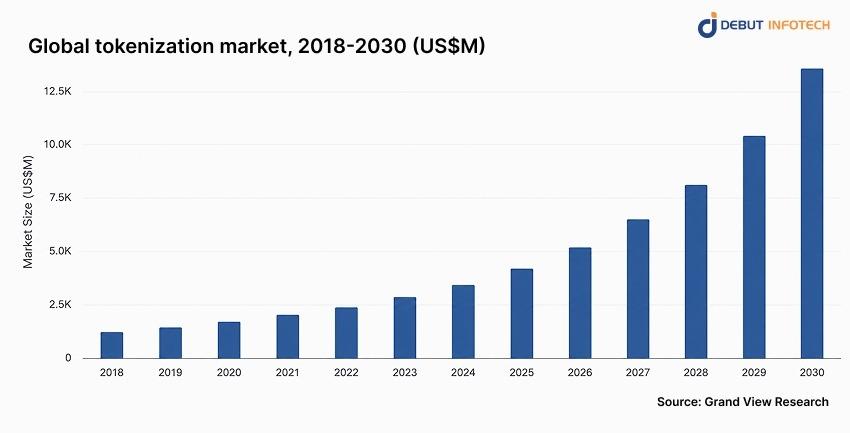
As more institutions issue and manage tokenized assets, scalable Layer 2 networks will become increasingly important for handling higher transaction volumes efficiently.
2. Boston Consulting Group (BCG) estimates that tokenized real-world assets (RWAs) could reach approximately $14 trillion by 2030 and $55 trillion by 2035 under its baseline scenario.
Such growth would require blockchain infrastructure capable of processing enterprise-scale transaction volumes while maintaining security, compliance, and interoperability. Layer 2 solutions are expected to play a central role in supporting this expansion.
3. Stablecoins have surpassed $300 billion in market capitalization, while tokenized U.S. Treasuries reached approximately $13.6 billion in April 2026, representing 170% year-over-year growth.
This demonstrates growing institutional confidence in blockchain-based settlement and the high demand for stablecoin development.
It also highlights increasing demand for scalable infrastructure capable of supporting regulated digital assets and high-volume financial transactions.
4. Visa continues to expand its stablecoin initiatives as financial institutions adopt blockchain-based settlement.
According to Visa’s research, non-USD stablecoin adoption is growing rapidly across more than 30 blockchain networks, reflecting increasing institutional interest in using blockchain infrastructure for cross-border payments, treasury management, and settlement services.
This trend further reinforces the need for Layer 2 solutions that can deliver enterprise-grade scalability and lower transaction costs.
Layer 2 blockchain solutions are changing how financial institutions process payments, settle transactions, and manage digital assets.
Rather than replacing existing banking infrastructure, they introduce a scalable settlement layer that works alongside established systems. This enables institutions to improve efficiency while preserving investments in legacy technology.
As enterprise blockchain adoption accelerates, L2 networks are becoming a practical tool for addressing operational challenges that have persisted for decades.
Traditional cross-border payments often involve multiple correspondent banks, manual reconciliation, and settlement cycles that can take one to five business days.
Layer 2 networks reduce these delays by processing transactions off-chain before recording the final state on the underlying Layer 1 blockchain.
Layer 2 blockchain technology in payments significantly shortens settlement times, enabling many transfers to reach near-real-time completion while maintaining cryptographic security.
Faster settlement improves liquidity management across financial institutions. Banks no longer need to maintain large amounts of idle capital to support delayed settlements, while payment providers can recycle working capital more efficiently. These improvements reduce operational costs and enhance the customer experience for both retail and enterprise clients.
High gas fees have long limited enterprise blockchain adoption. During periods of heavy network activity, executing thousands of transactions directly on Layer 1 becomes financially inefficient.
Layer 2 networks batch numerous transactions into a single submission, spreading costs across many participants and significantly reducing the average fee per transaction.
Lower transaction costs make new financial services economically viable.
Institutions can process micropayments, recurring machine-to-machine transactions, digital loyalty rewards, and high-frequency settlements without transaction fees exceeding the value of the payment itself. This expands the range of products banks and fintech companies can offer while improving profitability.
Every transaction recorded through Layer 2 contributes to an immutable audit trail that authorized stakeholders can verify.
Unlike fragmented legacy systems that require reconciliation across multiple databases, blockchain-based settlement creates a shared source of truth for participating institutions. This transparency benefits regulators, auditors, and compliance teams by providing real-time visibility into transaction histories.
Instead of relying primarily on post-event reporting, institutions can continuously monitor settlement activity, identify anomalies earlier, and simplify financial reporting requirements.
Financial institutions are expanding beyond digital payments into tokenized financial products.
Layer 2 infrastructure enables the efficient issuance, transfer, and settlement of tokenized deposits, money market funds, real estate investments, private equity holdings, and other real-world assets. These assets benefit from programmable ownership, faster transfers, lower administrative costs, and fractional ownership models.
Banks can introduce entirely new investment products while reducing the complexity traditionally associated with custody, settlement, and recordkeeping.
Enterprise blockchain adoption does not require replacing core banking platforms.
Most implementations rely on middleware that connects Layer 2 infrastructure with payment gateways, customer databases, core banking systems, enterprise resource planning platforms, and compliance tools. This integration strategy reduces implementation risk while allowing institutions to modernize incrementally.
Existing customer-facing applications continue operating with minimal disruption, while blockchain infrastructure enhances settlement, reporting, and reconciliation behind the scenes.
Institutional interest in Layer 2 technology continues to grow as financial organizations move beyond proof-of-concept projects toward production deployments.
Banks, payment providers, and asset managers increasingly recognize that scalable blockchain infrastructure can improve operational efficiency without compromising regulatory obligations.
The expansion of tokenized funds, digital asset custody services, and blockchain-based payment networks demonstrates that enterprise adoption is shifting from experimentation to commercial implementation.
As more regulated institutions deploy L2 infrastructure, industry standards and interoperability are also improving.
Layer 2 blockchain solutions provide opportunities to embed compliance directly into transaction workflows.
Smart contracts can automatically enforce transaction limits, identity verification requirements, reporting obligations, and predefined business rules before settlement occurs.
This represents a shift from reactive compliance toward continuous compliance. Rather than identifying issues after transactions have settled, financial institutions can automate policy enforcement in real time.
The result is improved regulatory visibility, reduced compliance costs, and stronger operational controls without significantly slowing transaction processing.
Enterprise blockchain adoption is no longer driven solely by innovation goals. It is increasingly shaped by operational efficiency, regulatory expectations, and competitive pressure.
While Layer 1 blockchains established the security model for decentralized systems, they were not designed to support the transaction volumes, performance requirements, and compliance obligations of banks, fintech companies, and global payment platforms.
Layer 2 blockchain solutions bridge this gap by combining the security of Layer 1 with the speed and scalability required for enterprise-grade financial services.
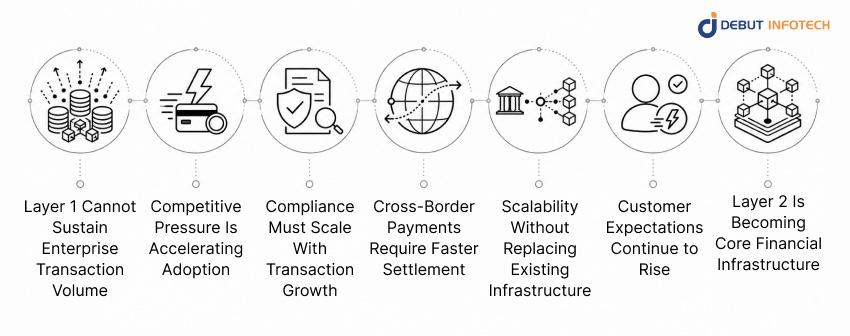
Banks and payment platforms process thousands or even millions of transactions every day. Public Layer 1 networks typically support far fewer transactions per second than enterprise payment systems require.
During periods of network congestion, confirmation times increase while transaction fees become unpredictable. These limitations make direct Layer 1 deployment unsuitable for large-scale payment processing, treasury operations, or securities settlement.
Layer 2 addresses this bottleneck by processing transactions off-chain and periodically committing validated transaction batches to the underlying blockchain.
When utilizing blockchain for cross-border payments, Institutions gain significantly higher throughput while continuing to rely on the security guarantees of the base network. This approach enables enterprise-scale operations without compromising settlement integrity.
Competition within financial services is increasingly based on speed, cost efficiency, and customer experience. Fintech companies are introducing payment services that settle faster and charge lower fees than traditional banking channels.
Financial institutions that continue relying exclusively on legacy payment infrastructure or direct Layer 1 transactions risk higher operating costs and slower service delivery.
Layer 2 allows organizations to remain competitive by supporting instant transfers, programmable payments, and lower transaction costs.
Faster settlement also improves liquidity management, enabling institutions to deploy capital more efficiently rather than holding funds in transit for extended periods.
Regulatory requirements continue to expand across global financial markets. Anti-money laundering (AML), Know Your Customer (KYC), sanctions screening, transaction monitoring, and audit reporting must all operate alongside increasing payment volumes.
Traditional compliance processes often introduce additional operational overhead as transaction activity grows. Layer 2 infrastructure enables compliance controls to be incorporated directly into transaction workflows.
Smart contracts can automatically verify predefined conditions before settlement, while integrated reporting mechanisms generate auditable records in real time. This reduces manual intervention and helps institutions maintain regulatory compliance without significantly affecting processing performance.
International payments remain one of the most complex areas of financial infrastructure. Multiple intermediaries, correspondent banking relationships, currency conversions, and reconciliation processes contribute to delays, higher costs, and trapped liquidity. Businesses often wait several days before funds become fully available.
Layer 2 networks streamline settlement by reducing dependence on lengthy intermediary processes. Near real-time settlement shortens payment cycles, lowers liquidity requirements, and improves transparency throughout the transaction lifecycle. These improvements are particularly valuable for multinational corporations, remittance providers, and global payment networks handling continuous cross-border activity.
Modernizing financial infrastructure does not require replacing decades of investment in core banking platforms.
Most enterprise Layer 2 implementations operate alongside existing systems through middleware, APIs, and integration layers. This allows organizations to improve settlement capabilities while preserving customer-facing applications and operational workflows.
A phased integration strategy also reduces migration risk. Institutions can begin with specific use cases, such as cross-border settlements or tokenized asset transfers, before expanding blockchain capabilities across additional business units. This incremental approach minimizes operational disruption while delivering measurable business value.
Consumers and businesses increasingly expect financial transactions to settle within seconds rather than days.
Digital payment platforms have reshaped expectations around speed, transparency, and availability. Financial institutions that cannot match these experiences risk losing customers to more agile competitors.
Layer 2 blockchain solutions provide the infrastructure needed to deliver these expectations consistently. Faster confirmations, lower transaction costs, and improved transaction visibility strengthen customer confidence while enabling financial institutions to introduce new digital services that would be difficult to support using legacy payment rails alone.
Layer 2 has evolved beyond an experimental scaling solution. It is increasingly becoming foundational infrastructure for enterprise blockchain deployments.
Banks, fintech companies, payment providers, and asset managers are incorporating L2 technologies into long-term digital transformation strategies because they offer a practical path toward scalable blockchain adoption.
Organizations that begin planning today are better positioned to integrate tokenized assets, programmable payments, and blockchain-based settlement into their operations.
Early adoption also reduces the cost and complexity of future modernization initiatives, allowing institutions to adapt more efficiently as financial markets continue moving toward digital asset ecosystems.
Table: Enterprise Challenges vs Layer 2 Benefits
| Enterprise Challenge | Layer 2 Solution |
| High gas fees | Transaction batching |
| Slow confirmation | Off-chain execution |
| Cross-border delays | Near real-time settlement |
| Limited scalability | Higher TPS |
| Legacy integration | Middleware & APIs |
| Compliance overhead | Embedded AML/KYC logic |
| Customer expectations | Instant payments |
Enterprise interest in Layer 2 blockchain infrastructure is no longer limited to pilot projects.
Some of the world’s largest financial institutions have already demonstrated how blockchain-based settlement, tokenization, and digital asset management can improve operational efficiency.
Although their implementations vary, they illustrate a broader industry shift toward scalable blockchain infrastructure.
JPMorgan Chase developed Onyx to modernize wholesale payments and digital settlement between institutional participants.
The platform supports blockchain-based transfers and programmable financial transactions while reducing reliance on traditional correspondent banking processes.
Its initiatives demonstrate how distributed ledger technology can improve liquidity management and shorten settlement cycles for institutional clients.
Franklin Templeton and BlackRock have both expanded into tokenized investment products by recording fund ownership on blockchain infrastructure.
Tokenization enables more efficient issuance, transfers, and recordkeeping while improving transparency for investors and administrators.
These initiatives show how blockchain infrastructure extends beyond cryptocurrency applications.
Asset managers are increasingly using distributed ledgers to improve operational efficiency, reduce settlement complexity, and expand access to investment products through fractional ownership models.
Visa has explored stablecoin-based settlement to improve cross-border payment efficiency and reduce delays associated with traditional financial rails.
By integrating blockchain settlement into existing payment infrastructure, Visa demonstrates that digital assets can complement established payment networks rather than replace them.
A Layer 2 blockchain solution is more than a scaling mechanism. It is a collection of technologies that work together to improve transaction throughput while preserving the security of the underlying Layer 1 blockchain.
For banks, fintech companies, and payment platforms, selecting the right architecture affects settlement speed, transaction costs, interoperability, regulatory compliance, and long-term scalability.
Understanding the core infrastructure components helps enterprises design solutions that align with both business objectives and technical requirements.
| Component | Role |
| Rollups | Process transactions off-chain |
| State Channels | High-frequency payments |
| Sidechains | Independent execution |
| Sequencer | Orders transactions |
| Data Availability Layer | Stores transaction data |
| Bridge | Transfers assets |
| Smart Contracts | Automates settlement |
| API | Connect legacy systems |
Rollups are the most widely adopted Layer 2 architecture because they process transactions off-chain before submitting compressed batches to the Layer 1 blockchain. This significantly reduces network congestion and lowers transaction costs while maintaining the security of the base chain.
Enterprises generally choose between Optimistic Rollups and Zero-Knowledge (ZK) Rollups. Optimistic Rollups assume transactions are valid unless challenged through fraud proofs, making them easier to deploy but introducing a delay before final settlement.
ZK Rollups generate cryptographic validity proofs that confirm transaction correctness before submission, enabling faster settlement finality, improved privacy, and stronger assurances for financial institutions handling regulated transactions.
State channels allow two or more participants to conduct multiple off-chain transactions before recording only the final result on the main blockchain. This approach is well-suited for recurring payments, bilateral settlements, or other scenarios involving a fixed group of participants.
Sidechains, by contrast, operate as independent blockchains connected to a Layer 1 network through bridges. They provide greater flexibility and higher throughput but rely on their own consensus mechanisms and security models.
Enterprises should evaluate these trade-offs carefully, particularly when processing high-value financial transactions.
A sequencer is responsible for receiving, ordering, and batching Layer 2 transactions before they are submitted to the settlement layer. Its performance directly affects throughput, latency, and user experience.
Many current Layer 2 networks use centralized sequencers to maximize efficiency.
However, financial institutions increasingly prefer architectures that include decentralized or shared sequencer models to improve resilience, reduce single points of failure, and strengthen trust among multiple participating organizations.
Data availability determines where transaction data is stored and how validators can verify it. Storing all transaction data on Layer 1 provides the highest level of security but increases costs.
Alternative models, including Validium and hybrid data availability architectures, store portions of transaction data off-chain while maintaining cryptographic verification.
Banks processing high transaction volumes often evaluate hybrid approaches because they balance cost efficiency with regulatory requirements for data integrity, recoverability, and auditability.
Most enterprise Layer 2 ecosystems prioritize compatibility with the Ethereum Virtual Machine (EVM).
EVM-compatible environments allow development teams to reuse existing smart contracts, security libraries, developer tools, and testing frameworks without rebuilding applications from scratch.
Popular enterprise development frameworks include OP Stack, Polygon CDK, ZK Stack, and Arbitrum Orbit. Each provides different capabilities for customization, interoperability, governance, and scalability.
The right choice depends on factors such as transaction volume, settlement requirements, privacy needs, and integration with existing enterprise systems rather than on technical popularity alone.
Financial institutions evaluate Layer 2 platforms based not only on performance but also on operational resilience, regulatory compliance, and security.
A scalable blockchain network offers little value if it introduces unacceptable settlement risks or fails to meet regulatory standards.
Enterprise Layer 2 deployments, therefore, require a comprehensive security architecture that addresses infrastructure, governance, compliance, and operational continuity from the outset.
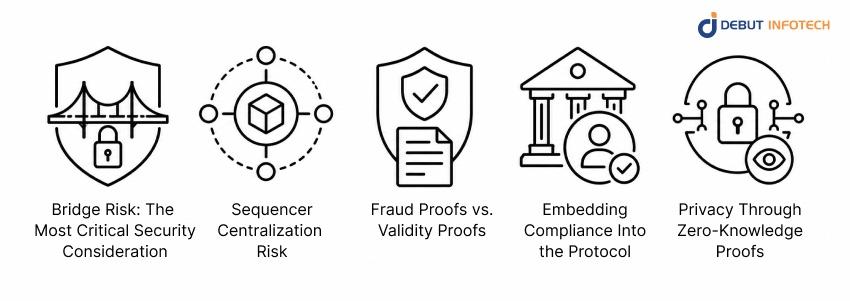
Blockchain bridges connect Layer 2 networks with their underlying Layer 1 blockchains or other blockchain ecosystems. They are essential for transferring assets and data across networks, but have also become among the most frequent targets of blockchain exploits.
Before selecting a bridge, banks should assess its security architecture, validator model, audit history, monitoring capabilities, and incident response procedures.
Canonical bridges maintained by the Layer 2 protocol generally offer stronger security assurances than third-party alternatives, although every implementation should undergo independent risk assessment before production deployment.
Many Layer 2 networks currently depend on a single sequencer to order transactions. While this improves efficiency, it also creates operational and governance risks.
A sequencer outage can temporarily interrupt transaction processing, while malicious behavior could affect transaction ordering or delay settlement.
Enterprises should evaluate sequencer redundancy, decentralization roadmaps, governance structures, and disaster recovery mechanisms.
Financial systems handling high-value transactions benefit from architectures that minimize reliance on a single operational entity.
The method used to verify transactions directly affects settlement guarantees.
Optimistic Rollups rely on fraud-proof windows, allowing participants time to challenge invalid transactions before they become final. This introduces a waiting period that may not align with every financial use case.
ZK Rollups use validity proofs to mathematically verify transaction correctness before settlement. This provides stronger finality guarantees and reduces settlement delays, making them particularly attractive for applications involving institutional payments, securities settlement, and regulated financial products.
Modern Layer 2 solutions increasingly integrate compliance controls directly into smart contract workflows, rather than relying solely on external systems. Identity verification, transaction limits, sanctions screening, and policy enforcement can be automated before transactions are executed.
This approach reduces manual review, strengthens operational consistency, and creates standardized compliance processes across multiple jurisdictions.
Off-chain compliance platforms can still complement these controls by handling document management, customer onboarding, and regulatory reporting.
Financial institutions must balance transaction confidentiality with regulatory transparency.
Zero-knowledge proofs allow selected transaction details to remain private while still proving that regulatory and business requirements have been satisfied.
This capability enables institutions to protect commercially sensitive information without limiting supervisory access.
Regulators can verify compliance through cryptographic evidence and audit trails rather than relying exclusively on unrestricted access to confidential transaction data.
As privacy regulations continue to evolve, zero-knowledge technologies are expected to play an increasingly important role in enterprise blockchain compliance architectures.
Enterprise blockchain adoption rarely takes place on a single network. Banks, fintech companies, and payment platforms often operate across multiple jurisdictions, currencies, payment systems, and blockchain ecosystems.
A Layer 2 solution, therefore, needs more than scalability. It must exchange assets, data, and settlement instructions securely across different networks without introducing operational complexity.
Strong interoperability enables institutions to expand blockchain initiatives while avoiding isolated systems that limit liquidity and increase reconciliation efforts.
Modern cross-chain messaging protocols allow applications running on separate blockchain networks to communicate without relying on centralized intermediaries.
Instead of simply transferring tokens, these protocols securely exchange transaction data, settlement instructions, and application logic between blockchain environments.
Technologies such as LayerZero and Chainlink Cross-Chain Interoperability Protocol (CCIP) enable financial institutions to coordinate transfers across multiple Layer 2 networks while maintaining consistent business rules.
For banks, this creates opportunities to build unified payment ecosystems rather than maintain separate settlement processes for each blockchain deployment.
Financial institutions increasingly manage liquidity across several blockchain networks simultaneously.
Different business units may process transactions on separate Layer 2 environments depending on regional regulations, asset classes, or customer requirements.
A multi-chain treasury strategy provides centralized visibility while enabling settlement where it is most efficient.
Treasury systems should continuously monitor balances, transaction flows, and liquidity positions across supported networks.
Automated routing policies can determine the most efficient settlement path based on transaction costs, network congestion, and settlement requirements. This improves capital utilization while reducing operational overhead associated with manual fund management.
Organizations deploying multiple Layer 2 environments must determine how transactions will be ordered and coordinated. Shared sequencers provide a common transaction ordering service across multiple rollups, reducing fragmentation and improving interoperability between participating networks.
Isolated Layer 2 deployments provide greater operational independence and stronger organizational control but may require additional infrastructure to synchronize liquidity and settlement between networks. This model can be appropriate for institutions with strict regulatory separation requirements or highly specialized financial services.
The decision ultimately depends on governance, performance expectations, and regulatory obligations.
Shared infrastructure can improve efficiency across consortium-based financial ecosystems, while isolated deployments may better support institutions requiring dedicated operational environments.
Interoperability should be incorporated into the architecture from the beginning rather than added after deployment.
Financial institutions should establish standardized messaging formats, governance policies, identity frameworks, and security controls that are consistent across all connected blockchain networks.
A well-designed cross-chain settlement architecture enables institutions to move assets, synchronize transaction data, and coordinate payments without increasing operational complexity.
As enterprise blockchain ecosystems continue expanding, interoperability will become a critical capability for supporting tokenized assets, cross-border payments, and multi-network financial services while maintaining compliance and operational resilience.
Building enterprise Layer 2 blockchain solutions requires more than selecting a scaling technology.
Success depends on aligning technical architecture with business objectives, regulatory obligations, operational processes, and long-term growth plans.
The following implementation framework outlines the key stages financial institutions should follow when designing and deploying production-ready Layer 2 infrastructure.
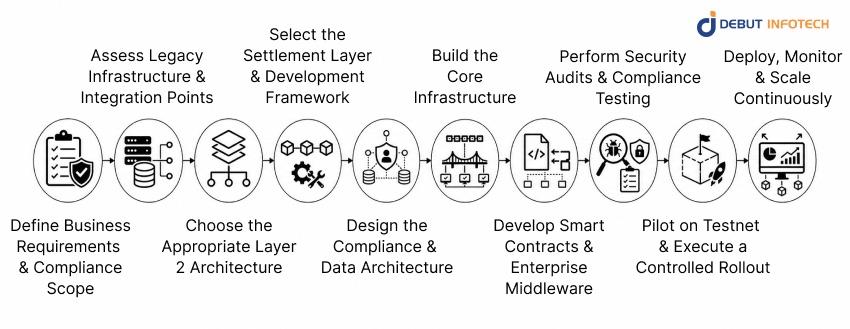
Begin by identifying the primary business objective. This may include cross-border payments, wholesale settlement, tokenized assets, programmable payments, or digital securities.
Establish transaction volume expectations, settlement speed targets, availability requirements, and the jurisdictions where the platform will operate.
Compliance obligations such as AML, KYC, sanctions screening, and reporting requirements should be documented before architectural decisions are made.
Evaluate the existing technology landscape to determine how the Layer 2 solution will interact with core banking platforms, payment gateways, treasury systems, customer databases, and reporting tools.
Rather than replacing proven infrastructure, identify where middleware, APIs, and event-driven integrations can extend existing capabilities while minimizing operational disruption.
Select the Layer 2 model that best supports business priorities.
Optimistic Rollups are suitable for applications where lower costs are more important than immediate settlement.
ZK Rollups offer stronger privacy and faster finality, making them attractive for regulated financial services.
State channels work well for recurring bilateral transactions, while sidechains provide flexibility for specialized enterprise deployments with independent governance requirements.
Choose the underlying blockchain that will provide settlement security, then evaluate development frameworks such as OP Stack, Polygon CDK, ZK Stack, or Arbitrum Orbit.
Consider ecosystem maturity, developer tooling, interoperability, governance options, community support, and long-term maintenance before making a final decision.
Compliance should be integrated into the platform rather than added after deployment. Design workflows that incorporate identity verification, transaction monitoring, sanctions screening, audit logging, and regulatory reporting directly into transaction processing.
At the same time, establish clear data governance policies covering encryption, retention, access controls, and privacy requirements across all participating jurisdictions.
Deploy the essential Layer 2 components, including the sequencer, canonical bridge, validator services, and data availability layer.
Decide whether transaction data will be stored entirely on-chain, through a Validium model, or within a hybrid architecture.
Infrastructure should be designed for redundancy, scalability, and high availability to support enterprise service-level objectives.
Develop secure smart contracts that govern settlement, asset transfers, payment logic, and business workflows.
Alongside these contracts, build middleware that connects blockchain services with existing enterprise applications through APIs, messaging queues, and integration platforms. This layer enables blockchain functionality without requiring significant changes to customer-facing systems.
Before deployment of enterprise blockchain solutions, conduct multiple independent smart contract audits alongside penetration testing, infrastructure assessments, and operational resilience reviews.
Compliance teams should verify that regulatory controls function as intended during normal operations and under stress scenarios. Address identified issues before progressing to production environments.
Deploy the solution to a testnet environment before launching a limited production pilot.
Process a controlled subset of transactions while monitoring settlement speed, throughput, integration stability, compliance workflows, and user experience.
Feedback from this phase helps refine operational processes before full-scale deployment.
Following a successful pilot, transition to full production while implementing continuous monitoring for transaction throughput, sequencer performance, bridge activity, infrastructure health, and compliance reporting.
Establish incident response procedures, disaster recovery plans, and governance frameworks that support ongoing improvements as transaction volumes and business requirements evolve.
Layer 2 implementation should be viewed as an ongoing operational program rather than a one-time deployment.
Regular software updates, security reviews, performance optimization, and regulatory assessments ensure the platform remains resilient as financial markets, compliance standards, and customer expectations continue to change.
Building a Layer 2 blockchain solution for a bank, fintech company, or payment platform typically costs between $150,000 and $3 million or more, depending on the platform’s complexity, regulatory requirements, transaction volume, legacy system integration, and security architecture.
A proof of concept generally falls at the lower end of the range. In contrast, enterprise-grade platforms supporting tokenized assets, cross-border payments, and multi-region deployments often exceed $3 million due to extensive compliance engineering, infrastructure, interoperability, and security requirements.
A payment platform offering domestic settlements has significantly different requirements from a multinational bank issuing tokenized assets across multiple jurisdictions.
As a result, enterprise blockchain budgets should account for both development costs and long-term operational investments.
In most cases, infrastructure development accounts for only a portion of the total investment.
Compliance engineering, legacy system integration, independent security audits, cloud infrastructure, and ongoing maintenance often account for a substantial share of the overall budget of Layer 2 blockchain solutions for fintech.
Organizations should therefore evaluate the total cost of ownership rather than focusing solely on initial development expenses.
| Project Tier | Typical Scope | Estimated Cost (USD) |
| Basic | Proof of concept, limited payment workflows, basic smart contracts, simple middleware integration | $150,000–$350,000 |
| Mid-Level | Production-ready settlement platform, enterprise APIs, compliance workflows, moderate legacy integration | $350,000–$900,000 |
| Enterprise | Multi-region deployment, tokenized assets, advanced security architecture, cross-chain interoperability, high-availability infrastructure | $900,000–$3M+ |
These estimates vary based on transaction volume targets, regulatory obligations, infrastructure choices, and customization requirements.
Institutions operating across multiple countries typically incur higher implementation costs due to additional compliance, governance, and integration work.
Beyond core platform development, enterprises should budget for several supporting workstreams that are essential for a secure and compliant deployment.
| Cost Component | Estimated Cost (USD) |
| AML/KYC and compliance implementation | $50,000–$250,000+ |
| Legacy banking system integration | $100,000–$500,000+ |
| Independent smart contract audits | $30,000–$200,000+ |
| Infrastructure deployment and cloud services | $50,000–$300,000+ |
| Penetration testing and security assessments | $25,000–$150,000+ |
| Ongoing maintenance and monitoring (annual) | 15–25% of the initial development cost |
Development frameworks can also influence the overall costs of blockchain solutions for banks, fintech and payment platforms.
Leveraging established ecosystems such as OP Stack or Polygon CDK may reduce engineering effort and accelerate delivery.
However, organizations with specialized governance, privacy, or compliance requirements often invest in additional customization, increasing both development time and budget.
Rather than treating cost as a standalone metric, decision-makers should evaluate the long-term operational value of the platform.
Reduced settlement times, lower transaction fees, improved liquidity management, automated compliance, and support for tokenized financial products can generate efficiencies that justify the initial investment over time.
While Layer 2 Technologies & Ecosystems addresses many of the scalability challenges associated with public blockchains, enterprise implementation introduces its own technical, operational, and regulatory complexities.
Banks and payment providers must balance performance improvements with resilience, compliance, and interoperability.
Identifying these challenges early allows organizations to design architectures that remain scalable and secure as adoption grows.
Blockchain bridges enable assets and data to move between Layer 1 and Layer 2 networks, but they also introduce operational risk.
In addition, liquidity distributed across multiple Layer 2 environments can lead to fragmented settlement processes and increased capital inefficiency.
Organizations can reduce these challenges by prioritizing canonical bridges, implementing continuous bridge monitoring, and adopting shared liquidity models where appropriate.
Shared sequencers and standardized settlement protocols can further reduce fragmentation by coordinating transactions across multiple Layer 2 networks while improving overall liquidity utilization.
Most financial institutions operate complex technology environments that have evolved over decades.
Replacing core banking platforms is rarely practical due to operational risk, regulatory oversight, and implementation costs.
A middleware-driven integration strategy offers a more practical approach.
APIs, event streaming platforms, enterprise service buses, and integration gateways allow Layer 2 infrastructure to communicate with existing payment systems, customer databases, treasury platforms, and reporting tools without requiring large-scale replacement of legacy applications.
Regulatory frameworks for digital assets continue to evolve across different jurisdictions.
Requirements for customer identification, digital asset custody, stablecoins, tokenized securities, and reporting obligations vary considerably between markets.
Financial institutions can address this uncertainty by designing flexible compliance architectures for KYC AML blockchain solutions.
Policy engines, configurable reporting workflows, and modular identity verification systems allow organizations to adapt to changing regulations without redesigning the entire platform. This approach supports long-term scalability while reducing future compliance costs.
Enterprise Layer 2 development requires expertise across blockchain architecture, cryptography, distributed systems, cloud infrastructure, cybersecurity, and financial regulations.
Professionals with experience spanning all these disciplines remain in limited supply.
Many organizations reduce implementation risk by partnering with specialized blockchain development firms while simultaneously building internal expertise. This hybrid model accelerates delivery, improves knowledge transfer, and allows internal teams to assume greater operational responsibility over time.
Centralized sequencers remain common across many Layer 2 ecosystems because they simplify transaction ordering and improve performance. However, reliance on a single sequencer creates potential operational risks if outages, cyberattacks, or governance issues occur.
Enterprises should evaluate Layer 2 platforms with clear decentralization roadmaps, redundant infrastructure, and robust disaster recovery capabilities.
High-availability architectures, automated failover mechanisms, and continuous monitoring reduce operational disruption while improving service reliability.
As transaction volumes increase, storing every transaction directly on Layer 1 can become expensive. Financial institutions processing millions of transactions must balance security, performance, and operating costs when selecting a data availability strategy.
Hybrid architectures, including Validium-based models, reduce storage expenses by keeping portions of transaction data off-chain while preserving cryptographic verification.
The appropriate choice depends on regulatory requirements, recovery objectives, and the sensitivity of the underlying financial data.
Many implementation challenges arise when organizations focus exclusively on immediate deployment goals.
Layer 2 platforms should instead be designed with future expansion in mind, including interoperability, governance, compliance updates, and infrastructure scaling.
A modular architecture makes this possible. By separating settlement, compliance, integration, and application layers, financial institutions can upgrade individual components without disrupting the broader ecosystem. This improves resilience, simplifies future enhancements, and positions the platform to support emerging financial products and evolving regulatory requirements.
Selecting a Layer 2 blockchain development partner is a strategic decision that extends beyond software delivery.
Enterprise blockchain platforms support high-value transactions, regulated financial products, and critical settlement infrastructure.
An enterprise blockchain development partner should therefore demonstrate technical expertise alongside a strong understanding of banking operations, security standards, and regulatory requirements.
Evaluating these capabilities early helps reduce implementation risk and improves the likelihood of long-term project success.
Look for a partner with experience building blockchain solutions for banks, fintech companies, payment providers, or other regulated financial institutions.
Prior experience with settlement systems, tokenized assets, digital wallets, and payment infrastructure indicates an understanding of the operational and compliance challenges unique to financial services.
Case studies, production deployments, and client references provide stronger evidence than proof-of-concept demonstrations alone.
Enterprise blockchain projects should be designed with compliance in mind from the outset.
Your development partner should understand AML, KYC, sanctions screening, audit reporting, data privacy requirements, and jurisdiction-specific financial regulations.
They should also be able to design architectures that allow compliance controls to evolve as regulatory expectations change.
Security should be embedded throughout the software development lifecycle rather than treated as a final review step.
Assess whether the provider follows secure coding practices, conducts internal code reviews, performs threat modeling, and supports independent smart contract audits.
Experience implementing infrastructure monitoring, incident response plans, and disaster recovery procedures is equally important for enterprise deployments.
A capable development partner should be proficient in leading Layer 2 ecosystems, including Optimistic Rollups, ZK Rollups, sidechains, and enterprise blockchain frameworks.
They should also have expertise in technologies such as OP Stack, Polygon CDK, ZK Stack, and Arbitrum Orbit, as well as integration with cloud infrastructure, APIs, and existing banking systems.
This breadth of knowledge enables them to recommend an architecture based on business requirements rather than familiarity with a single technology.
Enterprise blockchain platforms require ongoing maintenance after deployment.
Choose a partner that provides long-term support for infrastructure monitoring, software updates, security patching, performance optimization, and compliance enhancements.
A structured post-launch engagement ensures the platform continues to meet operational and regulatory requirements as transaction volumes grow.
Before making a final decision, confirm that the development partner can demonstrate:
| Evaluation Criteria | Why It Matters |
| Banking and fintech project experience | Reduces implementation risk and shortens delivery time |
| Regulatory and compliance expertise | Supports evolving financial regulations |
| Independent security audit support | Improves platform resilience and trust |
| Experience with leading Layer 2 frameworks | Enables scalable, future-ready architecture |
| Legacy system integration capabilities | Simplifies adoption without replacing core systems |
| Post-launch maintenance and monitoring | Ensures long-term operational stability |
The right partner or blockchain consulting services contribute more than technical implementation. They help shape architecture decisions, strengthen governance, reduce operational risk, and provide the expertise needed to support enterprise blockchain adoption at scale.
Layer 2 blockchain solutions are becoming a core component of modern financial infrastructure.
They enable banks, fintech companies, and payment platforms to achieve higher transaction throughput, lower settlement costs, stronger compliance automation, and support for tokenized financial products without sacrificing the security of Layer 1 networks.
As enterprises accelerate their blockchain initiatives, partnering with an experienced Layer 2 blockchain development company like Debut Infotech can significantly reduce implementation risk and shorten deployment timelines.
A trusted technology partner can design secure, scalable, and compliance-ready Layer 2 solutions tailored for banking, fintech, and payment platforms.
From architecture design and smart contract development to legacy system integration, security audits, and post-launch support, the right expertise helps organizations build enterprise-grade blockchain infrastructure that meets today’s operational demands, delivers long-term operational value, and adapts to future innovations in digital finance.
Layer 2 solutions process most transactions off the main blockchain, then bundle and settle them together. That cuts network congestion, lowers gas fees, and speeds up confirmations.
Banks and payment providers can handle thousands of transactions at a lower cost without sacrificing the security of the underlying blockchain.
Layer 2 networks significantly reduce transaction fees by processing transfers away from the main chain and settling them in batches.
Instead of paying high fees for every transaction, users share the cost of a single settlement. This makes micropayments and high-volume transactions much more affordable.
Layer 2 boosts scalability by moving transaction processing away from the base blockchain.
Thousands of transactions can be executed simultaneously before being recorded on the main chain. This increases throughput, prevents network congestion, and maintains steady performance even during periods of heavy demand.
Layer 2 networks don’t replace compliance processes. Banks still apply KYC, AML, transaction monitoring, and reporting through their existing systems.
Enterprise Layer 2 deployments can also include permissioned access, identity verification, audit trails, and compliance tools that align with regulatory requirements.
Optimistic rollups assume transactions are valid unless challenged, making them simpler but slower to finalize withdrawals.
ZK rollups use cryptographic proofs to verify transactions in real time, providing faster finality and stronger security.
For many financial applications, ZK rollups are often the better long-term choice.
Yes. Layer 2 platforms can connect with core banking systems through APIs, middleware, and payment gateways. Banks don’t need to replace their existing infrastructure.
Instead, they can add blockchain capabilities alongside current systems, making adoption faster and far less disruptive.
The right choice depends on your requirements, but Polygon, Arbitrum, Base, zkSync, and Starknet are among the strongest options. They offer mature ecosystems, good developer support, and enterprise-friendly infrastructure.
Many organizations also build custom Layer 2 networks when they need tighter control and compliance.
A basic Layer 2 integration usually takes around 2 to 4 months.
Building a custom Layer 2 network with smart contracts, security testing, compliance features, and production deployment typically takes 6 to 12 months, depending on complexity and regulatory requirements.
Existing Layer 2 networks are faster and more cost-effective to launch, making them ideal for many fintech products. A custom Layer 2 gives banks greater control over security, governance, privacy, and compliance.
The better option depends on regulatory obligations, scalability goals, and long-term business strategy.
Layer 2 helps banks process payments faster, reduce settlement costs, and support higher transaction volumes. It also improves cross-border transfers by cutting delays and fees.
Banks can deliver quicker payment services while keeping the security and transparency of the underlying blockchain network.

Our Latest Insights
USA
2501 Chatham, Rd Suite R Springfield, IL 62704
+1-708-515-4004
info@debutinfotech.com
UK
7 Pound Close, Yarnton, Oxfordshire, OX51QG
+44-770-304-0079
info@debutinfotech.com
Canada
154 Eden Oak Trail, Kitchener, ON N2A 0H9
+1-708-515-4004
info@debutinfotech.com
INDIA
Sector 101-A, Plot No: I-42, IT City Rd, JLPL Industrial Area, Mohali, PB 140306
9888402396
info@debutinfotech.com