ON THIS PAGE
Progress0%






Our Global Presence :




Vehicle maintenance apps can serve individual owners, fleets, workshops, dealerships, and connected automotive ecosystems.
Core features include maintenance records, service reminders, expense tracking, booking, notifications, and vehicle management.
Advanced products may integrate OBD-II, telematics, AI, predictive maintenance, and connected vehicle data.
Development can range from $25,000 to $250,000+, with timelines from 10 to 16 weeks for an MVP to 6 to 9+ months for advanced AI/IoT products.
Product scope, vehicle data sources, integrations, and target users should be defined before development begins.
The most expensive vehicle in your fleet may not be the one in the repair shop. It could be the one still operating with a maintenance issue nobody has detected yet.
That is the tricky part of vehicle maintenance. Problems rarely announce themselves at the right time. Service dates slip, repair histories get buried, and minor issues can turn into costly downtime.
A vehicle maintenance app brings maintenance schedules, repair history, vehicle condition, and service data into one place. Advanced solutions can also connect with telematics, GPS, OBD-II devices, and diagnostic systems to support proactive maintenance.
If you are planning vehicle maintenance app development, this guide covers essential features, integrations, technology choices, development costs, timelines, monetization models, and the key considerations for building a scalable vehicle maintenance management app.
A vehicle maintenance app is a digital system for managing servicing throughout the vehicle lifecycle. It centralizes service history, maintenance schedules, repair records, mileage, expenses, and vehicle health data in one platform.
The platform can support a single vehicle or an enterprise fleet. More advanced applications may also connect with vehicle data sources, service networks, and business systems. This gives users better visibility into maintenance requirements, vehicle condition, and service activity.
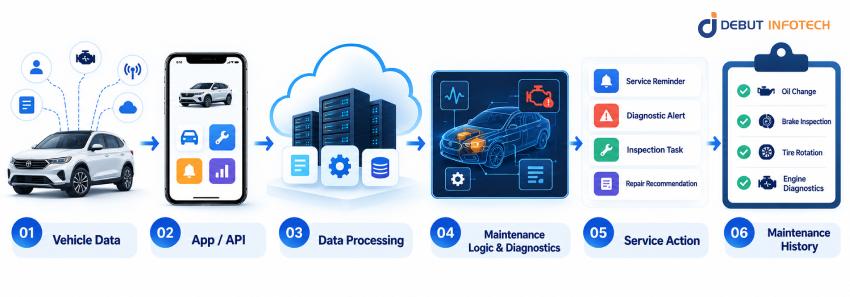
A vehicle maintenance app pulls data from driver inputs, service records, OBD-II devices, telematics systems, and connected APIs. The backend normalizes the incoming data and evaluates it against mileage thresholds, service intervals, fault codes, and maintenance rules.
When a threshold is reached or a fault is detected, the system triggers a service reminder, diagnostic alert, inspection task, or repair recommendation. A vehicle diagnostics app can also process live fault data to support faster issue detection and maintenance decisions.
| App Type | Primary Use |
| Car Maintenance App | Service reminders, repair history, expenses, and maintenance records |
| Truck Maintenance App | Preventive servicing, inspections, mileage, and truck maintenance |
| Auto Service App | Service booking, repair coordination, and workshop workflows |
| Bike Maintenance App | Service intervals, component replacement, repairs, and ownership costs |
| Fleet Maintenance App | Multi-vehicle servicing, work orders, maintenance costs, and fleet availability |
| Heavy-Duty Vehicle Maintenance App | Preventive maintenance for trucks, buses, construction equipment, and heavy-duty fleets |
| EV Maintenance App | Battery health, charging systems, software updates, and EV-specific maintenance |
| Connected Vehicle Maintenance App | Uses connected vehicle data to support maintenance monitoring and service decisions |
Vehicle maintenance is becoming more connected and data-driven. Centralized maintenance platforms can help businesses reduce missed servicing, improve maintenance planning, and gain better visibility into vehicle condition and availability.
Verizon Connect’s 2026 Fleet Technology Trends Report found that 80% of surveyed fleet professionals use GPS fleet tracking. This reflects the growing use of connected data across fleet operations.
The IEA’s latest 2026 update expects electric cars to account for about 29% of global car sales in 2026, increasing demand for digital tools that support EV-specific maintenance.
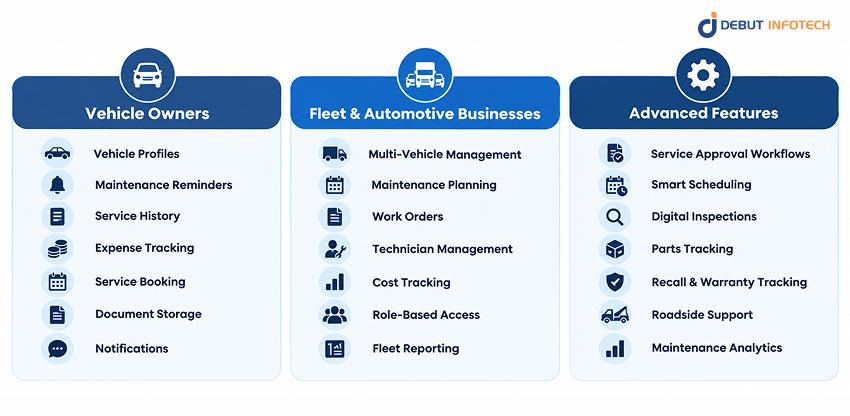
The right vehicle maintenance app features depend on who will use the product and how maintenance is managed. Consumer applications prioritize convenience and service visibility, while fleet and automotive platforms require stronger operational controls.
| Feature | Purpose |
| Vehicle Profiles | Store vehicle details, mileage, warranty, and ownership information |
| Maintenance Reminders | Trigger service alerts based on time or mileage |
| Service History | Maintain records of repairs, inspections, and completed servicing |
| Expense Tracking | Monitor repair and maintenance spending |
| Service Booking | Schedule appointments with workshops or service providers |
| Document Storage | Keep invoices, insurance, and service documents together |
| Notifications | Alert users about servicing, renewals, recalls, or overdue tasks |
These capabilities form the core of most car maintenance app features and replace fragmented manual tracking with structured maintenance records.
| Feature | Operational Value |
| Multi-Vehicle Management | Centralize maintenance activity across multiple assets |
| Maintenance Planning | Schedule servicing before defined usage thresholds |
| Work Orders | Create and track repair or maintenance jobs |
| Technician Management | Assign tasks and monitor service activity |
| Cost Tracking | Compare maintenance spend across vehicles |
| Role-Based Access | Control permissions for drivers, technicians, and managers |
| Fleet Reporting | Monitor downtime, overdue service, and maintenance performance |
These functions support the broader requirements of an automotive service management app or enterprise maintenance platform.
| Feature | Business Use |
| Service Approval Workflows | Route repairs or maintenance requests for authorization |
| Smart Scheduling | Prioritize servicing by urgency and availability |
| Digital Inspections | Capture structured checks, images, and issue reports |
| Parts Tracking | Monitor spare parts and workshop inventory |
| Recall & Warranty Tracking | Track recalls, warranty coverage, and related service requirements |
| Roadside Support | Connect drivers with nearby assistance |
| Maintenance Analytics | Identify recurring faults, cost trends, and high-risk vehicles |
Advanced functionality should be added where it improves automation, maintenance accuracy, or operational decision-making.
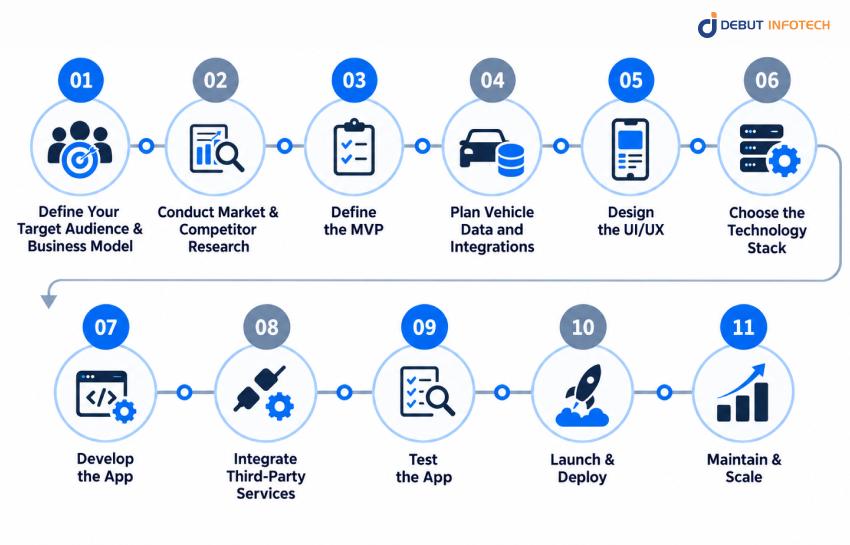
The vehicle maintenance app development process should begin by defining whether the product will be a maintenance tracker, connected vehicle application, fleet maintenance platform, or AI-enabled diagnostic product. This decision shapes the required features, vehicle data sources, integrations, technology choices, budget, and delivery plan.
Start by identifying whether the application is for individual vehicle owners, fleets, workshops, dealerships, rental businesses, or multiple user groups. The target audience determines the required workflows, access levels, integrations, and monetization model.
Review existing maintenance, diagnostics, fleet, and connected vehicle applications to understand common capabilities and product gaps. Focus on how competing products handle servicing, vehicle data, diagnostics, user experience, and integrations rather than simply copying their feature sets.
Prioritize the functionality required for the first release. An MVP may include vehicle profiles, maintenance records, service reminders, expense tracking, and basic reporting. Advanced capabilities such as telematics, AI, or diagnostics can be introduced when they support the product’s core use case.
Define where vehicle information will come from and how it will enter the system. Sources may include user input, service records, OBD-II devices, telematics platforms, OEM APIs, GPS systems, or third-party services. This step is particularly important in connected vehicle app development.
Map the main user journeys before development begins. Maintenance status, upcoming service, vehicle health, records, alerts, and actions should be easy to understand without forcing users through complex navigation.
Select mobile, backend, database, cloud, and integration technologies based on the product requirements. The vehicle maintenance app technology stack should support expected data volumes, real-time processing needs, integrations, security requirements, and future expansion.
During vehicle maintenance mobile app development, build the mobile application, backend services, database, and administration components in planned development cycles.
Working with an experienced Mobile App Development Company can help coordinate mobile engineering, backend development, integrations, testing, and deployment within one delivery process. Keep the product modular so new vehicle integrations and maintenance capabilities can be added without major restructuring.
Connect the application with required external systems such as maps, payment gateways, telematics providers, diagnostic services, notification platforms, or workshop systems. For vehicle diagnostic app development, integration reliability is particularly important because diagnostic data can vary across vehicles and devices.
Validate functionality across devices, operating systems, user roles, integrations, and real-world data conditions. Testing should also cover performance, security, connectivity failures, incorrect data inputs, and edge cases involving vehicle or diagnostic information.
Prepare the production environment, publish the mobile application, configure monitoring, and validate integrations after deployment. A controlled rollout can help identify issues before expanding access to a larger user base.
After launch, monitor application performance, integration stability, user behavior, and infrastructure usage. As adoption grows, the platform can expand with additional vehicle types, data sources, automation, AI capabilities, service partners, or enterprise workflows.
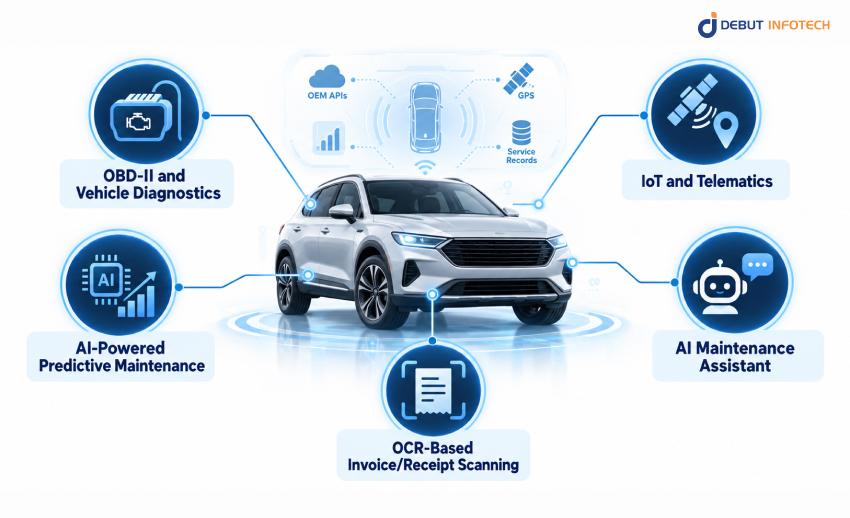
Advanced technologies can improve diagnostics, automation, data capture, and maintenance decision-making across connected vehicle platforms.
Note: OBD-II data availability varies by vehicle. Standard OBD-II primarily provides diagnostic trouble codes and supported powertrain parameters, while EV battery data, TPMS, ABS, and manufacturer-specific systems may require OEM APIs, enhanced diagnostics, UDS, or proprietary integrations.
Businesses planning predictive maintenance, intelligent diagnostics, or AI-assisted workflows can also work with an AI Development Company to design the required data pipelines, models, and production integrations.
Real-world automotive and fleet platforms show how vehicle data, diagnostics, telematics, and AI can improve maintenance planning, issue detection, and service coordination.
Tesla combines remote diagnostics with its mobile app to support vehicle servicing. Owners can receive service alerts, schedule appointments, review estimates, and track repairs, while service teams can remotely diagnose certain issues before a workshop visit. This can reduce unnecessary service-center visits and give technicians more context before the vehicle arrives.
Ford Pro Telematics uses live vehicle data to provide fleet operators with vehicle health alerts, maintenance information, and connected fleet visibility. Earlier identification of developing issues can help businesses schedule service before a vehicle becomes unavailable, improving uptime across larger fleets.
BMW’s Proactive Care uses connected vehicle data and AI to identify existing and predictable service requirements. The system can contact customers when attention is required and recommend an appropriate service action, helping move maintenance from customer-initiated servicing toward more proactive support.
Caterpillar’s VisionLink provides access to equipment hours, fault codes, service requirements, fuel information, and maintenance alerts across mixed fleets. Centralized equipment-health data helps maintenance teams prioritize service, identify faults remotely, and manage preventive maintenance without relying on separate records for each asset.
Technology choices should reflect the target platforms, expected data volume, integration requirements, and whether the product includes diagnostics, telematics, or AI capabilities. The stack should support reliable data processing, secure integrations, and future product expansion.
| Layer | Technology Options | Role in the Application |
| Mobile App | Flutter, React Native, Swift, Kotlin | Build iOS and Android applications for vehicle owners, drivers, technicians, and fleet users |
| Web and Admin Panel | React, Next.js, Angular | Manage vehicles, users, maintenance activity, reporting, and administrative workflows |
| Backend | Node.js, Python, Java, .NET | Handle business logic, APIs, user access, maintenance workflows, and integrations |
| Database | PostgreSQL, MySQL, MongoDB | Store vehicle profiles, service history, maintenance records, users, and operational data |
| Cloud Infrastructure | AWS, Microsoft Azure, Google Cloud | Support hosting, storage, scalability, monitoring, and application availability |
| Application APIs | REST, GraphQL | Connect mobile, web, backend, payments, maps, and third-party services |
| Vehicle Connectivity | OBD-II, OEM APIs, telematics APIs, device SDKs | Collect supported diagnostic, mileage, location, utilization, and vehicle-health data |
| Data Ingestion & Streaming | MQTT, Kafka, Kinesis, Event Hubs | Ingest and stream telemetry, vehicle events, alerts, and connected data for real-time workflows |
| Notifications | Firebase Cloud Messaging, Apple Push Notification Service | Deliver maintenance reminders, service updates, and important alerts |
| AI & Analytics | Python, TensorFlow, PyTorch, managed AI services | Support predictive models, maintenance analysis, and intelligent assistance |
| DevOps & Monitoring | Docker, GitHub Actions, monitoring tools, Kubernetes where required | Support deployment, release management, observability, and system reliability |
There is no universal stack for every vehicle maintenance product. A basic consumer app may need only mobile, backend, database, and notification services. Connected fleet or diagnostic products typically require additional vehicle integrations, real-time data processing, monitoring, and analytics.
The final stack should match the product’s current requirements while leaving room for additional vehicles, users, integrations, and connected services as the platform grows.
The vehicle maintenance app development cost can range from approximately $25,000 to $250,000+ in 2026. The final investment depends on product scope, user roles, target platforms, vehicle-data integrations, backend complexity, and capabilities such as telematics, diagnostics, IoT, or AI.
| App Complexity | Estimated Cost |
| Basic / MVP Vehicle Maintenance App | $25,000 to $50,000 |
| Mid-Level / Connected Vehicle Maintenance App | $50,000 to $120,000 |
| Advanced AI/IoT-Powered App | $120,000 to $250,000+ |
These figures provide a planning range for vehicle maintenance app development cost in 2026. Final estimates vary with the actual feature set, data sources, integrations, and technical requirements.
The final cost varies with the product’s functionality, connectivity, and technical complexity.
Post-launch costs may include cloud infrastructure, monitoring, bug fixes, security updates, operating-system compatibility, API changes, and feature improvements. Connected and AI-enabled applications may require additional support because vehicle integrations, data pipelines, and models need ongoing monitoring and updates.
The vehicle maintenance app development timeline depends on product scope, platform coverage, integration requirements, and vehicle data complexity. A focused MVP can be developed faster, while connected and AI-enabled applications require more time for integration, validation, and testing.
| App Scope | Estimated Timeline |
| Basic / MVP App | 10 to 16 weeks |
| Connected Vehicle App | 4 to 6 Months |
| AI / IoT-Powered App | 6 to 9+ Months |
Timelines are planning estimates and vary by team structure, scope, integrations, and validation requirements.
An MVP usually focuses on core maintenance workflows such as vehicle profiles, service records, reminders, and basic administration. A connected or AI vehicle maintenance app requires additional time for vehicle integrations, connected data, intelligent capabilities, and external system dependencies.
These additional components can extend the vehicle maintenance app development process because they require compatibility testing, data validation, integration checks, and additional quality assurance before release.
Vehicle maintenance app development involves technical challenges beyond standard mobile functionality, particularly when the platform depends on connected vehicle data, diagnostics, or AI.
| Challenges | Solutions |
| Handling Large Volumes of Vehicle Data | Structure storage and processing to handle growing maintenance, diagnostic, and telematics data efficiently. |
| OBD-II & Vehicle-System Compatibility | Account for differences across vehicle models, protocols, and diagnostic devices during vehicle diagnostic app development. |
| Data Security & Privacy | Protect vehicle, location, user, and service data with encryption, role-based access, secure APIs, credential management, and appropriate data-retention controls. |
| Real-Time Data Processing | Build reliable pipelines for telemetry, alerts, and vehicle-health updates in connected vehicle app development. |
| App Performance & Battery Consumption | Balance background tracking, connectivity, and data synchronization without excessive device resource usage. |
| Accuracy of Maintenance Recommendations | Validate data and recommendation logic carefully, particularly when building an AI vehicle maintenance app. |
A vehicle maintenance management app can generate revenue through recurring subscriptions, transaction-based services, partnerships, and licensing. The right model depends on whether the platform serves individual drivers, fleets, workshops, or automotive businesses.
At Debut Infotech, we approach vehicle maintenance app development around real servicing, fleet, and connected vehicle requirements. Our team helps businesses plan and build products for car owners, workshops, fleet operators, and automotive service networks.
We focus on:
✔ Defining the right MVP before adding advanced capabilities
✔ Designing practical workflows for drivers, technicians, and fleet teams
✔ Integrating vehicle data, telematics, service platforms, and external systems
✔ Testing data flows, connectivity, and real-world operating conditions
✔ Supporting future expansion across EVs, AI, fleets, and new service models
From initial planning to deployment and ongoing product growth, we keep the development approach aligned with how vehicle maintenance is becoming more connected, data-driven, and automated.
Vehicle maintenance platforms are becoming more connected, data-driven and proactive. Strong products start with clear user needs, reliable vehicle data, and a focused initial scope.
As the product matures, connected services, EV support, diagnostics, automation, and AI can be introduced where they provide measurable value to users and maintenance operations.
Core vehicle maintenance app features include vehicle profiles, service reminders, maintenance history, expense tracking, notifications, and service booking. Fleet products may also include work orders, technician management, and reporting.
The vehicle maintenance app development cost can range from approximately $25,000 to $250,000+ in 2026. The final cost is influenced by product complexity, platforms, integrations, and advanced capabilities such as AI or IoT.
A basic MVP may take 10 to 16 weeks. Connected applications can take 4 to 6 months, while AI/IoT-powered products may require 6 to 9+ months.
The best vehicle maintenance app technology stack depends on product requirements. Common choices include Flutter or React Native for mobile, Node.js or Python for backend development, and PostgreSQL for structured data.
Common types include car maintenance apps, fleet maintenance platforms, auto service apps, EV maintenance apps, and connected vehicle maintenance systems. Each supports different users and workflows.
Revenue can come from subscriptions, freemium upgrades, fleet SaaS licensing, service booking fees, partnerships, marketplaces, and white-label licensing.
A vehicle maintenance app centralizes service records and maintenance schedules. It can reduce missed servicing, improve vehicle visibility, and simplify coordination between users and service providers.
Yes. A vehicle diagnostics app can connect with compatible OBD-II devices to access fault codes and supported vehicle parameters. Compatibility can vary by vehicle and device.

Our Latest Insights


USA

2501 Chatham, Rd Suite R Springfield, IL 62704
+1-708-515-4004
info@debutinfotech.com
UK

7 Pound Close, Yarnton, Oxfordshire, OX51QG
+44-770-304-0079
info@debutinfotech.com
Canada

154 Eden Oak Trail, Kitchener, ON N2A 0H9
+1-708-515-4004
info@debutinfotech.com
INDIA

Sector 101-A, Plot No: I-42, IT City Rd, JLPL Industrial Area, Mohali, PB 140306
9888402396
info@debutinfotech.com

9001:2015
Quality Certified

ISO 27001
Security Certified

A+ Rating
Accredited Business

Certik
Security & Audit


Copyright © 2026, Debut Infotech. All rights reserved. | Privacy Policy