ON THIS PAGE
Progress0%






Our Global Presence :


Planning cross-border stablecoin payments? Learn how to build payment rails with the right infrastructure compliance controls and integrations.



Stablecoin payment rails can move funds between providers on-chain and deliver local currency to a recipient’s bank account or mobile wallet.
Compare routes by what it costs to deliver the same amount and when the recipient can use the funds.
Pilot one corridor and one payout method. Test how your team handles failed payouts before increasing volume.
Check which activities each partner is authorized to perform and what information must accompany covered transfers.
Build pricing and routing where you need control. Use specialist providers for custody, conversion, and local payouts when they meet your corridor requirements.
A cross-border payment rail earns its place when it helps you reach more customers or improves the economics of each payout. For a marketplace, that could mean paying sellers in a new country through local bank deposits. For a payments platform, lower costs on a high-volume route can give the platform room to improve pricing or protect margins.
Stablecoin payment rails connect blockchain transfers with banks and local payout providers. A fintech can accept funds through its existing payment methods, use a stablecoin to move value across borders, and pay recipients in their local currency. Businesses can add a settlement option and keep the payout experience their customers already know.
In its 2026 Cross-Border Payments 100 analysis, FXC Intelligence found that 44 companies had a live stablecoin product and another 22 were developing one.
The economics of cross-border stablecoin payments depend on the route. A 2026 IMF working paper estimated an average cost of about 2% for a $200 transfer using the lowest-cost funding and payout options. The cheapest traditional provider still cost less in roughly one-third of the corridors where researchers could compare costs in detail.
This guide explains how funds move, what infrastructure and compliance work you’ll need, and how to evaluate your first corridor. It also covers which components to build or buy and what to budget for a pilot and rollout.
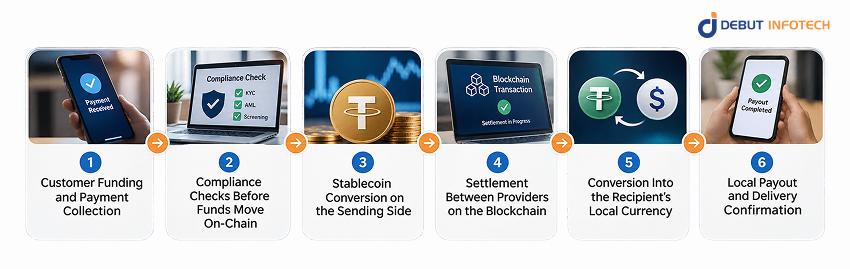
In a common cross-border payment setup, the customer pays in one currency and the recipient receives another. The providers use a stablecoin to move funds between them. Here’s how that route works.
A bank or payment processor collects the customer’s funds. The platform records the amount in its internal ledger and confirms when the funds are available to send.
2027 Business Decision: Choose funding methods customers already use in the sending market. Compare collection fees and how long each method takes to make funds available before setting payout prices and delivery estimates.
The platform checks the parties and payment details before releasing the transfer. Transaction monitoring can flag payments for manual review.
2027 Business Decision: Assign ownership for flagged payments and set a target review time. Use that target to set delivery expectations when a payment needs manual review.
A fiat on-ramp converts the funding currency into a stablecoin that both payment partners support. A liquidity provider can supply the stablecoin for the conversion.
2027 Business Decision: Decide whether to convert funds for each payment or in batches. If you batch conversions, set a cutoff so customers know when their payments will move.
The sending provider transfers the stablecoin to the receiving partner’s wallet. The receiving partner may wait for blockchain confirmations before making the funds available for conversion.
2027 Business Decision: Decide what status customers should see once the funds have moved on-chain and the local payout is still pending.
The fiat off-ramp exchanges the stablecoin for the payout currency. Available local liquidity affects how much the provider can convert and at what rate.
2027 Business Decision: Decide when to guarantee the amount the recipient will receive. If you guarantee it before conversion, assign responsibility for any difference between the quoted and actual conversion costs.
A local payment provider delivers funds by bank deposit, mobile money, or another supported method. The platform matches the provider’s status update to the original payment in its ledger.
2027 Business Decision: Decide how long customers should wait before your support team investigates a payout that hasn’t arrived.
| Business Scenario | Where Stablecoin Rails Can Help | What to Measure in a Pilot |
| Weekend payout demand | If transfers between providers pause over the weekend, a stablecoin route may help you meet demand for weekend payouts. The local payout provider must also operate during those hours. | Share of weekend payouts delivered by the promised time. |
| Too much cash tied up in local accounts | If you keep large balances in destination markets to cover peak demand, faster replenishment may let you hold less cash there. | Average funds tied up in local accounts and stablecoin balances at the same payout volume. |
| Dependence on a single settlement route | If a provider outage can halt payouts across a corridor, a stablecoin route with independent partners can give you a fallback. | Time to switch routes and the share of delayed payouts the fallback can handle. |
| Customers already receive revenue in stablecoins | A fintech serving platforms that receive stablecoins can use those balances to fund local payouts. This may remove an intermediate conversion to the sending currency. | Total cost per completed payout compared with converting the balance to fiat first. |
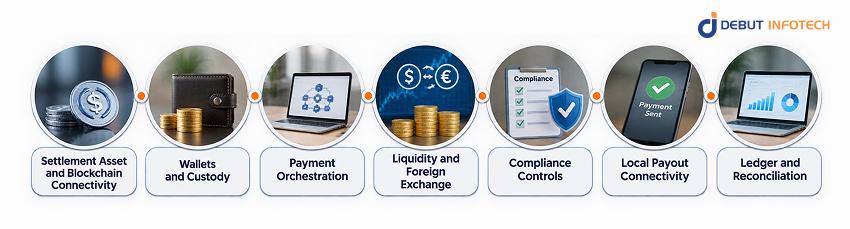
Stablecoin payment infrastructure connects your existing payment API and ledger to the providers that hold, convert, and deliver funds. Some providers cover several layers through one integration.
Choose a stablecoin and network your transfer partners support. Confirm whether the receiving partner sells the stablecoin for local currency or redeems it through the issuer. If the issuer redeems in a currency other than the payout currency, plan for a separate FX conversion. Assign responsibility for transfers, network fees, and delays.
Digital asset custody and wallet infrastructure determine who controls the keys and authorizes transfers. When comparing custodial and non-custodial wallets, ask who can change an approved destination or restore access if a signer becomes unavailable.
Payment orchestration gives each transfer one internal payment ID and tracks its status across providers. The orchestration layer applies routing rules and controls retries. If a provider times out, check the status of the original payment before retrying. If the provider supports idempotency keys, reuse the original key when retrying the same request to help prevent a duplicate payout.
Stablecoin liquidity management tracks available balances, provider limits, and quote expiry. A quote needs to hold long enough to execute the conversion at the agreed rate. Set rules for what happens when it expires or a provider can fill only part of a payout batch.
Connect screening results and manual review decisions to the payment workflow. Define which results place a transfer on hold, who can release it, and what evidence the platform retains for audit.
Connect to the payout methods your recipients use. Ask whether “completed” means the payout was submitted or the recipient was credited. Require a payout reference and a reason for any rejection.
Cross-border payment reconciliation matches bank movements, blockchain transactions, and provider reports against your internal ledger. Track blockchain confirmation and recipient delivery as separate events so finance can see which funds are still in transit. Understanding how wallets, custody, and internal ledgers work together helps your team trace a blockchain transaction back to the customer’s payment record.
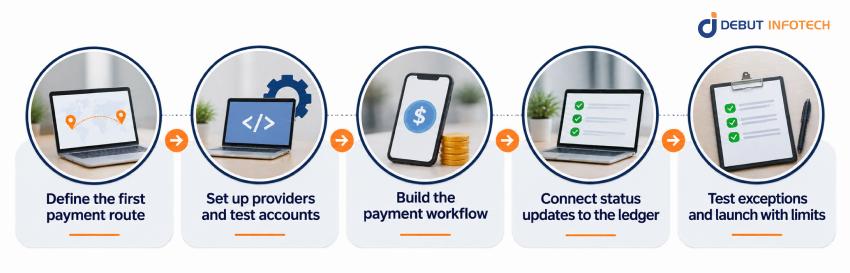
Start with one corridor and one payout method. Choose the result you want to improve, such as on-time delivery or cost per completed payout. Record how the existing route performs so you have a baseline for the pilot.
Choose the sending and receiving markets, funding method, stablecoin, blockchain network, and payout method. Document who holds the funds at each handoff, who performs the required checks, and who can act if a payment stalls.
Get sandbox access and configure the API credentials, test wallets, and payout accounts the route requires. Send a test request to each provider and confirm that it returns the expected response before you build the full payment workflow.
Use your stablecoin payment integration to route eligible payments from funding through local payout. Validate the recipient’s details and request a conversion quote if the provider requires one. Store any accepted quote with the payment record.
For teams building this part in-house, blockchain development services can help connect the on-chain transfer to the existing payment workflow.
Link the funding reference, blockchain transaction ID, and payout reference to the same payment record. Flag any provider update that cannot be matched to a payment so finance can investigate it before closing the record.
Test a successful payment, a provider timeout, and a local payout rejection after on-chain settlement. Verify that your team can locate the funds and handle each failure without sending a duplicate payout. Before going live, confirm production access, status notifications, and payout funding. Start with low limits and expand once the route meets the pilot target.
A stablecoin payment can involve different rules for the issuer, the transfer provider, and the local payout partner. Check which requirements apply in the sending and receiving markets before opening a corridor.
The GENIUS Act establishes a federal and state framework for payment stablecoin issuers. The OCC’s final rule takes effect on January 18, 2027. For a business using an existing stablecoin, assess whether its payment activities trigger FinCEN registration, Bank Secrecy Act obligations, or state money transmitter licensing. Check the rules for offering or selling foreign-issued stablecoins to US customers if the route uses one.
MiCA’s stablecoin rules have applied since June 30, 2024. For an EU corridor, check whether the token can be offered or admitted to trading in the EU. Verify that your partner’s authorizations cover the services it will actually provide, including conversion and local payout. Certain services involving e-money tokens can also require payment-services authorization under PSD2.
The Travel Rule requires covered providers to collect and securely share specified sender and recipient information. FATF’s 2026 survey found that 91 of 109 responding jurisdictions had passed legislation implementing the Travel Rule. Check the rules at both ends of the corridor, including which transfers are covered, what data must be shared, and how your counterparties will exchange it.
Build the parts that give your product an advantage or let your team make decisions it needs to own. Buy services when a provider can cover your first corridor on acceptable terms. For each option, weigh how quickly you can launch, which changes you can make yourself, and which obligations each party carries.
| Approach | What to Build or Buy | When it makes sense |
| Custom build | Build your payment workflow, pricing, and routing. Use specialist providers for services such as custody and local payouts where needed. | Your corridor needs approval rules, routing, or reporting that available platforms cannot support. Allow time to integrate and test each service. |
| White-label platform | Buy the core workflow and configure the payout methods, pricing options, and reporting the vendor supports. | You want to test one corridor and the platform already covers it. Check which changes require the vendor’s help before committing. |
| Hybrid | Buy custody, currency conversion, and payout connectivity. Build the pricing and routing rules that make your product distinct. | Your team needs control over customer pricing or provider selection and can use existing services to move funds. |
Before signing, confirm which controls the vendor operates, which obligations your business retains, and what records you can export. Ask whether you can change a routing rule or replace a payout provider without rebuilding the workflow. The answers show how much control you’ll have when you add a corridor or a partner stops meeting your needs.
Debut Infotech helps fintechs add stablecoin settlement to existing payment systems. Our stablecoin development services include designing the first payment route and integrating custody, currency conversion, and local payout providers. Before launch, we test whether operations and finance teams can trace funds when a payout is delayed or rejected.
XSGD Stablecoin Infrastructure: We optimized the blockchain infrastructure for XSGD, a Singapore dollar-pegged stablecoin. The project supported more than $10 million in cross-border transactions over six months and improved transaction processing efficiency by 35%.
NDAX Wallet Infrastructure: For NDAX, we built multi-chain wallet functionality, asset swaps, and real-time portfolio tracking within its digital asset platform.
A. They can be, depending on the corridor and payment size. Ask each provider what it would debit to deliver the same amount in local currency. Include funding fees, the exchange-rate spread, blockchain fees, and any payout deductions.
A. Delivery depends on when the sender’s funds become available and when the local provider credits the recipient. Blockchain confirmation is one part of cross-border payment settlement. Check delivery estimates for weekends and payments submitted after local cutoffs.
A. Yes. On routes that support bank deposits, a fiat off-ramp converts the stablecoin into local currency for delivery to the recipient’s bank account. The recipient provides bank details.
A. Yes. A stablecoin payment integration can use the fintech’s existing payment API and ledger. Link provider updates to the original payment ID so support and finance can track the transfer in their existing systems.
A. Use the payout reference to find out where the funds are and why the payout failed. Depending on the provider’s process, you may be able to correct the details, retry, or return the funds. Confirm the original payout’s status before retrying.
A. Fintechs can use an existing stablecoin supported by their settlement and payout partners. Their compliance obligations depend on the activities they perform, such as holding or transferring customer funds.

USA
2501 Chatham, Rd Suite R Springfield, IL 62704
+1-708-515-4004
info@debutinfotech.com
UK
7 Pound Close, Yarnton, Oxfordshire, OX51QG
+44-770-304-0079
info@debutinfotech.com
Canada
154 Eden Oak Trail, Kitchener, ON N2A 0H9
+1-708-515-4004
info@debutinfotech.com
INDIA
Sector 101-A, Plot No: I-42, IT City Rd, JLPL Industrial Area, Mohali, PB 140306
9888402396
info@debutinfotech.com