ON THIS PAGE
Progress0%






Our Global Presence :



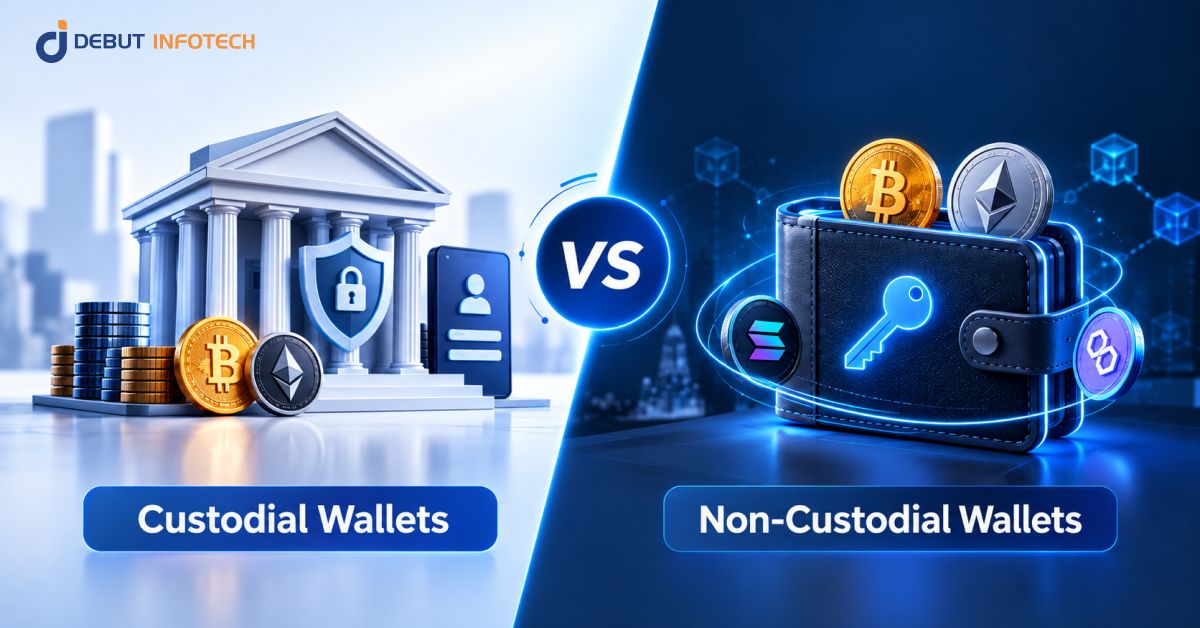


Custody determines who controls transaction authorization: custodial wallets rely on provider-controlled signing authority, while non-custodial wallets place signing control with the user or a defined authorization policy.
Security risks shift between the two models: custodial wallets add provider and counterparty risk, while non-custodial wallets place greater responsibility on users to protect credentials, devices, transaction approvals, and backups.
Neither wallet model is automatically safer: security depends on key management, transaction controls, recovery processes, infrastructure, user behavior, and incident response.
Recovery requirements differ by custody model: custodial services can restore account access through provider-controlled processes, while non-custodial recovery depends on recovery phrases, backup devices, MPC key shares, or smart-account guardians.
KYC and AML obligations depend on the service provided: non-custodial wallet creation may not require KYC, while exchanges, fiat gateways, payment services, and other regulated functions can introduce identity verification and compliance requirements.
MPC, multisig, and hardware wallets address specific security needs: these technologies do not determine custody by themselves; the key question is who controls enough signing authority to approve transactions.
Wallet architecture should follow product requirements: transaction flows, recovery, compliance, user capabilities, integrations, and operating responsibilities should guide the choice between custodial, non-custodial, hybrid, custom, white-label, or Wallet-as-a-Service models.
Choosing between a custodial vs. non-custodial wallet comes down to who controls the mechanism that authorizes transactions. In a custodial model, the provider controls the private keys, and signs any transaction that you approve. In a non-custodial model you manage your key, recovery phrase or signing policy.
This difference is more than just in ownership. It defines the responsibility for security and account recovery, transaction limits, regulatory requirements, and usability. While a custodian can make things easier for the access and support, it also brings in provider risk and counterparty risk. Self-custody diminishes that reliance, while increasing your vulnerability to key loss, phishing, malicious approvals, and bad backup practices.
Both models aren’t necessarily safer. It’s a choice that will depend on your use case, technical ability, recovery requirements, and threat model. This guide outlines the strengths and weaknesses of each model, as well as the crypto wallet security needs, KYC implications and modern wallet recovery options, to assist users and product teams in selecting the model that suits their needs best while managing risk.
At the simplest level, the distinction between custodial and non-custodial wallets lies in the difference between asking for a transaction and signing it cryptographically. With a custodial wallet, you sign in and instruct the provider to move assets. The provider evaluates the request against its security and compliance policies before using its key infrastructure to sign it. With a non-custodial wallet, authorization comes from a private key, sufficient key shares, or a smart-account policy under your control.
Neither wallets store cryptocurrency within themselves. The wallet gives users access to and tools for interacting with balances and transaction records on the blockchain. A private key produces transaction signatures. Its corresponding public key allows the network to verify those signatures. A wallet address is the shareable identifier used to receive assets and is generally derived from or associated with public-key data, depending on the network.
Therefore, crypto wallet private keys function more like final authorization than login details. A password, passkey, or biometric check may unlock an application without controlling the underlying blockchain account itself.
| Area | Custodial wallet | Non-custodial wallet |
| Transaction authorization | Provider signs under its policies | User-controlled key or policy authorizes |
| Key protection | Managed by the provider | Managed by the user or shared by design |
| Recovery | Provider may restore account access | Relies on backups, key shares, or programmed recovery |
| Provider authority | May approve, delay, or restrict transactions | Cannot sign alone in a genuinely non-custodial design |
The test is very simple: identify who can sign for you, who can get access for you, and who can transfer or limit assets without your permission. Custody does not necessarily make either model safer, rather it is a reflection of the division of authority and responsibility.
A custodial crypto wallet is one that is managed by a third party, like a centralized exchange or a payment provider. A user logs in with the credentials to request transactions, and the provider controls the key infrastructure that authorizes transactions. This separates the user-facing account from the underlying blockchain-signing process.
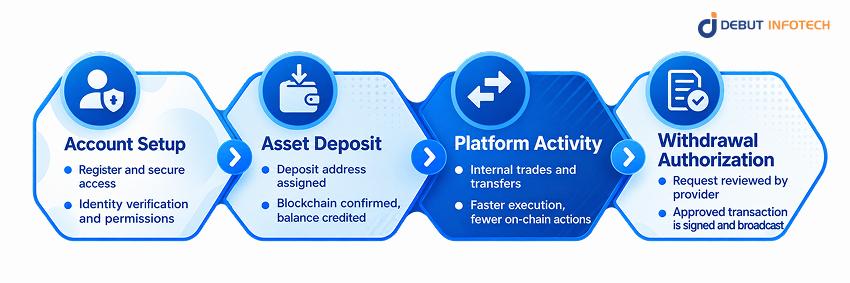
A typical custodial wallet workflow involves four stages:
Providers may protect signing operations through hardware security modules, MPC systems, multiple approval levels, and separate hot and cold storage environments. However, the exact architecture and control quality vary between platforms.
Custody enables exchanges to manage customer balances, liquidity, order execution, deposits and withdrawals in a single operating environment. Users can trade without signing every internal order themselves, while the exchange can provide account recovery, customer support, transaction monitoring, and policy enforcement. In return, the exchange assumes substantial security, compliance, and operational responsibilities.
This structure creates the main custodial wallet pros and cons.
Custodial wallets typically offer simpler onboarding, familiar account recovery, integrated trading, and access to customer support. Well-designed providers can also apply institutional controls that individual users may find difficult to maintain independently.
Users depend on the provider’s security, availability, financial stability, and withdrawal policies. A breach, insider incident, account takeover, outage, insolvency event, or legal restriction could delay or prevent access. The provider may also collect identity and transaction data. Therefore, convenience does not remove risk; it transfers much of the responsibility and control to the custodian.
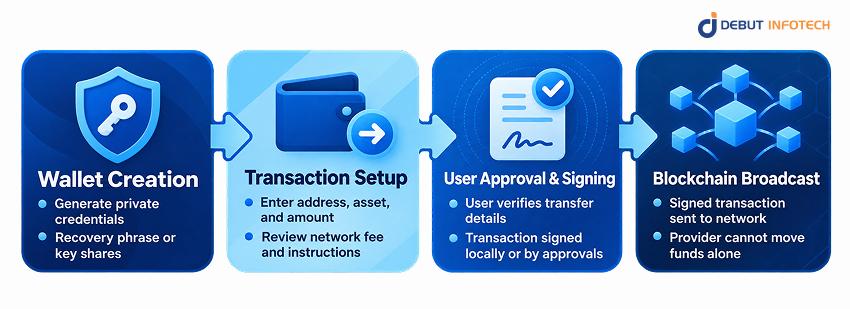
A non-custodial crypto wallet keeps transaction authorization outside a provider’s sole control. When you create the wallet, its software generates cryptographic credentials or establishes another signing arrangement. A traditional wallet may produce a recovery phrase, a hardware wallet can isolate the key on a dedicated device, and an MPC or smart-account design can distribute authorization across key shares or programmed rules. In each case, the provider should not be able to move assets independently.
Once you’ve started a transfer, the wallet will prepare the transaction with data like the recipient’s wallet address, the asset, the amount, the network fee, and contract instructions. You review those details before approving them. The wallet then signs the transaction, either locally, or gathers the necessary approvals and transmits the signed instruction to the blockchain network for verification.
A password, passkey or biometric verification may stop an individual from opening the wallet app on your device. However, it is not necessarily the underlying blockchain credential or recovery mechanism. This distinction matters because resetting an app password does not automatically restore a lost private key, recovery phrase, or controlling key share.
Non-custodial wallets can be in the form of mobile apps, browser extensions, desktop software, hardware devices, or embedded smart accounts. For instance, MetaMask calls itself a self-custodial wallet because users, not MetaMask, control their wallet credentials to authorize transactions.
The main non-custodial wallet pros and cons come from this separation of control.
Users can now transact directly on supported blockchains, dApps and DeFi protocols without having to request any custodian to do the processing for every transaction. They also reduce their exposure to a provider’s insolvency, withdrawal limits, or service outages. Compatible credentials may be imported into another interface, giving users greater portability when the original wallet application becomes unavailable.
The user becomes responsible for protecting signing credentials and verifying each transaction. A stolen recovery phrase, compromised device, fake wallet, phishing page, malicious token approval, or unreadable contract request can expose funds. If access is lost, customer support cannot recreate credentials it never possessed. A reliable wallet backup and recovery process is therefore essential.
While financial service providers may not ask for KYC to establish a non-custodial wallet, an integrated exchange, fiat gateway, or regulated financial service provider can request identity verification.
A comparison between custodial wallets and non-custodial wallets needs to include more than just the possession of a private key. The four related functions that are handed over from custody to self-custody are who can authorize transactions, who manages the signing credentials, who restores access and who manages the security and compliance controls. The changes impact convenience, recoverability, privacy, counterparty exposure and access to on-chain services.
| Responsibility | Custodial model | Non-custodial model |
| Authorizing transactions | Provider signs after validating the request | User-controlled credentials or policies sign |
| Protecting key material | Custodian operates the security infrastructure | User, device, or shared design provides protection |
| Recovering access | Provider can usually restore account access | Recovery depends on backups, shares, or guardians |
| Approving withdrawals | Provider can apply limits and review rules | User generally submits transactions directly |
| Maintaining availability | Provider operates systems and responds to outages | User depends on the wallet, device, network, and selected services |
| Handling security incidents | Provider investigates and contains platform events | User must respond to credential or device compromise |
| Supporting users | Provider can resolve account-level issues | Support can guide but may not restore credentials |
| Managing identity data | Provider commonly collects customer information | Wallet creation may require little or no identity data |
| Enabling dApp access | Provider may restrict or mediate connections | User manages permissions and transaction approvals |
| Carrying counterparty risk | User depends on the custodian’s stability and conduct | Custodian exposure falls, but software and protocol risks remain |
The first important distinction is that custody and connectivity answer different questions. Custody identifies who controls transaction authorization, while hot or cold status describes whether signing credentials are exposed to an internet-connected environment. A custodian can keep most key material in cold storage, while a self-custody browser wallet can remain online. Similarly, hardware wallets can reduce online exposure, but the wider setup still determines who controls recovery and signing.
Recovery also changes with the model. In a custodial vs. non-custodial wallet recovery comparison, provider-assisted recovery is usually easier because the custodian retains control of the underlying signing system. Self-custody recovery depends on arrangements established beforehand, such as a recovery phrase, backup device, MPC shares, or smart-account guardians. Adding recovery support can improve usability, but it may also introduce another party or policy that users must trust.
Privacy is not determined by custody alone. Custodial providers will typically take identity and transaction data for account management and KYC/AML compliance. A non-custodial wallet might gather less data, however, it is still possible to trace the activity that occurs on the public blockchain, and identity verification can be requested through connected services.
The practical trade-off is straightforward: convenience generally increases provider dependence, while direct control increases the user’s operational burden. The appropriate model is the one whose responsibilities the user or business can manage consistently, not the one with the more appealing label.
Neither model is automatically safer. A useful custodial vs. non-custodial wallet security comparison asks which failures are most likely and which party is better equipped to prevent them. Custodial wallets concentrate trust in a provider’s people, systems, and financial stability. Non-custodial wallets reduce that dependence but place greater responsibility on the user’s devices, recovery setup, and transaction decisions.
Four questions provide a more reliable way to assess crypto wallet security.
Custodial platforms present a concentrated target because their infrastructure may control large amounts of value. They require multi-layered crypto wallet key management, such as HSM or MPC, limited hot wallet balances, role-based access, multi-signature, transaction policies, monitoring, and incident response testing.
With self-custody, attackers will be more likely to target a user’s recovery phrase, device, cloud back up or wallet software. Exposure can be minimised with secured enclaves, protected device storage, encrypted backups and hardware wallets. However, no device control can compensate for a recovery phrase entered into a phishing site. The OWASP mobile security standard therefore treats key protection as a lifecycle issue covering generation, storage, use, and recovery.
A private key can remain secret while funds are still lost through a valid but deceptive signature. Non-custodial users may encounter fake wallet interfaces, malicious dApps, token approvals, address substitution, or blind-signing requests they cannot interpret.
Wallets should present the network, destination, amount, token permissions, and expected transaction effect in readable language. Transaction simulation and clear signing can help users identify harmful requests before approval. The Ethereum Foundation’s clear-signing initiative addresses this gap by making transaction intent easier to understand.
Custodians can add withdrawal screening, allowlists, cooling periods, and fraud checks. However, compromised customer accounts or internal approvals can still produce unauthorized withdrawals.
Custodians can usually restore account access after identity and risk checks, reducing the chance that a forgotten password causes permanent loss. The downside to weak verification of recovery is that it can serve as an attack path.
A seed phrase, backup device, distributed key shares or smart-account guardians may be used to achieve non-custodial recovery. Each option allows you to keep a certain amount of control and convenience. Their security relies on the division, protection, revocation and testing of recovery authority before an emergency.
A custodial user may be cut off during an outage, withdrawal suspension, cyber incident or in the event of an insolvency. Technical controls alone cannot remove this counterparty risk.
A self-custody user may switch to another compatible interface when the original wallet application fails, provided the credentials or account design remain portable. However, RPC providers, blockchain networks, bridges, dApps, and smart contracts introduce separate availability and security dependencies.
Multi-Party Computation (MPC) distributes signing across key shares and can produce a signature without reconstructing the full key. As NIST’s threshold cryptography guidance shows, it is a security mechanism, not automatically a custody model. Custody depends on who controls the required shares.
Multisig instead requires several keys or signatures under a defined blockchain policy. A hardware wallet isolates signing on a dedicated device, while cold storage keeps signing credentials offline. All enhance a specific design, none ensures security.
The safer model is therefore one in which the key protection, transaction review, recovery and incident-response functions of the model can be consistently managed.
Recovery is where the custody choice becomes most visible. A custodial provider can typically get access restored as they still have the signing infrastructure for the customer account. With a non-custodial wallet, there is no single reset button; recovery works only if the user or product team had developed a viable recovery process prior to the loss of access.
Within wallet backup and recovery, four actions should remain distinct. A backup preserves what is needed to restore access. Recovery uses that material or an approved process. Rotation replaces a compromised authorization method, while revocation disables it where the wallet architecture allows.
| Failure scenario | Custodial wallet | Non-custodial wallet |
| Forgotten password | Provider resets account access after verification | User restores the wallet from an existing backup |
| Lost device | Account may be accessed from another approved device | Recovery phrase, key share, backup device, or guardian is required |
| Compromised credentials | Provider may freeze access and change account controls | User may need to move assets or rotate authorization where supported |
| Provider becomes unavailable | Access depends on the provider’s continuity process | A portable backup may work with another compatible interface |
| All recovery material is lost | Provider may still verify the customer | Access may be permanently lost without assisted recovery |
A custodial password reset does not reconstruct a private key previously held by the user. It restores permission to use the provider-managed account. This makes identity verification, recovery notifications, cooling periods, and escalation controls essential because attackers can target the reset process through email compromise, SIM swapping, or social engineering.
The wallets based on seeds are different. The BIP-39 standard outlines a popular approach to creating a mnemonic phrase that can be used to reconstruct the deterministic wallet keys. If a phone or piece of hardware is lost, the phrase can restore access via a compatible software or another device. However, anyone who obtains that phrase may gain the same control. A device PIN protects the device; it does not replace the backup.
Modern wallets can reduce reliance on one recovery phrase. Multi-Party Computation (MPC) distributes signing across key shares, allowing a supported recovery process to replace a lost share or device. Whether the wallet remains non-custodial depends on who controls the required threshold. A provider must not be able to combine enough shares to sign alone without that authority being clearly disclosed.
Account Abstraction (ERC-4337) enables programmable smart-account validation. Developers can add guardians, passkeys, recovery delays, spending controls, or replaceable signers. ERC-4337 does not define one recovery method, so the wallet’s contracts and policies determine the actual safeguards. Poor guardianship, upgrading privileges, or poor back-up procedures can open up new attack avenues.
To ensure the business can recover from realistic failures, such as the loss of the phone, a stolen credential, an unavailable guardian, a provider outage and compromised signer, recovery must be tested. The user should be familiar with the individuals who may initiate, approve, delay, cancel and complete the process. Good recovery restores legitimate access without quietly giving another party permanent control.
A custodial wallet service generally does require the identity verification of the wallet holder, whereas a standalone non-custodial wallet may be set up without it. When comparing custodial vs. non-custodial wallets, however, the product label is not the deciding factor. KYC/AML compliance depends on the functions a provider performs, its control over transactions, the parties involved, and the laws of each operating market.
Custodial exchanges and hosted wallet providers can hold assets, facilitate transfers or swap virtual assets for customers. Depending on local law, the operator can be considered a virtual asset service provider (VASP) or other regulated financial institution, and may require suspicious-activity reporting, record keeping, transaction monitoring, screening for sanctions, and customer due diligence. Qualifying transfers may also trigger Travel Rule duties involving originator and beneficiary information.
Non-custodial wallet creation usually works differently. When software only generates or manages user-controlled keys and does not provide a regulated service on the user’s behalf, KYC may not apply during wallet setup. FATF guidance supports this functional approach: merely developing or selling wallet software does not normally make a company a VASP, but actively facilitating covered services or retaining sufficient control can change that assessment.
The feature set can also change the answer. Fiat on-ramps and off-ramps, token swaps, brokerage, payment execution, or custodial recovery may introduce verification requirements. A wallet may remain non-custodial while its banking, exchange, or payment partner requires identity verification before enabling a specific feature.
No KYC should not be mistaken for guaranteed anonymity. Public blockchain transactions are generally visible and traceable, although wallet addresses are pseudonymous and do not reveal someone’s identity by themselves.
Before launch, product teams should map each transaction flow, controlling party, embedded provider, and target jurisdiction. They should then obtain market-specific legal guidance on licensing, verification, monitoring, sanctions, recordkeeping, and Travel Rule obligations. FATF’s 2026 update confirms that national implementation remains uneven, so one compliance model may not work everywhere. This content is informational and does not constitute legal advice.
Choose a wallet model around the activity it must support and the failure its user can manage. A trader needs exchange access, a DeFi user needs direct signing, and a long-term holder may prioritize isolation. The custodial vs. non-custodial wallet question is therefore about where control, support, and responsibility should sit.
Self-custody places key protection with the user, while third-party custody adds reliance on the provider’s security and continued operation. Investor.gov recommends evaluating technical ability, recovery responsibilities, fees, safeguards, and what happens if a custodian fails.
| User or product need | Suitable starting point | Condition to validate |
| Beginner prioritizing support and familiar recovery | Evaluated custodial service | Confirm account protection, withdrawal rules, fees, and failure provisions. |
| Frequent centralized-exchange trading | Custodial balance for active trades | Retain only what is needed for trading and assess withdrawal availability. |
| DeFi or dApp interaction | Non-custodial wallet | Users must manage approvals, phishing exposure, signing, and recovery. |
| Long-term personal holdings | Hardware-backed self-custody or an evaluated custodian | Consider asset value, access frequency, technical ability, and recovery needs. |
| Business or institutional treasury | Institutional custody, governed MPC, multisig, or a mixed model | Require approval policies, audit trails, continuity, and incident procedures. |
| Consumer fintech or embedded wallet | Custodial, non-custodial, or hybrid architecture | Align control with onboarding, recovery promises, integrations, and regulated functions. |
When considering a custodial vs. non-custodial wallet for long-term storage, don’t confuse custody with connectivity. A self-custody wallet can stay online, but there are cold systems available for a custodian to hold funds. While hardware can limit online exposure, there are still essential steps to take to ensure users have protected backups and a tested recovery plan. Ethereum.org lists hardware wallets as a choice for long-term investors, and Investor.gov states that any offline devices may be lost, stolen, or damaged.
The exchange wallet vs. self-custody wallet decision can also be divided by purpose. A user might keep an active trading balance with an exchange and hold reserves elsewhere. A company may choose to use an operating wallet to make regular payments and MPC, multisig, or institutional custody for treasury funds. Each transfer boundary needs limits, approval rules, monitoring, and a recovery owner.
For an embedded wallet, start with the product promise. If users expect password-style recovery, pure self-custody may be unsuitable unless the architecture includes a transparent smart-account, guardian, or distributed recovery method. If the product promises exclusive user control, the provider should not retain undisclosed signing authority.
Do not choose self-custody when intended users cannot safely maintain access and the product offers no resilient recovery path. Do not choose custody for easier onboarding if the operator cannot sustain key infrastructure, compliance, treasury controls, support, and incident response. When neither extreme fits, use a hybrid design, but document who can sign, block, and recover each account.
Prior to the development, four decisions should be taken by a business: who controls the transactions, how access can be recovered, which security and compliance responsibilities the product brings, and how much of the wallet stack will the business own. These are not interface preferences. They affect architecture, vendor selection, testing, support, staffing, and the cost of operating the product after launch.
Start with a control map covering deposits, withdrawals, swaps, fees, staking, dApp connections, and recovery. For each flow, record who can initiate a request, approve it, access signing material, apply a policy, broadcast the transaction, or stop it before execution. This exposes the real custody model more accurately than a “custodial” or “non-custodial” product label.
Map customer assets, business treasury, reserve funds, and gas wallets separately because they may need different limits, signers, and storage policies. Identify every exchange, fiat provider, custodian, and payment partner involved as well. FATF applies an activity-based approach to virtual-asset services, so the services performed and control retained can influence regulatory obligations.
Then, specify the action that should occur when a device is lost, if a signer is unavailable, an administrator account is compromised, the provider goes offline, or a withdrawal is suspicious. These situations must be considered before deciding on individual technologies for effective crypto wallet security.
For a custodial architecture, hardware security modules, Multi-Party Computation (MPC), split between hot and cold wallets, thresholds of approval, separation of duties, fraud rules, reconciliation, audit trails, and disaster recovery testing are key components. On-device protection, user-controlled key shares, clear signing, transaction simulation, dApp permissions, token allowances and safe SDK and RPC dependencies are all relevant to a non-custodial design.
Document wallet backup and recovery without creating hidden custody. A support team should know what assistance it can provide and what it must never be able to authorize. If Account Abstraction (ERC-4337) supports recovery or spending policies, define the account’s validation logic, upgrade authority, guardians, bundler dependencies, and paymaster limits. ERC-4337 enables programmable validation, but the chosen implementation still determines who holds effective control.
Treat crypto wallet key management as a lifecycle rather than a storage decision. Cover key or share generation, protection, use, backup, recovery, rotation where supported, compromise handling, and destruction. NIST provides lifecycle-oriented key-management guidance, while OWASP MASVS supplies relevant controls for mobile storage, cryptography, authentication, networking, and resilience.
| Delivery model | Main advantage | Decision to resolve |
| Custom build | Maximum control over differentiated workflows | Can the team fund, test, and operate the complete stack? |
| White-label wallet | Faster delivery of standard functionality | Are customization, audit access, upgrades, and migration sufficient? |
| Wallet-as-a-Service | Modular infrastructure through APIs or SDKs | Who owns availability, data, signing dependencies, pricing risk, and exit planning? |
Complete these decisions during discovery, before visual design or final estimates. The resulting specification should identify every signing path, recovery authority, operating owner, external dependency, failure response, and control that must be tested before release.
A wallet architecture should follow the product’s responsibilities, not a preferred technology. At Debut Infotech, we begin with four practical questions: Who must control signing? What should happen when access is lost? Which transactions require additional approval? What must your team operate after launch? The answers establish the custody boundary before code, screens, or estimates are finalized.
We then help you select a custodial, non-custodial, hybrid, or Multi-Party Computation (MPC) design that fits those requirements. Our crypto wallet development services cover mobile, web, backend, API, and smart contract development, alongside multi-asset support, cross-chain routing, and dApp integrations.
Architecture is only part of the assignment. We define key-management and recovery workflows, authentication, permissions, transaction policies and monitoring requirements. If the product needs regulated third-party services, we can integrate KYC/AML compliance tools, fiat gateways, exchanges, or payment provider services, and maintain transparency and control over data and responsibilities. We also support test environments, security assessments, planning and coordination of third party audit, deployment, maintenance, and planned updates.
This helps maintain the holistic security, recovery, compliance and usability of a crypto wallet within the same product decisions. It also provides stakeholders with a clear understanding of their responsibilities and dependencies whether internal or external, prior to the launch.
Schedule a project-specific wallet architecture session with our team. We will help you map signing authority, recovery paths, integrations, security controls, and the delivery roadmap needed to move forward.
The main difference is who controls the credentials or signing mechanism that authorizes blockchain transactions. In a custodial wallet, the provider manages that authority and acts after the user authenticates. In a non-custodial wallet, the user controls it. This shifts recovery, counterparty exposure, transaction restrictions, and daily security responsibility.
In a conventional non-custodial wallet, the user controls the crypto wallet private keys or recovery phrase. In MPC or smart-account designs, control may instead be distributed across shares, devices, guardians, or programmed rules. What matters is whether the user controls sufficient authority to approve transactions without provider permission.
No. Non-custodial wallets remove some custodian risks but remain exposed to phishing, malicious dApps, malware, compromised devices, seed theft, dangerous token approvals, software flaws, and user error. Their crypto wallet security depends on wallet implementation, device hygiene, signing awareness, backups, and the safety of every connected protocol.
MetaMask is a self-custodial wallet: users control wallet access, and MetaMask cannot restore access if the required recovery credentials are unavailable. However, some buy, sell, swap, card, or embedded services may involve external providers and separate terms. Users should verify which party handles each connected service.
Crypto exchanges use custodial wallets to operate trading accounts, manage liquidity, process deposits and withdrawals, and update internal balances quickly. Custody also supports account recovery, risk controls, and compliance processes. The trade-off is dependence on the exchange’s key management, withdrawal availability, asset segregation, solvency, and incident response.

Our Latest Insights
USA
2501 Chatham, Rd Suite R Springfield, IL 62704
+1-708-515-4004
info@debutinfotech.com
UK
7 Pound Close, Yarnton, Oxfordshire, OX51QG
+44-770-304-0079
info@debutinfotech.com
Canada
154 Eden Oak Trail, Kitchener, ON N2A 0H9
+1-708-515-4004
info@debutinfotech.com
INDIA
Sector 101-A, Plot No: I-42, IT City Rd, JLPL Industrial Area, Mohali, PB 140306
9888402396
info@debutinfotech.com