ON THIS PAGE
Progress0%






Our Global Presence :





STO platform development costs range from $50,000 to $450,000 or more in 2027, depending on platform complexity, token functionality, investor management, and financial integrations.
Platform requirements determine the development budget. Basic single-issuer platforms need fewer features, while enterprise solutions require multi-issuer support, advanced permissions, reporting, and financial system integrations.
Smart contracts and token standards influence engineering costs. ERC-3643 supports permissioned security token transfers through identity verification and compliance checks, making contract testing and validation essential.
Custom, white-label, and hybrid development offer different cost trade-offs. Custom platforms provide greater control, white-label solutions reduce initial engineering work, and hybrid models combine existing infrastructure with tailored functionality.
Regulatory compliance adds expenses beyond software development. Legal documentation, investor verification, securities filings, independent smart contract audits, and ownership recordkeeping must be considered in the launch budget.
STO platform development can take 3–12 months or longer, depending on project complexity, integrations, and testing. Legal preparation, provider onboarding, and independent audits can extend the overall launch schedule.
Ongoing maintenance requires a separate operating budget. Businesses should account for blockchain infrastructure, software updates, security reviews, external integrations, and investor support, with illustrative technical costs of $2,000–$12,000 or more per month.
From token issuance to investor management, the cost of an STO platform depends on the infrastructure needed to support a regulated securities offering.
A company can create a digital token on a blockchain without building much of a platform. The challenge begins when that token represents financial security and real investors need to buy or hold it.
Each investment must follow the conditions of the offering. Ownership records must remain accurate when tokens change hands. The issuer also needs a way to manage those securities long after the initial sale.
This is what makes security token offering (STO) platforms different from conventional token applications.
For businesses planning an STO launch, the platform’s cost depends on how those responsibilities are handled. A private offering for a single asset may need a relatively simple system. A platform serving multiple issuers may require extensive integration with financial service providers and more sophisticated ownership controls.
Under the development assumptions used in this guide, STO platform development cost can range from $50,000 to $450,000 or more in 2027. The amount covers custom software development, legal preparation, and other launch expenses that require separate funding.
Understanding what goes into that investment can help businesses avoid paying for unnecessary infrastructure or overlooking capabilities they will need later.
The cost of developing an STO platform is determined by the functions it must support. A single-issuer platform requires less engineering than a multi-issuer system with complex ownership rules. The difference becomes more pronounced when investor verification and third-party financial services are part of the project.
For initial budgeting, custom STO platforms can be divided into three levels of complexity.
| Platform Type | Estimated Development Cost | Typical Requirements |
| Basic STO Platform | 50,000–100,000 | Single issuer, standard token contracts, investor onboarding and basic administration |
| Advanced STO Platform | 100,000–225,000 | Custom transfer controls, investor verification, ownership management and external integrations |
| Enterprise STO Platform | 225,000–450,000+ | Multiple issuers, complex permissions, advanced reporting and extensive financial infrastructure integrations |
Consider a real estate company that wants to tokenize ownership interests in one property. Its platform might only need investor registration and subscription management alongside the issuance of security tokens. Once the tokens are distributed, the system must maintain ownership records and support any required investor communications.
Now consider an investment company planning to issue tokenized equity and debt instruments through the same platform. Each instrument may have different transfer restrictions and payment obligations. The business may also need separate issuer accounts and connections to external recordkeeping providers.
Both companies are developing STO platforms, but the second needs a more complex system because it must support several distinct financial workflows.
This explains why estimating the security token platform development cost requires more than identifying the preferred blockchain or counting the number of features.
Most of the software investment goes toward building the systems that connect token issuance with investor operations.
For example, a hypothetical $150,000 STO platform project could distribute its engineering budget as follows:
| Development Component | Illustrative Cost |
| Discovery and platform architecture | $10,000 |
| User experience and interface design | $15,000 |
| Security token smart contracts | $40,000 |
| Backend and administration systems | $40,000 |
| Third-party integrations | $25,000 |
| Internal testing and deployment | $20,000 |
| Total Development Budget | $150,000 |
These figures illustrate how a project budget might be structured. They are not independent price benchmarks for individual services.
The allocation also shows why an STO platform cannot be priced solely around token creation. Smart contracts form one part of the system, but the surrounding infrastructure determines how investors participate and how the issuer manages the offering.
Before accepting a development proposal, businesses should confirm which of these components are included. An inexpensive quotation can become costly if investor verification or external integrations must be added later.
A security token represents rights associated with a financial instrument. Those rights may involve ownership in a company or an entitlement to payments. They may also place restrictions on who can hold the security and when it can be transferred.
The platform needs to reflect those conditions.
Several technical decisions influence how much work this requires.
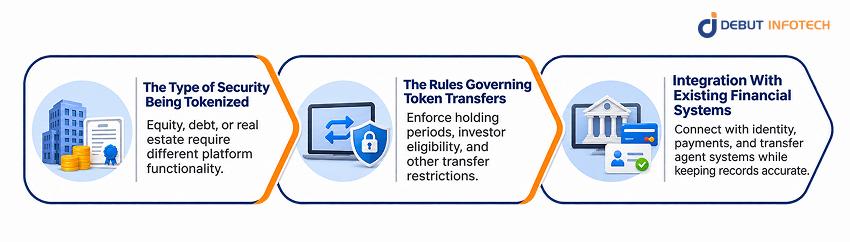
An STO platform designed for tokenized equity has different responsibilities from one supporting debt instruments.
A tokenized bond may require interest payments and a redemption schedule. A tokenized equity interest may involve ownership updates or voting-related processes. Real estate investment interests can require distributions and reporting that follow the underlying investment structure.
The blockchain can record token transactions, but it does not automatically administer these financial obligations.
The platform therefore needs software that connects ownership records with the terms of the security.
For a business issuing only one type of instrument, this functionality may be relatively straightforward. The cost increases when the same platform must handle several securities with different contractual requirements.
Security tokens may be subject to restrictions that ordinary cryptocurrency tokens do not have.
For example, an investor might be prohibited from transferring a security during a specified holding period. Another investor may not qualify to receive the token because of eligibility requirements.
The platform must enforce the applicable rules before a transfer is completed.
This requires smart contracts to work with investor identity systems and compliance-related information. Each additional restriction introduces conditions that need to be implemented and tested.
A platform supporting one defined investor category will usually be easier to build than one managing several categories across different jurisdictions.
STO platforms rarely operate independently of the issuer’s wider financial infrastructure.
Investor identities may be checked through external providers. Payments may pass through a banking or payment service. Official ownership records may be maintained by a transfer agent.
The platform needs to exchange information with these systems while keeping its own records accurate.
Consider what happens when an investor completes payment but token issuance fails. The platform must identify the unsuccessful transaction and prevent its ownership records from becoming inconsistent.
Handling such situations requires more than connecting two APIs. The system needs reconciliation procedures and a reliable way to recover from failed operations.
These dependencies can account for a significant portion of the cost of STO development services.
Smart contracts determine how security tokens behave on the blockchain. They can establish the conditions for issuance and restrict transfers that do not meet the rules of the security.
For an initial estimate, STO smart contract development expenses may fall between $15,000 and $55,000 or more. The amount depends on the contract architecture and the rules it must enforce. An independent security audit is additional.
A useful example is ERC-3643. This token standard was developed to support permissioned transfers of security tokens.
Unlike a conventional ERC-20 token, an ERC-3643 implementation can check whether the receiving wallet is associated with an eligible investor. It can also evaluate additional transfer restrictions before allowing the transaction.
The ERC-3643 specification describes how an identity registry works with a compliance contract to perform these checks.
Imagine an investor trying to transfer tokens to another wallet.
The receiving wallet may exist on the blockchain and be capable of holding tokens. That alone does not mean the transfer is permitted. The smart contract must first confirm the recipient’s eligibility and evaluate the rules attached to the security.
If those conditions are not satisfied, the transaction is rejected.
The standard also includes administrative functions that can support token recovery and other authorized actions.
These capabilities are valuable because they allow issuers to implement certain operating rules directly within the token infrastructure. However, each function increases the importance of testing and access control.
A contract that correctly issues tokens but incorrectly processes ownership restrictions can create serious operational problems.
This is why businesses should budget for contract validation rather than treating successful deployment as proof that the system is ready.
A business does not necessarily need to build every component of an STO platform from scratch.
Several technology providers offer platforms with existing token issuance and investor management capabilities. These solutions can reduce the amount of custom engineering required for an offering.
However, the financial advantage depends on how closely the available software matches the business’s needs.
Custom development allows the platform to be designed around a specific operating model.
An issuer can define the investor experience and determine how ownership records are managed. The software can also be integrated with existing financial systems without relying entirely on a standard vendor workflow.
This approach can make sense for organizations with specialized securities or complex operational requirements.
The trade-off is a larger initial engineering investment. Under the assumptions used in this guide, custom development may range from $50,000 to $450,000 or more.
The business must also plan for maintenance and future changes to the system.
White-label solutions offer an existing technology foundation that can be configured for another company’s use.
The provider supplies the core platform. The customer pays for setup and access to the software.
DigiShares provides a published example of this pricing model.
| DigiShares Package | Setup Fee | Monthly Fee |
| Launch | €5,000 | €300 |
| Standard White-Label | €35,000 | €950 |
| Advanced White-Label + APIs | From €50,000 | €1,500 |
The cost advantage is most apparent when a business can use the existing functionality without extensive modifications.
A company issuing one type of security may find that the standard investor management and token issuance features are sufficient.
An enterprise that needs a specialized custody integration or complex ownership administration may face greater customization requirements.
In that case, the lower initial cost of a white-label platform needs to be weighed against the recurring subscription and any additional development work.
A hybrid model uses an existing tokenization platform for selected functions while introducing custom software around it.
A business might license the token issuance infrastructure but develop its own investor portal. It could also connect the platform to internal administration systems.
This can reduce development effort without requiring the organization to adopt an entirely standardized operating model.
The main consideration is long-term dependence on the underlying provider. Changes to its APIs or licensing terms can affect the custom components built around the platform.
For this reason, businesses should compare the total cost of ownership rather than focusing only on the implementation price.
Security tokens remain subject to the laws governing the underlying securities.
In January 2026, staff from three divisions of the U.S. Securities and Exchange Commission published a statement on tokenized securities.
The statement explains that securities can be represented through different tokenization structures. The use of blockchain technology does not change the application of federal securities laws.
For businesses developing STO platforms, this means regulatory requirements need to be considered before the software architecture is finalized.
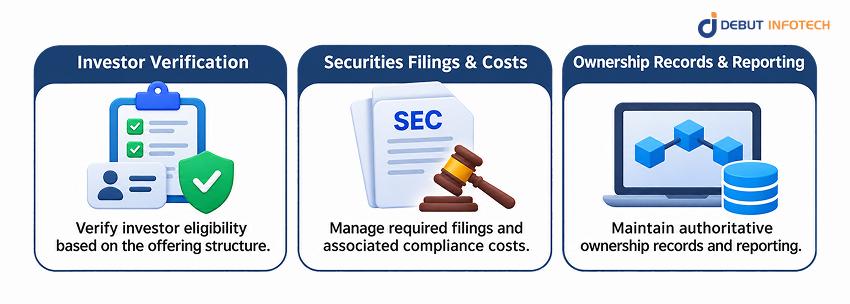
A company conducting a U.S. offering under Regulation D Rule 506(c) must take reasonable steps to verify that purchasers are accredited investors.
The platform may therefore need to prevent an investor from proceeding until the required verification process is complete.
The rules are different for other offering structures.
A system designed for one offering exemption may not provide everything needed for another. Supporting several jurisdictions can introduce further differences in investor eligibility and documentation.
The software must reflect the operating requirements established by the issuer’s legal advisers.
For a defined verification integration, businesses might use an illustrative engineering allowance of $5,000 to $20,000. Actual vendor charges and professional fees are separate.
Some regulatory activities involve official filing requirements. Others require legal preparation and ongoing professional services.
For example, the SEC does not charge a federal filing fee for Form D notices or amendments. State notice filings may still involve fees.
Preparing the offering documents and determining the appropriate exemption can also require legal advice.
The important distinction is between a government filing fee and the broader cost of complying with securities regulations.
Businesses should not assume that a low official filing fee makes the entire regulatory process inexpensive.
A token balance alone may not be sufficient to satisfy every recordkeeping obligation.
The issuer or its service providers need to determine which records are authoritative and how they will be maintained.
In May 2025, SEC staff explained that a registered transfer agent may use distributed ledger technology as its official master securityholder file or as a component of that file if the applicable requirements are satisfied.
This creates opportunities for blockchain-based recordkeeping, but it also places importance on system reliability and access to accurate information.
For businesses, ownership administration should be considered part of the platform architecture rather than a reporting feature added after launch.
A completed platform does not mean a securities offering is ready to accept investments.
The issuer may still need legal documentation and independent security assessments. External service providers must also be prepared to support the offering.
These activities create a separate category of launch expenses.
Consider a hypothetical business building a custom STO platform for a defined U.S. offering.
| Expense | Illustrative Budget |
| Custom software development | $145,000 |
| Legal preparation and offering documents | $30,000 |
| Independent smart contract audit | $18,000 |
| External service-provider setup | $12,000 |
| Initial operating reserve | $18,000 |
| Total Launch Investment | $223,000 |
This example is a modeled budget rather than a standard market price. It assumes an operating reserve of $3,000 per month for six months.
It also excludes expenses that could materially change the final investment. These may include placement commissions and additional regulated services.
The example demonstrates why the total investment required to build a security token offering platform should be evaluated separately from the cost of launching the offering.
A business may be able to control its software expenses while still facing significant legal or operational requirements.
The reverse is also possible. An issuer may already have suitable service providers but need substantial investment in custom technology.
The best estimate accounts for both sides of the project.
Once the offering is launched, the platform becomes part of the issuer’s ongoing operations.
It must continue to support ownership records and investor access. The software also needs maintenance as connected systems change.
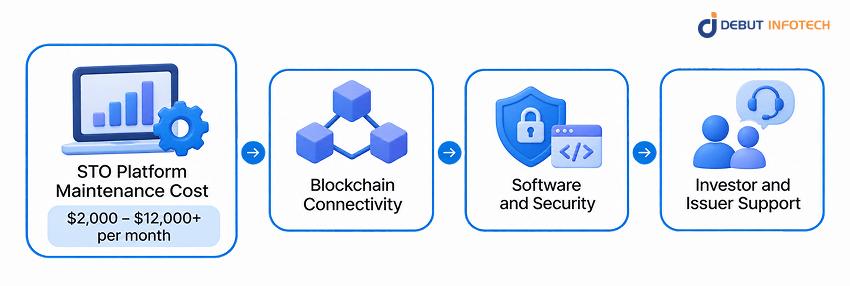
For a focused custom STO platform, an illustrative allowance of $2,000 to $12,000 or more per month can provide a starting point for technical operating expenses.
The actual amount depends on transaction activity and support requirements. Legal services and regulated intermediaries may add substantial separate costs.
The application needs reliable access to the selected blockchain.
This often involves third-party infrastructure services that process requests and monitor transactions.
Costs vary with the number of transactions and the level of service required.
Applications that support multiple blockchain networks generally have more infrastructure dependencies than single-network platforms.
External integrations change over time. Software libraries also require updates.
These changes can affect how the platform communicates with verification providers or handles blockchain transactions.
Smart contract modifications may require additional testing and independent review.
For businesses, maintaining the platform means protecting its ability to perform the same financial operations reliably as its supporting technology evolves.
Investors may need help with account access or wallet-related problems.
Issuers may also need to administer distributions and maintain ownership information.
The amount of support required generally depends on the investor base and the complexity of the securities.
These activities create operating expenses even when the underlying smart contracts are functioning correctly.
Development time is another factor in project planning.
A focused platform may require three to five months of software work. A more complex system can take considerably longer because of its integration and testing requirements.
| Project Scope | Illustrative Timeline |
| Basic STO Platform | 3–5 months |
| Advanced STO Platform | 5–8 months |
| Enterprise STO Platform | 8–12 months or longer |
These are software delivery estimates rather than guaranteed launch timelines.
An offering may require additional time for legal preparation or external service-provider onboarding. Independent audits can also affect the release schedule.
Businesses should therefore distinguish between the date the software becomes technically ready and the date the securities offering can begin.
Making that distinction early helps avoid development commitments based on regulatory or operational dependencies that remain outside the engineering team’s control.
The most effective way to reduce development expenses is to narrow the first release around a clearly defined offering.
A platform supporting one asset type does not need every feature that a multi-issuer marketplace might eventually require.
For example, a company issuing a single tokenized debt instrument may not need infrastructure for voting across several share classes. It may also be unnecessary to integrate multiple blockchain networks during the first release.
Removing those requirements can reduce engineering work without affecting the platform’s ability to support the intended offering.
Several decisions can help businesses control the initial investment:
These decisions make the project easier to estimate because they establish a clear boundary around the first release.
They also help prevent businesses from investing in capabilities that may not be needed until the platform has demonstrated commercial demand.
The success of an STO project depends on how closely its technology reflects the operating requirements of the security.
A platform designed without considering investor eligibility or ownership administration may require extensive changes once the offering structure is finalized.
Debut Infotech works with businesses to develop security token infrastructure and investor-facing applications. Our STO development services cover smart contract development and token issuance workflows. They also include platform interfaces and integration with relevant external systems.
Our published work for The Econophy Group LLC provides an example of how these requirements influence platform design.
The project involved tokenizing biotech patents associated with advanced diagnostic technology. The implementation used ERC-3643 and included an investor-facing portal.
The underlying asset shaped the technical approach. The platform needed to represent the intended investment while providing a way for investors to participate and manage their holdings.
For businesses evaluating a new STO, our team can help define the technical scope and identify dependencies before development begins. This provides a clearer foundation for preparing a cost estimate and deciding which capabilities belong in the initial release.
Legal structuring and regulated financial activities should be addressed with qualified advisers and authorized service providers.
An STO platform is more than a system for issuing blockchain tokens. It is part of the infrastructure used to administer a financial security.
That distinction explains why development costs vary so widely. A focused issuance platform may be relatively straightforward to build, while an enterprise solution must support more demanding ownership and operating requirements.
Custom software development may require $50,000 to $450,000 or more under the assumptions used in this guide. But that figure is only one part of the investment. Legal preparation and external services can add to the overall launch budget.
White-label solutions may reduce initial engineering work when their existing functionality is sufficient. Custom development becomes more relevant when the business needs greater control over specialized processes.
Before selecting a development approach, businesses should establish what the token represents and how it will be administered.
Once those requirements are clear, the platform’s architecture becomes easier to define. So does the investment needed to build and operate it.
A. There is no reliable universal average because STO platforms serve different types of securities and operating models. For planning purposes, a focused custom solution may require $50,000 to $100,000. Advanced platforms may cost $100,000 to $225,000. Enterprise projects can exceed $225,000. These ranges are illustrative engineering estimates and do not include the full cost of launching the securities offering.
A. The launch budget includes more than the software. Businesses may need legal documentation and independent smart contract audits. External service-provider setup and operating reserves also contribute to the total. The hypothetical example in this guide requires $223,000 across these categories. Actual costs can be substantially different depending on the security and the regulatory structure of the offering.
A. The main factors are the security being tokenized and the functionality needed to administer it. Complex smart contracts increase engineering work. Investor eligibility requirements can add verification systems and transfer restrictions. External integrations also affect the scope. Businesses should define the offering structure before finalizing the software architecture because that decision determines many of the platform’s technical requirements.
A. For preliminary budgeting, STO smart contract development may require $15,000 to $55,000 or more. The cost depends on transfer restrictions and investor eligibility rules. Administrative functions and lifecycle requirements can add complexity. An independent security audit is generally a separate expense. Businesses should confirm whether the contract work is already included in the broader platform development quotation.
A. White-label platforms usually require less initial engineering when their existing functionality matches the offering. However, businesses must account for setup charges and recurring licensing fees. Custom development involves greater upfront investment but provides more control over specialized workflows. The more economical choice depends on how much customization the issuer requires and the expected operating costs over time.
A. A focused custom STO platform may require an illustrative technical operating budget of $2,000 to $12,000 or more per month. Costs depend on hosting and transaction activity. Software maintenance and investor support also require funding. Regulated service providers and professional advisers may charge separately. Businesses should calculate maintenance based on the platform’s expected activity rather than applying a fixed percentage of development cost.

Our Latest Insights
USA
2501 Chatham, Rd Suite R Springfield, IL 62704
+1-708-515-4004
info@debutinfotech.com
UK
7 Pound Close, Yarnton, Oxfordshire, OX51QG
+44-770-304-0079
info@debutinfotech.com
Canada
154 Eden Oak Trail, Kitchener, ON N2A 0H9
+1-708-515-4004
info@debutinfotech.com
INDIA
Sector 101-A, Plot No: I-42, IT City Rd, JLPL Industrial Area, Mohali, PB 140306
9888402396
info@debutinfotech.com