ON THIS PAGE
Progress0%






Our Global Presence :





AI improves the entire media content lifecycle by enhancing content creation, personalization, localisation, audience analytics, advertising, and content moderation while supporting not replacing creative teams.
High-value AI use cases deliver measurable business outcomes, including recommendation engines, generative AI, computer vision, NLP, automated dubbing, metadata tagging, and real-time audience insights.
Successful AI implementation starts with business goals and phased execution, using KPIs, data readiness assessments, pilot projects, and a build, buy, or partner strategy before enterprise-wide scaling.
Technology architecture directly impacts AI performance, requiring the right mix of cloud, on-premises, or hybrid infrastructure, GPU resources, scalable data pipelines, and integration with MAM and CMS platforms.
AI investment varies by project scope and complexity, with pilot initiatives offering a lower-risk path to validate ROI before expanding to enterprise-grade production and automation workflows.
Governance is essential for sustainable AI adoption, requiring strong data privacy, regulatory compliance, deepfake detection, security controls, and human oversight to reduce operational and reputational risks.
Artificial intelligence is reshaping how media and entertainment companies create, distribute and monetise content. What began with recommendation engines has evolved into technology that supports script development, video production, visual effects, localisation, advertising, audience analytics, and content moderation. Rather than using AI for isolated tasks, organisations are embedding it across production and business operations to improve efficiency and respond faster to changing audience expectations.
Consumers now expect personalized recommendations, multilingual content, interactive experiences, and seamless access across devices.
At the same time, studios, broadcasters, streaming platforms, publishers, and gaming companies are under pressure to produce more content while managing costs. AI helps address these demands by automating repetitive workflows, accelerating creative processes, and generating insights from audience data.
AI complements creative talent instead of replacing it. Writers use AI to develop ideas, editors streamline post-production, VFX teams speed up rendering, and marketing teams optimize campaigns with predictive analytics.
This guide explores how AI in Media and Entertainment is transforming industry operations, its key benefits, practical use cases, implementation strategies, technology architecture, costs, emerging trends, and how to choose the right AI development partner.
The market for AI in Media and Entertainment is expanding rapidly as organisations invest in generative AI, predictive analytics, automation, and personalised digital experiences.
Streaming platforms, broadcasters, publishers, gaming companies, and film studios are integrating AI into production, distribution, advertising, and audience engagement to improve efficiency and remain competitive in an increasingly digital market.
Industry forecasts reflect this momentum. According to Grand View Research, the global AI in media and entertainment market was valued at US$33.7 billion in 2025 and is projected to reach US$159.3 billion by 2033, growing at a 20.5% CAGR.
The report also notes that Asia-Pacific accounted for 32.5% of global revenue in 2025, while services represented more than 60% of the market, highlighting strong demand for AI integration, consulting, and managed services.
Broader industry growth is also creating favourable conditions for AI adoption. PwC’s Global Entertainment & Media Outlook 2025–2029 projects that the global entertainment and media industry will reach US$3.5 trillion by 2029, supported by continued growth in digital advertising and personalized consumer experiences.
As organisations scale their AI investments, the technology is becoming a core capability for content creation, audience engagement, localisation, and operational efficiency rather than an experimental innovation.
AI is transforming the media and entertainment industry by automating production workflows, personalising audience experiences, improving data-driven decision-making, and streamlining content distribution. The role of AI in media and entertainment continues to expand as organisations embed intelligent technologies across every stage of the content lifecycle.
The following shifts illustrate how AI is redefining the industry’s day-to-day operations and laying the foundation for future innovation.
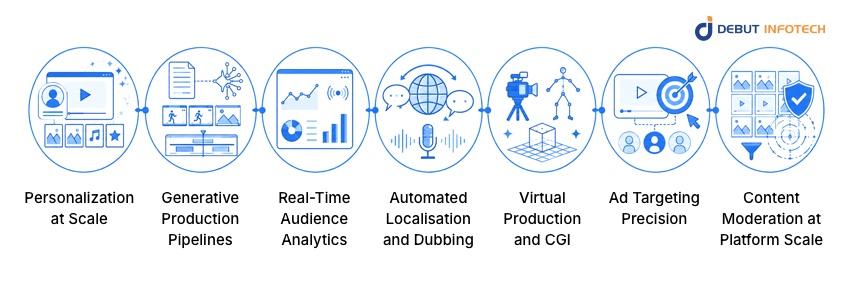
Enterprise AI for media enables companies to deliver highly personalised experiences by analysing viewing history, search behaviour, engagement patterns, and user preferences in real time.
Instead of offering the same content to every viewer, platforms dynamically tailor recommendations, homepages, and promotions for each individual. This operational shift allows streaming services, publishers, and gaming platforms to manage millions of unique user journeys automatically while continuously refining recommendations as audience interests evolve.
AI is reshaping production workflows by supporting script development, storyboarding, concept art, voice generation, editing, and visual asset creation.
Creative teams use generative AI in media and entertainment to accelerate repetitive tasks and quickly explore multiple ideas before finalising content.
Rather than replacing creative professionals, AI streamlines production pipelines, shortens review cycles, and enables departments to collaborate more efficiently from pre-production through post-production.
AI processes audience data from streaming platforms, websites, mobile apps, and social media as it is generated, giving media companies immediate visibility into viewer behaviour.
Instead of relying on delayed reports, decision-makers can monitor engagement, identify content trends, evaluate campaign performance, and respond quickly to changing audience preferences. This allows organisations to make faster operational decisions based on continuously updated insights.
AI is simplifying global content distribution by automating translation, subtitle generation, voice synthesis, and multilingual dubbing.
Modern language models preserve context while speech technologies produce natural-sounding voiceovers across multiple languages.
Human reviewers still refine cultural nuances and quality, but AI significantly reduces localisation timelines, allowing media companies to release content simultaneously across international markets and expand their global reach more efficiently.
AI is modernising virtual production by automating complex visual effects tasks such as object tracking, facial enhancement, motion capture cleanup, and digital de-ageing.
Production teams use AI to accelerate rendering, improve compositing, and visualise scenes before filming begins. These capabilities reduce manual workloads, shorten production schedules, and give filmmakers greater flexibility when creating high-quality visual experiences for audiences.
AI improves advertising operations by analysing behavioural, contextual, and engagement data to deliver more relevant campaigns. Instead of targeting broad audience segments, advertisers can personalise ads based on individual viewing patterns and preferences.
AI also monitors campaign performance in real time, allowing continuous optimisation of audience targeting, content placement, and advertising spend while helping media companies maximise monetisation opportunities.
AI enables media platforms to moderate massive volumes of user-generated content by automatically detecting harmful material, copyright violations, misinformation, spam, and inappropriate content.
Working alongside human moderators, AI accelerates review processes and improves policy enforcement across digital platforms. This operational shift helps organisations maintain safer online communities while reducing the time and resources required for large-scale moderation.
AI benefits media and entertainment companies by reducing production costs, improving operational efficiency, increasing audience engagement, accelerating global content delivery, and creating new revenue opportunities. The impact of AI on the entertainment industry is evident in faster production cycles, smarter content distribution, and more personalised audience experiences.
AI automates repetitive tasks such as video editing, metadata generation, subtitle creation, asset tagging, and quality checks. Teams complete projects faster while reducing dependence on manual workflows.
Production schedules become shorter because AI assists with planning, editing, localisation, and rendering. This enables organisations to deliver more content without proportionally increasing operational costs.
Personalised recommendations encourage viewers to spend more time on a platform and return more frequently.
AI identifies viewing patterns, predicts user preferences, and recommends relevant content before users lose interest, helping media businesses improve engagement and reduce subscriber churn.
AI enables advertisers to deliver highly relevant campaigns based on behavioural signals rather than broad audience segments.
Better targeting improves click-through rates, increases advertising effectiveness, and creates premium advertising inventory for publishers and streaming platforms.
AI accelerates localisation through automated translation, dubbing, subtitle generation, and cultural adaptation support.
Media companies can launch content across multiple regions simultaneously. AI in media industry reduces delays and expanding international reach without significantly increasing production resources.
AI assists editors, animators, and VFX artists by automating repetitive processes such as scene segmentation, object tracking, colour matching, audio cleanup, facial enhancement, and metadata tagging.
Creative professionals spend more time refining content instead of completing routine technical work.
AI helps platforms detect harmful or inappropriate content before it reaches audiences.
Combined with human moderation, these systems improve policy enforcement, reduce reputational risk, strengthen advertiser confidence, and foster safer digital communities for creators and consumers alike.
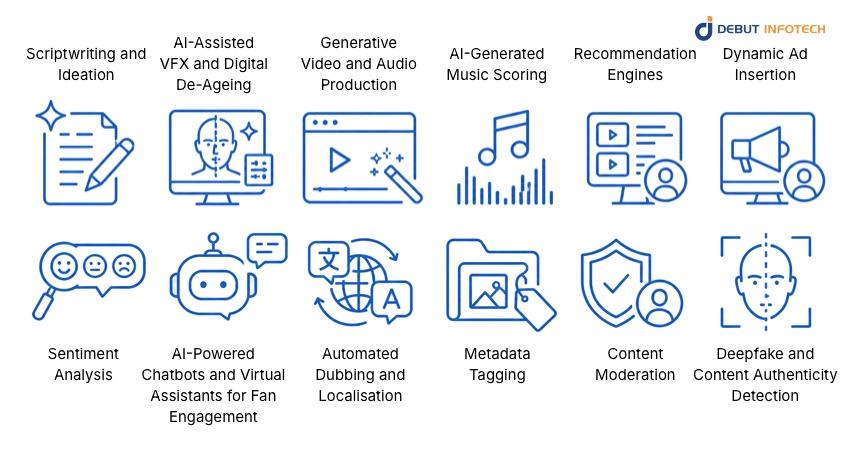
AI supports media and entertainment across content creation, audience engagement, and operational workflows. From scriptwriting and recommendation engines to automated localisation and content moderation, AI helps organisations improve efficiency, creativity, and user experiences throughout the content lifecycle.
While the underlying technologies differ for AI use cases in media and entertainment, most AI implementations fall into three broad categories: content creation, distribution and audience engagement, and Media & entertainment workflow automation.
Generating compelling stories remains a human-driven process, but AI has become a valuable creative assistant during pre-production.
Large language models (LLMs) help writers develop story concepts, outline scripts, generate dialogue variations, and refine character development based on creative prompts.
Production teams also use AI to evaluate scripts against historical performance data. By analysing audience preferences, genre trends, pacing, and emotional arcs, AI can identify areas that may require refinement before production begins. These insights support creative decisions without replacing the writer’s vision.
Beyond film and television, AI content generation supports newsrooms, podcast producers, advertising agencies, gaming studios, and social media teams that need to produce high-quality content at scale. Human review remains essential to ensure originality, creativity, and brand consistency.
Examples
Visual effects production often involves time-intensive processes such as rotoscoping, object tracking, facial enhancement, and compositing. AI accelerates these workflows by automating repetitive tasks that previously required extensive manual effort.
Computer vision models can identify actors, separate foreground objects from backgrounds, enhance image quality, and reconstruct facial details with remarkable accuracy.
AI in entertainment industry also supports digital de-ageing by analysing facial structures and generating realistic age transformations while preserving natural expressions.
These capabilities reduce production timelines while giving artists greater flexibility during post-production. Rather than replacing VFX professionals, AI enables them to focus on creative refinement and complex visual storytelling.
Examples
Generative AI enables media organisations to create videos, animations, voiceovers, and audio assets with significantly less manual effort.
Diffusion models and foundation models can generate visuals from text prompts, create synthetic voices, and produce realistic sound effects for various production needs.
These tools are particularly valuable for producing promotional videos, explainer content, social media campaigns, product demonstrations, educational content, and internal communications. AI can rapidly generate multiple content variations tailored to different audiences and platforms.
Human oversight remains critical for quality assurance, editorial accuracy, and creative direction. However, AI dramatically shortens production cycles and enables organisations to produce content at a scale that traditional workflows cannot easily support.
Examples
Music plays a vital role in shaping emotional experiences across films, games, advertisements, and digital media. AI-powered music generation platforms help composers create original scores, background tracks, and soundscapes more efficiently.
Instead of composing every piece from scratch, creators can use AI to generate musical drafts based on genre, tempo, mood, instrumentation, or scene requirements. Composers then refine these outputs to align with the creative vision of the project.
AI-generated music is particularly useful for projects requiring large volumes of royalty-free or adaptive audio, such as mobile games, podcasts, online videos, and interactive experiences.
Examples
Recommendation engines are among the most mature AI applications in media and entertainment. These systems analyse viewing history, search behaviour, ratings, watch duration, device usage, and user preferences to recommend relevant content.
Modern recommendation systems combine collaborative filtering, deep learning, and behavioural analytics to deliver increasingly accurate suggestions. As users continue interacting with a platform, AI continuously updates personalized recommendations based on new behavioural signals.
Effective recommendation engines improve content discovery while helping platforms maximise the value of their content libraries.
Examples
AI in broadcasting enables advertisers and broadcasters to insert personalised advertisements into live and on-demand content based on audience profiles, geographic location, viewing behaviour, and contextual information.
Unlike traditional advertising, where every viewer sees identical commercials, AI dynamically selects the most relevant advertisement for each individual. This increases advertising effectiveness while improving the viewing experience.
AI also measures campaign performance in real time, allowing advertisers to adjust targeting strategies without interrupting ongoing campaigns.
Examples
Media companies monitor public opinion across social media, reviews, discussion forums, and customer feedback using AI-powered sentiment analysis.
Natural language processing models classify opinions as positive, neutral, or negative while identifying recurring themes.
These insights help organisations evaluate audience reactions to films, television shows, music releases, advertising campaigns, and live events.
Marketing teams can respond quickly to changing public sentiment and refine communication strategies accordingly.
Sentiment analysis also supports content planning by identifying emerging audience interests, trending topics, and unmet viewer expectations before they become mainstream.
Examples
AI-powered virtual assistants provide instant support across websites, streaming platforms, mobile applications, and social media channels. These systems answer questions, recommend content, resolve common issues, and guide users through subscription or purchasing processes.
Entertainment brands also deploy conversational AI to strengthen fan engagement. Virtual assistants can deliver exclusive content, provide event updates, conduct interactive quizzes, and personalise interactions based on user preferences.
As conversational AI becomes more sophisticated, these assistants increasingly act as digital brand representatives, providing consistent engagement around the clock while reducing pressure on customer support teams.
Examples
Workflow and Operations Automation
AI streamlines multilingual content distribution by automating speech recognition, machine translation, subtitle generation, and synthetic voice production. These capabilities significantly reduce the time required to localise content for international audiences.
Modern localisation platforms also synchronise translated dialogue with speakers’ lip movements, improving viewing quality while reducing manual editing.
Examples
Managing thousands of digital assets becomes increasingly difficult without accurate metadata. AI automatically analyses video, images, audio, and text to generate descriptive tags, making content easier to search, organise, and retrieve.
Automated tagging improves collaboration across production teams while supporting faster editing, licensing, compliance checks, and archive management.
Examples
User-generated content continues to grow across streaming platforms, gaming communities, and social media. AI moderation systems automatically identify harmful content, copyright violations, explicit material, misinformation, and spam before it reaches wider audiences.
These systems work alongside human moderators to improve consistency, accelerate review processes, and maintain compliance with platform policies and regulatory requirements.
Examples
As synthetic media becomes more convincing, verifying digital authenticity has become a business priority. AI-powered detection systems analyse visual artefacts, audio inconsistencies, facial movements, and metadata to distinguish authentic content from manipulated media.
News organisations, broadcasters, and streaming platforms increasingly rely on these tools to combat misinformation, protect intellectual property, and maintain public trust. Detection models continue to evolve alongside generative AI, creating an ongoing cycle of innovation between content generation and verification.
Beyond security, authenticity detection also supports copyright enforcement, digital rights management, and compliance with emerging regulations governing AI-generated media.
As synthetic content becomes more common, robust verification capabilities will become an essential component of responsible media operations.
Summary of AI Use Cases
| Category | AI Use Case | Primary Business Value |
| Content Creation | Scriptwriting and ideation | Faster concept development and creative support |
| AI-assisted VFX and de-ageing | Reduced post-production time and improved visual quality | |
| Generative video and audio | Rapid content production at scale | |
| AI-generated music scoring | Faster soundtrack creation and lower production costs | |
| Distribution & Engagement | Recommendation engines | Improved content discovery and viewer retention |
| Dynamic ad insertion | Higher advertising revenue and campaign relevance | |
| Sentiment analysis | Real-time audience insights and marketing optimisation | |
| AI chatbots and virtual assistants | Stronger fan engagement and customer support | |
| Workflow Automation | Automated dubbing and localisation | Faster international distribution |
| Metadata tagging | Efficient content management and retrieval | |
| Content moderation | Safer platforms and reduced compliance risk | |
| Deepfake and authenticity detection | Content integrity and intellectual property protection |
AI applications in media and entertainment rely on specialised models, scalable infrastructure, and integrated data pipelines. Together, these technologies enable intelligent content creation, recommendation systems, localisation, visual effects, and real-time analytics across modern media platforms.
The following components form the technical foundation of most AI-powered media and entertainment applications.
Computer vision models analyse images and videos to automate tasks such as object tracking, facial recognition, background segmentation, and motion analysis.
In media production, they support visual effects, digital de-ageing, animation, and image enhancement while reducing manual editing and accelerating post-production workflows.
Common Technologies
Natural Language Processing (NLP) and large language models help media companies generate scripts, translate dialogue, create subtitles, and automate multilingual dubbing.
Combined with speech recognition and speech synthesis technologies, these models streamline language-based workflows while preserving context, improving consistency, and supporting faster global content distribution.
Typical Applications
Recommendation engines combine collaborative filtering and deep learning to analyse viewing history, user preferences, search activity, and engagement patterns. These models predict the content users are most likely to enjoy and continuously improve as new behavioural data becomes available, enabling highly personalised viewing experiences.
Core Components
Diffusion models generate realistic images and videos from text prompts, reference media, or existing visual assets. Media organisations use them to produce concept art, marketing materials, animations, and video content more efficiently. These models accelerate creative workflows while allowing designers to refine AI-generated outputs before production.
Common Use Cases
Generative Adversarial Networks (GANs) continue to support image enhancement and synthetic media generation, while deepfake detection classifiers identify manipulated images, videos, and audio.
Together, these technologies help media organisations create high-quality content, verify authenticity, protect intellectual property, and reduce the risks associated with AI-generated media.
Successful AI implementation depends on infrastructure that supports high-performance computing, seamless system integration, secure data management, and scalable deployment.
Careful planning ensures AI solutions perform reliably across production, distribution, and audience-facing applications.
Media organisations typically choose between cloud infrastructure, on-premises environments, or hybrid architectures depending on security requirements, workload patterns, and operational costs.
Cloud deployment provides elastic computing resources that scale automatically during rendering, AI model training, or large-scale content processing. This makes it suitable for organisations with fluctuating workloads.
On-premises deployment offers greater control over sensitive production assets and predictable long-term infrastructure costs. Studios handling confidential projects often prefer this model for security and compliance reasons.
Many organisations adopt hybrid architectures that combine both approaches. Sensitive content remains on-premises while compute-intensive AI workloads run in the cloud using GPU clusters.
Comparison
| Cloud | On-Premises |
| Flexible scaling | Full infrastructure control |
| Lower upfront investment | Higher capital expenditure |
| Faster deployment | Greater data sovereignty |
| Managed services available | Custom hardware optimisation |
| Suitable for variable workloads | Suitable for predictable workloads |
AI applications involving real-time rendering, live broadcasting, generative video, and automated editing require powerful GPU infrastructure capable of processing large media files with minimal latency.
Organisations should evaluate current and future computing needs based on content volume, video resolution, concurrent users, and AI workloads.
Scalable GPU resources help maintain performance, reduce rendering delays, and support increasingly demanding production environments as AI adoption grows.
AI solutions for media and entertainment should integrate smoothly with existing Media Asset Management (MAM), Content Management Systems (CMS), editing tools, and publishing platforms to avoid disrupting established workflows.
APIs and SDKs enable data exchange between AI services and operational systems, allowing organisations to automate metadata generation, transcription, content recommendations, and workflow orchestration.
Effective integration improves collaboration while preserving existing technology investments and production processes.
Examples of AI integrations include:
Recommendation models rely on continuous access to accurate, well-structured audience data collected from streaming platforms, websites, mobile applications, and other digital channels.
Organisations need scalable data pipelines that capture, clean, transform, and store behavioural information for machine learning models.
Strong data governance, quality controls, and privacy practices help maintain model accuracy while ensuring compliance with applicable data protection regulations and internal governance policies.
Some AI applications tolerate minor delays, while others require near-instant responses. Live sports broadcasting, automated camera switching, real-time language translation, and AI-assisted editing demand extremely low latency to maintain a seamless viewing experience.
Reducing latency requires careful optimisation across the entire technology stack, including network architecture, GPU allocation, inference servers, caching strategies, and edge computing infrastructure.
Organisations should define latency requirements during project planning to ensure infrastructure decisions align with business expectations. Applications supporting live production often require different architectural approaches than systems designed for offline content creation.
Infrastructure Planning Checklist
| Consideration | Key Questions |
| Deployment model | Cloud, on-premises, or hybrid? |
| Compute resources | Are GPU requirements sufficient for current and future workloads? |
| System integration | Can AI integrate with existing MAM, CMS, and production tools? |
| Data management | Are pipelines reliable, secure, and scalable? |
| Performance | Can the infrastructure meet latency requirements for real-time applications? |
| Security | Are encryption, access controls, and compliance measures in place? |
Implementing AI in media and entertainment starts with clear business objectives, reliable data, and the right technology strategy. Following a structured process helps organisations reduce risk, validate results, and scale AI initiatives more effectively.
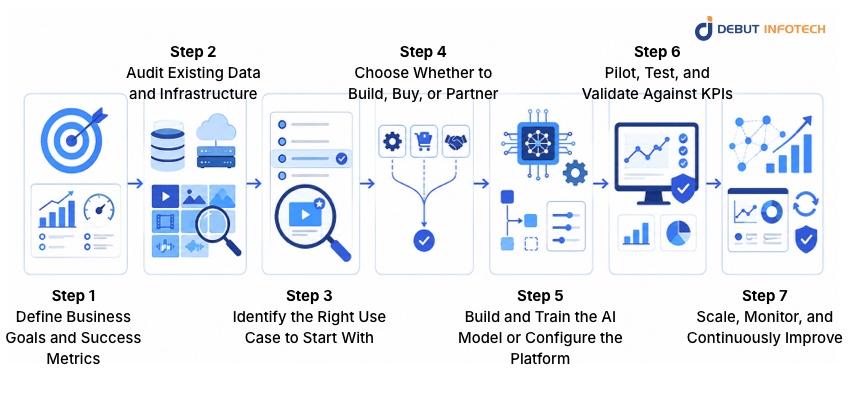
The following framework provides a practical roadmap for introducing AI into media and entertainment operations
Every AI project should begin with a clear understanding of the business challenge it is expected to solve. Without defined objectives, organisations risk investing in technology that delivers little measurable value.
Start by identifying the outcomes that matter most to your organisation. These may include reducing production costs, improving viewer retention, accelerating content localisation, increasing advertising revenue, or shortening post-production timelines.
Once goals are established, define measurable Key Performance Indicators (KPIs) that can be tracked throughout implementation.
Example KPIs
| Business Goal | Example KPI |
| Improve viewer engagement | Increase average watch time by 15% |
| Reduce localisation costs | Lower translation costs by 30% |
| Accelerate production | Reduce editing time by 40% |
| Improve recommendations | Increase content click-through rate |
| Increase advertising revenue | Improve ad conversion rates |
AI systems depend on high-quality data. Before building models, organisations should assess whether they have sufficient, accurate, and well-structured data to support their chosen use case.
Review existing content libraries, metadata quality, audience analytics, customer interaction data, production workflows, and technology infrastructure. Identify data gaps, duplicate records, inconsistent formats, and missing metadata that could affect model performance.
Infrastructure should also be evaluated. Determine whether current storage systems, GPU resources, cloud platforms, and networking capabilities can support AI workloads or require upgrades before implementation begins.
Audit Checklist:
Rather than launching multiple AI initiatives simultaneously, organisations should begin with one high-impact use case that delivers measurable business value within a relatively short timeframe.
Projects such as automated metadata tagging, subtitle generation, recommendation engines, or audience sentiment analysis typically require less organisational change than fully AI-powered production pipelines. Early success builds confidence and encourages wider adoption across the business.
Prioritise use cases based on business value, technical feasibility, implementation complexity, and expected return on investment.
Evaluation Matrix
| Criterion | Questions to Ask |
| Business impact | Will this solve a significant business problem? |
| Technical feasibility | Is sufficient data available? |
| Implementation effort | How complex is deployment? |
| ROI | How quickly can value be demonstrated? |
| Scalability | Can this solution expand across the organisation? |
There is no single implementation model that suits every organisation. The right approach depends on internal expertise, project complexity, budget, and long-term strategic goals.
| Approach | Best For | Advantages | Limitations |
| Build | Organisations with experienced AI teams | Full customisation and ownership | Higher cost and longer development time |
| Buy | Businesses needing rapid deployment | Faster implementation and lower upfront effort | Limited flexibility |
| Partner | Organisations seeking custom solutions without expanding internal teams | Access to specialist expertise and ongoing support | Vendor selection becomes critical |
Many organisations adopt a hybrid approach. They purchase proven AI platforms for common capabilities such as speech recognition or translation while partnering with AI development companies to build proprietary recommendation engines or production workflows tailored to their business.
The decision should balance speed, flexibility, maintenance requirements, and long-term scalability rather than focusing solely on initial implementation costs.
Once the implementation approach has been selected, development begins. Custom solutions require data preparation, model selection, training, testing, and optimisation. Commercial platforms require configuration, workflow integration, and user access management.
During this stage, teams prepare datasets, engineer features, fine-tune machine learning models, establish security controls, and integrate AI services with existing production systems.
Collaboration between technical teams and business stakeholders is essential. Editorial teams, producers, marketers, and product managers should validate outputs throughout development to ensure the solution meets operational requirements.
Typical activities include:
Before organisation-wide deployment, AI solutions for media and entertainment should be tested in a controlled environment. Pilot programmes allow organisations to identify technical issues, gather user feedback, and measure business impact without disrupting production operations.
Compare pilot results against the KPIs established during the planning phase. Evaluate accuracy, response times, user adoption, operational efficiency, and financial performance.
Feedback from creative teams, editors, producers, and operational staff should inform further refinements before broader deployment.
Common Pilot Metrics:
AI implementation does not end after deployment. Models require continuous monitoring because audience behaviour, content preferences, and business requirements evolve over time.
Organisations should establish governance processes for monitoring model accuracy, infrastructure performance, security, compliance, and user adoption. Retraining models with updated data helps maintain prediction quality as new content and audience behaviours emerge.
Continuous improvement also creates opportunities to expand AI into additional workflows, such as advanced audience analytics, automated production planning, generative content creation, or predictive advertising optimisation.
AI Implementation Roadmap
| Phase | Primary Objective |
| Define goals | Establish measurable business outcomes |
| Audit infrastructure | Assess data readiness and technical capabilities |
| Select use case | Prioritise the highest-value opportunity |
| Choose implementation model | Build, buy, or partner |
| Develop solution | Train models or configure AI platform |
| Pilot deployment | Validate performance against KPIs |
| Scale and optimise | Expand deployment and improve continuously |
Organisations that follow a phased implementation strategy are more likely to achieve sustainable returns from AI investments. Starting with clearly defined objectives, validating results through pilot projects, and expanding gradually helps reduce implementation risk while building internal confidence and expertise.
The cost to implement AI in media and entertainment typically ranges from US$5,000 for a pilot project to over US$100,000 for enterprise-grade solutions. The final investment depends on project scope, AI capabilities, infrastructure, integrations, and custom development requirements.
The estimates below provide a general guide for typical AI implementation projects.
Estimated AI Implementation Costs
| Project Tier | Typical Scope | Estimated Cost |
| Pilot / MVP | Metadata tagging, subtitle generation, sentiment analysis, chatbot prototype, proof of concept | US$5,000–US$20,000 |
| Mid-Complexity Solution | Custom recommendation engine, AI localisation, predictive analytics, workflow automation, production integrations | US$20,000–US$50,000 |
| Enterprise AI Platform | End-to-end production pipeline, generative AI, VFX automation, virtual production, multi-platform deployment, enterprise integrations | US$100,000+ |
These figures are indicative only. Final costs depend on project scope, data availability, infrastructure, security requirements, compliance obligations, and the level of customisation required.
Cost Optimisation Tips
| Recommendation | Benefit |
| Start with a pilot project | Validates ROI before large-scale investment |
| Reuse pre-trained AI models where appropriate | Reduces development time and cost |
| Prioritise high-impact use cases | Delivers faster business value |
| Use scalable cloud infrastructure | Avoids unnecessary upfront hardware investment |
| Partner with an experienced AI development service provider | Reduces implementation risk and accelerates delivery |
AI implementation should be viewed as a long-term business investment rather than a one-time technology purchase. Organisations that begin with targeted use cases, establish measurable objectives, and scale gradually are better positioned to maximise returns while controlling costs.
AI implementation in media and entertainment presents challenges including data privacy, integration complexity, talent shortages, high upfront costs, and deepfake risks. Addressing these issues early helps organisations deploy AI securely, responsibly, and at scale.
AI systems process large volumes of user and operational data, making privacy and regulatory compliance a significant challenge. Media organisations should implement strong data governance, encryption, access controls, and consent management to protect sensitive information.
Regular compliance reviews also help meet legal requirements while maintaining audience trust and reducing regulatory risk.
Best practices include:
Implementing AI for entertainment often requires significant investment in infrastructure, software, cloud services, system integration, and skilled professionals.
Costs can increase further for advanced applications such as generative video or enterprise recommendation engines. Starting with a pilot project allows organisations to validate business value, control spending, and expand implementation gradually as measurable returns become evident.
Building and maintaining enterprise AI solutions for media industry requires expertise in machine learning, data engineering, cloud computing, and media production workflows. Many organisations struggle to recruit professionals with this combination of skills.
Partnering with experienced AI development companies and investing in workforce training helps close capability gaps while supporting successful long-term AI adoption.
Generative AI increases the risk of deepfakes, copyright infringement, identity misuse, and unauthorised content creation.
Media organisations should establish governance policies for AI-generated assets, verify ownership of training data, and deploy authentication technologies to protect intellectual property. These safeguards help preserve brand credibility while reducing legal and reputational risks.
AI models can produce biased recommendations or moderation decisions if trained on incomplete or unbalanced datasets.
Regular model evaluations, diverse training data, and human oversight help improve fairness and accuracy.
Establishing ethical AI governance also enables organisations to make responsible decisions while maintaining audience confidence in AI-powered media solutions.
Many media organisations rely on legacy production systems that were not designed for modern AI workloads.
Integrating AI with older platforms often requires custom APIs, middleware, or phased modernisation strategies.
Careful planning allows organisations to introduce AI capabilities without disrupting existing operations or replacing critical infrastructure all at once.
Common Challenges and Mitigation Strategies
| Challenge | Business Impact | Mitigation Strategy |
| Data privacy and compliance | Regulatory penalties and loss of customer trust | Strong data governance, encryption, and compliance monitoring |
| High implementation costs | Delayed AI adoption | Start with pilot projects and prioritise high-value use cases |
| AI talent shortage | Slower implementation and higher operational risk | Partner with experienced AI specialists and upskill internal teams |
| Deepfake and IP risks | Reputational damage and legal exposure | Implement authentication tools and content governance policies |
| Algorithmic bias | Reduced fairness and customer confidence | Audit models regularly and diversify training data |
| Legacy infrastructure | Integration delays and increased costs | Adopt phased modernisation and API-based integration |
AI trends in media and entertainment are focused on generative AI, real-time personalisation, virtual production, content authentication, and regional market growth. These developments are shaping the next generation of content creation, distribution, and audience engagement.
Generative AI is moving beyond post-production and becoming part of live broadcasting workflows. Broadcasters are experimenting with AI-assisted highlight generation, automated captions, real-time graphics, and instant content summaries during live sports, concerts, and news coverage.
AI also supports production teams by generating scripts, social media updates, and promotional content while live events are still taking place. This shortens publishing cycles and enables audiences to receive relevant content almost immediately.
Recommendation systems are becoming increasingly dynamic. Rather than relying primarily on historical viewing data, modern AI models incorporate real-time behavioural signals such as current viewing sessions, search activity, interaction patterns, and contextual information.
This allows platforms to adapt recommendations instantly as user interests change, creating more relevant viewing experiences and improving audience engagement throughout a session.
Film studios and production companies are increasingly integrating AI into virtual production environments.
Combined with LED stages, real-time rendering engines, and computer vision, AI reduces production complexity while expanding creative possibilities.
Digital de-ageing, facial enhancement, automated rotoscoping, and AI-assisted compositing are becoming standard components of high-end production pipelines rather than experimental technologies.
As AI-generated media becomes more sophisticated, verifying digital authenticity is becoming just as important as generating new content. Organisations are investing in AI-powered verification tools that detect manipulated media, validate content origins, and identify unauthorised modifications.
Content authentication is expected to play an increasingly important role in journalism, digital publishing, advertising, and social media as businesses seek to protect brand reputation and strengthen audience confidence.
Asia-Pacific continues to lead investment in AI across media, gaming, streaming, and digital entertainment. Strong government support, expanding digital infrastructure, and rapidly growing consumer markets have accelerated AI adoption throughout the region.
Organisations looking to expand internationally are increasingly developing AI strategies that support multilingual content, regional personalisation, and local regulatory requirements to better serve diverse audiences across Asia-Pacific.
Emerging Trends at a Glance
| Trend | Expected Business Impact |
| Generative AI in live production | Faster content creation and publishing |
| Real-time hyper-personalisation | Improved engagement and customer retention |
| AI-powered virtual production | Lower production costs and greater creative flexibility |
| Content authentication platforms | Stronger trust, copyright protection, and compliance |
| Asia-Pacific AI expansion | Increased market opportunities and global scalability |
Choose an AI development partner with proven media and entertainment expertise, strong technical capabilities, robust security practices, transparent pricing, and reliable post-launch support. The right partner should deliver scalable AI solutions that align with your business goals and production workflows.
The following considerations can help you identify a development partner capable of delivering scalable, secure, and future-ready AI solutions.
A partner familiar with production workflows, streaming platforms, broadcasting, publishing, and digital content management can recommend practical solutions, anticipate industry challenges, and integrate AI more effectively into existing operations, reducing implementation risks and accelerating project delivery.
Questions to ask include:
Review the company’s portfolio to understand the types of AI solutions it has successfully delivered. Well-documented case studies should explain the client’s challenge, the technologies used, and measurable business outcomes.
Evidence of successful projects demonstrates technical capability, industry knowledge, and the ability to deliver AI solutions that generate tangible value for media organisations.
Pay particular attention to measurable business outcomes, such as:
AI solutions often process valuable content assets and sensitive audience data, making security a critical evaluation factor.
Select a development company with strong data governance practices, secure infrastructure, encryption, access controls, and experience meeting regulatory requirements.
A robust security framework helps protect intellectual property, maintain compliance, and reduce operational and reputational risks.
Key security considerations include:
AI models require continuous monitoring, optimisation, and retraining to maintain accuracy as business requirements and audience behaviour change.
Choose a partner that offers long-term support, including performance monitoring, software updates, infrastructure maintenance, and technical assistance. Ongoing support helps maximise system reliability, extend solution lifespan, and ensure AI continues delivering measurable business value.
Ask whether the provider offers:
A reliable AI development agency should provide transparent pricing, a clearly defined project scope, realistic timelines, and measurable deliverables before development begins.
Clear communication throughout discovery, design, implementation, and deployment reduces misunderstandings and unexpected costs. A structured delivery process also helps stakeholders track progress, manage expectations, and make informed decisions throughout the project.
A well-defined proposal should include:
Vendor Evaluation Checklist
| Evaluation Criteria | What to Look For |
| Industry expertise | Experience with media, entertainment, streaming, gaming, or broadcasting projects |
| Technical capabilities | AI, machine learning, computer vision, NLP, generative AI, cloud engineering |
| Case studies | Demonstrated success with measurable business outcomes |
| Security and compliance | Strong governance, encryption, regulatory compliance, IP protection |
| Integration expertise | Experience integrating with MAM, CMS, streaming, and analytics platforms |
| Scalability | Ability to support future growth and enterprise workloads |
| Post-launch services | Model monitoring, retraining, maintenance, and technical support |
| Pricing transparency | Clear scope, timelines, milestones, and cost breakdown |
Successful AI adoption in media and entertainment requires more than selecting a model or adding automation to an existing product. Organizations need to identify where AI can improve discovery, personalization, content operations, and audience engagement while ensuring the underlying solution can perform reliably as usage grows.
Debut Infotech brings product engineering and AI capabilities together to help media businesses move from early concepts to production-ready solutions. Our machine learning development expertise supports recommendation systems, audience intelligence, intelligent automation, and other data-driven experiences, while businesses can also hire AI development experts for dedicated expertise across evolving AI initiatives.
Our experience in the sector includes Friendspire, a personalized entertainment recommendation platform built for iOS and Android. What started as a PoC progressed into full-scale development after gaining early traction. The platform helps users discover movies, TV shows, books, and podcasts through personalized recommendations and later secured $560K in funding.
As AI becomes more embedded across content creation, discovery, distribution, and engagement, the strongest opportunities will come from selecting applications that address genuine business needs.
Explore additional AI use cases to identify where artificial intelligence can create value across your company or industry.
Media companies should begin with one or two high-impact use cases, such as video editing, content recommendations, or audience analytics. Set clear goals, use quality data, integrate AI with existing tools, and train employees to work alongside it. Regular testing and updates help improve results and maximise long-term value.
AI keeps audiences engaged by recommending content based on viewing habits, personalising homepages, and sending relevant notifications. It also analyses user behaviour in real time, helping media companies deliver content people are more likely to watch, read, or listen to, which increases retention and satisfaction.
AI is used to recommend movies, automate video editing, generate subtitles, personalise advertising, moderate content, create visual effects, and analyse audience preferences. It also supports scriptwriting, music production, voice synthesis, and content localisation, helping media companies produce and distribute content faster and more efficiently.
The cost depends on project size, features, and integration needs. Small AI solutions may start at around £8,000 to £25,000, while enterprise-grade platforms with custom models, automation, and analytics can exceed £150,000. Ongoing maintenance, cloud infrastructure, and model updates also add to the total investment.
AI cuts production costs by automating repetitive work like video editing, captioning, transcription, tagging, and quality checks. It also speeds up content creation, reduces manual errors, and shortens production timelines. Teams spend less time on routine tasks and more time creating higher-value content.
AI is changing media jobs more than replacing them. It automates repetitive tasks, but creative decisions, storytelling, strategy, and quality control still depend on people. Many companies use AI to support production teams, allowing employees to focus on work that requires creativity, judgment, and original thinking.

Our Latest Insights

USA
2501 Chatham, Rd Suite R Springfield, IL 62704
+1-708-515-4004
info@debutinfotech.com
UK
7 Pound Close, Yarnton, Oxfordshire, OX51QG
+44-770-304-0079
info@debutinfotech.com
Canada
154 Eden Oak Trail, Kitchener, ON N2A 0H9
+1-708-515-4004
info@debutinfotech.com
INDIA
Sector 101-A, Plot No: I-42, IT City Rd, JLPL Industrial Area, Mohali, PB 140306
9888402396
info@debutinfotech.com