ON THIS PAGE
Progress0%






Our Global Presence :





Blockchain delivers the most value in multi-party banking workflows such as cross-border payments, trade finance, securities settlement, and shared KYC, where reducing reconciliation and improving transaction visibility create measurable operational benefits.
Permissioned blockchain complements rather than replaces traditional banking systems, enabling controlled access, smart contracts, and shared ledgers while integrating with core banking, compliance, fraud detection, and payment infrastructure.
Successful blockchain adoption depends on governance, compliance, and integration as much as technology, requiring clear participant roles, privacy controls, KYC/AML alignment, and interoperability with legacy systems.
Implementation costs should be justified by measurable business outcomes, as blockchain introduces additional governance, security, and maintenance complexity that may outweigh benefits for single-organization workflows.
Enterprise platforms such as Kinexys, HSBC Orion, and the Eurosystem DLT initiative demonstrate that blockchain is advancing through targeted production use cases instead of replacing the global banking ecosystem.
A phased implementation strategy reduces project risk, starting with a defined business problem, selecting the right blockchain platform, validating through pilots, and scaling only after proving regulatory readiness and operational value.
Blockchain investment decisions should prioritize business fit over technology trends, comparing enterprise blockchain with conventional databases based on settlement efficiency, shared trust requirements, implementation timeline, and long-term total cost of ownership.
Blockchain in banking can provide the ability for the banks to share verified information about transactions, automatically execute agreed processes and coordinate payments or transfers of assets among authorised participants. It is best suited for banking operations that involve multiple organizations, including cross-border payments, clearing, settlement, trade finance, KYC, and AML, where different systems can lead to delays, duplicate checks, and repeated reconciliation.
But blockchain technology in banking is not cryptocurrency, nor is it intended to replace all traditional banking systems. Most blockchain banking solutions are based on permissioned networks that have controlled access, privacy protections, governance mechanisms, and integration with core banking, fraud detection, compliance, payment, and reporting systems.
This guide examines how blockchain for banks works, the leading blockchain use cases in banking, its potential benefits, platform options, regulatory considerations, implementation challenges, and the factors financial institutions should assess before adopting enterprise blockchain for banks.
Banks are adopting blockchain technology to address inefficiencies that arise when several institutions participate in the same transaction. In conventional banking, each bank, payment provider, custodian or clearing organisation may maintain its own record. These separate systems often require repeated verification and reconciliation before a payment or asset transfer can be completed.
A permissioned blockchain can provide authorised participants with a shared and synchronised transaction record. Access remains controlled, meaning participants see only the information allowed by the network’s privacy and governance rules. Banks must still apply customer identification, cybersecurity, data protection and financial regulations.
The main drivers of blockchain adoption in banking include:
Recent initiatives show that banks are moving from isolated experiments towards controlled implementation. In July 2026, Swift announced that its blockchain-based shared ledger was ready for initial use, with 17 banks preparing to pilot tokenised-deposit transactions for round-the-clock payments. The project is designed to work alongside Swift’s existing financial infrastructure rather than replace it.
In general, blockchain banking transformation is likely to be more about integration rather than replacement. The value of blockchain is greatest when there are multiple independent organizations requiring a shared, programmable record and when faster settlement, greater visibility or fewer reconciliation requirements are worth the extra technical, regulatory and governance effort. If one bank is in control of the entire process, a traditional database might still be a more straightforward and economical choice.
Traditional banking systems and permissioned blockchain networks both record financial activity. However, they differ in how they control, validate, store, share, and correct transaction information. The main differences include:
| Decision Area | Traditional Banking System | Permissioned Blockchain System |
| System control | Managed by one bank or central operator | Governed by approved network participants |
| Record storage | Each organisation maintains its own database | Participants use a synchronised ledger |
| Transaction validation | Updates are approved by a central authority | Updates follow agreed network rules |
| Reconciliation | Required when records differ across institutions | Reduced when participants rely on the same validated state |
| Data access | Controlled within the institution’s infrastructure | Defined by roles, channels, and network permissions |
| Transaction correction | Reversals and amendments follow established banking procedures | Correction rules must be built into governance and application design |
| System upgrades | Decided by the institution operating the platform | Require coordination among participating organisations |
| Best fit | Processes controlled by one organisation | Processes involving several independent parties |
| Main weakness | Data silos and duplicated recordkeeping | Governance and integration complexity |
A traditional banking system is usually controlled by one bank or central operator. That institution determines who can access the system, approve transactions, and modify records.
A permissioned blockchain is governed by several approved participants operating under agreed rules. This shared structure is useful when banks, custodians, payment providers, and other institutions need to coordinate without giving one participant complete control.
In traditional banking, each institution maintains its own database. When a transaction involves several organisations, each participant records its version of the transaction separately.
In a permissioned blockchain system, authorised participants use a synchronised ledger. This provides a consistent transaction state while privacy controls determine which information each participant can access.
Traditional systems rely on a bank, clearing house, payment processor, or another central authority to validate and approve transaction updates.
Blockchain systems use agreed network protocols and designated validator nodes. These nodes confirm that a transaction satisfies the network’s authorisation, compliance, formatting, and asset-availability requirements before it is recorded.
Traditional banking systems often require reconciliation because participating institutions maintain separate records. Differences in transaction status, timing, or data must be identified and resolved.
Blockchain can reduce reconciliation when all authorised participants rely on the same validated transaction state. This benefit is most valuable in processes involving several independent organisations.
Traditional banking systems keep data within infrastructure controlled by the institution. Internal access policies determine who can view or modify customer and transaction information.
Because blockchain records may be distributed across multiple nodes, permissioned networks require more deliberate privacy controls. Encryption, private channels, role-based access, off-chain storage, and data-minimisation policies help protect confidential information.
Traditional banking systems have established procedures for reversals, amendments, disputed transactions, and account corrections.
Blockchain records are generally designed to be difficult to alter after validation. Banks must therefore use corrective entries, controlled smart-contract upgrades, and emergency intervention procedures to address inaccurate instructions or disputed transactions.
In a traditional system, the bank or central operator can decide when and how to update the platform.
Upgrading a permissioned blockchain may require coordination among participating institutions. The network’s governance framework must define how technical changes are proposed, approved, tested, and implemented.
Traditional databases can process high transaction volumes efficiently when one institution controls the entire workflow. They do not require several organisations to agree on common operating rules.
The case for blockchain for banks becomes stronger when a process crosses organisational boundaries. Shared validation can reduce duplicated recordkeeping, status enquiries, and reconciliation activities, although these benefits must justify the additional integration and governance requirements.
Traditional banking systems are generally better suited to processes controlled by one institution, including customer account management, internal reporting, and centrally managed payment operations.
Permissioned blockchain systems may be more appropriate for cross-border payments, securities settlement, trade finance, shared KYC processes, and tokenised assets involving multiple independent participants.
The principal limitation of traditional banking infrastructure is the presence of separate data silos, which can create duplicated records and reconciliation work across institutions.
The main limitation of blockchain banking solutions is their governance and integration complexity. Participants must agree on responsibilities, privacy standards, technical protocols, liability, transaction-correction procedures, and system upgrades.
Neither model is inherently faster, cheaper, or more secure in every situation. The practical decision is whether blockchain in banking creates sufficient value through shared validation and reduced reconciliation to justify its additional governance, privacy, integration, and operational requirements.
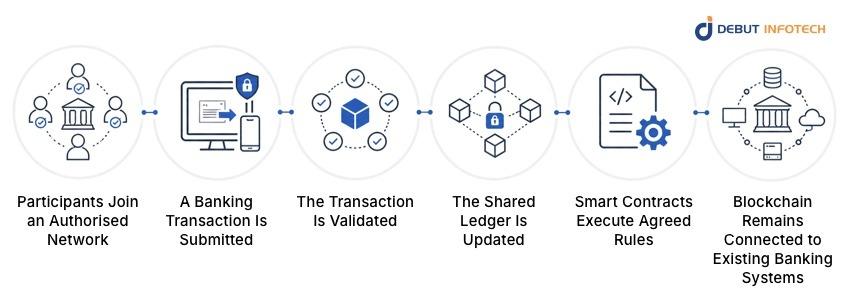
Enterprise blockchain network architecture for banks combines a permissioned distributed ledger with identity controls, validation mechanisms, smart contracts, privacy tools, and integration services. Unlike a public cryptocurrency network, participation is restricted to verified organisations such as banks, payment providers, custodians, regulators, and authorised technology providers.
The architecture works through the following steps:
Each participating institution receives a verified digital identity and permissions based on its role. The network’s governance framework determines who can:
These controls enable blockchain for banks to support shared processes without exposing sensitive financial information to every participant.
A transaction begins when an approved banking application sends an instruction through a secure API or another integration service. The instruction may involve a payment, asset transfer, trade finance document, collateral update, securities transaction, or tokenised deposit.
Customers and employees do not usually interact with the blockchain directly. Instead, existing banking applications provide the interface through which transaction instructions enter the network.
Before the transaction reaches the ledger, connected banking systems perform the required checks. Depending on the use case, these may include:
Keeping these controls connected to the network allows banks to apply existing compliance requirements to blockchain-based transactions.
Designated validator nodes examine the instruction according to the network’s consensus protocol and governance rules. They may confirm that the sender is authorised, the required approvals are available, the transaction follows the correct format, and the instruction does not conflict with an existing record.
The precise validation process depends on the blockchain platform, transaction type, and responsibilities assigned to each participant.
After validation, the transaction is recorded on the shared ledger. Authorised participants receive an updated view of the transaction according to the network’s privacy rules.
Participants do not necessarily have access to identical information. Encryption, private channels, role-based permissions, and data segregation can restrict access to confidential customer and commercial data. This controlled visibility is a central feature of distributed ledger technology in banking.
Smart contracts can perform predefined actions when specified conditions are satisfied. For example, they may:
Release payment after confirmation of delivery
Although smart contracts support banking automation, they require testing, monitoring, audit controls, and procedures for correcting errors or upgrading their instructions. Human oversight and dispute-resolution mechanisms remain necessary.
An enterprise blockchain network rarely operates independently. It must connect with core banking platforms, payment rails, customer databases, identity systems, accounting software, fraud-monitoring tools, and regulatory-reporting systems.
Banks can keep personal and commercially sensitive records off-chain while storing permissions, transaction references, verification results, or cryptographic evidence on the blockchain. This hybrid architecture allows institutions to benefit from a shared ledger without treating blockchain as a replacement for every existing banking system.
A banking blockchain rarely operates as a standalone platform. The solutions required for blockchain banking need to be deeply coupled with the core banking systems, payment rails, customer databases, identity platforms, and accounting software, as well as fraud-monitoring systems and regulatory-reporting systems.
Banks should also not put any unnecessary personal or confidential data directly on the ledger. Sensitive records can remain off-chain, while the blockchain stores permissions, references, verification results, or cryptographic evidence. This architecture helps banks pursue secure transactions without treating the ledger as a replacement for every existing system.
When multiple financial institutions need to coordinate transactions or verify the same information, or perform the same rules across different systems, the advantages of blockchain in banking are most pronounced.The technology can enhance these workflows, but the effectiveness of the outcome relies on network participation, governance, integration quality, security measures and if the chosen process really requires a shared ledger.
Banks and custodians, payment providers and clearing organisations may keep their own records of the same financial event. The variations in those records may lead to investigations, delays and further operational tasks.
A shared ledger provides authorised participants with a common understanding of the state of the validated transaction. This can reduce the time spent comparing records and resolving discrepancies. The benefit is especially significant in the context of securities settlement, syndicated lending, trade finance and cross border payments, where multiple organisations may need to confirm the same instruction.
A permissioned network can support continuous transaction processing rather than relying entirely on fixed operating windows or sequential updates between separate databases. It may also enable payment and asset-transfer instructions to be completed together, reducing the period in which one side of a transaction remains unsettled.
However, faster processing does not automatically guarantee final settlement. Banks must still account for liquidity, regulatory checks, transaction limits, settlement assets, and the legal recognition of the resulting record.
A blockchain can provide a time-stamped record of approved actions, which will ease the way for authorised users to trace the way a transaction was carried out. This visibility can enhance your internal audits, investigations of disputes, regulatory reporting, and operational monitoring.
Traceability can also help in fraud prevention by making it harder for fraudsters to make changes to records and highlight any discrepancies between authorised actions. It is not intended to be a substitute for fraud detection systems, behavioural analytics, transaction monitoring or human investigations.
Smart contracts allow institutions to convert agreed business rules into executable instructions. They can release funds after verified delivery, update asset ownership after payment, calculate obligations, or trigger an alert when a compliance condition is not met.
This form of banking automation can reduce manual handoffs and improve process consistency. The rules must still be reviewed, tested, monitored, and updated when policies or regulations change. Badly designed automation can make errors faster than they are eliminated.
Cryptographic validation and linked transaction records can make unauthorised retrospective changes more difficult. This can help protect the integrity of shared financial information and improve confidence that approved participants are working from an agreed record.
Still, blockchain does not make banking systems immune to attack. The security of blockchain banking solutions also depends on private-key protection, access management, application security, smart contract testing, node security, and incident-response planning.
Banks can use blockchain infrastructure to develop tokenised deposits, programmable payments, digital collateral, tokenised securities, and fractionalised assets. These products may allow ownership, transfer restrictions, payment conditions, and lifecycle events to be managed through shared digital infrastructure.
Such applications do not operate outside financial rules. Existing obligations involving KYC, AML, customer protection, custody, capital treatment, and reporting still apply according to the product and jurisdiction.
The broader value of blockchain for banks is its ability to improve coordination where no single participant should control the complete process. A shared network can give banks, regulators, custodians, and commercial partners access to the information and functions permitted by their roles.
This benefit is central to enterprise blockchain for banks. The technology creates the most value when shared validation reduces real operational friction. When one institution already controls the workflow, a conventional system may deliver the same outcome with less cost and complexity.
The following blockchain use cases in banking have attracted the greatest institutional attention because they address complex workflows involving payments, financial instruments, customer verification and commercial documentation.
| Use Case | Practical Application | Main Requirement |
| Cross-border payments | Tracks international payment instructions and coordinates settlement events | Access to liquidity, foreign exchange, and local payment rails |
| Securities settlement | Connects the exchange of funds with the transfer of ownership | Legally recognised settlement finality |
| Trade finance | Digitises document approvals and transaction milestones | Reliable external data and participant adoption |
| KYC and AML | Enables controlled reuse of verification evidence | Strong privacy, consent, and accountability rules |
| Tokenised financial products | Supports programmable deposits, securities, and collateral | Clear legal, accounting, and custody treatment |
Cross-Border Payments
Banks can apply blockchain to follow an international payment from initiation through compliance approval and settlement. Participants may view authorised status updates instead of relying on separate enquiries across correspondent networks. This supports greater transparency and may reduce uncertainty surrounding delayed transfers.
Still, cross-border payments require more than transaction messaging. Banks must provide the relevant currencies, manage intraday liquidity, perform sanctions checks, calculate foreign exchange, and complete settlement through recognised financial infrastructure.
Securities Clearing and Settlement
Securities markets require participants to exchange ownership and payment according to precise conditions. Blockchain can coordinate both legs of the transaction and record changes in asset ownership after those conditions are fulfilled.
This application may shorten settlement cycles and reduce exposure between trading parties. Its viability depends on whether courts, regulators, market operators, and custodians recognise the digital record as evidence of final ownership and settlement.
Trade Finance
Trade transactions generate numerous records, including purchase orders, invoices, insurance documents, customs declarations, and bills of lading. Blockchain applications in banking can organise these records within a controlled digital workflow and record when each participating organisation provides its approval.
Automated instructions may initiate financing or payment after specified milestones are confirmed. However, the system remains dependent on trustworthy shipping, inspection, and customs information. Digitising an inaccurate document does not make its contents reliable.
KYC and AML Processes
Banks may use permissioned networks to exchange evidence that a customer has undergone specific KYC checks. This could reduce unnecessary repetition when customers work with several participating financial institutions.
The ledger may also support compliance automation by documenting approvals and applying transaction restrictions. It does not replace AML investigations, customer risk assessment or sanctions databases or regulatory reporting. Institutions will need to decide who is responsible for updating verification records, how to get consent from customers and who is responsible if the information becomes outdated.
Tokenized Deposits and Financial Assets
Tokenization allows banks to represent deposits, bonds, securities, funds, or collateral through programmable digital records. These instruments can include rules covering transfer eligibility, payment conditions, maturity, redemption, and ownership restrictions.
The success of these blockchain banking solutions depends on more than technical functionality. Banks must establish the holder’s legal rights, protect cryptographic keys, maintain appropriate reserves, separate client assets, and ensure compatibility with accounting and regulatory systems.
Banks evaluating these applications should prioritise use cases that address a specific operational challenge and have clearly defined, measurable outcomes. The strongest opportunities are those supported by committed participants, recognised legal arrangements, dependable data, and an operating model that can move beyond a limited pilot.
In the banking sector, blockchain use cases are at various stages of maturity. Some platforms already process institutional transactions, while others remain in controlled pilot or testing stages. The difference between these stages is crucial if the experiment is to be considered a success because it only proves that the technology is technically viable, not necessarily commercially viable or ready for industry wide rollout.
| Initiative | Primary Application | Current Stage | Main Lesson |
| Kinexys by J.P. Morgan | Institutional payments, programmable money, and tokenised assets | Production | A bank-led blockchain network can operate at institutional transaction volumes |
| HSBC Orion | Digital bond issuance and lifecycle management | Production | Permissioned blockchain can support regulated capital-market transactions when connected to established infrastructure |
| Eurosystem DLT initiative | Wholesale transactions settled in central bank money | Completed trials with a further pilot planned | Central banks can test links between distributed ledgers and conventional settlement systems |
Kinexys is a production example of blockchain in banking used for institutional payments, tokenized assets, programmable transaction instructions, and blockchain-based deposit accounts. As of June 29, 2026, J.P. Morgan reported that the platform had processed more than $4 trillion in cumulative transaction volume, with average daily transactions exceeding $7 billion.
The platform allows institutional clients to move funds and assets through controlled blockchain infrastructure while remaining within J.P. Morgan’s banking environment. Its programmable payment capabilities can also trigger transactions when approved conditions or business events occur, supporting automated treasury and settlement processes.
The significance of Kinexys lies in its production scale. It demonstrates that blockchain banking solutions can support substantial institutional activity when the network has a defined operator, approved participants, established compliance controls, and a clear financial use case.
However, the results should not be interpreted as evidence that the same model will suit every bank. Kinexys operates within a bank-led environment, which simplifies some governance and participation decisions that would be more complex in a consortium involving several competing institutions.
HSBC Orion provides a production example of blockchain being used in regulated capital markets. The permissioned digital-assets platform supports the issuance and management of digitally native bonds. As of February 12, 2026, HSBC reported that Orion had enabled more than $3.5 billion in digital bond issuances across sovereign, supranational, central bank, financial institution, and corporate sectors.
One notable transaction was the Hong Kong government’s HKD6 billion-equivalent multi-currency digital green bond. The bonds were issued directly on HSBC Orion through the Hong Kong Monetary Authority’s Central Moneymarkets Unit rather than being created conventionally and subsequently tokenized. The transaction settled in one business day, compared with the five-day cycle HSBC identified as typical for conventional bond issuances in Hong Kong. The platform also supported secondary-market settlement and coupon payments.
The significance of HSBC Orion lies in its ability to support multiple stages of a bond’s lifecycle while remaining connected to established financial-market infrastructure. It shows how blockchain can improve issuance, ownership recording, settlement, and asset servicing without requiring institutions to abandon existing central securities depositories and international market links.
However, Orion’s results do not mean that every securities market is ready for blockchain-based issuance. Wider adoption still depends on legal recognition, investor participation, digital custody, cash-settlement arrangements, interoperability, and consistent regulatory treatment across jurisdictions.
The Eurosystem has examined how distributed-ledger transactions could settle in central bank money without requiring financial institutions to abandon established central bank infrastructure. From May to November 2024, 64 entities across nine countries participated in the initiative, which tested 58 use cases and handled over 200 transactions worth €1.59 billion.
The trials brought together central banks, financial market participants, and DLT operators. They assessed how tokenised securities and other wholesale financial transactions could connect to central bank settlement mechanisms.
Following this exploratory work, the European Central Bank announced a two-track strategy. Pontes is intended to connect DLT platforms to TARGET Services for settlement in central bank money, with a pilot planned by the end of the third quarter of 2026. Appia focuses on a longer-term integrated ecosystem for tokenised financial markets.
This initiative shows that distributed ledger technology in banking can be integrated with regulated wholesale settlement rather than operating outside it. It also shows why central bank involvement matters: blockchain may record and coordinate transactions, but the credibility of wholesale settlement often depends on legally recognised central bank money.
Eurosystem’s work remains evidence of structured testing and infrastructure development, not proof that DLT has replaced existing wholesale settlement systems.
Together, these initiatives show that blockchain adoption in banking is progressing through narrowly defined applications rather than complete system replacement. Kinexys demonstrates production use within a bank-led network, HSBC Orion shows how blockchain can support regulated digital bond issuance and lifecycle management, and the Eurosystem shows how central banks are testing DLT-based transactions within regulated settlement arrangements.
Software development is not the only challenge of blockchain in banking. Banks need to safeguard sensitive data, integrate new networks into existing infrastructures, and ensure interbank coordination and adherence with jurisdiction-specific regulations. Good governance, security, interoperability and business value are required for a technically competent platform to be successful.
Banks handle identity, account, credit, transaction information that cannot be shared with all network participants. This means that it is critical to have permissioned access, encryption, private channels, and off-chain storage. Personal information that is correctable, deletable, or has to be stored for a certain period should not be stored permanently on a shared ledger. The architecture needs to clearly specify what is stored on-chain and who can access it.
For most blockchain implementation in banks, integration with other core banking, payment, accounting, identity, treasury and regulatory-reporting systems is required. Integration can be challenging when the older platforms use batch processing, proprietary formats or have poor APIs. Banks also need to determine which system is authoritative in the event of differences in records or when a component becomes unavailable.
The systems don’t automatically exchange value or information. Interoperability needs to encompass transaction status, settlement finality, ownership and data formats. While cross-network bridges can enhance connectivity, they also create extra dependencies and security issues.
A permissioned network needs to have well-defined rules for participation, validation, upgrading, access, cost sharing, dispute resolution and participant withdrawal. It also needs to stipulate who is responsible if a smart contract fails, if a transaction is incorrectly entered, or if there is an error by a network operator. Poor governance can stop an otherwise functional platform from reaching production.
Blockchain can enhance the integrity of records, but it doesn’t necessarily ensure secure transactions. Private keys may be compromised, authorised accounts can be hacked, and smart contracts might have exploitable weaknesses. Banks require robust key management, multi-factor authentication, code review, smart contract testing and monitoring, controlled upgrade mechanisms and incident response mechanisms.
Banks are still required to comply with the KYC, AML, sanctions, consumer protection, data protection, custody and operational resilience requirements. Compliance automation will enforce certain rules, but it can’t be a substitute for legal interpretation, investigation, or engagement with compliance. The uncertainty around regulation could also impact treatment of tokenised deposits, digital assets and cross-border settlement.
A pilot may work technically without producing a viable service. Banks must test realistic transaction volumes, privacy controls, node failures, storage growth, and integration performance. They must also compare development, governance, compliance, and maintenance costs with expected savings.
The strongest blockchain banking solutions solve a measurable multi-party problem. When an API, shared database, or process redesign can deliver the same result more simply, blockchain may add unnecessary cost and complexity without delivering a proportionate operational benefit.
The regulatory requirements for blockchain in banking depend on the financial activity, asset type, transaction structure, participating institutions, and jurisdictions involved. A bank using blockchain for payments, deposits, securities, custody, lending, or settlement remains subject to the laws governing those services. The technology alters the nature of the transactions being recorded and processed but doesn’t eliminate the legal requirements of the bank.
Banks are required to conduct KYC, AML, sanctions checks, transaction monitoring and report any suspicious activity. Blockchain can be used to enable compliance automation by keeping track of verification status, enforcing transaction rules, and enhancing audit trails. But, human intervention is still required to investigate alerts, interpret risk, update customer profile and to prevent unallowed transactions.
The regulatory treatment also varies according to the asset. A bank using a permissioned ledger as infrastructure may face different obligations from one issuing tokenised deposits, holding stablecoins, or providing custody for digital assets. Capital, liquidity, valuation, redemption, custody, and disclosure requirements must therefore be assessed before launch.
Data protection is another central issue. Banks should avoid placing unnecessary personal or confidential information directly on-chain. Records that are sensitive may be kept in a protected off-chain system and the ledger may contain limited references and permissions, verification results, or cryptographic evidence.
Prior to implementation, banks need to outline the roles and responsibilities of customer onboarding, data access, transaction monitoring, settlement finality, error correction, incident response and regulatory reporting. They must also determine which financial regulations apply in every market where the network operates.
Architectural design should be based on compliance. Leaving regulatory review at the end can lead to high cost of redesign, delayed approval or a solution that cannot advance into production.
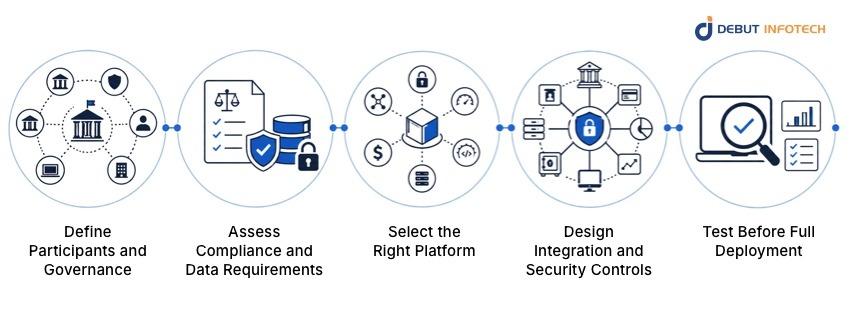
The best way to start a blockchain implementation in banks is not to select a platform of your choice, but rather, to start with a well-defined business problem. The bank needs to understand what is causing the delays or the reconciliation costs, data gaps, or manual tasks in the current workflow. It should then set quantifiable goals, such as shorten settlement time, improve transactions’ visibility, decrease administrative efforts or automate agreed clauses.
The bank should identify all organizations that will submit, validate, approve or view transactions. The participants can be other banks, custodians, payment vendors, corporate clients, regulators and technology vendors.
Clear governance rules must determine:
These decisions help to determine if the solution will be a private blockchain network, consortium, public blockchain network, or hybrid network solution.
Legal, compliance, risk and cybersecurity teams need to be involved from the start. They need to determine which regulations apply, what information they are allowed to share, and which records do not need to be in the ledger.
Protected databases might be used to keep sensitive customer data, whereas the blockchain can be used to record transaction states, verification outcomes, permissions, references or cryptographic evidence. The architecture should also enable KYC, AML, sanctions screening, audit and reporting needs.
Banks should compare platforms according to privacy, permissioning, interoperability, transaction performance, smart contract capabilities, infrastructure requirements, and total ownership cost.
Using professional blockchain consulting services can help a bank evaluate these factors and choose an architecture that matches its operational and regulatory requirements.
To be effective, blockchain banking solutions need to integrate with the core banking platforms, payment rails, identity platforms, accounting software, treasury applications and fraud-monitoring platforms. The bank should also specify the authoritativeness of the system for each record.
Access management, key custody, transaction approvals, smart contract testing, system monitoring, incident response, and business continuity are examples of security controls that need to be covered.
A proof of concept should be limited to a single specific workflow and determine if the intended design is able to address the problem that was identified. Success metrics can include processing time, data accuracy, reduced data reconciliation, system availability, or reduced manual steps.
The bank can then run a controlled pilot with selected participants and limited transaction volumes. Failed transactions, access revocation, integration outages, compliance checks, exception handling are all areas to be tested.
Having functional software is not enough for blockchain to be a success in banking. Banks should transition to production only when the solution is proven to be of measurable value, regulatory-ready, securely integrated, with committed participants, and with a sustainable governance model.
For banks to make blockchain a secure, compliant and scalable business system, they require more than a working prototype. Debut Infotech provides its support for this process by conducting feasibility assessment, architectural planning, bespoke development, smart contract development, enterprise integration, deployment and optimisation post-launch.
The engagement begins by evaluating the banking problem, participating organisations, data flows, permissions, governance requirements, and expected business outcomes. This helps determine whether blockchain is appropriate and which network model best fits the use case. Regulatory conclusions should still be reviewed by the bank’s legal, risk, and compliance teams.
As a blockchain application development company, Debut Infotech builds private, permissioned, public, and hybrid solutions around defined operational requirements. These capabilities can support blockchain banking solutions for payments, trade finance, tokenisation, shared records and other approved multi-party processes.
The company also connects blockchain platforms with core banking, identity, payment, accounting, and monitoring systems. This integration helps an enterprise blockchain for banks operate within existing technology environments instead of becoming an isolated platform.
Post-launch support can include expansion of the ecosystem, performance optimisation, smart contract updates, and monitoring. Before deployment, banks should define ownership, security obligations, and service levels, as well as regulatory jurisdiction.
Blockchain technology in banking allows authorised institutions to submit, validate, and record transactions on a shared ledger. Permission rules determine who can access information, approve transactions, or operate network nodes. Smart contracts can automate defined actions, while integrations connect the ledger with core banking, payment, identity, accounting, and compliance systems.
The main benefits of blockchain in banking include reduced reconciliation, improved transaction traceability, programmable payments, more coordinated settlement, and stronger record integrity. These benefits are most valuable when several independent institutions need to verify the same transaction. Their achievement still depends on governance, integration quality, privacy controls, and regulatory readiness.
Common blockchain use cases for banks include cross-border payments, clearing and settlement, trade finance, tokenized deposits, asset tokenization, syndicated lending, collateral management, and reusable KYC verification. Blockchain may also support audit trails and compliance automation, although each use case requires a clear business case and committed participants.
For cross-border payments, blockchain can give participating institutions a shared view of transaction status and support programmable settlement instructions. This may reduce status enquiries, duplicated recordkeeping, and processing delays. However, banks still need foreign exchange services, liquidity management, sanctions screening, regulatory reporting, and access to domestic settlement systems.
Blockchain can support secure transactions by using cryptographic validation, controlled permissions, and time-stamped records that make unauthorized changes easier to identify. It does not make banking systems unhackable. Security still depends on private-key protection, identity controls, application security, smart contract testing, employee access management, monitoring, and incident-response procedures.

Our Latest Insights
USA
2501 Chatham, Rd Suite R Springfield, IL 62704
+1-708-515-4004
info@debutinfotech.com
UK
7 Pound Close, Yarnton, Oxfordshire, OX51QG
+44-770-304-0079
info@debutinfotech.com
Canada
154 Eden Oak Trail, Kitchener, ON N2A 0H9
+1-708-515-4004
info@debutinfotech.com
INDIA
Sector 101-A, Plot No: I-42, IT City Rd, JLPL Industrial Area, Mohali, PB 140306
9888402396
info@debutinfotech.com