ON THIS PAGE
Progress0%





Our Global Presence :





Blockchain in education can help verify university-issued credentials, but issuer authority and identity checks remain essential.
Key use cases include digital diplomas, transcripts, micro-credentials, credit transfers, and lifelong learning records.
Blockchain proofs can help detect altered credentials, while digital signatures can provide verification without a shared ledger.
Student records should remain in controlled systems, with blockchain storing verification proofs where appropriate.
Successful implementation depends on credential standards, system integration, secure key management, and clear governance.
Institutions should compare blockchain with conventional verification systems before committing to development costs and ongoing operations.
A focused pilot can help measure verification time, administrative effort, adoption, and cost before wider implementation.
Verifying a degree can mean another email, another records search, and another delay. For universities handling repeated requests, these checks add to registrar workloads and leave employers and graduates waiting for confirmation.
Blockchain in education can help employers and other institutions check whether a digital credential matches the version issued by a university. A shared ledger can hold verification proofs while student records remain in controlled systems. The university remains responsible for confirming who earned the qualification.
For institutions evaluating this approach, integration, privacy, and governance shape the investment. This guide examines practical applications, benefits, implementation requirements, and costs to help you assess whether blockchain fits your institution’s needs.
Blockchain technology in education uses a shared digital ledger to record information or verification proofs that participating organizations can check. Institutions can use it to support academic credential verification, track approved updates, and maintain a shared history across organizations.
A blockchain organizes entries into cryptographically linked records. Network participants follow agreed rules to validate new entries, making unauthorized changes to recorded history detectable and difficult to carry through when the network operates as intended.
Within an institutional credential platform, blockchain works alongside student information systems and verification services. Detailed student records should remain off-chain in systems with appropriate access controls. The ledger can hold proofs that help receiving organizations detect changes to issued credentials.
Three participants shape the digital credential workflow:
These roles also apply to digital credentials that use signatures without blockchain. A ledger adds a shared verification reference where the application requires one.
The institution remains responsible for confirming who earned an award. Blockchain can support checks on the issued record’s integrity, while issuer recognition and identity checks establish whether it should be accepted for a particular decision.
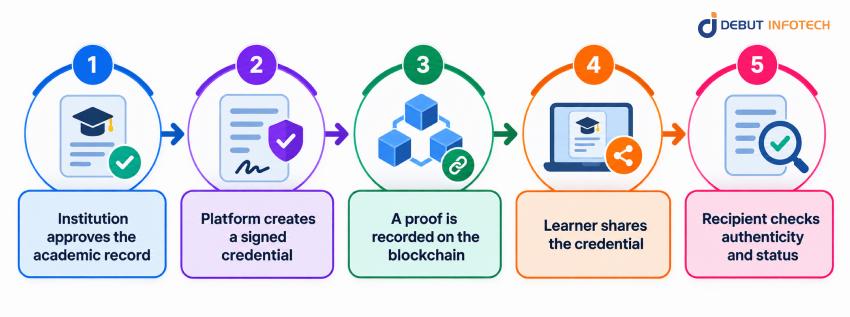
For blockchain-based digital credentials, the workflow connects approved academic records with cryptographic evidence that employers and other institutions can check. It moves from institutional approval to issuance, sharing, and verification.
The registrar or authorized program team confirms that a learner has met the award requirements. The source remains the approved institutional record. A course marked complete in a learning management system may still require institutional approval before a credential is issued.
The credential service converts approved information into a structured digital record and signs it using the issuer’s private key. Verification uses the corresponding public key to detect changes and check the signature.
A verifiable credential is a structured way to express claims that can be checked cryptographically. W3C’s credential model defines roles for issuers, holders, and verifiers. Verifiable credentials do not inherently require blockchain.
A cryptographic hash acts as a fingerprint of data. In an anchoring design, a proof derived from the credential is recorded on the ledger. A single ledger entry can anchor a batch of credentials, with a separate proof linking each credential to that entry.
In this design, the complete credential remains off-chain. The credential may be stored in an institutional repository or a learner-controlled application. Keeping records off-chain allows the platform to apply appropriate access and retention controls.
The learner shares a digital credential file or presents it through a credential wallet or verification portal. Students should not need to interpret transaction identifiers or understand network fees to use their qualifications.
Verification software checks the signature against a trusted issuer key and validates the blockchain proof. It also checks expiry and any supported suspension or revocation status. If required verification services are unavailable, the result should indicate that verification is incomplete.
A decentralized identifier, or DID, may help identify an issuer and reference its verification methods. DID methods differ and do not all use blockchains.
These checks help establish credential integrity and status. They do not independently confirm the underlying academic claims. The verifier must still assess the institution’s authority and, where required, confirm that the credential belongs to the person presenting it.
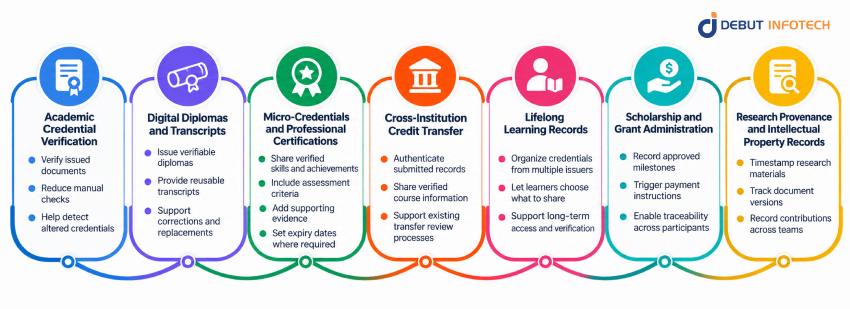
Practical blockchain applications in education include verifying academic credentials, sharing learning records, and coordinating approved actions across institutions. Each use case requires clear ownership, reliable source data, and controls appropriate to the information involved.
Repeated degree checks consume time across registrars’ offices and recruitment teams. The challenge becomes harder when documents arrive as scans or screenshots without a reliable verification route.
Blockchain for academic credential verification can support checks against institution-issued proofs. Employers can check a compatible credential through a verification portal, potentially reducing routine requests to the issuing institution.
Three core questions guide credential verification:
Blockchain proofs can help with the first question. Institutional trust rules and identity checks address the others. A layered verification process can help detect altered credentials and reduce certain forms of credential fraud. It cannot eliminate deception or independently establish that the original academic decision was correct.
Graduates often need academic documents long after their campus accounts expire. Digitally signed diplomas and transcripts can give graduates reusable records that receiving organizations can verify.
An institution can generate a diploma from approved student information system data. The platform signs the credential and can anchor a proof on a ledger. A transcript follows a similar technical pattern but carries more detailed information and different disclosure requirements.
The design must account for changes after issuance. Corrected grades may require a replacement transcript. A legal name change may require a new document. The institution needs clear rules for superseding earlier versions.
Blockchain for digital diplomas and transcripts should support corrections, replacement, and status checks while keeping personal information off public ledgers. A corrected credential should supersede the earlier version, and verifiers need a reliable way to check which version remains valid. The authoritative academic record remains under institutional control.
Short courses and workforce programs issue credentials that employers may struggle to interpret. A certificate becomes more useful when it explains what was assessed and who approved the result.
Blockchain micro-credentials can combine structured achievement information with shared verification proofs. Depending on the program, the record may include:
Open Badges provides a standard for representing achievements and associated information. It can inform credential design without requiring a blockchain.
For certification providers, value depends on clear assessment criteria, recognized issuers, and credentials employers can verify. Blockchain proofs support record integrity within that process.
Transfer evaluation involves two different tasks. Staff must authenticate the submitted record. Academic teams must decide whether the learning meets their institution’s requirements.
A shared credential platform can support the authentication stage. Verified course information can then enter the existing transfer review process. The receiving institution applies its academic policies and any relevant articulation agreements to decide whether credit is accepted.
This may reduce preliminary document checks. It cannot resolve differences in course content or award credit without institutional authorization. Participating institutions need clear evaluation policies and a process for reviewing disputed decisions.
A learner’s achievements may span several colleges and professional organizations. Keeping those records usable over time requires more than a collection of downloadable certificates.
A lifelong learning platform can organize credentials from multiple issuers and let learners choose which records to share. The ledger can hold proofs while the learning history remains outside the public chain.
The Comprehensive Learner Record standard structures learning achievements for exchange between systems. Blockchain proofs can complement these records where a shared ledger provides additional value.
Long-term usefulness depends on export options and continued verification support. Employers also need to accept the format. A learner should not lose practical access because one application closes.
Funding programs can involve several organizations confirming milestones before releasing payments. Shared records could help those participants trace approved actions and reconcile disagreements.
In a proposed blockchain workflow, authorized administrators submit milestone approvals. A smart contract could record an approved milestone or trigger a payment instruction when agreed conditions are met. Payments through banking systems require an external integration.
Institutional policies govern eligibility, appeals, and exceptions. Clear approval responsibilities and payment controls are essential before automating any release of funds.
Collaborating research teams may need a reliable history of document versions and recorded contributions. A ledger can timestamp a proof associated with material stored in a controlled repository.
This can support traceability during collaboration. Confidential research data and participant information should remain in systems with appropriate permissions.
A ledger timestamp can support evidence that a particular version existed when its proof was recorded. Authorship, ownership, and permitted use depend on supporting documentation and applicable agreements.
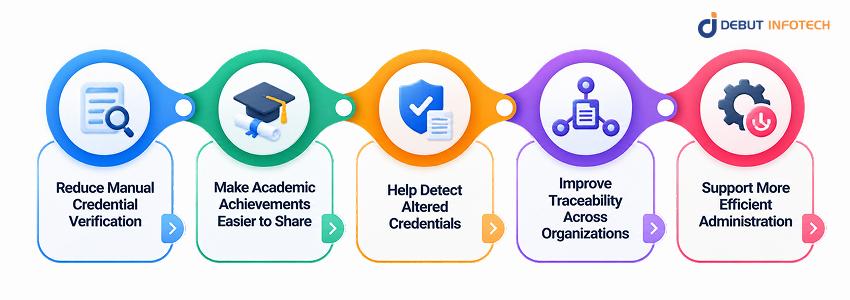
The benefits of blockchain in education depend on how shared verification improves institutional workflows. Combined with digital credentials and reliable integrations, blockchain can support easier record checks, clearer audit trails, and less administrative coordination.
Electronic verification can reduce routine requests that require individual staff responses. Registrars can spend more time resolving incomplete records and unusual cases.
Assess the impact through staff handling time, support requests, and unresolved verifications. This shows whether the platform reduces work across the full process.
Portable credentials can help graduates reuse their records across applications. They may also reduce the need to obtain repeated copies from the issuer.
Familiar sharing tools and compatible verification services make these records more useful across admissions and employment applications. Recipient acceptance determines how widely graduates can reuse them.
A document that no longer matches its signed or anchored version can fail an integrity check. This helps receiving organizations identify certain changes to submitted records.
Secure issuance approvals and protected signing keys help ensure that the record being verified reflects an authorized academic decision.
A shared record can establish when an approved event was recorded. Participants can use that history when investigating a discrepancy or reconciling records.
Agreed definitions for events such as issuance, correction, and revocation help participating organizations interpret that history consistently.
For workflows involving several institutions, a shared ledger can provide a common reference for approved actions. Integration with existing systems may reduce repeated status checks and reconciliation between teams.
Clear responsibilities and reliable data flows determine the operational value. Compare the workflow with a simpler digital alternative to assess blockchain’s specific contribution.
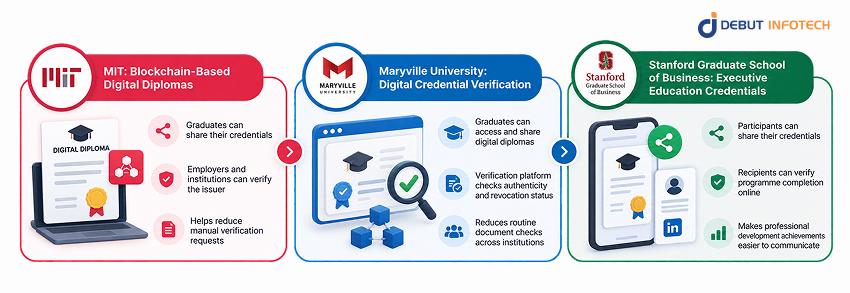
Universities are increasingly exploring blockchain for digital credential issuance and verification. How are universities using blockchain in education? Examples include MIT’s blockchain-based digital diplomas and Maryville University’s digital credential verification, which allow graduates to share their credentials and help employers and other institutions verify their authenticity.
The Massachusetts Institute of Technology (MIT) introduced blockchain-based digital diplomas using the Blockcerts standard. Graduates can share their credentials with employers and other institutions, which can verify the issuer and check whether the credential matches the issued record.
For institutions, this approach can reduce reliance on manual verification requests for compatible digital credentials. The university remains responsible for the original academic decision, while blockchain supports verification of the issued credential.
Maryville University in Missouri provides blockchain-based digital diplomas that graduates can access and share with employers or other institutions. Its verification platform supports checks on credential authenticity and status, including whether a credential has been revoked.
This implementation illustrates how blockchain can support credential verification across institutional boundaries. For registrars and recruitment teams, the potential value lies in reducing routine document checks while maintaining a process for handling corrected or invalid credentials.
Stanford Graduate School of Business uses blockchain-based digital credentials for eligible Executive Education programmes. Participants can share their credentials through professional profiles and other channels, allowing recipients to verify programme completion online.
For organizations investing in employee training, verifiable digital credentials can make professional development achievements easier to communicate and assess. Their practical value depends on whether employers recognize the issuing institution and can access a compatible verification service.
These implementations demonstrate how blockchain can support academic credential integrity and digital verification. However, blockchain does not replace institutional approval, identity checks, or credential lifecycle management. Institutions should assess whether ledger-based verification offers a measurable advantage over digitally signed credentials and existing verification portals.
Blockchain may be appropriate when a shared verification requirement justifies its additional infrastructure. The decision depends on who issues records, who verifies them, and how participating organizations establish trust.
A ledger may be worth evaluating when independent organizations need a shared verification reference. The requirement should explain what ledger anchoring adds beyond digital signatures and existing institutional services.
Look for clear conditions:
A single institution may manage issuance and verification through a centralized service. Digitally signed credentials can also provide portable evidence without blockchain anchoring.
Missing records and inconsistent source data require institutional review regardless of architecture. Establish reliable academic records and approval processes before adding verification infrastructure.
The following approaches serve different requirements and can be combined within one platform.
Centralized Verification Portal
The institution maintains credential records in its database. Employers or other recipients check a document through an institution-operated portal.
Best Suited to: Workflows with one accountable operator and established access arrangements.
Key consideration: Verification depends on the continued availability of the operator’s service and the integrity of its records.
Digitally Signed Verifiable Credentials
The institution issues a structured credential secured by a digital signature. Compatible verification software checks the signature, issuer information, and relevant credential status without requiring blockchain.
Best Suited to: Portable credentials that learners can share across compatible systems.
Key consideration: Verification still requires trusted issuer keys, supported formats, and any necessary status services.
Blockchain-Anchored Credentials
The institution issues a digital credential and records an associated proof on a blockchain. Verification checks the credential against that proof alongside issuer trust and relevant status information.
Best suited to: Workflows where a shared ledger provides a justified reference across organizations.
Key Considerations: Anchoring adds network dependencies and operating costs. The ledger does not replace institutional approval, secure key management, or credential lifecycle services.
Blockchain vs traditional academic credential verification highlights differences in how credentials are checked, how records are shared, and how much institutions depend on a central verification service. Blockchain can provide a shared reference for checking credential integrity across organizations, while digitally signed credentials can also support authenticity checks without requiring a blockchain.
Ask prospective providers to demonstrate the same workflow with and without blockchain. Compare verification dependencies, governance, interoperability, recovery, and total operating cost. Select the architecture that meets the institutional requirement with manageable complexity.
Blockchain adoption in higher education requires coordination across academic operations, IT, and data governance teams. Unclear responsibilities can delay integration, credential corrections, and ongoing support.
For covered US institutions, FERPA generally requires consent before disclosing personally identifiable information from education records, subject to specified exceptions. It also provides rights to inspect records and seek amendment.
Blockchain does not automatically ensure FERPA compliance. Build the design around approved disclosures and institutional responsibilities:
Student information systems hold approved academic records. Learning management systems may provide evidence of course activity. Those systems do not necessarily use the same identifiers or approval rules.
Map data fields and assign ownership before development. Identify the authoritative system and approval process for each change. Reconciliation should flag missing or duplicated credentials so staff can resolve them promptly.
Two products can support the same named standard yet fail to exchange credentials successfully. They may implement different versions or use incompatible verification methods.
What standards are used for blockchain-based digital credentials? Relevant standards include the W3C Verifiable Credentials data model, which provides a framework for verifiable claims, and Open Badges, which supports the representation and sharing of achievements and skills. Institutions should assess compatibility with their existing systems and intended verification platforms. Neither standard inherently requires blockchain.
Test the complete journey across your intended products. Include issuance and sharing alongside verification and status checks. Where decentralized identity in education uses DIDs, test identifier resolution, key rotation, and recovery across the intended systems.
Records need lifecycle management even when their proofs cannot be rewritten. A corrected credential should replace or supersede the earlier version through an approved process.
Revocation, suspension, and expiry require distinct checks. W3C’s Bitstring Status List provides a mechanism for publishing revocation or suspension information. Define how verifiers handle unavailable or outdated status information.
Issuer signing keys need tightly controlled storage and use. A compromised key may allow unauthorized credentials to appear legitimately signed.
Protect signing operations with restricted access and documented rotation procedures. Test recovery for both institutional keys and learner accounts. The support team should know when reissuance is necessary and who can authorize it.
A verification platform delivers limited value if intended recipients do not use it. Involve employers, admissions teams, and other participating organizations during planning and interface testing.
Assign ongoing responsibility for disputes, maintenance, and support. Network fees, transaction capacity, and energy use vary by architecture. Assess these alongside hosting, integrations, and credential-status services when estimating operating costs.
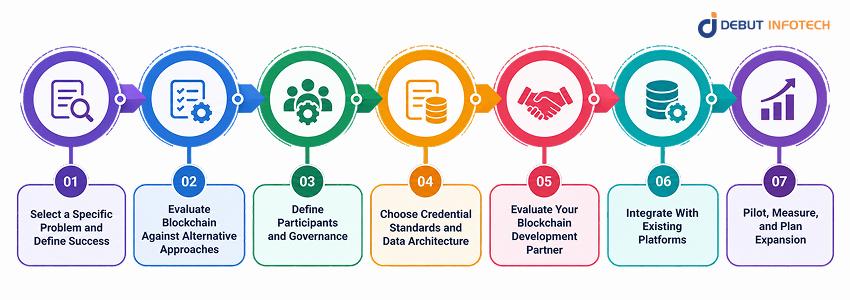
For credential projects, begin with one manageable workflow and a defined group of issuers and verifiers. Expand after the pilot demonstrates operational value and reliable support.
Start with one credential type and its receiving organizations. Degree verification and continuing education certificates create different requirements. Avoid combining them into an institution-wide transformation before understanding either workflow.
Record current handling time and the volume of requests. Identify the exceptions that consume the most effort. This baseline gives your institution a meaningful way to evaluate improvement.
Compare an institution-operated verification portal, portable signed credentials, and credentials with blockchain anchoring. These approaches can overlap. Each proposal should explain issuer trust, verification dependencies, and service availability.
Our blockchain consulting services can support the feasibility assessment. The output should identify the recommended architecture and explain why it fits the workflow.
List every organization involved in issuance and verification. Then assign decision rights before selecting the network.
Your operating agreement should establish:
These decisions shape both implementation scope and long-term accountability.
Select credential formats based on the intended recipients and available tools. Define which information must travel with the credential. Keep supporting records in appropriate institutional systems.
Document signing services, credential-status checks, and off-chain storage separately from optional ledger proofs. Then choose the network and governance model, including who operates infrastructure and controls participation.
Relevant engineering experience matters more than a long list of supported platforms. Ask candidates to demonstrate a credential moving through its complete lifecycle.
Assess prospective partners on:
Our blockchain development services cover application architecture and integration. The project scope should translate those capabilities into specific institutional deliverables.
Connect the credential service to approved source records and identity services. Use supported APIs or controlled exports according to your existing system constraints.
Test what happens when an approval arrives late or a message is processed twice. Check identity mismatches and interrupted issuance. Before launch, validate access controls, signing-key protection, recovery procedures, and learner accessibility.
Launch with a defined cohort and committed verifiers. Suggested pilot measures include:
Compare pilot results with the baseline and review feedback from learners, issuers, and verifiers. Expand once agreed acceptance criteria are met, with a funded operating plan and named support owners.
The cost of implementing blockchain technology in higher education depends on workflow scope, integration complexity, and operating requirements.
According to Clutch’s blockchain development pricing guide, typical blockchain project budgets fall within $10,000 to $49,999, with commonly listed agency rates of $25 to $49 per hour.
Indicative project cost ranges:
These project-level ranges are indicative planning estimates, not verified industry-wide averages.
Costs vary from project to project. The main factors affecting the final budget include:
Project timelines depend on the solution’s complexity, integration requirements, testing, and institutional approvals. The following are indicative planning estimates:
The actual timeline may vary based on data readiness, stakeholder coordination, security reviews, and the availability of existing system interfaces. Institutions should confirm both cost and delivery estimates through a technical assessment before beginning development.
The future of blockchain in education will depend on whether institutions and employers can verify credentials across different systems. Portable learning records could help learners combine degrees, micro-credentials, and professional certifications throughout their careers.
Blockchain may serve as a shared verification layer where multiple organizations need a common reference. Digitally signed credentials without ledger anchoring will also remain an option. Adoption will depend on practical value, privacy, and operating costs.
As credential standards and tools evolve, institutions will need interoperable formats and dependable verification services. Learners should retain access to usable records when platforms or providers change.
Long-term value will come from credentials that remain understandable, verifiable, and supported over time. Clear issuer authority, correction processes, and recovery options will remain central to institutional trust.
Debut Infotech helps institutions evaluate blockchain’s role in credential issuance, verification, and academic record sharing. Our services cover consulting, architecture, development, integration, testing, and deployment, with maintenance planning built into the delivery scope.
We start by reviewing your existing workflow, source systems, and approval requirements. This assessment establishes technical suitability and shapes a roadmap around institutional priorities.
Our services include:
Where workflows require automated execution, our smart contract development services can implement agreed rules using authorized institutional inputs, such as approved milestone confirmations.
For universities evaluating blockchain solutions for education, we connect delivery planning with existing systems and governance requirements. Your academic, IT, and procurement teams gain a defined scope, acceptance criteria, and operating responsibilities to evaluate the proposed investment.
Academic credential verification, digital diplomas, transcripts, and professional certifications are practical applications. Blockchain can provide shared proofs that receiving organizations check against issued records. Credit transfer and funding administration may also use shared records, but academic and financial decisions remain subject to institutional policies and approvals.
No. Digitally signed credentials can support authenticity and integrity checks without a blockchain. Ledger anchoring is an additional option where a shared verification reference provides value. The choice depends on institutional trust arrangements, verification requirements, and operating costs.
Verification software compares evidence derived from the credential with a proof recorded on the blockchain. It also checks relevant signatures, issuer information, and credential status. These checks help detect alterations. Establishing the issuer’s authority and confirming the presenter’s identity require additional checks.
Yes, if the platform supports credential lifecycle management. The institution can revoke or supersede an incorrect credential and issue a replacement. The original blockchain proof generally remains, while status information indicates whether the earlier credential should still be accepted.
Yes, where supported interfaces and permissions are available. APIs or controlled exports can connect approved academic records to a credential platform. Integration must account for student identifiers, approval workflows, duplicate messages, and failed processing to keep issuance consistent with institutional records.
Not necessarily. Institutions can manage blockchain transactions and network charges while students access credentials through an account, downloadable file, or credential wallet. A credential wallet serves a different purpose from a cryptocurrency wallet. The experience should include clear sharing and recovery options.
Costs depend on workflow scope, system integrations, credential formats, security requirements, and migration of existing records. Recurring expenses include hosting, monitoring, support, and any network charges. Estimates should distinguish initial development from ongoing operations and identify third-party fees and institutional responsibilities.
Timing depends on project scope, institutional approvals, integration access, and data readiness. Security testing and participation from intended verifiers also affect pilot completion. A delivery plan should identify milestones, dependencies, and acceptance criteria for assessment, development, testing, and rollout.

Our Latest Insights

Updated September 18, 2026
USA
2501 Chatham, Rd Suite R Springfield, IL 62704
+1-708-515-4004
info@debutinfotech.com
UK
7 Pound Close, Yarnton, Oxfordshire, OX51QG
+44-770-304-0079
info@debutinfotech.com
Canada
154 Eden Oak Trail, Kitchener, ON N2A 0H9
+1-708-515-4004
info@debutinfotech.com
INDIA
Sector 101-A, Plot No: I-42, IT City Rd, JLPL Industrial Area, Mohali, PB 140306
9888402396
info@debutinfotech.com