ON THIS PAGE
Progress0%






Our Global Presence :



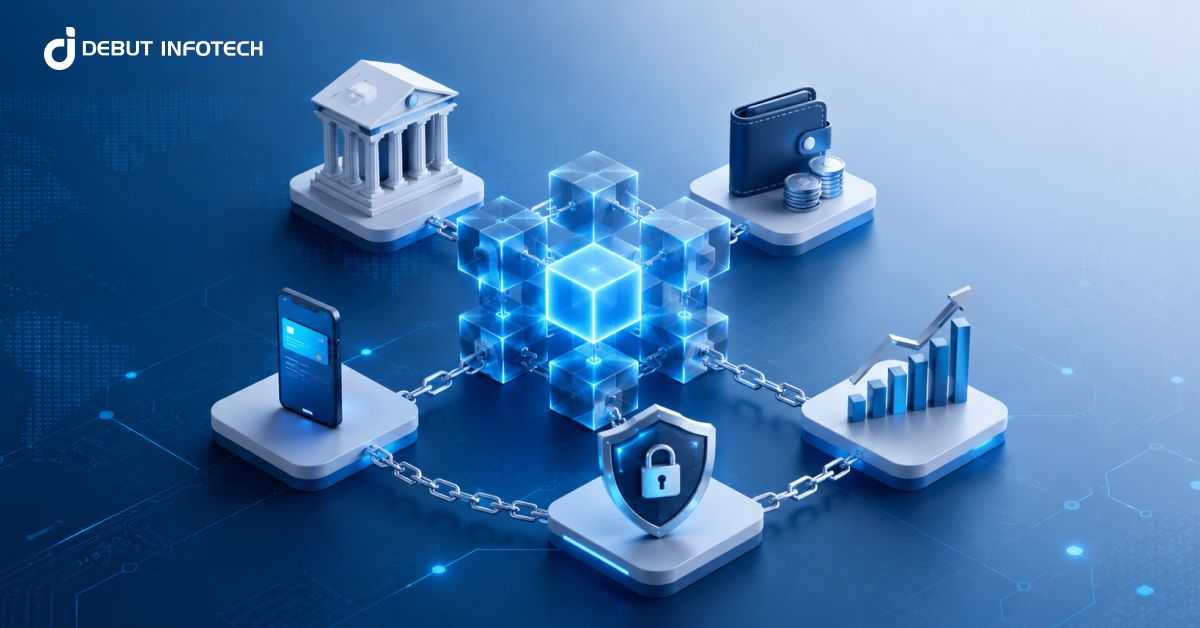


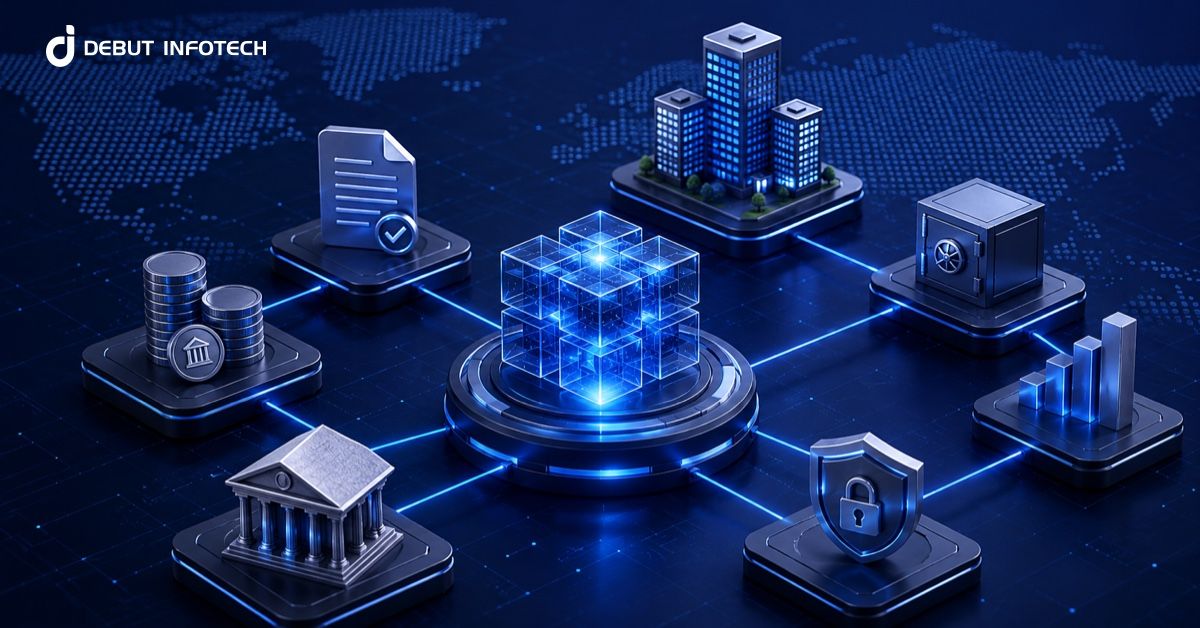
Blockchain delivers the greatest value in multi-party financial ecosystems where banks, payment providers, insurers, and regulators need a shared, tamper-resistant source of truth with reduced reconciliation overhead.
Cross-border payments, digital identity, asset tokenization, trade finance, and smart contract automation are among the most mature blockchain fintech use cases, driving faster settlement, transparency, and operational efficiency.
Permissioned platforms such as Hyperledger Fabric, Corda, and Quorum are preferred for regulated financial services, while Ethereum and other public networks are better suited for DeFi, tokenization, and open ecosystem participation.
Blockchain is not a replacement for traditional fintech infrastructure in every scenario; conventional databases remain more practical when a single organization owns the data and controls all participants.
Implementation success depends on architecture, compliance, and integration planning, including KYC/AML controls, smart contract audits, middleware design, consensus selection, and legacy system connectivity.
Blockchain project costs vary significantly by scope and complexity, ranging from roughly $30,000–$80,000 for a proof of concept to over $2 million for enterprise-grade banking and settlement networks.
Future fintech innovation will be shaped by institutional DeFi, tokenized deposits, CBDCs, real-world asset tokenization, and AI-powered compliance, creating new opportunities for programmable and data-driven financial services.
Blockchain in fintech is changing how financial institutions process transactions, manage data, and build trust across digital ecosystems.
Instead of relying on multiple intermediaries and disconnected databases, blockchain enables authorized participants to access a shared, tamper-resistant ledger that records transactions in real time. This approach helps reduce settlement delays, improve transparency, and streamline processes that have traditionally been slow and resource-intensive.
The technology is tipped to make real-world impacts. According to the World Economic Forum, around 10% of global GDP could be stored on blockchain-enabled technologies by 2027. This highlights the growing role of distributed ledger technology in the global economy.
Industry investment also continues to accelerate. Fortune Business Insights projects the global blockchain technology market to grow from USD 31.18 billion in 2025 to USD 577.36 billion by 2034. This reflects increasing adoption across banking, payments, insurance, and capital markets.
Financial institutions are now using blockchain to solve practical challenges rather than simply exploring emerging technology. Applications such as cross-border payments, tokenized assets, digital identity, and automated compliance demonstrate measurable improvements in efficiency and security.
This guide explains what blockchain in fintech is, how it works, where it delivers value, how leading financial institutions implement it, and what organizations should consider when planning a blockchain deployment.
Blockchain in fintech refers to the use of distributed ledger technology (DLT) to securely record, verify and share financial transactions across a network of participants.
Instead of storing records in a centralized database controlled by one organization, blockchain maintains synchronized copies of the ledger across multiple authorized nodes. Each transaction is verified through a consensus mechanism, grouped into blocks, and cryptographically linked to previous records, making the ledger highly resistant to unauthorized changes.
Blockchain in financial services provides a shared source of truth for banks, payment providers, insurers, regulators, and other institutions. This reduces reconciliation efforts, strengthens auditability, and improves transaction transparency.
While blockchain is not a replacement for every database, it is particularly valuable when multiple organizations need to exchange trusted information securely without relying entirely on a central authority.
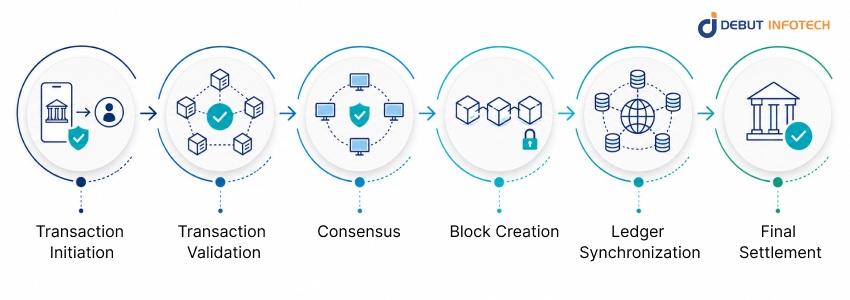
Understanding the transaction lifecycle helps explain why blockchain offers advantages over many conventional financial systems.
While implementation details differ across blockchain platforms, most fintech applications follow a similar sequence from transaction initiation to final settlement.
A customer, financial institution, or application initiates a transaction. This could involve transferring money, issuing a loan, tokenizing an asset, executing a securities trade, or updating customer identity information.
The transaction request is digitally signed using cryptographic keys, confirming the sender’s authorization.
The transaction is transmitted to participating nodes within the blockchain network. Validators examine predefined conditions before accepting it.
Depending on the application, validation may include verifying account balances, confirming customer identity, checking regulatory rules, or ensuring that digital assets have not already been spent.
Once validated, participating nodes agree on whether the transaction is legitimate through a consensus mechanism. Permissioned financial networks often use Practical Byzantine Fault Tolerance (PBFT) or Raft because these algorithms deliver fast transaction finality among known participants.
Public blockchains commonly use Proof of Stake (PoS), in which validators confirm transactions using staked assets.
Valid transactions are grouped into a new block. Each block contains transaction data, timestamps, cryptographic hashes, and references to previous blocks.
These cryptographic links ensure the ledger’s integrity by rendering historical records resistant to unauthorized modification.
After consensus is reached, the new block is distributed across every authorized node in the network.
Each participant updates its ledger copy simultaneously, ensuring that all parties share the same transaction history without requiring separate reconciliation.
Once the block is confirmed, settlement is considered complete according to the network’s rules.
Unlike many traditional financial systems where settlement may require additional reconciliation between institutions, blockchain provides a synchronized record immediately after validation, reducing operational delays and settlement risk.
Financial institutions choose blockchain architectures based on privacy requirements, regulatory obligations, transaction volume and governance needs.
Four primary blockchain models are used across fintech applications.
| Blockchain Type | Governance | Privacy | Performance |
| Public | Open community | Low | Moderate |
| Private | Single organization | High | High |
| Consortium | Multiple institutions | High | High |
| Hybrid | Shared governance | Selective | High |
Public blockchains allow anyone to participate in validating transactions and viewing the ledger.
Networks such as Ethereum provide open access, making them suitable for decentralized finance (DeFi), public token issuance and applications that require global liquidity.
While transparency is a major advantage, public networks may present challenges for organizations handling confidential financial data.
Private blockchains are operated by a single organization that controls network access and governance.
These networks offer higher transaction throughput and stronger privacy controls than public chains, making them suitable for internal record management, enterprise workflows and proprietary financial systems where decentralization is not the primary objective.
Consortium blockchains are governed collectively by multiple trusted organizations rather than one institution.
Banks participating in shared payment networks or trade finance platforms often adopt this model because it balances decentralization with regulatory oversight.
Access remains restricted to approved participants while enabling shared data management across institutions.
Hybrid blockchains combine features of both public and private networks.
Sensitive customer information remains protected within private infrastructure, while selected transaction records or digital assets can interact with public blockchain ecosystems when needed.
This approach supports compliance requirements without eliminating opportunities for interoperability and broader market participation.
Blockchain technology in financial services introduces a fundamentally different approach to recording and validating financial transactions.
However, that does not mean traditional infrastructure becomes obsolete. Each model has strengths that depend on the business problem being addressed.
Understanding these differences helps organizations determine whether blockchain provides meaningful advantages for a particular application.
| Feature | Traditional Fintech Infrastructure | Blockchain-Based Infrastructure |
| Settlement Time | Minutes to several business days depending on intermediaries | Near real-time to minutes, depending on the network |
| Transaction Costs | Higher due to clearing houses and intermediaries | Potentially lower through shared validation |
| Intermediaries | Multiple institutions often participate | Fewer intermediaries required |
| Trust Model | Central authority manages records | Shared trust among network participants |
| Data Storage | Centralized databases | Distributed ledger shared across nodes |
| Transparency | Limited to participating institutions | Shared visibility for authorized participants |
| Auditability | Separate audit logs across organizations | Single immutable transaction history |
| Availability | Often restricted by banking hours and maintenance windows | Many blockchain networks operate continuously |
| Reconciliation | Frequently required between institutions | Greatly reduced through synchronized ledgers |
| Programmability | Business logic implemented in applications | Smart contracts automate execution |
| Security Model | Centralized security controls | Cryptographic validation with distributed consensus |
| Typical Use Cases | Retail banking, internal databases, payment processing | Cross-border payments, tokenization, trade finance, digital identity |
Traditional financial transactions often move through payment processors, correspondent banks, clearing systems, and settlement networks before completion. Each stage introduces additional processing time.
Blockchain reduces these dependencies by enabling participating institutions to validate transactions on a shared ledger, thereby significantly shortening settlement cycles.
Operational costs differ because blockchain reduces duplication rather than eliminating infrastructure entirely. Financial institutions still require compliance systems, customer support, cybersecurity, and operational oversight.
Savings typically come from reduced reconciliation, fewer intermediaries, and greater automation, rather than from lower infrastructure costs alone.
Centralized databases generally provide visibility only to the organization that owns them. When several institutions participate in a transaction, each maintains separate records that must be reconciled.
Blockchain replaces these disconnected records with a synchronized ledger, creating a consistent audit trail for authorized participants and regulators.
Both approaches can be highly secure when implemented correctly, but they rely on different security models. Traditional systems protect centralized databases through access controls, firewalls, and monitoring.
Blockchain supplements these controls with cryptographic signatures, distributed validation, and immutable transaction records, making unauthorized modification significantly more difficult.
Blockchain is not always the best choice. If a single organization owns the data, controls all participants, and has no need for distributed trust, a reputable fintech software development company will recommend a conventional database since it’s simpler, faster, and less expensive to maintain.
Adding blockchain in these situations may increase complexity without delivering proportional business value.
Blockchain is most effective when several independent organizations need to exchange trusted information, automate shared business processes, or maintain synchronized records without relying entirely on a central authority.
These characteristics explain why blockchain adoption continues to grow in payments, capital markets, trade finance, digital identity, and tokenized asset management.
Traditional financial transactions frequently pass through correspondent banks, clearing houses, payment processors and reconciliation systems before settlement is complete. Each intermediary introduces additional processing time.
Blockchain in financial services streamlines this process by allowing authorized participants to validate and record transactions on a shared ledger.
Cross-border transfers that previously required several business days can often be completed within minutes, improving cash flow and reducing settlement risk.
Every intermediary involved in financial transactions adds infrastructure costs, service fees, and administrative overhead.
Blockchain reduces these expenses by enabling direct transaction validation among network participants.
Automated reconciliation, fewer manual processes, and reduced dependency on third-party clearing services contribute to lower operational costs over time, particularly for institutions handling high transaction volumes.
Fraud remains a significant concern across payments, lending, insurance, and digital banking. Blockchain strengthens security by creating immutable transaction records that cannot be altered without network consensus.
Combined with cryptographic authentication and distributed validation, this makes unauthorized transaction manipulation substantially more difficult than in traditional centralized systems.
Every approved participant has access to the same transaction history, creating a consistent, verifiable audit trail.
Regulators can review transaction records more efficiently, financial institutions spend less time reconciling discrepancies, and customers benefit from increased visibility into transaction status. This transparency supports stronger governance while reducing compliance workloads in the blockchain financial ecosystem.
Smart contracts execute predefined business rules automatically once specified conditions are satisfied.
In fintech, these programmable contracts can release loan funds, settle insurance claims, distribute investment returns, or execute escrow payments without requiring manual intervention.
Automation reduces processing delays, minimizes human error, and ensures transactions follow consistent rules.
Millions of individuals remain underserved by traditional banking systems due to limited infrastructure or high service costs.
Blockchain-powered fintech enables peer-to-peer financial services, reducing reliance on physical bank branches.
Digital wallets, cross-border remittances, decentralized lending platforms, and tokenized financial products provide broader access to financial services for individuals and businesses that previously faced significant barriers to participation.
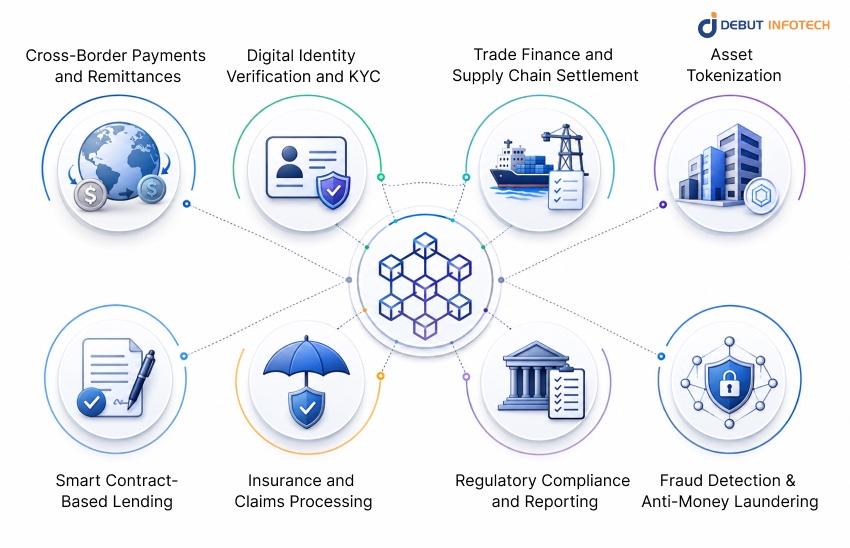
Blockchain delivers measurable value when it addresses a specific operational challenge rather than serving as a standalone technology initiative.
Financial institutions increasingly adopt blockchain in areas where multiple parties need to exchange trusted information, complete transactions more efficiently, or automate processes that traditionally rely on manual verification.
The following use cases demonstrate how blockchain is being applied across payments, lending, compliance, insurance, capital markets, and digital asset management.
Cross-border payments remain one of blockchain’s most established applications in fintech.
Conventional international transfers often involve multiple correspondent banks, currency conversion services, clearing networks, and settlement institutions. Every intermediary introduces processing delays, additional fees, and operational complexity.
Businesses may wait several days before funds become available, while individuals sending remittances often lose a noticeable percentage of the transfer amount to transaction costs.
Blockchain for cross-border payments simplifies this process by enabling participating financial institutions to share a synchronized ledger for payment validation and settlement.
Rather than routing transactions through multiple intermediaries, payment instructions are verified on the blockchain, reducing reconciliation requirements and accelerating settlement. This approach benefits both financial institutions seeking greater operational efficiency and customers expecting faster access to transferred funds.
Several fintech companies have demonstrated how blockchain can improve international payments:
Beyond remittances, blockchain also improves treasury management for multinational businesses.
Faster settlement enables organizations to manage working capital more effectively, reduce liquidity requirements, and gain greater visibility into international cash flows.
Customer identity verification remains one of the most expensive compliance responsibilities for financial institutions.
Every bank, payment provider, and fintech platform typically performs its own Know Your Customer (KYC) checks, even when another regulated institution has already verified the same individual. This duplication increases onboarding costs, slows customer acquisition, and creates inconsistent identity records across organizations.
Blockchain introduces a shared identity framework in which verified credentials can be securely referenced by multiple authorized institutions.
Rather than repeatedly collecting and validating identical documentation, institutions can rely on cryptographically secured identity records while maintaining compliance with applicable regulations.
A blockchain-based identity solution generally follows this workflow:
This model reduces onboarding times while improving data consistency. It also gives customers greater control over how their identity information is shared between financial service providers.
Since blockchain records are tamper-resistant, institutions can demonstrate when identity verification occurred, who performed it, and whether any subsequent changes have been made. This strengthens auditability without exposing confidential customer information on public networks.
Trade finance involves numerous participants, including exporters, importers, banks, shipping companies, customs authorities, insurers, and logistics providers. Each organization maintains its own records, making document verification and payment reconciliation both time-consuming and prone to errors.
Blockchain creates a shared ledger that allows approved participants to access synchronized transaction records throughout the trade lifecycle.
Shipping updates, customs approvals, financing milestones, and payment events are visible to authorized stakeholders in real time, reducing document duplication and improving coordination between organizations.
Smart contracts in fintech further automate trade finance by releasing payments when predefined conditions are satisfied. For example, payment may be triggered automatically after shipping documentation has been validated, customs clearance has been confirmed, and the receiving party has acknowledged delivery.
This reduces processing delays while lowering administrative costs associated with manual verification, document handling, and dispute resolution.
Asset tokenization converts ownership rights into digital tokens recorded on a blockchain.
Instead of representing ownership through paper certificates or centralized databases, blockchain records ownership as programmable digital assets that can be transferred more efficiently between participants.
Financial institutions are exploring tokenization across multiple asset classes, including:
One significant advantage of real world asset tokenization is fractional ownership. Rather than purchasing an entire high-value asset, investors can acquire smaller tokenized portions that represent proportional ownership. This lowers investment barriers while increasing market accessibility and liquidity.
Tokenization also streamlines post-trade processing. Ownership transfers occur directly on the blockchain, reducing settlement delays and minimizing reconciliation between custodians, brokers, and clearing institutions.
Traditional lending involves numerous manual processes, including application reviews, document verification, contract preparation, payment scheduling, and loan servicing. These activities require substantial administrative effort and often extend approval timelines.
Smart contracts automate many of these functions by embedding lending rules directly into blockchain applications. Once the predefined conditions are satisfied, the contract executes automatically without requiring manual intervention.
A blockchain lending workflow may include:
Automation improves operational efficiency while ensuring consistent application of lending policies. Financial institutions also benefit from improved auditability because every contract action is permanently recorded on the blockchain.
This model is increasingly used across decentralized finance platforms, although permissioned blockchain implementations are also emerging among regulated financial institutions exploring automated commercial lending.
Insurance claims frequently involve extensive documentation, manual verification, and coordination between multiple organizations. Processing delays increase administrative costs while affecting customer satisfaction.
Blockchain fintech solutions enable insurers to automate claims processing using smart contracts that execute predefined business rules. Rather than requiring manual approval for every claim, eligible events can trigger automated workflows based on verified external data.
Parametric insurance illustrates this concept particularly well. Instead of assessing damages individually, payouts occur automatically when measurable conditions are met.
Examples include:
External data sources known as oracles provide verified information to the smart contract. Once contractual conditions are satisfied, payments are released automatically, reducing administrative workloads while improving settlement speed.
Compliance requirements continue to expand across banking, payments, investment management, and digital asset services.
Financial institutions dedicate significant resources to transaction monitoring, reporting, auditing, and record management to satisfy regulatory expectations.
Blockchain simplifies many of these responsibilities by maintaining an immutable transaction history that regulators and authorized auditors can review. Rather than assembling reports from multiple disconnected systems, organizations can generate compliance evidence from a synchronized ledger.
Smart contracts also support automated compliance by embedding regulatory rules directly into transaction workflows. For example, transactions can be blocked if customer verification is incomplete, jurisdictional restrictions apply, or transaction limits are exceeded.
Real-time reporting further improves regulatory oversight. Instead of relying solely on periodic submissions, regulators may access permissioned blockchain records that provide continuous visibility into approved transaction activity.
Fraud prevention remains a priority for every financial institution. Criminal activity often exploits fragmented data, delayed reporting, and inconsistent monitoring across organizations. Blockchain enhances fraud detection by providing a tamper-resistant, immutable transaction history that cannot be altered after validation.
While blockchain alone does not eliminate financial crime, it creates a more reliable data foundation for advanced analytics.
Artificial intelligence and machine learning systems can analyse immutable transaction records to identify suspicious behavior, unusual transaction patterns, and potential money laundering activities more accurately than fragmented legacy systems.
AML solutions built on blockchain may monitor:
Because every validated transaction remains permanently recorded, investigators can trace financial activity more efficiently than in systems where records are distributed across separate institutions. This improves transparency while supporting stronger regulatory enforcement.
Enterprise blockchain adoption has progressed beyond pilot programs and proof-of-concept demonstrations.
Leading financial institutions now use blockchain to address practical business challenges such as cross-border settlement, digital asset management, identity verification, and securities issuance.
While implementation approaches vary, most enterprise deployments rely on permissioned blockchain networks where participants are known, governance is clearly defined, and regulatory requirements can be enforced.
One of the most mature enterprise blockchain deployments is JPMorgan Chase’s Kinexys platform (formerly Onyx).
Designed for institutional clients, Kinexys supports programmable payments, tokenized deposits, and wholesale settlement on a permissioned blockchain network.
Traditional interbank payments often involve several reconciliation steps between participating institutions. These processes may introduce delays, particularly when transactions cross jurisdictions or occur outside standard banking hours.
Kinexys addresses this by enabling participating institutions to settle eligible transactions on a shared ledger with near real-time finality. The platform processes billions of dollars in transaction value daily, demonstrating that blockchain infrastructure can support high-value institutional payment flows at scale.
From a technical perspective, Kinexys operates on a permissioned architecture in which only approved participants can run validator nodes.
Smart contracts automate payment execution based on predefined business rules, while existing banking systems continue to manage customer accounts, conduct compliance checks, and generate reports. This hybrid architecture allows blockchain to improve settlement efficiency without requiring organizations to replace their core banking infrastructure.
The primary problem Kinexys solves is settlement friction. By reducing reconciliation across institutions and enabling continuous transaction processing, participating organizations gain faster access to liquidity while reducing operational overhead.
HSBC launched the Orion platform to support tokenized assets within regulated financial markets. The platform enables eligible financial instruments to be issued, managed, and settled using blockchain infrastructure.
Orion illustrates how enterprise blockchain differs from many public cryptocurrency networks. Access is limited to authorized participants, governance follows established institutional rules, and compliance controls are integrated directly into transaction workflows.
Smart contracts automate selected settlement processes while permissioned validators maintain network integrity.
The broader objective is to modernize financial market infrastructure without introducing unnecessary operational disruption.
Existing banking systems continue to perform customer management, risk monitoring, and regulatory reporting, while blockchain enhances selected transaction processes.
Identity verification represents one of the largest operational challenges in digital finance. Mastercard addresses this through Crypto Credential, an identity framework designed to improve trust across blockchain-based transactions.
Instead of requiring users to rely solely on long cryptographic wallet addresses, Crypto Credential links verified identities to blockchain transactions. Participating institutions validate customers in accordance with applicable regulatory requirements before issuing credentials recognised across supported blockchain ecosystems.
The technical architecture separates identity verification from transaction execution. Customer identities remain protected within regulated verification systems, while blockchain records reference approved credentials rather than exposing sensitive personal information. This approach improves usability while maintaining privacy and regulatory compliance.
For fintech companies, identity layers such as Crypto Credential reduce transaction errors, strengthen customer protection, and simplify compliance across digital asset services.
Although these organizations operate in different financial sectors, their blockchain strategies share several common characteristics:
These examples demonstrate that blockchain adoption in fintech is increasingly driven by measurable business outcomes.
Faster settlement, improved auditability, reduced reconciliation, and programmable financial services provide tangible value that extends well beyond the technology itself.
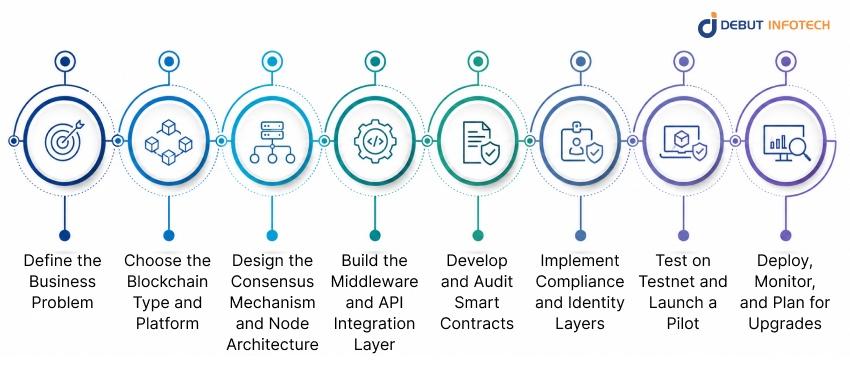
Implementing blockchain in a fintech environment involves far more than selecting a blockchain platform and writing smart contracts.
Financial institutions operate within strict regulatory frameworks, manage sensitive customer data, and depend on legacy banking systems that cannot simply be replaced.
A successful implementation balances technical architecture, operational requirements, security, and compliance while solving a clearly defined business problem.
The first question should never be, “Which blockchain should we use?” Instead, organizations should ask whether blockchain is the right technology for the problem they are trying to solve.
Many projects fail because blockchain is introduced where a conventional database would deliver the same result with less complexity and lower cost.
Blockchain is most valuable when multiple independent parties need to share trusted data without relying entirely on a central authority.
Examples include interbank settlements, syndicated lending, trade finance, and shared identity verification. If a single organization owns the data and controls every process, traditional infrastructure is often the more practical choice.
During this phase, project teams should define measurable business objectives, such as reducing settlement times, lowering reconciliation costs, improving auditability, or automating compliance workflows.
Clear objectives make it easier to evaluate whether blockchain delivers meaningful value after deployment.
Once blockchain has been identified as an appropriate solution, the next decision is to select the underlying network architecture.
The choice depends on transaction volume, privacy requirements, governance, interoperability, and regulatory obligations.
Most regulated fintech applications use permissioned blockchains, where participants are known and approved before joining the network. Common platforms include:
These platforms offer controlled access, predictable performance, and robust privacy controls, making them well-suited for banking, payments, insurance, and capital markets.
Public blockchains such as Ethereum and Solana are more appropriate for applications that require open participation, decentralized finance (DeFi), token issuance, or access to broader liquidity ecosystems.
While public networks provide greater openness, organizations must carefully consider transaction costs, scalability, and data privacy requirements.
Selection criteria typically include:
Consensus determines how blockchain participants agree on the validity of transactions. Different mechanisms offer different balances among speed, decentralization, and fault tolerance.
Permissioned financial networks commonly rely on algorithms such as Practical Byzantine Fault Tolerance (PBFT) or Raft, which provide fast transaction finality because validators are known and trusted participants.
Public blockchains typically use Proof of Stake (PoS), where validators participate according to the network’s staking rules.
Node architecture is equally important. Organizations must determine:
A consortium of banks, for example, may assign validator responsibilities to participating institutions. At the same time, a private blockchain operated by a single organization may centralize node management under its internal infrastructure team.
Blockchain rarely operates in isolation. It must exchange information with customer applications, payment gateways, compliance platforms, core banking systems, customer relationship management software, and reporting tools. This integration layer is where many enterprise blockchain projects encounter their greatest technical challenges.
Middleware serves as the communication bridge between blockchain networks and existing enterprise applications. APIs transmit transaction requests, retrieve blockchain data, synchronize account balances, and trigger downstream business processes.
External information required by smart contracts is typically delivered through oracles. These services provide trusted off-chain data such as:
Without secure middleware and reliable oracle services, blockchain applications cannot interact effectively with the broader financial ecosystem.
Smart contracts define the business rules executed automatically on the blockchain.
In fintech, they may govern loan agreements, escrow services, insurance payouts, securities transfers, or compliance checks.
Every smart contract handling financial assets should undergo an independent security audit before deployment.
Audits identify vulnerabilities that may expose funds, customer information, or operational processes to unnecessary risk.
Typical audit activities include:
Security audits should never be treated as optional. Even small coding errors can create significant financial exposure once smart contracts become operational.
Compliance should be integrated into blockchain architecture from the beginning rather than added after deployment.
Financial institutions remain responsible for meeting regulatory obligations regardless of the technology they use.
Common compliance components include:
Many organizations implement these controls through middleware rather than storing sensitive customer information directly on-chain. This approach improves privacy while allowing blockchain transactions to reference verified customer credentials.
Production deployment should never be the first real-world test. Organizations typically validate blockchain applications in test environments before introducing live transactions.
Testing commonly includes:
After laboratory testing, many organizations conduct limited pilot programs involving selected customers or institutional partners. This allows teams to observe real transaction volumes, monitor operational performance, and identify issues before wider deployment.
Blockchain implementation does not end after deployment. Continuous monitoring ensures network stability, identifies performance bottlenecks, and supports ongoing regulatory compliance.
Monitoring typically covers:
Financial regulations evolve over time, and business requirements change. Organizations therefore adopt upgradeable smart contract patterns and structured governance processes that allow controlled updates while preserving operational continuity.
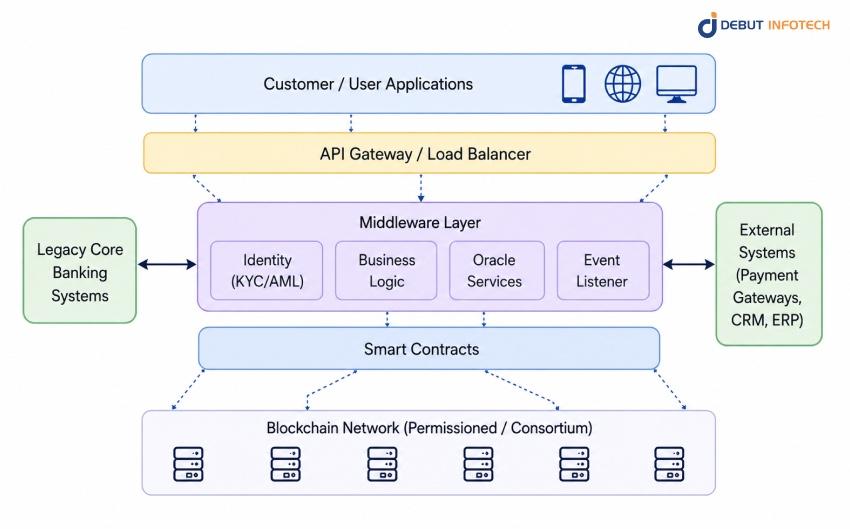
Deployments of enterprise blockchain solutions typically function as one component within a broader financial technology ecosystem.
Customer-facing applications, banking systems, compliance platforms and reporting services continue to perform their existing roles while blockchain provides a trusted transaction layer.
A simplified architecture looks like this:
This layered architecture allows blockchain to integrate with existing infrastructure rather than replacing systems that financial institutions already depend on.
| Platform | Network Type | Primary Strength | Common Fintech Use Cases |
| Hyperledger Fabric | Permissioned | Privacy and modular architecture | Banking, trade finance |
| Corda | Permissioned | Selective data sharing | Capital markets, insurance |
| Quorum | Permissioned | Enterprise Ethereum compatibility | Institutional payments |
| Ethereum | Permissionless | Smart contract ecosystem | DeFi, tokenization |
Permissioned networks remain the preferred option for most enterprise fintech applications because they provide stronger governance, predictable performance, and greater control over participant access.
| Consensus | Typical Network | Approximate TPS | Finality | Best Use Case |
| PBFT | Permissioned | 1,000-10,000+ | Seconds | Banking consortia |
| Raft | Permissioned | 5,000-20,000+ | Near instant | Private enterprise networks |
| Proof of Stake | Public | Varies by blockchain (dozens to thousands+) | Seconds to minutes | Public blockchain applications |
Actual throughput depends on hardware, network configuration, transaction complexity, and implementation.
Rather than focusing solely on maximum transactions per second, fintech organizations should evaluate consistency, fault tolerance, governance, and regulatory suitability.
Not every piece of financial information belongs on the blockchain. Storing excessive customer data on-chain increases costs and creates privacy challenges.
| On-Chain | Off-Chain |
| Transaction hashes | Customer documents |
| Token ownership | Passport copies |
| Smart contract state | Credit reports |
| Settlement records | Banking history |
| Digital signatures | Internal analytics |
A common enterprise approach stores only essential verification data on-chain while maintaining sensitive customer information in secure off-chain databases.
Blockchain records reference this information using hashes or encrypted identifiers, preserving data integrity while keeping records confidential.
The cost of implementing blockchain in fintech depends on the project’s complexity, regulatory requirements, integration needs, and security expectations.
A proof-of-concept typically costs $30,000 to $80,000, while a production-ready minimum viable product (MVP) generally ranges from $80,000 to $250,000.
Mid-sized fintech platforms often require $250,000 to $750,000, whereas enterprise-grade blockchain solutions for banks, insurers, or payment providers usually cost $750,000 to more than $2 million.
Large-scale interbank settlement networks or tokenization platforms involving multiple institutions can exceed $10 million due to extensive integration, compliance, and infrastructure requirements.
Here is a more detailed breakdown:
| Cost Component | Typical Cost (USD) |
| Discovery & Solution Architecture | $10,000–$40,000 |
| UI/UX Design | $10,000–$35,000 |
| Smart Contract Development | $25,000–$150,000 |
| Backend & API Development | $40,000–$250,000 |
| Legacy System Integration | $30,000–$200,000 |
| Security Audit | $15,000–$100,000+ |
| Compliance & Legal | $20,000–$150,000 |
| Cloud Infrastructure & Node Setup | $10,000–$80,000 annually |
| Maintenance & Support | 15–25% of the initial development cost per year |
These figures reflect typical enterprise software development rates and should be presented as indicative estimates, as actual costs vary by region, scope, and compliance requirements.
| Project Type | Estimated Cost (USD) | Typical Timeline |
| Proof of Concept (PoC) | $30,000–$80,000 | 2–3 months |
| Minimum Viable Product (MVP) | $80,000–$250,000 | 3–6 months |
| Mid-sized Fintech Platform | $250,000–$750,000 | 6–9 months |
| Enterprise Blockchain Solution | $750,000–$2 million+ | 9–18 months |
| Multi-bank or Global Settlement Network | $2 million–$10 million+ | 12–24+ months |
Blockchain implementation costs vary widely because every fintech project differs in scope, regulatory requirements, system complexity, and integration needs.
A payment platform connecting two financial institutions requires significantly less effort than a tokenized securities exchange or a multi-bank settlement network.
Rather than asking, “How much does blockchain cost?” organizations should evaluate the individual components that contribute to the overall project budget.
One of the earliest strategic decisions is whether to build a blockchain platform from scratch, purchase an existing enterprise solution, or adopt a white-label platform.
| Approach | Advantages | Limitations |
| Custom Development | Maximum flexibility, tailored architecture | Highest cost and longest timeline |
| Enterprise Platform | Faster deployment, vendor support | Less customization, licensing costs |
| White-Label Solution | Lowest initial investment, rapid launch | Limited differentiation and flexibility |
The right approach depends on long-term business objectives.
Organizations seeking a competitive advantage often invest in custom development, while startups validating new products may prefer white-label platforms or managed blockchain services before committing to larger investments.
Financial institutions cannot separate blockchain implementation from regulatory compliance.
Whether an application supports payments, lending, insurance, digital assets, or securities trading, it must comply with applicable financial regulations in every jurisdiction where it operates.
Anti-Money Laundering (AML) and Know Your Customer (KYC) obligations remain unchanged when blockchain is introduced. Institutions must still verify customer identities, monitor transactions, assess risk, and report suspicious activities.
Blockchain can strengthen these processes by:
Most enterprise implementations avoid storing personal information directly on-chain. Instead, encrypted references or cryptographic hashes point to secure off-chain records maintained within existing compliance systems.
Privacy regulations create one of the most significant architectural challenges for blockchain. Since blockchain records are intentionally difficult to modify, organizations must carefully consider how customer information is stored.
A common strategy includes:
This architecture supports both data integrity and privacy while reducing conflicts with regulations governing customer information.
Compliance requirements vary considerably between jurisdictions.
Organizations deploying blockchain internationally should design systems that accommodate region-specific reporting obligations rather than assuming one compliance framework applies globally.
Examples include:
Compliance logic is often implemented in middleware rather than hardcoding regulations directly into smart contracts. This approach allows organizations to update reporting requirements more efficiently as regulations evolve.
Although blockchain offers significant opportunities, implementation also introduces technical, operational, and regulatory challenges.
Understanding these limitations helps organizations develop realistic deployment strategies.
As transaction volumes increase, some blockchain networks struggle to maintain consistent throughput and low latency.
Public blockchains, in particular, may experience network congestion and higher transaction fees during peak demand. These limitations can affect payment processing, trading platforms, and other fintech services that require fast, high-volume transaction handling.
Solution
Fintech companies can improve scalability by selecting high-performance permissioned blockchains, implementing Layer 2 scaling solutions where appropriate, and optimizing smart contract design.
Load testing under realistic production conditions also helps identify performance bottlenecks early, ensuring the network can support future business growth without compromising reliability.
Many blockchain platforms operate independently, making it difficult to exchange assets or information across networks. This fragmentation limits liquidity, complicates data sharing, and increases integration complexity for fintech companies that rely on multiple blockchain ecosystems or need to connect with external financial institutions.
Solution
Organizations should adopt interoperability standards and secure cross-chain communication protocols when designing blockchain solutions.
Technologies such as blockchain bridges, interoperability frameworks, and standardized APIs help connect isolated networks while maintaining security, enabling assets and transaction data to move efficiently between different blockchain environments.
Blockchain regulations continue to evolve across different jurisdictions, creating uncertainty for fintech companies operating internationally.
Licensing requirements, digital asset classifications, reporting obligations, and consumer protection rules may vary significantly, making compliance more complex and increasing the risk of costly legal or operational adjustments after deployment.
Solution
Businesses should engage legal and compliance experts during the planning stage and design flexible systems that can adapt to changing regulations.
Separating compliance logic from smart contracts through middleware also makes it easier to update reporting processes without rebuilding the underlying blockchain infrastructure.
Skilled blockchain architects, smart contract developers, cryptography specialists, and blockchain security professionals remain in limited supply. This shortage can delay implementation, increase hiring costs, and make it difficult for organizations to build and maintain secure enterprise-grade blockchain solutions without external technical expertise.
Solution
Companies can address the talent gap by partnering with experienced blockchain solution providers, investing in employee training, and adopting widely supported blockchain platforms with active developer communities.
Building internal expertise while leveraging external specialists creates a more sustainable approach to long-term blockchain adoption.
Most financial institutions depend on legacy banking systems that were not designed to interact with blockchain networks.
Integrating modern distributed ledger technology with existing payment systems, customer databases, and compliance platforms often requires significant customization, making this one of the most time-consuming stages of blockchain implementation.
Solution
A well-designed middleware layer and standardized APIs simplify communication between blockchain networks and legacy applications.
Organizations should adopt phased integration strategies, beginning with limited pilot deployments before expanding blockchain functionality across critical business systems, thereby reducing operational risk and implementation complexity.
Financial institutions must balance blockchain transparency with strict privacy requirements.
Storing sensitive customer or transaction data directly on-chain may conflict with data protection regulations and internal security policies, particularly in highly regulated sectors such as banking, insurance, and investment management.
Solution
Organizations should store confidential information in secure off-chain databases while recording only cryptographic hashes or verification references on the blockchain.
Encryption, role-based access controls, and permissioned blockchain networks further protect sensitive information while preserving data integrity and supporting regulatory compliance.
Enterprise blockchain projects require considerable investment beyond software development.
Integration, cybersecurity, infrastructure, compliance, smart contract audits, and ongoing maintenance can substantially increase total project costs, particularly for organizations deploying blockchain across multiple business units or international operations.
Solution
Businesses should begin with clearly defined use cases and phased implementation plans to control costs.
Conducting feasibility studies, prioritizing high-value applications, and choosing the appropriate development approach—custom, enterprise platform, or white-label—helps maximize return on investment while minimizing unnecessary expenditure.
Blockchain adoption within fintech is becoming increasingly focused on practical business outcomes rather than experimentation.
Financial institutions are prioritizing projects that improve operational efficiency, strengthen compliance, and support the launch of new digital financial products.
Institutional decentralized finance is expected to become a major growth area as regulated financial institutions explore blockchain-based lending, trading, and liquidity management within permissioned environments.
By combining smart contracts with identity verification, compliance controls, and governance frameworks, institutional DeFi can deliver greater efficiency while meeting the regulatory standards required by banks, asset managers, and payment providers.
Tokenized deposits are gaining momentum as commercial banks look for regulated alternatives to stablecoins.
By representing traditional bank deposits as blockchain-based digital tokens, financial institutions can enable faster settlement, programmable payments, and improved liquidity management while maintaining the protections, regulatory oversight, and customer trust associated with conventional banking infrastructure.
As more central banks move from pilot programs to production-ready initiatives, central bank digital currencies are expected to become a core part of the global payments ecosystem.
Fintech companies will play an important role by developing wallets, payment gateways, merchant solutions, and APIs that integrate CBDCs with existing financial services and digital banking platforms.
The tokenization of real-world assets such as real estate, government bonds, private equity, and investment funds is expected to accelerate over the coming years.
Blockchain enables fractional ownership, faster settlement, and greater market accessibility, allowing investors to participate in asset classes that have traditionally required substantial capital or involved lengthy transaction processes.
Artificial intelligence and blockchain are increasingly being combined to strengthen financial crime prevention and regulatory compliance.
AI systems can analyze immutable blockchain transaction records to detect suspicious patterns, automate risk assessments, and generate real-time compliance insights. This helps financial institutions improve operational efficiency while responding more effectively to emerging fraud and money laundering threats.
Building a successful blockchain solution requires more than technical expertise. Fintech companies must balance performance, security, regulatory compliance, and seamless integration with existing financial systems.
Debut Infotech helps organizations navigate these challenges by delivering end-to-end blockchain development services tailored to banking, payments, lending, insurance, and digital asset platforms.
Whether you’re validating a new concept or scaling an enterprise-grade solution, the focus remains on building secure, compliant, and business-ready blockchain applications.
Our team works closely with clients throughout the development lifecycle, from solution discovery and architecture design to smart contract development, API integration, testing, deployment, and ongoing support.
We build on leading blockchain platforms, including Hyperledger Fabric, Ethereum, Corda, Quorum, and other enterprise-ready technologies, selecting the platform that best aligns with your business objectives, scalability requirements, and regulatory obligations.
Beyond development, Debut Infotech places strong emphasis on security and compliance. Every solution is designed with robust identity management, KYC/AML integration, smart contract audits, and data privacy considerations to support highly regulated financial environments.
By combining blockchain expertise with deep fintech experience, we help businesses launch reliable blockchain solutions that improve operational efficiency, accelerate digital transformation, and create long-term value for customers and stakeholders alike.
Blockchain is steadily becoming a practical component of modern fintech infrastructure rather than an emerging concept.
From faster cross-border payments and automated lending to tokenized assets and streamlined compliance, the value of blockchain in fintech lies in solving real operational challenges with greater efficiency, transparency, and security.
Successful implementation of blockchain in fintech depends on choosing the right architecture, integrating seamlessly with existing financial systems, and meeting evolving regulatory requirements.
Whether you need to overhaul outdated payment rails or launch a new digital financial product, our blockchain development company provides the technical expertise you need.
With over fifteen years of experience in the blockchain industry, we can help turn your blockchain idea into a scalable, production-ready solution. We bridge the gap between traditional software and next-generation architecture to deliver secure, transparent, and highly efficient digital products.
No. Blockchain isn’t replacing traditional banking. It’s helping banks improve how they handle payments, identity verification, fraud detection, and record-keeping.
Most financial institutions are combining blockchain with their existing systems instead of starting from scratch. Banks still play a central role in lending, compliance, customer service, and financial regulation.
Blockchain is a technology that securely stores and verifies data across a distributed network. Cryptocurrency is a blockchain-based application that enables digital payments and asset transfers.
In fintech, companies use blockchain for many purposes beyond crypto, including cross-border payments, digital identity, smart contracts, and transaction tracking.
The cost depends on what you’re building. A basic blockchain-based fintech app typically costs between $30,000 and $80,000.
A more advanced platform with smart contracts, payment features, compliance tools, and high security can cost $100,000 to over $500,000. Features, integrations, and development complexity drive the final price.
Most blockchain fintech projects take three to twelve months.
A simple payment or wallet application may be ready in three to six months, while larger platforms with smart contracts, compliance features, and third-party integrations often require six to twelve months or longer.
Proper testing and security audits also affect the timeline.
Blockchain supports financial services by making transactions faster, more secure, and easier to verify.
It reduces paperwork, automates agreements through smart contracts, and creates a permanent transaction history that can’t be easily altered. Financial institutions also use it to lower costs, improve transparency, and speed up settlement times.
Blockchain provides the infrastructure for secure, transparent, and efficient financial transactions. It allows fintech companies to automate processes, reduce reliance on intermediaries, strengthen data integrity, and improve payment systems. It’s also used for digital identity, lending platforms, asset tokenization, compliance, and fraud prevention.
Fintech companies start by identifying processes that benefit from decentralization, such as payments, identity verification, lending, or asset management.
They then choose a suitable blockchain platform, develop smart contracts as needed, integrate the solution with existing systems, meet regulatory requirements, and conduct thorough security testing before launch.
Banks use blockchain to send money directly between financial institutions, bypassing multiple intermediaries. This reduces transfer times from days to minutes or hours while lowering transaction costs.
Blockchain also enables real-time tracking, enhances transparency, and reduces settlement errors in international money transfers.
Combining AI with blockchain enables fintech companies to detect fraud faster, automate risk assessments, improve customer support, and analyse financial data more accurately.
Blockchain keeps records secure and tamper-resistant, while AI turns that trusted data into useful insights. Together, they improve decision-making, operational efficiency, and customer experience.
Today, blockchain powers digital payments, cryptocurrency exchanges, decentralized finance platforms, cross-border transfers, smart contracts, digital identity verification, tokenized assets, and fraud prevention systems.
Many fintech companies also use it to improve transaction transparency, reduce processing costs, and simplify regulatory compliance across the financial services industry.
Blockchain helps prevent fraud by recording every transaction in an immutable ledger that can’t be changed without network approval.
Each transaction is encrypted, time-stamped, and traceable, making unauthorized changes easy to detect. This improves transparency, reduces data tampering, and makes fraudulent activities much harder to hide.

Our Latest Insights
USA
2501 Chatham, Rd Suite R Springfield, IL 62704
+1-708-515-4004
info@debutinfotech.com
UK
7 Pound Close, Yarnton, Oxfordshire, OX51QG
+44-770-304-0079
info@debutinfotech.com
Canada
154 Eden Oak Trail, Kitchener, ON N2A 0H9
+1-708-515-4004
info@debutinfotech.com
INDIA
Sector 101-A, Plot No: I-42, IT City Rd, JLPL Industrial Area, Mohali, PB 140306
9888402396
info@debutinfotech.com