ON THIS PAGE
Progress0%






Our Global Presence :





Blockchain in government is most valuable for shared trust: It can strengthen record integrity, auditability, verification, and coordination where multiple agencies or organizations need a common transaction history.
Permissioned and hybrid architectures generally fit sensitive public-sector workflows: They can combine controlled access and off-chain personal data with blockchain-based verification or public-chain anchoring where independent proof is useful.
Government use cases extend beyond digital identity and records: Land registries, procurement, welfare payments, taxation, civil records, healthcare credentials, customs, judicial workflows, and public payments can benefit when blockchain addresses a defined process problem.
Platform selection should follow operational requirements, not technology preference: Hyperledger Fabric, R3 Corda, Ethereum-compatible networks, custom infrastructure, and public-chain anchoring involve different trade-offs in privacy, scalability, interoperability, governance, and vendor dependence.
Blockchain does not eliminate implementation risks: Scalability, legacy-system integration, data correction, privacy, legal enforceability, cybersecurity, governance, workforce capability, and vendor lock-in must be addressed before production deployment.
Successful adoption requires measurable, phased implementation: Governments should start with a narrow pilot, establish legal and governance requirements early, define performance and cost baselines, and scale only after demonstrating operational value.
The next phase is likely to emphasize integrated digital infrastructure: CBDCs, digital identity, interoperable government networks, tokenized assets, cross-border payments, and AI-supported administration could make blockchain an underlying verification or settlement layer rather than a visible citizen-facing technology.
Governments are under pressure to deliver faster, more transparent and more reliable public services while managing growing volumes of data and transactions.
Blockchain in government offers one approach by creating shared, tamper-evident records that multiple agencies can verify without relying entirely on separate databases. Its applications now extend beyond cryptocurrencies to digital identity, land registries, public procurement, welfare payments, taxation, civil records, healthcare, customs and public-sector payments.
However, blockchain is not a universal replacement for existing government technology. Its value depends on the problem being solved, the architecture selected, and how well the system fits existing legal, technical, and organizational structures.
Governments also have to address scalability, interoperability, privacy, governance, and workforce readiness before moving from pilots to production.
This guide examines the benefits and use cases of blockchain in government, real-world implementations, leading platforms, adoption challenges, practical implementation strategies, and what the technology could mean for public administration from 2026 onward.
Blockchain in government refers to using distributed ledger technology to record, verify, share, or automate government transactions and records. Instead of relying on a single database controlled by a single department, a blockchain network enables authorized participants to maintain synchronized records under predefined rules. The technology can create a tamper-evident transaction history while providing participating agencies with a common record to verify.
Blockchain usually works alongside existing databases rather than replacing them. Sensitive information can remain off-chain while hashes, transaction references, or cryptographic proofs are stored on the ledger.
A permissioned blockchain limits participation to approved organizations or users. Governments can control who operates nodes, submits transactions, accesses records, and approves network changes. This suits sensitive information such as health, tax, identity, legal, and procurement records while providing clear accountability. Hyperledger Fabric is one example of a permissioned framework.
Public blockchains allow broader participation and independent transaction verification. Bitcoin and Ethereum are examples. Governments can use them without exposing confidential data by combining architectures:
This hybrid model provides controlled access while adding public proof of record integrity.
Governments need controlled access, clear accountability, predictable governance, privacy, and integration with existing legal systems. Fully permissionless networks can make these requirements harder to manage.
This is why government systems generally favor permissioned or hybrid architectures, where authorized participants validate transactions and governance remains clearly defined.
For example, an agency can:
This approach provides controlled access while adding an independently verifiable integrity layer.
Adoption is still uneven. Some projects remain in pilot mode, while others have moved into production or serve as supporting infrastructure. The numbers below provide a clearer picture of where government blockchain adoption stands.
A European Commission Joint Research Centre inventory identified 167 blockchain use cases across national, regional, and local public administrations in Europe. The study found a generally positive adoption trend but also noted that many projects still needed to move toward larger-scale implementation.
India’s National Informatics Centre reported 10,47,74,055 documents on its Centre of Excellence in Blockchain Technology platform as of June 19, 2026. The platform had also recorded more than 43.05 million document verifications, with 19 departments onboarded.
Estonia reports that digital signatures save about 2% of GDP each year. The figure relates to the country’s broader digital government infrastructure, while blockchain-based KSI technology protects the integrity of several government registries.
By 2018, Georgia had published more than 1.5 million land titles through its blockchain-supported land registry. The system also reduced registration times from several days to minutes.
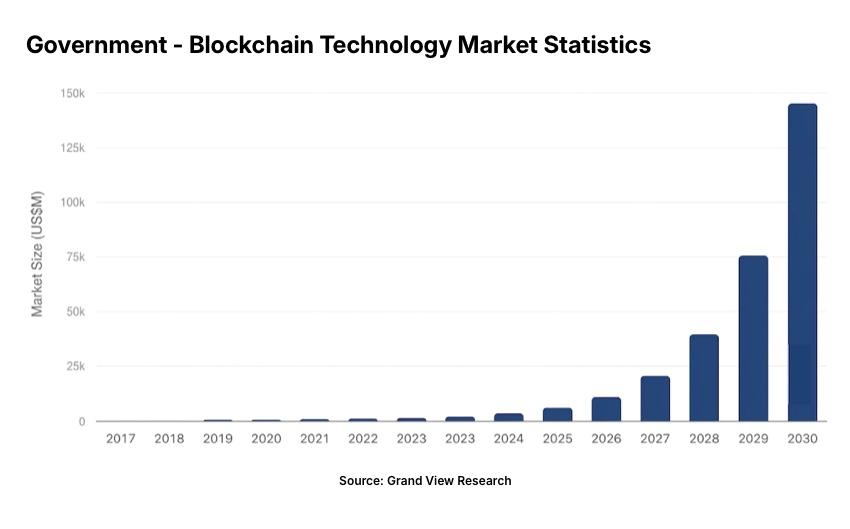
Grand View Research estimates that the global government segment of the blockchain technology market reached approximately $3.10 billion in 2024 and projects a 90.7% CAGR from 2024 to 2030.
These figures show that government blockchain adoption is at different stages. Some jurisdictions already process millions of documents through blockchain-backed infrastructure, while others remain at the pilot or proof-of-concept stage. This makes deployment quality more important than raw project counts, with functioning production systems providing stronger evidence of meaningful adoption.
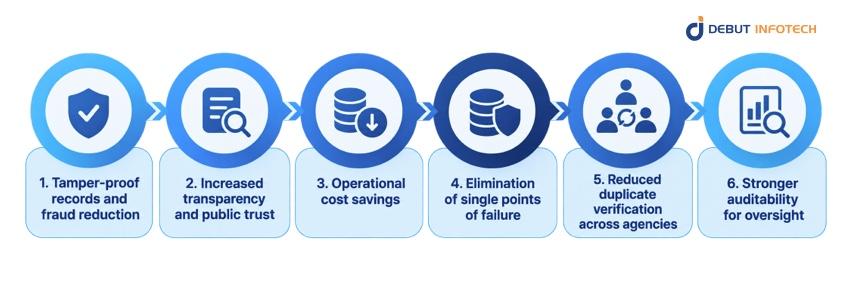
Blockchain can help governments create tamper-evident records, improve transparency, reduce administrative costs, eliminate some single points of failure, and limit duplicate verification. It can also strengthen auditability by creating traceable transaction histories. The biggest benefits of blockchain in the public sector generally appear where several agencies need to share trusted records or coordinate transactions.
Here are detailed benefits of blockchain technology in government:
Blockchain creates a chronological record that is difficult to alter without leaving evidence of the change. Each transaction is cryptographically linked to previous records, creating an audit trail that can expose attempts to forge, remove, or backdate information.
This can be valuable for land titles, certificates, procurement records, licenses, court documents, and other records where historical accuracy matters.
Blockchain does not make bad information true. If an agency enters incorrect data, it can still be recorded. The benefit is that unauthorized changes after verification become easier to detect.
India’s land-record blockchain initiative, for example, describes digitally signed records stored after approval and identifies traceability, accountability, and resistance to fraudulent transactions as key objectives.
Government transparency often depends on whether citizens and oversight bodies can verify what happened.
A shared ledger can reduce reliance on a single agency’s internal reporting by providing authorized stakeholders with an independently verifiable transaction history.
Blockchain for transparency in government is particularly useful for public procurement, land ownership, grants, licenses, and government payments. Journalists, auditors, regulators, and other authorized parties can verify records against a common source rather than reconciling separate versions maintained by different departments.
Georgia’s land registry demonstrates this principle. The blockchain layer was introduced partly to improve confidence in property records and strengthen public trust in the registration process.
Blockchain can reduce government operating costs by eliminating repetitive verification, manual reconciliation, paperwork, and unnecessary intermediaries.
The potential savings depend heavily on the process being redesigned. Simply adding blockchain to an inefficient workflow will not automatically reduce costs.
Several government projects illustrate where savings can emerge.
| Government/project | Application | Reported or projected benefit |
| Estonia | Digital signatures and digital government | Digital signatures save an amount equivalent to roughly 2% of GDP annually |
| Georgia | Land registration | Registration processes reduced from days to minutes in the blockchain-supported system. |
| Sweden | Blockchain land registry pilot | Research associated with the pilot estimated potential taxpayer savings exceeding €100 million annually. |
| Dubai | Paperless government | Digital transformation reduced paperwork and associated administrative costs. |
Traditional government systems often concentrate critical information in a central database or a small number of systems.
A serious outage, a compromised administrator account, a ransomware incident, or a corrupted database can disrupt access to important records.
Distributed ledgers provide another layer of resilience by maintaining synchronized copies across authorized participants. If one node becomes unavailable, other nodes can retain the record.
This does not make blockchain immune to cyberattacks. Even if endpoints, private keys, APIs, identity systems, and connected databases are properly secured, they can still be compromised. The resilience benefit therefore depends on the complete architecture rather than the ledger alone.
Citizens often submit the same information repeatedly because government departments maintain separate systems. A person may provide identity documents to one agency and then submit similar documents again to another.
A shared ledger can allow authorized agencies to verify credentials or transactions without requiring citizens to provide the same evidence repeatedly. The data itself does not necessarily have to be copied between agencies. A permissioned system can allow an agency to confirm that a credential exists and remains valid.
This approach can reduce administrative duplication while giving citizens more control over how credentials are shared.
Auditing becomes easier when transactions have a consistent timestamp, identity, approval history, and cryptographic record. Auditors can trace who initiated an action, which organizations approved it, when it occurred, and whether the record changed afterward.
Smart contracts can add another layer by automatically enforcing predefined rules. For example, a procurement contract could release a payment only after the required parties verify specified milestones.
The goal is not to replace auditors. It is to give them a cleaner transaction trail and reduce the manual reconciliation work that often consumes audit resources.
Governments can use blockchain for digital identity, land registries, elections, procurement, welfare payments, taxation, civil records, legal documents, business licensing, healthcare, customs, and public payments. These applications primarily use blockchain to improve verification, record integrity, transparency, and coordination among government agencies and other participating organizations.
Here are detailed blockchain use cases in the public sector:
| Use case | What blockchain can support | Primary government benefit |
| Digital identity | Credentials, licenses, e-Residency | Verifiable identity and credentials |
| Land registries | Titles, transfers, ownership history | Stronger record integrity |
| Voting | Ballot records and audit trails | Verifiability and auditability |
| Procurement | Tenders, contracts, milestones | Transparency and traceability |
| Welfare | Eligibility and benefit payments | Better coordination and fraud controls |
| Tax administration | Invoices, VAT, customs data | Faster verification and auditing |
| Civil registry | Birth, death, marriage records | Trusted records and credential verification |
| Judicial records | Filings, evidence, notarization | Stronger chain of custody |
| Business registration | Company records and licenses | Faster verification |
| Healthcare | Credentials, certificates, traceability | Trusted data exchange |
| Customs and supply chains | Goods movement and provenance | Better compliance and visibility |
| Public payments | Government disbursements and settlement | Faster, more traceable transactions |
Blockchain for government digital identity can support citizen identity, government credentials, e-Residency, professional qualifications, and access to public services. A citizen could hold a verifiable credential and share only the information required for a specific service.
The ledger can verify that an authorized institution issued a credential and has not been revoked or altered. The underlying personal data can remain outside the blockchain.
Land registration is one of the clearest blockchain use cases in government services because ownership records require historical integrity and verification.
Blockchain can record title transfers, mortgages, liens, cadastral references, and ownership history. Smart contracts can also coordinate approvals among registries, banks, notaries, and other authorized parties.
Georgia’s implementation is one of the most established examples of real-world blockchain use cases in government. India is also testing blockchain for land records, including a 2024 pilot in Assam that linked blockchain records with its land-registration infrastructure.
Blockchain can provide a tamper-evident record of ballots, election transactions, or tallying events. It may also allow voters or independent observers to verify parts of the election process.
However, blockchain does not solve every e-voting problem. Voter authentication, ballot secrecy, coercion, device security, malware, accessibility, and endpoint security remain major challenges.
For this reason, a blockchain-based voting system should be evaluated as part of a complete election architecture rather than as a standalone security solution.
Procurement is well suited to shared transaction records because multiple parties participate in the process. Government agencies, vendors, auditors, banks, and oversight bodies may all need access to different parts of the same procurement lifecycle.
Blockchain for government transparency can record tender submissions, approvals, contract changes, delivery milestones, and payment events. Smart contracts can automate predefined payment conditions after authorized verification.
This creates a stronger audit trail while reducing the likelihood that records will be altered after the fact.
Governments can use blockchain to manage benefit eligibility, payment authorization, and distribution records. This could apply to unemployment benefits, subsidies, pensions, emergency assistance, agricultural support, and disaster relief.
A shared ledger can help prevent duplicate claims and provide agencies with a consistent transaction history. Eligibility data should remain subject to privacy controls, and agencies still need reliable identity and benefits databases outside the blockchain.
Blockchain in the public sector can support tax records, VAT reporting, customs transactions, invoice verification, and audit trails. Smart contracts could automatically reconcile certain transactions or flag discrepancies between reported and recorded activity.
For tax authorities, the biggest opportunity may come from connecting multiple participants. Businesses, customs agencies, tax departments, banks, and logistics providers can work from a single, synchronized record rather than repeatedly submitting and reconciling the same transaction data.
Birth certificates, death certificates, marriage records, adoption records, and other civil documents require strong integrity controls. Blockchain for government services can provide a verifiable history of issuance and changes while keeping sensitive personal information in controlled databases.
The distinction from digital identity is important. A civil registry is the record of the underlying event. Digital identity is the access and authentication layer that enables a person to prove their identity.
Courts and legal institutions can use blockchain to timestamp filings, preserve evidence histories, verify notarized documents, and establish a chain of custody.
For evidence, the blockchain would not necessarily store the complete file. Instead, the system could store a cryptographic hash that proves whether a file has changed since it was recorded.
This can make later verification easier. Legal admissibility still depends on applicable laws and court procedures.
Governments can use blockchain to record company formation, beneficial ownership references, professional licenses, permits, and regulatory approvals.
A shared registry can reduce duplication between business registrars, tax authorities, licensing agencies, and financial institutions. It can also make license status easier to verify without requiring every institution to maintain a separate copy of the same information.
Healthcare applications can include credential verification, vaccination certificates, pharmaceutical traceability, provider credentials, and controlled sharing of patient information.
The most practical architecture keeps sensitive medical information off-chain. Blockchain can instead provide consent records, verification proofs, timestamps, or references to data held within approved healthcare systems.
This distinction is important because immutability is difficult to reconcile with requirements to correct or delete sensitive health information.
Governments can use distributed ledgers to track goods from origin to destination. Customs authorities, ports, shipping companies, exporters, importers, and regulators can verify milestones against a shared record.
The technology can help establish provenance, detect inconsistencies, and automate compliance checks. It is particularly relevant where goods move across several jurisdictions and organizations.
Central bank digital currencies can provide digital settlement infrastructure for government payments and other public-sector financial operations. Potential applications include government-to-citizen transfers, inter-agency settlement, tax payments, grants, and cross-border public payments.
The technology architecture varies by jurisdiction. A CBDC is not automatically synonymous with blockchain. Some systems may use distributed ledger technology, while others may use alternative centralized or hybrid architectures.
Government blockchain projects vary widely in purpose, architecture, and maturity. Some operate as production infrastructure. Others remain pilots designed to test a particular workflow.
The most useful way to assess these projects is to look beyond the technology itself.
Each case raises three practical questions: What problem was the government trying to solve? What technology did it choose? What measurable result followed?
| Case study | Primary problem | Technology approach | Reported outcome |
| Estonia | Digital-record integrity | KSI blockchain as an integrity layer | Digital signatures save 2% of GDP annually |
| Georgia | Land registration and trust | Permissioned ledger + Bitcoin anchoring | Registration reduced to minutes; 1.5M+ titles published through the system by 2018 |
| Dubai | Paper-based, fragmented government services | Government-wide blockchain strategy | Contributed to broader 100% paperless-government transformation |
| Colombia | Land transparency and formalization | Ethereum-based blockchain and smart contracts | Pilot demonstrated a more transparent land-formalization workflow |
| India | Fragmented government records and verification | Government blockchain platform and state-level pilots | 104.7M+ documents and 430.5M+ verifications reported in 2026 |
Estonia is one of the most advanced examples of digital government infrastructure. Its blockchain story is also different from the common idea that a government puts its databases on a blockchain.
The problem
Estonia built a highly connected digital public sector, enabling citizens to access a wide range of government services online. That created a corresponding need to protect the integrity of information moving between government systems.
The country also faced a practical cybersecurity concern. A digital government depends on the ability to prove that critical records have not been altered without authorization.
The technology choice
Estonia developed Keyless Signature Infrastructure (KSI) to protect the integrity of digital information. KSI uses cryptographic signatures and hash-based structures to provide evidence about the state and history of data.
The technology is used as an integrity layer across parts of Estonia’s digital infrastructure. It does not mean every government record exists directly on a blockchain.
This distinction matters because Estonia’s digital government relies on several technologies working together, including digital identity, X-Road data exchange, electronic signatures, and government databases.
The measurable outcome
Estonia reports that digital signatures save around 2% of GDP annually by reducing paperwork and administrative work. The saving relates to the country’s broader digital-signature infrastructure rather than blockchain alone.
The country has also used KSI technology to protect the integrity of government databases and services.
Georgia’s land registry is one of the clearest examples of a government using blockchain to improve the integrity and accessibility of property records.
The problem
Land registration traditionally involved paperwork, multiple administrative steps, and opportunities for errors or manipulation. Property ownership also requires a reliable historical record, as changes in ownership can have major financial and legal consequences.
Georgia sought to speed up property registration while strengthening confidence in the country’s land records.
The technology choice
Georgia’s National Agency of Public Registry worked with Bitfury to develop a blockchain-supported land registry.
The system used a private blockchain for government land records and anchored cryptographic hashes to the public Bitcoin blockchain.
That created a hybrid architecture.
The government maintained control over the actual land-registration process and sensitive information. Bitcoin provided an additional public verification layer that could demonstrate that the relevant record existed at a particular point in time.
The measurable outcome
The blockchain-supported system substantially reduced registration times. Earlier descriptions of the project reported that property registration could be completed in roughly three minutes, compared with several days under the older process.
More than 1.5 million land titles had also been published through the blockchain-supported system by 2018.
These results demonstrate two potential benefits simultaneously. The process became faster, while the government gained an additional mechanism for proving that registered information had not been altered.
Dubai took a broader approach. Instead of limiting blockchain to one government database, it explored the technology as part of a wider digital transformation strategy involving multiple agencies.
The problem
Dubai sought to reduce paperwork, improve government efficiency, and increase digital interactions among government entities.
A fragmented administrative environment can create duplicate records and repeated verification. It can also force citizens and businesses to transfer information between agencies manually.
The government therefore pursued a broader strategy for using emerging technologies across public services.
The technology choice
Dubai launched the Dubai Blockchain Strategy in 2016. The strategy focused on three broad areas: government efficiency, industry creation, and international leadership.
Government applications have included business registration, financial reconciliation, health, education, and document verification.
The strategy was aligned with Dubai’s broader ambition to become a paperless government.
The measurable outcome
Dubai announced a goal of becoming a 100% paperless government by December 12, 2021. The initiative involved thousands of government services and processes, rather than relying solely on blockchain.
The Dubai Paperless Strategy reported that government entities had stopped issuing internal and external paper documents after completing the transition.
Blockchain for government efficiency formed one part of this wider transformation.
The result illustrates an important point. Blockchain can support a digital government strategy, but it does not create one on its own.
Colombia provides a different example. Rather than focusing on a nationwide blockchain infrastructure, the country has explored blockchain in areas where transparency and land rights are significant concerns.
The problem
Land ownership in Colombia has been affected by displacement, incomplete records, administrative fragmentation, and disputes over property rights.
These problems make reliable land information particularly important. A record that can be independently verified can help reduce uncertainty about a property’s history and the administrative process behind its registration.
The technology choice
Colombia’s National Land Agency explored blockchain for land formalization. A pilot used blockchain and smart contracts to create a more transparent workflow for land-registration processes.
The project used Ethereum-based technology and smart contracts to record relevant steps in the process and make certain decisions easier to verify.
The pilot research describes how blockchain was used to track the land formalization process and to provide greater transparency around administrative decisions.
The measurable outcome
The strongest result from the Colombian work was improved process transparency rather than a verified nationwide deployment.
The pilot demonstrated how blockchain could create an auditable record of land-formalization activities. It also showed that technology cannot resolve underlying ownership disputes on its own.
That distinction is important for government decision-makers.
Blockchain can establish a more reliable record of administrative actions. It cannot determine who legally owns disputed land without the appropriate legal and institutional process.
India’s approach is particularly useful because its federal structure creates different implementation conditions from countries such as Estonia and Georgia.
The problem
India’s land records involve multiple levels of government, including state departments, registration authorities, revenue agencies, and local administrations.
Historically, land information has also been distributed across different systems and records. This can make verification more difficult and create inconsistencies between registration and land-revenue databases.
The government has therefore pursued broader digitization and modernization of land records.
The technology choice
India has experimented with blockchain at the state and departmental level rather than adopting a single nationwide blockchain land registry.
In 2024, the Department of Land Resources launched a blockchain pilot in Darrang district, Assam.
The pilot used the Unique Land Parcel Identification Number (ULPIN) as a blockchain identifier and linked blockchain records to the land registration process.
The Department of Land Resources said the pilot was intended to improve the integrity, traceability, and accountability of land records.
The measurable outcome
India’s broader government blockchain infrastructure has already reached significant volumes of documents.
The National Informatics Centre reported that its Centre of Excellence in Blockchain Technology had recorded more than 104.7 million documents and more than 430.5 million document verifications as of June 19, 2026. The platform had onboarded 19 departments and organizations across central and state government.
Those numbers cover the wider government blockchain platform rather than the Assam land-record pilot specifically.
Government blockchain systems rely on different platforms and architectures depending on privacy, governance, scalability, and interoperability requirements. Permissioned frameworks, public networks, hybrid models, and custom infrastructure each offer distinct advantages and trade-offs.
| Platform or approach | Architecture | Best suited to | Main advantage | Key consideration |
| Hyperledger Fabric | Permissioned | Inter-agency records, credentials, procurement | Fine-grained access control | Requires careful network governance |
| R3 Corda | Permissioned | Financial, legal, contractual workflows | Data shared only with relevant parties | Strong focus on bilateral or multi-party transactions |
| Quorum/Ethereum-compatible networks | Permissioned Ethereum-based | Smart contracts and Ethereum-compatible applications | Access to Ethereum development concepts | Governance and privacy need careful design |
| Custom infrastructure | Purpose-built | National digital infrastructure | Maximum control | Higher development and maintenance burden |
| Public-chain anchoring | Hybrid | Integrity verification | Publicly verifiable proof | Does not make underlying data public |
| Algorand and other public chains | Public | Open verification and public settlement | Open network participation | Privacy, governance, and transaction-cost considerations |
Hyperledger Fabric is a permissioned distributed ledger framework designed around known participants, identity management, access policies, channels, and private data.
It is a strong fit for government networks where several agencies need to share selected information while retaining control over sensitive records. A tax authority, licensing department, treasury, and regulator could operate separate nodes while using policies to determine who can access particular transactions.
Fabric’s channel architecture also allows subsets of organizations to maintain private transaction environments.
Corda is designed around transactions between identifiable parties rather than broadcasting every transaction to every network participant. Its notary architecture provides uniqueness and timestamping services, while its data-visibility model limits the transaction information revealed to parties that need it.
That makes Corda relevant to regulated government workflows involving financial institutions, legal agreements, procurement, and inter-agency settlement. Its architecture can be useful when privacy is as important as shared verification.
Quorum emerged as a permissioned Ethereum-based blockchain designed for enterprise applications where compatibility with Ethereum smart contracts and tooling is useful.
For government systems, the appeal of an Ethereum-compatible architecture lies in the broader development ecosystem. Agencies can work with established smart-contract concepts while restricting network membership and controlling data visibility.
However, the platform choice should be based on the required governance and privacy model rather than Ethereum compatibility alone.
Governments can also build purpose-specific infrastructure rather than adopting a general-purpose blockchain framework.
Estonia’s KSI model illustrates this route. The technology was developed specifically around the country’s need to protect the integrity of distributed government data.
A custom approach gives an agency greater control over governance, identity, data models, security policies, and long-term infrastructure. It also increases development, maintenance, and skills requirements.
Hybrid architectures can combine the control of a permissioned blockchain with the independent verification of a public blockchain.
Georgia provides a clear example. Its private land-record infrastructure anchored hashes to Bitcoin, allowing the government to control the operational system while creating a public timestamping mechanism.
This model can be attractive when a government wants external verifiability without exposing confidential records.
Public blockchain networks can also support government applications where open verification, global accessibility, or public settlement infrastructure is part of the objective.
The trade-off is greater exposure to the governance, performance, privacy, transaction-cost, and regulatory characteristics of a public network. Governments therefore need to distinguish applications that benefit from open networks from those that require restricted participation.
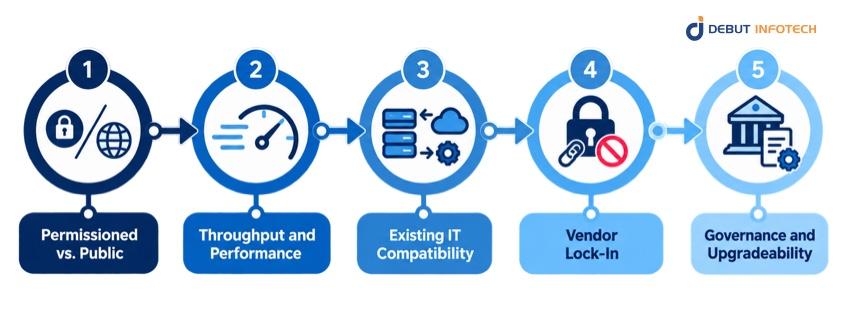
Platform selection should begin with requirements rather than brand names.
A government agency should first define the problem, participants, data, transaction volume, legal obligations, and governance structure. The technology can then be evaluated against those requirements.
The first decision is whether the network needs controlled membership.
A permissioned system is generally better when participants are known organizations and sensitive information is involved.
A public network may be more appropriate when independent verification, open participation, or public settlement is part of the application’s purpose.
A hybrid model can provide both.
Governments need to estimate actual transaction requirements rather than relying on generic blockchain performance claims.
A national identity system may generate millions of verification events. A land registry may generate fewer transactions but require strong reliability and auditability.
Performance testing should reflect the real workload, including:
A platform that performs well in a laboratory environment may behave differently once connected to national government systems.
Government blockchain systems rarely operate in isolation.
The selected platform should integrate with existing:
Integration should be considered during architecture design rather than treated as a later development task.
Governments often operate systems for decades. A blockchain platform should therefore be evaluated beyond its initial deployment.
Procurement teams should ask:
A cheap initial deployment can become expensive if the government cannot move away from the original provider.
Blockchain systems still need governance.
Someone has to approve protocol upgrades, add or remove network participants, respond to security incidents, modify smart contracts, and handle disputes.
A government should establish these rules before production.
For example, a network might require approval from a designated technology committee before a smart contract is upgraded. Another system might require multiple agencies to approve protocol changes.
The governance model should reflect the legal authority and responsibilities of the participating institutions.
Government Blockchain Platform Selection Framework
The following framework can help agencies compare options before procurement.
| Evaluation criterion | Key question | What a strong solution should provide |
| Access model | Who can participate? | Clearly defined permissioning |
| Privacy | Who can view each record? | Role-based or transaction-level access controls |
| Scalability | Can it handle expected demand? | Tested performance under realistic workloads |
| Interoperability | Can it connect to existing systems? | APIs and established integration options |
| Security | How are identities and keys protected? | Strong cryptographic and identity controls |
| Governance | Who controls upgrades? | Documented decision-making framework |
| Data ownership | Who controls government data? | Clear government ownership and portability |
| Legal compliance | Can the architecture meet data laws? | Off-chain storage and correction mechanisms where needed |
| Vendor dependence | What happens if the provider leaves? | Exit strategy and migration options |
| Cost | What is the total lifecycle cost? | Development, infrastructure, support, training, and migration costs |
| Public verification | Does the public need independent proof? | Public-chain anchoring or transparent verification where appropriate |
Government blockchain adoption faces technological, organizational, legal, regulatory, and trust-related challenges. Scalability and interoperability can complicate implementation, while skills shortages and institutional resistance can slow adoption. Governments must also address data-correction requirements, legal uncertainty, liability, privacy, cross-border rules, cybersecurity, and employee acceptance before scaling blockchain systems.
Scalability is a major concern for blockchain technology in government. A national government may process millions of transactions, documents, payments, and identity events. A blockchain architecture that works for a pilot may behave differently under national workloads.
Interoperability is another problem. Government IT environments often contain decades-old databases, proprietary applications, identity systems, and disconnected departmental platforms. Blockchain must connect to those systems rather than operate as another isolated database.
Immature tooling and limited production benchmarks can also complicate procurement. A government cannot rely solely on laboratory throughput figures. It needs evidence from workloads that resemble the actual deployment environment.
Government institutions are usually built around centralized authority. Blockchain introduces shared governance, multi-party validation, and new responsibilities around network administration.
That can create institutional resistance. Agencies may question who controls the network, who approves upgrades, who manages cryptographic keys, and who is accountable when a transaction fails.
There is also a skills gap. Many government agencies lack sufficient internal specialists in distributed systems, smart contracts, cryptography, tokenization, or blockchain security. External vendors can fill the gap, but excessive reliance on a single supplier creates long-term risks.
Running blockchain alongside existing systems incurs additional costs. During transition, agencies may need to maintain both legacy and new ledger infrastructure simultaneously.
Immutability creates a legal tension when records need to be corrected. Data protection laws may give individuals the right to rectify inaccurate personal information or to request its deletion in certain circumstances. A blockchain design that stores personal data directly on-chain can therefore create unnecessary compliance problems.
Smart contracts also raise questions about legal enforceability. Code can execute automatically, but governments still need to determine whether the resulting transaction has the same legal status as a conventional contract.
Liability is another unresolved issue. If several agencies operate a network and an automated transaction causes harm, responsibility needs to be clearly defined.
Cross-border applications introduce another layer of complexity for blockchain technology in government. Different countries can have different rules for digital identity, electronic signatures, data localization, financial transactions, and blockchain records.
Blockchain does not automatically create public trust. Citizens may be skeptical of a new system, particularly when government agencies are already responsible for the underlying data.
There is also a misuse risk for blockchain in the public sector. Agencies need to consider how blockchain could be used to automate actions that should remain subject to human review.
Change management matters just as much internally. Employees may resist new workflows if the system adds complexity or changes established responsibilities without adequate training.
These challenges do not make blockchain unsuitable for government. They show why deployment should begin with a clearly defined problem and measurable outcome.
The European Commission’s public-sector review reached a similar conclusion. Blockchain has potential to improve public administration, but governments still need larger-scale use cases, stronger inter-organizational collaboration, and greater legal certainty.
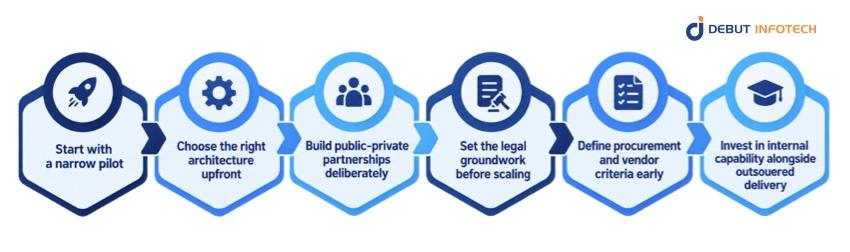
Governments should begin with a narrowly defined pilot, select the architecture based on the use case, establish partnerships and legal safeguards, and define procurement criteria early. They should also measure results against clear baselines and build internal expertise alongside external delivery. This approach reduces implementation risk and supports informed decisions about scaling.
Begin with one agency and one problem. Land registration, document verification, benefit distribution, or certificate authentication can provide a manageable starting point.
The pilot should define measurable targets before development begins. These might include processing time, cost per transaction, fraud attempts detected, reconciliation time, number of manual steps removed, or percentage of transactions completed digitally.
Decide whether the system should be permissioned, public, or hybrid before choosing the technology stack.
The government should also define who operates the nodes, who controls identities, who approves upgrades, and which information remains off-chain.
Getting these decisions wrong can lead to costly redesigns later. Sweden’s land-registry work is a useful reminder that successful technical pilots do not automatically translate into nationwide production systems.
Government agencies often need external technical expertise, but partnerships should have clear responsibilities.
The agency should retain ownership of policy, data governance, and operational requirements. A technical partner can provide architecture and development expertise. Banks, telecom operators, universities, logistics companies, or other private organizations can participate where their systems need to connect to the government network.
The partnership should define security responsibilities, service levels, data ownership, upgrade procedures, and exit conditions before development begins.
Legal review should happen before production deployment rather than after the technology has been built.
Governments should clarify the legal status of blockchain records, electronic signatures, smart contracts, digital credentials, data correction, privacy controls, and automated decisions.
The architecture should then reflect those legal requirements. Storing sensitive personal information directly on an immutable ledger may create problems that could have been avoided through an off-chain design.
Procurement documents should evaluate more than technical performance.
Technical criteria can include interoperability, transaction throughput, security, disaster recovery, API support, identity integration, and scalability.
Governance criteria should cover who can change the protocol, how organizations join or leave the network, how disputes are resolved, and what happens if the technology provider stops supporting the system.
Vendor lock-in deserves particular attention. Government agencies should require clear documentation, data portability, open interfaces, and a realistic transition plan.
External developers can build the first version of a system, but government staff still need enough knowledge to operate and govern it.
Training should cover blockchain architecture, key management, security, smart-contract risks, data governance, incident response, and vendor oversight.
This creates institutional ownership and reduces dependence on external suppliers over time.
The future of blockchain in government will likely focus on practical infrastructure rather than standalone blockchain initiatives. CBDCs, digital identity, interoperable government networks, tokenized assets, cross-border payments, and AI-supported public administration could drive adoption.
Greater regulatory clarity and interoperability will also determine whether long-running pilots develop into production systems.
Government digital infrastructure is likely to bring identity, payments, credentials, and public services closer together. CBDCs are part of this broader trend.
The Bank for International Settlements reported that 91% of the 93 central banks surveyed were exploring retail, wholesale, or both CBDCs in 2024. The same survey found that wholesale CBDC work was generally further advanced than retail work.
The future opportunity is less about creating a standalone digital currency and more about connecting digital money with identity, government benefits, taxation, licensing, and public payment systems.
Regulatory certainty will determine whether blockchain remains confined to pilots or becomes part of mainstream government infrastructure.
The United States has already moved toward clearer digital-asset regulation through the GENIUS Act, which became Public Law 119-27 in July 2025 and establishes a federal framework for payment stablecoins.
In Europe, the digital euro project is moving through a structured pilot process. The ECB selected 36 payment service providers in July 2026 for a pilot planned for the second half of 2027. The ECB says it aims to be ready for potential first issuance in 2029, assuming the necessary legislation is adopted.
For governments, clearer rules reduce uncertainty around digital assets, tokenized payments, digital credentials, and distributed infrastructure.
Government blockchain projects are likely to shift from proving that blockchain works to proving that it works economically and operationally at scale.
The next stage involves production questions: uptime, security, interoperability, operating costs, governance, user adoption, legal enforceability, and integration with existing government systems.
India’s growing blockchain-backed document infrastructure is one example of this transition. Its government platform reported more than 10.47 million documents and more than 43.05 million verifications by June 2026.
Citizens are unlikely to interact with a “blockchain service” in the future. They will use a government portal, a digital identity application, a payment system, or a mobile service.
The blockchain layer will sit behind the interface and handle verification, settlement, auditability, or data integrity.
That is similar to how people use internet-based services without thinking about TCP/IP. The infrastructure matters, but the technology itself does not need to be visible to the end user.
Government systems will increasingly need to exchange information with banks, payment networks, enterprise blockchains, tokenized asset platforms, and cross-border settlement systems.
This creates demand for common standards and interoperability layers. A land registry may need to connect with banks. A customs platform may need to connect with logistics providers. A government payment system may need to settle through regulated digital-money infrastructure.
Tokenized real-world assets could further increase this overlap as governments and financial institutions experiment with digital representations of securities, commodities, property, and other assets.
AI can automate decisions and analyze large volumes of government data. Blockchain can provide an auditable record of selected inputs, approvals, actions, and outcomes.
This could be useful where governments need to demonstrate how an automated process was executed. For example, an AI system could recommend eligibility for a government program while a blockchain-backed audit layer records the relevant model version, approval event, and final decision.
Blockchain would not make an AI model accurate. It would make selected parts of the decision process easier to trace and verify.
Government blockchain projects require more than selecting a platform and deploying a ledger. Debut Infotech helps government organizations design and develop blockchain technology solutions around specific operational, security, compliance, and interoperability requirements. Our team can support use cases such as digital identity, land registries, public procurement, document verification, and government payments.
From architecture and smart contract development to system integration and deployment, we focus on building solutions that can work alongside existing government infrastructure.
Whether you are validating a new blockchain concept or preparing a proven pilot for production, our company can help define the right architecture, technology stack, and implementation roadmap for long-term adoption.
Blockchain in government can strengthen record integrity, improve transparency, reduce repetitive verification, and support more auditable public services. Its strongest applications involve multiple agencies or organizations that need to share trusted information and coordinate transactions.
However, successful adoption depends on more than choosing a blockchain platform. Governments need clear governance, legal safeguards, interoperability with existing systems, realistic performance testing, and internal expertise.
The most practical path is to start with a focused use case, measure its results, and scale only when the technology delivers clear public-sector value.
Blockchain is used in government to create tamper-resistant records, track transactions, verify identities, and improve data sharing between agencies. Governments can use it for land registries, digital certificates, public procurement, tax records, voting systems, and benefit distribution. The technology creates a shared record that authorized parties can verify without relying on one database.
Blockchain can make government services faster, easier to verify, and less dependent on paperwork. Agencies can share trusted records, automate routine processes with smart contracts, and reduce duplicate data entry. For citizens, this can mean quicker applications, easier document verification, fewer administrative delays, and better visibility into how government processes work.
Yes, blockchain can improve accountability by creating records that are difficult to alter without detection. Government transactions, approvals, and fund movements can be recorded with timestamps and traceable histories. This makes it easier for auditors and authorized officials to trace what happened, identify irregularities, and verify that public funds were handled as intended.
Blockchain can support digital identity by providing people with a secure, verifiable way to manage their credentials. Instead of repeatedly submitting the same documents to different agencies, users could present verified credentials when needed. Blockchain can record proof that a credential is valid without necessarily storing sensitive personal information directly on the blockchain.
Blockchain can strengthen government security by making records harder to modify in secret and creating a transparent, traceable history of transactions. Blockchain for government security can also support decentralized data sharing and cryptographic verification. However, blockchain does not automatically make a system secure. Weak access controls, poor software design, compromised devices, or bad data can still create risks.
Governments are likely to adopt blockchain selectively rather than replace existing systems overnight. Adoption depends on factors such as cost, regulations, interoperability, privacy requirements, and whether blockchain solves a real problem. Governments are already exploring applications in identity, payments, records, supply chains, and public administration, but large-scale adoption will take time.

Our Latest Insights
USA
2501 Chatham, Rd Suite R Springfield, IL 62704
+1-708-515-4004
info@debutinfotech.com
UK
7 Pound Close, Yarnton, Oxfordshire, OX51QG
+44-770-304-0079
info@debutinfotech.com
Canada
154 Eden Oak Trail, Kitchener, ON N2A 0H9
+1-708-515-4004
info@debutinfotech.com
INDIA
Sector 101-A, Plot No: I-42, IT City Rd, JLPL Industrial Area, Mohali, PB 140306
9888402396
info@debutinfotech.com