ON THIS PAGE
Progress0%






Our Global Presence :




A crypto wallet address identifies where cryptocurrency is sent. It can be shared to receive payments, but private keys and recovery seed phrases must remain secret to protect access to funds.
Crypto wallet address formats differ across blockchains. Bitcoin, Ethereum, Solana, XRP Ledger, Cardano, and Tron use different formats, and similar-looking addresses do not guarantee network compatibility.
Wallet addresses are generated through cryptographic processes. Private keys authorize transactions, public keys support cryptographic operations, and recovery seed phrases can restore access to wallet keys.
Finding a wallet address requires selecting the correct cryptocurrency and network. Wallet apps and exchanges display receiving addresses, while some deposits also require a memo or destination tag.
Verifying the complete address helps prevent transfer errors. Check the recipient, blockchain network, and transaction details before approval; a valid address does not guarantee that the funds will reach the intended recipient.
Address poisoning, clipboard malware, and phishing can lead to cryptocurrency theft. Compare addresses against trusted records, verify hardware wallet displays, and never share private keys or recovery seed phrases.
Recovery after a mistaken transfer is uncertain. Confirmed transactions are generally irreversible, and recovering funds depends on the destination, network, key ownership, and whether a receiving exchange can assist.
Crypto wallet address is essential for sending and receiving cryptocurrency. Whether you’re transferring Bitcoin, receiving USDT, or moving Ethereum between wallets, using the correct blockchain address and network helps prevent costly mistakes. Although wallet addresses are designed to be shared, confusing them with crypto wallet private keys or recovery phrases can put your assets at risk.
The growing use of cryptocurrency makes wallet address security increasingly important. According to Crypto.com’s H1 2026 report, global crypto ownership reached an estimated 774 million people by June 2026, up from 741 million at the end of 2025. Meanwhile, the FBI’s 2025 Internet Crime Report, released in April 2026, recorded more than $11 billion in reported losses involving cryptocurrency-related complaints.
Understanding how a crypto wallet address works helps you manage transfers with greater confidence. This guide explains address formats, generation, and wallet types. It also shows you how to find, create, and verify an address, recognize common scams, and understand what happens when crypto goes to the wrong destination.
A crypto wallet address is a string of letters and numbers that identifies a destination for cryptocurrency on a blockchain. Think of it as an account number for receiving digital assets.
For example, a Bitcoin address may look like `bc1qxy2kgdygjrsqtzq2n0yrf2493p83kkfjhx0wlh`. This illustrates the crypto wallet address format, not a verified destination for sending funds. You can share your receiving address with someone who wants to pay you.
A wallet address is different from a wallet, a public key, and a private key. A wallet is software or hardware that manages your keys and helps you send or receive crypto. A public key is derived from a private key and is used to support cryptographic operations. An address is generated from public-key data or other blockchain-specific information. A private key authorizes transactions, so anyone who obtains it may be able to spend your assets.
Sharing your receiving address is generally safe because it does not, by itself, give someone control over your funds. However, public blockchain records may reveal your transaction history and balances. Never share your private key or recovery seed phrase. These secrets can provide access to your cryptocurrency.
A cryptocurrency wallet address identifies a transaction’s destination. After confirmation, blockchain records show the addresses involved and the amount transferred, although they do not automatically reveal the owner’s real-world identity.
A crypto wallet address is generated through cryptographic processes that connect a wallet’s secret credentials to a public identifier. In many wallets, the process begins with a recovery seed phrase, which is used to derive the private keys that manage assets.
The process generally follows three steps:
Not every blockchain follows exactly the same process. Some account-based networks derive addresses from public-key hashes, while other systems use different methods.
Most modern wallets use hierarchical deterministic (HD) designs. One recovery seed phrase can generate multiple private keys and receiving addresses through a defined derivation process. This lets you manage multiple addresses with a single backup. Protect the seed phrase offline because anyone who obtains it may be able to recover your wallet and access its funds.
Crypto wallet address formats vary by blockchain. Their structure helps identify the network or address type, but appearance alone does not prove that an address is safe or suitable for a transfer.
Bitcoin supports several formats. Legacy addresses typically begin with `1`, while Pay-to-Script-Hash addresses begin with `3`. Native SegWit addresses start with `bc1q`, and Taproot addresses start with `bc1p`. These formats support different transaction structures.
Ethereum and many Ethereum Virtual Machine (EVM) networks use hexadecimal addresses that begin with `0x`, followed by 40 hexadecimal digits. The same account may have the same address on Ethereum, Polygon, and other EVM-compatible networks. However, assets and balances remain network-specific.
Other blockchains use distinct address formats.
| Blockchain | Typical address format | Important detail |
| Bitcoin | `1…`, `3…`, `bc1q…`, `bc1p…` | Several address types |
| Ethereum | `0x…` | 40 hexadecimal characters after the prefix |
| Solana | Base58 string | Case-sensitive |
| XRP Ledger | Usually starts with `r.` | May require a destination tag |
| Cardano | Often starts with `addr1.` | Format varies by address type |
| Tron | Usually starts with `T` | Used for TRON network assets |
Exchange deposits may require a memo or destination tag alongside the address. This extra identifier helps the platform credit funds to the correct customer. Enter it exactly as instructed. An address can be correct, yet a missing tag can delay crediting or complicate recovery.
Always confirm the asset and blockchain network before sending. Similar-looking addresses do not mean different blockchains are interchangeable.
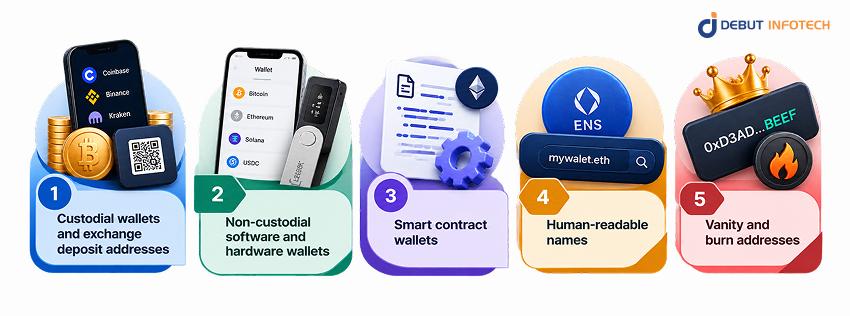
Wallet addresses also differ according to how wallets store keys and manage transactions. Understanding these differences helps you choose the right wallet and know who controls access to your funds.
Exchanges such as Coinbase, Binance, and Kraken provide addresses for supported deposits. The platform manages the underlying wallet infrastructure and credits deposits to your account. Address reuse policies vary, so follow the platform’s current instructions.
Mobile and browser wallets let you manage your own keys. Hardware wallets store private keys in a dedicated device and sign transactions through a controlled process. You remain responsible for protecting your recovery phrase and approving transfers carefully.
These addresses belong to blockchain-based contracts rather than traditional externally owned accounts. Some support account abstraction. Some smart contract account abstraction wallet can enable features such as transaction batching, sponsored fees, and flexible authorization rules. Their security depends on the contract’s design and configuration.
Ethereum Name Service (ENS) lets users associate names with blockchain addresses. Names are easier to remember, but always confirm that the name resolves to the intended destination before transferring funds.
Vanity addresses contain chosen character patterns. Burn addresses are intended to make assets inaccessible, although their properties depend on how they are constructed.
Regardless of crypto wallet address type, verify the destination and supported network before sending. A familiar address does not guarantee compatibility or recoverability.
You can find a crypto wallet address in a wallet app, exchange account, or hardware wallet companion app. The exact steps depend on the cryptocurrency and network you plan to use.
In MetaMask, Trust Wallet, or Phantom, open your wallet and select the relevant account. Choose Receive and select the asset or network if prompted. Copy the displayed address or use its QR code. Confirm that the wallet supports the network the sender is expected to use.
On Coinbase, Binance, or Kraken, open the deposit section, select the cryptocurrency, and choose the correct network. Copy the displayed deposit address and any required memo or destination tag. Check the current instructions rather than relying on an old deposit record.
With Ledger or Trezor, open the relevant account in its companion app and follow the verification steps. Compare the address on your computer or phone with the address displayed on the hardware device. Approve it only when both match.
QR codes reduce typing errors, but they can still display a fraudulent destination. After scanning, inspect the address before sharing it or sending funds.
Always check the copied address’s first, last, and middle characters. Avoid manually retyping long strings, and never assume that a successful copy guarantees accuracy.
You can create a crypto wallet address by setting up a wallet that supports the cryptocurrency you want to receive. You do not need to purchase crypto before generating a receiving address.
In crypto wallet development, developers integrate blockchain protocols and cryptographic key generation to create addresses that users can use to receive digital assets securely.
For a non-custodial wallet, download the official app or browser extension. Create a wallet and write down the recovery seed phrase when prompted. Store it offline in a secure place. Anyone who obtains this phrase may be able to recover your wallet and access its funds.
Alternatively, create an account with an exchange and complete any required verification. Open its deposit section, select a supported cryptocurrency, and choose the correct network. The platform provides an address and manages the underlying wallet infrastructure.
Many wallets let you generate another receiving address within the same wallet. This can help separate payments and improve privacy. You usually do not need to create an entirely new wallet for each transaction.
Whether addresses change depends on the wallet and blockchain. Some wallets generate fresh Bitcoin receiving addresses, while other accounts commonly reuse the same address. Older addresses often remain usable, but this is not guaranteed across all services. Follow the wallet or exchange’s current instructions, especially when deposits require a memo or destination tag.
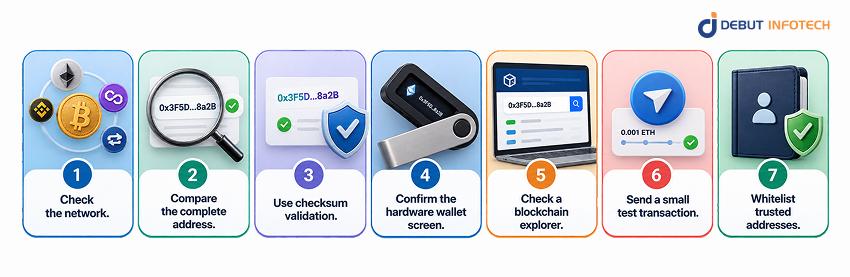
Verifying a crypto wallet address before sending funds helps prevent expensive mistakes. Blockchain transactions are generally irreversible once confirmed, so check the destination, network, and transaction details before approving a transfer.
Confirm that the receiving wallet supports the network selected for the transfer. A token may exist on several blockchains, but those versions are not automatically interchangeable. Sending through the wrong network may cause a deposit to fail or make recovery difficult. Follow the recipient’s exact instructions.
Check the first and last characters, then inspect the middle. Scammers can create lookalike addresses that resemble those of legitimate destinations. Comparing only the beginning and end may miss a substitution in between. For large transfers, compare the entire address with a trusted record.
Some address formats include checksums that help detect certain typing errors. Ethereum addresses, for example, may use mixed-case checksums. A valid checksum does not prove that an address belongs to your intended recipient. Use your wallet’s built-in address validation where available.
If you use a Ledger or Trezor, compare the address displayed on the device with the address shown in its companion app. Malware can alter information on a computer screen. Approve the destination only when the device displays the address you intended to use.
Use Etherscan for Ethereum or Blockstream Explorer for Bitcoin to inspect addresses and transactions. Confirm that the explorer or crypto wallet address checker matches the correct network. Transaction history can provide useful context, but it cannot prove that an address belongs to your intended recipient.
When transferring a substantial amount to a new address, consider sending a small amount first. Wait for confirmation and ask the recipient to verify receipt before sending the remainder. Check network fees and minimum deposit requirements, especially when sending to an exchange.
For repeat payments, use an address book or withdrawal-whitelisting feature when available. Add addresses through a trusted process and verify them before saving. Some exchanges require extra security checks or a waiting period before withdrawals to newly safelisted addresses are allowed.
No single check catches every threat, but combining these steps reduces the chance of sending funds to the wrong place.
Crypto wallet address scams exploit mistakes, trust, and weaknesses in how people copy or verify transaction details. Because confirmed blockchain transfers are generally irreversible, a single oversight can result in permanent financial loss.
Scammers send small transactions from addresses that resemble those you use regularly. The fraudulent address may share the same opening and ending characters as your legitimate recipient’s address. They hope you will copy it from your transaction history and send funds to them. Always compare the full blockchain wallet address against a trusted record.
Malicious software can replace a copied wallet address with an attacker’s address. When you paste it into a transaction, you may unknowingly direct funds to the wrong destination. Inspect the pasted address before signing. For valuable transfers, confirm the destination on your hardware wallet screen and avoid installing software from untrusted sources.
Scammers may impersonate wallet providers or exchange employees and claim they need your private key or recovery seed phrase to fix a problem. They may also send links to fake websites that imitate legitimate wallet services. Never share your private key or seed phrase, even if someone claims your account is at risk.
Be cautious with unsolicited messages, unfamiliar links, and unexpected requests to connect your wallet. Enable available crypto wallet security controls on exchange accounts.
If you suspect that malware or a compromised key has exposed your wallet, stop using the affected device for transactions.
If you can do so safely, move remaining funds to a newly secured wallet. Seek assistance through verified support channels, and never trust anyone promising guaranteed recovery in exchange for an upfront fee.
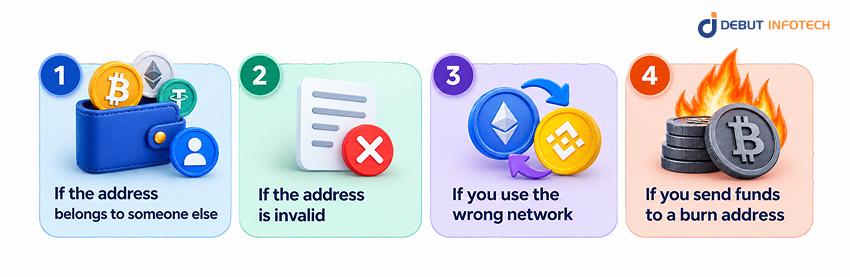
Sending cryptocurrency to the wrong address can have different outcomes.
Recovery depends on whether the address is valid, who controls it, which network processed the transaction, and whether a receiving service can help. Confirmed blockchain transactions generally cannot be reversed through a bank or blockchain explorer.
The transaction may confirm successfully, giving the recipient control of the funds. Contact the recipient or the exchange involved if you can identify them. Recovery depends on their cooperation and the platform’s policies. Do not assume that a confirmed transaction can be canceled.
Your wallet may reject it before broadcasting the transaction. Address-format and checksum checks can catch some errors. However, a valid address can still belong to the wrong recipient, so passing these checks does not guarantee that your funds will reach the intended person.
Funds may arrive on a blockchain different from the one the recipient expects. Recovery may be possible if you control the destination address’s keys and the relevant network is supported. Exchange deposits can be harder to recover because the platform manages the receiving wallet.
The assets may become permanently inaccessible, particularly if no one can produce the private key required to spend them. Recovery is generally impossible.
If a transfer goes wrong, check its status using the relevant blockchain explorer. Contact the receiving exchange through its official support channel if a platform is involved.
If you sent funds to someone you know, contact them directly. Never share your private key or recovery phrase with anyone offering recovery services. Beware of people demanding upfront fees while promising guaranteed results.
A crypto wallet address makes sending and receiving digital assets possible, but mistakes can be expensive. Understand your wallet type, confirm the correct network, and verify every destination before sending. Protect your private keys and recovery phrase, and treat every transaction with care to reduce the risk of losing your funds.
Debut Infotech helps businesses build secure blockchain solutions, including cryptocurrency wallets and platforms for managing digital assets. As a top provider of blockchain development services, our team can develop wallet applications with secure transaction handling, blockchain integration, address generation, and features that help users verify transfer details.
Whether you’re launching a new crypto wallet or upgrading an existing product, we can tailor the solution to your business requirements.
No, someone cannot access your crypto wallet using your wallet address alone. The address lets others send you cryptocurrency and view your public transactions on a blockchain explorer. However, anyone with your private key or recovery phrase may be able to control your funds, so keep them private.
Yes, a crypto wallet address can often be traced through public blockchain records. Anyone can check its transaction history, wallet balance, and transfers using a blockchain explorer. However, tracing an address does not automatically reveal the owner’s real identity unless other information connects the address to that person.
Yes, one crypto wallet can have multiple addresses, depending on the wallet type and cryptocurrency. Many wallets generate new addresses for receiving funds while keeping them linked to the same wallet. This helps protect your privacy and organize transactions. However, the exact setup varies between wallets and blockchains.
Finding the owner of a crypto wallet address is possible, but it is not always straightforward. Blockchain explorers show transaction records, not personal details like names or phone numbers. You may identify an owner if the address is publicly linked to an exchange, business, or known individual.
Different cryptocurrencies use different blockchain networks, address formats, and cryptographic rules. For example, Bitcoin addresses differ from Ethereum addresses because their networks handle transactions differently. Some networks share similar address formats, but that does not mean their assets are interchangeable. Always confirm the network before sending cryptocurrency.
No, a crypto wallet address is not the same as a public key. A public key is used in cryptographic processes, while a wallet address is typically derived from the public key or related cryptographic data. You share your wallet address to receive funds, but never share your private key.
No, a crypto wallet address is not the same as a public key. A public key is used in cryptographic processes, while a wallet address is typically derived from the public key or related cryptographic data. You share your wallet address to receive funds, but never share your private key.
You can track a crypto wallet address using a blockchain explorer that supports its network. Enter the address into a tool such as Etherscan for Ethereum or Blockchain.com Explorer for Bitcoin. You can then review transactions, balances, timestamps, and wallet interactions. Tracking public activity does not necessarily reveal the owner’s identity.

Our Latest Insights
USA
2501 Chatham, Rd Suite R Springfield, IL 62704
+1-708-515-4004
info@debutinfotech.com
UK
7 Pound Close, Yarnton, Oxfordshire, OX51QG
+44-770-304-0079
info@debutinfotech.com
Canada
154 Eden Oak Trail, Kitchener, ON N2A 0H9
+1-708-515-4004
info@debutinfotech.com
INDIA
Sector 101-A, Plot No: I-42, IT City Rd, JLPL Industrial Area, Mohali, PB 140306
9888402396
info@debutinfotech.com