ON THIS PAGE
Progress0%






Our Global Presence :




Cryptocurrency exchange development involves trading infrastructure, wallet connectivity, compliance, and mobile functionality.
CEX, DEX, and hybrid models have different execution and custody requirements.
Security, liquidity availability, and financial reconciliation affect operational reliability.
Development costs depend on whether the business needs an application or an entire exchange.
Custom and white-label development offer different benefits for ownership, flexibility, and launch speed.
Building a cryptocurrency exchange app involves much more than creating a trading interface. Businesses must connect the application to reliable exchange infrastructure capable of processing orders, managing digital assets, maintaining accurate balances, and protecting sensitive financial information.
The complexity increases when an exchange needs multiple trading pairs, high-volume transactions, liquidity providers, fiat payment integration, and jurisdiction-specific compliance controls. Each requirement affects the technology architecture, development budget, and operational responsibilities.
For enterprises planning to enter the digital asset market, developing a cryptocurrency exchange app requires careful decisions about the trading model, custody arrangements, platform ownership, and long-term operating costs.
This guide explains the essential features, architecture, technology choices, development stages, security requirements, costs, and timelines involved in cryptocurrency exchange app development.
Cryptocurrency exchange app development is the process of designing and engineering applications that allow users to buy, sell, exchange, and manage digital assets through a trading platform.
A typical application provides access to live prices, trading pairs, order placement, wallet balances, transaction history, and account management. However, most of the complex trading operations take place outside the mobile interface.
The application connects to backend systems responsible for validating orders, maintaining balances, executing trades, and coordinating asset deposits and withdrawals. For instance, an enterprise may develop an iOS and Android trading app for an existing cryptocurrency exchange. In this case, the project primarily involves mobile development, API integration, authentication, and transaction synchronization.
Another business may need to build the exchange infrastructure from the beginning. That project requires additional systems, including a matching engine, internal ledger, wallet infrastructure, liquidity connectivity, and operational administration.
Understanding this distinction is important because both projects fall under the broader category of crypto exchange app development, but their costs and engineering requirements differ substantially.
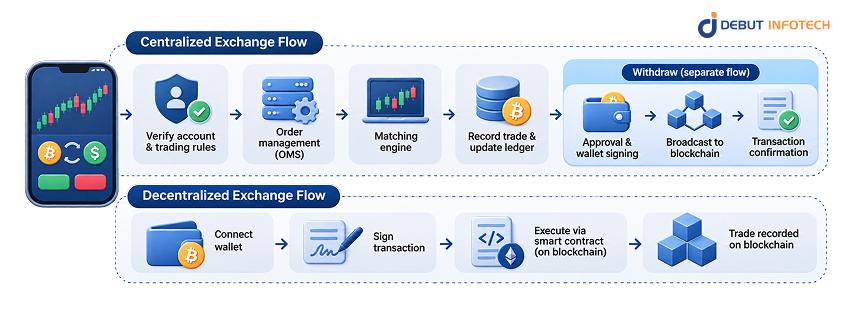
Consider a customer who wants to purchase Bitcoin using US dollars. After signing in, the customer selects the BTC/USD trading pair and places an order. The application submits the request to the exchange backend through an authenticated API.
The backend verifies account permissions, available balances, order limits, and relevant trading restrictions. For a centralized exchange, the order management system then routes the accepted order to the matching engine.
The matching engine compares available buy and sell orders according to the exchange’s execution rules. When a trade occurs, the platform records the execution, updates its internal financial ledger, and sends the result to the application.
If the customer later withdraws Bitcoin, a separate workflow handles withdrawal approval, wallet signing, blockchain broadcasting, and transaction confirmation. This separation allows the mobile app to display trading activity while the backend controls financial records and execution.
A decentralized exchange follows a different model. Depending on its design, users may sign transactions through their wallets and execute trades using blockchain-based smart contracts rather than a centralized matching engine.
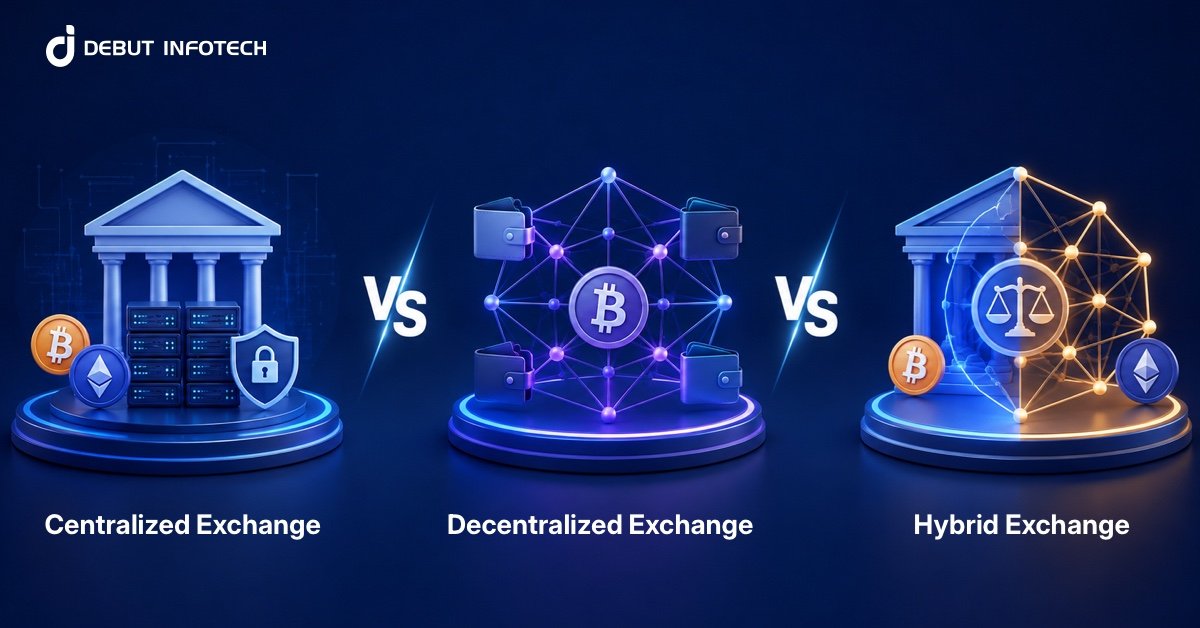
The exchange model determines how users trade, who controls their assets, and which components the development team must build. Businesses generally evaluate three approaches.
Centralized cryptocurrency exchanges operate through infrastructure controlled by an exchange operator.
Users place orders through mobile or web applications, while the platform handles order matching, transaction records, and associated account services.
These applications can support spot trading, fiat deposits, multiple trading pairs, and advanced trading functionality. Operators may also integrate market makers or external liquidity providers to support trading activity.
Centralized exchanges usually use custodial wallet arrangements, although the precise custody model depends on the provider and operating structure.
Best suited for: Businesses that want direct control over trading operations, customer accounts, administrative processes, and platform functionality.
Decentralized exchange applications allow users to trade digital assets through blockchain-based protocols.
Many DEX applications connect to non-custodial wallets and execute transactions through smart contracts. Trading may involve automated market makers, liquidity pools, or on-chain order books. These applications require wallet connectivity, blockchain interaction, transaction signing, and smart contract integration.
The development team must consider gas fees, transaction finality, contract vulnerabilities, and the behavior of the underlying blockchain networks.
Best suited for: Businesses developing self-custodial trading products, decentralized finance applications, or blockchain-native marketplaces.
Hybrid exchanges combine selected elements of centralized trading infrastructure with blockchain-based functionality. For example, a platform may use an off-chain order management system while settling eligible transactions through smart contracts.
Another implementation may provide centralized liquidity routing while allowing customers to maintain control over certain digital assets.
Hybrid designs can support differentiated trading experiences, but they also require clearly defined custody responsibilities and coordination between off-chain and on-chain systems.
Best suited for: Enterprises that need centralized trading capabilities alongside selected decentralized settlement or custody features.
| Comparison | Centralized Exchange | Decentralized Exchange | Hybrid Exchange |
| Trade execution | Operator-managed matching engine | Smart contracts or blockchain-based protocols | Combination of off-chain and on-chain execution |
| Asset custody | Commonly custodial | Commonly user-controlled | Depends on the design |
| Liquidity | Internal and external providers | Pools, order books, or aggregators | Multiple liquidity sources |
| Operational control | Exchange operator | Protocol and governance-dependent | Shared across components |
| Main complexity | Trading infrastructure and custody | Smart contracts and blockchain execution | Integration and settlement coordination |
| Typical use case | Managed trading platforms | Self-custodial trading | Specialized enterprise trading solutions |
The selection should reflect business requirements rather than assumptions that one model is universally faster, more secure, or more compliant.
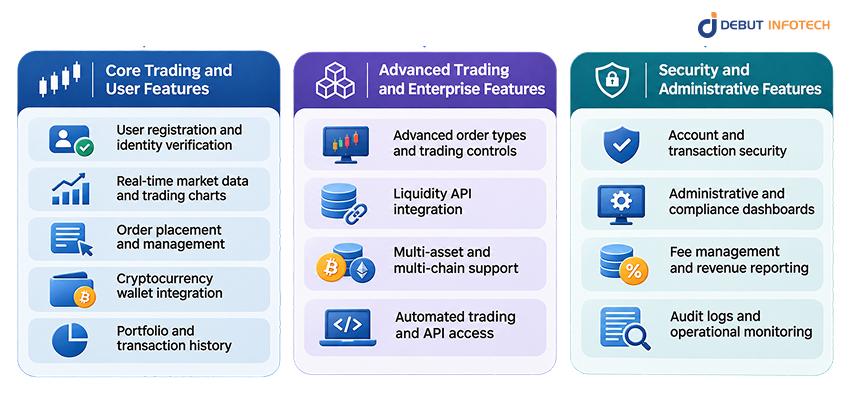
A successful exchange application needs to support complete trading workflows while giving operators sufficient control over transactions, accounts, and operational risks. The most important cryptocurrency exchange app features fall into three categories.
The application should support secure account creation, user authentication, and identity verification workflows where required.
For regulated exchange businesses, onboarding may involve document verification, biometric checks, customer due diligence, sanctions screening, and approval workflows.
The system should also support account restrictions and additional verification when a customer’s activity or risk profile changes.
Traders need access to current prices, trading volumes, order book depth, and historical market information. Market data services typically distribute updates through WebSocket connections or other streaming mechanisms.
The application should indicate when information becomes stale or the connection is interrupted. This prevents customers from assuming that an outdated price reflects current market conditions.
A trading interface should allow users to place, review, and cancel supported orders. An MVP may begin with market and limit orders, while advanced applications can introduce stop orders, conditional orders, and other exchange-supported order types. The interface must clearly display order status, execution prices, fees, partial fills, and remaining quantities.
Wallet integration enables deposits, withdrawals, balance visibility, and digital asset transfers.
Custodial platforms generally require an internal ledger alongside blockchain wallet services. Non-custodial products instead need reliable wallet connection and transaction-signing workflows.
Businesses developing specialized custody functionality can explore crypto wallet development services to evaluate wallet architecture and asset management requirements.
Customers should be able to monitor asset holdings, account balances, executed trades, deposits, withdrawals, and associated fees.
Transaction records should distinguish pending, completed, failed, and reversed operations where those states are applicable. For financial accuracy, portfolio views must retrieve balances from authoritative backend records rather than calculate account holdings independently on the device.
Professional trading applications may support stop-limit orders, time-in-force settings, trading APIs, and conditional execution.
Margin or derivatives trading requires additional systems for collateral, leverage limits, liquidation, and position risk. These capabilities should only be introduced where the business has the necessary technical and regulatory arrangements.
Liquidity availability directly affects the ability to execute trades at competitive prices. Through Liquidity API Integration, an exchange may connect with market makers, external venues, or aggregation services to access market data and executable liquidity.
Crypto exchange liquidity integration should address provider authentication, order routing, execution acknowledgments, rate limits, and service interruptions. Operators also need controls for spread, slippage, exposure, and provider concentration.
Supporting multiple cryptocurrencies requires more than displaying additional asset symbols. Each blockchain may introduce different deposit confirmation rules, address formats, token standards, network fees, and transaction monitoring requirements.
The backend should treat these differences explicitly instead of assuming that all assets share identical transfer workflows.
Exchange APIs allow authorized customers to connect trading bots, portfolio management tools, and institutional systems. API access should include permission scopes, rate limits, credential rotation, request authentication, and activity logging.
Withdrawal permissions should remain separate from ordinary trading permissions to reduce the impact of compromised API credentials.
Multi-factor authentication, device management, withdrawal address controls, and suspicious activity alerts help reduce account takeover and unauthorized asset movement risks.
Sensitive operations should require additional verification based on transaction value, user behavior, and risk policies.
Exchange operators need interfaces for reviewing onboarding cases, monitoring transactions, managing account restrictions, and investigating operational exceptions.
Role-based permissions should prevent employees from accessing or changing information outside their responsibilities. High-risk administrative actions may require approval from another authorized employee.
Cryptocurrency exchange app monetization commonly involves trading commissions, maker-taker fees, withdrawal charges, and premium account services. Depending on the business model, exchanges may also earn revenue from permitted market-making arrangements or institutional trading services.
The application should disclose applicable charges before customers confirm transactions. Backend reporting must record fee calculations accurately and support financial reconciliation.
The platform should maintain records of administrative changes, access events, trading operations, and transaction decisions.
Operations teams need alerts for failed deposits, delayed withdrawals, liquidity disruptions, and unusual trading behavior. These capabilities become increasingly important as the exchange expands its customer base and trading activity.
Businesses searching for how to build a crypto exchange app should begin by defining the underlying exchange requirements before selecting development frameworks.
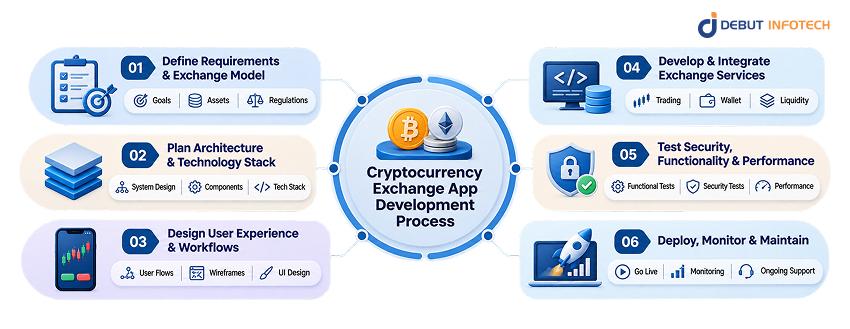
A practical crypto exchange app development process follows six connected stages, from initial business planning to deployment and ongoing operations.
Begin by identifying the exchange’s target users, supported assets, trading products, operating jurisdictions, and anticipated transaction volumes.
An application for retail spot trading has different requirements from an institutional platform offering advanced order execution and account management.
The discovery stage should answer several operational questions.
The team should also establish transaction volume assumptions, performance objectives, and recovery requirements.
For example, a platform expecting frequent market orders needs appropriate matching and risk controls. A business serving institutional customers may prioritize trading APIs, account permissions, reporting, and liquidity arrangements.
Expected deliverables: Requirements specification, exchange model, initial feature scope, regulatory dependency list, and delivery roadmap.
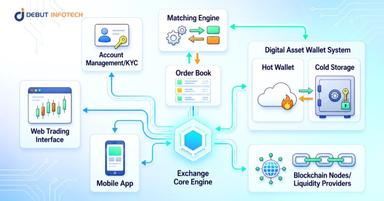
Once requirements are defined, architects can determine how the mobile application will communicate with trading, wallet, and administrative services.
A typical crypto exchange app architecture includes several connected components.
These components do not all need to become independent microservices. The appropriate boundaries depend on scale, engineering resources, reliability requirements, and system complexity.
Technology selection should reflect system requirements, development capabilities, and existing infrastructure.
| Component | Common Technology Options |
| Native mobile applications | Swift, Kotlin |
| Cross-platform mobile development | Flutter, React Native |
| Web trading interface | React, Next.js |
| Trading and backend services | Java, Go, Rust, C++, Node.js |
| Relational database | PostgreSQL |
| Caching | Redis |
| Event streaming | Apache Kafka |
| Real-time market updates | WebSockets |
| Blockchain connectivity | RPC APIs, custody SDKs |
| Cloud infrastructure | AWS, Microsoft Azure, Google Cloud |
| Deployment and monitoring | Docker, Kubernetes, OpenTelemetry, Prometheus |
The matching engine deserves particular attention because it must process orders consistently under concurrent trading activity. Depending on performance requirements, businesses may adopt an existing engine, license one, or commission a custom implementation.
An exchange should also maintain recoverable order state and reliable financial records. A fast matching engine offers little operational value if failures produce inconsistent balances or untraceable executions.
At the mobile level, native applications can provide greater control over platform-specific functionality. Cross-platform frameworks may reduce duplicated frontend work when both iOS and Android are required.
Our Mobile App Development Services cover native and cross-platform engineering for applications that require secure backend integration.
Expected deliverables: System architecture, integration specifications, technology choices, data model, and infrastructure plan.
Trading interfaces require a different design approach from ordinary consumer applications because users make financial decisions based on the information displayed. The design team should map complete journeys for account registration, verification, deposits, order placement, order cancellation, portfolio monitoring, and withdrawals.
Special attention should be given to incomplete transactions and unexpected system behavior. For example, if a trader submits an order and temporarily loses connectivity, the interface must not assume that the order failed. It should retrieve the authoritative order status before allowing the user to retry.
Similarly, a withdrawal screen should distinguish between a submitted request, an approved transfer, a broadcast blockchain transaction, and a confirmed transfer. Clear error messages, visible fees, and understandable order states reduce confusion and support better customer decisions.
Expected deliverables: User flows, wireframes, interactive prototypes, and approved interface specifications.
Development teams can now implement the trading interface and connect it to the required backend services. For an existing exchange, this stage may concentrate on mobile APIs, authentication, market data streaming, wallet interfaces, and transaction history.
A new exchange requires additional backend engineering. The order management system must coordinate with the matching engine and ledger so that valid trades update the correct customer balances.
Developers should use idempotent transaction handling to prevent retries from creating duplicate financial operations. Services also need procedures for recovering from interrupted requests or unavailable dependencies.
Wallet integration requires separate handling for deposits and withdrawals. Deposits should only become available according to the platform’s confirmation and crediting policies. Withdrawals require balance validation, risk checks, authorization, signing, and reconciliation.
Liquidity connections need testing for partial execution, provider timeouts, rejected orders, and inconsistent market data. Businesses should also integrate the compliance and reporting services identified during planning, rather than treating these requirements as final-stage additions.
Expected deliverables: Working trading application, integrated backend services, transaction workflows, administrative tools, and tested APIs.
Exchange testing must verify financial correctness alongside application behavior. Functional tests should cover successful trades, order cancellations, insufficient balances, partial fills, deposits, withdrawal requests, and failed transactions.
Concurrency tests should verify that simultaneous orders and account operations cannot create inconsistent financial records. Performance testing should measure order processing, API response times, market data delivery, and system behavior during sudden traffic increases.
Security testing should include authentication controls, API authorization, secrets management, dependency vulnerabilities, penetration assessments, and wallet transaction safeguards.
The team should also simulate disrupted liquidity connections, delayed blockchain confirmations, and backend service failures. Where smart contracts are involved, dedicated contract testing and independent security assessment may be necessary.
Expected deliverables: Test reports, remediated findings, performance results, reconciliation evidence, and operational acceptance criteria.
Deployment should follow a controlled release process. Before public availability, operators need functioning monitoring, backup procedures, administrative access policies, incident escalation paths, and customer support processes. The team should validate production configurations and confirm that development credentials, test funds, and unnecessary permissions are absent from live environments.
A limited rollout can help identify unexpected user behavior and integration failures before wider expansion. After launch, ongoing responsibilities include application updates, infrastructure monitoring, security patches, wallet integration changes, and adjustments to trading or compliance requirements.
Exchange development does not end when the app appears in an app store. The business must maintain both the customer-facing application and the financial systems supporting it.
Expected deliverables: Production deployment, operational documentation, monitoring dashboards, incident procedures, and maintenance plan.
Crypto exchange app development cost depends primarily on whether the business needs a mobile application for existing exchange infrastructure or must develop the wider trading system. Additional factors include the trading model, supported assets, custody arrangements, regulatory requirements, liquidity connections, and expected transaction volumes.
The following figures are illustrative planning ranges in USD, not fixed vendor quotations or verified market averages.
| Development scope | Illustrative cost | Estimated development duration |
| Mobile app integrated with an existing exchange backend | 30,000–80,000 | 3–5 months |
| MVP exchange app with selected backend services | 80,000–180,000 | 5–8 months |
| Custom exchange application and substantial trading infrastructure | 180,000–400,000 | 8–12 months |
| Enterprise exchange ecosystem with advanced integrations | 400,000–800,000+ | 12–18+ months |
These estimates assume a professional multidisciplinary development team. They are planning scenarios rather than independent survey findings, and actual proposals may fall outside the ranges.
They also exclude costs that may vary considerably by project, including licensing, legal services, capital requirements, liquidity commitments, external audits, and ongoing operational staffing.
For an app-only project, the existing exchange must already provide reliable trading, custody, ledger, and compliance capabilities. If those components require replacement or significant modification, the project may move into a higher cost category.
1. Trading Model and Infrastructure
A mobile interface connected to an existing exchange requires less backend engineering than a new platform with its own matching engine and account ledger. The decision to license or build trading infrastructure can materially change both upfront spending and ongoing commitments.
2. Wallet and Blockchain Integrations
Supporting multiple networks increases the number of deposit, withdrawal, confirmation, and reconciliation workflows the team must implement. Custody provider fees and network-specific requirements also affect the total investment.
3. Liquidity and Payment Integration
Connecting market makers, payment processors, banking partners, and liquidity aggregators introduces integration and testing work. Fees may depend on the provider, transaction volume, supported regions, and commercial agreements.
4. Security and Compliance Requirements
Identity verification, transaction screening, audit records, withdrawal controls, and independent security assessments require dedicated engineering and operational expenditure. Different jurisdictions may require additional product restrictions or reporting capabilities.
5. Application Complexity
Supporting one mobile platform and basic spot trading is generally less involved than delivering native iOS and Android applications with advanced charts, derivatives, trading APIs, and institutional account management. The number of screens alone is not a reliable estimate of engineering effort. Backend dependencies and financial correctness often have a greater impact.
The crypto exchange app development timeline depends on feature scope, existing infrastructure, vendor dependencies, and required testing.
An application connected to a stable backend may take several months. Building an exchange from scratch commonly requires a longer implementation period because the team must develop and validate the underlying financial systems. Regulatory approval and third-party onboarding may extend the overall launch schedule beyond software delivery.
Businesses should also budget for crypto exchange app maintenance costs, including:
A useful budgeting approach separates initial engineering expenditure from recurring technology costs, third-party fees, compliance operations, and internal staffing.
For example, a $150,000 development project with $8,000 in monthly technology and support expenditure would require an illustrative first-year budget of $246,000, excluding other operational and regulatory costs. The objective is to understand the total cost of ownership rather than select a development partner solely on the initial quotation.
Businesses can develop exchange applications from scratch, adopt white-label infrastructure, or combine licensed components with custom engineering.
The best approach depends on the launch schedule, available budget, technical ownership requirements, and long-term product strategy.
| Factor | Custom Development | White-Label Solution | Hybrid Approach |
| Initial development effort | Higher | Usually lower | Moderate to high |
| Launch speed | Usually longer | Potentially faster | Depends on integration scope |
| Feature customization | Extensive | Vendor-dependent | Selective |
| Infrastructure ownership | Defined by architecture and contracts | Often vendor-dependent | Shared across components |
| Integration flexibility | High when designed appropriately | Limited by provider APIs | Depends on component compatibility |
| Vendor dependency | Can be managed through architecture | Often significant | Component-specific |
| Long-term maintenance | Business or engineering partner | Vendor plus operator | Shared responsibility |
Custom development is appropriate when the exchange needs differentiated trading workflows, specialized integrations, proprietary infrastructure, or substantial control over its technical roadmap.
It may also be necessary where existing products cannot satisfy specific custody, performance, or operational requirements.
However, custom ownership creates ongoing responsibilities for security, infrastructure, upgrades, and incident handling.
White-label software can accelerate implementation when its existing functionality matches the intended product.
Businesses should assess the provider’s security practices, custody model, liquidity arrangements, API capabilities, update policies, and contractual responsibilities.
A shorter implementation period does not automatically mean lower long-term costs. Recurring licensing charges, customization restrictions, and migration difficulties may become important as the exchange grows.
A hybrid approach can offer an alternative when businesses want to retain an established trading engine while developing a differentiated mobile application and selected supporting services.
Cryptocurrency exchange projects require engineers who understand mobile applications alongside the financial and blockchain infrastructure that supports trading operations.
At Debut Infotech, our teams work across blockchain engineering, mobile application development, backend integration, and enterprise software delivery.
With over 15 years of technology experience and a multidisciplinary engineering team, we support businesses through technical discovery, architecture planning, application development, integration, testing, and post-launch maintenance.
Our development approach focuses on defining system responsibilities early, identifying external dependencies, and establishing testable requirements for trading accuracy, security, and operational reliability.
Our exchange-related portfolio includes work associated with NDAX, a Canadian digital asset trading platform.
Debut Infotech’s published project material references more than $12 billion in cumulative trading volume associated with the platform. This is an exchange business metric, not a claim that our software independently generated that volume.
The project provides a relevant example of our experience in the cryptocurrency exchange sector. Specific engineering responsibilities, architectures, and delivery outcomes should be assessed through the approved project case study.
Businesses evaluating a development partner should ask for comparable project experience, clarity on architectural ownership, security review procedures, integration capabilities, and a documented support model.
Cryptocurrency exchange app development requires coordinated decisions about trading functionality, infrastructure, liquidity, custody, security, and compliance. For businesses entering the market, the most important early decision is determining whether to develop a customer-facing application for an existing platform or create the underlying exchange infrastructure.
A well-defined scope helps engineering teams select appropriate technologies, establish realistic budgets, and address operational risks before deployment.
Custom development offers greater flexibility, while white-label infrastructure may reduce implementation time when its capabilities meet business requirements. Debut Infotech works with businesses to assess these decisions and engineer cryptocurrency exchange applications that support their technical and commercial objectives.
Essential features include secure registration, identity verification where required, real-time market data, order placement, wallet integration, portfolio tracking, deposits, withdrawals, and transaction history. Operators also need administrative controls, risk monitoring, and reporting. Advanced applications may include trading APIs, additional order types, liquidity integrations, and institutional account functionality. Feature selection should reflect the intended trading model.
Development costs depend on whether the project requires a mobile application or complete exchange infrastructure. Illustrative budgets range from 30,000–80,000 for a mobile app using an existing backend to 400,000–800,000 or more for an enterprise exchange ecosystem. Actual estimates depend on trading functionality, custody, integrations, security requirements, and testing. Legal, licensing, and operational costs require separate consideration.
The main factors include exchange architecture, matching engine requirements, wallet integrations, supported assets, liquidity connectivity, regulatory obligations, and mobile platform selection. Advanced trading functionality and custom backend systems can significantly increase engineering effort. Businesses should also account for infrastructure, third-party subscriptions, security testing, ongoing maintenance, and support rather than relying exclusively on the initial development estimate.
There is no universally preferred technology stack. Swift and Kotlin support native mobile applications, while Flutter and React Native support cross-platform development. Backend services may use Java, Go, Rust, C++, or Node.js, depending on their responsibilities. PostgreSQL, Redis, Kafka, and WebSockets support common data and communication requirements. Trading performance, security, maintainability, and existing infrastructure should guide the final selection.
Exchange applications generally integrate identity verification services with backend compliance workflows. Depending on jurisdictional requirements, these workflows may include document verification, biometric checks, customer risk assessment, sanctions screening, and transaction monitoring. Operators need procedures for reviewing alerts, retaining records, and reporting suspicious activity when required. Compliance controls should be designed around the exchange’s actual obligations rather than assuming one framework applies globally.
Businesses should evaluate authentication, API security, wallet custody, key management, withdrawal controls, encryption, financial reconciliation, and incident response. Regulatory considerations may include licensing, customer due diligence, AML monitoring, sanctions compliance, Travel Rule obligations, privacy laws, and financial reporting. Requirements depend on the jurisdiction and operating model. Legal and security specialists should review these responsibilities before production deployment.
An application integrated with the existing exchange infrastructure may require approximately 3 to 5 months, depending on the scope. An MVP with additional backend services may take five to eight months, while a custom enterprise exchange can take twelve months or longer. These are illustrative delivery ranges. Integration complexity, security testing, third-party onboarding, and regulatory approval can affect the final launch date.
Yes. White-label crypto exchange software provides existing trading components that businesses can configure and integrate with their applications. It may shorten implementation time when the provider supports the required assets, trading products, security controls, and integrations. However, companies should review source-code access, licensing arrangements, operational responsibilities, customization limits, and ongoing fees before selecting a vendor. Custom development may be preferable for specialized requirements.

Our Latest Insights
USA
2501 Chatham, Rd Suite R Springfield, IL 62704
+1-708-515-4004
info@debutinfotech.com
UK
7 Pound Close, Yarnton, Oxfordshire, OX51QG
+44-770-304-0079
info@debutinfotech.com
Canada
154 Eden Oak Trail, Kitchener, ON N2A 0H9
+1-708-515-4004
info@debutinfotech.com
INDIA
Sector 101-A, Plot No: I-42, IT City Rd, JLPL Industrial Area, Mohali, PB 140306
9888402396
info@debutinfotech.com