ON THIS PAGE
Progress0%




Our Global Presence :





Successful blockchain applications begin with business-first planning, requiring clear objectives, user requirements, compliance considerations, and validation that blockchain is the right solution before development starts.
Blockchain platform selection directly impacts scalability, security, and operating costs, making comparisons between Ethereum, Polygon, Solana, Avalanche, Hyperledger Fabric, and BNB Chain a critical early decision.
A scalable architecture balances on-chain and off-chain components, using technologies such as smart contracts, APIs, IPFS, Arweave, oracles, and databases to optimize performance and storage costs.
Security and governance must be embedded throughout the lifecycle, including smart contract audits, multi-signature controls, access management, continuous monitoring, and compliance-focused design.
Blockchain development costs vary significantly by complexity, ranging from roughly $15,000 for MVPs to $500,000+ for enterprise ecosystems with advanced integrations, compliance, and governance requirements.
Implementation timelines depend on project scope and technical requirements, with MVPs typically taking 2–4 months while enterprise-grade platforms may require 9–15 months or longer.
Long-term success depends on maintainability and future readiness, including upgradeable smart contracts, interoperability strategies, regulatory adaptability, and emerging technologies such as AI integration and Zero-Knowledge Proofs (ZKPs).
As organizations adopt decentralized technologies to improve security, transparency, and operational efficiency, understanding how to build a blockchain application has become increasingly important.
Blockchain technology is no longer limited to cryptocurrency use cases. Businesses across finance, healthcare, supply chain management, gaming, digital identity, and enterprise operations are exploring blockchain applications to automate processes, strengthen trust, and create new digital services.
Adoption continues to accelerate across both consumer and enterprise markets. According to Crypto.com, global cryptocurrency ownership reached 741 million users in 2025, representing a 12.4% increase from 659 million users in 2024. This growth reflects rising institutional participation, broader consumer adoption, and increasing interest in blockchain-powered services and applications.
Enterprise investment is also expanding rapidly. Research from Grand View Research estimates that the global blockchain technology market will grow from $57.7 billion in 2025 to more than $9.06 trillion by 2033, representing a compound annual growth rate (CAGR) of 88.2%. The forecast highlights growing demand for secure, transparent, and decentralized digital infrastructure across industries.
Security remains a major priority as blockchain adoption grows. Grand View Research estimates the global blockchain security market reached approximately $6.37 billion in 2025 and is projected to exceed $31.25 billion by 2033, reflecting the increasing need for smart contract auditing, digital asset protection, identity management, and blockchain security services.
Learning how to build a blockchain application from scratch involves much more than selecting a blockchain network and writing smart contracts. Organizations must evaluate business objectives, select appropriate infrastructure, design scalable architectures, implement robust security controls, and establish long-term maintenance strategies. This blockchain development guide explains the development process, technology stack, costs, timelines, challenges, and emerging trends shaping blockchain application development in 2026.
Organizations across industries are increasingly investing in blockchain technology to improve efficiency, transparency, and security. These benefits are driving adoption and encouraging businesses to explore new blockchain-powered products and services.
Businesses are adopting blockchain to improve visibility across transactions and operations. Every recorded activity is time-stamped and verifiable across distributed nodes. This reduces disputes between parties and strengthens accountability in multi-stakeholder environments. Organizations benefit from clearer audit trails, improved reporting accuracy, and stronger confidence in shared data integrity.
Blockchain enhances security through cryptographic techniques and decentralized validation. Unlike centralized databases that can be targeted through a single attack point, blockchain requires consensus across multiple nodes. This structure makes unauthorized data modification extremely difficult, helping businesses protect sensitive information, financial records, and transactional data from tampering or breaches.
Businesses use blockchain to streamline processes that typically depend on intermediaries. Smart contracts automate tasks such as settlements, approvals, and compliance checks. This reduces manual intervention, lowers administrative overhead, and minimizes errors. Over time, organizations achieve cost savings by eliminating redundant verification steps and improving overall operational efficiency.
Blockchain enables faster transaction processing by removing delays caused by intermediary approvals and legacy systems. Transactions are validated directly through network consensus and smart contracts. This allows businesses to execute cross-border payments, asset transfers, and agreements more quickly, improving cash flow efficiency and reducing waiting periods in multi-party workflows.
Blockchain ensures data integrity by making records immutable once they are confirmed. Any attempt to alter historical data requires consensus across the network, which is highly impractical. This creates a reliable data environment where businesses can depend on accurate records for auditing, compliance, reporting, and long-term operational decision-making.
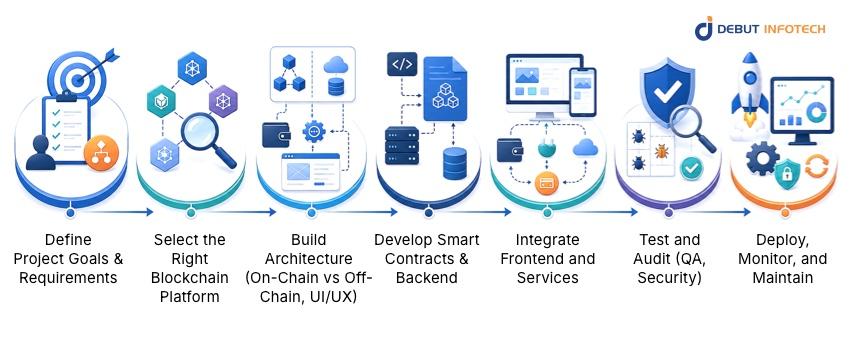
To build a blockchain application, start by defining clear project goals and requirements, then select the most suitable blockchain platform. Design the application architecture, develop smart contracts and backend systems, integrate frontend components and external services, perform comprehensive testing and security audits, and deploy the solution. Ongoing monitoring, maintenance, and updates help ensure long-term security, scalability, and performance. Here are the detailed blockchain development steps:
Every blockchain project should begin with a clear understanding of business objectives, user expectations, and operational requirements. This stage helps determine whether blockchain is genuinely necessary and identifies the features needed for long-term success. A detailed discovery process reduces blockchain app development risks and prevents costly changes later in the project lifecycle.
Key considerations include:
Choosing the right blockchain platform directly impacts scalability, transaction costs, development complexity, and future growth potential. Different blockchains offer varying strengths, making blockchain platform selection one of the most important technical decisions.
Businesses should evaluate performance, ecosystem maturity, security standards, developer support, and compatibility with project requirements before committing to a specific network.
Popular platform options include:
After selecting a platform, developers design the application’s architecture. This involves deciding which functions should operate on-chain and which should remain off-chain for efficiency and scalability.
The architecture must also account for user experience, security, data flow, and integration requirements. Proper planning ensures the application remains maintainable, cost-effective, and capable of supporting future expansion.
Key architectural components include:
Smart contracts form the core operational layer of many blockchain applications, handling transactions, business rules, and automated workflows. Developers write, test, and optimize contract logic while building supporting backend services. Backend systems often manage user accounts, data processing, notifications, and integrations. Careful development practices help ensure functionality, security, and reliable performance across the application ecosystem.
Backend development may include:
The frontend serves as the primary interface between users and blockchain functionality. Developers connect user interfaces with smart contracts, wallets, APIs, and external services to create a seamless experience. Effective integration ensures users can perform transactions, access data, and interact with decentralized features without unnecessary complexity, improving usability and supporting broader adoption.
Common integrations include:
Testing and auditing are critical because blockchain applications often handle valuable assets and sensitive transactions. Developers conduct extensive quality assurance processes to identify bugs, performance issues, and security vulnerabilities.
Independent smart contract audits provide an additional layer of protection. Thorough testing reduces deployment risks and helps maintain user trust after the application goes live.
Testing activities typically include:
Once testing is complete, the application is deployed to a live environment where users can begin interacting with its features. Development does not end at launch. Teams must continuously monitor performance, address security concerns, release updates, and adapt to changing business requirements. Ongoing maintenance helps ensure reliability, compliance, scalability, and long-term operational success.
Ongoing responsibilities include:
One of the most important architectural decisions in blockchain development involves determining where data should reside. Proper separation of on-chain and off-chain data improves scalability, reduces costs, and supports compliance requirements.
Data should only be stored on-chain when it requires immutability, decentralized verification, or direct interaction with smart contracts. Information such as user profiles, images, documents, logs, and analytics generally belongs off-chain. Storing large datasets directly on a blockchain can dramatically increase costs, whereas storing only a content hash delivers integrity verification with significantly lower storage expenses.
IPFS and Arweave provide decentralized alternatives for storing large files and metadata outside the blockchain. IPFS uses content-addressing and Content Identifiers (CIDs) to reference data, while Arweave focuses on permanent storage through a one-time payment model. Storing a CID on-chain creates a verifiable link between blockchain records and externally stored content without increasing blockchain storage requirements.
Blockchain applications frequently require access to external information such as market prices, weather data, or sporting results. Decentralized Oracle Networks aggregate data from multiple independent sources before submitting a consensus result on-chain. Solutions such as Chainlink Data Feeds and Chainlink VRF support pricing data and verifiable randomness while helping reduce the risk of manipulation attacks.
Smart contract events function as an efficient communication mechanism between blockchain networks and application infrastructure. Rather than continuously polling the blockchain, backend systems listen for specific events and respond when they occur. Indexing platforms such as The Graph organize these events into queryable datasets, improving application performance and reducing unnecessary blockchain interactions.
GDPR-compliant blockchain architectures separate sensitive personal information from immutable ledger records. Organizations typically store a SHA-256 hash on-chain while maintaining encrypted personal data off-chain.
If a user requests erasure, the off-chain record is deleted and encryption keys are retired. This approach preserves blockchain integrity while supporting privacy and regulatory obligations.
Smart contract immutability provides security and transparency, but it can also create operational challenges when applications need updates. Upgradeability patterns help developers fix issues, add functionality, and maintain long-term application viability.
Immutability prevents deployed smart contracts from being modified, which becomes problematic when bugs or feature requests emerge after launch. Historical incidents such as the Parity Wallet freeze demonstrated how vulnerabilities in immutable contracts can permanently impact user assets. Upgradeability planning allows teams to address issues without forcing users to migrate to entirely new contracts.
The Transparent Proxy Pattern separates storage from business logic through two independent contracts. The proxy contract stores application state and forwards requests, while implementation contracts contain executable logic. Upgrades occur by replacing the implementation contract while retaining the same proxy address. This approach preserves user interactions, maintains stored data, and simplifies application maintenance.
UUPS and Transparent Proxy patterns both support upgradeability but differ in implementation. Transparent Proxies prioritize security by placing upgrade controls within the proxy itself, while UUPS reduces operational costs by moving upgrade logic into implementation contracts. UUPS often suits consumer-focused applications, whereas Transparent Proxies are frequently preferred for enterprise environments handling high-value assets.
Storage collisions occur when contract upgrades unintentionally alter existing storage layouts, potentially corrupting application data. Developers must preserve variable ordering and storage structure across contract versions. Libraries such as OpenZeppelin StorageSlot and automated upgrade validation tools help identify conflicts before deployment, reducing the risk of silent data corruption during contract upgrades.
Upgrade authority should never depend on a single private key because compromised credentials could expose an entire application. Multi-signature wallets require approval from multiple stakeholders before upgrades can proceed, reducing governance risks. Additional safeguards such as timelocks provide transparency by announcing upgrades before execution, while decentralized governance models further distribute decision-making authority.
Blockchain technology supports a wide range of applications across different industries. These use cases demonstrate how decentralized systems are helping organizations solve business challenges and create new digital opportunities
| Use Case | How It Works | Key Benefits | Common Industries |
| Decentralized Finance (DeFi) | Uses smart contracts to provide lending, borrowing, staking, trading, and other financial services without traditional intermediaries | Lower costs, increased accessibility, faster transactions, greater transparency. | Finance, Banking, Investment Management |
| Supply Chain Management | Records product movements and transactions on a shared ledger throughout the supply chain. | Improved traceability, reduced fraud, enhanced transparency, better inventory visibility. | Manufacturing, Logistics, Retail, Food & Beverage |
| Digital Identity Solutions | Stores and verifies digital credentials through blockchain-based identity systems. | Stronger privacy, reduced identity fraud, faster verification processes. | Healthcare, Insurance, Medical Research |
| NFT Marketplaces | Enables users to create, buy, sell, and trade unique digital assets with verifiable ownership records. | Digital ownership verification, creator monetization, automated royalties. | Art, Entertainment, Gaming, Sports |
| Healthcare Data Management | Facilitates secure sharing and management of patient records across healthcare providers. | Better data security, improved interoperability, reduced record duplication. | Healthcare, Insurance, Medical Research |
| Gaming and Metaverse Platforms | Uses blockchain to manage ownership of in-game assets, currencies, and virtual properties. | True asset ownership, player-driven economies, asset portability. | Gaming, Entertainment, Virtual Worlds |
| Real Estate Platforms | Automates property transactions and enables asset tokenization through blockchain technology. | Faster transactions, increased transparency, fractional ownership opportunities. | Real Estate, Property Investment |
| Cross-Border Payments | Processes international transactions through blockchain networks instead of traditional banking channels. | Faster settlements, lower fees, greater transaction visibility. | Banking, FinTech, Global Commerce |
Blockchain applications can be categorized based on their purpose, functionality, and target users. Understanding these categories helps businesses identify the most suitable application model for their goals and industry requirements.
| Type | Description |
| Financial Applications | Payments, lending, trading, asset management |
| Enterprise Applications | Business process automation and data sharing |
| Identity Applications | Digital identity verification systems |
| Supply Chain Applications | Product tracking and logistics management |
| Gaming Applications | Blockchain-based games and virtual economies |
| Asset Tokenization Platforms | Digital representation of physical and financial assets |
Financial blockchain applications are designed to facilitate payments, lending, borrowing, asset trading, remittances, and investment management. These platforms use smart contracts to automate financial processes and reduce reliance on traditional intermediaries. Businesses and consumers benefit from faster transactions, improved transparency, lower operational costs, and broader access to financial services.
Enterprise blockchain applications help organizations streamline internal operations, improve data sharing, and strengthen collaboration across departments or business partners. They are commonly used for workflow automation, document management, compliance tracking, and audit reporting. By creating trusted records, these applications improve efficiency while reducing administrative overhead and reconciliation challenges.
Identity-focused blockchain applications enable users to securely store, manage, and share verified credentials. Instead of relying on centralized identity providers, individuals maintain greater control over personal information. These applications help reduce identity fraud, simplify verification processes, improve privacy protection, and support secure authentication across various digital services and platforms.
Supply chain blockchain applications provide end-to-end visibility into product movement, sourcing, and inventory management. Every transaction is recorded on a shared ledger, allowing stakeholders to track goods throughout the supply chain. This improves transparency, strengthens accountability, reduces fraud risks, and helps organizations verify product authenticity and regulatory compliance.
Blockchain gaming applications enable players to own, trade, and monetize digital assets within virtual environments. In-game items, characters, and collectibles can exist as blockchain-based assets with verifiable ownership records. These applications create new economic opportunities for players and developers while supporting more interactive and decentralized gaming ecosystems.
Asset tokenization applications convert physical or financial assets into blockchain-based digital tokens. Real estate, commodities, artwork, and securities can be represented digitally and traded more efficiently. These platforms improve liquidity, simplify ownership transfers, enable fractional ownership models, and create new investment opportunities across multiple asset classes.
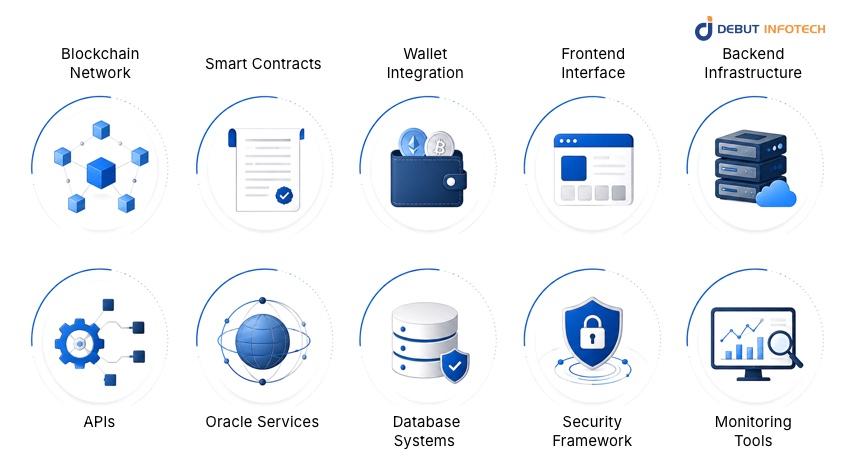
The blockchain network serves as the foundation of the application, storing transactions and maintaining consensus across participating nodes. It determines factors such as scalability, transaction speed, security, and operational costs. Selecting the appropriate network is critical to meeting both technical and business requirements.
Smart contracts are self-executing programs that automate business logic and transaction processing. They define how users interact with the application and how specific actions are performed. Properly developed smart contracts improve efficiency, reduce manual intervention, and build trust through transparent, consistent execution rules.
Wallet integration enables users to securely store digital assets, manage credentials, and sign blockchain transactions. It acts as the bridge between users and decentralized functionality. A seamless wallet experience improves usability, strengthens security, and simplifies access to blockchain-powered features within the application.
The frontend interface provides the visual layer through which users interact with blockchain services. It must present complex blockchain functionality in a simple and intuitive manner. Well-designed interfaces improve user adoption, reduce friction during transactions, and contribute significantly to the overall user experience.
Backend infrastructure supports application functionality beyond the blockchain itself. It manages APIs, business logic, notifications, analytics, and data processing activities. A reliable backend ensures efficient communication between application components while supporting performance, scalability, and integration with external systems and services.
APIs enable communication between blockchain networks, frontend interfaces, backend services, and third-party platforms. They facilitate data exchange and system interoperability. Effective API implementation enables developers to connect to external services, enhance functionality, and deliver a more seamless experience for users and administrators.
Oracle services enable blockchain applications to access external real-world data. Since blockchains cannot directly access off-chain data, oracles provide information such as market prices, weather updates, and event outcomes. This allows smart contracts to execute actions based on verified external inputs.
Database systems store application data that does not need to reside directly on the blockchain. They improve performance, reduce storage costs, and support faster data retrieval. Combining traditional databases with blockchain infrastructure allows developers to balance scalability, efficiency, and decentralization requirements.
A security framework protects application assets, smart contracts, user accounts, and infrastructure components. It includes access controls, encryption, monitoring systems, and vulnerability management processes. Strong security measures reduce operational risks and help maintain trust among users, partners, and stakeholders.
Monitoring tools track application performance, transaction activity, system health, and potential security threats. They provide real-time visibility into operational conditions and help development teams identify issues quickly. Continuous monitoring supports reliability, improves maintenance efficiency, and enhances the overall stability of blockchain applications.
Selecting a blockchain platform is one of the most important decisions in the development process. The right choice for blockchain platform selection affects scalability, costs, security, ecosystem support, and the application’s long-term growth potential.
| Platform | Best For | Strength |
| Ethereum | General-purpose dApps | Large ecosystem |
| Polygon | Scalable applications | Lower transaction costs |
| Solana | High-speed applications | Fast throughput |
| Avalanche | Enterprise and DeFi projects | Scalability |
| Hyperledger Fabric | Private enterprise solutions | Permissioned networks |
| BNB Chain | Consumer-focused applications | Large user base |
Ethereum remains one of the most widely adopted blockchain platforms for decentralized application development. It offers a mature ecosystem, extensive documentation, and strong developer support. Ethereum is commonly used for DeFi platforms, NFT marketplaces, and enterprise blockchain projects that require flexibility and broad ecosystem compatibility.
Pros:
Cons:
Polygon is a Layer 2 scaling solution designed to improve Ethereum’s speed and reduce transaction costs. It enables developers to build blockchain applications while benefiting from Ethereum compatibility. Businesses often choose the Polygon blockchain for consumer-facing applications that require lower fees, faster confirmations, and improved scalability without sacrificing ecosystem access.
Pros:
Cons:
Solana is known for its high throughput and ability to process large transaction volumes efficiently. It is particularly popular for trading platforms, gaming ecosystems, and applications requiring near-instant transaction confirmation. Solana development architecture prioritizes speed and scalability, making it attractive for projects with demanding performance requirements.
Pros:
Cons:
BNB Chain provides a cost-effective environment for building decentralized applications and digital asset solutions. Its compatibility with Ethereum development tools simplifies migration and deployment. The platform is frequently chosen for DeFi applications, marketplaces, and consumer-focused projects seeking a balance between affordability and functionality.
Pros:
Cons:
Hyperledger Fabric is a permissioned blockchain framework designed for enterprise use cases. Organizations can control participant access, data visibility, and governance structures. It is commonly used in supply chain management, healthcare, logistics, and financial services where privacy, compliance, and controlled collaboration are important operational requirements.
Pros:
Cons:
Avalanche is a high-performance blockchain platform designed to support scalable decentralized applications and enterprise solutions. It offers rapid transaction finality, customizable blockchain environments, and growing ecosystem support. Businesses often consider the Avalanche blockchain when they need strong performance without compromising security or flexibility.
Pros:
Cons:
A blockchain application’s performance and functionality depend heavily on the technologies used during development. A well-chosen tech stack helps ensure scalability, maintainability, security, and efficient integration across all system components.
Frontend technologies are responsible for the user-facing portion of a blockchain application. Frameworks such as React, Next.js, Vue.js, and Angular help developers create responsive and interactive interfaces. These tools simplify communication with wallets, smart contracts, and backend services while ensuring users can easily navigate blockchain functionality without unnecessary technical complexity.
Common frontend technologies:
The smart contract layer contains the code that governs blockchain transactions and automated business processes. Languages such as Solidity, Rust, and Vyper are widely used to create secure and efficient smart contracts. The choice of programming language often depends on the blockchain platform, performance requirements, and the development team’s technical expertise.
Common smart contract languages:
Backend technologies manage application logic, data processing, authentication, and communication between system components. While blockchain handles decentralized transactions, backend services support functions that are more efficiently processed off-chain. Popular backend frameworks provide scalability, flexibility, and integration capabilities that help maintain smooth application performance and user experiences.
Common backend technologies:
Database systems store application data that does not need to reside permanently on the blockchain. User profiles, analytics information, logs, and other operational data are often maintained in traditional databases. This approach improves performance, reduces blockchain storage costs, and enables faster access to information required by the application.
Common database solutions:
Infrastructure tools provide the environment required to deploy, manage, and scale blockchain applications. Solutions such as Docker, Kubernetes, AWS, and Azure help development teams automate deployment, manage workloads, and maintain application availability. Proper infrastructure planning ensures reliability, scalability, and operational efficiency throughout the application’s lifecycle.
Common infrastructure tools:
Blockchain development tools simplify the creation, testing, deployment, and debugging of smart contracts. They provide developers with local testing environments, deployment automation, and contract management capabilities. These tools accelerate development workflows, improve code quality, and help teams identify issues before deploying applications to production networks.
Common blockchain development tools:
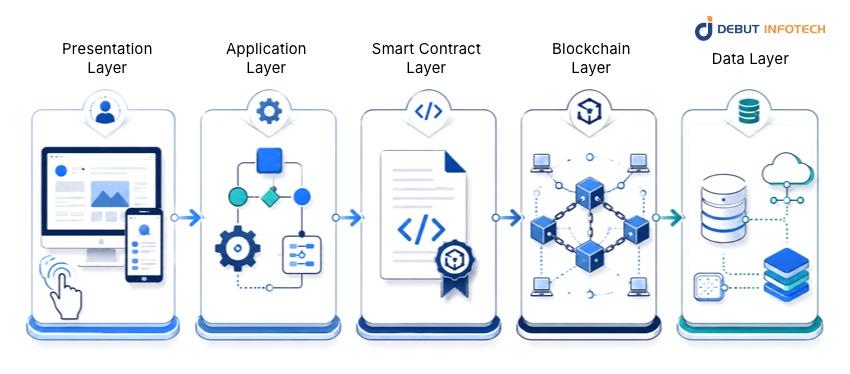
Blockchain applications rely on multiple architectural layers that work together to process transactions, manage data, and deliver user experiences. Understanding blockchain architecture layers provides insight into how decentralized applications are structured.
The presentation layer serves as the interface between users and the blockchain application. It includes web, mobile, or desktop interfaces where users perform actions and access information. A well-designed presentation layer improves usability, simplifies blockchain interactions, and helps users complete transactions without needing extensive technical knowledge of underlying systems.
The application layer manages business logic and coordinates communication between different system components. It processes user requests, validates data, and facilitates interactions with smart contracts and backend services. This layer acts as a bridge between the user interface and blockchain infrastructure, ensuring efficient execution of application functions.
The smart contract layer contains the self-executing programs that automate blockchain-based processes. These contracts define transaction rules, ownership conditions, and business workflows. Once deployed, smart contracts execute automatically when predefined conditions are met, reducing manual intervention while ensuring consistent, transparent enforcement of application rules.
The blockchain layer is responsible for transaction validation, consensus, and distributed record-keeping. It stores immutable transaction histories and ensures data consistency across participating nodes. This layer provides transparency, security, and decentralization, distinguishing blockchain applications from traditional software systems built on centralized infrastructure.
The data layer manages both on-chain and off-chain information required by the application. While critical transactions may be stored directly on the blockchain, other data is often maintained in external databases for efficiency. This hybrid approach balances performance, scalability, storage costs, and accessibility while supporting application functionality.
Regulatory and legal requirements influence blockchain architecture decisions as much as technical considerations. Addressing compliance early helps reduce risks, avoid costly redesigns, and support long-term scalability across different jurisdictions and industries.
Token classification determines whether a digital asset falls under securities regulations. In the United States, the SEC commonly applies the Howey Test to assess whether a token represents an investment contract. For applications targeting European users, MiCA introduced a clearer regulatory framework in 2024. Understanding these requirements helps businesses structure token models, fundraising activities, and compliance obligations appropriately.
GDPR grants individuals the right to request deletion of personal data, while blockchain records are intentionally immutable. A practical solution involves storing only a cryptographic hash of personally identifiable information on-chain while maintaining the actual data in a secure off-chain database. When deletion is requested, the off-chain record is removed, leaving the on-chain hash without any meaningful personal information attached.
Blockchain applications involving token trading, fiat payments, or financial services often trigger Know Your Customer and Anti-Money Laundering requirements. Identity verification providers such as Jumio and Onfido can be integrated into onboarding workflows, while blockchain analytics platforms help monitor transactions. Proper implementation strengthens compliance without creating excessive friction for legitimate users.
Smart contracts automate agreements through code, but their legal enforceability varies across jurisdictions. Regions such as Wyoming and several European jurisdictions have introduced legal recognition frameworks, while many countries remain less explicit. For high-value transactions, organizations often combine traditional legal agreements with smart contracts, ensuring contractual intent and blockchain execution remain aligned.
Compliance-by-design involves embedding regulatory controls directly into application architecture rather than adding them after deployment. Features such as audit trails, access logs, monitoring systems, and data retention controls simplify compliance management.
Permissioned blockchain frameworks like Hyperledger Fabric are particularly valuable because they offer granular access controls and comprehensive audit capabilities required by regulated industries.
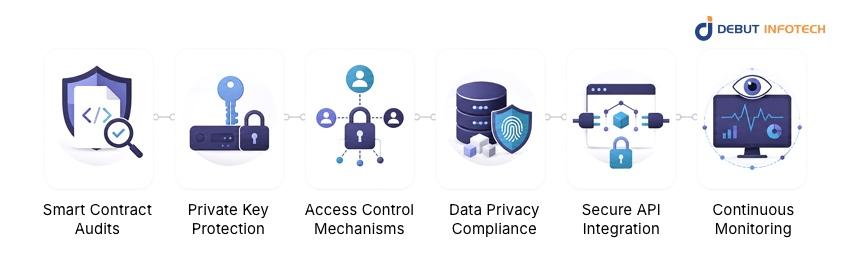
Security plays a central role in blockchain application development because vulnerabilities can lead to financial losses, data exposure, and operational disruptions. These considerations help organizations strengthen application security throughout the decentralized application development lifecycle.
Smart contract audits help identify vulnerabilities, logic flaws, and coding errors before deployment. Independent security experts review contract code to detect weaknesses that attackers could exploit. Conducting thorough audits reduces security risks, improves code quality, and provides greater confidence that blockchain transactions will execute as intended.
Private keys provide access to blockchain accounts, assets, and administrative functions. If compromised, attackers may gain complete control over sensitive resources. Organizations should implement secure storage, multi-signature controls, hardware wallets, and strict access policies to protect private keys and reduce the risk of unauthorized access.
Access control mechanisms determine which users, administrators, and systems can perform specific actions within the application. Proper permission management helps prevent unauthorized activity and limits exposure to internal threats. Clearly defined access policies improve security, reduce operational risks, and support compliance with governance and regulatory requirements.
Blockchain applications must address data privacy obligations while maintaining transparency. Organizations should ensure compliance with applicable regulations governing data collection, storage, and sharing. Privacy-focused design strategies, encryption techniques, and careful handling of sensitive information help balance regulatory requirements with the benefits of blockchain technology.
APIs often connect blockchain applications with external services, databases, and third-party platforms. Weak API security can expose applications to unauthorized access and data breaches. Developers should implement authentication controls, encryption protocols, rate limiting, and continuous monitoring to secure integrations and maintain the integrity of connected systems.
Continuous monitoring enables organizations to detect unusual activity, performance issues, and potential security threats in real time. Monitoring tools provide visibility into transactions, smart contract behavior, and infrastructure health. Ongoing oversight helps teams respond quickly to incidents, minimize disruptions, and maintain a secure operating environment.
While blockchain offers significant advantages, development teams often encounter technical, operational, and regulatory obstacles.
Many blockchain networks struggle to process large transaction volumes efficiently, particularly during periods of heavy network activity. As user demand increases, transaction speeds may decline, and fees can rise significantly. These limitations can affect user experience and make it difficult for applications to support large-scale adoption without additional scalability solutions.
Recommendation
Development teams should evaluate scalability requirements during the planning phase and select platforms that align with expected transaction volumes. Layer 2 solutions, sidechains, and optimized smart contract designs can help improve performance. Regular testing under simulated workloads also helps identify bottlenecks before they impact production environments.
Blockchain regulations continue to evolve across different countries and industries. Requirements related to digital assets, data privacy, taxation, and compliance may change over time, creating uncertainty for businesses. This can complicate product planning, increase legal risks, and make it challenging to launch applications across multiple jurisdictions.
Recommendation
Organizations should work closely with legal and compliance professionals throughout the blockchain app development process. Monitoring regulatory developments and designing applications with compliance flexibility can reduce future risks. Maintaining detailed records, implementing appropriate controls, and preparing for evolving requirements helps businesses adapt more effectively to regulatory changes.
Many blockchain applications require users to manage wallets, private keys, transaction confirmations, and network fees. These concepts can be confusing for individuals unfamiliar with blockchain technology. Poor user experiences often create adoption barriers, leading to lower engagement rates and making it more difficult for applications to reach mainstream audiences.
Recommendation
Developers should prioritize simplicity and usability when designing blockchain applications. Streamlined onboarding processes, intuitive interfaces, clear transaction guidance, and user-friendly wallet integrations can reduce friction. Educational resources and helpful support systems also make blockchain features easier to understand and encourage broader user adoption.
Blockchain applications frequently handle valuable digital assets and sensitive transaction data, making them attractive targets for attackers. Vulnerabilities in smart contracts, APIs, or infrastructure can lead to financial losses, service disruptions, or reputational damage. Security issues become particularly difficult to address once smart contracts are deployed.
Recommendation
Security should be integrated into every stage of development rather than treated as a final step. Smart contract audits, penetration testing, code reviews, access controls, and continuous monitoring help identify vulnerabilities early. Adopting security best practices significantly reduces exposure to threats and strengthens overall application resilience.
Blockchain applications often need to connect with existing enterprise systems, databases, payment platforms, and third-party services. Integrating these technologies can be technically challenging due to differences in architecture, data formats, and operational requirements. Poor integration planning can lead to inefficiencies and increase long-term maintenance costs.
Recommendation
Teams should establish integration requirements early and design flexible architectures that support interoperability. Using standardized APIs, middleware solutions, and reliable testing processes can simplify communication between systems. Careful integration planning reduces implementation challenges and helps maintain stable application performance as the ecosystem expands.
Blockchain development requires specialized expertise in smart contracts, cryptography, decentralized systems, and security practices. Skilled professionals remain in high demand, making recruitment difficult and potentially increasing project costs. Limited access to experienced talent can slow development timelines and affect overall project quality.
Recommendation
Businesses should invest in experienced blockchain specialists, ongoing training programs, and strategic development partnerships. Leveraging established frameworks and development tools can also improve team productivity. Building a knowledgeable team with expertise across blockchain technologies helps reduce risks and supports successful project delivery.
Blockchain app development costs vary based on application complexity, infrastructure requirements, security needs, and integration demands
| Project Type | Estimated Cost Range | Typical Features | Suitable For |
| MVP Blockchain App | $15,000–$40,000 | Basic smart contracts, wallet integration, simple user interface, core functionality, limited testing. | Startups, Proof-of-Concept Projects, Early Validation |
| Basic Blockchain Application | $40,000–$80,000 | Custom smart contracts, backend services, improved UI/UX, security measures, third-party integrations | Small Businesses, Early-Stage Products |
| Mid-Level Business Application | $80,000–$150,000 | Advanced workflows, analytics, scalability planning, multiple integrations, enhanced security controls. | Growing Businesses, Industry-Specific Solutions |
| Advanced Enterprise Solution | $150,000–$500,000+ | Enterprise architecture, private blockchain support, compliance features, extensive integrations, advanced security. | Large Enterprises, Regulated Industries |
| Large-Scale Ecosystem Platform | $500,000+ | Multi-user ecosystems, governance systems, complex infrastructure, extensive scalability requirements, advanced testing. | Global Platforms, Enterprise Networks, Large Marketplaces |
Development timelines can vary significantly depending on project scope, features, compliance requirements, and testing needs. Understanding expected timelines helps businesses set realistic expectations and plan project execution more effectively.
| Project Complexity | Estimated Timeline |
| MVP | 2–4 Months |
| Basic Application | 3–6 Months |
| Mid-Level Application | 6–9 Months |
| Enterprise Platform | 9–15 Months |
| Large Ecosystem Project | 12–24 Months |
MVP development takes between 2–4 Months. It focuses on launching a functional product with essential blockchain features and limited complexity. Timelines generally include planning, smart contract development, interface creation, testing, and deployment. Projects with clearly defined requirements and minimal integrations can often be completed within this timeframe.
Basic blockchain applications take from 3–6 Months. They require additional functionality, improved user experience, and broader testing. Development typically includes custom smart contracts, backend services, wallet integrations, and enhanced security measures. The expanded scope increases development complexity and extends timelines beyond those associated with MVP projects.
Mid-level projects typically take from 6–9 Months. They involve advanced workflows, multiple integrations, scalability planning, and stronger security requirements. Development teams spend additional time designing architecture, implementing business-specific features, and conducting comprehensive testing. These factors contribute to longer development cycles while helping ensure reliability and performance after launch.
Enterprise blockchain platforms take 9–15 months. They often require custom infrastructure, compliance considerations, permission management systems, and extensive integration with existing business environments. Development timelines increase due to detailed planning, stakeholder involvement, security audits, and large-scale testing. These projects demand careful execution to meet operational and regulatory expectations.
Large ecosystem projects take anywhere from 12 – 24 months. They support multiple user groups, interconnected services, and complex governance structures. Development includes extensive architecture planning, scalability optimization, security reviews, and long-term testing. The broad scope of these platforms requires significant coordination across teams, resulting in substantially longer implementation and deployment timelines.
Blockchain technology continues to evolve as developers, enterprises, and regulators address long-standing challenges related to scalability, privacy, interoperability, and adoption.
Several emerging trends are shaping the next generation of blockchain applications and influencing how organizations approach development, deployment, and long-term innovation.
Zero-Knowledge Proofs are becoming increasingly important for blockchain applications that require privacy and scalability. This technology allows one party to verify information without revealing the underlying data itself. As blockchain adoption grows, ZKPs are helping organizations protect sensitive information, reduce network congestion, and support more efficient transaction validation across decentralized systems.
The integration of artificial intelligence and blockchain is creating new opportunities for automation, analytics, and decision-making. AI can process large datasets and generate insights, while blockchain provides transparency and data integrity. Together, these technologies are supporting smarter applications, improved operational efficiency, enhanced fraud detection, and more reliable automated business processes.
Interoperability is becoming a major focus as organizations seek to connect multiple blockchain networks. Cross-chain technologies enable assets, data, and applications to move seamlessly between ecosystems. This improves flexibility, reduces fragmentation, and expands functionality. As adoption grows, interoperability solutions are expected to play a critical role in blockchain scalability and collaboration.
Governments and regulatory bodies continue to develop clearer frameworks for blockchain technologies and digital assets. Greater regulatory clarity helps businesses operate with more confidence while encouraging broader adoption. Organizations are increasingly building compliance considerations into development strategies to meet evolving legal requirements and support sustainable long-term growth.
Sustainability remains an important consideration for enterprise blockchain development. Many modern blockchain networks are adopting energy-efficient consensus mechanisms that reduce resource consumption while maintaining security and performance. As environmental concerns gain greater attention, businesses are increasingly selecting blockchain platforms that align with sustainability goals and responsible technology practices.
Examining real-world deployments by enterprise development firms like Debut Infotech bridges the gap between theory and execution. Here are five real-life examples of how blockchain applications solve distinct problems across industries.
| Project | Industry | Business Challenge | Blockchain Solution Delivered | Technologies Used | Outcomes & Impact |
| Everledger | Supply Chain & Asset Traceability | High-value assets such as diamonds and luxury goods require transparent provenance tracking to reduce fraud and improve trust among stakeholders. | Debut Infotech helped build a blockchain-powered provenance and traceability platform that records asset history, ownership, and movement across the supply chain. The platform combines blockchain, IoT, and AI to create verifiable records and automate transactions through smart contracts. | Hyperledger Fabric, Docker, Kafka, Kubernetes | Received $20 million in funding from Tencent, earned a place on the Forbes Blockchain 50 list, and established a partnership with Alrosa, one of the world’s largest diamond producers. |
| Agriculture & Supply Chain | Coffee producers and buyers often face challenges related to transparency, traceability, and fair pricing throughout the supply chain. | Debut Infotech built a blockchain-powered coffee supply chain platform that tracks coffee from farm to consumer while using smart contracts to improve transaction transparency and stakeholder trust. | Blockchain Infrastructure, Smart Contracts | Recognized by the Coffee Association Boston USA and used by more than 10,000 stakeholders across the coffee ecosystem. The platform improved traceability and supply chain transparency. | |
| PRC Blockchain Exchange Platform | Real Estate Finance | Real estate investment traditionally involves high entry barriers, limited liquidity, and complex fundraising processes. | Debut Infotech developed a blockchain-based ecosystem combining an ICO platform, exchange functionality, and payment infrastructure to support real estate fundraising and digital asset trading. | Blockchain Exchange Infrastructure, Tokenization Frameworks | More than 12,000 registered investors participated through a unified platform that combined fundraising, trading, and payment capabilities |
| Healthcare Blockchain Platform | Healthcare | Healthcare providers needed a secure and interoperable way to manage patient records and share information among stakeholders. | Debut Infotech delivered a blockchain-enabled healthcare platform designed to improve record management, data integrity, and stakeholder collaboration while maintaining secure access controls. | Enterprise Blockchain Architecture | The platform manages more than 25,000 patient records and connects over 50 healthcare stakeholders within a shared ecosystem |
| Integra Ledger | Legal Technology | Legal professionals needed a secure way to verify document authenticity, streamline workflows, and improve collaboration while maintaining compliance and security standards. | Debut Infotech developed a blockchain-based digital signature and document verification platform that uses blockchain records to validate authenticity, improve security, and automate legal processes | Hyperledger Fabric 2.0, React.js, Angular, MySQL | Secured $3 million in funding, expanded to more than 300 law firms worldwide, and was adopted by major enterprises including Seven Eleven, Mohawk, and Hogan Lovells. |
These case studies reflect the depth of experience Debut Infotech brings to blockchain application development, spanning multiple industries, architectures, and use cases. Here’s why you should choose Debut Infotech for Blockchain Application Development:
Covers everything from discovery, architecture design, smart contract development, testing, deployment, to post-launch support. This reduces coordination gaps and keeps development aligned across all stages.
Experience across supply chain, healthcare, legal tech, finance, and real estate helps tailor solutions to specific business problems instead of generic implementations.
Security practices include smart contract audits, code reviews, penetration testing, and continuous monitoring to reduce risks in production environments.
Solutions are built to handle growth in users, transactions, and integrations without requiring major redesigns later in the product lifecycle.
Supports multiple blockchain networks and hybrid architectures, allowing businesses to choose platforms based on cost, performance, compliance, and scalability needs.
Understanding how to build a blockchain application requires a balanced approach that combines business strategy, technical planning, security, and scalability. From defining project goals and selecting the right blockchain platform to developing smart contracts and maintaining deployed systems, every stage plays a role in determining project success. Organizations that invest time in proper planning are better positioned to avoid costly mistakes and build reliable solutions.
As blockchain technology continues to mature, applications are expanding across finance, healthcare, supply chain management, digital identity, gaming, and many other sectors.
Businesses that understand how to create a blockchain app, its infrastructure requirements, security considerations, and emerging industry trends will be better equipped to create blockchain applications that deliver long-term value, support growth, and adapt to changing market demands.
Building a blockchain application starts with defining the problem you want to solve and deciding whether blockchain is necessary. From there, you choose a blockchain network, design the architecture, develop smart contracts, build the frontend and backend, thoroughly test everything, and deploy the application to users.
The typical process includes requirement analysis, selecting a blockchain platform, designing the application architecture, developing smart contracts, building the user interface and backend systems, integrating wallets and APIs, testing for security and performance, and finally deploying and maintaining the application after launch.
The most common blockchain programming languages include Solidity for smart contracts on Ethereum-compatible networks, Rust for Solana and other high-performance blockchains, Go for blockchain infrastructure, JavaScript and TypeScript for dApps, and Python for automation, testing, and backend development tasks.
A blockchain tech stack usually includes a blockchain network like Ethereum or Solana, smart contract frameworks such as Hardhat or Foundry, frontend tools like React, backend technologies such as Node.js, databases, wallet integrations, APIs, cloud infrastructure, and security testing tools.
Development timelines depend on complexity. A basic blockchain application may take 2–4 months, while a feature-rich platform with custom smart contracts, wallet integration, advanced security measures, and extensive testing can take 6–12 months or longer.
Blockchain app development costs vary based on features, complexity, and team size. A simple application may cost between $15,000 and $50,000. Mid-level projects often range from $50,000 to $150,000, while enterprise-grade blockchain platforms can exceed $250,000 due to advanced functionality and security requirements.
Blockchain makes sense when your business needs transparency, secure record-keeping, decentralized transactions, or trust between multiple parties. If a traditional database can handle the same job more efficiently and at a lower cost, blockchain may not be the best investment for your project.

Our Latest Insights
USA
2501 Chatham, Rd Suite R Springfield, IL 62704
+1-708-515-4004
info@debutinfotech.com
UK
7 Pound Close, Yarnton, Oxfordshire, OX51QG
+44-770-304-0079
info@debutinfotech.com
Canada
154 Eden Oak Trail, Kitchener, ON N2A 0H9
+1-708-515-4004
info@debutinfotech.com
INDIA
Sector 101-A, Plot No: I-42, IT City Rd, JLPL Industrial Area, Mohali, PB 140306
9888402396
info@debutinfotech.com