ON THIS PAGE
Progress0%






Our Global Presence :






Blockchain consulting services help businesses validate use cases before development, reducing the risk of investing in blockchain where conventional databases or other technologies may deliver better value.
Architecture and platform selection have long-term cost and scalability implications, making early evaluation of public, private, and consortium blockchain models critical to avoid expensive redevelopment or migration.
Consultants combine specialized expertise across strategy, security, compliance, smart contracts, and DevOps, giving businesses access to multidisciplinary capabilities without building a full-time blockchain team.
A structured implementation roadmap reduces execution risk, typically progressing from discovery and feasibility through architecture, PoC/MVP, security testing, phased deployment, and continuous optimization.
Blockchain consulting costs vary significantly with complexity and expertise, so businesses should assess total project cost, regulatory requirements, security needs, and expected ROI rather than comparing hourly rates alone.
Industry-specific requirements shape blockchain strategy, with banking, supply chain, healthcare, real estate, and retail requiring different approaches to privacy, governance, interoperability, tokenization, and compliance.
The right consulting partner should demonstrate technical depth and business objectivity, including transparent pricing, security and compliance planning, platform-neutral recommendations, and evidence of sustainable post-launch outcomes.
Blockchain has grown well beyond its early association with cryptocurrency and is now helping businesses improve transparency, automate processes, strengthen security, and create new digital business models.
But successful adoption requires more than choosing a platform or developing smart contracts. Companies must assess whether blockchain fits their needs, select the right architecture, address regulatory requirements, and plan for long-term scalability.
This is where blockchain consulting services for business adds value. Consultants help organizations validate use cases, reduce implementation risks, and make informed decisions before committing significant resources to development.
Enterprise interest in blockchain is also growing. According to a survey by Casper Labs, 87% of global business decision-makers expect to invest in blockchain technologies in the near term as part of their digital transformation initiatives. Furthermore, a Deloitte survey reveals that 73% of global executives agree their organization will lose a competitive advantage if they fail to adopt blockchain technologies.
As more businesses move from exploration to implementation, the need for informed strategy, technical expertise, and regulatory guidance is becoming more important. This guide explains why businesses hire blockchain consultants, how consulting services support implementation, what they cost, industry-specific use cases, and how to choose the right consulting partner.
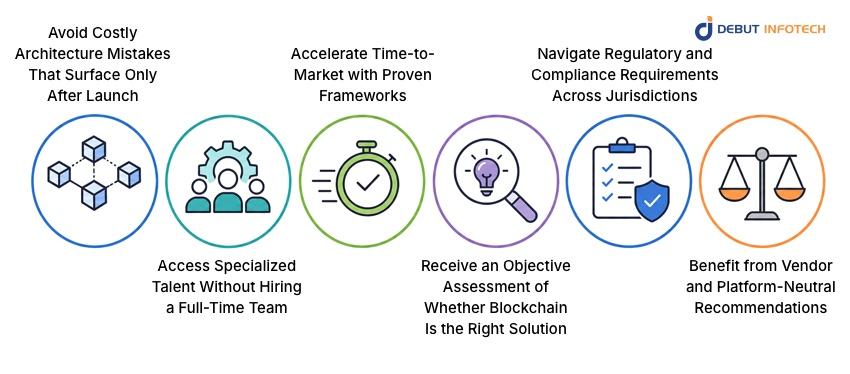
Businesses should hire blockchain consultants to reduce implementation risks, make informed technology decisions, and maximize the return on their blockchain investments.
Consultants provide specialized expertise in strategy, architecture, security, compliance, and platform selection. They help organizations avoid costly mistakes, accelerate deployment, and build scalable blockchain solutions that align with long-term business objectives.
Blockchain initiatives often fail for reasons that have little to do with coding. Poor planning, unrealistic expectations, unsuitable technology choices, and weak governance are far more common causes of failure than software bugs.
Experienced blockchain consultants address these issues before they become expensive business problems.
The architecture chosen during the planning stage determines how well a blockchain solution performs years after deployment.
Decisions involving consensus mechanisms, network design, interoperability, smart contract architecture, and scalability cannot easily be reversed without significant redevelopment. Businesses that rush into implementation often discover these limitations only after customers begin using the platform.
Selecting the wrong blockchain network is one of the most expensive mistakes organizations make.
A public blockchain may provide excellent transparency but struggle with transaction costs or regulatory requirements.
A private blockchain may satisfy internal governance needs but limit ecosystem participation.
Consultants evaluate technical and business requirements together before recommending the most appropriate architecture, preventing organizations from rebuilding critical infrastructure later.
Upgradeability is another common oversight. Many early blockchain projects deployed immutable smart contracts without considering future regulatory changes or feature enhancements.
Modern consultants design upgrade mechanisms, governance frameworks, and version-control strategies that allow businesses to evolve without compromising security or disrupting operations.
Blockchain development combines several disciplines rarely found within a single internal team.
Successful projects require expertise in distributed systems, cryptography, smart contract engineering, token economics, cybersecurity, DevOps, cloud infrastructure, API integration, and regulatory compliance for enterprise blockchain. Recruiting specialists across all these areas is expensive and time-consuming.
Blockchain consulting firms provide immediate access to multidisciplinary teams that have already solved similar technical and business challenges.
Instead of hiring individual specialists for every stage of development, businesses can engage experts only when their knowledge is required. This approach significantly reduces recruitment costs while maintaining access to high-level expertise.
Consultants also bring experience from multiple industries and blockchain ecosystems. Their exposure to different protocols, governance models, and implementation strategies enables them to recommend proven solutions rather than experimenting with untested approaches on a client’s budget.
Building a blockchain solution from scratch often extends project timelines unnecessarily.
Many technical components, development standards, and security practices have already been established through years of enterprise adoption. Experienced consultants reuse these proven frameworks while tailoring them to individual business requirements.
Faster implementation creates competitive advantages beyond launching earlier.
Organizations begin collecting operational data sooner, validate assumptions faster, and identify improvement opportunities before competitors complete their planning phases. Reducing development cycles also lowers project costs by minimizing prolonged engineering efforts.
Established consulting firms typically maintain reusable smart contract templates, security checklists, governance frameworks, testing methodologies, and deployment pipelines. These resources improve development efficiency without sacrificing reliability or compliance, allowing businesses to focus on delivering measurable value rather than reinventing foundational components.
Not every business problem requires blockchain technology.
Some organizations pursue blockchain simply because it appears innovative, even when a conventional database offers better performance, lower costs, and simpler maintenance.
Responsible consultants recognize this distinction and provide honest recommendations based on business value instead of technology trends.
During the discovery phase, consultants evaluate factors such as trust between participants, data immutability requirements, transaction transparency, decentralization needs, and multi-party collaboration.
If blockchain offers no meaningful advantage, they recommend alternative architectures that better align with operational objectives.
This objectivity protects businesses from investing in unnecessary infrastructure while strengthening confidence among executives, investors, and stakeholders.
Rather than validating preconceived ideas, consultants focus on identifying the solution that delivers the strongest commercial outcome.
Regulations surrounding blockchain, digital assets, tokenization, and decentralized finance continue to evolve across global markets.
Organizations operating internationally often face overlapping legal requirements related to data privacy, financial reporting, consumer protection, anti-money laundering, and digital identity management.
Blockchain consultants work alongside legal and compliance professionals to incorporate regulatory considerations into technical planning from the beginning.
Instead of treating compliance as a final approval step, they integrate governance controls directly into system architecture, reducing costly redesigns later.
This proactive approach becomes particularly important for regulated industries such as banking, healthcare, insurance, and government services, where non-compliance can result in financial penalties, operational disruption, and reputational damage.
Experienced consultants help organizations prepare for regulatory change while maintaining flexibility for future expansion.
Many technology providers recommend solutions that align with their own products or preferred ecosystems.
While these recommendations may be technically sound, they do not always represent the best fit for every business.
Independent blockchain consultants evaluate multiple platforms objectively before recommending a direction.
Rather than promoting a single blockchain network, consulting firms compare public, private, hybrid, and consortium models against business requirements, scalability goals, governance preferences, integration complexity, and long-term operating costs. This structured evaluation helps organizations make decisions based on measurable criteria instead of marketing claims.
Vendor neutrality also improves future flexibility. Businesses avoid becoming dependent on a single technology stack that may limit interoperability, increase licensing costs, or complicate future migrations.
By selecting blockchain consulting solutions that align with both present needs and long-term strategy, consultants position organizations for sustainable growth rather than short-term implementation success.
Blockchain consulting focuses on planning the right solution before development begins, while blockchain development is the process of building and deploying that solution.
Consultants help businesses evaluate whether blockchain is the right fit, define a strategy, select the most suitable platform, and identify potential risks.
Developers then turn that strategy into a functional blockchain application using smart contracts, decentralized applications (dApps), APIs, and supporting infrastructure.
Although the two services are closely connected, they solve different business challenges.
Blockchain consulting answers the ”what,” “why,” and “how” behind a project, ensuring it aligns with business goals and delivers a positive return on investment.
Blockchain development answers the ”how to build it” by translating the approved roadmap into a secure, scalable, and production-ready solution.
Many businesses engage a blockchain implementation consulting firm first to validate the project before committing to full-scale development.
| Criteria | Blockchain Consulting | Blockchain Development |
| Primary Focus | Business strategy, feasibility, and implementation planning | Building, testing, and deploying blockchain solutions |
| Main Objective | Determine whether blockchain is the right solution and how it should be implemented | Develop the blockchain platform according to the approved strategy |
| Typical Activities | Business analysis, use-case validation, platform selection, ROI modeling, compliance planning, architecture design | Smart contract development, dApp development, backend integration, testing, deployment, and maintenance |
| Project Stage | Before and during the early planning phase | After the strategy and roadmap have been approved |
| Key Deliverables | Feasibility study, implementation roadmap, technical architecture, cost estimates, risk assessment | Working blockchain application, smart contracts, APIs, integrations, deployment, and documentation |
| Primary Stakeholders | Executives, product managers, business leaders, compliance teams | Software engineers, blockchain developers, DevOps engineers, QA teams |
| Success Metrics | Business value, ROI, regulatory readiness, implementation strategy | Performance, security, scalability, reliability, and user adoption |
| Best For | Organizations evaluating or planning a blockchain initiative | Organizations ready to build, launch, or scale a blockchain solution |
Blockchain consulting services help businesses identify high-value use cases, evaluate costs and risks, choose the right blockchain platform, strengthen security, and prepare employees for adoption.
They also provide the strategic guidance organizations need to implement blockchain technology in business efficiently while minimizing risk and maximizing long-term value.
Here’s how blockchain consultants help businesses:
One of the first responsibilities of a blockchain consultant is identifying where blockchain creates genuine value.
Many organizations generate dozens of ideas during strategy sessions, but not every idea deserves investment. Blockchain consulting for enterprises separates promising opportunities from low-impact initiatives using structured evaluation frameworks.
A common approach involves scoring each use case based on three criteria:
| Evaluation Factor | Questions to Ask |
| Business Value | Will this improve revenue, reduce costs, or enhance customer experience? |
| Implementation Risk | Are there regulatory, technical, or operational challenges? |
| Execution Difficulty | What level of investment, talent, and organizational change is required? |
This scoring process helps leadership focus resources on projects capable of delivering measurable returns within realistic timelines. Instead of launching multiple initiatives simultaneously, organizations can prioritize quick wins while building experience for larger enterprise deployments.
Blockchain projects often involve significant upfront investment. Infrastructure, software development, smart contract engineering, cybersecurity, legal review, and employee training all contribute to total project costs.
Without financial modeling, organizations may underestimate budgets or struggle to justify investments to executive leadership.
Consultants develop detailed cost projections before implementation begins. These models estimate development expenses, infrastructure requirements, licensing fees, operational costs, maintenance, and future scaling requirements. They also compare blockchain implementation against existing systems to determine whether the expected benefits justify the investment.
Return on investment extends beyond direct financial savings. Consultants evaluate improvements in transaction speed, fraud reduction, operational efficiency, reconciliation costs, customer trust, and regulatory reporting.
Quantifying these benefits enables executives to make informed investment decisions supported by measurable business outcomes rather than assumptions.
Choosing the right blockchain platform is one of the most influential decisions in any blockchain consulting implementation.
Each blockchain ecosystem offers different strengths, governance models, transaction costs, scalability characteristics, privacy features, and developer support. Selecting the wrong platform can create unnecessary technical limitations for years.
Consultants evaluate business requirements before recommending whether a public, private, or consortium blockchain is the best fit. For organizations prioritizing privacy, performance, and controlled access, they may recommend private blockchain development to support secure internal operations or collaboration among trusted partners.
| Blockchain Type | Best For | Key Advantages |
| Public Blockchain | Open ecosystems, tokenized assets, decentralized applications | High transparency, decentralization, broad participation |
| Private Blockchain | Internal enterprise operations | Better privacy, faster performance, stronger governance |
| Consortium Blockchain | Multiple organizations collaborating | Shared control, improved trust between participants, efficient data sharing |
Platform selection also considers interoperability, developer ecosystem maturity, smart contract capabilities, transaction throughput, governance flexibility, cloud integration, and long-term vendor support.
A platform that meets today’s requirements should also support future expansion without requiring expensive migration projects.
Blockchain systems are designed to be resilient, but poor implementation introduces significant risks. Smart contract vulnerabilities, weak access controls, insecure key management, and flawed tokenomics can expose businesses to financial losses and reputational damage.
Consultants identify these risks during planning rather than after deployment. They conduct architecture reviews, security assessments, threat modeling, and smart contract design evaluations before development progresses too far.
Addressing vulnerabilities early costs significantly less than correcting them after launch.
Tokenized platforms require additional scrutiny. Consultants assess token supply mechanisms, governance models, incentive structures, and economic sustainability to ensure the system remains secure and commercially viable over time. This holistic review reduces technical and business risks simultaneously.
Technology adoption depends as much on people as software. Employees, partners, and customers often need guidance before they fully embrace new blockchain-enabled processes.
Organizations that overlook change management frequently experience slower adoption despite technically successful implementations.
Blockchain consultants develop structured adoption strategies that prepare stakeholders for operational changes. Training sessions, documentation, executive workshops, and communication plans help employees understand not only how the technology works but also why the organization is investing in it.
Consultants also establish governance frameworks that define responsibilities across departments. Business leaders understand decision-making processes, IT teams receive operational guidance, compliance teams know their oversight responsibilities, and end users gain confidence in new workflows. This coordinated approach increases adoption rates while reducing organizational resistance.
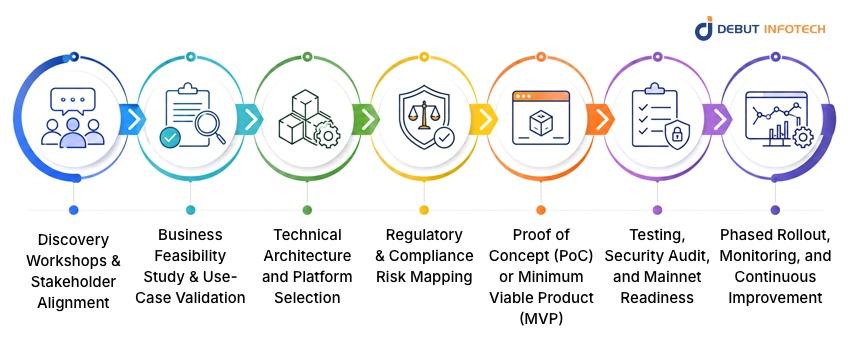
A successful blockchain initiative follows a structured roadmap rather than a single development phase. Breaking the project into manageable stages reduces uncertainty, improves governance, and allows organizations to validate assumptions before making larger investments.
Experienced consultants create a blockchain implementation roadmap by aligning business objectives with technical requirements, regulatory obligations, and long-term growth plans.
The roadmap outlines every stage of the project—from discovery and feasibility analysis to architecture design, development, testing, deployment, and ongoing optimization—ensuring the implementation remains structured, scalable, and aligned with measurable business outcomes.
Every engagement begins by bringing together decision-makers from across the organization.
Executives, department heads, IT leaders, legal teams, compliance officers, and operational managers all contribute unique perspectives on business challenges and strategic priorities.
These workshops clarify project goals, identify pain points, define success metrics, and establish governance expectations.
Consultants also document existing workflows, technology infrastructure, integration requirements, and operational constraints. This shared understanding minimizes conflicting expectations later in the project.
Once business objectives are clear, consultants evaluate whether blockchain is the most appropriate technology. This stage combines technical analysis with commercial assessment to determine whether expected benefits justify implementation costs and organizational change.
The feasibility study examines several factors, including transaction volumes, trust requirements, regulatory obligations, data privacy needs, ecosystem participants, and expected return on investment.
In blockchain strategy and feasibility assessment, consultants may compare blockchain against centralized alternatives before presenting a recommendation.
If blockchain is not the right fit, experienced consultants say so. Avoiding an unnecessary implementation saves both capital and executive attention, allowing organizations to focus on technologies better suited to their operational needs.
After validating the business case, consultants design the solution architecture. This includes blockchain network selection, smart contract architecture, identity management, API integrations, cloud infrastructure, data storage strategy, and security controls.
The architecture also considers scalability from day one.
Rather than designing only for current transaction volumes, consultants account for anticipated business growth, additional users, expanding partner networks, and evolving regulatory requirements. This future-focused approach reduces the likelihood of expensive redesigns later.
Compliance planning becomes increasingly important as blockchain solutions interact with regulated data, financial assets, or customer identities.
Waiting until deployment to address legal requirements often delays projects and increases costs.
Consultants work with compliance teams to identify applicable regulations, define governance processes, establish audit trails, and implement controls that support ongoing regulatory obligations. These measures become part of the technical design rather than an afterthought.
Rather than committing immediately to enterprise-wide deployment, consultants typically recommend building an enterprise blockchain proof of concept or Minimum Viable Product. This approach validates assumptions with limited investment while exposing technical or operational issues early.
A PoC demonstrates technical feasibility, while an MVP introduces core business functionality to selected users.
Feedback gathered during this phase helps refine both the technology and the business process before broader implementation.
Before production deployment, the solution undergoes comprehensive testing.
Functional testing verifies business logic, performance testing measures scalability, integration testing validates interoperability, and user acceptance testing confirms operational readiness.
Security audits play an equally important role. Independent smart contract reviews, penetration testing, vulnerability assessments, and infrastructure validation reduce the likelihood of exploitable weaknesses reaching production.
Consultants ensure issues are resolved before approving mainnet deployment.
Enterprise blockchain implementations rarely succeed through a single large-scale launch.
Consultants instead recommend phased deployments that gradually expand users, business functions, or geographic regions. This approach minimizes operational disruption while allowing continuous learning.
After launch, consultants establish monitoring processes covering system performance, transaction throughput, uptime, security events, and user adoption. Analytics collected during this phase identify opportunities for optimization and future enhancements.
The roadmap does not end with deployment. Blockchain platforms evolve alongside business requirements, regulatory expectations, and customer demands.
Consultants treat the first production release as the foundation for continuous improvement, helping organizations expand capabilities while maintaining security, compliance, and operational stability.
Blockchain consulting drives business growth and sustainability by helping organizations reduce operational costs, create new revenue opportunities, improve transparency, and build scalable digital infrastructure.
Consultants align blockchain initiatives with long-term business goals, ensuring technology investments deliver measurable value instead of becoming isolated technical projects.
Many business processes rely on intermediaries to verify transactions, reconcile records, or coordinate activities between multiple organizations. These manual processes increase costs, introduce delays, and create opportunities for human error.
Blockchain replaces many of these manual verification activities with shared, tamper-resistant ledgers and programmable smart contracts.
Once predefined conditions are met, contracts execute automatically without requiring manual approval. This reduces administrative overhead while improving transaction accuracy and consistency.
Industries handling large transaction volumes often realize the greatest operational savings.
Financial institutions can simplify settlement processes, logistics providers can automate document verification, and manufacturers can reduce reconciliation across suppliers.
Consultants identify where automation creates the highest return before recommending implementation.
Blockchain enables business models that are difficult or impossible to deliver through traditional systems.
Instead of focusing solely on operational efficiency, organizations can generate entirely new sources of revenue by digitizing assets, expanding customer participation, or creating programmable financial products.
Asset tokenization is one of the strongest examples.
Businesses can represent physical or financial assets as blockchain-based tokens, enabling fractional ownership, faster transfers, and improved liquidity. This approach allows investors to participate in markets that were previously accessible only to institutions or high-net-worth individuals.
Smart contracts also enable subscription models, automated royalty distribution, decentralized marketplaces, and programmable financial agreements.
Consultants evaluate which revenue opportunities align with the organization’s commercial strategy while ensuring regulatory requirements remain a core consideration.
Trust remains one of blockchain’s defining advantages. Because records cannot be altered without authorization, participants gain confidence that shared information is accurate and verifiable. This transparency becomes particularly valuable when multiple organizations contribute to the same process.
Customers increasingly expect visibility into product origins, sustainability claims, and transaction histories.
Blockchain provides verifiable records that strengthen confidence without relying solely on individual organizations to maintain data integrity.
Consultants help determine which information should remain transparent and which should stay confidential.
Balancing openness with privacy is essential for enterprise adoption, particularly in regulated industries where sensitive information cannot be publicly exposed.
Many industries still depend on fragmented systems, paper-based workflows, and lengthy reconciliation processes.
Businesses that modernize these operations gain advantages in efficiency, customer experience, and partner collaboration.
Blockchain consulting identifies opportunities where digital trust becomes a competitive differentiator.
Faster settlements, improved supply chain visibility, secure digital identities, and automated compliance processes all contribute to stronger customer relationships and operational excellence.
Competitive advantage is most sustainable when blockchain supports a broader business strategy instead of functioning as an isolated technology initiative.
Consultants ensure blockchain investments complement digital transformation efforts across cloud computing, artificial intelligence, cybersecurity, and enterprise integration.
Enterprise systems must support changing business requirements over time.
New regulations, acquisitions, international expansion, and evolving customer expectations all place additional demands on technology infrastructure.
Blockchain consulting for digital transformation designs blockchain architectures that accommodate future growth without requiring complete redevelopment.
Modular smart contracts, API-first integrations, interoperable networks, and flexible governance frameworks allow organizations to expand capabilities while minimizing operational disruption.
Scalability also includes organizational maturity.
Consultants establish governance structures, documentation standards, operational procedures, and upgrade strategies that enable internal teams to manage blockchain platforms confidently long after initial deployment.
Blockchain consulting typically costs between $25 and $300+ per hour, depending on the expertise and complexity involved.
Development-focused blockchain agencies may charge around $25–$49 per hour, while senior consultants and strategy-focused firms often charge $120–$300+ per hour.
Enterprise blockchain projects can range from $50,000 to $1 million+ based on scope, compliance needs, and technical requirements.
Project complexity, industry requirements, geographic location, and the level of expertise required also affect blockchain consulting costs. Strategy-focused engagements generally command higher rates than development-only services because they combine technical architecture, regulatory planning, business analysis, and executive advisory support.
Businesses should evaluate consulting costs alongside expected business outcomes rather than focusing solely on hourly rates.
A higher initial investment often reduces long-term expenses by preventing architectural mistakes, avoiding unnecessary redevelopment, and accelerating deployment timelines.
Development-focused blockchain agencies commonly charge between $25 and $49 per hour for implementation services, particularly in regions with lower labor costs.
Senior blockchain consultants and specialized strategy firms typically charge $120 to $300 or more per hour. These engagements often involve enterprise architecture planning, tokenomics design, governance consulting, regulatory assessments, and executive advisory services rather than software development alone.
Project pricing depends on scope, technical complexity, integrations, compliance obligations, and the number of stakeholders involved.
These estimates generally include consulting, solution architecture, software development, testing, deployment, and project management. Integrations with existing enterprise systems, advanced security requirements, or multi-country regulatory compliance may increase costs.
Security audits should never be treated as optional. Even well-written smart contracts can contain vulnerabilities that expose organizations to financial loss or operational disruption.
Smart contract audit services commonly cost between $5,000 and $25,000, depending on contract complexity, code volume, and the depth of security analysis required. Highly complex decentralized finance platforms or token ecosystems may require multiple audit rounds before production deployment.
Several variables determine the overall cost of blockchain consulting engagements.
| Cost Driver | Impact on Budget |
| Engagement model | Project-based engagements provide predictable pricing, while retainers support ongoing advisory services |
| Industry regulations | Banking, healthcare, and government projects typically require additional compliance work. |
| Project complexity | More integrations, smart contracts, and stakeholders increase consulting effort. |
| Geographic region | Consulting rates vary significantly across global markets. |
| Specialist involvement | Tokenomics experts, cybersecurity specialists, and compliance advisors increase overall project costs. |
When you decide to hire blockchain consultant, selecting the lowest-cost provider rarely produces the best long-term value. Businesses should assess experience, delivery methodology, security practices, and post-launch support alongside pricing before making a decision.
Choosing between building an internal blockchain team and hiring a consulting firm depends on business objectives, budget, project timelines, and long-term technology strategy. Neither option is universally better. The right choice depends on whether the organization values speed, flexibility, institutional knowledge, or specialized expertise.
Many organizations adopt a hybrid model. Consultants lead strategy, architecture, and early implementation while internal teams gradually assume responsibility for operations and future enhancements. This approach combines external expertise with long-term organizational ownership.
| Evaluation Criteria | In-House Blockchain Team | Blockchain Consulting Firm |
| Cost Structure | Ongoing salaries, benefits, recruitment, training, and software costs | Project or retainer fees with no permanent employment overhead |
| Time to Value | Recruiting and onboarding specialists often takes 3–6 months | Experienced consultants can begin immediately using proven frameworks |
| Breadth of Expertise | Limited to available employees and hiring budget | Access to specialists in cryptography, compliance, tokenomics, DevOps, security, and architecture |
| Risk Exposure | Internal teams may face a learning curve on new technologies | Consultants apply experience gained from previous enterprise projects |
| Long-Term Control | Greater ownership of institutional knowledge and intellectual property | Faster execution, objective advice, and scalable expertise without expanding payroll |
Businesses planning blockchain as a long-term strategic capability may eventually benefit from building internal expertise.
However, organizations entering blockchain for the first time often reduce cost, risk, and implementation time by partnering with experienced consultants during the initial stages. This approach enables internal teams to learn from proven practitioners while avoiding many of the mistakes that commonly delay enterprise blockchain projects.
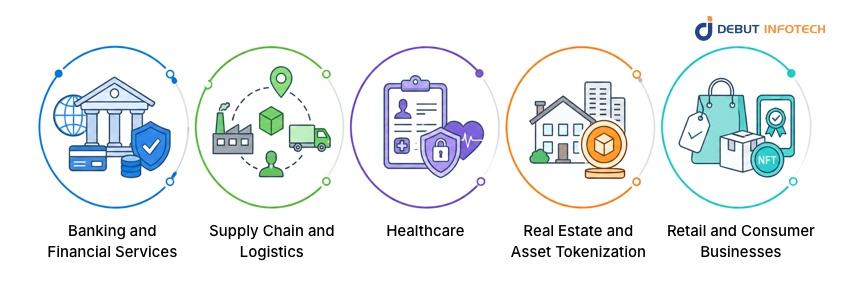
Blockchain adoption looks different across industries because each sector faces unique operational, regulatory, and customer challenges.
A solution that works well for a financial institution may not be suitable for a healthcare provider or a retail business. This is why blockchain consulting services for business begin with industry-specific requirements instead of applying a one-size-fits-all approach.
Experienced consultants understand both the technology and the business processes unique to each sector. They identify where blockchain delivers measurable value, determine how it integrates with existing systems, and ensure implementation aligns with regulatory obligations.
The result is a solution designed around business outcomes rather than technical capabilities.
Financial institutions process enormous transaction volumes across multiple jurisdictions, often relying on intermediaries to validate transfers and reconcile records. These processes increase settlement times, operating costs, and compliance complexity.
Blockchain consulting for financial services helps banks modernize these operations by designing secure distributed ledger solutions for cross-border payments, trade finance, digital identity, and fraud prevention. Smart contracts automate settlement workflows, while shared ledgers reduce reconciliation between participating institutions.
Consultants also prepare financial organizations for emerging opportunities such as Central Bank Digital Currencies (CBDCs), tokenized financial assets, and programmable payments.
Because financial regulations continue to evolve, consulting firms work closely with compliance teams to balance innovation with regulatory obligations.
Supply chains involve manufacturers, suppliers, distributors, logistics providers, customs authorities, and retailers. Each participant maintains separate records, making it difficult to verify product movement, detect fraud, or resolve disputes efficiently.
Blockchain in supply chain management creates a shared source of truth that authorized participants can access in real time. Consultants design systems that track product provenance, automate customs documentation, and improve visibility across the entire supply chain.
These capabilities strengthen quality assurance and simplify compliance with industry regulations. With blockchain consulting for supply chain, businesses also gain faster recall management, improved inventory accuracy, and stronger consumer confidence through verifiable product histories.
Healthcare organizations generate vast amounts of sensitive patient information while operating under strict privacy regulations.
Sharing records securely between hospitals, clinics, insurers, and laboratories remains a persistent challenge.
Blockchain consultants develop architectures that improve patient data interoperability without compromising confidentiality.
Permissioned blockchain networks allow authorized healthcare providers to verify records while maintaining strict access controls and audit trails.
Beyond medical records, blockchain supports professional credential verification, pharmaceutical supply chain tracking, and clinical trial data integrity.
Consultants ensure these implementations satisfy healthcare regulations while integrating with existing electronic health record systems.
Real estate transactions traditionally involve extensive paperwork, multiple intermediaries, and lengthy settlement periods. These processes increase administrative costs while limiting investment accessibility.
Blockchain consulting firms help organizations tokenize real estate assets, enabling fractional ownership and broader investor participation. Tokenization also simplifies ownership transfers, improves liquidity, and creates transparent records of asset ownership.
Beyond property investments, consultants support broader real-world asset (RWA) tokenization initiatives involving infrastructure projects, commodities, investment funds, and private equity assets. These solutions create new funding opportunities while improving transaction efficiency.
Modern consumers increasingly expect transparency regarding product authenticity, sustainability, and ownership. Traditional databases often struggle to provide verifiable information across complex supplier networks.
Blockchain consultants help retailers implement digital loyalty programs, counterfeit prevention systems, blockchain-based warranties, and NFT-backed ownership certificates. These solutions improve customer engagement while reducing fraud throughout the product lifecycle.
Businesses also gain stronger insights into customer interactions without compromising data integrity. When integrated thoughtfully, blockchain strengthens brand trust while supporting long-term customer retention strategies.
Choosing the right enterprise blockchain consulting partner is just as important as choosing the right technology.
An experienced consultant should demonstrate technical expertise, business understanding, and a structured delivery process.
If these elements are missing, the project may face unnecessary delays, budget overruns, or implementation failures.
Experienced consultants explain why they recommend a particular blockchain platform, architecture, or governance model. Their advice should reflect your organization’s objectives, regulatory requirements, scalability expectations, and integration needs.
Be cautious of firms that promise blockchain benefits without discussing specific technologies or explaining the reasoning behind their recommendations. Vague proposals often indicate limited technical experience or a sales-first approach.
Enterprise blockchain projects require security planning from the beginning.
Smart contract audits, access controls, identity management, governance frameworks, and regulatory compliance should all form part of the standard engagement.
If security discussions only appear near deployment or after contracts are signed, the consultant may be treating them as optional services instead of essential project components. That significantly increases long-term risk.
Transparent pricing demonstrates professionalism and builds trust. While exact project costs may require discovery sessions, reputable consulting firms explain their pricing methodology, engagement models, deliverables, and assumptions before work begins.
Organizations should understand whether services are billed hourly, by milestone, or through ongoing retainers.
Hidden costs often emerge when project scope, security reviews, or compliance work were never clearly defined at the outset.
Case studies should demonstrate more than successful software delivery.
Strong consulting firms showcase long-term partnerships, platform upgrades, operational improvements, and measurable business outcomes achieved after deployment.
Ask prospective consultants how many of their blockchain platforms remain active today, what challenges arose after launch, and how they supported clients during subsequent growth phases.
Long-term engagement usually reflects stronger delivery quality than one-off projects.
One of the clearest warning signs is a consultant who recommends blockchain for every business challenge.
Professional advisors understand that decentralization is valuable only under specific circumstances.
Consultants should explain when conventional databases, cloud applications, or enterprise software provide better solutions.
Honest recommendations build credibility and help organizations invest where technology creates measurable value, not unnecessary complexity.
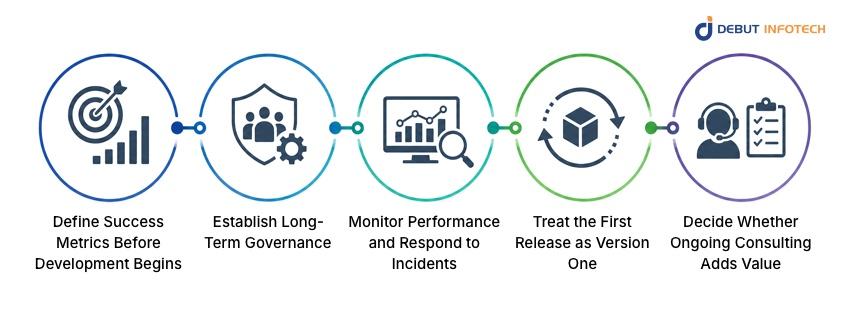
Launching a blockchain platform marks the beginning of its operational lifecycle, not the end of the project.
Organizations that monitor performance, strengthen governance, and refine implementation over time consistently achieve better long-term outcomes than those treating deployment as the final milestone.
Meaningful performance measurement starts before implementation.
Consultants work with leadership teams to establish clear Key Performance Indicators (KPIs) that align with business objectives rather than technical outputs.
Typical success metrics include:
Defining these metrics early enables organizations to measure whether blockchain delivers measurable business value and identify opportunities for further optimization.
Blockchain governance extends beyond technical administration. Organizations must determine who approves upgrades, manages cryptographic keys, resolves disputes, controls permissions, and oversees smart contract modifications.
Consultants create governance frameworks that clearly assign responsibilities across executive leadership, technical teams, compliance departments, and operational stakeholders.
Well-defined governance minimizes uncertainty while supporting business continuity.
Continuous monitoring helps organizations detect issues before they affect operations.
Performance dashboards, security alerts, and blockchain analytics provide real-time visibility into network health and transaction activity.
Consultants frequently recommend enterprise monitoring platforms such as Tenderly for smart contract observability and OpenZeppelin Defender for secure contract operations, automated monitoring, and incident response. These tools improve operational resilience while simplifying ongoing platform management.
Enterprise blockchain platforms should evolve continuously. Customer expectations, regulatory requirements, and business priorities change over time, making ongoing improvements essential for long-term success.
Consultants encourage organizations to collect user feedback, analyze operational data, and schedule regular enhancement cycles.
Incremental improvements reduce implementation risk while ensuring the platform continues delivering business value as requirements evolve.
Some organizations require consulting support only during implementation.
Others benefit from long-term advisory relationships that include governance reviews, regulatory guidance, security assessments, and architecture optimization.
A retainer engagement often delivers greater value for businesses operating in highly regulated industries or rapidly evolving blockchain ecosystems.
Regular access to experienced advisors helps organizations respond quickly to changing market conditions while maintaining secure and compliant operations.
Choosing a blockchain consulting partner is about more than technical expertise.
The right blockchain consulting services should understand your business objectives, evaluate whether blockchain is the appropriate solution, and deliver an implementation strategy that supports long-term growth.
Debut Infotech combines strategic consulting with end-to-end blockchain development, helping organizations move from initial concept to enterprise deployment with confidence.
Our consulting approach begins with business discovery rather than technology selection. Our team works closely with stakeholders to identify high-impact use cases, assess technical and commercial feasibility, recommend the most suitable blockchain architecture, and develop a practical implementation roadmap.
Whether the project involves private blockchain networks, decentralized applications, smart contracts, tokenization, or enterprise integrations, every recommendation is aligned with measurable business goals.
Beyond implementation, we prioritize security, scalability, and regulatory readiness. Our specialists conduct architecture reviews, smart contract audits, and governance planning while designing solutions that can adapt as business needs evolve.
From proof-of-concept development to enterprise-scale deployment and ongoing optimization, we provide the strategic guidance and technical expertise businesses need to reduce risk, accelerate delivery, and maximize the long-term value of their blockchain investments.
Blockchain is no longer an emerging technology reserved for early adopters.
For many organizations, it has become a practical tool for improving operational efficiency, strengthening trust, and creating new digital business models. The challenge is not deciding whether blockchain is valuable, but determining where it creates the greatest impact.
That is why investing in blockchain consulting services for business is often the smartest first step.
Experienced consultants help organizations validate ideas, avoid costly implementation mistakes, navigate regulatory requirements, and build scalable solutions that support long-term growth.
With the right blockchain strategy and execution partner, businesses can move beyond experimentation and deploy blockchain with confidence, delivering measurable value today while remaining prepared for tomorrow’s opportunities.
Blockchain consulting services start by reviewing your business goals, existing systems, and challenges. Consultants then recommend the right blockchain approach, whether it involves smart contracts, tokenization, or decentralized applications.
They help with strategy, architecture, development planning, security checks, and implementation guidance to ensure the project moves in the right direction.
Choose a blockchain consulting company based on its experience, technical expertise, past projects, and understanding of your industry. Check their blockchain platforms, development capabilities, security practices, and client reviews.
A good consultant should focus on your business needs instead of pushing unnecessary blockchain solutions that do not solve real problems.
Blockchain consultants manage security and compliance by conducting risk assessments, reviewing smart contract vulnerabilities, and following industry standards.
They also help businesses understand regulations related to data privacy, digital assets, and financial transactions. This ensures blockchain solutions are built with proper security measures and aligned with relevant legal requirements.
Hiring blockchain consultants typically costs between $25,000 and $100,000, depending on project complexity, required expertise, and engagement length.
Simple blockchain strategy consulting costs less, while services involving blockchain architecture, smart contracts, audits, or full implementation require a bigger budget. The final cost depends on your specific business requirements.
Blockchain consulting services can help your business identify where blockchain can create real value. Consultants can improve processes, reduce inefficiencies, increase transparency, and design secure solutions for areas like payments, supply chains, identity management, and digital assets. They also help you avoid costly mistakes by creating a clear blockchain strategy before development begins.
Small businesses can benefit from blockchain consulting too. Consultants help smaller companies find practical use cases, choose affordable solutions, and avoid investing in unnecessary technology.
Blockchain is not limited to large enterprises. With the right approach, small businesses can use it for payments, customer loyalty, data security, and automation.
A typical blockchain consulting engagement takes between 4 and 12 weeks, depending on the project scope.
A basic strategy review may take a few weeks, while detailed architecture planning, market research, and technical assessments can take longer.
Larger projects usually require ongoing consulting support throughout development and deployment.
Blockchain consultants can help migrate existing systems, not just build new ones. They analyze your current infrastructure, identify what can be improved, and create a migration plan.
Consultants also handle integration with existing software, data transfer strategies, and testing to ensure the transition happens smoothly without disrupting business operations.

Our Latest Insights
USA
2501 Chatham, Rd Suite R Springfield, IL 62704
+1-708-515-4004
info@debutinfotech.com
UK
7 Pound Close, Yarnton, Oxfordshire, OX51QG
+44-770-304-0079
info@debutinfotech.com
Canada
154 Eden Oak Trail, Kitchener, ON N2A 0H9
+1-708-515-4004
info@debutinfotech.com
INDIA
Sector 101-A, Plot No: I-42, IT City Rd, JLPL Industrial Area, Mohali, PB 140306
9888402396
info@debutinfotech.com